You’ve pulled into a lay-by after a long day. The kettle’s on, the logbook’s out, and one question is nagging at you: are you actually within the rules, or just hoping you are?
Most drivers know their daily driving limit and their break pattern cold. Far fewer can say, with any confidence, what the Working Time Directive actually requires of them, or how it’s different from the drivers’ hours rules they already know. That gap catches out newly qualified drivers, experienced drivers who’ve never had it explained properly, and self-employed owner-drivers who still believe a rule that stopped being true in 2012.
This guide sets out what the Road Transport (Working Time) Regulations 2005 actually say in 2026: who they apply to, what counts as working time, the limits themselves, and what happens if you get it wrong.
Working Time Directive or Drivers’ Hours? Why Drivers Mix Them Up
The confusion is understandable, because the UK runs two separate sets of rules on top of each other for the same job. They were written for different purposes, by different bodies, at different times, and they measure different things.
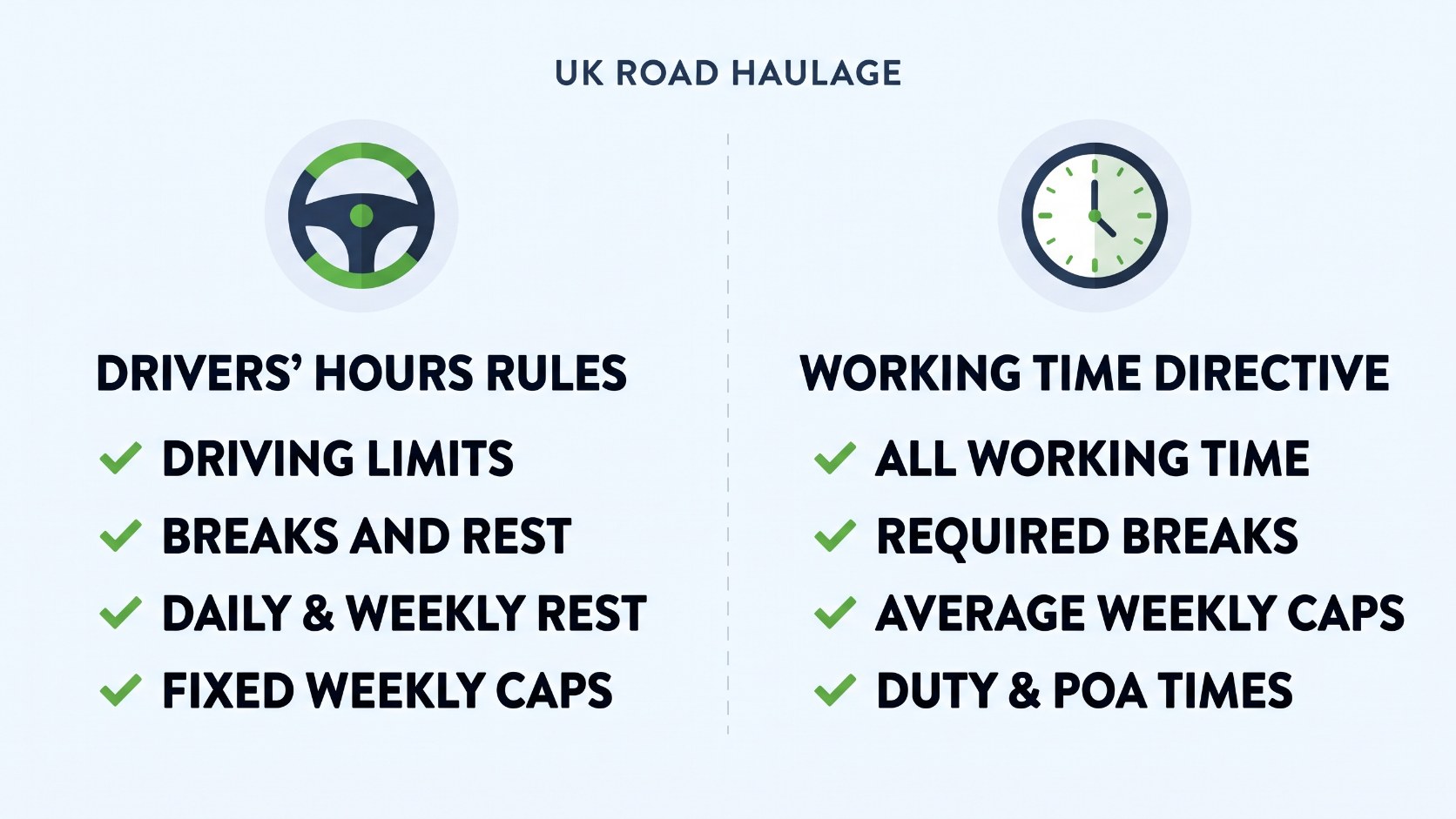
The assimilated drivers’ hours rules (the retained EU rules, formerly Regulation 561/2006, alongside the AETR agreement for journeys further into Europe) control your actual driving. They set your daily and weekly driving limits, your break pattern while driving, and your daily and weekly rest periods.
The Road Transport (Working Time) Regulations 2005, which implement what’s commonly still called the Working Time Directive, control something broader: the total time you spend working, across an entire shift, not just the time you spend behind the wheel.
Drivers’ hours rules limit how long you can drive. The Working Time Directive limits how long you can work, full stop, including everything around the driving.
That distinction matters because a driver can be fully compliant with every driving-hours rule and still be in breach of the working time rules, simply by doing too much loading, unloading, cleaning, or admin work around a shift that already includes a full day’s driving.
What the Road Transport (Working Time) Regulations Actually Cover
The Regulations apply to “mobile workers”: drivers and travelling crew (such as a driver’s mate) working on vehicles that fall under the assimilated drivers’ hours rules or the AETR agreement. In practice, that means most goods vehicles over 3.5 tonnes fitted with a tachograph.
Who Counts as a Mobile Worker
You’re covered whether you’re a permanent employee, a temporary worker on an agency contract, or, since 2012, a genuinely self-employed owner-driver. Agency drivers get no automatic exemption just because they move between different hirers.
There’s one narrow carve-out worth knowing: if your work under the drivers’ hours rules only happens occasionally, fewer than 11 days in a reference period shorter than 26 weeks, or fewer than 16 days in any other case, you fall outside the Regulations for that work.
What Counts as Working Time
Working time is any period when you’re at your workstation, at your employer’s or client’s disposal, or carrying out your duties. In practice, for most drivers, that covers a specific set of activities.
Driving itself, for the whole of the time you’re behind the wheel.
Loading and unloading the vehicle.
Cleaning and technical maintenance of the vehicle.
Vehicle safety checks and walkaround inspections.
Training that’s directly linked to the job, done during your working day.
Any unplanned waiting time, where you don’t know in advance how long a delay will last.
Other work carried out for the same employer, such as warehouse or office duties, where it’s connected to the transport operation.
Statutory paid leave, including holiday and sickness absence covered by your contract, is also credited as working time for the purposes of the averaging calculation, at 48 hours for a complete week off and 8 hours for a single day.
What Doesn’t Count
Breaks and rest periods taken under the drivers’ hours rules don’t count as working time, provided they’re genuinely free time. Your daily commute to and from your usual place of work doesn’t count either, regardless of how far you travel.
Periods of Availability, known in the Regulations as POAs, also fall outside working time. A POA is waiting time you know about in advance, such as a pre-booked loading slot two hours after you arrive, during which you’re not required to stay at your workstation but must remain reachable.
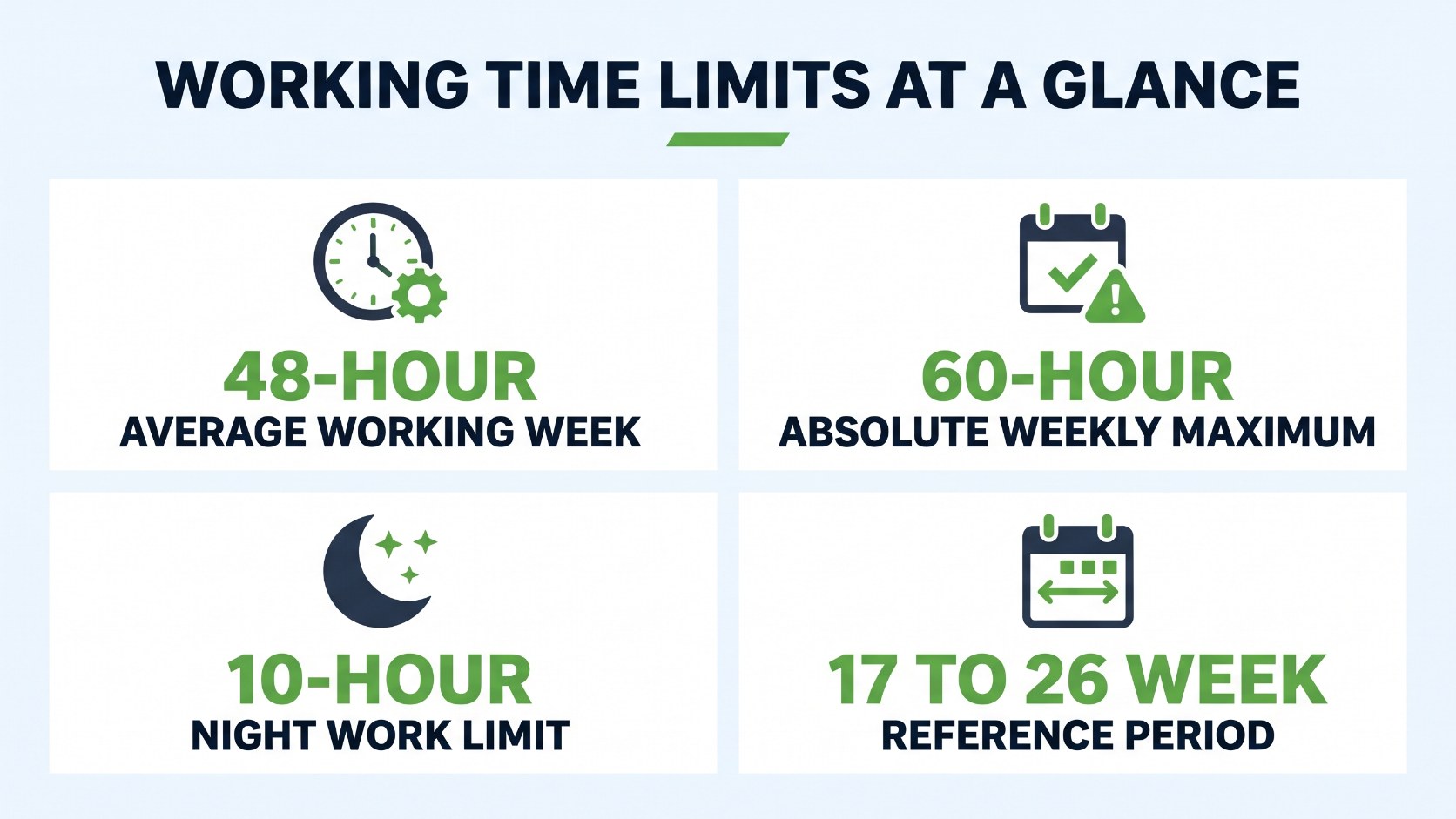
Working Time Limits at a Glance
The headline numbers are straightforward on their own. The difficulty is almost always in applying them correctly to a real working pattern, not in remembering what they are.
Limit
What it means
48-hour average working week
Your working time cannot average more than 48 hours a week over the reference period
60-hour absolute weekly maximum
You cannot work more than 60 hours in any single week, even if your average stays under 48
10-hour night work limit
If any of your shift falls in the goods-vehicle night period, your working time in that 24-hour window is capped at 10 hours
Reference period
Normally 17 or 18 weeks, extendable up to 26 weeks by a collective or workforce agreement
The 48-Hour Average Working Week
This is the rule people most often get wrong, because it’s an average, not a hard weekly cap. You can work well over 48 hours in a single busy week, provided it’s balanced out by lighter weeks across the reference period.
The default reference period runs 17 or 18 weeks, depending on fixed start dates your employer sets, or a rolling 17-week window if they choose that method instead and tell the workforce. A collective or workforce agreement can stretch this out to 26 weeks, which gives more room to absorb a genuinely busy stretch.
The 60-Hour Absolute Weekly Maximum
Unlike the 48-hour figure, the 60-hour limit is not an average. It is a hard ceiling on any single week, and there’s no agreement or exception that can lift it.
If your working time in any one week, counting everything that qualifies above, reaches 60 hours, you’ve breached the Regulations regardless of how light the surrounding weeks were.
Night Work: The 10-Hour Rule
For goods-vehicle drivers, night time runs from midnight to 4am. If any part of your working time starts, finishes, or falls within that window, you’ve done night work, and a separate cap applies.
Night workers cannot work more than 10 hours in any 24-hour period, unless a collective or workforce agreement extends it. A self-employed driver can elect to extend their own limit for objective, technical, or work-organisation reasons, but this is a genuine election, not something an employer or client can simply impose.
This rule exists specifically because fatigue-related driving risk rises sharply overnight, and it cannot be opted out of by individual agreement with your employer.
Self-Employed and Owner-Drivers: The Rule Many Still Think Doesn’t Apply to Them
This is the single most common misconception found in this area, and it’s an outdated one rather than a genuine grey area.
Since 2012, the Old Exemption Mostly Doesn’t Exist
Self-employed and owner-drivers were originally excluded from the working time rules. That changed on 11 May 2012, when amendments to the 2005 Regulations brought genuinely self-employed drivers into scope, following years of delay after an earlier exemption deadline passed in March 2009.
The self-employed exemption people still quote from the mid-2000s stopped being true in May 2012. If you’re a genuinely self-employed driver today, the working time limits apply to you too.
The legal definition of a “self-employed driver” under the Regulations is also narrower than most people assume. It requires genuine freedom to organise your own work, income tied to your own profits rather than a fixed rate, and the ability to work for more than one customer, not just a label on an invoice.
The Narrow Exemption That Remains
The genuine carve-out that still exists is the occasional-work exemption covered earlier: fewer than 11 days of relevant work in a short reference period, or fewer than 16 days otherwise. Outside that, a self-employed driver must take all reasonable steps to stay within the 48-hour average, the 60-hour maximum, and the 10-hour night limit, and must keep working time records for two years, the same as an employed driver.
How Working Time Rules Interact With Drivers’ Hours Rules
Where the two sets of rules overlap, the stricter driving-specific requirements take precedence while you’re actually driving. Your break pattern and daily and weekly rest under the drivers’ hours rules don’t disappear just because the working time rules exist alongside them.
Think of drivers’ hours rules as the detailed rulebook for driving itself, and the Working Time Directive as the wider cap on your whole working day around it.
What the Working Time Directive adds is the wider lens: the loading, the admin, the vehicle checks, and the unplanned waiting that drivers’ hours rules don’t directly limit, but that can still tip a legally-compliant driving day into an illegally long working day.
For more detail on the driving-specific side of this (daily and weekly driving limits, the break pattern, and daily and weekly rest), see our separate guide to staying compliant with your HGV driving hours.
Record-Keeping: What You and Your Employer Must Do
Employers must keep accurate working time records for two years and give you a practical way to record your own time, whether that’s a timesheet, a rota system, or your tachograph data used as supporting evidence.
If you work for more than one employer, or combine agency work with a direct contract, you carry a personal responsibility too.
Tell each employer in writing about any other work you do that falls under these rules, and roughly how many hours it involves.
Keep your own simple record alongside your employer’s, even a basic notebook or phone note, as a backup.
Use your tachograph printout or digital card data as a cross-check against what’s logged elsewhere.
Flag any discrepancy to your employer as soon as you spot it, rather than letting it accumulate.
Never knowingly sign off or submit a record you know to be wrong. Doing so with intent to deceive is treated far more seriously than an honest mistake.
Working Time Directive vs Drivers’ Hours Rules: Quick Comparison
Area
Drivers’ hours rules
Working Time Directive
What it limits
Daily and weekly driving time, breaks while driving, daily and weekly rest
Total working time across the whole shift, including non-driving duties
Typical daily cap
9 hours’ driving, extendable to 10 hours twice a week
No single daily cap; measured as a 48-hour weekly average and a 60-hour absolute weekly maximum
Night rules
Covered through rest-period requirements
Separate 10-hour cap on working time in any 24 hours that includes night work
Applies to self-employed drivers
Yes, always has
Yes, since May 2012, with a narrow occasional-work exemption
Main enforcement body
DVSA, via tachograph and roadside checks
DVSA, via working time records and investigation
Can conflict be resolved
Takes precedence while actually driving
Still applies across the rest of the working day
What Happens If You Break the Rules
Enforcement sits with the DVSA, and the response scales with how serious and how deliberate the breach looks.
A minor, isolated, accidental infringement might get nothing more than a verbal warning on the spot. Beyond that, the available sanctions get progressively more serious.
A single late finish rarely ends badly on its own. A pattern of unrecorded hours, or a falsified record, is a different matter entirely.
A fixed penalty notice issued to the driver, usually at the roadside, scaled to the seriousness of the breach.
A prohibition stopping the vehicle being driven further, with the vehicle immobilised in more serious cases.
Prosecution in the magistrates’ court, where fines run up to Level 4 (currently £2,500) for most offences, or an unlimited Level 5 fine for the most serious ones.
Up to 2 years’ imprisonment on indictment specifically for falsifying records with intent to deceive.
Referral to the Traffic Commissioner, who can take administrative action against a driver’s or operator’s repute, with real consequences for an operator’s licence.
Operators carry liability for their drivers’ infringements too, unless they can show the work was properly organised, drivers were properly instructed, and regular checks were genuinely made.
Common Mistakes HGV Drivers Make With Working Time Rules
Most breaches aren’t deliberate. They come from genuine gaps in understanding, repeated across enough drivers that they’re worth naming directly.
Assuming self-employed status is still an automatic exemption, when it stopped being one in 2012.
Treating drivers’ hours compliance as proof of working time compliance, when they’re measuring different things.
Not telling a second employer, in writing, about hours already worked elsewhere in the same week.
Assuming all waiting time is excluded, when only genuinely unplanned waiting counts as working time, not pre-booked Periods of Availability, which is often remembered the wrong way round.
Ignoring the separate night-work cap on an early-start or late-finish shift that technically stays within the normal weekly average.
Relying entirely on an employer’s records with no personal backup of their own.
Where This Fits Into Your HGV Career
If you’re newly qualified, working time rules are one of several pieces of compliance admin that sit alongside the licence itself, your first driver tachograph card application and keeping your Driver CPC card renewed on time. None of it is complicated once it’s explained properly, but all of it is worth getting right from day one.
What is the difference between the Working Time Directive and drivers’ hours rules?
Drivers’ hours rules control your actual driving: daily and weekly driving limits, breaks while driving, and rest periods. The Working Time Directive controls your total working time across a whole shift, including loading, unloading, cleaning and admin, not just the time you spend driving.
Does the Working Time Directive apply to self-employed HGV drivers?
Yes. Genuinely self-employed and owner-drivers have been covered by the Road Transport (Working Time) Regulations since 11 May 2012. The only exemption left is for occasional work: fewer than 11 days in a reference period shorter than 26 weeks, or fewer than 16 days otherwise.
How many hours can an HGV driver legally work in a week?
Your working time cannot average more than 48 hours a week over the reference period, which is normally 17 or 18 weeks and can be extended to 26 weeks by a collective or workforce agreement. You also cannot exceed 60 hours in any single week, regardless of your average.
What counts as working time under the regulations?
Driving, loading and unloading, vehicle cleaning and maintenance, safety checks, job-related training, and unplanned waiting time all count. Genuine rest breaks, your commute to work, and pre-booked Periods of Availability do not count.
Can I work more than 60 hours in a single week?
No. The 60-hour weekly maximum is an absolute limit, not an average, and there is no agreement that can extend it. The 48-hour figure is the one that works as an average across the reference period.
What is night work and how many hours can I work at night?
For goods-vehicle drivers, night time runs from midnight to 4am. If your shift starts, finishes or falls within that window, your working time in that 24-hour period is capped at 10 hours unless a workforce or collective agreement extends it.
Do agency drivers have to follow the Working Time Directive?
Yes. Agency and temporary drivers are covered in exactly the same way as permanent employees. If you work for more than one employer or agency in the same period, you must tell each one in writing about the hours you’ve worked for the other.
What happens if my employer breaks the working time rules?
The DVSA can issue fixed penalties, prohibit a vehicle from being driven further, or prosecute in the magistrates’ court, with fines up to Level 4 (£2,500) or an unlimited Level 5 fine for serious cases. Operators can also be referred to the Traffic Commissioner, which puts their operator’s licence at risk.
How long do working time records have to be kept?
Employers must keep accurate working time records for two years, and must give drivers a practical way to record their own time. Drivers with more than one employer carry a personal duty to declare their other hours in writing too.
Related Articles
23/10/2026
Driver CPC Card Renewal: How to Avoid a Lapsed DQC (2026 UK Guide)
If your Driver CPC card is sitting in your wallet with a date on it you haven't looked at properly in years, you're not alone....