If you’re weighing up a Cat C licence, cost is almost always the first question. Fair enough: training runs into thousands of pounds, and getting the numbers wrong before you start can throw your whole plan off.
This guide breaks down exactly what you’ll pay for Cat C training and testing in 2026, what funding options exist, how long the whole process takes, and what you can realistically expect to earn once you’re qualified.
What a Cat C Licence Actually Lets You Drive
Cat C vs C1 vs C+E
A Cat C licence, often called a Class 2 licence, lets you drive rigid vehicles over 3,500kg with no upper weight limit in most cases. Think a rigid box lorry or tipper, not an articulated unit.
It sits between a C1 licence, which covers smaller rigid vehicles up to 7,500kg, and a full C+E licence, which adds a trailer and lets you drive articulated lorries.
Most drivers use Cat C as their entry point into HGV driving, then add C+E later once they’ve built experience and want access to better-paid Class 1 work.
Typical Cat C vehicles and job types
Cat C drivers typically work in distribution, waste collection, construction supply and general haulage, driving vehicles like box trucks, skip lorries and flatbeds.
It’s a genuinely solid entry route. Demand for Class 2 drivers has stayed consistently high across the UK, and most training providers report strong job placement rates for newly qualified drivers.
If you already hold, or plan to add, an ADR licence, Cat C plus ADR opens up tanker and hazardous goods work too, which tends to pay a premium.
Sectors that hire Cat C drivers consistently include retail distribution, food and drink logistics, builders’ merchants and waste management, all of which run large Class 2 fleets across the UK.
Is Cat C the right licence for you?
Cat C makes the most sense if you want to start earning as an HGV driver as quickly as possible, without the extra time and cost of training for an articulated licence straight away.
It also suits drivers who prefer local or regional routes over long-distance trunking, since Class 2 work is more likely to have you home most nights compared with Class 1 haulage.
If your main goal is the highest possible starting salary and you’re comfortable committing to a longer training path, it may be worth comparing the full cost of going straight for C+E against doing Cat C first and upgrading later.
A Cat C licence is rarely the end goal for most drivers. It’s the licence that gets you earning while you build the experience, and often the money, to go further.
The Real Cost of a Cat C Licence in 2026
Training course fees
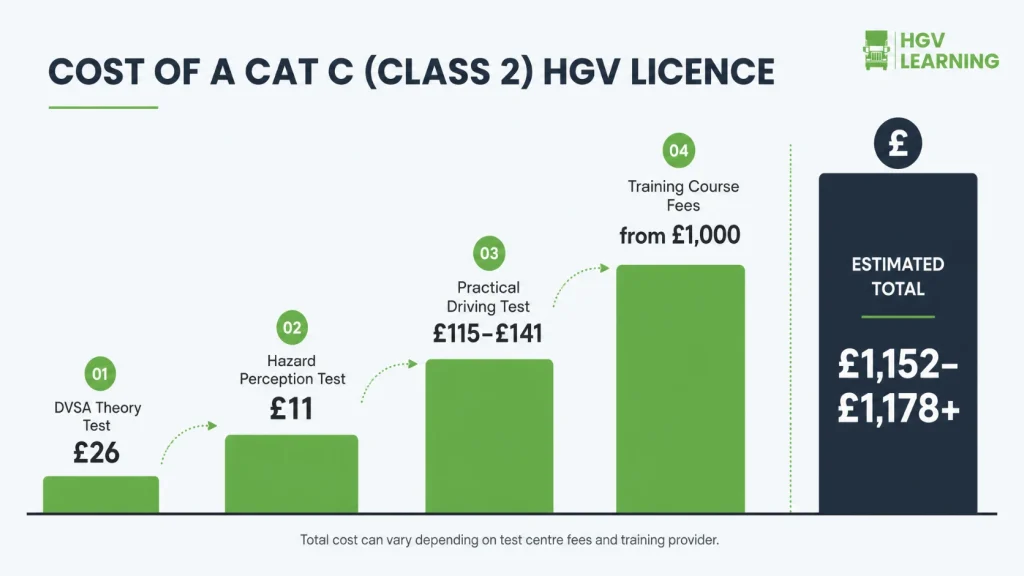
Training course prices vary by provider, vehicle access and how much one-to-one instruction you book, but a full Cat C course from a reputable provider typically runs from around £1,200 to £2,000.
That figure usually covers vehicle hire, instructor time and enough practice hours to get you test-ready, though exact inclusions differ, so always check what’s bundled before you book.
Intensive courses, often five days a week over one or two weeks, tend to sit at the higher end of that range because you’re booking concentrated instructor and vehicle time.
Standard courses spread across several weeks can work out cheaper overall, but only if you’re disciplined about attending regularly. Gaps between sessions mean more time relearning rather than progressing.
Group training, where two or three learners share a vehicle and instructor, is usually the lowest-cost option, though you’ll get less individual driving time per session than with one-to-one tuition.
Location matters too. Providers in areas with higher overheads, or with waiting lists for test centre slots, sometimes charge more simply because demand for their courses is higher.
If you already hold a car licence and some driving confidence, you may need fewer hours than someone starting from scratch, which can bring the overall cost down.
DVSA test, theory and medical fees
On top of training, you’ll pay DVSA directly for each stage of the Driver CPC qualification process. These fees are fixed regardless of which provider you train with.
Your Part 3a off-road exercises test can cost up to an extra £40 if you sit it with an approved test provider rather than DVSA directly, so check with your training provider which route they use.
You’ll also need a D4 medical examination report completed by a doctor before DVSA will issue your provisional Cat C entitlement. This typically costs between £50 and £150, depending on your GP or a private provider.
The medical checks things like eyesight standards, blood pressure and general fitness to drive a large vehicle, and the standards for a Group 2 licence like Cat C are stricter than for an ordinary car licence.
Fail any test component and you’ll need to pay that fee again to resit it. It’s a cost that catches people out because it’s easy to budget for the course and forget DVSA fees sit on top.
All told, once you add training, DVSA fees and the medical together, most learners should budget somewhere between £1,500 and £2,500 for a first-time pass with no resits.
Funding, loan and employer-sponsored options
Not everyone pays training costs upfront. Some employers, particularly larger logistics firms, sponsor Cat C training for new recruits in exchange for a minimum service commitment once qualified.
Government-backed skills funding and sector-specific bursaries are sometimes available too, though eligibility rules change, so it’s worth checking current schemes before assuming you don’t qualify.
Self-funding through savings or a personal loan remains the most common route. If you’re going down that path, factor in a buffer for at least one resit, since first-time pass rates vary by test component.
Some training providers also offer payment plans that split the course fee over several months, which can make the upfront cost easier to manage without taking on a separate loan.
Our training cost calculator lets you work out a realistic total for your situation, including finance options if you’d rather spread the cost.
Budget for the DVSA fees separately from your course price. They’re easy to forget, and missing a test means paying the fee again.
The Step-by-Step Path to Getting Qualified
Before you start: provisional entitlement and medical
Before booking any training, you need a provisional Cat C entitlement added to your driving licence, which means passing the D4 medical and submitting the relevant application to DVLA.
This step alone can take several weeks, depending on how quickly your medical is booked and how DVLA is processing applications. It’s worth starting early rather than leaving it until you’ve already booked your course.
Most training providers will talk you through this stage before you commit to a course date, since there’s little point booking training you can’t yet legally start.
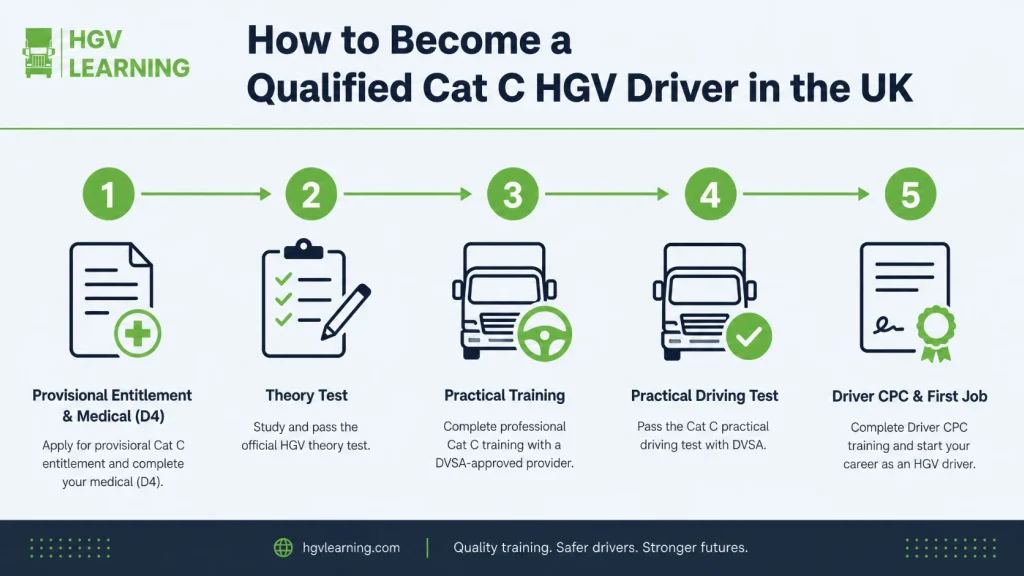
The five steps to a full Cat C licence
Once your provisional entitlement is confirmed, the qualification path follows a set order:
Pass the Driver CPC Part 1a theory test: multiple-choice questions on driving theory and HGV-specific rules.
Pass the Driver CPC Part 1b hazard perception test, usually booked alongside Part 1a.
Complete your practical Cat C training with an approved instructor or training provider.
Pass the Driver CPC Part 2 case studies test and the Part 3 practical driving test, covering off-road exercises and on-road driving.
Pass the Driver CPC Part 4 practical demonstration, which covers vehicle safety and loading checks.
You don’t have to complete all five in strict sequence, but most training providers, including our Cat C course, structure the programme this way because it’s the most efficient route through.
Once you’ve passed all four Driver CPC parts, your full Cat C entitlement is added to your licence and you’re legally qualified to drive professionally.
How Long It Takes and What to Expect
Full-time vs part-time training timelines
A full-time intensive course can get you from provisional entitlement to a full Cat C licence in as little as two to four weeks, assuming you pass each test first time and slots are available.
A typical intensive week might run Monday to Friday, starting with theory revision and yard-based vehicle familiarisation before moving into on-road driving practice as your confidence builds.
Part-time or evening and weekend training stretches that out considerably, often to two or three months, which suits people training around an existing job.
DVSA test availability is the biggest variable. Booking slots can be tight in some regions, and that alone can add weeks to an otherwise fast timeline.
Signing up during a DVSA test backlog
DVSA practical test waiting times have fluctuated significantly in recent years, and lorry test slots can be harder to find than car test slots in some areas.
If you’re on a deadline, whether that’s a job offer or a provider’s intake date, book your theory tests and practical test slots as early as your provisional entitlement allows, rather than waiting until training finishes.
Our theory test tips guide covers how to prepare efficiently, so you don’t need a resit, which only adds to the wait.
Some providers keep a waiting list for cancellations and can get you into an earlier practical test slot than booking independently, so it’s worth asking directly what access they have.
What Happens After: Jobs, Pay and Progression
Starting salary and typical roles
Licence
Typical salary (full-time)
Hourly rate (agency/temp)
Cat C (Class 2)
£28,000–£36,000/yr
£16–£20/hr
Cat C+E (Class 1)
£38,000–£50,000/yr
£18–£24/hr
Cat C+E, experienced/specialist routes
£45,000–£55,000+/yr
Varies by route
Source: Aspion HGV Driver Salary Guide 2026. These are recruitment industry figures rather than official statistics, so treat them as a realistic guide rather than a guarantee, since pay varies by region, employer and shift pattern.
Entry-level Class 2 drivers with under two years’ experience typically start toward the lower end of that range, with pay rising as you build a clean driving record and route experience.
Shift pattern affects take-home pay significantly too. Night trunking, early starts and weekend cover usually attract premium rates on top of the base salary figures above.
Progressing to Class 1 / C+E
Many Cat C drivers use their first year or two to build experience, then train for a C+E licence to move into Class 1 work, which pays noticeably more.
Some employers will part-fund or fully fund that next step once you’ve proven yourself as a reliable Cat C driver, so it’s worth raising it directly with your employer once you’re settled in.
Our recruitment advice guide covers how to approach that conversation, and what employers typically look for before investing in a driver’s next licence.
Beyond C+E, some drivers specialise further into ADR tanker work, abnormal loads or temperature-controlled distribution, all of which can command an additional premium over standard Class 1 rates.
Cat C isn’t a ceiling. Most drivers who progress to Class 1 do it within two years of qualifying, once they’ve built a solid track record behind them.
Self-employed and agency work
Plenty of Cat C drivers work through agencies rather than going straight into a permanent role, which suits people who want flexibility over guaranteed hours.
Agency rates are often quoted hourly rather than as an annual salary, and can work out well if you’re willing to take shifts at short notice, though income can be less predictable than a permanent contract.
Some experienced Class 2 drivers move to self-employed or owner-operator status further into their career, though that route usually comes after several years of building contacts and a strong driving record.
Common Mistakes That Cost Time and Money
Choosing the right training provider
The cheapest course isn’t always the best value. A provider offering unusually low prices may cut corners on practice hours, vehicle access or instructor availability, all of which increase your risk of failing a test and paying to resit it.
Ask any provider directly how many practical hours are included, what happens if you fail a test component, and whether their pass rates are published anywhere you can check.
It’s also worth asking how many vehicles they operate and whether you’ll train on the same vehicle you’ll be tested in, since switching vehicles late in training can knock your confidence.
Beyond provider choice, a few mistakes come up again and again among drivers we’ve trained:
Booking training before your provisional Cat C entitlement and D4 medical are confirmed, which can delay your start date.
Underestimating DVSA fees and only budgeting for the course price, then being caught short if a resit is needed.
Leaving practical test bookings until the last minute, when slots in your area may already be full.
Not researching which industries are actually hiring locally before committing to training.
Assuming Cat C and C1 licences work the same way, then being surprised by the extra CPC requirements Cat C involves.
If you’re ready to move forward, this guide already covers how Cat C compares against other categories above, and our Driver CPC guide explains the qualification requirements in more depth. For a look at what daily checks involve once you’re qualified, see our guide to vehicle defect reporting.
Cat C Licence Cost: Frequently Asked Questions
How much does a Cat C licence cost in total, including tests?
Most learners should budget between £1,500 and £2,500 in total, covering training, all four Driver CPC test parts and the D4 medical, assuming a first-time pass with no resits.
Can I get a Cat C licence without paying upfront?
Some employers sponsor training in exchange for a service commitment, and some providers offer payment plans. Fully free routes are limited and eligibility depends on current government or sector schemes.
How long does it take to get a Cat C licence?
An intensive full-time course can take two to four weeks. Part-time training typically takes two to three months, with DVSA test availability the main variable affecting either timeline.
Do I need a medical for a Cat C licence?
Yes. You need a D4 medical examination report completed by a doctor before DVLA will issue your provisional Cat C entitlement, and the standards are stricter than for a standard car licence.
What can I earn with a Cat C licence?
Cat C, or Class 2, drivers typically earn between £28,000 and £36,000 a year in a full-time permanent role, with pay rising as you gain experience or move into specialist work.
What happens if I fail a Driver CPC test?
You can resit, but you’ll pay the DVSA fee again for that part. There’s no limit on resits, though your training provider may need to book you in for extra practice first.
Do I need to hold a provisional Cat C entitlement before training?
Yes. Your provisional entitlement, granted after the D4 medical and DVLA application, must be in place before you can legally drive an HGV on the road, even with an instructor.
A Cat C licence is a real investment, in time as much as money, but it’s one of the most reliable routes into a stable, well-paid driving career in the UK. Get the costs and timeline right from the start, and there’s no reason it shouldn’t pay off within your first year on the road.
What Age Can You Start HGV Driver Training? A 2026 UK Guide to Licence Age Requirements
If you're asking what age you can start HGV driver training, the honest answer depends on which licence you're after. A C1 licence, covering vehicles...