If your Driver CPC card is sitting in your wallet with a date on it you haven’t looked at properly in years, you’re not alone. Over 100,000 UK drivers let theirs lapse in the space of twelve months, and most of them didn’t plan it that way. It crept up on them.
Renewing your Driver Qualification Card (DQC) is not complicated once you know the steps, but it has a habit of being left too late precisely because nothing visibly goes wrong until the day you try to start a shift and realise you can’t. This guide walks through exactly what Driver CPC renewal involves, when to start it, what it costs in 2026, and what actually happens if you let it slide.
Whether you passed your Initial CPC last year or you’ve been driving professionally for two decades, the renewal process is exactly the same. There’s no seniority exemption, no grace period built in by default, and the rules apply equally whether you’re employed, agency-based or working for yourself.
Why This Matters Right Now
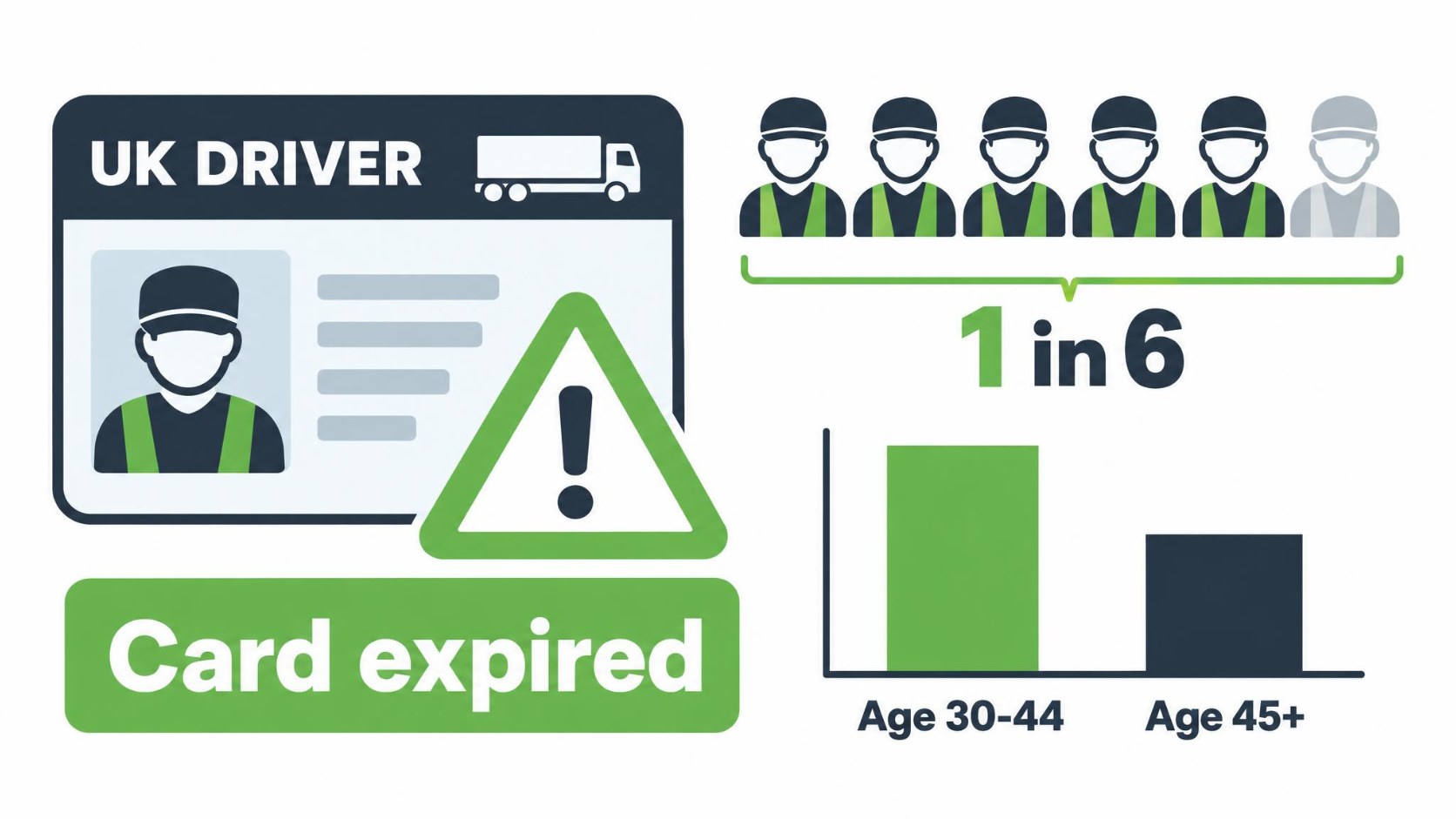
The scale of the problem is bigger than most drivers realise. A 2025 industry report using DVLA data found that more than 117,000 Driver Qualification Cards expired between October 2024 and May 2025 alone. That’s roughly one in six working HGV drivers quietly dropping out of the available pool.
A lapsed Driver CPC card doesn’t stop you holding your HGV licence. It stops you earning a living with it.
The drivers hit hardest aren’t the ones you’d expect. The report found drivers aged 30 to 44 were over 1.5 times more likely to let their card lapse than drivers aged 45 to 69, often because a quiet patch in work meant renewal kept getting pushed back. Drivers over 45 tend to stay current simply because they’re still working steadily.
The knock-on effect is significant for the whole industry. The Road Haulage Association estimates the UK needs around 60,000 new HGV drivers trained every single year just to keep pace with demand, and a workforce where thousands of already-qualified drivers have quietly gone inactive makes that harder, not easier.
What a Driver CPC Card Renewal Actually Involves
It’s worth being clear on what “renewal” actually means here, because the Driver CPC system has two completely different qualification routes, and mixing them up is one of the most common sources of confusion.
Initial CPC vs Periodic CPC, a quick recap
The Initial Driver CPC is what gets you your first Driver Qualification Card, bundled into your licence training. Once you hold one, you move onto Periodic CPC, which is what this article is about: the ongoing requirement to keep that card valid for your entire career.
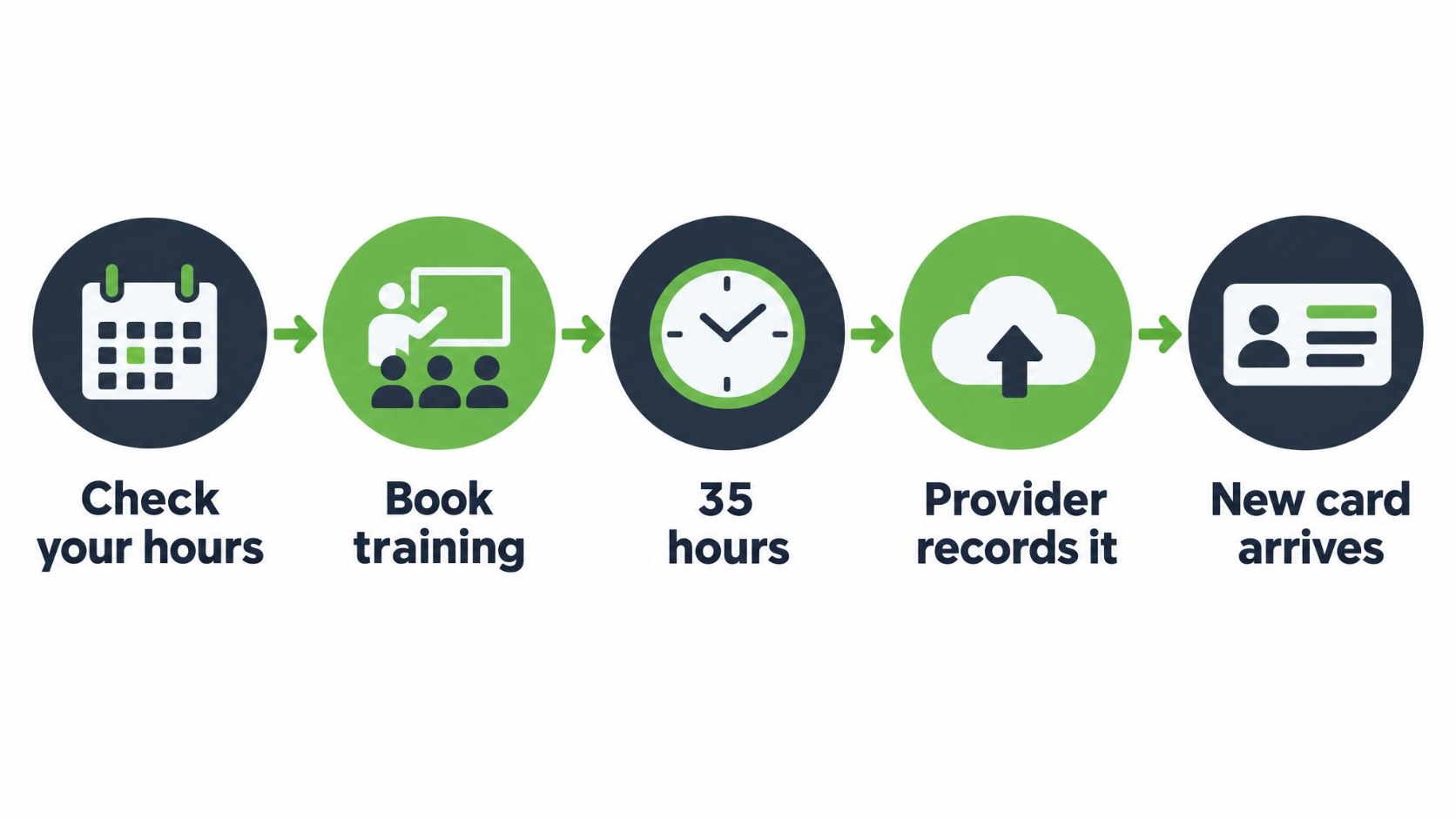
Periodic CPC renewal means completing 35 hours of training every 5 years. It isn’t a test you pass or fail. It’s a training requirement, and once you’ve done the hours, a new card follows. The 5-year deadline is printed on your current Driver CPC card itself, so that’s the first thing worth checking today if you’re not sure where you stand.
If you drive both lorries and buses or coaches, you only need to complete one set of 35 hours every 5 years. It covers both categories, so there’s no need to double up.
The 35-Hour Rule, Explained
The 35 hours don’t need to be done in one block, and most drivers spread them out over the full 5-year period rather than cramming them in at the last minute, which is usually where the trouble starts.
How training is usually structured
Most approved providers package the 35 hours as five separate 7-hour training days, which you can take individually, in a single intensive week, or spread across months. Courses typically cover topics like drivers’ hours and tachographs, road traffic law, safe driving and accident procedures, and vehicle safety and loading.
You can mix and match providers and course dates, as long as every session is a genuine Driver CPC-approved course.
Training must be taken in the country where you work or normally live.
If you want to drive professionally in Europe as well as the UK, every one of your 35 hours needs to be an International course rather than a National one.
National vs International courses
A National course only counts toward a card that lets you drive professionally within the UK. An International course counts toward both UK and EU professional driving. If you take a mix, your hours split between a National card and an International one, and you can’t carry International hours over onto a National card. If you’re not sure which you need, HGV Learning can talk you through it alongside your wider licence training.
When to Start Your Renewal
Timing your renewal properly matters more than most drivers expect, because finishing too early can actually work against you.
Check the deadline printed on your current Driver CPC card and work out roughly how many of your 35 hours you’ve already completed.
Book your remaining hours with an approved training provider, ideally starting well before your deadline rather than in the final weeks.
Complete all your sessions, keeping your certificates of completion as a backup record.
Let your provider confirm your hours have been recorded with DVSA, which should happen within 5 working days of each course.
Wait for your new card, which is sent automatically to the address on your driving licence.
If you finish your 35 hours within the 12 months before your deadline, your new card is issued straight away. If you finish your training more than a year early, the card isn’t issued until closer to your current card’s actual expiry date. Doing your hours too far in advance doesn’t get you ahead of the system, it just means a longer wait for the physical card.
How to Check Your Remaining Hours
You don’t need to guess or dig through old certificates to find out where you stand. The government’s “check your Driver CPC periodic training hours” service shows exactly how many hours you’ve logged in your current 5-year period, pulled directly from DVSA’s own training record.
It’s worth checking this at least once a year rather than only when your deadline is looming, since it also flags whether any of your hours are National rather than International, which matters if you ever plan to drive in Europe.
Finding and Booking an Approved Training Provider
Not every driving-related course counts toward your 35 hours. It has to be run by a provider approved to deliver Driver CPC periodic training, and the course itself has to be registered as a genuine CPC module, not a generic safety briefing.
A few practical things worth checking before you book:
Confirm the provider is JAUPT-approved and that the specific course is a registered Driver CPC module, not just general driver training.
Ask whether the course is classed as National or International, especially if you ever work across borders.
Check how soon after the course your hours actually get uploaded, since this affects when you’re legally covered to keep driving.
Course formats vary more than they used to. Some providers still run the traditional full-day classroom session, often at a depot or training centre, while others offer online or blended courses covering some of the more theory-heavy modules. A blended approach can make the 35 hours easier to fit around shift work, but check that any online element is still a genuine CPC-approved course and not a generic e-learning module that won’t count toward your hours.
Price alone isn’t a reliable way to judge a provider. A cheaper course that turns out not to be properly registered wastes both the money and the hours you thought you’d banked, so it’s worth confirming approval status directly with the provider before paying rather than assuming a professional-looking website is enough.
If you’re newly qualified and haven’t done your Initial CPC yet, that’s a different process covered by your core licence training, whether that’s Cat C, C+E, or one of HGV Learning’s other licence courses. This guide is specifically about keeping an existing card valid.
What Happens Once You’ve Finished Your Hours
Once your training provider has recorded your completed hours, you’re legally allowed to keep driving professionally while you wait for your physical card to arrive, as long as the training has genuinely been logged.
You don’t need to apply for your renewed card yourself in most cases. It’s sent out automatically once your 35 hours are on record.
For the vast majority of UK-only drivers, the card is issued and posted automatically to the address held on your driving licence, which is exactly why it’s worth double-checking that address is current before you start your renewal. You only need to apply in writing if some of your training was taken in an EU country, Switzerland, Norway, Iceland or Liechtenstein, or in a specific set of cross-border cases.
If your new card hasn’t turned up within 20 days of finishing your training, contact DVSA directly rather than assuming it’s lost in the post. Keep a record of your course completion dates and any confirmation emails in the meantime, since you may need them if there’s a query.
What It Costs in 2026
Periodic CPC training is priced by each individual provider, and costs can vary depending on location, course format and whether you book all five days together or spread them out. For a fuller breakdown of how CPC pricing compares across the Initial and Periodic routes, see our dedicated CPC course cost guide.
Item
Typical 2026 cost
Full 35-hour Periodic CPC course (5 days)
£250 to £450
DVSA fee for adding training taken abroad
£25
Replacement card after late non-arrival report
£25
Fixed penalty for driving without your card on you
£50
Maximum fine for driving professionally without valid CPC
Up to £1,000
For most drivers renewing in good time, the only real cost is the training itself. The DVSA and penalty fees above apply to specific situations, like training completed abroad or a card that goes missing, rather than being a standard part of every renewal.
What Happens If You Let It Lapse
This is the part that catches drivers out, because nothing dramatic happens the day your card actually expires. You simply stop being legally able to drive professionally until it’s sorted, and a lot of drivers don’t register that until an employer or an agency asks to see a valid card.
You don’t lose your licence, but you do lose your livelihood
Your underlying HGV licence entitlement stays intact. What lapses is your permission to drive for hire or reward, which is the entire point of working as a professional driver. Driving professionally without a valid Driver CPC can bring a fine of up to £1,000, and training older than 5 years stops counting toward your 35 hours at all.
There is no partial credit for being nearly there. If your card lapses, you need to complete a full fresh block of periodic training before you can drive professionally again, and your next 5-year deadline resets from whenever you finish that training, not from your old expiry date.
The scale of the problem is now a genuine workforce issue
Industry researchers estimate that getting lapsed drivers back on the road, even on a temporary basis, would require over 800,000 hours of training nationally, rising past 4 million hours if every lapsed driver were to become fully qualified again. That’s not a quick fix, and it’s a big part of why the driver shortage persists even when licence numbers on paper look healthy.
A lapsed card also means you can’t realistically apply for most HGV jobs, since any reputable employer or recruitment agency will check your Driver CPC status before offering you work. It’s one of the first things that gets verified, right alongside your licence and your tachograph card.
The “return to driving” option is narrowing
A fast-track return route was introduced for some drivers whose cards had lapsed, aimed at getting experienced people back on the road without starting completely from scratch. Industry commentators have flagged that this option is expected to become unavailable to most lapsed drivers from peak 2026 onwards, as the window set when it was introduced closes.
If your card has already lapsed, the practical takeaway is not to wait and hope a simplified route will still be open by the time you get round to it. Checking your actual options now, rather than assuming the easiest path will still be there in a few months, is the safer approach.
Driver CPC Renewal If You’re Self-Employed or Agency-Based
If you’re employed directly, your transport manager or compliance team often tracks renewal deadlines across the whole driver pool and chases you before anything lapses. Self-employed and agency drivers don’t get that safety net, which is part of why this group shows up so heavily in the lapsed-card figures.
There’s no employer HR system flagging your deadline for you, so it genuinely is down to checking it yourself.
Gaps between contracts are exactly when renewal tends to slip, since there’s no immediate shift forcing the issue.
Agencies will ask to see your current Driver CPC card before placing you on a job, so a lapsed card can cost you work even if you’re otherwise ready and available.
Treating your renewal deadline the same way you’d treat an MOT or an insurance renewal date, as a fixed commitment rather than something to deal with when work is quiet, is the simplest way to avoid joining that statistic.
Nobody else is tracking your Driver CPC deadline for you if you’re self-employed. Treat it like your MOT date, not an optional extra.
Common Mistakes Drivers Make With Renewal
Leaving all 35 hours until the final few months before the deadline, which leaves no room for a cancelled course or a busy work period.
Not checking whether a course is genuinely CPC-approved before booking it, then finding out too late it doesn’t count.
Letting a driving licence address go out of date, so the new card is posted somewhere the driver no longer lives.
Assuming a quiet spell out of work means renewal can wait, when it’s often exactly the drivers who step back from driving who end up lapsing.
Mixing National and International courses without realising the hours don’t transfer between the two card types.
The real cost of a lapsed Driver CPC isn’t the fine. It’s every job you can’t take until it’s sorted.
Where This Fits in Your HGV Career
Keeping your Driver CPC current is one of the quieter pieces of admin behind a stable HGV career, but it sits right alongside the other post-qualification steps drivers are expected to manage, from your tachograph card to the licence category rules you trained under in the first place.
If you’re newly qualified and still working out how to land your first HGV job, a valid, in-date Driver CPC card is one of the basics an employer expects to see from day one, not something you can leave until you’re already in post. And if you’re returning to driving after a break, checking your card status before you start job-hunting saves a wasted application.
Whatever stage you’re at, whether you’re training for your ADR, HIAB or telescopic handler qualification, or you’re years into your career and due a renewal, HGV Learning’s recruitment advice covers the practical side of staying employable, not just getting qualified in the first place.
Already Mid-Career and Need Advice?
If you’re not sure how many hours you’ve actually completed, whether a course you’re considering genuinely counts, or what your renewal timeline should look like given your own deadline, it’s worth getting a straight answer rather than guessing. You can also use HGV Learning’s repayment calculator if you’re weighing up further training alongside your existing commitments, or get in touch directly with a specific question about your situation.
Frequently Asked Questions
How often do I need to renew my Driver CPC card?
Every 5 years. You need to complete 35 hours of periodic training before your current card’s deadline, which is printed on the card itself.
How much does Driver CPC renewal cost in 2026?
The 35-hour course itself typically costs £250 to £450, depending on your provider and location. Most drivers renewing on time pay no additional DVSA fee at all.
What happens if my Driver CPC card expires before I finish my hours?
You can’t legally drive professionally until you’ve completed a full fresh block of 35 hours training. There’s no partial credit, and your next 5-year deadline resets from your completion date.
Can I do all 35 hours in one go?
Yes. Most approved providers run it as five 7-hour days, which you can take as one intensive week or spread out across months, as long as every course is genuinely CPC-approved.
Do I need to apply for my new card myself?
In most cases, no. Your new card is issued and posted automatically to the address on your driving licence once your training provider has recorded your completed hours.
What’s the difference between a National and an International Driver CPC course?
A National course only counts toward driving professionally within the UK. An International course counts toward both UK and EU professional driving, so it’s worth checking which you need before booking.
Does a lapsed Driver CPC affect my HGV licence?
No, your underlying licence entitlement stays valid. What you lose is permission to drive for hire or reward, which in practice means you can’t work as a professional driver until your CPC is current again.
How do I check how many CPC hours I’ve already completed?
Use the government’s online service to check your Driver CPC periodic training hours. It shows exactly what’s logged against your licence for your current 5-year period.
Can I keep driving while I wait for my renewed card to arrive?
Yes, as long as you’ve completed your training and your provider has recorded it with DVSA, which should happen within 5 working days of each course finishing.
Related Articles
20/10/2026
Driver Tachograph Card: How to Get Your First One (2026 UK Guide)
You've passed your test, your Driver CPC is sorted, and then a recruiter or transport manager asks, "Have you got your tacho card sorted yet?"...
What Age Can You Start HGV Driver Training? A 2026 UK Guide to Licence Age Requirements
If you're asking what age you can start HGV driver training, the honest answer depends on which licence you're after. A C1 licence, covering vehicles...