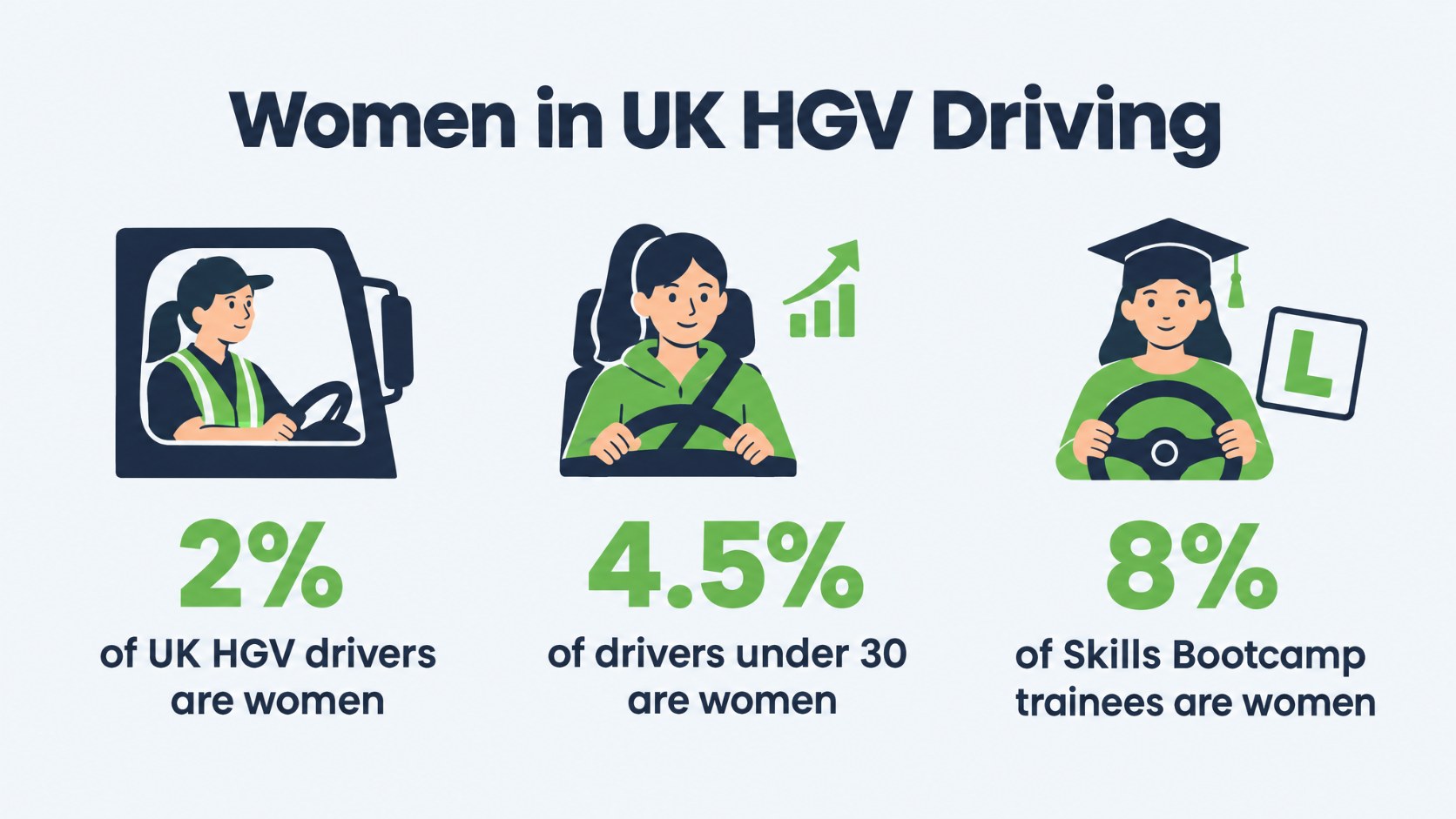
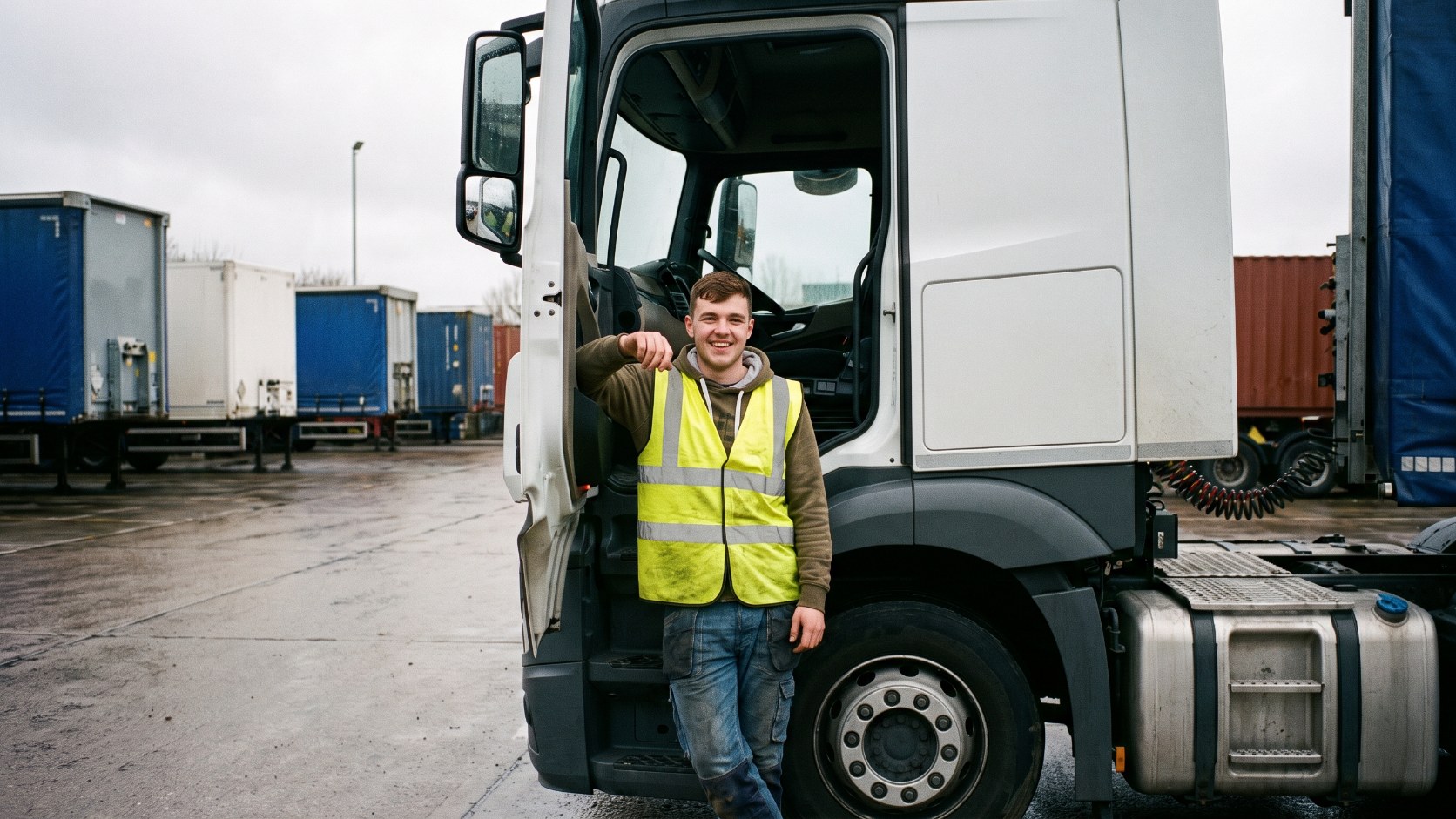
Only 2% of HGV drivers in the UK are women. Among drivers under 30, that figure rises to 4.5%, and on government-funded Skills Bootcamps it reaches 8%, according to the Road Haulage Association’s most recent driver workforce report. That gap is not evidence that women cannot do the job. It is evidence of an opportunity that most of the industry has barely started to talk about.
If you are weighing up an HGV career and wondering whether it is genuinely open to you, this guide answers that honestly: what the licence process actually involves, what the job is really like day to day, what it pays, where funding comes from, and what to watch for once you are qualified and looking for your first role. No filler, no assumptions about what you can or cannot lift.
Why So Few Women Drive HGVs in the UK Today
The numbers above are not a quirk of recent recruitment. Women have been a tiny minority of UK HGV drivers for decades, and the reasons have almost nothing to do with the actual demands of the job.
The Road Haulage Association’s workforce analysis puts the current figure at 2% female drivers across the whole licensed workforce of 684,000 active Driver Qualification Card holders. That is a stark number on its own, but the detail underneath it matters more: among drivers under 30, the proportion more than doubles to 4.5%, and participants on Skills Bootcamp training programmes run even higher, at 8% female. Younger entrants and funded-training routes are visibly moving the number, even if the overall workforce is still overwhelmingly male.
A workforce that is 98% male is not a reflection of who can drive a lorry. It is a reflection of who has historically been shown the job exists.
The Real Barriers, According to Women Already Doing the Job
Ask women already driving HGVs why so few of their peers consider it, and the same three answers come up repeatedly in industry reporting. None of them are about physical capability.
It is rarely promoted as an option. HGV driving is not routinely presented to women at school, at careers fairs, or in career-change advice the way it is to men.
The “man’s job” perception persists. Decades of near-total male representation create a self-reinforcing assumption that the job is not for women, even though nothing in the licence, the test or the vehicle cares who is driving it.
Welfare facilities on the road are inconsistent. Toilet and washing provision at depots, customer sites and some rest stops is a genuine, widely reported frustration, not a minor complaint. More on this below.
None of these are reasons the job cannot be done. They are reasons it has not yet been chosen by more women, which is a different problem, and one that is slowly shifting.
Common Myths About Women and HGV Driving
Before getting into the practical route to a licence, it is worth clearing up the misconceptions that put people off before they even look into it.
“You need to be strong to drive an HGV.” Modern trucks use power steering, air suspension and automatic or automated-manual gearboxes. Coupling and uncoupling a trailer, winding trailer legs and operating a tail lift take technique and practice, not raw strength, something every new driver, male or female, has to learn from scratch.
“The licence test is different, or harder, for women.” It is not. The DVSA theory test, practical test and Driver CPC modules are exactly the same test, assessed against exactly the same standard, regardless of who is sitting it.
“You will always be away from home.” Long-haul, multi-day trunking is one part of the industry, not all of it. Regional distribution, retail delivery and local multi-drop work are all HGV roles that get you home every night (see the section on what the job actually looks like, below).
What the Job Is Actually Like Day to Day
“HGV driver” covers a wide range of actual working patterns, and the stereotype of weeks away from home living in a cab applies to only part of it.
Regional distribution work, moving goods between depots, stores or construction sites within a defined area, typically means day shifts and a drive home every evening. Retail and supermarket delivery rounds follow a similar pattern, often with fixed, predictable hours. Long-distance trunking between national depots is where overnight stays and irregular hours come in, and it is genuinely one option among several, not the default.
You do not have to choose between an HGV career and being home every night. The industry has day-shift, local and regional roles in real numbers: you just have to ask the right question at interview.
Working Time Regulations apply to every HGV driver equally: maximum driving hours, mandatory breaks and rest periods are set by law, not negotiated per driver, which means the basic structure of your working day is predictable and protected by rule, not by goodwill.
Choosing Your Route: C1, Cat C or C+E
HGV Learning trains across all three core lorry licence categories, and which one makes sense for you depends on the kind of work you want and how much you are ready to commit up front.
C1: The Lighter Entry Point
The C1 licence covers vehicles between 3.5 and 7.5 tonnes. It is the fastest and cheapest route into professional driving, commonly used for local multi-drop delivery and smaller commercial vehicles, and a realistic first step if you want to test the career before committing to a full Class 2 or Class 1 course.
Cat C: Class 2, the Workhorse Licence
The Cat C (Class 2) licence covers rigid vehicles up to 32 tonnes and is the most widely held licence in the industry. It opens up the largest single pool of regional and local distribution jobs, many of which are home-every-night roles. Full detail on cost and the step-by-step process is in our Cat C licence cost guide.
C+E: Class 1, the Top of the Pay Scale
The C+E (Class 1) licence covers articulated and drawbar combinations and commands the highest pay in the sector, particularly on specialist or night trunk routes. It is the licence most associated with long-distance work, though plenty of Class 1 roles are also regional. Our Class 1 driver training guide covers the full route from a car licence through to qualified C+E driver.
Licence
Vehicle weight
Typical roles
Best for
C1
3.5â7.5 tonnes
Local multi-drop, smaller commercial vehicles
Lowest-cost entry, testing the career
Cat C (Class 2)
Up to 32 tonnes
Regional and local distribution, retail delivery
Home-every-night work, large job pool
C+E (Class 1)
Articulated, up to 44 tonnes
National trunking, specialist and night routes
Highest pay, drivers wanting long-distance work
How to Qualify: The Licence Process Step by Step
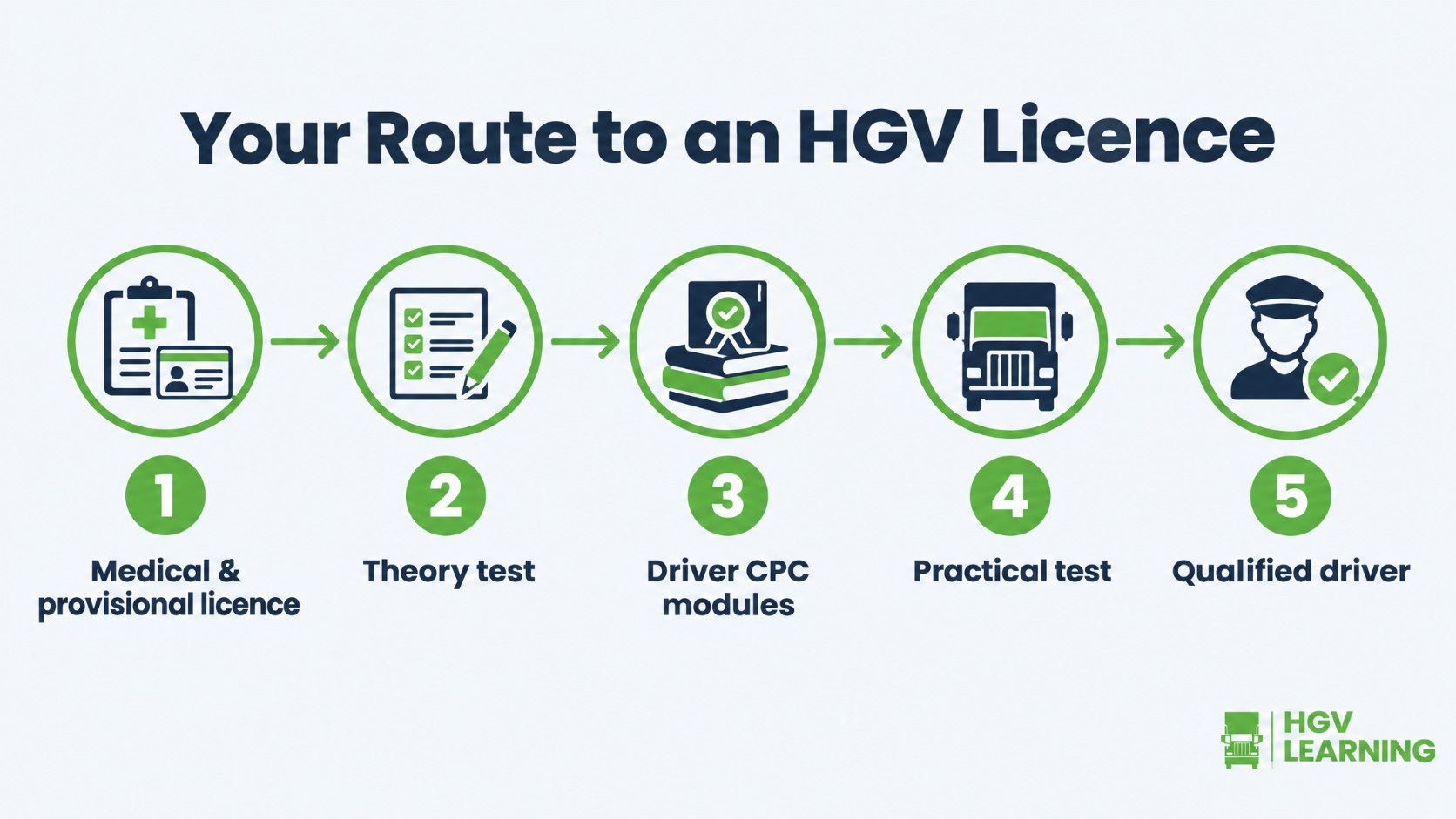
The process is identical for every applicant, regardless of gender. It runs through five clear stages from a standing start to a qualified HGV driver.
Medical examination and provisional entitlement. A D4 medical, completed by your GP or an approved medical examiner, confirms you meet the eyesight and general health standards DVSA requires. You then apply for provisional HGV entitlement on your licence.
Theory test. A multiple-choice and hazard-perception test covering HGV-specific rules, vehicle safety and the law. Our theory test guide covers what to expect and how to prepare.
Driver CPC modules. The Certificate of Professional Competence combines a case-study module and a practical demonstration module (loading, safety and emergency procedures), both required before you can drive commercially.
Practical driving test. Covers vehicle manoeuvres, on-road driving and an off-road exercise, assessed to the same DVSA standard for every candidate.
Qualified driver. Once you pass, you hold a full category entitlement and your Driver CPC, and you are legally able to drive commercially and start applying for roles.
Paying for Your Training
Cost is one of the most common things that stops anyone, not just women, from starting HGV training. The good news is there are genuine funded and part-funded routes worth checking before you assume you have to pay the full course fee yourself.
According to gov.uk’s official overview of HGV driver training, Skills Bootcamps are free, government-funded courses of up to 16 weeks, available in England, and one of the clearest routes into HGV driving without paying training costs upfront. Apprenticeships pay you a salary while you train, across all four UK nations. Some vocational qualification routes offer full or partial cost coverage depending on your circumstances. Our own guide to funding for HGV training breaks down every option in detail, including eligibility, and our training cost calculator can help you work out the likely numbers for your own situation.
Before you price up a course, check whether you qualify for a funded place. The cost barrier that puts people off is often smaller than it first appears.
What to Expect From Training and Instructors
A reputable training provider teaches every learner, male or female, to the same syllabus, at a pace matched to the individual, not a fixed assumption about prior experience. If you have never driven anything larger than a car, that is the normal starting point for the large majority of trainees, not a disadvantage specific to you.
Good instructors spend real time on the parts that feel most unfamiliar at first: judging the length and width of the vehicle, reversing and manoeuvring, and the physical technique for coupling, uncoupling and trailer legs, broken down into steps rather than assumed. If a provider cannot clearly explain how they support first-time learners through exactly these points, that is a fair question to ask before you book.
Welfare and Facilities: A Real Issue, Addressed Honestly
It would be dishonest to write this guide without naming the facilities problem directly, because it is the single most consistently reported frustration from women already driving HGVs in the UK.
Toilet and washing facilities at some depots, customer delivery sites and rest stops are inconsistent, and in some documented cases there is only a single shared facility not maintained to a standard anyone would consider acceptable. This is a genuine, practical issue, not a minor inconvenience, and it is worth factoring into how you choose an employer.
The legal baseline exists: employers have a duty under the Health and Safety Executive’s welfare regulations to provide clean, properly maintained toilet and washing facilities at the workplaces they control, with running water, soap and adequate provision for the number of people on site. That duty applies to depots and premises an employer operates directly, and it is a weaker lever at a third-party customer site or a public rest stop, which is exactly where the inconsistency tends to show up in practice.
Ask a prospective employer directly what facilities look like at the depots and routes you would actually be working, not just at head office.
Ask other drivers, if you can, rather than relying on what is in the job advert.
Treat a clear, confident answer to this question as a genuine signal about how seriously an employer takes its drivers generally.
This is improving as the industry becomes more conscious of it, but it has not disappeared, and pretending otherwise would not help anyone reading this guide make a real decision.
Pay: What HGV Drivers Actually Earn by Licence Type
Pay is set by the role and the licence category, not by who is driving. The figures below, drawn from Aspion’s 2026 UK HGV driver salary guide, reflect the current UK market across both genders.
Licence
Entry-level
Standard range
Experienced / specialist
Cat C (Class 2)
£21,000â£26,000
£28,000â£36,000
£16â£20/hr agency
C+E (Class 1)
£30,000+
£38,000â£50,000
£45,000â£55,000+ on specialist/night trunk routes
The overall UK market average sits at roughly £32,000â£34,000 a year for a standard full-time permanent role, though that figure masks a real spread: the gap between an entry-level Class 2 role and an experienced Class 1 position on specialist work can exceed £15,000 a year. Our Cat C cost and career guide breaks the Class 2 side of this down further.
Getting Your First Job After Qualifying
Passing your test is not the end of the process, and this applies to every newly qualified driver, not specifically women. Most standard UK fleet insurance policies require a minimum of two years’ licence experience and a set number of driving days in-category before they will cover a driver, which locks a large share of advertised vacancies out of reach immediately after qualifying.
This is a real, structural barrier, and it catches new drivers off guard if nobody has told them about it in advance. Our dedicated guide on how to get your first HGV job with no experience covers exactly how newly qualified drivers of any background get past the insurance wall, from targeting the right employers to building a CV that leads with your qualification rather than apologising for the lack of road experience.
The insurance rule catches every newly qualified driver, regardless of background. Knowing about it before you qualify means you can plan your job search around it, instead of being blindsided by it afterwards.
It is also worth being deliberate about which employers you approach first. Larger fleets with structured induction programmes and smaller, owner-driven haulage firms both take on newly qualified drivers, but for different reasons, and a CV or covering message that explains why you chose HGV driving tends to land better than one that treats the qualification as self-explanatory.
HGV Learning’s own recruitment advice service works specifically with newly qualified drivers on exactly this problem, matching candidates to employers who take on drivers at the start of their career rather than filtering them out automatically.
Where to Find Support and Role Models
You do not have to find your way into this career alone. Industry reporting on women already driving HGVs consistently highlights the same practical point: experienced drivers, male and female, are generally willing to help a newcomer learn the parts of the job that only come with time on the road, from reversing technique to route planning.
Seek out other women who have already made this move, where you can, through your training provider, your eventual employer, or industry networking groups focused on diversity in logistics. Hearing directly from someone who has done exactly what you are considering is worth more than any amount of generic encouragement.
If you still have questions about the practical side of training, our FAQs page covers the most common ones, and our team is happy to talk you through your options before you commit to anything.
Frequently Asked Questions
Do you need to be especially strong to drive an HGV?
No. Modern HGVs use power steering, air suspension and automatic or automated-manual gearboxes. Coupling, uncoupling and operating a tail lift take technique learned through practice, not raw physical strength, and training covers this step by step for every new driver.
Which HGV licence should a woman starting out choose?
The right licence depends on the work you want, not your gender. C1 is the lowest-cost entry point for local delivery, Cat C (Class 2) opens the largest pool of regional and home-every-night roles, and C+E (Class 1) offers the highest pay, particularly on specialist and night trunk routes.
Is HGV training different for women?
No. Every learner follows the same DVSA-set syllabus and is assessed against the same theory test, Driver CPC modules and practical test, regardless of who is sitting it. A good provider paces training to the individual, not to assumptions about prior experience.
How much does HGV training cost, and is funding available?
Costs vary by licence category, but genuine funded routes exist. Skills Bootcamps are free, government-funded courses of up to 16 weeks in England, and apprenticeships pay a salary while you train. See our full guide to funding for HGV training for every option and eligibility criteria.
Will I have to work nights or be away from home for long stretches?
Not necessarily. Regional distribution and retail delivery roles commonly offer day shifts and a drive home every evening. Long-distance trunking, which does involve overnight stays, is one option among several rather than the default for every HGV job.
What’s the real situation with toilets and welfare facilities on the road?
It is a genuine, widely reported issue. Provision at some depots, customer sites and rest stops is inconsistent. Employers have a legal duty to provide proper facilities at premises they control, so it is a fair and useful question to ask any prospective employer before accepting a role.
How much do HGV drivers actually get paid?
Pay is set by licence category and role, not by who is driving. Cat C (Class 2) typically ranges from £21,000 for entry-level up to £36,000, while C+E (Class 1) ranges from around £30,000 up to £50,000, with experienced specialist and night trunk routes paying £45,000-£55,000 or more.
Will I struggle to get hired once I’m qualified?
Most standard UK fleet insurance requires around two years’ licence experience before covering a driver, which affects every newly qualified driver, not just women. Our guide to getting your first HGV job with no experience covers exactly how to get past this, and HGV Learning’s recruitment advice service works specifically with newly qualified drivers.
Are there networks or support groups for women HGV drivers?
Yes, informally and through the industry more broadly. Experienced drivers are generally willing to help newcomers learn the practical skills that come with time on the road, and seeking out other women who have already made this move, through your training provider or employer, is worth more than generic encouragement alone.
Related Articles
20/10/2026
Driver Tachograph Card: How to Get Your First One (2026 UK Guide)
You've passed your test, your Driver CPC is sorted, and then a recruiter or transport manager asks, "Have you got your tacho card sorted yet?"...
What Age Can You Start HGV Driver Training? A 2026 UK Guide to Licence Age Requirements
If you're asking what age you can start HGV driver training, the honest answer depends on which licence you're after. A C1 licence, covering vehicles...