You’re probably in one of two places right now. You’ve decided you want to drive for a living, or you’ve looked at HGV work and realised it could give you a more stable path than the job you’re in now. Then the official process appears on screen, and the first big obstacle jumps out at you. The lorry theory test.
A lot of people freeze at this point. Not because they can’t do it, but because the process feels more formal than expected and the stakes feel higher when the licence leads to a job, not just private driving.
That reaction is normal. The key is to stop seeing the theory test as a random exam and start seeing it as the first working part of your licence journey. It’s where you build the habits that matter later on: reading carefully, spotting risk early, and understanding why rules exist.
Your First Step Towards an HGV Career
The first mistake many learners make is treating the lorry theory test online like a quick box to tick before practical driving starts. It isn’t. It’s the first proper check that you can think like a professional driver.
Professional driving brings a different level of responsibility. You’re not just moving your own car from A to B. You’re handling a larger vehicle, carrying weight, managing blind spots, and working within stricter rules. That’s why the theory stage matters so much.
Recent DVSA data shows the overall UK driving theory test pass rate sits around 46.0%, which tells you something important. Plenty of candidates turn up underprepared and don’t get through. You can see that summary in this guide to theory test pass rates. The lesson isn’t that the test is unfair. It’s that casual preparation usually isn’t enough.
Why this stage matters more than people think
When learners struggle, it’s often for one of three reasons:
They revise like it’s a car test: The content is broader and the standard is higher for professional driving.
They rely on memory only: That works for some signs and facts, but it won’t carry you through hazard awareness and rule-based questions.
They leave practice too late: Last-minute cramming makes people panic on timed questions.
Practical rule: If you want to pass first time, study for understanding, not recognition.
That means learning what a rule is for, not just what the right answer looks like in a mock test. If a question changes the wording, you still need to know the logic.
There’s another reason to take this seriously. Employers want drivers who understand the bigger picture of road transport, safety, timing, and delivery pressure. If you’re also curious about the commercial side of transport work, this SMB guide for delivery operations gives a useful view of how delivery businesses think about drivers, routes, and reliability.
Think of the theory pass as stage one
A strong start makes every later step easier. When you understand road law, vehicle limits, and hazard development early, your practical training tends to make more sense. Instructors can focus on sharpening your driving, not correcting gaps that should have been fixed before you got in the cab.
That’s the right mindset for the lorry theory test online. Not fear. Not guesswork. Just a clear first milestone on the road to an HGV career.
Eligibility Paperwork and Booking Your Test
Before you book anything, make sure the basics are in place. This part catches people out because it feels administrative, but it’s just as important as revision. If your paperwork is wrong or incomplete, your progress slows down before you’ve even opened a practice question.
The checks you need to pass first
To book the UK lorry theory test online, you must be at least 18 years old and have lived in Great Britain for at least 185 days in the last 12 months, as outlined in this booking guide for HGV theory eligibility.
Those rules are there for a reason. HGV licensing is tightly controlled because the vehicles, risks, and legal duties are different from private motoring. Age and residency checks help make sure candidates are entering the system properly and can be processed through the correct UK channels.
The paperwork most learners hear about first
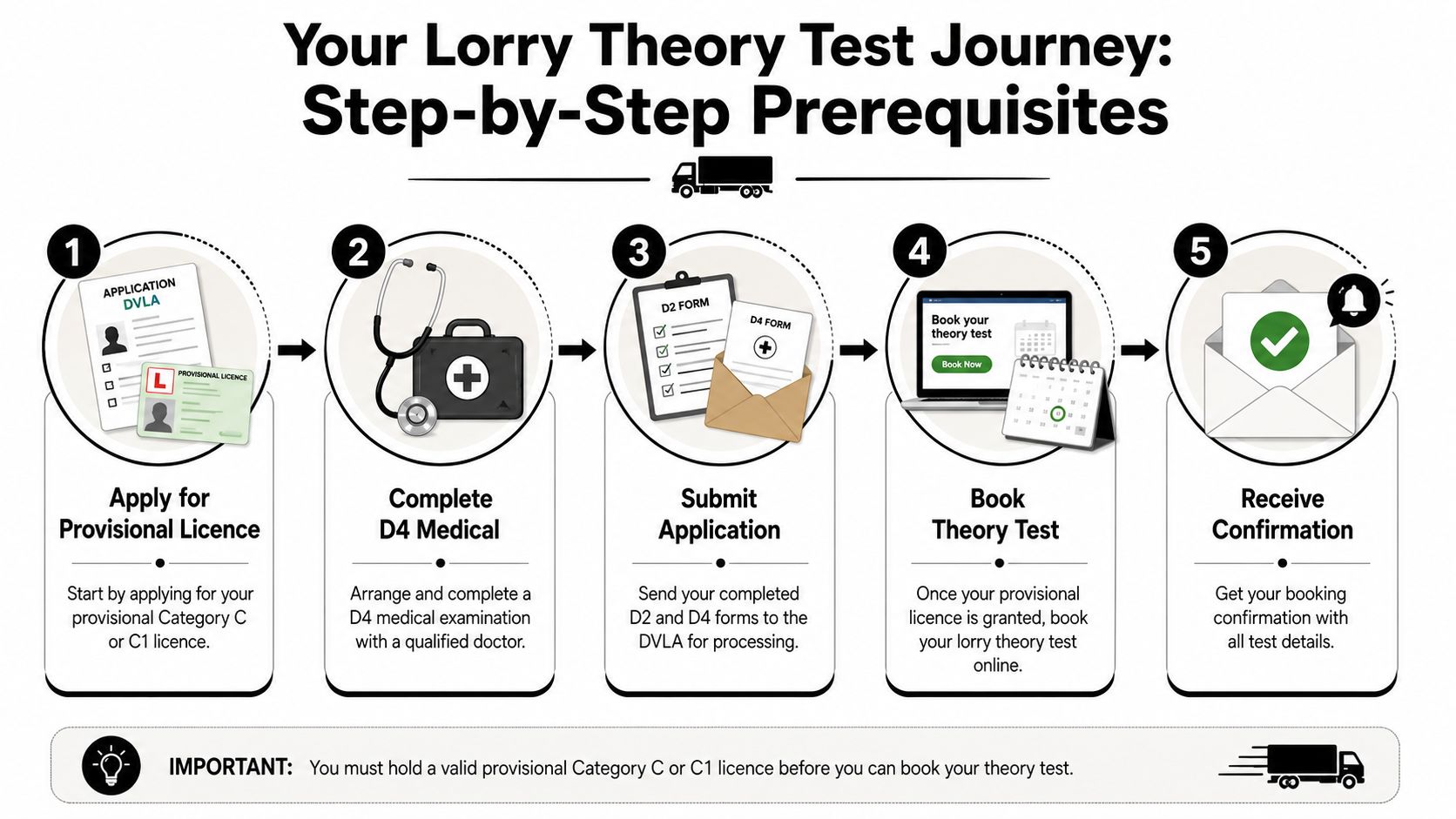
You’ll usually come across two key forms early on.
D2 form: This is the application form linked to lorry driving entitlement.
D4 form: This is the medical report form that must be completed by a qualified doctor.
The D4 matters because HGV drivers need to meet a higher medical standard than ordinary car drivers. A doctor checks whether you’re fit to drive safely in a professional setting. That can include eyesight and other health factors relevant to safe control of a heavy vehicle.
A simple order that keeps things tidy
Many learners feel overwhelmed because they try to do everything at once. Keep it in sequence.
Apply for the right provisional entitlement
Make sure you’re applying for the HGV category that fits your goal, such as C1, Category C, or C+E progression.
Arrange your D4 medical
Book this with a qualified doctor and bring the form that needs completion.
Send off the D2 and D4
Check names, addresses, dates, and licence details carefully before posting anything.
Wait for confirmation
Don’t try to rush ahead and book before your entitlement is properly in place.
Book your test online
Once you’re cleared to move forward, use the official route and keep your booking details safe.
A surprising number of delays come from simple errors like mismatched names, missing signatures, or rushed form filling.
Booking without the usual confusion
When you’re ready to book, have your driving licence details beside you and use a step-by-step guide if you need one. This comprehensive HGV theory test booking guide is useful if you want a practical walkthrough before you commit to a date.
A good habit is to book only when you’ve got a realistic revision plan. Some people book early to force themselves to study, which can work. Others book too early, lose confidence, and then spend weeks worrying. Be honest with yourself. A test date should create focus, not panic.
Understanding the Two-Part Theory Test
A lot of new drivers talk about “the theory test” as if it’s one exam. For lorry drivers, it’s better to think of it as two linked checks. One tests what you know. The other tests how you spot danger as it develops.
Part 1a and Part 1b are different jobs
The lorry theory test includes a 100-question multiple-choice section costing £26 and a hazard perception section costing £11. You get 115 minutes for the multiple-choice part and need 85 out of 100 to pass it, according to the official Driver CPC Part 1 guidance on GOV.UK.
That high mark tells you a lot. This isn’t designed for half-ready candidates. It expects broad knowledge and careful reading.
Here’s the layout in a simple format.
Component
Number of Questions/Clips
Time Allotted
Pass Mark
Cost
Multiple-choice
100 questions
115 minutes
85 out of 100
£26
Hazard perception
Video clips
Not stated here in the verified data
Pass required
£11
What the multiple-choice section is really testing
The multiple-choice part checks more than signs and simple rules. It’s looking at whether you understand how professional driving works in practice.
You can expect topics such as:
Road law and the Highway Code: The legal baseline for safe driving.
Vehicle safety: Checks, defects, warnings, and safe use.
Loading and stability: Why load security matters and how weight affects braking and control.
Professional responsibility: The kind of thinking expected from someone operating a large commercial vehicle.
A common misunderstanding is that a long test always means you should rush. Don’t. 115 minutes is enough time if you stay calm and read properly. Trouble starts when people skim the question, spot a familiar word, and click too quickly.
Hazard perception is not a guessing game
This part catches out learners who only practise questions and ignore video work. Hazard perception is about recognising when a normal situation changes into something that needs a response.
For a lorry driver, that skill matters even more because your vehicle is larger, slower to stop, and more restricted in space. A parked car isn’t automatically the hazard. A parked car with a door about to open into your path is a developing hazard. A pedestrian on a pavement isn’t automatically the hazard. A pedestrian turning towards the crossing point and stepping forward is.
Don’t click because something exists. Click because the situation is changing.
If you want a clearer explanation of how this part works and what DVSA expects you to notice, this hazard perception test guide is worth reading before you start serious practice.
Why learners get confused about the split format
Part of the confusion comes from comparing the HGV route with the ordinary car route. The lorry pathway has stricter standards and more specialist content, so the structure feels heavier from the start. That’s normal.
It helps to separate your preparation in your head:
Learn facts and rules for multiple-choice.
Train your timing and observation for hazard perception.
These are related skills, but they don’t improve in exactly the same way. One grows through revision and recall. The other grows through repeated observation and disciplined timing.
If you keep those two lanes separate during study, the whole lorry theory test online process becomes much easier to manage.
Building Your Online Study and Practice Strategy
A high pass mark changes how you should revise. You can’t drift through this with a few random quizzes and hope your road sense carries you. If you want to get through the lorry theory test online, your preparation needs structure.
The multiple-choice pass requirement is 85 out of 100, which is a notably high standard and demands a proper study plan, as referenced in this video explanation of the HGV theory pass mark.
Start with official-style material
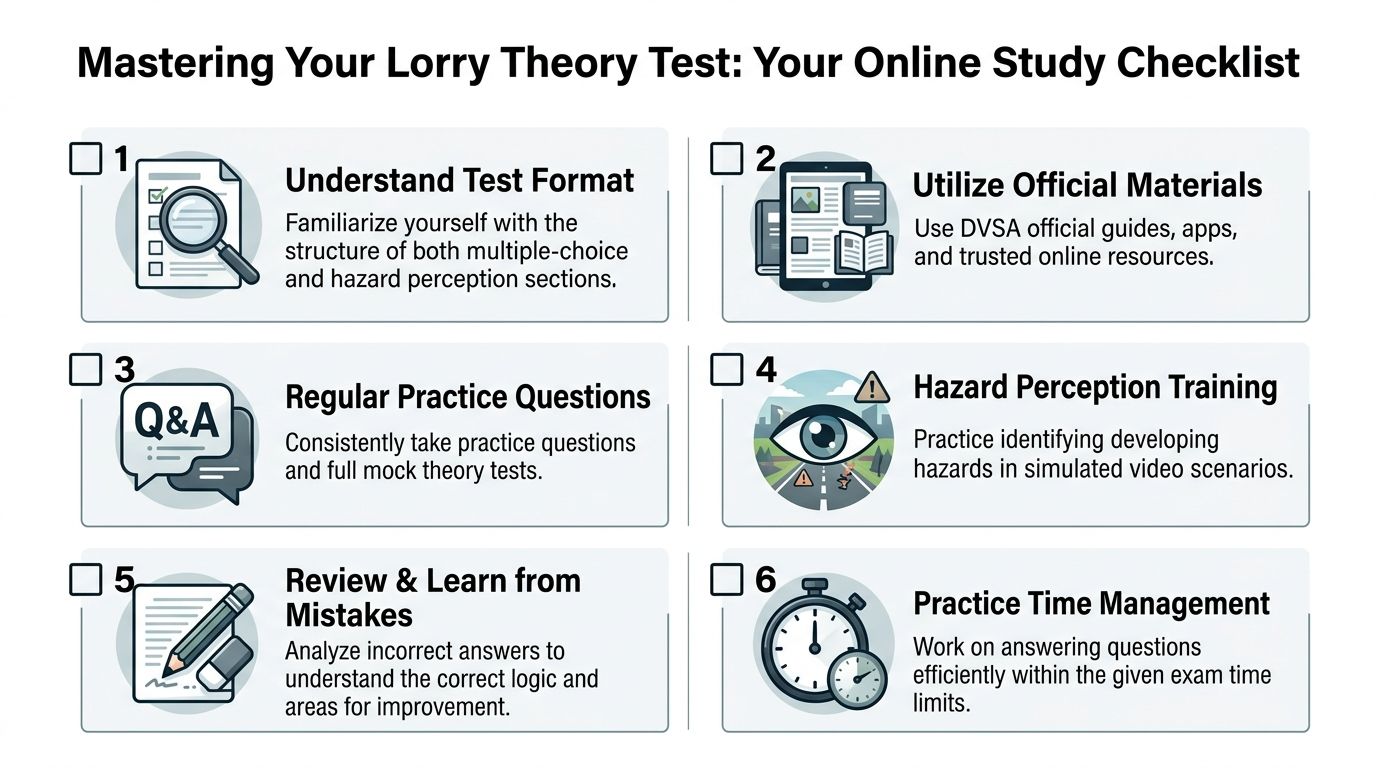
Your first job is to learn the format, not just the content. If the screen layout, wording style, and subject areas feel familiar, you’re less likely to waste energy on test-day nerves.
Use material that reflects DVSA topics and question style. That helps you build the right habits from day one.
Use the Highway Code properly: Don’t dip in at random. Read by topic.
Practise category-specific questions: Lorry content goes beyond standard car-driver knowledge.
Train hazard perception separately: Treat it as its own subject.
A lot of learners revise only what they enjoy. They’ll hammer road signs because signs feel straightforward, then avoid weak areas like loading, safety checks, or rules that require slower thinking. That’s backwards. Your weak areas deserve the most attention.
Build a schedule you can keep
The best study plan is one you’ll follow. Short regular sessions often work better than occasional marathons. That’s especially true if you’re fitting revision around work, family, or shift patterns.
Try a weekly rhythm like this:
Early in the week: Read and learn one topic area in detail.
Midweek: Do focused question practice on that same topic.
Later in the week: Take a mixed mock test.
At the weekend: Review mistakes and repeat hazard perception practice.
That pattern works because it keeps learning active. You read, apply, test, and review. You’re not just stuffing information in and hoping it stays there.
Study habit: If you get a question wrong, don’t just note the correct answer. Ask why your first answer felt tempting.
That one habit improves scores quickly because many wrong answers in theory tests are designed to sound plausible.
A good practice platform should also show you patterns. If you keep missing the same type of question, that’s useful information. This practise HGV theory test resource can help you find targeted revision options rather than relying on unfocused browsing.
To see hazard awareness explained in a more visual way, this short video is a useful companion while you practise:
Make mock tests work for you
Mock tests are valuable only if you use them properly. Some learners chase a high score and ignore what the score means. Others panic when they get things wrong and stop practising. Neither approach helps.
Use mocks for diagnosis.
What to check
Why it matters
Your recurring weak topics
They show where to revise next
Your timing
It tells you whether you’re reading carefully or rushing
Your concentration drop-off
It shows where fatigue starts affecting choices
When you review a mock, sort your mistakes into groups:
Knowledge gaps: You didn’t know the rule.
Reading errors: You knew it, but misread the wording.
Pressure mistakes: You changed from a correct first thought to a wrong one.
Each type needs a different fix. Knowledge gaps need study. Reading errors need slower scanning. Pressure mistakes need confidence and routine.
Don’t save hazard perception until the end
Many people do. Then they find out too late that they’ve trained one skill and ignored the other.
Hazard practice works best when it becomes normal. Watch clips. Anticipate what could change. Notice road users who might step out, brake suddenly, swing wide, or force a lane decision. Over time, your reactions become calmer and more accurate.
That’s what good preparation for the lorry theory test online looks like. Not heroic cramming. Steady work, repeated exposure, and honest review.
Avoiding Common Pitfalls and Tricky Questions
Even prepared learners can drop marks in silly ways. Usually it isn’t because the whole topic is beyond them. It’s because pressure changes how they read, click, and judge timing.
The click-happy hazard perception problem
A learner practises hazard clips at home and starts clicking whenever anything moves. Cyclist in view. Click. Brake lights ahead. Click. Car near a junction. Click again and again.
That feels active, but it isn’t smart. Hazard perception rewards recognising the developing hazard, not spraying clicks across the whole clip.
A better approach is measured observation. You watch the scene build. You notice what could become risky. Then you respond when the danger starts to develop.
Too early can be as unhelpful as too late if you haven’t identified the right moment in the clip.
A simple example helps. A child standing on the pavement near a ball is a warning sign. The developing hazard is when the child moves towards the road or the situation clearly starts to unfold. That’s the point where your awareness should become active.
The multiple-choice trap of half-reading
Another common error is recognising one phrase and assuming you know the whole question.
Take a drivers’ hours style question. A learner sees a familiar term, thinks “I revised this”, and answers from memory before checking the rest of the wording. But the question may be asking for the safest action, the legal action, or the first action. Those aren’t always the same thing.
Here’s the pattern I see often:
First read: The learner spots a keyword and jumps.
Second look: They realise the question includes a condition they missed.
Result: An avoidable lost mark.
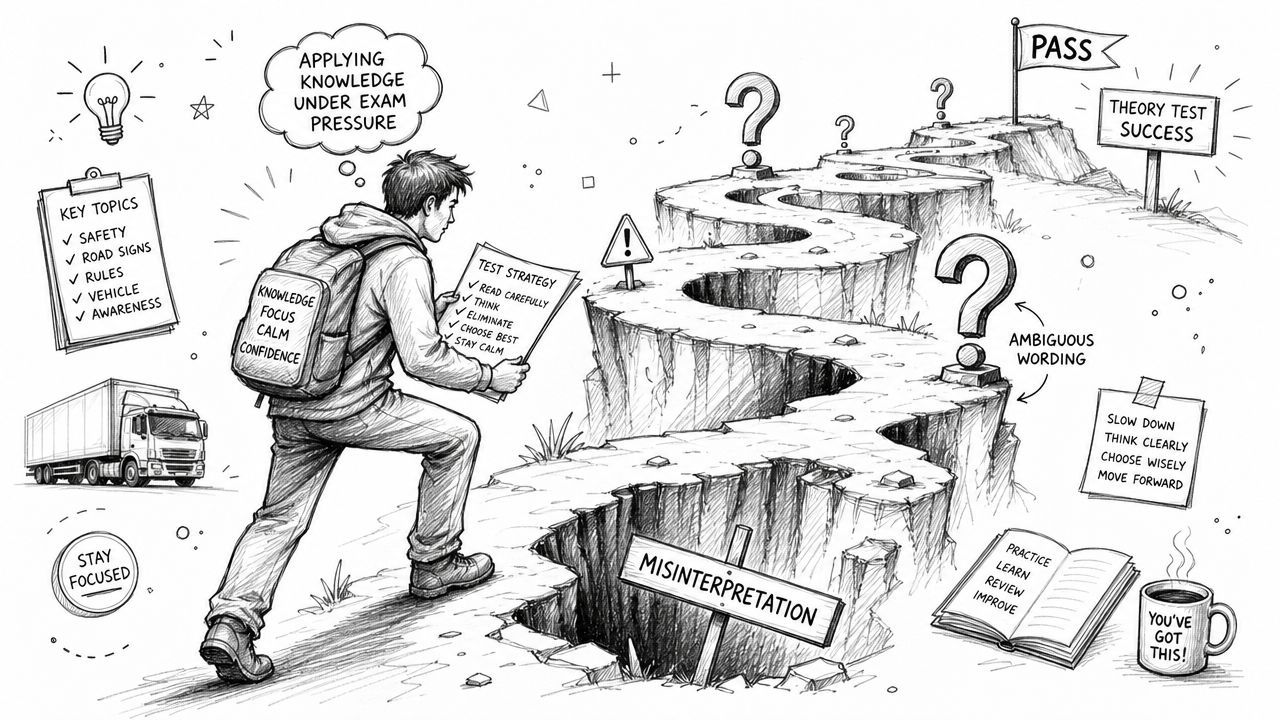
How to handle tricky wording calmly
When a question seems awkward, strip it down.
Find what the question is asking.
Ignore any extra wording that doesn’t change the decision.
Rule out the clearly unsafe or clearly unrealistic answers.
Choose the answer that fits both safety and professional responsibility.
That method works well for topics like loading, coupling, uncoupling, and operational checks, where the wrong options often sound possible but fall apart if you think about safety in a real yard or on a live road.
One small story from test-day nerves
I’ve seen learners revise well, score strongly in practice, then panic because the first few live questions feel oddly worded. They assume the whole paper will be like that and start second-guessing everything.
The fix is simple. Slow down early. Build rhythm from the first page. You don’t need to prove anything in the opening minutes.
Read the whole question. Then read the answers. Then choose.
That sounds basic, but it prevents a lot of unnecessary errors. Most dropped marks come from haste, not lack of ability.
From Theory Pass to Practical Licence with HGV Learning
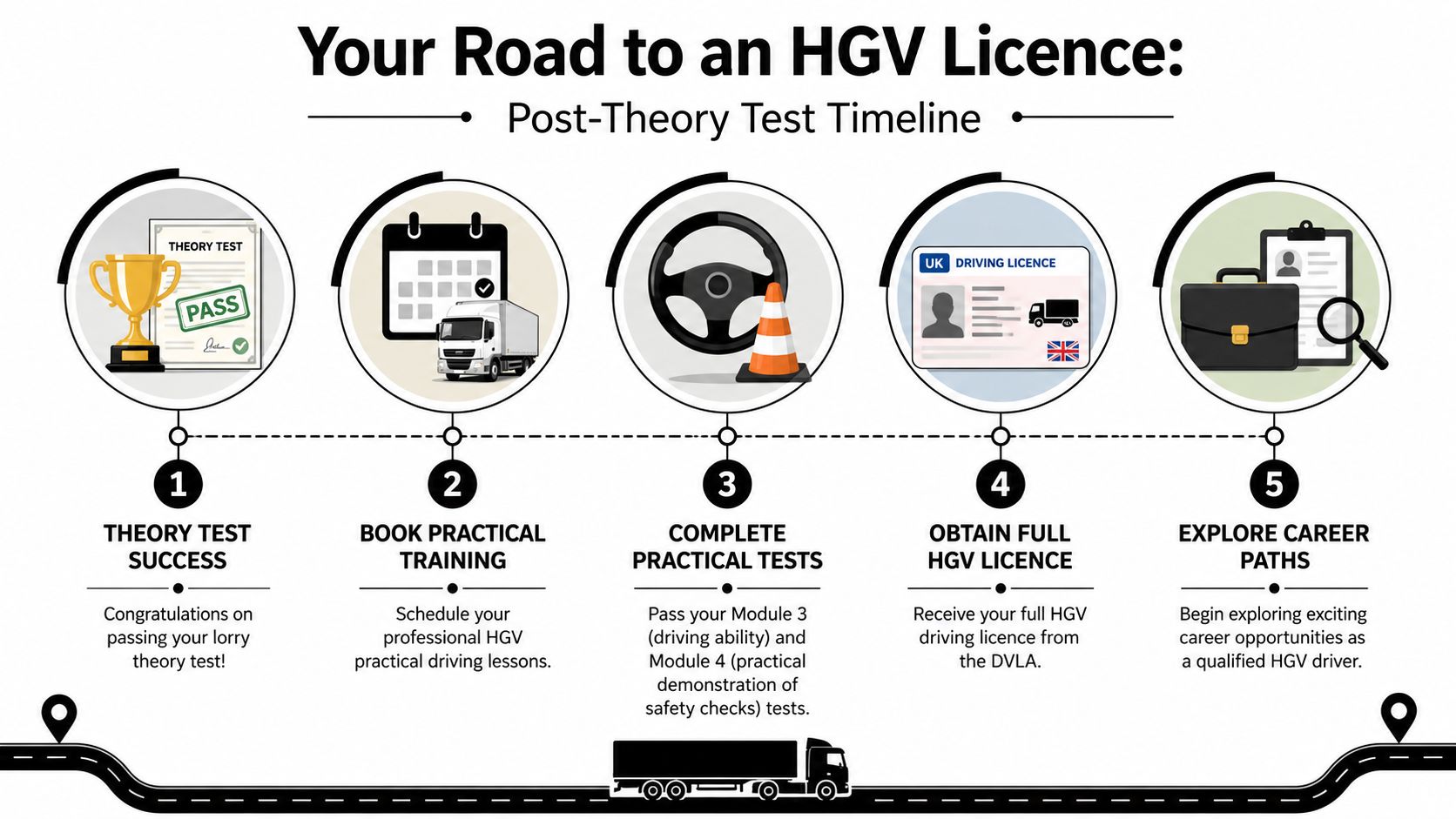
Passing the theory test is a big moment, but it isn’t the finish line. It’s the point where your training stops being mainly screen-based and starts becoming practical, local, and career-focused.
That’s why it helps to think in stages rather than isolated tasks. The theory pass is stage one. It proves you can meet the knowledge standard needed before moving into practical vehicle training.
The three-stage pathway in real terms
A sensible HGV route works best when it’s joined up.
Stage one
Documentation, medical steps, and theory preparation.
Stage two
Practical driver training with qualified instructors.
Stage three
Final testing, licence progression, and support towards work.
A common challenge is that many learners lose momentum after the theory pass. They’re pleased with the result, then hit a new problem. Where do they train? Which local centre has space? What gets booked next? Who keeps the process moving?
Why support matters after the pass
The practical stage asks for different strengths. You’re applying road knowledge in a live vehicle, dealing with positioning, mirrors, turning space, reversing, safety routines, and test standards under observation.
That’s a big shift. Learners usually do better when someone coordinates the next steps clearly, books training sensibly, and lines up test dates without leaving long gaps between milestones.
Passing your lorry theory test online should open the next door smoothly. It shouldn’t leave you stuck piecing the route together on your own.
Keep the momentum going
The best candidates don’t pause too long after a pass. They carry that confidence forward while the knowledge is still fresh and let the practical training build on it.
If you’ve reached this point, you’ve already done something important. You’ve shown that you’re willing to work to a professional standard. That’s exactly the mindset that carries people through practical training and into paid driving work.
If you want a clear route from paperwork to theory to practical training, HGV Learning helps coordinate the whole process. Their three-stage pathway covers the admin and medical side, supported theory preparation, and locally arranged practical training, so you can move from first enquiry to full licence with less confusion and better support.
What Age Can You Start HGV Driver Training? A 2026 UK Guide to Licence Age Requirements
If you're asking what age you can start HGV driver training, the honest answer depends on which licence you're after. A C1 licence, covering vehicles...