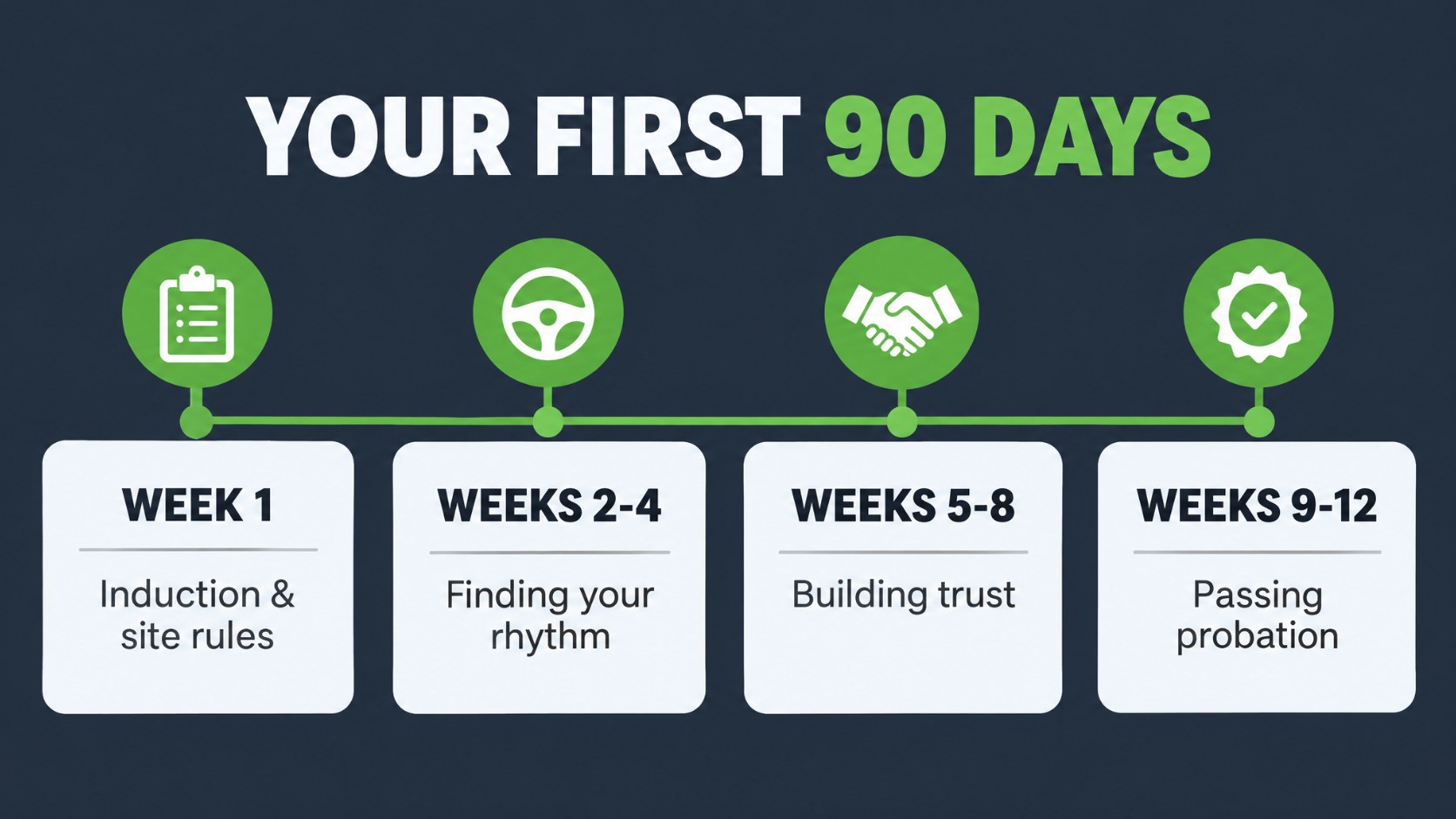
Passing your driving test and landing an HGV job feels like the finish line. It isn’t. For most new drivers, the real test starts the Monday after you’re hired, and it runs for roughly the next three months. Get through that probation period well and you’ve got a solid career ahead of you. Get it wrong, through nothing more dramatic than a late start, a knocked wing mirror or a tachograph mix-up, and you’re back job-hunting with a gap on your CV to explain.
This guide covers what actually happens during a new HGV driver’s probation period in the UK, what rights you have while it’s running, what trips people up most often, and the practical habits that get you through it and into a settled, long-term driving job.
Why Your First Few Months Behind the Wheel Matter So Much
The UK still has a real shortage of qualified HGV drivers. Driver Qualification Card holder numbers have fallen sharply in recent years, and operators up and down the country are short of staff to cover the work they already have. On paper, that should make this the easiest time in a decade to walk into a driving job and stay in it.
In practice, plenty of newly qualified drivers still don’t make it through their first few months. The reasons are rarely about driving ability. A 2020 UK industry survey of serving drivers found poor pay, poor working hours and a lack of respect for the role were the three most commonly cited frustrations, and the same research found most younger drivers wanted to progress in the job but relatively few felt their employer was actually set up to help them do it. Mismatched expectations on both sides, not a lack of skill behind the wheel, are what quietly end a lot of first jobs early.
Passing your test proves you can drive the vehicle. Passing probation proves you can be trusted to run it properly without someone watching your every move.
You’ve already cleared the hardest barrier
If you’re newly qualified and you’ve actually been offered a job, you’ve got past something that blocks a lot of people before they even start: new-driver insurance. Commercial insurers have historically treated anyone within two years of qualifying as a much higher risk, and trade reporting has put the proportion of HGV vacancies effectively closed off to newly qualified drivers by that two-year rule as high as 87%. If an operator has taken you on anyway, they’ve made a real investment in you. That’s a reason to take the next three months seriously, not a reason to relax.
What “Probation” Actually Means for an HGV Driver
Probation periods aren’t a legal requirement in the UK. Acas is clear that employers don’t have to use one at all, and where they do, there’s no set length; it can run anywhere from a few weeks to the better part of a year, though most driving jobs sit somewhere in the three-to-six-month range. During that time you’re usually on closer supervision, your manager reviews your performance more formally, and either side can generally end things with less notice than once you’re confirmed in post.
What catches a lot of new drivers out is assuming probation means reduced rights. It doesn’t. Acas is explicit that “day one” employment rights apply throughout a probation period, whatever your contract says about review dates.
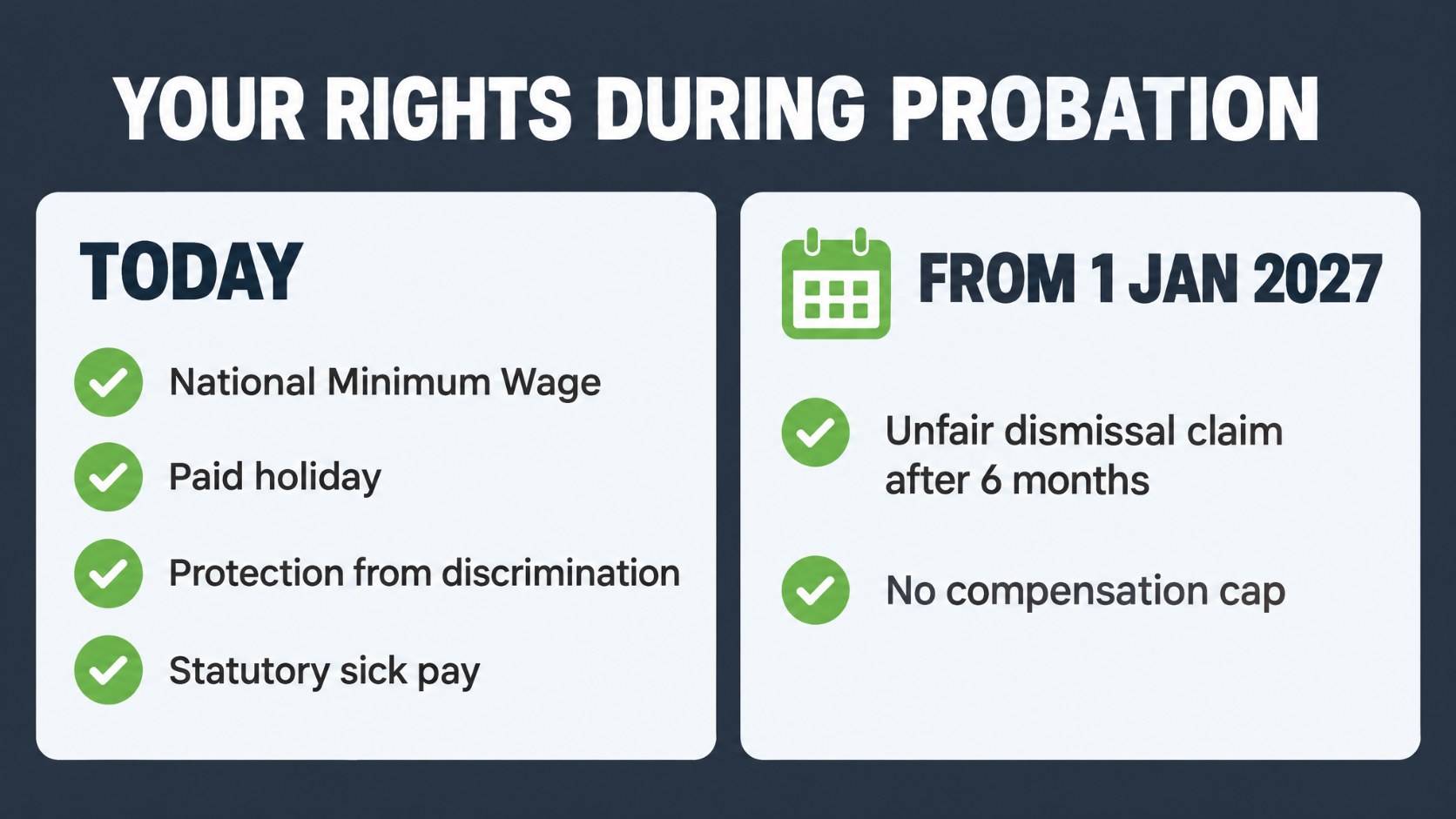
Rights you keep from your very first shift
The National Minimum Wage or National Living Wage for your age, paid correctly and on time.
Paid statutory holiday, building up from your very first day of work.
Protection from unlawful discrimination on the grounds of age, sex, race, disability and the other protected characteristics.
Statutory sick pay, if you meet the normal earnings and notification conditions.
Whistleblowing protection if you raise a genuine safety concern, and the right to join a trade union.
Workplace pension auto-enrolment can be delayed by an employer for up to three months from your start date, which is the one area where probation genuinely changes the timing of something you’re entitled to. Everything else above applies from day one, full stop.
The law is changing: what the Employment Rights Act 2025 means for new drivers
The biggest shift in UK employment law for a generation is already on the statute book and will matter directly to anyone starting a driving job over the next year. The Employment Rights Act 2025 became law on 18 December 2025, and from 1 January 2027 it cuts the qualifying period for claiming unfair dismissal from two years of service down to six months. The cap on unfair dismissal compensation is being scrapped from the same date. Neither change has taken effect yet, so for now the two-year qualifying period still applies, but it’s worth knowing it’s coming, since it will directly affect job security for anyone hired into this industry from here on.
Protection
Position right now
From 1 January 2027
National Minimum Wage, holiday pay, sick pay
Apply from day one
Unchanged
Protection from discrimination
Applies from day one
Unchanged
Right to claim unfair dismissal
After 2 years’ service
After 6 months’ service
Cap on unfair dismissal compensation
Capped award
Cap removed
Workplace pension enrolment
Can be delayed up to 3 months
Unchanged
Acas also notes that anyone who already has six months’ service on 1 January 2027 will be protected under the new rules from that date, so the practical effect lands sooner than the headline date suggests for anyone hired well before it.
Your First Week: Induction, Site Rules and Getting Your Bearings
Health and Safety Executive guidance on workplace transport is blunt about what a proper induction should cover before a new driver is left to get on with the job unsupervised: the site’s layout and traffic routes, who is actually authorised to drive where, how to report faults, hazards, accidents and near misses, the company’s policy on drugs and alcohol, and where to find PPE and first-aid equipment. If your new employer rushes through this in twenty minutes on day one, that’s worth noticing, and it’s fair to ask follow-up questions rather than nodding along and hoping it becomes clear later.
Questions worth asking in your first induction
Who do I actually contact, and how, if I break down or have an accident out on the road?
What’s the process for reporting a vehicle defect, and who signs it off?
Where are the yard’s one-way systems, pedestrian routes and reversing restrictions?
What’s the company policy on using a phone, even hands-free, while driving or in the yard?
Who is my first point of contact if something about the job isn’t matching what I was told at interview?
Employers also have a legal duty to give adequate training whenever a worker is exposed to new or increased risks, not just a one-off session in week one. That training should be tailored to your actual experience on that type of vehicle and that type of work, covering things like the risks of driving too fast for conditions, turning too sharply with a loaded trailer, or working on unsuitable or sloped ground. If a genuine new risk comes up later in your probation, such as a new route, a new trailer type or a new yard, you’re entitled to proper briefing on it, not just a verbal heads-up in passing.
Building the Habits That Actually Keep You Employed
Nobody fails probation because they can’t steer a lorry. They fail it because of small, repeated lapses in the basics that a transport manager notices within the first fortnight. DVSA guidance for vocational drivers is clear that conduct matters both on duty and off it, and that something as small as a single reported offence can put your entitlement to drive for a living at real risk.
The drivers who struggle in their first month are almost never the weakest behind the wheel. They’re the ones who skip the small, boring, repeatable habits that build trust.
Daily walkaround checks, every single time
A proper daily walkaround check isn’t a box-ticking formality. It’s your first and most visible signal to a new employer that you take the job seriously, and it’s a legal requirement, not an optional extra. Skipping it, or rushing it so obviously that a supervisor notices, is one of the fastest ways to lose an employer’s confidence in your first few weeks. Our guide to vehicle defect reporting covers exactly what a thorough check and a proper defect report should look like.
Tachograph and drivers’ hours discipline
Getting your digital tachograph card issued, carrying it every time you drive, and recording your activity correctly is non-negotiable from your very first shift. An infringement in your first month looks a lot worse to a new employer than the same mistake two years into a job, simply because they don’t yet have a track record to weigh it against. If you haven’t applied for your own driver card yet, our driver tachograph card guide walks through the application process. It’s also worth understanding how the Working Time Directive actually applies to HGV drivers, since drivers’ hours and working time rules aren’t quite the same thing and new drivers regularly confuse the two.
Professional conduct, on the road and off it
DVSA guidance says explicitly that your conduct should be appropriate both at work and at other times, because drink-driving, drug-driving, speeding and handheld phone offences in your own car can still cost you your vocational entitlement. Traffic Commissioners can suspend, revoke or disqualify an HGV licence holder for exactly this kind of offence, and operators are required to report any motoring offence a driver picks up in any vehicle, not just the lorry. If you do pick up points or an offence during probation, telling your employer immediately, rather than hoping it goes unnoticed, is almost always the better move. Being upfront with a new employer about a problem is recoverable. Being caught hiding one rarely is.
Common Reasons New Drivers Don’t Make It Past Probation
None of these are about driving skill. They’re about reliability and communication, and every one of them is avoidable.
Timekeeping. Persistent lateness, even by ten or fifteen minutes, is one of the fastest ways to lose a new employer’s confidence, because it directly affects whether a load leaves on time.
Vehicle damage left unreported. A minor knock reported immediately is a non-event. The same knock discovered later during an inspection, with no report on file, looks like an attempt to hide it.
Tachograph and drivers’ hours infringements. Even small, genuine mistakes stack up fast if they keep recurring, and they’re easy for a transport office to spot on a download.
Poor communication with the transport office. Not calling in about a delay, a breakdown or a delivery problem until it’s already become someone else’s emergency.
Attitude with customers or site staff. You’re the visible, physical representative of the business at every drop, and a rude or dismissive interaction gets reported back far more often than a polite one gets praised.
Failed or refused drug and alcohol testing. Most operators now run random testing programmes, and a failure here almost always ends a probation period immediately, regardless of how good the driving has been.
What to Do If It’s Not Going Well
If you sense your probation is wobbling, don’t wait for a formal meeting to find out why. Ask your manager directly for honest feedback and specific examples, not a vague reassurance that things are “fine.” A fair employer should be following a proper process before any decision to extend or end a probation period: clear expectations set from the start, a genuine opportunity to improve, and a conversation before any final decision rather than a surprise letter. If that process isn’t happening, it’s reasonable to ask, in writing, what specifically needs to change and by when.
A probation review should never be the first time you hear there’s a problem. If it is, that’s on your employer as much as on you.
It’s also worth being honest with yourself about fit. Multi-drop, trunking and long-haul work suit very different temperaments and home-life patterns, and a driver who’s struggling in one type of role often thrives in another. Our guide to the different types of HGV driving jobs is worth reading early, ideally before you accept an offer, rather than three months into a job that was never going to suit how you want to live.
Setting Yourself Up for the Long Term
Getting through probation isn’t the end goal, just the gateway to it. Once you’re confirmed in post, the smart move is to start thinking about where the job can take you rather than just coasting in it.
The driver who treats their first job as a launchpad, not a destination, is almost always the one who ends up with the better rates, the better routes and the better choices five years on.
Keep your paperwork and renewals in order
Your Driver CPC needs 35 hours of periodic training every five years to stay valid, and a lapsed qualification card is entirely avoidable admin that still catches out experienced drivers, let alone new ones. Our Driver CPC card renewal guide sets out exactly when to start that process so it never becomes a problem.
Think about where you want to go next
Once you’re settled, it’s worth deciding whether you want to stay with a direct employer, try agency work for variety and flexibility, or eventually go self-employed as an owner-driver. We’ve covered the trade-offs between agency driving and direct employment and what’s actually involved in going self-employed as an owner-driver in separate guides, both worth reading once your first job is secure rather than while you’re still finding your feet. Adding a licence category such as Cat C or C+E, or a specialist qualification like ADR or HIAB, is also far easier to arrange once you’ve got a confirmed, settled job behind you rather than while you’re still job-hunting.
If you do decide to move on from your first job once you’re through probation, do it properly: give the notice your contract requires, and don’t burn the bridge. Transport is a smaller industry than it looks from the outside, and a good reference from your first employer carries real weight with the next one. Our guide to building a strong HGV CV and working with recruitment agencies is worth a read whenever you’re ready to make that next move, and our recruitment advice service can help with it directly when the time comes.
Frequently Asked Questions
How long is probation for a new HGV driver?
There’s no legal minimum or maximum. Acas confirms employers can set probation at any length they choose, and most UK driving jobs run it somewhere between three and six months. Your contract or offer letter should state the exact length and any review points along the way.
Can I be dismissed during probation without notice?
You’re still entitled to at least your statutory minimum notice, or the notice stated in your contract if it’s longer, even during probation. What changes is how easily an employer can end your employment, since the right to claim unfair dismissal currently only kicks in after two years’ service. That drops to six months from 1 January 2027 under the Employment Rights Act 2025.
Do I get full pay and holiday while I’m on probation?
Yes. National Minimum Wage or National Living Wage, statutory holiday pay and statutory sick pay all apply from your very first shift, regardless of probation status. The only thing an employer can delay is auto-enrolment into a workplace pension, and only for up to three months.
What happens if I pick up penalty points during my probation?
Tell your employer straight away. DVSA guidance warns that a single reported motoring offence, in any vehicle, can put your vocational entitlement at risk, and Traffic Commissioners can suspend or revoke an HGV licence holder’s entitlement over it. Being upfront gives your employer the chance to support you through it; staying quiet and getting found out rarely ends well.
Will the Employment Rights Act 2025 change my probation?
Not immediately. The Act became law on 18 December 2025, but the change that matters most to new drivers, a shorter six-month qualifying period for unfair dismissal claims instead of two years, only takes effect from 1 January 2027. Until then, the existing two-year rule still applies.
What if my employer doesn’t give me a proper induction?
Ask for one. Employers have a legal duty to give adequate health and safety training, including route layout, fault reporting, site hazards and what to do in an emergency, before leaving a new driver to get on with the job unsupervised. If that hasn’t happened, raising it isn’t awkward, it’s reasonable, and a decent employer will want to know.
Do agency drivers go through probation too?
It varies. Some agencies and host employers run an informal trial period on each new placement, while others treat every booking as its own assignment with no formal probation at all. Ask your agency directly what applies before you start, since the answer affects how much job security you actually have in those first few weeks.
What should I do if I don’t think I’ll pass probation?
Ask for specific, honest feedback as early as possible, not just at a final review meeting. A fair employer should set clear expectations, give you a genuine chance to improve, and talk to you before making any final decision. If none of that is happening, it’s worth raising directly, and it’s also worth being honest with yourself about whether the role or the type of driving actually suits you.
How can I make the best impression in my first week?
Turn up early, do a thorough walkaround check every single time, report anything unusual immediately rather than hoping it goes unnoticed, and ask questions rather than guessing. Most transport managers judge a new driver on reliability and honesty long before they judge them on driving polish.
Related Articles
24/11/2026
Agency Driving vs Direct Employment: Which Is Right for HGV Drivers in 2026?
If you've passed your Cat C or C+E test, or you're already qualified and thinking about your next move, you'll hit this question fast. Do...
C1 on a driving licence means you can drive medium-sized vehicles weighing between 3,500kg and 7,500kg, such as 7.5 tonne lorries, horseboxes and larger motorhomes....