You’re parked in the yard before first light. It’s cold, you’ve got a route to start, and during the walkaround you spot a bulge in a tyre sidewall. That moment matters more than most drivers realise. If you wave it through, you’re gambling with your licence, your operator’s compliance, and everyone sharing the road with you.
That’s why good vehicle defect reporting isn’t paperwork for its own sake. It’s the chain that starts with what you see on the walkaround, moves through a proper driver defect report, and, in the right cases, ends with a formal safety notification outside your own firm. Many drivers are taught the first part. Far fewer are shown where the internal process ends and the serious safety defect process begins.
Why Flawless Defect Reporting Is Non-Negotiable
The tyre bulge example is a useful test. A professional driver doesn’t ask, “Can I get away with this for one shift?” The right question is, “Is this vehicle roadworthy, and who needs to know right now?”
That mindset protects people. In 2021, defective and poorly-maintained vehicles were a contributing factor in 1,759 UK road casualties. Worn and underinflated tyres were the most common specific defect linked to fatalities, causing 12 deaths according to UK casualty reporting on vehicle defects. For HGV work, that should end any idea that a defect note is admin fluff.
What the first five minutes should look like
When a driver finds something serious at the start of shift, the sequence should be calm and disciplined:
Stop the vehicle from going out: If the defect affects safety, the vehicle stays put.
Make the defect specific: “Offside steer tyre sidewall bulge” beats “tyre issue”.
Tell the right person fast: Usually the transport office, workshop controller, or duty manager.
Create a written record: Paper defect book or digital app. Either is fine if the detail is clear.
Decide if this is more than an internal maintenance matter: Some faults point to a wider design or construction problem, not just wear and tear.
Practical rule: If your report wouldn’t let a fitter find the fault without ringing you back, it’s too vague.
Firms that get this right don’t rely on memory or good intentions. They train drivers on repeatable habits and refresh those habits often. If you’re reviewing how training sticks after induction, these strategies for compliance retention are worth a look because they focus on recall, repetition, and real-world application rather than one-off sign-offs.
What works and what fails
What works is simple. Drivers follow the same inspection order every day, write defects in plain language, and never assume someone else will “sort it later”.
What fails is just as predictable. Rushed checks, vague wording, verbal-only reporting, and a culture where drivers feel pressure to keep the wheels turning. That’s how small defects stay in service until they become prohibitions, collisions, or questions from a Traffic Commissioner.
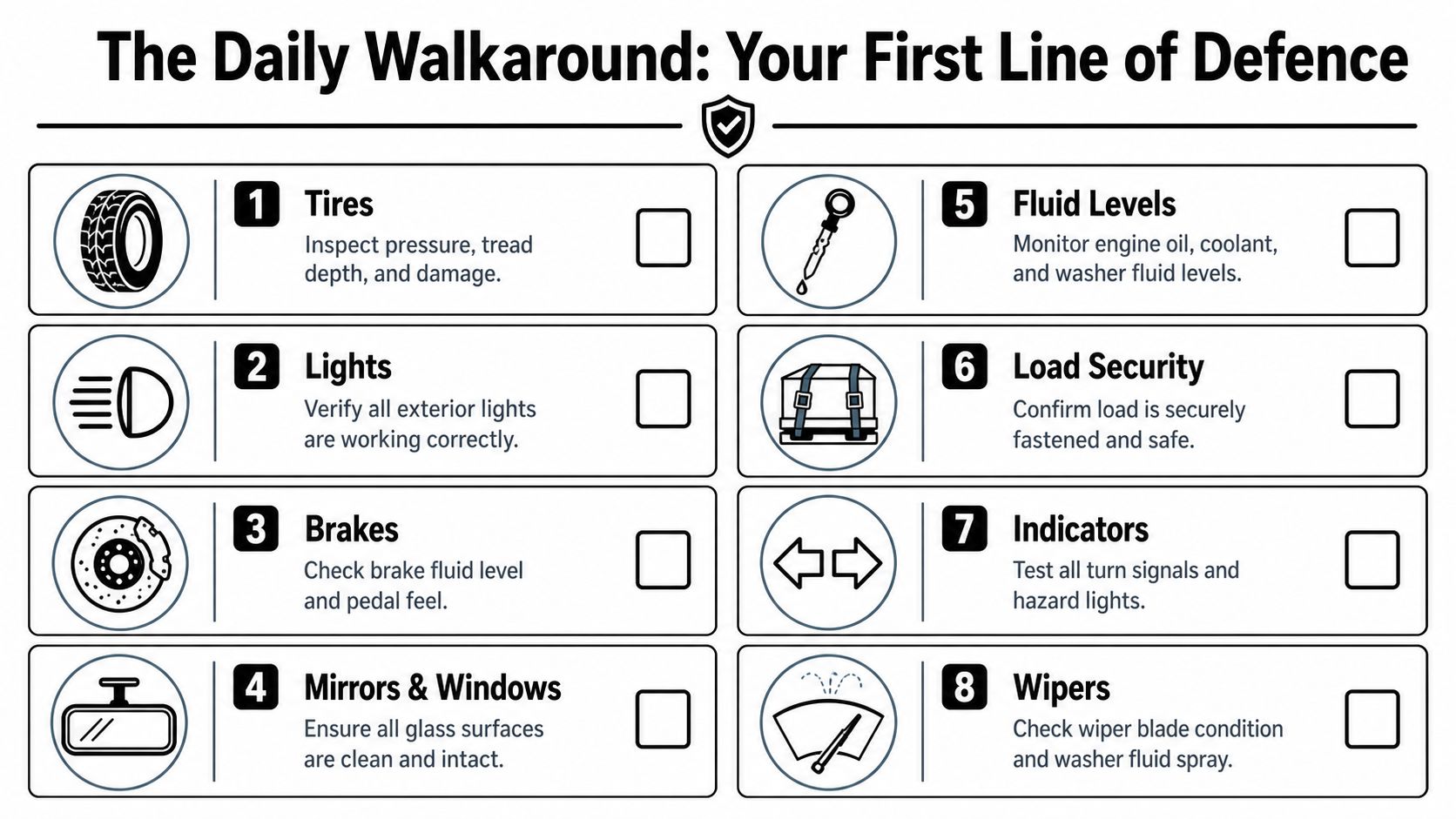
The Daily Walkaround Your First Line of Defence
A walkaround isn’t a lap of the vehicle. It’s a method. The best drivers do it in the same order every time because routine stops blind spots.
The biggest mistake I see in training is drivers checking for presence rather than condition. Yes, the tyre is there. Yes, the lamp comes on. That isn’t enough. You’re checking whether each item is safe, secure, and fit for service.
Build a defect-spotting routine
Pick a start point and don’t vary it. Many drivers begin at the driver’s door and move clockwise. Others start at the front offside corner. The exact route matters less than consistency.
Look low, then high, then underneath where safe to do so. Listen as well as look. Air leaks, rattles, and unusual movement often tell you more than a quick glance ever will.
A strong walkaround should cover:
Tyres and wheels: Check inflation by sight, tread condition, cuts, bulges, exposed cords, trapped objects, and wheel security.
Lights and lenses: Look for operation, damage, dirt, and the correct function for indicators, brake lights, and markers.
Brakes and air system: Listen for leaks, check lines and couplings, and pay attention to warning signs in cab checks.
Steering and suspension: Watch for visible damage, loose components, leaks, or anything sitting unevenly.
Mirrors, glass, and visibility aids: Clean, secure, not cracked, and properly positioned.
Bodywork and trailer condition: Look for insecure panels, doors, curtains, tail-lift issues, or sharp damage.
Load security: Straps, bars, curtains, locks, seals, and weight distribution all need to make sense before departure.
Know what a defect may be telling you
A defect is rarely just the obvious symptom. Uneven tyre wear can point to alignment or suspension trouble. A repeated bulb failure can point to wiring or water ingress. A lazy brake response may be more than adjustment. It may be an air issue that needs immediate attention.
Good drivers don’t just find faults. They recognise patterns.
That matters because the gap between routine checks and formal reporting is where many fleets come unstuck. While 94% of HGV drivers perform daily checks, audit data suggests only 12% of defects found escalate to the necessary formal DVSA notifications, often because drivers and operators are unclear on the reporting threshold, as noted in RHA maintenance guidance on roadworthiness.
Paper form or app
The tool doesn’t matter as much as the quality of the inspection. Paper defect books still work if they’re used properly. Digital systems are useful when they force completion of key fields, allow photos, and create a clean audit trail. For operators comparing formats, these digital vehicle inspection checklists show how structured templates can reduce missed details.
If you want a practical reference for what should be included in a proper HGV check, the HGV inspection manual guide is a solid operational checklist.
Completing Your Driver Defect Report Correctly
Finding the defect is only half the job. If the report is poor, the workshop loses time, the transport office may misjudge the risk, and you’ve weakened your own protection if questions come later.
A proper defect report should let another competent person understand what was found, where it was found, how serious it appears, and whether the vehicle was taken out of service.
Nil defect and active defect reports
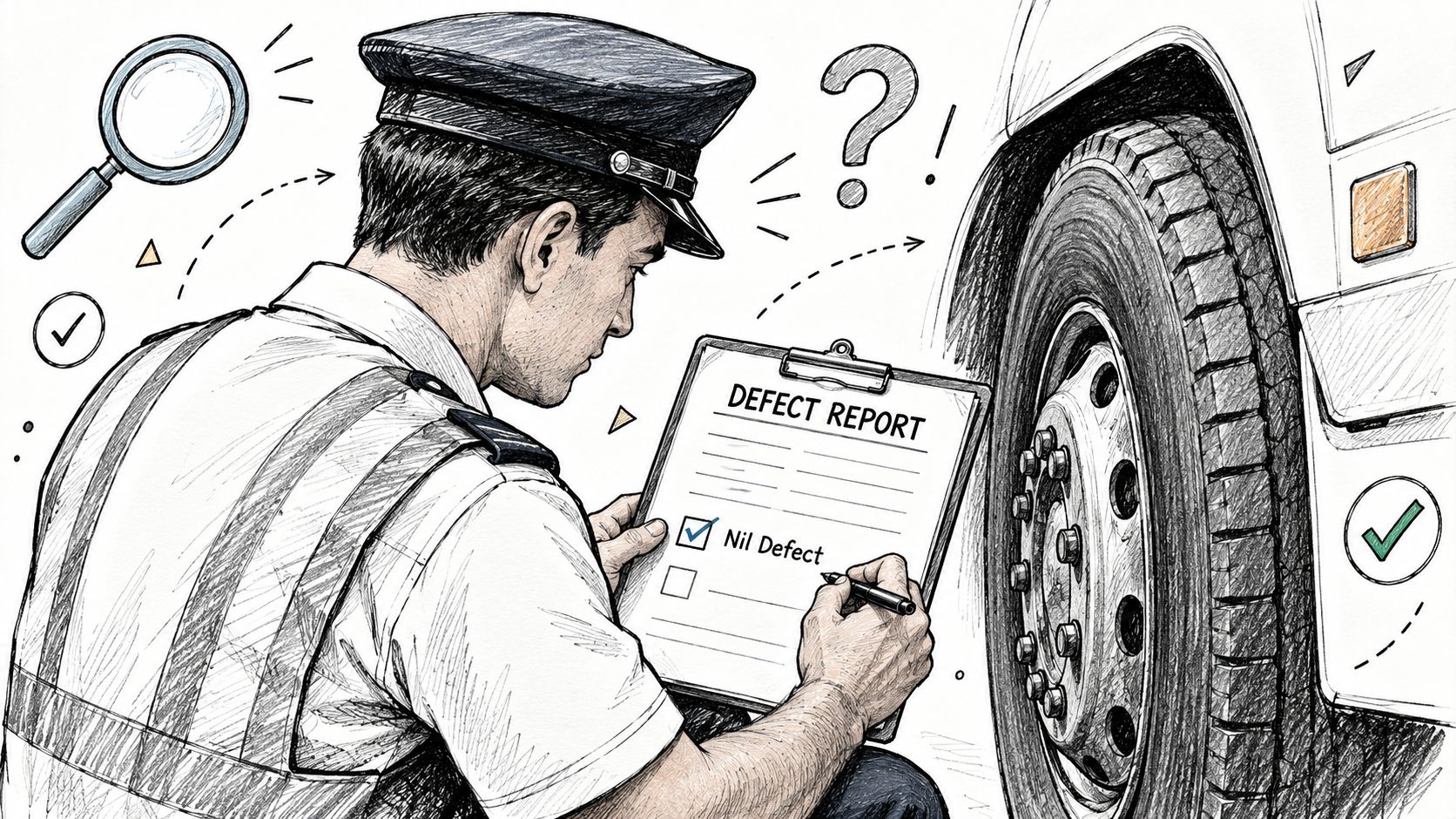
A nil defect report records that you carried out the inspection and found nothing requiring action. That matters. It shows the check happened.
An active defect report records a fault. That report needs enough detail for repair, follow-up, and, if needed, later scrutiny by enforcement or management.
Here’s the difference in practice:
Report style
Poor entry
Better entry
Light defect
Light broken
Nearside rear indicator not operating
Tyre defect
Bad tyre
Offside steer tyre has sidewall bulge
Brake issue
Brakes weak
Audible air leak near trailer suzie area during brake application
Body damage
Door damaged
Rear trailer door catch loose and not securing correctly
What every report should include
Whether you use paper or an app, these details should be clear:
Vehicle identity: Registration and, where relevant, trailer number.
Date and time: When the check was done and when the fault was found.
Driver details: Name or ID so the report is accountable.
Repair outcome: Completed by whom, when, and whether the vehicle was rechecked before use.
Write for action, not for appearance
The best reports use short, factual wording. Avoid guesses unless you’re qualified to make them and can support them. “Possible” can be useful, but only after you’ve described the actual symptom.
For example:
Vehicle checked before shift. Nearside front position lamp not working. Lens intact. Defect reported to transport office. Vehicle awaiting assessment.
That’s clear. It states what was seen, avoids drama, and shows the reporting chain started.
Common reporting errors
Some reports fail because the wording is too broad. Others fail because the driver leaves out the action taken. A defect note that says “brake issue” with no location and no explanation creates more confusion than protection.
Watch for these weak habits:
Using workshop slang: Write so anyone in the chain can understand it.
Relying on verbal follow-up only: If it isn’t recorded, it’s difficult to prove.
Leaving the seriousness unclear: If you took the vehicle off the road, say so.
Forgetting the trailer: Many defects sit on the trailer side and get described too loosely.
A clean, accurate report protects the driver as much as the vehicle. It shows you saw the issue, understood your duty, and passed on the information properly.
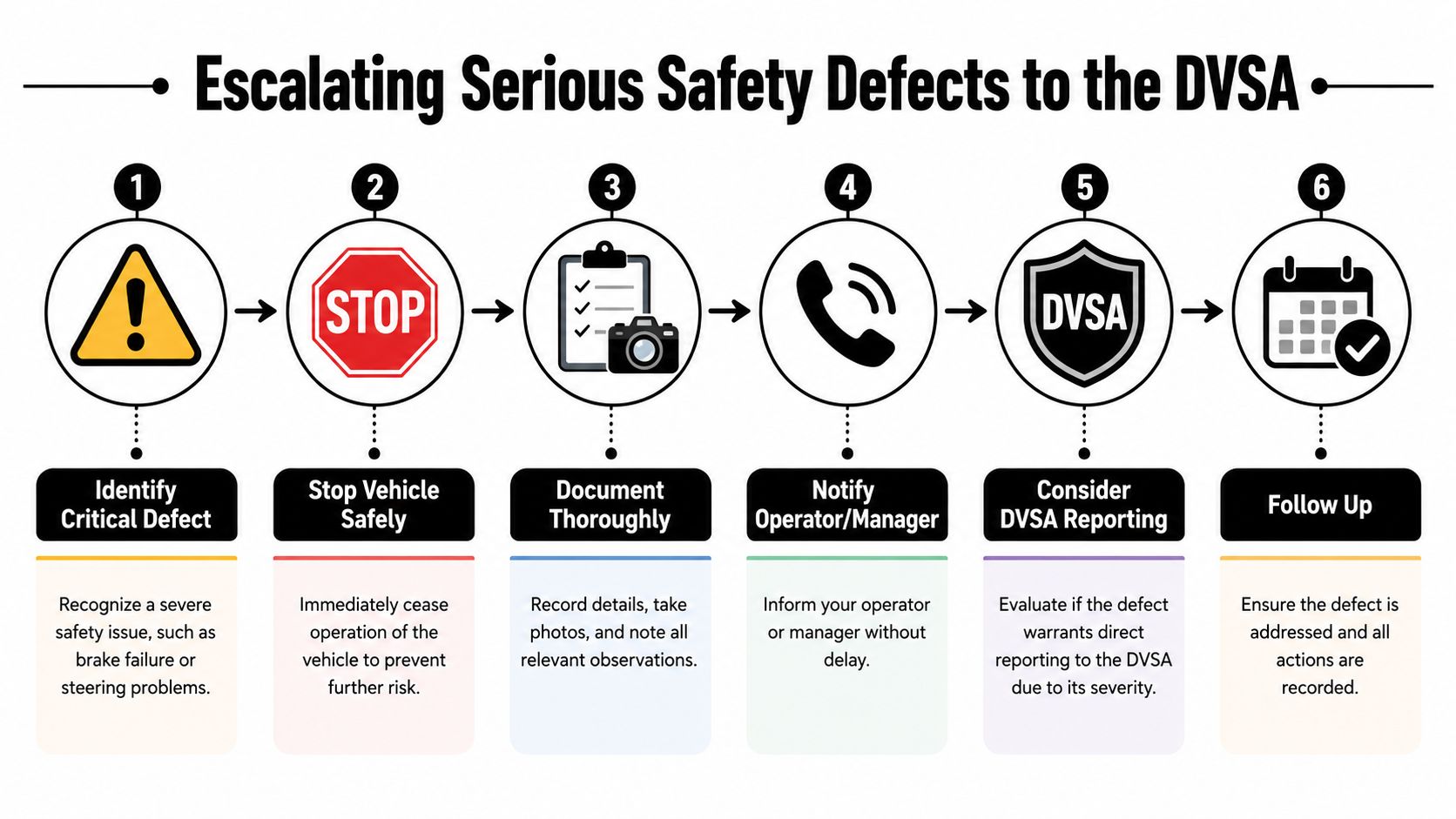
Escalating Serious Safety Defects to the DVSA
Most defects stay inside the operator’s maintenance system. That’s normal. A worn wiper blade, a failed bulb, or damage from ordinary wear and tear usually needs repair, not a national safety process.
The line changes when the issue looks like a serious safety defect rather than routine deterioration. Under the DVSA code, the key question is whether there may be a failure due to design or construction that is likely to affect safe operation without prior warning and creates a significant risk to the driver, occupants, or others. That’s a very different category from normal service wear.
When a routine issue becomes a serious safety matter
Ask these questions:
Is this fault likely to affect safe operation?
Could it happen with little or no warning?
Does it look like more than normal maintenance or misuse?
Could the same fault exist in other vehicles of the same make or model?
If the answer starts moving toward yes, think beyond the workshop job card.
A recurring steering component failure across similar units is one example. A structural mount failing unusually early may be another. A brake component that fractures in service without obvious neglect should ring alarm bells. Those are the cases where formal external reporting may be needed.
The reporting route that drivers and operators should know
The formal route is not guesswork. The reporting process requires the reporter to give technical data such as registration, make, model, and mileage to the manufacturer, who must investigate. If the manufacturer fails to act, the case must be escalated to the DVSA for analysis and potential intervention, as set out in the official GOV.UK process for reporting a serious safety defect.
That means the practical workflow is:
First, make the vehicle safe: Don’t continue operating a vehicle with a fault that may be safety-critical.
Second, gather the facts: Registration, make, model, year, mileage, engine type, gearbox type, and clear photos are all useful.
Third, report to the manufacturer: The producer must investigate whether the defect meets the safety threshold.
Fourth, keep your operator informed: Internal reporting still matters. External reporting doesn’t replace it.
Fifth, escalate to DVSA if needed: If the manufacturer’s response is absent or unsatisfactory, the defect can be taken to DVSA.
If you think a defect may harm more than one vehicle, don’t bury it inside a workshop booking.
What strong evidence looks like
Good serious defect reports are technical and specific. They don’t say “truck unsafe”. They say what failed, under what conditions, what warning existed, and what the consequence could have been if ignored.
Useful evidence includes:
Photographs: Clear, well-lit images of the failed part and surrounding area.
Operating context: Loaded or unladen, motorway or yard, braking, turning, coupling, tail-lift use.
Service history context: Whether the vehicle was maintained on schedule, if known.
Repeat occurrence information: If similar fleet units have shown the same defect, that’s relevant.
Don’t confuse operator defects with manufacturer defects
This is where many people go wrong. A neglected vehicle can be dangerous, but neglect alone doesn’t automatically make it a reportable manufacturer safety defect. Likewise, a well-maintained vehicle can still reveal a serious design or production issue.
The practical trade-off is simple. If it’s ordinary wear, accidental damage, or poor maintenance, deal with it hard and fast through the operator’s defect and repair process. If it points to a wider inherent safety problem, start gathering the kind of evidence that supports external escalation.
Your Legal Obligations and Keeping Records
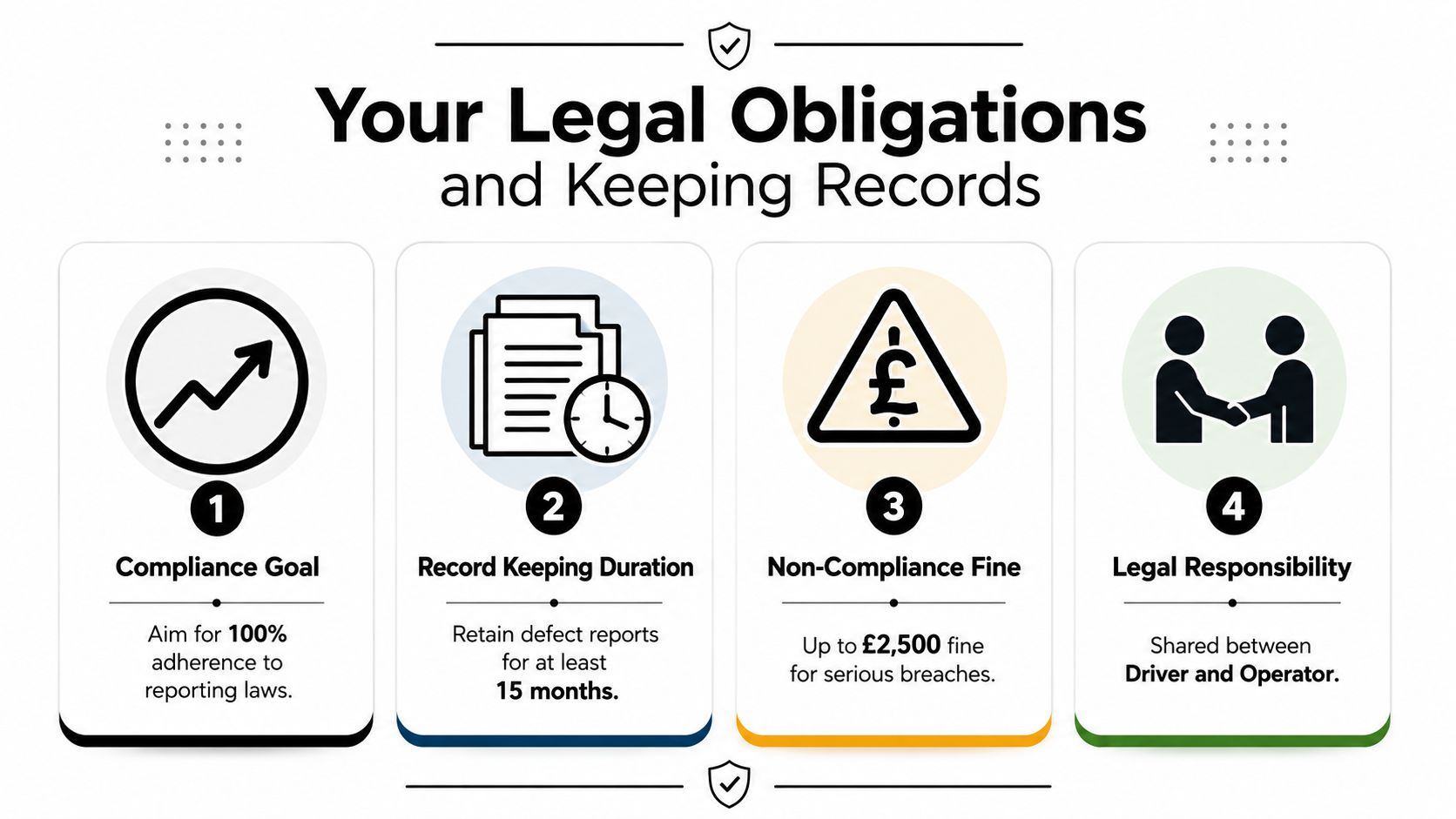
Drivers and operators sit on different parts of the same legal chain. Drivers inspect and report. Operators must make sure the system works, defects are actioned, and records are kept. If either side fails, the whole compliance picture weakens.
The law doesn’t reward informal systems. It rewards traceability. A clear record shows what was found, when it was found, who saw it, what was done, and whether the vehicle returned to service properly.
Who carries which duty
Driver responsibility Carry out the daily check properly, record defects clearly, and report safety issues without delay.
Operator responsibility Provide time, systems, supervision, maintenance control, and a full audit trail from defect report to repair and return to service.
One point is often missed by new drivers. Defect reports, including nil defect reports, need to be retained for 15 months. That record-keeping duty matters because it proves the check-and-repair system exists in practice, not just on paper. For a broader view of the paperwork drivers and operators need to keep in order, this guide to documentation requirements is useful background.
Why the legal timelines matter
Once a serious safety issue moves into the manufacturer and enforcement space, the timetable tightens. If a manufacturer knows a product poses a serious risk, it must notify enforcement authorities no later than three days after the information is obtained. For less severe risks, the deadline is 10 calendar days, as explained in UK guidance on product safety notification deadlines.
That tells you two things.
First, the law expects urgency where risk is high. Second, the sooner the original report is clear and complete, the easier it is for the right people to assess the danger and act.
Records that actually help
A good defect record system should answer five practical questions:
Question
What the record should show
Was the check done?
Driver name, vehicle ID, date, time
What was found?
Clear defect description and location
Was the vehicle used?
Stand-down decision or controlled use decision
What repair happened?
Action taken, fitter or workshop sign-off
Was it closed properly?
Reinspection or release confirmation
Poor operators keep fragments. Good operators keep a chain.
The strongest compliance systems are boring. Same process, same fields, same follow-up, every day.
That consistency protects everyone. If enforcement asks questions, if a vehicle is stopped at the roadside, or if a collision is investigated, the record is often what tells the full story.
Making Defect Reporting Second Nature
The safest fleets don’t treat vehicle defect reporting as a separate task. They build it into the day so tightly that drivers move from walkaround, to report, to repair follow-up without hesitation.
That rhythm matters because each stage supports the next. A sharp walkaround finds the issue. A precise report gets the right action. A proper escalation, when the defect points beyond ordinary maintenance, helps remove wider risks from the road network.
There’s also a bigger system working behind the scenes. The DVSA requires manufacturers to report their recall response rates quarterly, detailing the number of vehicles affected versus the number reworked. This tracks how effectively defective vehicles are being dealt with across the UK, as set out in the DVSA manufacturers guide to recalls. Your report can become the first useful signal in that chain.
Drivers who want to sharpen this habit should keep building the same skill that underpins every good walkaround: recognising risk early. This hazard identification resource is a practical extension of that mindset.
Professional driving isn’t just about moving a load from A to B. It’s about judgement. When you report defects properly, you protect your own licence, your operator’s standing, and the public who never get to choose whether they meet your vehicle on the road.
If you’re ready to build that standard from day one, HGV Learning helps new and experienced drivers develop the practical habits, compliance knowledge, and licence pathway needed for safe, professional HGV work across the UK.
What Age Can You Start HGV Driver Training? A 2026 UK Guide to Licence Age Requirements
If you're asking what age you can start HGV driver training, the honest answer depends on which licence you're after. A C1 licence, covering vehicles...