If you’re weighing up HGV training, you’ve probably hit the same question most learners do: go for Cat C first, or train straight for C+E? Until a few years ago the choice was made for you. Now it isn’t, and that changes the maths.
This guide walks through what Cat C and C+E actually cover, what changed with the DVSA’s 2021 reforms, the real pay gap between the two using the latest industry figures, and the practical factors that should decide which route you take. We train both routes at HGV Learning, so this is the same advice we give learners who call us undecided.
What’s the Difference Between Cat C and C+E?
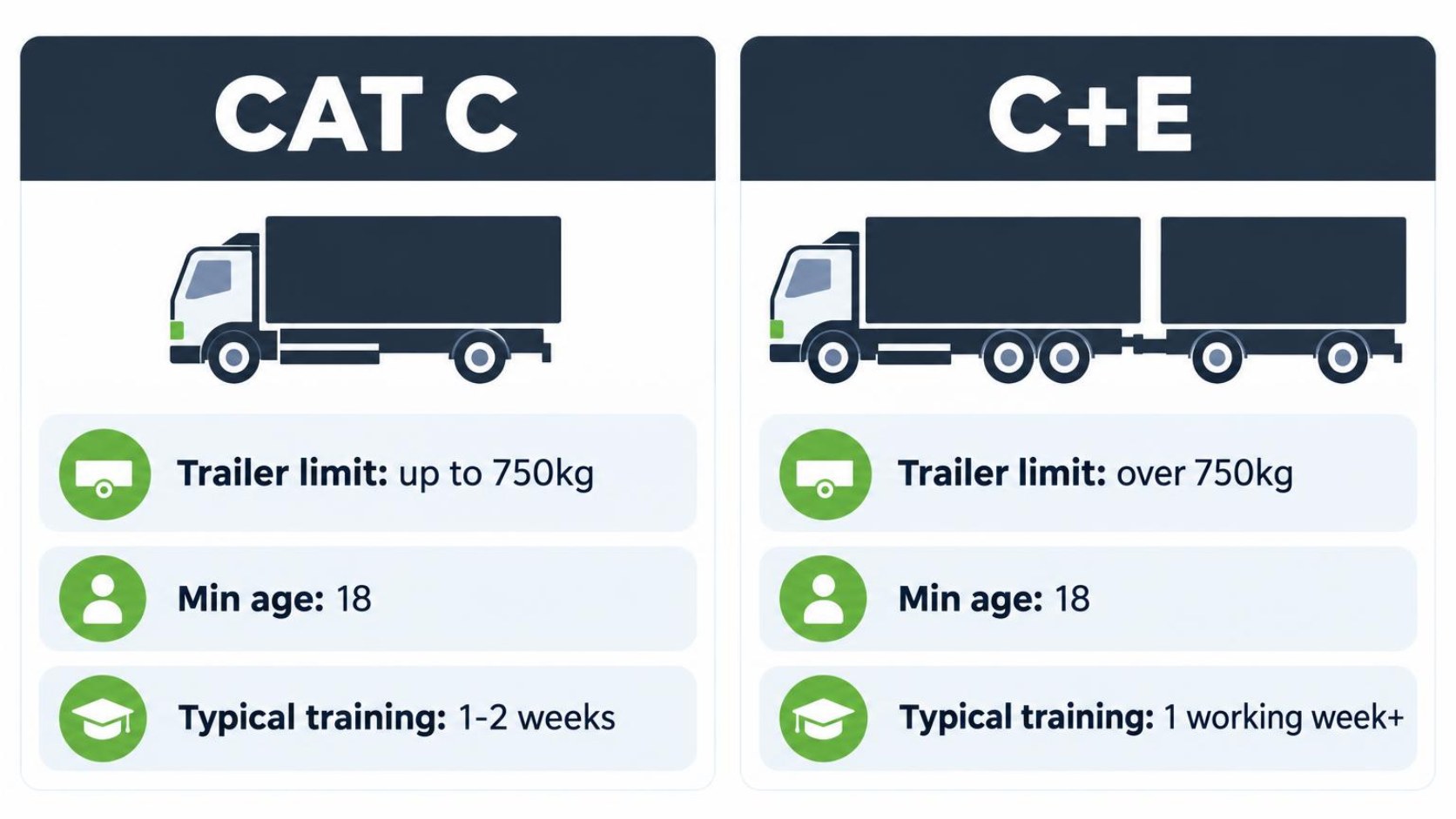
Both categories let you drive a lorry over 3,500kg. The difference is what you’re allowed to tow behind it, and that single detail changes your training, your job options and your pay. GOV.UK’s official licence category breakdown sets out the exact weight and trailer thresholds if you want the regulatory detail.
Feature
Cat C
C+E
Also known as
Class 2
Class 1
Vehicle type
Rigid lorry, no separate trailer unit
Articulated lorry or rigid plus drawbar trailer
Trailer limit
Up to 750kg
Over 750kg, no upper limit
Minimum age
18 (with Driver CPC)
18 (with Driver CPC)
Typical training length
A few weeks, depending on starting point
Around a working week of practical tuition, plus theory and medical
Common roles
Construction, waste and recycling, retail distribution, local delivery
Long-distance haulage, international freight, tramping work
What Cat C (Class 2) Covers
Cat C covers rigid lorries over 3,500kg, up to around 32 tonnes, with a trailer no heavier than 750kg. Think bin lorries, concrete mixers, box vans and most local delivery trucks. It’s the entry point most new drivers reach for first, and it opens up a wide spread of local and regional jobs without the commitment of articulated driving.
Our Cat C licence course covers the full route from provisional entitlement through to your practical test. If you’ve only got a car licence so far, our C1 licence course is worth a look as a smaller first step too.
What C+E (Class 1) Covers
C+E adds a trailer over 750kg to a category C vehicle. In practice that means articulated lorries (artics) and drawbar combinations, the vehicles you see running long-distance trunk routes and international freight.
It’s the licence behind most of the best-paid driving jobs in the industry, but it also demands more from you behind the wheel, particularly reversing and manoeuvring a loaded trailer. Full details are on our C+E licence course page.
You No Longer Have to Pass Cat C First
This is the part a lot of people researching HGV training still don’t know. Before November 2021, DVSA rules meant you had to hold a full Category C licence before you could even apply for provisional C+E entitlement. Every Class 1 driver in the UK went through Cat C first, whether they needed to or not.
That staged requirement was dropped as part of a wider DVSA shake-up of lorry and bus testing. A car licence holder can now apply for provisional C and provisional C+E entitlement at the same time, and choose which test to sit first. Pass the C+E practical test directly, and you’re automatically granted C, C1 and C1+E entitlement alongside it.
You can now go straight for Class 1 from a car licence. Whether you should is a different question, and the answer depends on your budget, your timeline and your nerves behind the wheel.
In other words, the “right” route isn’t fixed by DVSA rules any more. It’s a genuine choice, and like most genuine choices, it comes down to trade-offs rather than one objectively correct answer.
The Real Pay Difference Between Cat C and C+E Drivers
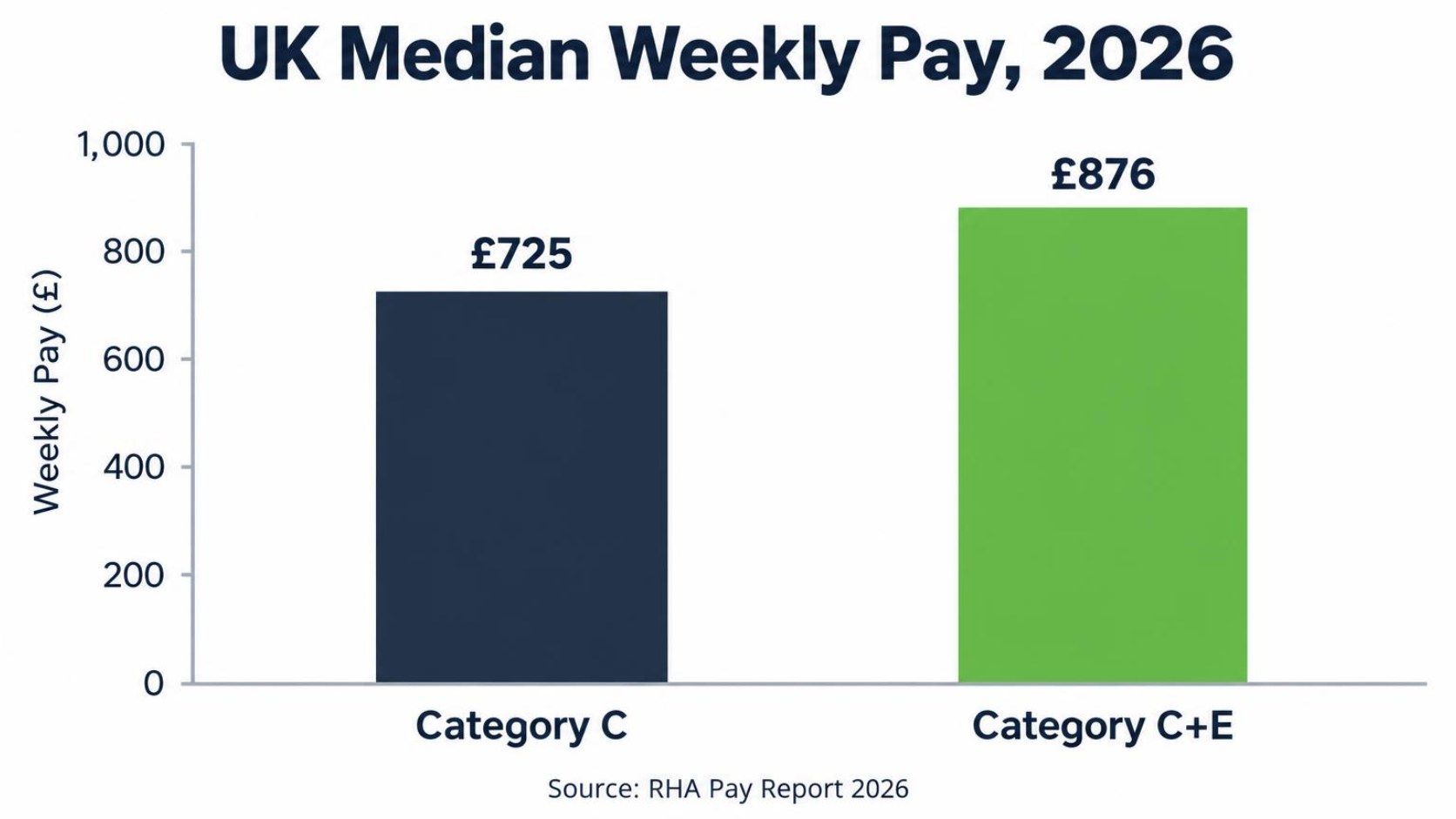
Pay is usually the deciding factor, so it’s worth looking at actual current figures rather than guesswork. The Road Haulage Association’s Pay Report 2026 gives a detailed national breakdown of driver earnings by category.
Measure
Cat C (LGV rigid)
C+E (LGV artic)
Median hourly rate
£14.50
£15.05
Average hourly rate
£14.78
£15.48
Median weekly pay
£725
£876
Average weekly pay
£741
£883
Average weekly hours
49
55
On median weekly pay, that’s a gap of £151 a week, or roughly £7,850 a year if the difference held steady. Part of that comes from longer average hours on C+E work, so it isn’t a clean hourly comparison, but even on the hourly figures C+E drivers are earning more.
A £151 weekly gap sounds significant on paper. Whether it’s worth chasing straight away depends on how much extra training and nervous first weeks behind an articulated unit cost you in return.
C+E pay also tends to open up tramping and international work, which carries its own premiums on top of the base figures above, though that comes with time away from home that not every driver wants.
Training Time and Cost: Straight to C+E or Cat C First?
Cost and time are where the two routes genuinely diverge, and where your own circumstances should do most of the deciding. Our Cat C training cost guide breaks down what the first route involves if you want the detail.
Going Straight to C+E
Training directly for C+E from a car licence means one combined course, one set of theory and medical costs, and one practical test campaign rather than two. If you’re confident behind the wheel and know you want long-haul or international work, it’s the more direct and ultimately cheaper path to your end goal.
The trade-off is that you’re learning to reverse and manoeuvre an articulated trailer with no rigid-lorry experience to fall back on. Most training providers, including HGV Learning, build in extra practical hours for learners coming straight from a car licence, which is worth budgeting for.
Cat C First, Then Upgrading Later
Training for Cat C first gets you earning sooner. Courses are typically shorter, the vehicle is more forgiving to learn on, and plenty of employers prefer to hire newly qualified drivers into Cat C roles before trusting them with an articulated unit and someone else’s freight.
The catch is that you’re paying for two rounds of practical training and two test campaigns if you do upgrade to C+E later, which usually costs more in total than training for C+E directly.
It can still be the right call if it gets you into paid work faster, or if you want real road experience before tackling trailer work.
Going straight to C+E suits confident drivers who know they want long-haul or artic work and want to avoid paying for training twice.
Cat C first suits nervous or completely new drivers, those wanting paid experience sooner, and anyone whose first-choice employer only hires Cat C to start.
Either route satisfies the same Driver CPC and medical requirements, so neither one is “faster” on the compliance side.
Upgrading later is always possible; there’s no time limit on moving from Cat C to C+E once you’re qualified.
A Worked Example: Two Learners, Two Routes
It helps to see how this plays out in practice rather than in the abstract, so here are two realistic, hypothetical learners starting from the same point: a full car licence and no lorry experience.
Learner A: Cat C First
Learner A has never driven anything bigger than a car and wants to get into paid driving work as quickly as possible. They train for Cat C, pass within a few weeks, and start in a local delivery role almost immediately.
After six months of rigid-lorry experience, they feel ready to upgrade, book a block of C+E practical training, and move into an articulated role roughly nine months after starting their first course. Along the way they’ve paid for two separate practical courses and two test campaigns, but they were earning throughout most of that period.
Learner B: Straight to C+E
Learner B is confident behind the wheel, has already decided long-haul work is what they want, and trains directly for C+E from their car licence. The course runs longer than a standalone Cat C course and the practical hours are more intensive, since there’s no rigid-lorry experience to draw on.
They pass in one combined campaign, move straight into an articulated role, and start earning C+E-level pay from day one, without the cost of a second round of training later.
Neither learner made a mistake. Learner A traded a longer overall timeline and a second training cost for an earlier paycheque and lower-pressure learning curve. Learner B traded a steeper initial learning curve for a single training cost and immediate access to C+E pay rates. The right choice depends entirely on which trade-off suits your own circumstances.
Which Route Suits You? Five Questions to Ask Yourself
There’s no universally correct answer here, but these five questions tend to settle it for most learners.
Do you already know you want long-distance or international haulage work, or are you still deciding what kind of driving suits you?
How confident are you reversing and manoeuvring a large vehicle, with no prior lorry experience to draw on?
Do you need to start earning as quickly as possible, or can you afford a longer, more thorough training route?
Has a specific local employer told you they only take on Cat C drivers initially, or are you training speculatively?
What’s your total training budget, and have you compared the one-off cost of C+E training against two rounds of training if you go via Cat C?
Most learners already know the answer to question one. If you don’t, that’s usually a sign Cat C first is the safer, lower-pressure route.
What the Driver Shortage Means for Your Choice
The UK’s HGV driver shortage hasn’t gone away, and it’s shaping job availability for both categories. The Road Haulage Association’s November 2025 update put the UK’s annual training need at 60,000 new HGV drivers a year for the next five years, up sharply from its earlier estimate of 40,000.
Around 100,000 drivers let their Driver Qualification Card lapse in the past year alone, roughly one in six of Britain’s working-age lorry drivers. An ageing workforce, cuts to bootcamp training funding, and working conditions such as long hours and poor roadside facilities are all cited as contributing factors.
A shortage this size means demand for both Cat C and C+E drivers, not just one category. Newly qualified drivers in either licence class are starting from a genuinely strong negotiating position right now.
That matters for your decision because it reduces the risk either way. Qualify in Cat C and there’s steady demand for local and regional work; qualify in C+E and the long-haul shortage means routes and premiums for drivers willing to tramp or travel further afield.
What You’ll Need Either Way: Medical, Theory and Driver CPC
Whichever route you choose, the groundwork is identical. These requirements don’t change based on which category you train for first, and it’s worth getting them sorted early rather than treating them as an afterthought once you’ve picked a licence category. A good training provider will walk you through all three before booking any practical hours.
The D4 Medical
Every HGV licence application needs a D4 medical examination, checking eyesight, hearing, cardiovascular health and general fitness to drive a large goods vehicle. It’s carried out by a doctor and needs renewing periodically, more frequently once you pass 45.
Theory and Hazard Perception
You’ll need to pass the LGV theory test, covering multiple-choice questions on road safety, vehicle maintenance and commercial driving rules, plus a hazard perception test specific to lorry driving. This sits alongside your Driver CPC case study module before provisional entitlement is added to your licence.
Driver CPC
Anyone driving an HGV professionally needs the full Driver Certificate of Professional Competence, made up of theory, case study, off-road exercises, on-road driving and a practical demonstration. Once qualified, you’ll need 35 hours of periodic CPC training every five years to stay compliant, regardless of whether you hold Cat C, C+E or both.
Letting your qualification card lapse is more common than most drivers expect, so it’s worth reading our Driver CPC card renewal guide before it becomes a problem. Age requirements are covered fully in our guide to HGV licence age requirements, including the routes available to under-18s.
Making the Switch Later: Upgrading From Cat C to C+E
If you start with Cat C and decide to upgrade, the process is straightforward. You’ll apply for provisional C+E entitlement, book a block of articulated practical training, and sit the C+E practical test.
Because you’ll already hold a valid LGV theory pass, you typically won’t need to resit the full theory test, provided your existing pass is still within its validity window.
Most drivers who upgrade do it once they’ve built confidence and road experience in a rigid vehicle, which can make the articulated practical training faster to pick up than it would be from a standing start. It’s a genuinely common path, not a consolation route, and plenty of experienced Class 1 drivers started exactly this way.
Common Mistakes to Avoid When Choosing Your Route
A few avoidable mistakes come up again and again with learners weighing up this decision.
Choosing C+E purely for the headline pay figure without checking whether local C+E jobs and tramping work actually suit your circumstances.
Assuming Cat C is “easier” and skipping proper research into which local employers actually hire newly qualified Cat C drivers.
Not asking a prospective employer which licence category they’re actually recruiting for before committing to a training route, or skipping a proper CV and recruitment agency strategy once you’re qualified.
Forgetting to budget for Driver CPC, medical renewals and periodic training costs, which apply regardless of which category you choose.
Picking a training provider based on price alone, without checking how much practical tuition is actually included for your starting experience level.
Underestimating how physically and mentally demanding the first few weeks of articulated driving can feel, even for confident car drivers, and not building in realistic time to adjust.
Talking to a training provider about your specific situation before you commit is the simplest way to avoid most of these. The right answer depends on your circumstances far more than any generic ranking of “best” licence category.
Frequently Asked Questions
Can I go straight for a C+E licence without getting Cat C first?
Yes. Since the DVSA’s November 2021 reforms, you can apply for provisional C and C+E entitlement at the same time from a car licence and choose which practical test to sit first. Passing C+E directly also grants you C, C1 and C1+E entitlement.
How much more do C+E drivers earn than Cat C drivers?
According to the RHA’s Pay Report 2026, median weekly pay is £876 for C+E (LGV artic) drivers against £725 for Cat C (LGV rigid) drivers, a gap of £151 a week. Average weekly hours are also higher on C+E work, at 55 against 49.
Is it cheaper to train for C+E directly or to go via Cat C?
Training for C+E directly is usually cheaper overall than training for Cat C first and upgrading later, since you avoid paying for two separate practical courses and test campaigns. Going via Cat C first can still make sense if it gets you into paid work sooner.
Do I need to retake my theory test if I upgrade from Cat C to C+E?
If your existing LGV theory test pass is still within its validity window, you typically won’t need to resit it to upgrade from Cat C to C+E. You will still need to complete the practical C+E training and test.
What’s the minimum age for Cat C and C+E licences?
Both categories have a minimum age of 18 for drivers completing the full Driver CPC qualification. Age requirements can differ for certain military or exempted routes, so check your specific circumstances with a training provider.
Do I need a Driver CPC for both Cat C and C+E?
Yes. The Driver CPC requirement is the same regardless of which category or categories you hold, including the 35 hours of periodic training needed every five years to stay qualified.
Which licence is better for a complete beginner with no driving experience beyond a car?
Many training providers recommend Cat C first for complete beginners, since the vehicle is more forgiving to learn on and it builds confidence before tackling an articulated trailer. Confident learners who already know they want long-haul work often go straight to C+E instead.
Can I still get a job as a Cat C driver given the current driver shortage?
Yes. The RHA’s November 2025 figures put the UK’s annual HGV driver training need at 60,000 a year, covering both Cat C and C+E roles, so demand remains strong for newly qualified drivers in either category.
Can I upgrade from Cat C to C+E at any point, or is there a time limit?
There’s no time limit on upgrading from Cat C to C+E. Many drivers wait months or even years, building road experience first, before booking C+E practical training when it suits them.
Whichever route makes sense for you, getting the groundwork right from the start, a current medical, a genuine theory pass and the right training provider, matters more than the category you pick first. Our recruitment advice and training calculator can help you plan the next step either way.
Related Articles
30/10/2026
Returning to HGV Driving After a Break: A 2026 UK Guide to Getting Back in the Cab
If you used to drive an HGV and stepped away for a few years, whether that was for a different job, family reasons, health, or...