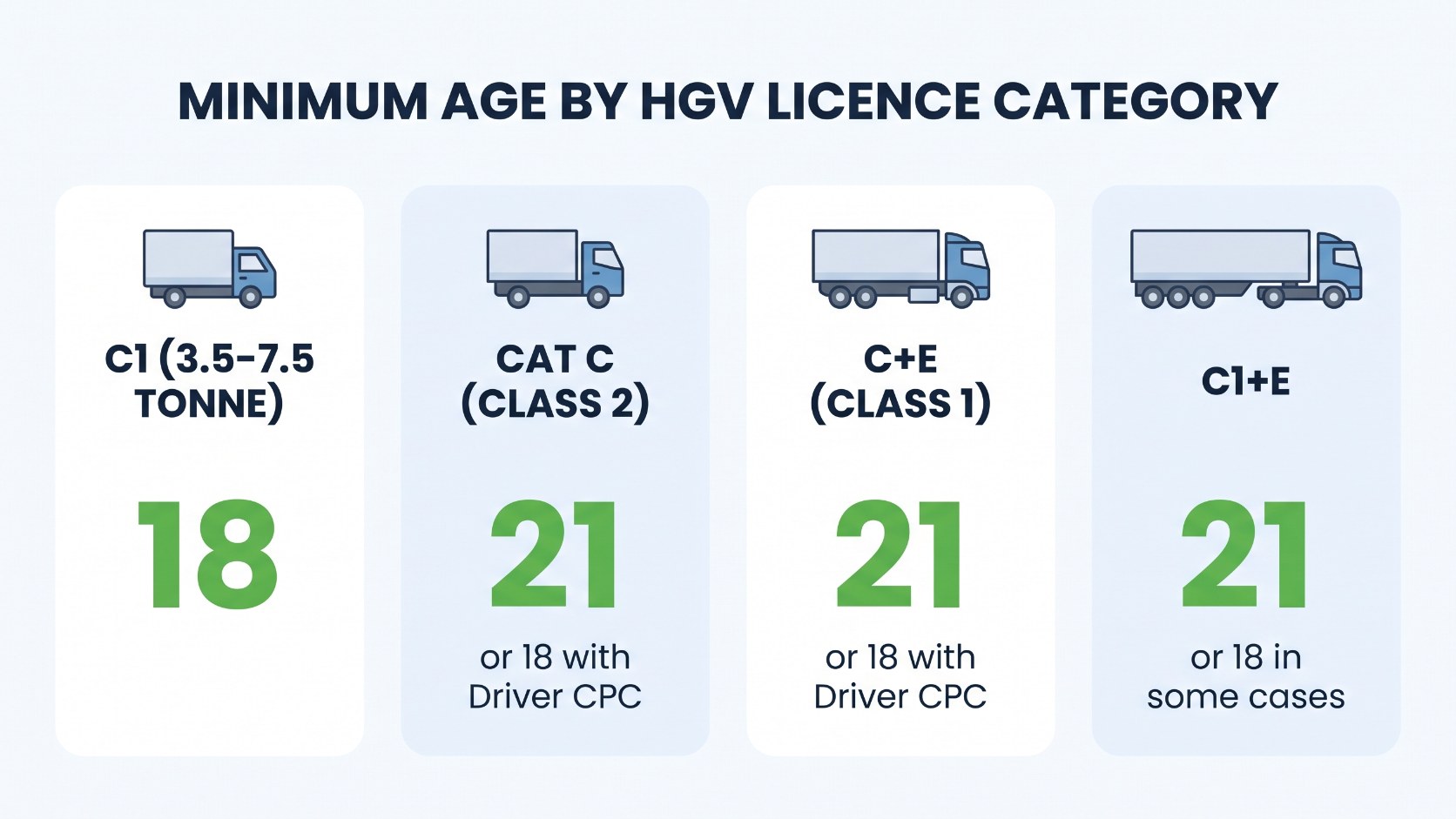
If you’re asking what age you can start HGV driver training, the honest answer depends on which licence you’re after. A C1 licence, covering vehicles from 3,500kg to 7,500kg, only needs you to be 18. Cat C and C+E normally need you to be 21, though there’s a genuine, legal route that lets you start both at 18 too.
This guide sets out the real minimum age for every HGV licence category, the Driver CPC route that gets some drivers behind the wheel of a 44-tonne artic three years earlier than most people assume, what happens to your licence once you pass 45, and the one part of this picture that catches a lot of newly qualified 18-year-olds out: actually getting hired afterwards.
Minimum age by HGV licence category, at a glance
Four HGV licence categories exist in the UK, and each one has its own minimum age. The table below gives you the headline figures. The sections after it explain the exceptions, because for Cat C and C+E, the exceptions matter more than the number on its own.
Licence category
What it covers
Standard minimum age
Minimum age with Driver CPC
C1
3,500kg to 7,500kg, trailer up to 750kg
18
18 (no reduction needed)
C1+E
C1 vehicles with a trailer over 750kg, combined weight up to 12,000kg
21
18, if combined weight is under 7,500kg, or while training for the Driver CPC initial qualification
C (Cat C / Class 2)
Over 3,500kg, trailer up to 750kg
21
18, while training for or holding the Driver CPC initial qualification
C+E (Class 1)
Over 3,500kg with a trailer over 750kg
21
18, while training for or holding the Driver CPC initial qualification
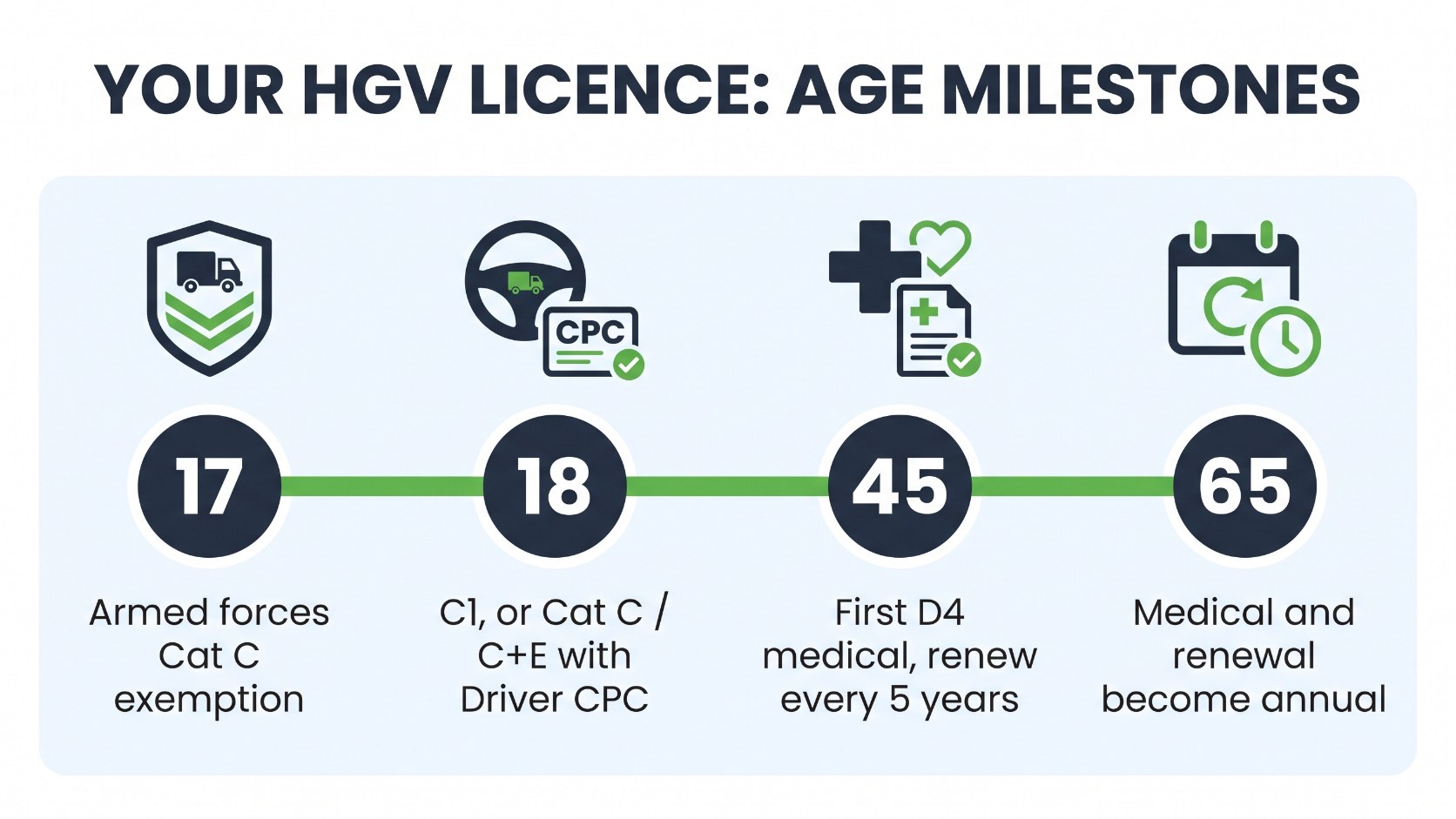
Members of the armed forces are a further exception: they can drive Cat C vehicles from 17, under the same rules that set the civilian minimum age at 21. This is confirmed in the official government guidance on driving licence categories and the related age-exemption notes.
C1 (3.5 to 7.5 tonne): straightforward, no exceptions needed
C1 is the only HGV category with a flat, exception-free minimum age of 18. There’s no Driver CPC shortcut to learn here, because there’s nothing to shortcut. This also makes C1 a common entry point for 18 and 19-year-olds who want to start driving professionally as soon as they legally can.
If you’re not sure whether C1 is the right first step or whether to go straight for a bigger licence, our C1 licence training page sets out exactly what the course covers and what you can drive once you pass.
Cat C (Class 2): rigid vehicles over 7.5 tonne
Cat C, still often called Class 2, covers any rigid vehicle over 3,500kg. The standard minimum age is 21. It drops to 18 if you’re learning to drive, taking your test, or working towards the Driver CPC initial qualification alongside your Cat C test, or if you’ve already passed both.
The headline age for Cat C and C+E is 21. The real age, for anyone willing to complete the Driver CPC initial qualification alongside their driving test, is 18.
Full details of the course itself, what it costs, and how long it takes are on our Cat C licence training page, and our dedicated Cat C licence cost guide breaks the fees down further.
C+E (Class 1): articulated and drawbar combinations
C+E, the old Class 1, covers anything over 3,500kg towing a trailer heavier than 750kg, including full articulated lorries. The standard minimum age is 21, with the same 18-year-old Driver CPC route available as for Cat C.
C1+E sits between C1 and C: it covers C1-sized vehicles towing a trailer heavier than 750kg, with a combined weight limit of 12,000kg. The standard minimum age is 21, but it drops to 18 either while you’re training for the Driver CPC initial qualification, or automatically if the combined vehicle and trailer weight comes in under 7,500kg.
The Driver CPC route: how to actually start Cat C or C+E at 18
The Driver Certificate of Professional Competence, or Driver CPC, is a mandatory qualification for anyone who drives professionally in the UK, separate from your driving licence itself. There are two versions that matter for age: the initial qualification, which you complete once, and periodic training, 35 hours every 5 years, which keeps you compliant for the rest of your career.
It’s the initial qualification that gets you the lower age limit. Under the rules that set this out, you can drive Cat C or C+E from 18, rather than 21, in any of these situations:
You’re learning to drive, or taking your driving test, for Cat C or C+E
You’re taking the Driver CPC initial qualification tests for that category
You’ve already passed both your driving test and the Driver CPC initial qualification
You’re on an approved National Vocational Training course working towards the Driver CPC initial qualification
The National Vocational Training route is worth knowing about specifically. Official guidance on how to become a qualified lorry or bus driver confirms that drivers on an approved course can work professionally for up to 12 months before completing the practical Driver CPC tests in full. That’s a genuinely useful bridge for an 18-year-old who wants to start earning while finishing their qualification.
This isn’t a loophole or a grey area. It’s a deliberate, legally defined route built into UK driver licensing law specifically so the industry isn’t forced to wait until 21 to train new drivers, at a time when the sector badly needs them.
Is there an upper age limit for driving an HGV?
No. There’s no maximum age in UK law for holding an HGV licence. What changes as you get older isn’t your right to hold the licence, but how often you have to prove, in writing, that you’re medically fit to keep it.
Medical requirements from 45
Once you turn 45, your HGV licence stops renewing automatically and starts requiring a medical. DVLA sends you a D47P renewal form and a D4 medical examination report 56 days before your licence runs out, and a doctor, or in some cases an optician for the vision section, has to complete the D4 before you send it back.
This repeats every 5 years from 45 until you turn 65. According to official DVLA guidance for drivers 45 or over, renewing the licence itself is free. You’ll typically pay the doctor or optician for carrying out the medical.
Medical requirements from 65 onward
From 65, the same D47P and D4 process repeats every year instead of every five. There’s no cut-off written into the rules where you’re no longer allowed to hold the licence. Plenty of drivers carry on well past 65, and some past 70, as long as each annual medical confirms they’re fit to.
Passing your medical at 45 isn’t a box-ticking formality. It’s the point DVLA starts checking, on paper, that you’re still fit to be in sole control of up to 44 tonnes, every five years and then every year.
Age bracket
Renewal frequency
What you need to send
Under 45
Normally runs through to your 45th birthday
D47PU form only
45 to 65
Every 5 years
D47P renewal form plus a completed D4 medical examination report
65 and over
Every year
D47P renewal form plus a completed D4 medical examination report
Age requirements for ADR, HIAB and telescopic handler training
The picture changes again once you move beyond the core driving licence categories. ADR, HIAB and telescopic handler qualifications aren’t DVLA licence categories, so none of them carry a statutory minimum age set in the same law as C1, Cat C and C+E.
For ADR training, official guidance on how to become a dangerous goods driver confirms there’s no minimum time you need to have held a full HGV licence before starting. If carrying dangerous goods is the main part of your job, though, you do need to already be a qualified HGV driver and Driver CPC holder, which in practice means most ADR trainees are 18 or older before they start. Our ADR training cost guide covers the fees and course structure.
Neither HIAB operator training nor telescopic handler training sits under DVLA licensing at all; both are competence-based qualifications governed by industry bodies rather than driving law. That means the minimum age is set by individual training providers rather than by statute. HGV Learning, like the large majority of ALLMI and NPORS-accredited providers, sets its minimum at 18, partly because most trainees are already working towards, or already hold, an HGV driving licence alongside it. Our HIAB training cost guide and telehandler training cost guide cover what each course involves.
You’re legally old enough. So why won’t anyone hire you?
This is the part that genuinely surprises a lot of newly qualified 18-year-olds. Passing your test and Driver CPC initial qualification at 18 gets you a legal licence to drive a 44-tonne artic. It doesn’t automatically get you a job driving one.
The reason is insurance, not law. Reporting on UK fleet cover has found that 87% of live HGV job listings either exclude newly qualified drivers outright or go silent on the point altogether, because most standard fleet and agency negligence policies require at least two years’ licence experience and 180 days driving in-category before they’ll cover a driver. Several insurers also set a minimum driver age of 21 for agency cover specifically, regardless of how long someone has held their licence, which shuts out an 18 or 19-year-old even if they’ve already clocked up real road time.
Turning 18 gets you behind the wheel for your test. It doesn’t automatically get you past the fleet insurer asking for two years’ licence experience before they’ll cover you.
This isn’t a reason to avoid training young. The industry genuinely needs young drivers: figures reported by the Road Haulage Association put the number of qualified drivers who let their Driver Qualification Card lapse at over 117,000 in a single 12-month period, against an estimated ongoing need for around 40,000 new drivers a year just to stand still. It is, however, a reason to plan your first year carefully. Our guide to getting your first HGV job with no experience and our HGV driver CV and recruitment agencies guide both go into exactly how to work around this gap.
Common misconceptions about HGV licence age
“Every HGV licence needs you to be 21.” Not true. C1 only needs you to be 18, with no exceptions required, and Cat C or C+E can both be started at 18 via the Driver CPC route above.
“Once you turn 45, renewing your licence gets harder.” It doesn’t get harder, it gets a medical requirement attached. The process itself is still free and still runs through DVLA in the normal way.
“There’s a maximum age you’re allowed to drive an HGV until.” There isn’t one in UK law. What changes is the frequency of your medical, not your right to hold the licence.
“ADR, HIAB and telehandler training all have the same minimum age as a car licence.” They don’t. Almost every UK provider, HGV Learning included, sets 18 as the floor for these courses, even though none of them are DVLA-regulated licence categories.
“The 18-year-old Driver CPC route is some kind of loophole.” It isn’t. It’s a deliberate, legally defined part of UK driver licensing law, built specifically to let the industry train new drivers three years earlier than the standard age.
Choosing the right course for your age and circumstances
Work out which licence category you actually need for the job you want, rather than assuming bigger is automatically better.
If you’re 18 to 20, check whether you’ll need the Driver CPC initial qualification route for Cat C or C+E, since the standard route only opens up at 21.
Decide whether to start with C1 first to build confidence and experience, or go straight for Cat C or C+E if your target job needs it.
If you’re 45 or over, book your D4 medical early rather than leaving it until your renewal forms arrive, so a hold-up with your GP doesn’t delay your course.
Talk to a training provider about which route, timeline and funding options actually fit your age and circumstances before you commit to a course.
Our training cost calculator is a useful starting point for working out what a realistic budget looks like once you’ve settled on a licence category, and the team is happy to talk it through directly via our contact page.
Training later in life: your 40s, 50s and beyond
Because there’s no upper age limit, a genuine second-career move into HGV driving at 45, 50 or later is entirely realistic. The only practical difference from training at 25 is the D4 medical you’ll need as part of your provisional application, and the fact you’ll be back in front of a doctor again in five years rather than waiting until 65.
In practice, older career changers often have an advantage: more driving experience generally, a settled approach to risk, and a clearer sense of why they want the job. None of that shows up in the age rules themselves, but it’s worth knowing the legal side genuinely isn’t the obstacle people sometimes assume it is.
There’s no age in UK law that stops you training for an HGV licence later in life. The only thing that changes after 45 is how often you prove you’re medically fit to hold it.
What HGV driver training costs, whatever age you start
How HGV Learning can help, whatever age you’re starting
Whether you’re 18 and taking your first step into professional driving, or 50 and changing career entirely, the course structure is the same and the legal age rules apply equally. We run C1, Cat C, C+E, ADR, HIAB and telescopic handler training, and our recruitment advice service is specifically built to help newly qualified drivers, of any age, get past the insurance and experience hurdles that come after you pass.
If you’re not sure which licence or route fits your age and situation, get in touch via our contact page and we’ll talk it through properly rather than pointing you at a generic course list.
Frequently Asked Questions
What’s the minimum age to start HGV driver training in the UK?
It depends on the licence. C1 (3,500kg to 7,500kg) only needs you to be 18. Cat C and C+E normally need you to be 21, but you can start both at 18 if you train for the Driver CPC initial qualification alongside your driving test.
Can I get my Cat C or C+E licence at 18 instead of 21?
Yes. If you’re learning to drive, taking your test, or working towards the Driver CPC initial qualification for Cat C or C+E, including through an approved National Vocational Training course, you can train and drive from 18 rather than waiting until 21.
What is the Driver CPC initial qualification, and why does it matter for age?
It’s a mandatory professional competence qualification, separate from your driving test, that every professional HGV driver needs. Completing it alongside your Cat C or C+E test is what legally allows you to drive those categories from 18 instead of 21.
Is there an upper age limit for driving an HGV?
No. UK law sets no maximum age for holding an HGV licence. What changes as you get older is how often you need a medical to prove you’re still fit to drive, not your right to hold the licence itself.
Do I need a medical to renew my HGV licence, and when does it change?
You need a D4 medical examination report from age 45. Renewal with a medical repeats every 5 years from 45 to 65, then becomes an annual requirement from 65 onward.
What age can you start ADR, HIAB or telescopic handler training?
None of these are DVLA-regulated licence categories, so there’s no statutory minimum age. Most UK providers, HGV Learning included, set a minimum of 18, partly because most trainees are already working towards or holding an HGV driving licence alongside it.
If I qualify at 18, can I actually get hired straight away?
Not always immediately. Many fleet and agency insurance policies require two years’ licence experience, 180 days in-category, and sometimes a minimum driver age of 21, regardless of how early you qualified. Our recruitment advice content covers how to work around this.
Can I train for my HGV licence at 45, 50 or later in life?
Yes, with no legal upper limit. The only practical difference from training younger is that you’ll need a D4 medical as part of your application, and you’ll renew with a medical every 5 years rather than not at all.
Does HGV Learning offer the Driver CPC route for 18-year-olds?
Yes. We train C1, Cat C and C+E, and can talk you through the Driver CPC initial qualification route if you’re 18 to 20 and want to start on Cat C or C+E rather than waiting until you’re 21.
Related Articles
13/10/2026
HGV Driver CV and Recruitment Agencies: A 2026 UK Guide to Getting Hired Faster
Passing your HGV test is only the first step. Turning a new Cat C, C+E or HIAB qualification into an actual wage is where a...