Leaving the forces means leaving behind a career built on discipline, logistics and getting a job done properly. HGV driving is one of the few civilian careers that genuinely rewards all three. It is also one of the most practical routes into stable, well-paid work for someone coming out of service life.
Funded training routes exist specifically for forces leavers, several of them little-known outside resettlement circles. This guide sets out what your time in the military actually gives you towards a civilian HGV licence, and what it does not.
It also covers how to pay for training without draining your resettlement grant. That means the real, current funded routes, from ELCAS to the Career Transition Partnership to charity-run schemes, plus what you can realistically expect to earn once you are qualified.
Nothing about your military driving licence automatically becomes a civilian HGV licence. But the habits that got you through service, discipline, reliability, working under pressure, are exactly what haulage employers say they struggle to find.
Why HGV Driving Suits a Lot of Service Leavers
Haulage runs on the same things the forces run on: routine, responsibility and showing up when you say you will. Employers in this industry talk constantly about driver reliability and professionalism, two things service leavers tend to have in abundance.
The job also suits people who do not want to sit behind a desk. You are out on the road, managing your own day within a clear set of rules, with a defined start and finish to each shift.
For many leaving a structured service environment, that balance of independence and structure is a genuine draw. It is close enough to the rhythm of service life to feel familiar, without anyone standing over you.
That shortage means a genuinely qualified new driver is not short of options. It also means employers are actively competing for exactly the kind of candidate a service leaver tends to be.
What Your Service Actually Gives You Towards a Civilian HGV Licence
This is the part most service leavers get wrong, usually because they have heard a version of events from someone who left years ago. The rules have moved on, and they are more specific than most people assume.
Driving under orders is not the same as holding a civilian licence
Serving personnel can drive category C and C+E vehicles from age 17, rather than the usual 18 or 21, but only while driving under the orders of the armed forces. That entitlement does not carry over to civilian life the moment you leave.
That is a genuine advantage of being in service, not something available after you have left. It is one of the strongest reasons to start this process before your discharge date, not after it.
Military Mechanical Transport permits are not recognised for exchange into a civilian licence. If you held one, you still need a full civilian provisional entitlement and the usual DVSA tests before you can drive commercially as a civilian.
The Driver CPC exemption, and why it is not automatic
Holders of a military driving qualification may be exempt from the initial Driver CPC: the theory test, case studies and two practical modules that every new civilian HGV driver normally has to pass. That can save real time and money if it applies to you.
If the exemption does apply, you still need 35 hours of periodic CPC training every five years, the same as every other professional driver. The exemption shortens the starting line, not the ongoing requirement.
This exemption is not automatic and is not the same for everyone. It depends on which military licences and categories you held and when, so confirm your actual status with the DVSA or your training provider before you plan your training around it.
The DVLA Group 2 medical applies to you too
Every professional HGV driver needs a DVLA Group 2 medical, assessed against a tougher standard than an ordinary car licence. Your forces medical history does not substitute for this. Book it early, since it can take a few weeks to arrange and is a genuine prerequisite, not paperwork you can leave until the last minute.
The honest version: your service can shorten the road to a civilian HGV licence, through a CPC exemption and funded training, but it does not skip the licence itself. Everyone still needs the entitlement, the medical and the test.
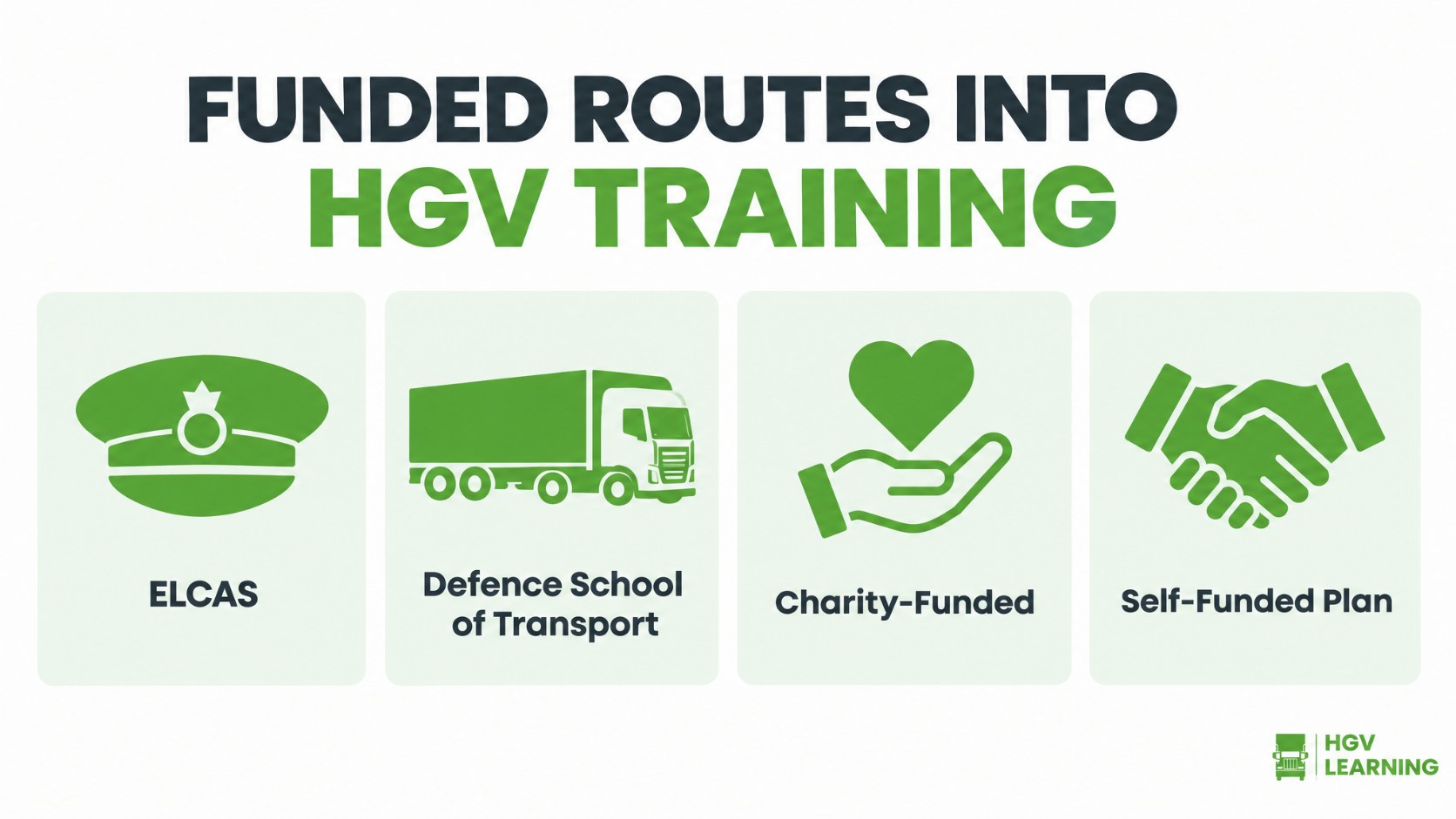
Paying For Your Training: ELCAS and Other Funded Routes
Training for a Cat C or C+E licence from scratch typically runs into several thousand pounds self-funded. Most service leavers do not need to pay that out of pocket, because several funded or part-funded routes exist specifically for this transition.
ELCAS: what it actually covers
The Enhanced Learning Credits Administration Service, ELCAS, is the MOD’s main resettlement funding scheme. You typically need at least six years’ qualifying service since April 2000 to access it, with different rules for some personnel who completed four years before April 2017.
Each claim year is worth £1,000 for six years’ service, or £2,000 for eight or more years, usable across up to three claim years. Courses normally need to be Level 3 or above through an ELC-approved provider, which on paper rules out standard Level 2 HGV training.
In practice, the MOD has previously granted a specific exemption letting ELCs fund Cat C, C+E, Driver CPC and ADR training through the Defence School of Transport, despite it sitting at Level 2. That exemption expanded training places from around 100 to nearly 350 a year when it was introduced, and separate government funding has backed HGV training charities for veterans on top of that.
Treat this as a route worth checking rather than a guaranteed entitlement, since scheme details and provider lists change over time. Confirm current eligibility and the approved-provider list directly through ELCAS before relying on it, or before turning down another funded route in favour of it.
Charity and MOD-funded training places
Veterans into Logistics is a charity that funds HGV driver training specifically for veterans, including early service leavers and those facing underemployment, and links trained drivers directly to logistics employers such as Asda and Muller. It has already trained several hundred veterans this way.
The Road Haulage Association runs its own Road to Logistics programme as part of its Armed Forces Covenant commitments, offering training, support and employer introductions to help service leavers become job-ready, plus a guaranteed interview for RHA roles where your skills match.
If you are self-funding
If none of the funded routes apply to you, or you need to bridge a gap, a straightforward repayment plan is often more realistic than paying training costs upfront. HGV Learning’s own training cost calculator gives you a real monthly figure before you commit to anything, and our FAQs page covers the practical questions most new drivers ask before they book a course.
The Career Transition Partnership: Your Resettlement Support
A Jobs Portal with vacancies from forces-friendly employers, supported by the Forces Employment Charity.
Employment Fairs held several times a year, free to attend, plus regular employer open days and webinars.
Employability workshops covering CVs, interviews and translating military experience into civilian terms.
One-to-one resettlement advice to build a Personal Resettlement Plan around your actual circumstances.
What support you get depends on length of service. Core Resettlement covers those with more than six years in; Employment Support covers four to six years; and Future Horizons covers anyone leaving before four years.
CTP Assist sits outside that scale and is available regardless of service length, for anyone facing significant challenges in their transition. Check your own entitlement with your unit’s resettlement staff rather than assuming which tier applies to you.
Funded Routes Into HGV Training, Compared
Route
Typical cost to you
Who it suits
What’s included
ELCAS
£0–£2,000 shortfall depending on course price and claim value
6+ years’ qualifying service
Funding towards an ELC-approved provider; confirm HGV courses are currently listed
Defence School of Transport / MOD-funded place
£0 if a place is available
Serving personnel in resettlement, subject to places
Cat C, C+E, Driver CPC and ADR training on military-arranged courses
Veterans into Logistics (charity)
£0, grant-funded
Veterans, including early service leavers and those facing underemployment
Fully funded HGV training plus direct introductions to logistics employers
RHA Road to Logistics
£0–low cost, scheme-dependent
Service leavers and veterans wanting an industry-backed route
Training, support, employer introductions and a guaranteed RHA interview where skills match
Self-funded with a repayment plan
Full course cost, spread monthly
Anyone not eligible for the above, or wanting to start sooner
Full control over provider and start date
Choosing Your Licence: C1, Cat C Or C+E
Which licence makes sense depends on the driving you actually want to do and, if you are still serving, which category your D1 application already covers. Civilian staging rules mean most new drivers without military provisional entitlement need to build up through the categories in order.
C1 covers vehicles up to 7.5 tonnes and suits drivers who want local, smaller-vehicle work without committing to a full articulated licence straight away. Cat C, sometimes called Class 2, covers rigid vehicles over 3.5 tonnes and is the most common entry point into haulage work.
C+E, Class 1, adds a trailer and opens up the best-paid, longest-distance work, including international and tramping routes. Our own Class 1 training guide and Cat C cost guide both break down real current pricing if you are comparing routes.
If your service included dangerous goods, recovery, or load-handling work, it is also worth looking at ADR training specifically. Our ADR training cost guide covers what that adds on top of a standard licence, and ADR-qualified drivers are consistently among the better-paid specialisms.
Why Employers Actively Want Ex-Forces Drivers
Haulage firms are not being polite when they say they want to hire veterans. The industry has a well-documented reliability problem, with the RHA citing around 100,000 lapsed Driver Qualification Cards in a single year as one driver of the ongoing shortage.
Against that backdrop, a candidate with a service record for turning up, following procedure and working safely under pressure is genuinely attractive. Many employers in this industry have been burned by unreliable hires before and say so openly.
That shows up in practical ways: the RHA’s guaranteed-interview pledge for veterans, and the direct employer partnerships run by charities such as Veterans into Logistics. These are not goodwill gestures. They are a response to a real hiring problem.
You are not asking an employer to take a chance on you. You are offering exactly the thing haulage firms say they cannot find enough of: people who reliably show up and do the job properly.
What You Can Expect To Earn
UK HGV driver pay currently averages around £43,617 a year, with a typical range from roughly £39,267 to £47,230 depending on licence category, location and experience. Agency day rates vary by region and shift pattern on top of that national picture.
Class 2, Cat C, work commonly pays in the region of £17 to £18 an hour PAYE, rising to £18 to £19 an hour for Class 1, C+E, work. Night shifts and umbrella-PAYE arrangements typically pay higher still.
Licence
Typical PAYE hourly rate
Typical umbrella PAYE hourly rate
Cat C / Class 2
£17–£18
£20–£21
C+E / Class 1
£18–£19
£21–£22
These are indicative agency figures rather than a guarantee, and specialisms such as ADR or HIAB work typically command a premium on top. Night shifts, weekend work and tramping routes generally pay more than standard daytime local runs.
Finding Your First Civilian HGV Job
Qualifying is only half the job search. Where you look matters, especially in your first few months as a newly qualified driver without commercial experience on your CV yet.
Use the CTP Jobs Portal and attend an Employment Fair before you leave, while you still have resettlement support behind you.
Register with the Forces Employment Charity, which works specifically with employers who actively want to hire from the forces community.
Approach Armed Forces Covenant signatory haulage firms directly, since they have formally pledged to support veteran recruitment.
Ask any charity-funded training provider, such as Veterans into Logistics, about their direct employer partnerships before you finish training.
If you qualified without commercial experience and are finding that a barrier with some employers, our guide on getting your first HGV job with no experience covers the insurance rules behind that and how to get past them.
Common Mistakes Service Leavers Make
Assuming a military driving licence converts automatically, then discovering late in resettlement that it does not.
Leaving the Group 2 medical until the last minute, when it can take several weeks to arrange.
Not checking current ELCAS eligibility and approved-provider status before committing to a course or provider.
Training for C+E first when local Cat C work would have suited their circumstances and family situation better.
Waiting until after leaving to start the CTP process, missing funded support that is only available before discharge.
Start the resettlement conversation before you leave, not after. Most of the funded routes in this guide, ELCAS, CTP and the Defence School of Transport places among them, are far easier to access while you are still serving than once you are out.
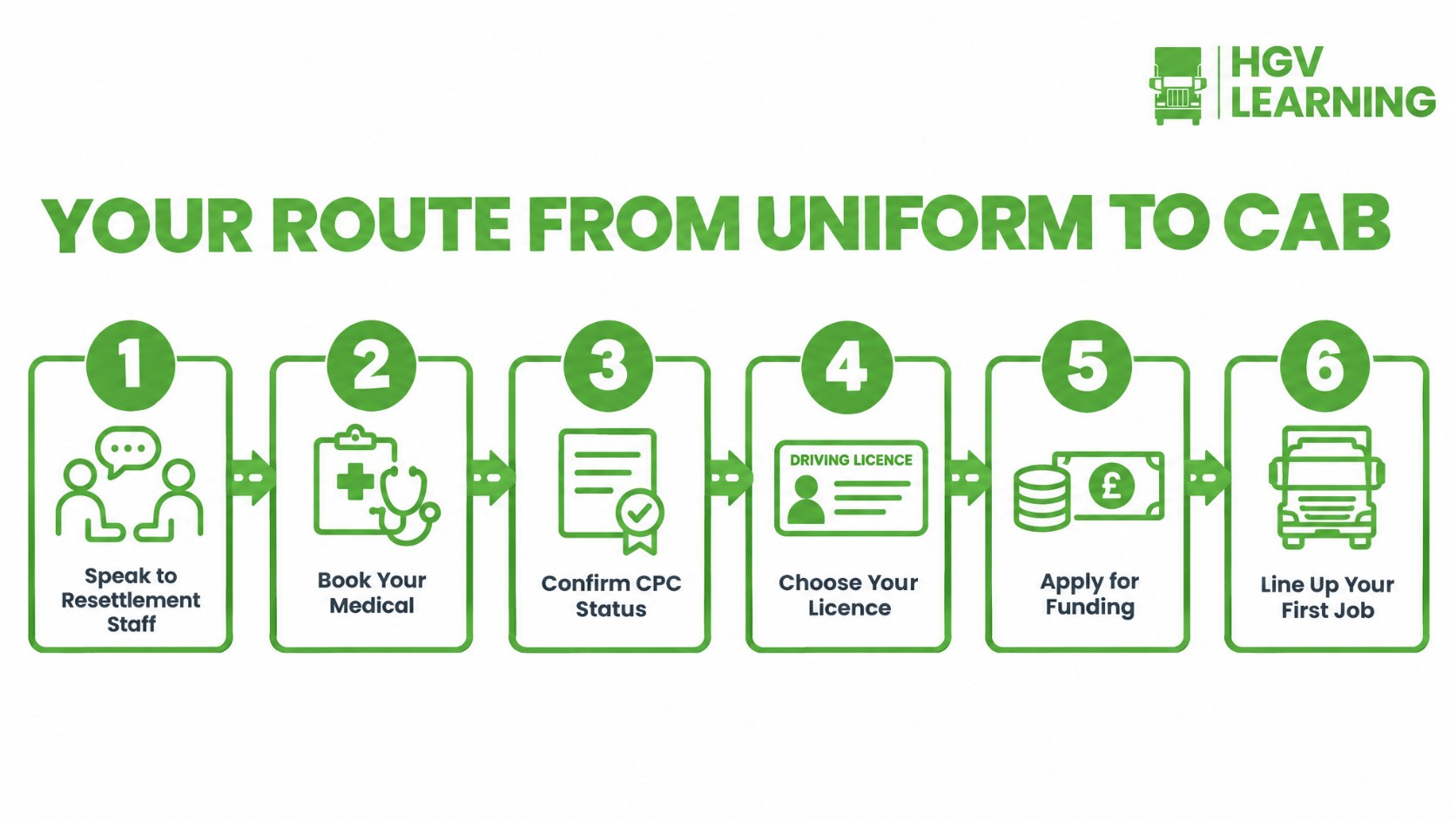
Your Route From Uniform To Cab, Step By Step
Speak to your resettlement staff about CTP eligibility and ELCAS entitlement as early as possible, ideally well before your discharge date.
Book your DVLA Group 2 medical in parallel, rather than waiting until training is arranged.
Confirm your Driver CPC status with the DVSA, since an exemption changes how much training you actually need.
Choose your licence category, C1, Cat C or C+E, based on the work you actually want, not just the quickest option.
Apply for your funded route, whether that is ELCAS, a Defence School of Transport place, or a charity scheme such as Veterans into Logistics.
Line up your first employer before you qualify, using the CTP Jobs Portal, the Forces Employment Charity, or a recruitment service like HGV Learning’s.
Frequently Asked Questions
Does my military driving experience count towards a civilian HGV licence?
It can shorten the road, mainly through a possible Driver CPC exemption, but it does not convert automatically. You still need the correct civilian provisional entitlement, a DVLA Group 2 medical and to pass the DVSA tests.
What is ELCAS and am I eligible?
ELCAS is the MOD’s Enhanced Learning Credits scheme. Most personnel need at least six years’ qualifying service since April 2000 to access it, with up to £2,000 a year available for eight or more years’ service.
Can ELCAS actually pay for HGV training?
Standard ELCAS courses normally need to be Level 3 or above, which HGV training usually is not. The MOD has previously granted a specific exemption for Cat C, C+E and ADR training through the Defence School of Transport, so check current eligibility directly with ELCAS before relying on it.
Is HGV training free for veterans?
It can be, through routes like a Defence School of Transport place, a charity scheme such as Veterans into Logistics, or the RHA’s Road to Logistics programme. Availability depends on places, funding rounds and individual eligibility, so confirm current status before planning around any one route.
Do I still need the Driver CPC if I drove in the military?
You may be exempt from the initial qualification depending on your military licences and categories, but this is not automatic. Even with an exemption, you still need 35 hours of periodic CPC training every five years like any other professional driver.
What does the Career Transition Partnership actually offer?
CTP is the MOD’s official resettlement service, covering a Jobs Portal, Employment Fairs, employability workshops and one-to-one resettlement advice. What you get depends on your length of service, so check your own tier with your unit’s resettlement staff.
How much can I earn as a newly qualified HGV driver?
UK HGV driver pay averages around £43,617 a year, with Cat C agency work typically paying £17–£18 an hour PAYE and C+E work £18–£19 an hour, though this varies by region, shift and specialism.
Which licence should I train for first, C1, Cat C or C+E?
It depends on the work you want. Cat C suits most new entrants to local and regional haulage, while C+E opens up better-paid, longer-distance work but is a bigger commitment to train for first.
How do I find my first civilian HGV job after leaving?
Use the CTP Jobs Portal and Forces Employment Charity before you leave, approach Armed Forces Covenant haulage employers directly, and speak to a recruitment service that works specifically with newly qualified drivers, such as HGV Learning’s own job-placement support.
Related Articles
16/10/2026
What Age Can You Start HGV Driver Training? A 2026 UK Guide to Licence Age Requirements
If you're asking what age you can start HGV driver training, the honest answer depends on which licence you're after. A C1 licence, covering vehicles...