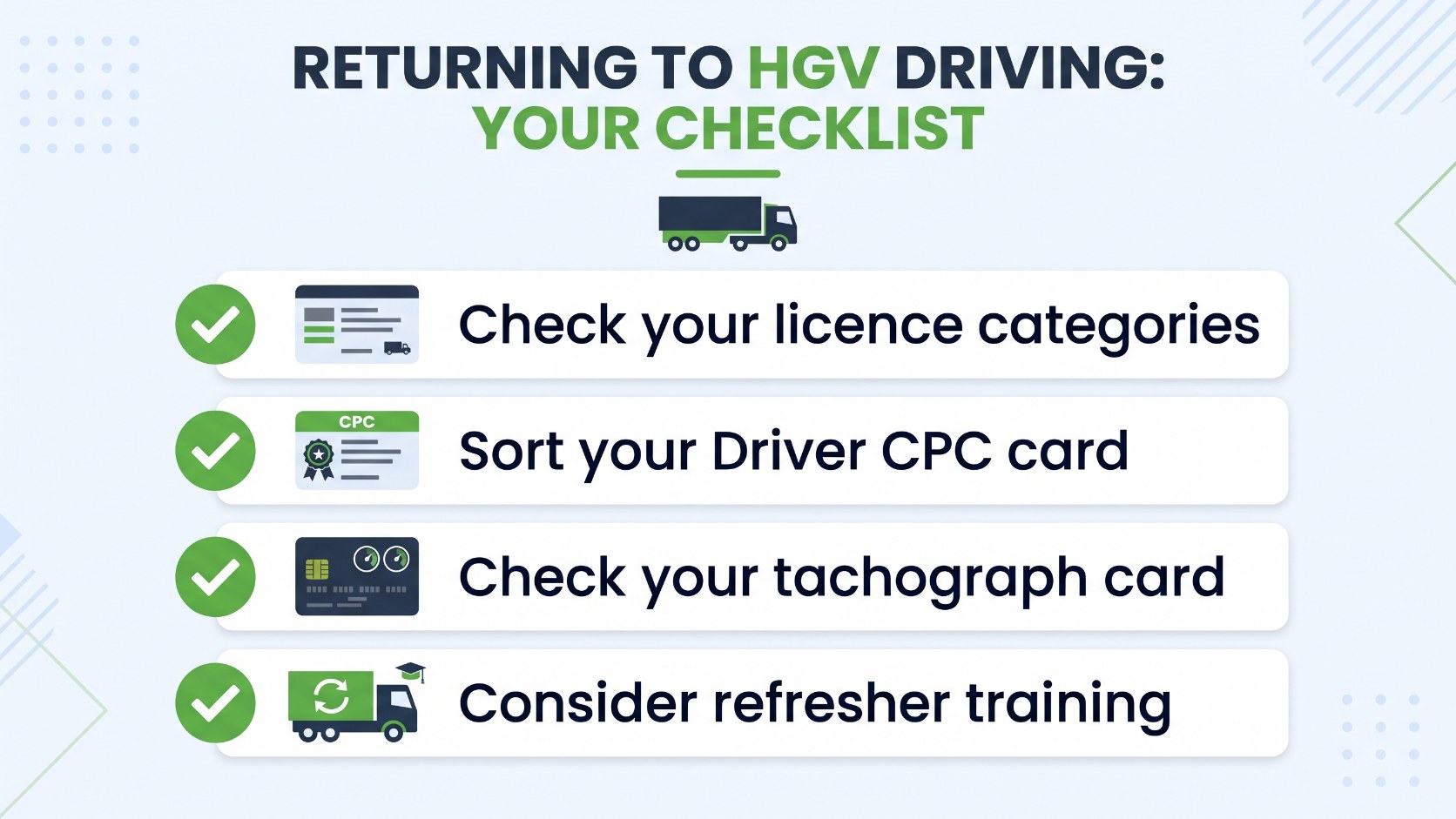
If you used to drive an HGV and stepped away for a few years, whether that was for a different job, family reasons, health, or just a change of pace, getting back behind the wheel is more straightforward than most returning drivers expect. It is not a case of starting from scratch. But it does mean working through a short, specific checklist on your licence, your Driver CPC card, and your tachograph card before you can legally drive professionally again.
This guide walks through exactly what to check, in what order, and what changes depending on how long you have been off the road. It also covers the parts nobody tells you about until you hit them: the insurance barrier some returning drivers face even once they are fully compliant on paper, and how to explain a gap on your CV without it working against you.
Why Drivers Come Back to HGV Driving (and Why the Industry Needs Them)
You are far from alone if you are thinking about returning. The UK haulage sector has a well-documented, long-running driver shortage, and a meaningful share of it is made up of people who already hold a valid HGV licence but are not currently using it.
The scale is bigger than most people realise. More than 100,000 UK drivers let their Driver Qualification Card lapse in a single recent year, roughly one in six working-age HGV licence holders, and the Road Haulage Association says the industry needs around 60,000 new drivers trained every year for the next five years just to keep pace with demand. A good share of that need could be met by drivers returning to a licence they already hold, rather than someone starting completely from zero.
Letting your Driver CPC card lapse does not take away your HGV licence. It takes away your ability to earn a living with it, which is exactly why sorting it out is worth doing properly rather than putting off again.
The workforce is also ageing, with the RHA flagging that significant numbers of experienced drivers are leaving the profession each year. That makes every returning driver with existing categories on their licence genuinely valuable, not a fallback option behind someone brand new.
Step 1: Check Your Driving Licence Is Still Valid
Before anything else, confirm your licence itself is still valid and check exactly which vehicle categories it still shows. Gov.uk’s official guidance on returning to HGV driving is a genuinely useful starting point, and you should use the government’s free online service to view your driving licence information rather than assuming your photocard or paper licence still reflects your HGV entitlement.
This matters because HGV and bus licence categories (C1, C, C1+E, C+E) are tied to a medical declaration, not just the standard 10-year photocard renewal that applies to a car licence. If that medical declaration lapsed while you were away, DVLA will have removed your lorry or bus categories from your licence, even though your basic car entitlement is untouched. If that has happened to you, you need to reapply for those categories rather than simply renew an expired card.
If You’re 45 or Over
Once you turn 45, your HGV or bus entitlement has to be renewed roughly every five years, and that renewal always needs a fresh medical. Per gov.uk’s guidance on renewing a lorry or bus licence, DVLA sends two forms 56 days before your licence is due to expire: the D47P application form and the D4 medical examination report, which a doctor completes. If those forms never arrived, or you missed them while you were off the road, you can pick up a D2/D4 pack from a participating Post Office instead. There is no fee for the renewal itself, only whatever your doctor charges for the examination.
If You’re 65 or Over
From age 65, the renewal cycle shortens from every five years to every single year, with the same D4 medical required each time. If your licence lapsed while you were in this age bracket, expect to go through the full D47P and D4 process again before DVLA restores your categories.
One important practical point either way: you can usually keep driving while a renewal application is pending, but only if your doctor or optician has not told you not to drive, you held a valid licence beforehand, you stick to the conditions of your previous licence, your application is less than a year old, and your last licence was never revoked or refused on medical grounds. If any of those do not apply to you, wait for DVLA’s decision before you get back in the cab.
Step 2: Sort Out Your Driver CPC Card
This is usually the part that actually stops a returning driver from working, even when their licence itself is fine. If you drive an HGV as the main part of your job, you need a valid Driver CPC card, and what you need to do to get yours current again depends entirely on how long ago it lapsed.
The good news: you never repeat the full qualification process from scratch if you already held a card before. What changes is how many training hours you need and whether you can start driving again immediately or have to wait.
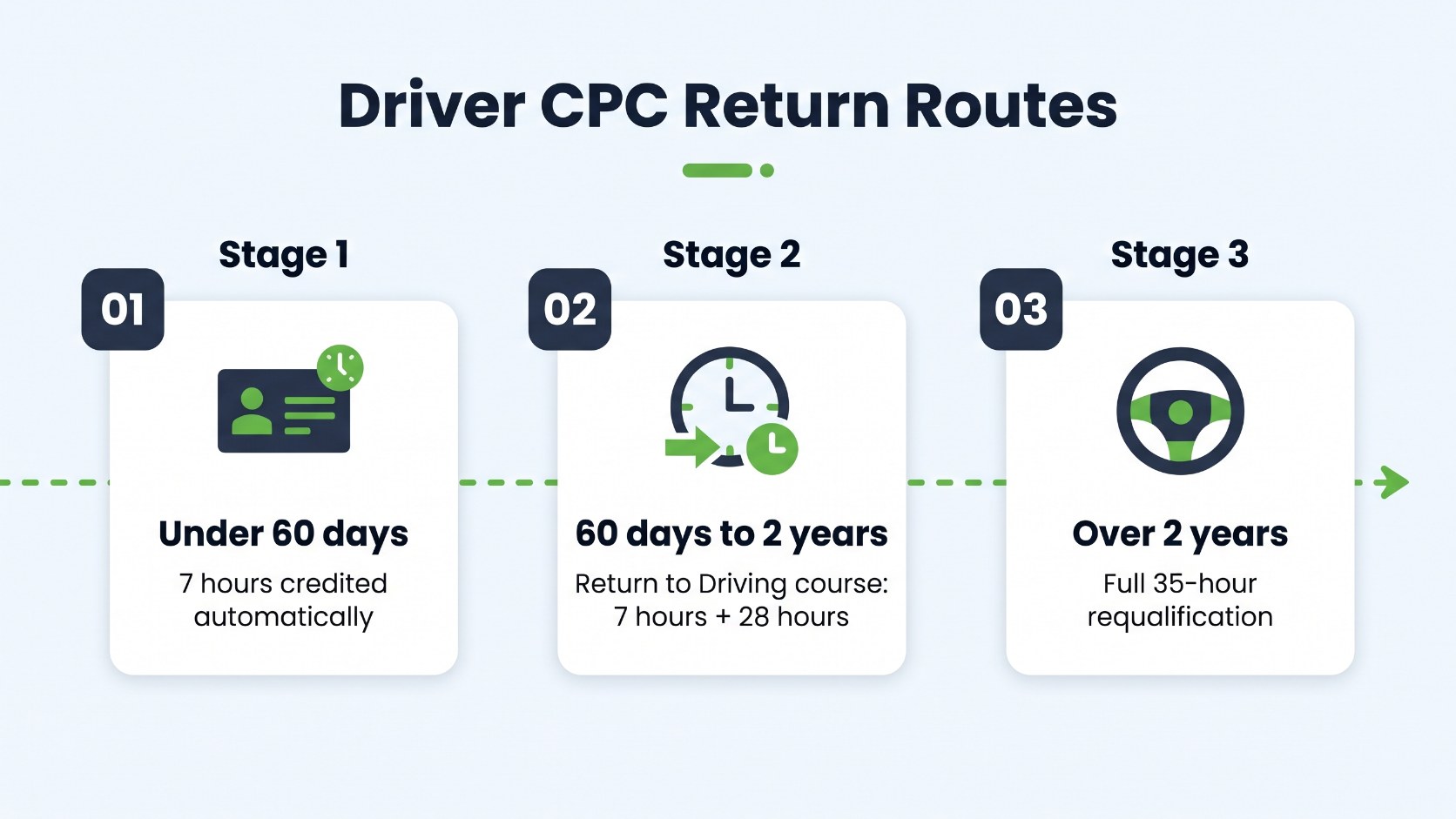
Lapsed Less Than 60 Days Ago (or Not Lapsed Yet)
If your card has not expired yet, or expired fewer than 60 days ago, you are credited with 7 hours of international Driver CPC training automatically added to your record. You still need to complete your normal periodic training to stay current, but there is no gap in your ability to drive.
Lapsed Between 60 Days and 2 Years Ago
This is where the genuinely useful “Return to Driving CPC” course comes in, introduced from 1 February 2025 specifically for drivers in this position. You complete a 7-hour course, which restores your National Driver CPC status the moment your training provider records it, meaning you can start driving professionally again straight away. You then have 12 months to complete a further 28 hours to bring your total back up to the standard 35, after which your new card, valid for the usual 5 years, is posted to the address on your driving licence.
Miss that 28-hour deadline and you lose the ability to keep driving professionally in the UK until you make it up, so it is worth booking the follow-up hours as soon as the 7-hour course is done, not leaving it until the deadline looms. You can only use this specific “Return to Driving” route once every 5 years, and if you want to drive professionally in Europe as well as the UK, you need the full 35 hours of international training rather than the 7+28 split.
Lapsed More Than 2 Years Ago
Once your card has been lapsed for more than 2 years, the fast-track Return to Driving course is no longer an option. You are back to the standard route described in gov.uk’s requalifying guidance: 35 hours of Driver CPC periodic training, the same requirement as anyone keeping their card current on the normal five-year cycle, just completed in one block rather than spread out. You do not need to retake a driving test, and you do not repeat the Initial Qualification tests, provided you already held a card before your break.
However long you have been away, the rule that matters most is the same one gov.uk sets out plainly: if you previously qualified, you never repeat the full qualification process again. What changes is how many hours of training stand between you and a current card, not whether you start from zero.
How Long Your Driver CPC Has Lapsed
What You Need to Do
Hours Required
When You Can Drive Again
Not expired, or under 60 days
Credited automatically
7 hours added to your record
No gap
60 days to 2 years
Return to Driving CPC course, then follow-up training
7 hours, then 28 more within 12 months
Immediately after the 7-hour course
More than 2 years
Standard periodic Driver CPC training
35 hours
Once all 35 hours are complete
Step 3: Check Whether You Need a New Tachograph Card
Your driver tachograph card is a separate item from both your licence and your Driver CPC card, and it has its own expiry date: five years from issue. If you have been off the road for anywhere near that long, there is a real chance yours has expired in the meantime, and you cannot legally drive a vehicle requiring tachograph records without a valid one. Our full guide to applying for a driver tachograph card covers the DVLA application process, current fees, and how long it takes to arrive, whether this is your first card or a renewal.
Worth checking even if your card has not technically expired: if you have been away for several years, the tachograph itself has probably moved on too. Smart, GNSS-enabled tachographs became mandatory in new vehicles from mid-2019, recording location data automatically in a way older units never did. If the last vehicle you drove had an analogue or early digital unit, using a modern one correctly is a genuine skill to relearn, not just a formality.
Returning to Driving: A Quick Reference by Length of Break
Putting the licence, Driver CPC and tachograph steps together, here is roughly what to expect depending on how long you have actually been away from professional driving.
Time Off the Road
Licence / Medical
Driver CPC
Tachograph Card
Refresher Training
Under 1 year
Usually unaffected
Return to Driving route if lapsed
Usually still valid
Optional, mainly confidence
1 to 2 years
Check expiry, may need D4
Return to Driving route if lapsed
Check expiry date
Worth considering
2 to 5 years
Likely needs D4 medical
Full 35-hour requalification
Likely needs renewal
Strongly recommended
5 years or more
Almost certainly needs D4 medical and category reapplication
Full 35-hour requalification
Needs a new card
Strongly recommended
Do You Need Refresher Training?
Legally, no UK rule forces a returning driver who still holds valid licence categories to take refresher lessons before getting back in the cab. Practically, most drivers who have been away for more than a year or two find it genuinely helpful, and some employers and agencies will ask for it before they will put you forward for a role.
Refresher training with a training provider like HGV Learning typically covers:
Manoeuvring and reversing practice, which fades faster than most drivers expect after a long break
Motorway and busy-road driving in current traffic conditions, especially if you previously drove mostly local or regional routes
Using a modern digital or smart tachograph correctly if your last vehicle had an older unit
Changes to the Highway Code and DVSA enforcement priorities since you last drove professionally
Rebuilding genuine confidence, which matters as much to an interviewer or a trial-shift supervisor as your paperwork does
A short refresher course is also a practical way to demonstrate to a sceptical employer or agency that you have actively addressed the gap, rather than simply asking them to take your word for it.
The Insurance and Hiring Barrier Returning Drivers Can Still Face
This is the part that catches a lot of returning drivers off guard. Being fully compliant on paper, with a valid licence, a current Driver CPC card and a valid tachograph card, does not automatically mean every employer or agency will put you forward for work straight away.
Standard UK fleet insurance policies commonly set a minimum threshold of two years of recent driving experience before they will cover a driver, a rule originally built around newly qualified drivers but one that can catch a returning driver with a long gap in a similar way. A 2026 industry report using SambaSafety claims data found that commercial driver crash risk actually peaks between 24 and 36 months into a role, and the report has openly challenged insurers to produce proper actuarial evidence that a flat two-year rule is the right measure of risk at all, rather than a blunt proxy that happens to exclude both the newly qualified and the recently returned.
A two-year gap in your driving history can create the same practical hiring hurdle as having no HGV experience at all, even though you are nothing like a brand-new driver in terms of underlying skill.
None of this means you cannot get hired. It means being upfront about the gap, leaning on refresher training as evidence you have addressed it, and being realistic that your first role back may come through an agency or a smaller, more flexible employer before a larger fleet operator with strict insurance criteria will consider you.
Updating Your CV to Explain the Gap
Do not leave an unexplained hole in your work history and hope nobody asks. A short, honest line covering why you stepped away and what you have done to get road-ready again reads far better than silence, which an experienced recruiter will notice immediately.
Our guide to writing an HGV driver CV and working with recruitment agencies covers this in detail, including how PAYE and umbrella company pay actually work if you are considering agency work on your way back in, but the short version for a returning driver is: state the licence categories and Driver CPC status you currently hold, mention any refresher training you have completed or booked, and keep the explanation for the gap itself brief and factual rather than apologetic.
Where to Find Your First Job Back
Most returning drivers land their first role back through one of a few routes, and it is worth trying more than one at once rather than waiting on a single application.
Check your licence, Driver CPC card and tachograph card status first, using the steps above, so you can state your situation accurately rather than guessing when an agency or employer asks
Book refresher training if it has been more than a year or two, both for your own confidence and as something concrete to point to on your CV
Register with two or three driving recruitment agencies rather than just one, since agency appetite for returning drivers varies a lot by branch and by client book
Apply directly to smaller, local operators alongside agency work, since they are often more flexible on insurance criteria than a large national fleet, consistent with the sourcing hierarchy covered in our CV and recruitment agencies guide
Be upfront about your gap and your current compliance status in every application, since consistency across applications builds trust faster than a different story each time
If you are weighing up whether to go back to the exact category you held before, or add a new one such as ADR or an additional vocational category while you are already retraining, our course pages for C1, Cat C, C+E and ADR training set out what each route involves, and our guide to HGV licence age requirements is useful if you are returning later in life and want to understand the medical and renewal rules that come with age.
Common Mistakes Returning Drivers Make
Assuming a valid-looking photocard means your HGV categories are still active, without actually checking via the government’s view-driving-licence service
Leaving the Driver CPC check until an employer asks for proof, rather than sorting it before you start applying
Forgetting the tachograph card entirely, since it is easy to overlook when you are focused on licence and CPC status
Skipping refresher training to save money, then struggling in an interview or trial shift that a few hours of practice would have fixed
Applying to only one agency or employer and waiting, rather than running several applications in parallel
Leaving the employment gap on a CV unexplained, which invites more suspicion than a short, honest line ever would
Where HGV Learning Can Help
If you already hold HGV categories and are simply working through the compliance checklist above, our recruitment advice service can help connect you with employers who are genuinely open to returning drivers, not just newly qualified ones. If your break has been long enough that you are effectively requalifying, or you want to add a category such as HIAB or telehandler training on top of your existing licence, our course pages set out cost, duration and what each one actually involves, and our training cost calculator is a useful starting point for budgeting. You can also read more about the wider working time rules that apply once you are back driving professionally, and our guide for drivers with no experience is a useful comparison if you are curious how your position differs from someone starting completely fresh.
Whatever stage you are at, our FAQs page and contact page are the quickest way to ask a question specific to your own situation rather than relying on a general guide alone.
Frequently Asked Questions
Does my HGV licence expire if I stop driving for a few years?
Not exactly. Your licence photocard itself lasts 10 years regardless of how much you drive, but your C1, C and C+E categories are tied to a medical declaration that lapses on its own schedule, every 5 years from age 45 and then every year from age 65. If that declaration lapsed while you were away, DVLA will have removed those categories from your licence, and you will need to reapply rather than simply wait it out.
How do I check if I still have my HGV categories on my licence?
Use the free government service to view your driving licence online. Do not rely on the printed photocard alone, since it will not show a category that DVLA has removed since the card was issued.
What happens if my Driver CPC card has lapsed?
It depends on how long ago it lapsed. Under 60 days, or not lapsed at all, and you are credited with 7 hours automatically. Between 60 days and 2 years, you can take the Return to Driving CPC course: 7 hours followed by 28 more within 12 months. Over 2 years, you need the standard 35 hours of periodic training. You never retake the original qualifying tests if you already held a card before.
Can I drive professionally while I wait for my Driver CPC to be sorted?
No, not as your main job. You need a valid Driver CPC card, or to have completed the relevant stage of the Return to Driving route, before driving an HGV professionally. The one exception is that completing the 7-hour Return to Driving course lets you start driving again immediately once your training provider records it, even before you finish the remaining 28 hours.
Does my tachograph card expire too?
Yes. A driver tachograph card is valid for 5 years from the date it is issued, separate from both your licence and your Driver CPC card. If you have been off the road for several years, check its expiry date and apply for a replacement before you get back into a vehicle that requires tachograph records.
Will insurers refuse to cover me because of the gap in my driving?
Not automatically, but many standard UK fleet insurance policies apply a two-year recent-experience threshold that was originally built around newly qualified drivers and can affect a returning driver with a long gap in a similar way. Being upfront about your situation and completing refresher training can genuinely help here.
Do I need to retake my HGV driving test if I’ve been away for years?
No. If you already passed your practical test and held the licence categories before your break, you do not retake that test. You may need to redo your medical and your Driver CPC training depending on how long you have been away, but not the original qualifying tests.
Is refresher training compulsory before I return to HGV driving?
No, not legally, provided your licence and Driver CPC are current. In practice it is strongly recommended after more than a year or two away, and some employers and agencies will ask for evidence of it before putting you forward for work.
How do I explain a driving gap on my CV?
Keep it brief and factual. State the reason for the gap in one line, confirm your current licence, Driver CPC and tachograph status, and mention any refresher training you have completed or booked, rather than leaving the gap unexplained and inviting questions you could have answered upfront.
Related Articles
27/10/2026
Working Time Directive for HGV Drivers: What the 2026 Rules Actually Mean
You've pulled into a lay-by after a long day. The kettle's on, the logbook's out, and one question is nagging at you: are you actually...