You’ve passed your test, your Driver CPC is sorted, and then a recruiter or transport manager asks, “Have you got your tacho card sorted yet?” For a lot of newly qualified HGV drivers, that’s the first time the driver tachograph card actually registers as something they need to deal with themselves, rather than just another acronym from the training classroom.
It’s easy to assume this is a small bit of admin you can sort out once a job offer is on the table. In practice, it’s one of the few things in this whole process with a fixed turnaround you don’t control, and it can genuinely hold up your start date if you leave it late. This guide walks through exactly what the card is, how to apply for your first one, what it costs in 2026, how long it takes, and where it fits alongside your licence and your Driver CPC on the road to your first HGV job.
The driver tachograph card is the one part of getting job-ready that has a fixed processing time you can’t speed up by paying more or asking nicely. Apply for it the moment you know your test date, not the week you start job-hunting.
Why This Matters Right Now for the UK’s Driver Shortage
This isn’t an abstract admin point. The Road Haulage Association’s own figures, updated in November 2025, show roughly 100,000 HGV drivers let their Driver CPC qualification lapse in the past year alone, and the RHA estimates the industry needs around 60,000 newly trained drivers every single year for the next five years just to keep up with demand (transportoperator.co.uk).
Put plainly, haulage operators are short of drivers and actively want to hire newly qualified ones. The bottleneck that’s left is almost never a shortage of job openings; it’s newly qualified drivers who haven’t got every piece of paperwork, including the tachograph card, sorted before an employer needs them to start.
What Is a Driver Tachograph Card and Who Actually Needs One
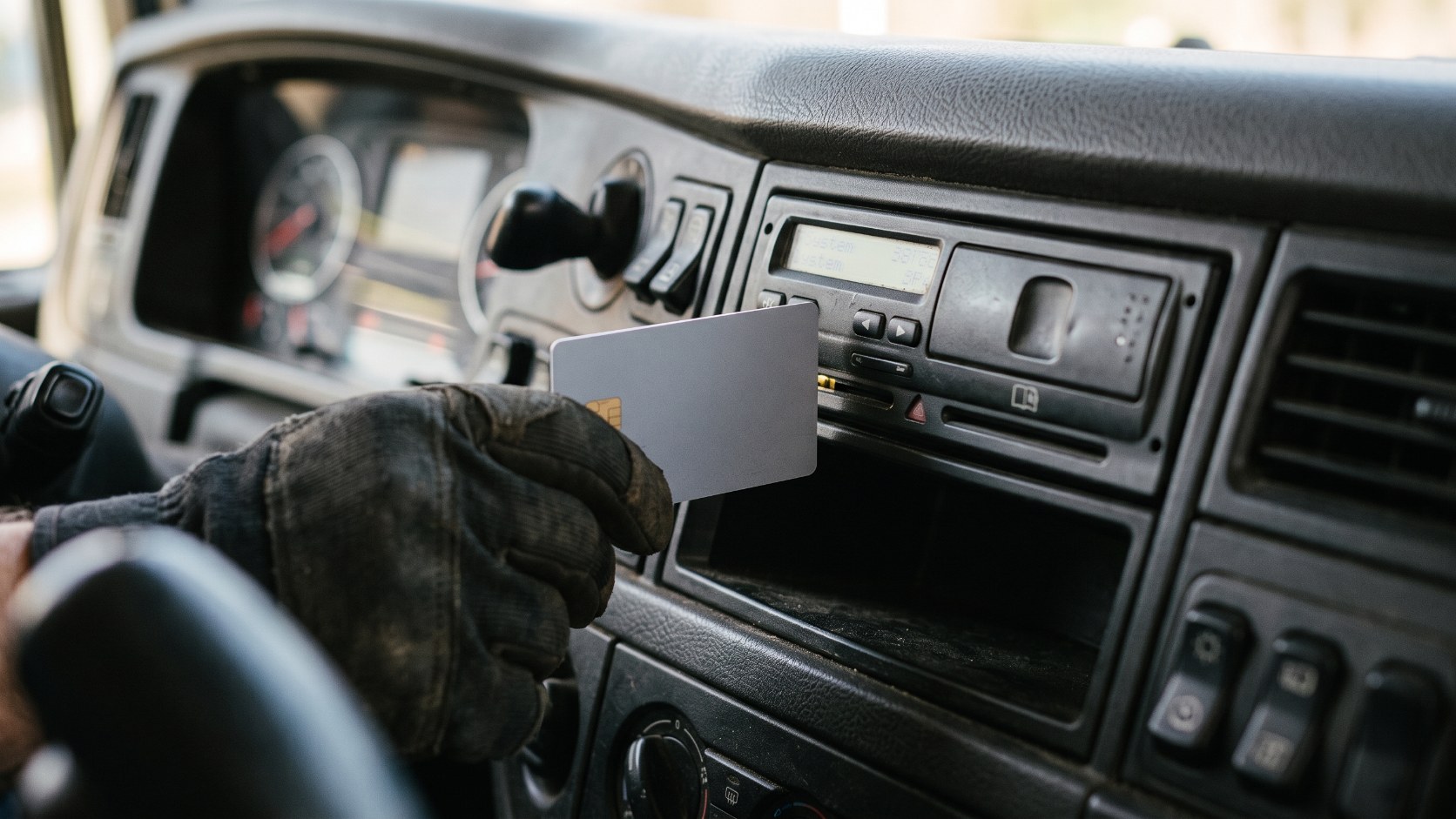
A driver digital tachograph card is a credit-card-sized smart card, unique to you, that slots into the tachograph unit fitted to most goods vehicles and plugs directly into the drivers’ hours rules. Every time you drive, the card records your driving time, breaks, rest periods and other working activities onto the card’s own memory, separately from the vehicle unit’s own record. It’s how you, your employer and DVSA enforcement officers can all prove you’re working within the legal limits on hours and rest.
You need a driver tachograph card if you drive a vehicle that’s fitted with a digital or smart tachograph and that falls under the EU/GB retained drivers’ hours rules. In practice, that covers the large majority of goods vehicles over 3.5 tonnes used for work, and most passenger-carrying vehicles doing the same kind of regulated work. If you’re training for a Cat C, C+E or C1 licence with a view to driving for a living, you will need one before you can legally start.
How This Differs From a Driver CPC Card and an Operator’s Licence
These three things get mixed up constantly by newly qualified drivers, and they genuinely are three separate items:
Driver CPC card (Driver Qualification Card) proves you’ve completed the mandatory periodic training required to drive professionally at all. Without a valid one, you can’t legally work as a professional HGV driver, full stop.
Operator’s licence belongs to the haulage business, not to you. It’s the permission the company holds from the Traffic Commissioner to run goods vehicles commercially. You don’t apply for this as an individual driver.
Driver tachograph card is the one this guide is about: your own personal card for recording drivers’ hours once you’re already licensed and CPC-qualified.
You need all three sorted at the right stage, but they’re issued by different routes, at different times, and mixing them up is one of the most common reasons a newly qualified driver’s start date slips. If you haven’t got your CPC card sorted yet, our guide to the Driver CPC card covers that separately.
Does This Apply If You’re Training for ADR, HIAB or Telehandler Work?
If your work also involves ADR (dangerous goods) driving, the vehicle itself still needs a tachograph card in the same way as any other regulated HGV, so nothing changes there. HIAB and telescopic handler work is a different case: once you’re off the road and purely operating lifting or loading equipment at a site, that activity itself doesn’t require a tachograph card, but if your role still involves driving the HGV it’s mounted on between sites, the usual tachograph rules apply to that driving time regardless.
How to Apply for Your First Driver Tachograph Card
The current route for a first-time GB application is DVLA’s online service, used via the gov.uk driver digital tachograph card page, open to applicants living in England, Scotland or Wales. It’s genuinely one of the more straightforward pieces of DVLA admin in this whole process, provided you have the right details ready.
What You’ll Need Before You Start
A valid GB photocard driving licence and its licence number.
A debit or credit card to pay the fee online.
The address currently held on your driving licence, since that’s where the card gets posted.
One detail that trips people up: DVLA reuses the photo and signature already held against your photocard licence rather than asking for a new one, so there’s no separate photo upload step. That also means if your photocard address or details are out of date, it’s worth updating your licence first, since the tachograph card will be posted to whatever address DVLA has on file for it.
Online vs Postal Application
Most first-time GB applicants can apply entirely online. The postal route, using form D777B (or D777B (ST1A) if you still hold a paper licence), is for anyone who can’t use the online service, and it’s also the only route if you’re exchanging an existing EU, EEA or Northern Ireland tachograph card for a GB one rather than applying completely fresh. The postal form is available to download from gov.uk or by calling DVLA directly.
What a Driver Tachograph Card Costs in 2026
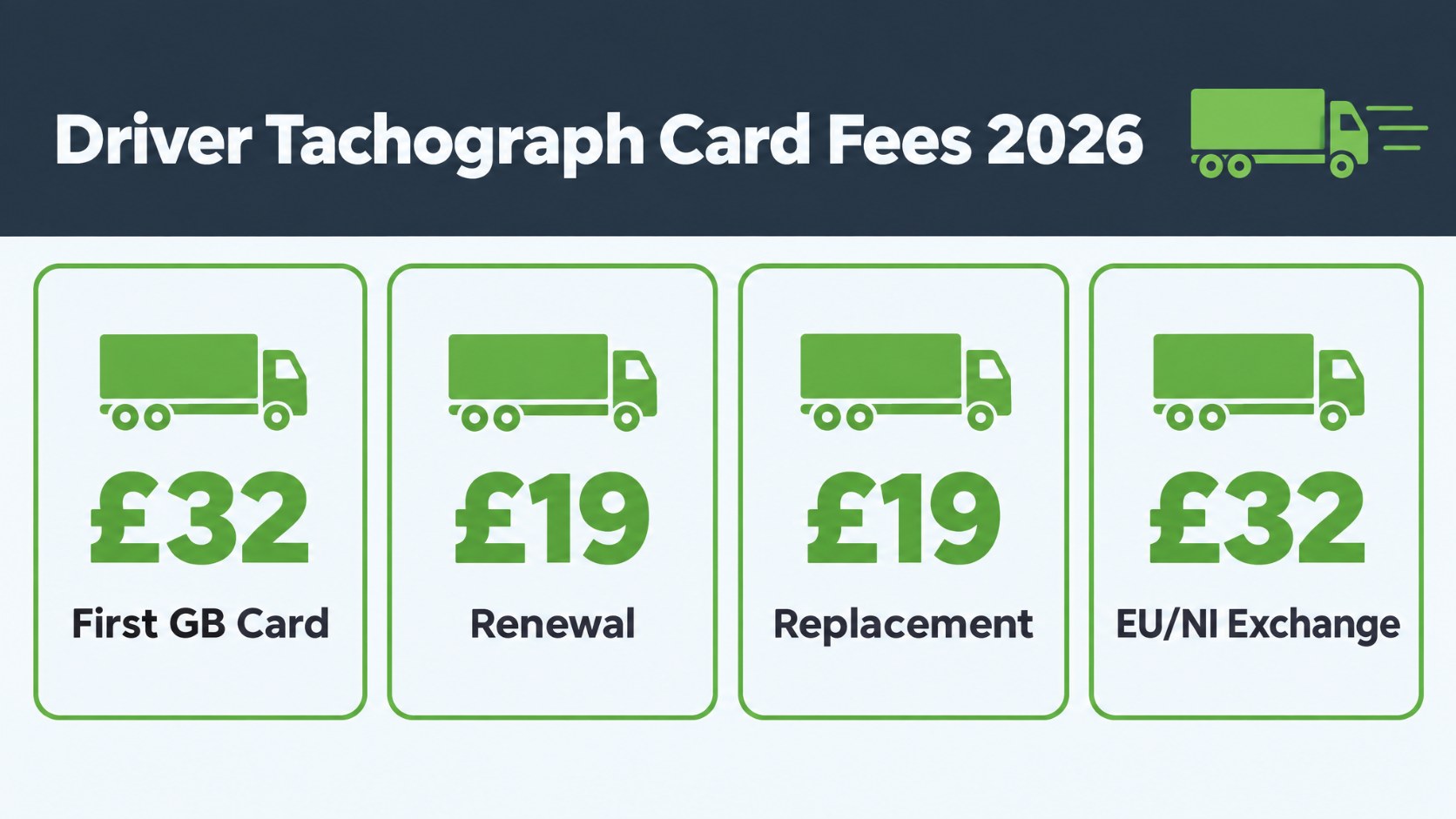
The fee depends on what you’re actually applying for, and it’s worth knowing the difference before you start, since a renewal costs noticeably less than a first-time application.
Application type
Fee
First GB driver tachograph card (new driver)
£32
Renewing an expired card
£19
Replacing a lost, stolen or damaged card
£19
Exchanging an EU/EEA/NI card for a GB card
£32
As a newly qualified driver applying for the very first time, you’re looking at the £32 fee, paid by card as part of the online application. It’s a one-off cost against a card that then lasts five years, so it’s a minor expense set against the training you’ve already invested in.
How Long It Takes to Arrive
Gov.uk doesn’t publish a single guaranteed turnaround figure, but industry guidance from Logistics UK states that a first application or renewal should arrive within 15 working days of DVLA receiving it, while a straightforward replacement is typically issued faster, within around five working days. Fifteen working days is the figure to plan around, not the five-day one, since that shorter timeline applies to replacements rather than brand-new cards.
Fifteen working days sounds manageable until you’re staring at a start date three weeks away and an employer who needs you on the road sooner. Apply the day you book your final test, not the day you accept a job offer.
This is the single most common cause of a delayed start for newly qualified drivers, and it’s entirely avoidable. There’s no requirement to wait until you’ve passed your test to apply, and no reason to wait until you’re job-hunting either. The moment your details and address are settled, there’s nothing stopping you applying.
Can You Start Work Before Your Card Arrives?
This is worth handling honestly rather than assuming the answer is a flat yes. The clearest documented provision covers a lost, stolen or damaged card being replaced: a driver can continue driving for up to 15 days (longer only if needed to return the vehicle to its operating centre) while taking manual printouts from the vehicle’s tachograph unit for every day driven, provided DVLA was notified immediately and a replacement applied for within 7 working days.
What’s genuinely unclear from DVLA’s own guidance is whether this exact 15-day manual-printout provision is intended to cover a brand-new driver who has never held a card at all, as opposed to someone replacing one they already had. Given that ambiguity, the safest and most practical approach for a newly qualified driver is not to plan around this provision at all: apply during your final week or two of training, well before you need the card for a real job, so the question never comes up.
How Long Your Card Lasts and How to Renew It
A driver tachograph card is valid for five years from the date it’s issued. DVLA sends a renewal reminder roughly 12 weeks before the expiry date, which gives you a reasonable window to act.
Stage
What to do
12 weeks before expiry
DVLA sends a renewal reminder
Within 90 days of expiry
You can renew online
Earlier than 90 days from expiry
Renew by post using form D786B (or D777B)
While waiting for the new card
Keep using the old card right up to its expiry date, and don’t post it off early
After the new card arrives
Keep the expired card for 28 days, then return the confirmation letter to DVLA as instructed
If your card expires before the replacement arrives, you can’t legally drive a vehicle subject to drivers’ hours rules until the new one is in your hand, since there’s no equivalent grace period to the lost-card provision above. That makes the 90-day renewal window genuinely useful: don’t leave it until the card has already expired to start the process.
What Happens If You Drive Without One, or Let It Expire
DVSA’s own enforcement guidance treats failing to use a tachograph card correctly, and failing to hand over your records to an enforcement officer, as serious offences under the Transport Act, with penalties reaching a court-level fine on the standard scale for the most serious cases, alongside a graduated fixed-penalty system for lesser breaches. Officers can also issue a roadside prohibition, stopping you driving until the issue is resolved, and repeated or serious breaches can be referred to the Traffic Commissioner, which affects both your own record and your employer’s operator licence.
A roadside check that finds you without a valid tachograph card doesn’t just cost you a fine. It can stop the vehicle moving at all until the issue is fixed, which is a far worse outcome for a newly qualified driver trying to make a good first impression.
How This Plays Out for Agency and Self-Employed Drivers Specifically
If your first job is through a recruitment agency rather than directly with an operator, the responsibility for holding a valid card doesn’t shift. The card is issued to you personally, and it’s your responsibility to keep it current between placements, even if you’re moving between several different agencies and vehicles in your first few months. An agency can check you hold one before placing you, but it won’t apply for one on your behalf or renew it for you.
None of that is a risk worth taking to save a couple of weeks. The practical lesson is the same one that runs through this whole guide: apply early enough that the question of driving without a valid card never actually arises.
Using Your Card Correctly Once You’re on the Road
Getting the card itself is only the start. Once you’re actually driving, you still need to know how to use it day to day: inserting it correctly at the start of your shift, switching activity modes properly, and taking a compliant printout if the vehicle unit or the card itself ever fails. Our guide on how to read a tachograph printout covers the practical day-to-day side of this once you’ve got your card in hand, and if the worst happens and you lose it mid-job, our guide on what to do when you lose your tacho card walks through the replacement process step by step.
It’s also worth getting your Driver CPC renewal cycle straight at the same time, since both cards run on their own separate clocks and mixing up their renewal dates is a common source of last-minute panic. Our guides on what Driver CPC training actually involves and what a CPC course costs cover that side in full.
Common Mistakes Newly Qualified Drivers Make
Waiting until a job offer is confirmed before applying, rather than applying as soon as a test date is booked.
Letting the postal address on their driving licence fall out of date, so the card is posted somewhere they no longer live.
Confusing the tachograph card with the Driver CPC card and assuming one covers the other.
Not realising that an existing EU, EEA or Northern Ireland card needs the postal exchange route rather than the standard online application.
Letting a card run close to its five-year expiry while working away from home, rather than acting on the 12-week reminder.
Where This Fits in Your Journey From Training to Your First Job
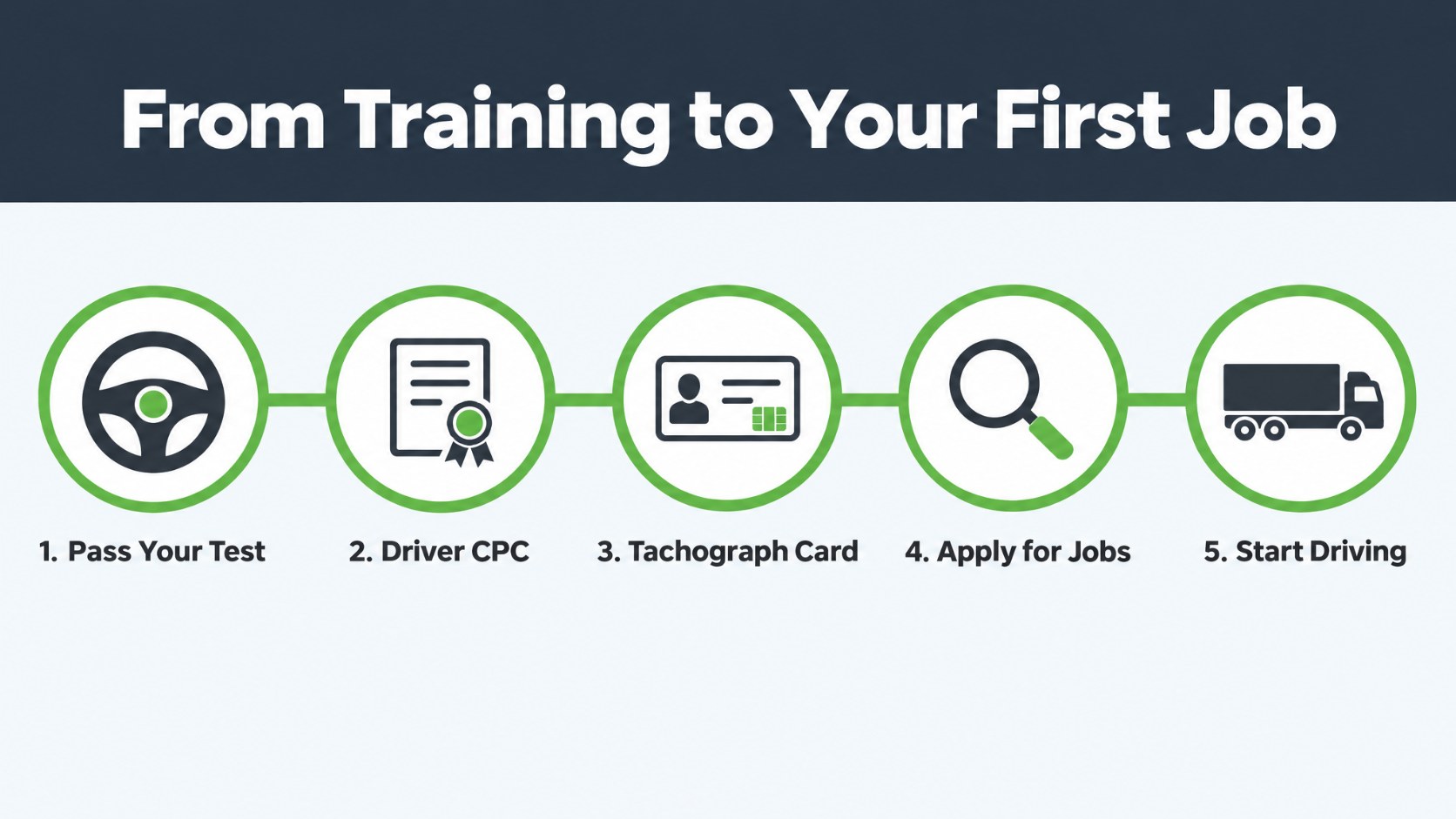
The tachograph card is one step in a sequence, not a one-off task that stands alone. Getting the order right makes the whole process noticeably smoother:
Pass your practical test for the licence category you’ve trained for, whether that’s C1, Cat C or C+E.
Make sure your Driver CPC is in place, whether through the initial qualification or periodic training.
Apply for your driver tachograph card online as soon as your licence details and address are confirmed, rather than waiting for a job offer.
Start applying for roles while the card is in transit, so you’re not held back once it arrives.
Keep both cards (CPC and tachograph) somewhere you won’t lose them, since losing either one mid-job is a genuinely common, avoidable headache.
Once your licence, CPC and tachograph card are all in place, the next hurdle for a lot of newly qualified drivers is the same one covered in our guide on getting your first HGV job with no experience: insurance and employer hesitancy around drivers with no logged time on the road yet. Our CV and recruitment agency guide covers exactly how to present yourself once you’ve got all your paperwork sorted, including the practicalities of agency work and PAYE versus umbrella pay.
HGV Learning’s own recruitment advice service exists specifically to help newly qualified drivers navigate this stage, from first application through to a confirmed start date, so you’re not working it out alone.
Frequently Asked Questions
Do I need a tachograph card if I only drive a 7.5 tonne (C1) vehicle?
Yes, if the vehicle and the work you’re doing fall under the drivers’ hours rules, which the large majority of commercial C1 driving does. The card requirement is about the regulated activity, not specifically about holding a Cat C or C+E licence.
Can I start driving professionally before my tachograph card arrives?
You shouldn’t plan around this. The documented 15-day manual-printout provision clearly covers a lost or stolen card being replaced, and it’s genuinely unclear whether it’s meant to cover a first-time applicant who has never held a card. Apply well before you need to start work so this never becomes an issue.
How much does a driver tachograph card cost in 2026?
A first GB application costs £32. Renewing an expired card or replacing a lost one costs £19. Exchanging an existing EU, EEA or Northern Ireland card for a GB card costs £32.
How long is a driver tachograph card valid for?
Five years from the date it’s issued. DVLA sends a renewal reminder around 12 weeks before it expires, and you can renew online once you’re within 90 days of the expiry date.
What’s the difference between a tachograph card and a Driver CPC card?
The Driver CPC card proves you’ve completed the periodic training required to drive professionally at all. The tachograph card is a separate, personal card for recording your actual driving and rest time once you’re already licensed and CPC-qualified. You need both, applied for separately.
Can I apply for my tachograph card before I’ve passed my test?
Yes. The application is tied to your GB driving licence details and address rather than to a confirmed job, so there’s no reason to wait until you’ve passed your test or found work before applying.
I already hold an EU or Northern Ireland tachograph card. Can I apply online for a GB one?
No. Exchanging an existing EU, EEA or Northern Ireland card for a GB card has to go through the postal application using form D777B, not the online service, which is for fresh applications only.
What happens if I lose my tachograph card while working?
Report it to DVLA immediately and apply for a replacement within 7 working days. You can keep driving for up to 15 days using daily manual printouts from the vehicle’s tachograph unit while you wait, as long as you’ve notified DVLA and applied in time.
Do agency drivers need their own tachograph card, or does the agency provide one?
The card belongs to you personally, not to any single employer or agency. You take the same card with you between jobs, agencies and vehicles for as long as it’s valid.
Related Articles
16/10/2026
What Age Can You Start HGV Driver Training? A 2026 UK Guide to Licence Age Requirements
If you're asking what age you can start HGV driver training, the honest answer depends on which licence you're after. A C1 licence, covering vehicles...