Passing your HGV test is only the first step. Turning a new Cat C, C+E or HIAB qualification into an actual wage is where a lot of newly qualified drivers get stuck, and it mostly comes down to two things: what you put on paper, and whether you go looking for work directly or through an agency.
The demand is real. The Road Haulage Association says the industry needs to train around 60,000 new drivers a year for the next five years, and that roughly 100,000 drivers, nearly a sixth of the UK’s working-age HGV drivers, let their Driver CPC qualification lapse over the past twelve months alone.
That gap is not evenly spread across the country or across licence categories, and it will not close itself. It means a genuinely employable newly qualified driver, with the right documents ready and a clear idea of how to apply, is in a stronger position than the headline shortage figures might suggest.
Demand will not get you hired on its own, though. Most adverts still ask for experience you do not have yet, and plenty of newly qualified drivers spend weeks applying to the wrong jobs with the wrong CV before anything comes back. This guide covers what actually belongs on an HGV driver’s CV, how recruitment agencies work in practice, what checks an employer will run before they hire you, and what you can realistically expect to earn in your first year.
What to Put on an HGV Driver CV
A good HGV CV is not long. Most transport managers and agency recruiters are skimming for a handful of specific facts: which categories you hold, whether your Driver CPC and tachograph card are current, and whether you can actually start work. Get those in front of them clearly and the rest of the CV just needs to back it up.
The Documents You Need Before You Start Applying
Before you send a single application, have the following ready, because a recruiter or transport manager will ask for proof of all of them before they can put you forward for anything:
Your full, clean UK driving licence, including the specific categories you hold (C1, C, C+E, and so on)
Your Driver CPC card, also called a Driver Qualification Card, with its expiry date
Your digital tachograph card, with its expiry date
A current DVLA medical certificate (D4) if your role or insurer requires one
Contact details for two referees who can confirm your conduct, ideally including your instructor or training provider
Scan or photograph each one now, even if you are not applying yet. Having them ready to attach the moment a recruiter asks saves days, and a slow response to a document request is one of the easiest ways to lose a placement to someone else.
Writing Your Personal Statement With No HGV Experience
You do not need HGV experience to write a convincing personal statement, you need to show you are ready to work. State your licence categories and qualification dates first, then name any driving you have done in smaller vehicles, however minor, and any job where reliability, timekeeping or dealing with the public mattered.
A transport manager reading a CPC-qualified driver with zero professional HGV hours is not expecting a seasoned trucker. They are checking for someone who turns up on time, follows instructions, and will not need managing. Say that plainly rather than padding the statement with generic phrases.
Common CV Mistakes That Cost New Drivers Interviews
Burying your licence categories and CPC expiry date at the bottom of the CV instead of the top
Leaving out your tachograph card number or expiry date entirely
Listing “driving” as a skill without saying what vehicle or how many hours
An email address or voicemail greeting that sounds unprofessional
No clear statement of your availability, start date, or whether you can work nights and weekends
The categories you hold and the date your Driver CPC expires matter more to a transport manager than almost anything else on your CV. Put them where they cannot be missed.
A Simple First-Job HGV CV Structure
If you are starting from a blank page, this is a reliable order. It puts the facts a recruiter checks first at the top, and leaves your work history and training detail below.
Three or four lines covering your qualification, your reliability, and your availability
Work history
Most recent role first, even if not driving-related, with specific responsibilities named
Driving-specific skills
Vehicle types, manual or automatic, any specialist training such as ADR or HIAB
Education and training
Where you trained, course dates, and any additional certificates
References
Two names and contact details, including your training provider where possible
Should You Apply Directly or Go Through a Recruitment Agency?
Most newly qualified drivers end up doing both, and that is usually the right call. Applying directly works well once you know roughly what kind of role and sector you want, through local haulier websites, job boards and our own guide to finding lorry driver jobs near you. An agency works best in the gap between qualifying and your first permanent offer.
How HGV Recruitment Agencies Actually Work
An HGV recruitment agency is not your employer in the traditional sense, it is a middleman between you and a haulage firm or distribution centre that needs cover. You register with the agency, provide your documents, and the agency puts you forward for shifts or temp-to-perm placements as they come up.
Agencies exist because hauliers need flexible cover for busy periods, holiday and sickness absence, and because they are often more willing to take a chance on a newly qualified driver for a single shift than for a permanent contract. A trial shift through an agency is frequently how a driver with zero hours gets their first real HGV experience on the road.
PAYE or Umbrella Company: What the Difference Means for Your Pay
Agencies will usually offer you a choice between being paid PAYE, directly by the agency, or through an umbrella company. The headline hourly rate can look identical either way, but what you actually take home often is not.
PAYE
Umbrella company
Who pays you
The agency, directly, as your employer
An umbrella company, which invoices the agency on your behalf
What is deducted before your pay is worked out
Income tax and National Insurance only
Employer’s National Insurance, the Apprenticeship Levy, and the umbrella’s own margin
Typical fee for the arrangement
None
Around £20–£30 a week, or roughly 1–5% of the assignment rate
What this means for you
The headline hourly rate is close to your actual gross pay
The same headline rate can produce noticeably lower take-home pay, since deductions happen before you see it
Neither option is automatically wrong, but you should know which one you are being offered and what it actually costs before you accept a placement. Ask the agency for a worked example of a full week’s pay, after every deduction, not just the headline rate.
Two agencies quoting the same hourly rate can hand you very different take-home pay depending on whether you are paid PAYE or through an umbrella company. Always ask for a worked example before you accept.
Red Flags to Watch For With Any Agency
Since 7 April 2026, UK recruitment agencies have been regulated by the Fair Work Agency, which replaced the old Employment Agency Standards Inspectorate. Agencies must follow the Employment Agencies Act 1973 and the Conduct of Employment Agencies and Employment Businesses Regulations 2003, and a genuine complaint can be reported to the Fair Work Agency directly, online, by email, or by phone.
Any agency asking you to pay a fee to register or to be found work, which is illegal under UK law
No written contract or Key Information Document before your first shift
Refusing to confirm your pay rate and deductions in writing before you start
Pressure to buy equipment, clothing or training from the agency or a named third party
Withholding pay for hours you have already worked, or being vague about when you will be paid
If any of this happens, you can report it to the Fair Work Agency, which investigates complaints and aims to acknowledge them within five working days.
A legitimate HGV recruitment agency will never ask you for money to find you work. If one does, that is a Fair Work Agency complaint, not a negotiation.
The Checks Employers Will Run Before They Hire You
Expect any genuine employer or agency to check your licence before they let you near a vehicle. The standard method is the DVLA’s driving licence check code, also called a share code, generated through the “View or share your driving licence information” service on GOV.UK using your licence number, National Insurance number and postcode.
The code is valid for 21 days and can only be used once, by whoever you share it with. Generate a fresh one for each new employer or agency rather than reusing an old code, and never share your code with anyone you have not already agreed to give it to, since using someone else’s licence details without permission is a criminal offence.
Alongside the check code, expect a right-to-work check, your Driver CPC card details, your tachograph card details, and possibly a basic medical declaration if your role requires one.
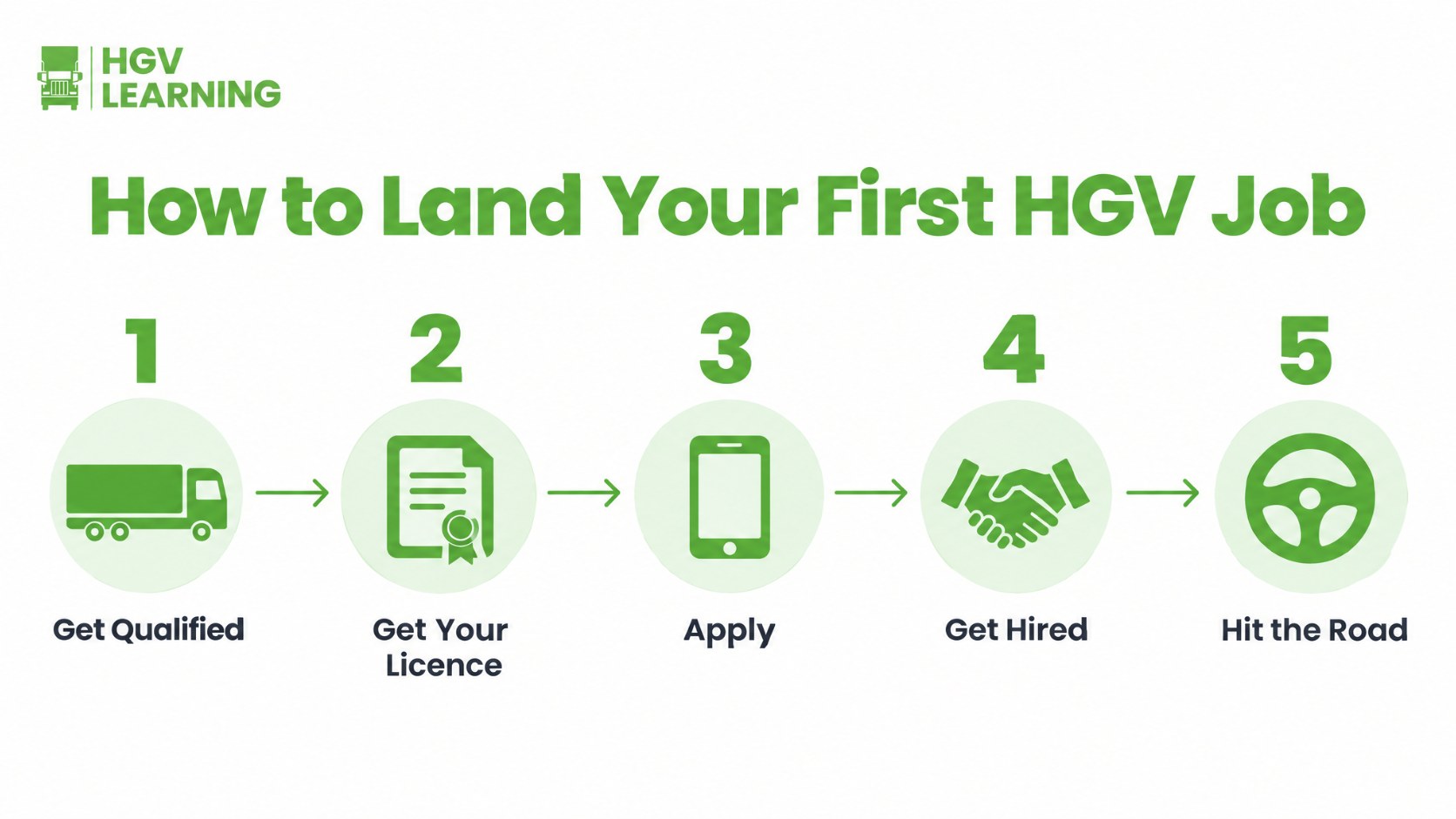
The Five-Step Process for Landing Your First Job
Get your documents scanned and ready: licence, CPC card, tacho card, medical certificate if needed, and two referees.
Register with two or three reputable agencies as well as applying directly to local hauliers, rather than relying on one route alone.
Say yes to the first reasonable shift offered, even if it is not your ideal route or vehicle, since agency hours are how most new drivers build real experience fastest.
Ask every agency for pay details in writing, PAYE or umbrella, rate and deductions, before you accept a placement.
Keep a simple log of every shift you work, including vehicle type and hours, so you have a genuine, specific work history to show the next employer.
Preparing for the Interview or Trial Shift
A trial shift is effectively a working interview, so treat it the same way you would a formal one. Arrive early, bring your documents even if you have already emailed copies, and ask the transport manager about the route, the vehicle, and what a normal day actually looks like.
Most questions are practical rather than technical: can you reverse confidently, do you know your daily walkaround checks, are you comfortable with the specific trailer or body type. Answer honestly if you have not done something before. A transport manager would rather know now than find out on the road.
Bring a notebook, even if you do not expect to need it. Depot layouts, site-specific rules, delivery contacts and loading procedures are a lot to take in on a first shift, and writing things down signals that you take the job seriously. It also means you are not asking the same question twice.
What Happens After You’re Placed
A single trial shift rarely turns into a permanent contract straight away. Most newly qualified drivers build up a pattern of agency shifts over several weeks or months, often with more than one haulier, before a permanent seat opens up, either with one of those hauliers directly or elsewhere once they have real hours on their CV.
Treat every shift as an audition, not just a pay cheque. Turning up reliably, communicating problems early, and being easy to work with is what gets you asked back, and eventually offered first refusal on a permanent role.
Keep applying and registering elsewhere while this builds, rather than waiting on one agency or one haulier to make the next move. Drivers who stay active across two or three routes at once tend to reach a permanent offer faster than those who commit to a single option and wait.
What You Can Realistically Earn in Your First Year
Pay varies a lot by licence category, region and whether you are working agency or permanent hours. The ranges below are drawn from Aspion’s 2026 UK HGV driver salary guide, so go in with accurate numbers rather than the headline figures quoted for experienced drivers.
Route
Typical first-year pay
Cat C (Class 2), newly qualified, permanent
£21,000–£26,000 a year
Cat C (Class 2), standard permanent role once settled
£28,000–£36,000 a year
Agency work, either category, hourly
£16–£20 per hour
C+E (Class 1), standard permanent role
£38,000–£50,000 a year
C+E roles pay more because the licence is harder and more expensive to get, and because the supply of qualified Class 1 drivers is tighter. Very few employers put a newly qualified driver straight into a permanent C+E role without some Cat C or agency experience first, so a realistic first-year plan is Cat C or agency work building toward a C+E upgrade once you have hours behind you. See our guide to Cat C jobs for more on that route specifically, and our training cost calculator if you are weighing up the next licence against what it will cost.
Your first year’s pay is rarely your ceiling. Most drivers who stay reliable and keep adding hours and licence categories see their income climb noticeably within twelve to eighteen months.
How HGV Learning Can Help You Make the Jump
Getting qualified and getting hired are two different problems, and HGV Learning works on both. Alongside C1, Cat C, C+E and specialist training, our recruitment advice service helps newly qualified drivers get in front of agencies and employers who are actually hiring, rather than guessing which job boards are worth your time.
If you are weighing up your options, whether that is which licence category to train for next or how to present the one you already have, our FAQs page covers the questions we hear most, and our guide to getting your first HGV job with no experience goes into more detail on the insurance barrier many newly qualified drivers hit. If you came into HGV driving from the forces, our guide for ex-forces drivers covers funded training routes too. You can also get in touch directly if you want to talk through your options.
Frequently Asked Questions
Do I need HGV experience to get my first job?
No. Employers and agencies expect to hire newly qualified drivers, which is exactly why agency work and trial shifts exist. What matters more is having your documents ready, a clear CV, and a flexible attitude to the shifts you are offered early on.
How long does it usually take to find a first HGV job after qualifying?
It varies, but most newly qualified drivers who register with agencies and apply directly in parallel find their first paid shift within a few weeks. Drivers who rely on a single job board or a single agency typically wait longer.
Is it better to go PAYE or through an umbrella company?
Neither is automatically better, but PAYE usually keeps more of the headline rate as your actual take-home pay, since there is no umbrella margin or employer’s National Insurance deducted first. Ask any agency for a worked weekly pay example before you accept, whichever option they offer.
Can a recruitment agency charge me a fee?
No. It is illegal under UK law for a recruitment agency to charge a work-seeker a fee for finding them work. If an agency asks you for money to register or to be put forward for jobs, that is a Fair Work Agency complaint, not a legitimate charge.
What is a driving licence check code and how do I get one?
It is a code, also called a share code, that lets an employer view your driving record through the DVLA’s online service. Generate one on GOV.UK using your licence number, National Insurance number and postcode, and note that each code is valid for 21 days and can only be used once.
Do I need a medical certificate to apply for HGV jobs?
Not always. Some employers and insurers require a DVLA medical certificate (D4) before you start, particularly for certain categories or older drivers, but plenty of agency roles do not ask for one upfront. Check with each specific employer or agency rather than assuming either way.
Should I register with more than one agency?
Yes, registering with two or three reputable agencies alongside applying directly gives you far more chances of a shift coming up quickly. Relying on a single agency means you only see the work that one recruiter happens to have.
What’s the difference between agency work and a permanent HGV job?
Agency work is flexible, shift-by-shift cover arranged through a recruitment agency, usually paid weekly, while a permanent job means a direct contract with one haulier. Most newly qualified drivers use agency work to build hours and experience before moving into a permanent role.
How much can I expect to earn in my first year as an HGV driver?
A newly qualified Cat C (Class 2) driver typically earns £21,000–£26,000 a year in a permanent role, or £16–£20 an hour through agency work, rising as you gain experience. A C+E (Class 1) permanent role typically pays £38,000–£50,000 once you have moved up to it.
Related Articles
16/10/2026
What Age Can You Start HGV Driver Training? A 2026 UK Guide to Licence Age Requirements
If you're asking what age you can start HGV driver training, the honest answer depends on which licence you're after. A C1 licence, covering vehicles...