You passed your test. You’ve got the licence in your hand and a Driver CPC card on the way. Then you start applying for jobs and nearly every advert says the same thing: minimum two years’ experience. It feels like nobody told you about this part before you paid for training.
You’re not imagining it, and it isn’t your CV. It’s insurance. The good news is there are real, working routes into a first HGV job that don’t depend on an employer bending the rules for you: you just need to know where they are and how to put yourself forward for them.
Why “No Experience” Feels Like a Brick Wall
Most newly qualified drivers assume the problem is a weak CV or a bad interview. It usually isn’t. The real obstacle sits with the fleet insurance policy an employer is operating under, long before your application reaches anyone’s desk.
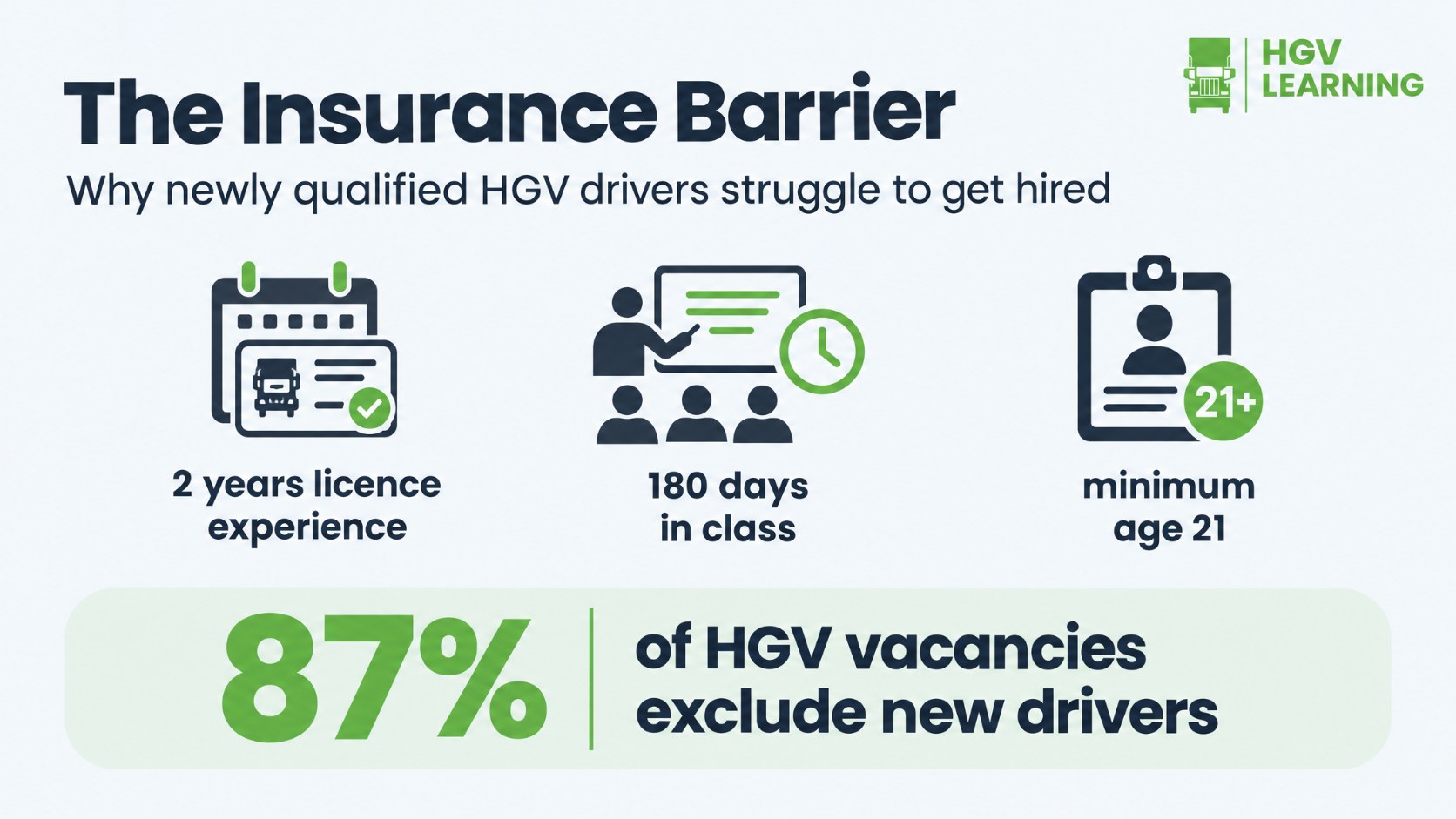
A 2026 industry report, Show the Data, found that 87% of live HGV vacancies either exclude newly qualified drivers outright or stay silent on the point, effectively ruling them out by default. Standard fleet policies typically demand a minimum of two years’ licence experience, 180 days actually spent driving in that licence category, and a minimum driver age of 21, regardless of how well someone drove in their test.
Newly qualified drivers meet none of the standard criteria most fleet insurers set, not because they’re unsafe, but because the policy was written around a driver who’s already been doing the job for two years.
What makes this harder to accept is that insurers have never published the data behind the two-year threshold. Over the same period this rule has hardened, HGV collision casualties actually fell by 49% between 2015 and 2023, and the UK’s self-employed driver pool shrank by 21% in just fifteen months. The restriction has been raised as a barrier in parliamentary evidence on nine separate occasions since 2016, and it still hasn’t been addressed by any government crisis measure introduced since 2021.
RHA Insurance Services has put it plainly: many major fleet insurers continue to impose blanket two-year restrictions, effectively excluding new entrants from available roles. That’s the real wall you’re hitting. The job is there. The training was real. The problem is a policy document sitting in an insurer’s office, and it’s one you can work around rather than one you need to argue with.
The Real Routes Into Your First HGV Job
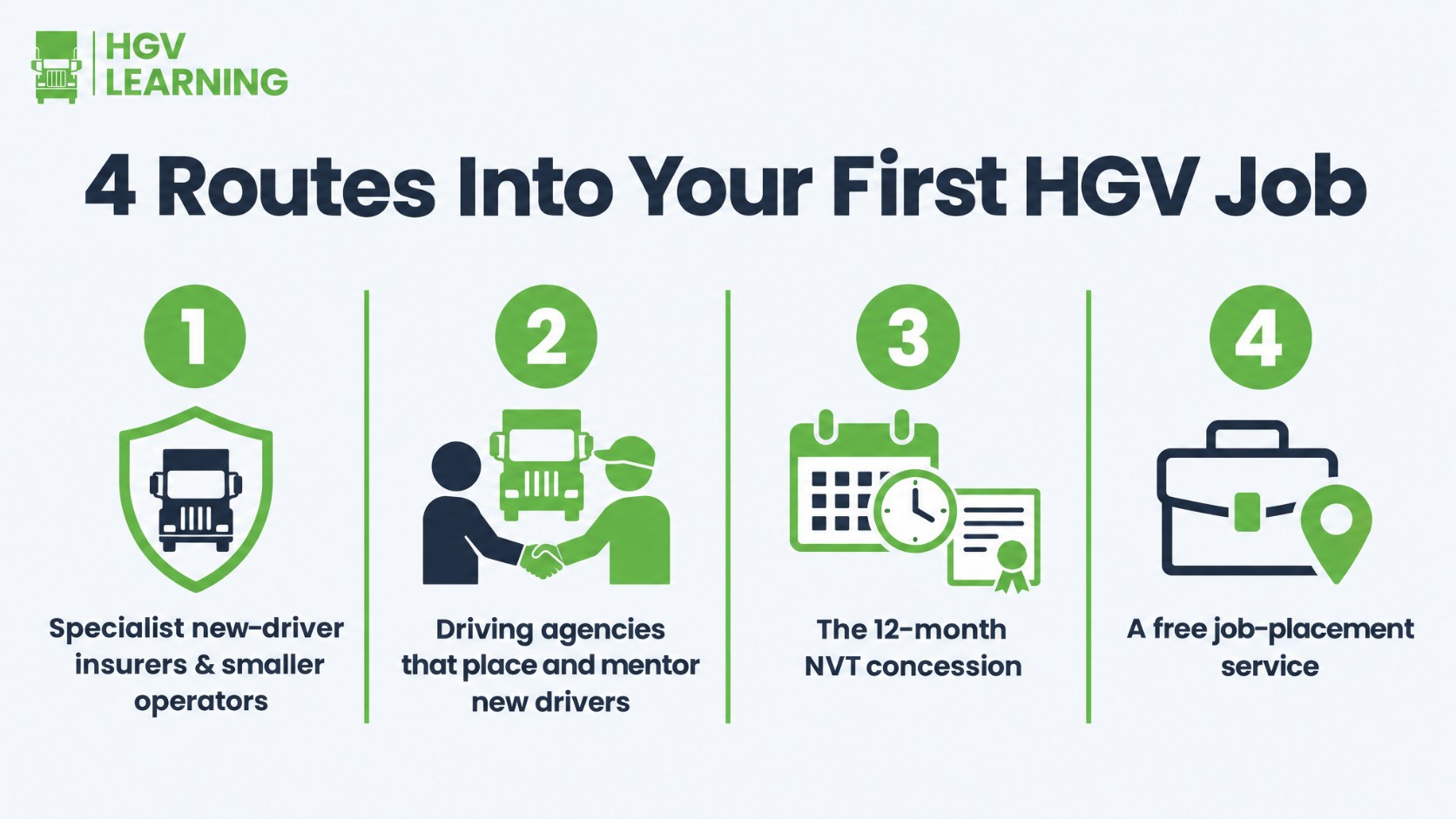
Once you understand that the two-year rule is an insurance default rather than a universal law, the task changes from “convince someone to break the rules” to “find the employers and routes that were never operating under that rule in the first place.” There are four that consistently work.
Specialist New-Driver Insurance and Smaller Operators
Not every fleet insurer applies the blanket two-year rule. Specialist commercial insurers increasingly offer cover for drivers from age 19, and smaller operators and owner-drivers are far more likely to be on one of these policies than the large national fleets whose insurance is written for scale, not flexibility. These operators are usually local, often family-run, and genuinely do take on newly qualified drivers, but they don’t always advertise it clearly, so it’s worth calling rather than only scrolling job boards.
Driving Agencies That Place and Mentor New Drivers
Agencies work differently from direct employers. Several specialise in placing newly qualified drivers with client operators under a supervised or mentored first placement, precisely because they carry their own negligence cover rather than relying solely on the client’s fleet policy. A first agency placement is often shorter-term and lower-paid than a permanent role, but it’s a legitimate, fast way to bank the 180 days and two years that direct employers are asking for everyone else to already have.
The 12-Month National Vocational Training Concession
If you trained through an approved Driver CPC course, you may be able to drive professionally for up to 12 months before completing the remaining parts of your Driver CPC test. This is the National Vocational Training (NVT) concession, and it genuinely widens the pool of roles open to you in your first year, since it lets an employer put you to work while you finish qualifying rather than waiting for every test to be passed first. Check with your training provider whether your course qualifies.
Using HGV Learning’s Job Placement Service
This is exactly the gap HGV Learning’s own recruitment support exists to close. It’s a free service for newly qualified drivers: your driving record and experience get properly assessed, you’re matched against a curated list of recruitment firms and operators who are actively looking for new drivers rather than filtering them out, and you get pointed toward local, long-haul and international roles that fit where you actually are, not where a generic job board assumes you should be. If you’ve trained with HGV Learning, this is the next step: see the recruitment advice page for how it works.
What Employers Actually Look For From a New Driver
Take the insurance rule out of the picture for a moment, because it isn’t the only thing an employer weighs up. The operators and agencies who do take on newly qualified drivers are still choosing between candidates, and a handful of things consistently separate the ones who get hired quickly from the ones who don’t:
A clean licence with no endorsements, and your full Driver CPC (or confirmed NVT concession status) ready to show, not just promised.
Honesty about being newly qualified rather than trying to talk around it (operators who take on new drivers already expect this and would rather know upfront).
Comfort with multi-drop work, manual handling and basic vehicle checks, even if your test routes never covered them in depth.
Flexibility on start times, routes and vehicle type in the first few months: the driver who says “I’ll take whatever gets me started” is easier to place than one with a long list of conditions.
A reference from your training provider or instructor, which carries real weight when you have no employer to vouch for you yet.
Building Real-World Confidence Before You Apply
You don’t need two years behind the wheel to walk into your first interview with something concrete to say. A handful of steps genuinely narrow the gap between “just passed” and “ready to work”:
Ask your training provider for a written reference the moment you pass, while your instructor’s assessment of you is fresh and specific.
Take any warehouse, yard or loading work you can get in the meantime: it shows you understand the environment you’ll be working in, even before you’re behind the wheel professionally.
If you hold or can add a related qualification, such as a forklift ticket, a HIAB or telehandler card, mention it. Multi-skilled new drivers are easier for a smaller operator to justify taking a chance on.
Drive as much as you reasonably can on a provisional or in a supervised capacity to keep your handling sharp between passing your test and starting work.
Register with two or three driving agencies that explicitly mention new-driver placements, rather than waiting on a single application to a large fleet operator.
Writing a CV That Gets You Hired With Zero On-Road Experience
A CV built around “experience: none” reads as a gap. A CV built around what you can actually prove reads as a genuine candidate. The difference is mostly about which section carries the weight.
CV section
What to put instead of “no experience”
Headline
“Newly qualified Cat C/C+E driver, full Driver CPC, clean licence.” State your qualification plainly, don’t apologise for it.
Training
Pass dates, training provider, and specific modules completed (manoeuvring, reversing, multi-drop practice) rather than just “completed HGV course”.
Work history
Any warehouse, logistics, driving (car/van) or physical work. Frame it around reliability, punctuality and handling goods safely.
Flexibility
State explicitly that you’re open to agency work, local routes first, or a supervised placement, as this tells an employer you understand the market.
References
Your instructor or training provider, plus any previous employer who’ll vouch for reliability and attitude.
Keep it to one page. Operators reading CVs from new drivers are scanning for the licence category, the pass date, and whether you sound like someone who’ll turn up and follow instructions, not for a polished personal statement.
Nailing the Interview With No HGV Experience
An interviewer hiring a newly qualified driver already knows you have no on-road history. What they’re actually testing is whether you understand the job well enough to be safe and reliable from day one.
Expect questions that probe judgement rather than war stories: how you’d handle a delayed delivery, what you’d do if a vehicle check flagged a fault, how you manage tiredness on a long shift, and whether you’re comfortable with manual handling and multi-drop work. Answer with what you were taught during training rather than guessing: examiners and instructors cover exactly these scenarios, and repeating that guidance accurately does more for you than inventing confidence you don’t have yet.
It’s also fine, and often better, to ask your own questions: what a typical first week looks like, whether there’s a mentor or more experienced driver you’d be paired with, and what the route to a permanent contract looks like if you start on an agency or trial basis. It signals that you’re thinking about the job seriously, not just trying to get past the interview.
What You Can Realistically Expect to Earn in Your First Role
Pay for a first HGV job varies by licence category and by route into the industry, and it’s worth going in with accurate numbers rather than the headline figures quoted for experienced drivers. The ranges below are drawn from Aspion’s 2026 UK HGV driver salary guide.
Route
Typical first-year pay
Cat C (Class 2), newly qualified, permanent
£21,000–£26,000 a year
Cat C (Class 2), standard permanent role once settled
£28,000–£36,000 a year
Agency work, either category, hourly
£16–£20 per hour
C+E (Class 1), standard permanent role
£38,000–£50,000 a year
C+E roles pay more because the licence itself is harder and more expensive to get, and because the supply of qualified Class 1 drivers is tighter, but very few employers will put a newly qualified driver straight into a Class 1 permanent role without at least some Cat C or agency experience first. A realistic first-year plan for most new drivers is Cat C or agency work building toward a Class 1 upgrade once the two-year mark and the day count are behind you.
The first year rarely pays what the job eventually will. Its job is to get the two years and 180 days behind you. After that, the market genuinely opens up.
Common Mistakes New Drivers Make When Job Hunting
Only applying to large national fleets, where the blanket two-year insurance rule is strictest and most consistently enforced.
Leaving a CV’s “experience” section blank instead of filling it with training detail, references and related work.
Turning down agency or supervised placements because they feel like a step down, when they’re usually the fastest route to banking the experience a permanent role will ask for next time.
Not asking training providers for a reference immediately after passing, when the instructor’s memory of your actual driving is freshest.
Giving up after the first few rejections from employers who were never going to consider a newly qualified driver in the first place, rather than redirecting effort toward the operators who do.
How HGV Learning Helps You Land Your First Job
Training is only half the journey, which is why HGV Learning’s support doesn’t stop at your test pass. The free recruitment service assesses your driving record and experience, matches you against operators and recruitment firms genuinely looking for newly qualified drivers, and gives you visibility of local, long-haul and international roles you’d likely never find by scrolling general job boards alone.
If you’re training for your C1, Cat C or C+E licence, or you’ve already passed and want a clearer first step than a stack of job adverts, start with the recruitment advice page or get in touch directly via the contact page. If cost is the thing holding you back from training in the first place, the repayment calculator is worth running the numbers through before you rule anything out.
It’s also worth reading up on what the job itself actually pays and involves before you commit to a route: our guides on Cat C licence costs, the Class 1 (C+E) training route, and if dangerous goods work interests you, ADR training costs all cover ground that affects which first job makes sense for you.
Is Your First Year Worth It If You’re Changing Careers?
If you’ve come into HGV driving from a completely different career, the first year can feel like a step backwards: lower pay than you were promised, agency work instead of a permanent contract, and a licence category you’ll likely upgrade from within eighteen months. It’s worth being honest about that trade-off rather than glossing over it.
What the first year buys you is the thing every better-paid role afterwards asks for: two years’ licence experience and 180 days in class, recorded and provable. Once you’re past that threshold, the insurance restriction that shut out 87% of vacancies simply doesn’t apply to you any more, and the roles that were never visible to you in year one open up properly: better routes, better vehicles and a real jump in pay.
Treat your first year less like a destination and more like the fastest route past the one restriction almost every new driver complains about.
Drivers coming from manual or driving-adjacent backgrounds, such as van delivery, warehouse work or forklift operation, tend to clear this first year fastest, because the physical side of the job is already familiar. If that’s you, it’s worth mentioning explicitly on your CV and in interview, since it’s a genuine point in your favour over someone with zero industry background at all. For a sense of what’s actually out there once you’re through the first year, our guides to Cat C job routes and finding lorry driver jobs near you are worth reading alongside this one.
Frequently Asked Questions
Can I get an HGV job with absolutely no experience in the UK?
Yes, but not from every employer. Large national fleets almost always apply the standard two-year insurance restriction, while smaller operators on specialist new-driver insurance, driving agencies that place and mentor new drivers, and recruitment services like HGV Learning’s free job-placement support all regularly place newly qualified drivers.
Why do so many HGV jobs ask for two years’ experience?
It comes from fleet insurance policies, not the law. Standard commercial fleet insurance typically requires a minimum of two years’ licence experience and 180 days spent driving in that category, and insurers haven’t published data justifying the threshold: it’s a default underwriting position, not a safety requirement with evidence behind it.
What is the 180-day rule for new HGV drivers?
It’s part of the standard insurance criteria alongside the two-year experience requirement: most fleet policies want to see 180 days actually spent driving in your licence category before covering you. It’s one of the two figures worth tracking as you build up your first year, alongside the two-year mark itself.
Can agencies really hire newly qualified drivers?
Yes. Agencies often carry their own negligence cover rather than relying solely on a client operator’s fleet policy, which lets them place newly qualified drivers into supervised or mentored first roles that a direct employer’s insurance wouldn’t otherwise allow. It’s usually the fastest legitimate route to banking real driving days.
What is the NVT concession and does it help me?
The National Vocational Training concession lets drivers who trained through an approved Driver CPC course drive professionally for up to 12 months before completing the remaining parts of the Driver CPC test. If your course qualifies, it can open up roles in your first year that would otherwise wait on your full CPC being complete, so check with your training provider whether it applies to you.
How much does a newly qualified HGV driver earn in their first year?
A newly qualified Cat C (Class 2) driver typically starts between £21,000 and £26,000 a year in a permanent role, or £16–£20 an hour through agency work. C+E (Class 1) roles pay considerably more, but very few employers put a newly qualified driver straight into a Class 1 permanent role without some Cat C or agency experience first.
Does HGV Learning help with job placement after training?
Yes, it’s a free service for newly qualified drivers. Your driving record and experience get assessed, you’re matched against recruitment firms and operators actively looking for new drivers, and you’re given visibility of local, long-haul and international roles you likely wouldn’t find on a general job board.
Should I take an agency job or hold out for a permanent contract?
For most newly qualified drivers, agency or supervised work is the faster route, not a step down. It builds the two years and 180 days that permanent employers are asking for, often faster than waiting on direct applications to large fleets that are least likely to consider a new driver in the first place.
What’s the fastest way to get past the two-year insurance threshold?
Start driving professionally as soon as possible after passing, even in agency or supervised work, since both the two-year clock and the 180-day count only move while you’re actually behind the wheel. Combining this with a reference from your training provider and applying to smaller operators and specialist-insured fleets alongside agencies gives you the best realistic odds of a fast first placement.
Related Articles
16/10/2026
What Age Can You Start HGV Driver Training? A 2026 UK Guide to Licence Age Requirements
If you're asking what age you can start HGV driver training, the honest answer depends on which licence you're after. A C1 licence, covering vehicles...