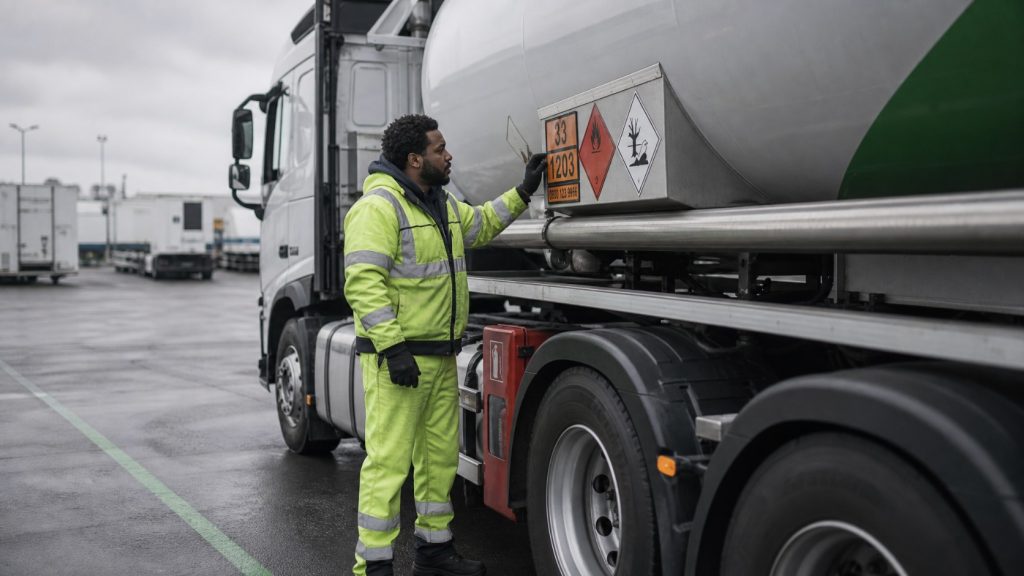
If you’ve got a full Cat C or C+E licence and you’re looking at moving into fuel, gas or chemical haulage, ADR is usually the next qualification on the list. The trouble is most training providers won’t give you a straight price until you fill in an enquiry form, and HGV Learning’s own course page is the same, it points you towards a tailored quote rather than a number. That’s not evasiveness, ADR pricing genuinely does depend on which modules you need, but it makes it hard to plan ahead if you’re weighing this up against other options.
This guide fixes that. Below is a real breakdown of what ADR training costs in 2026, what changes the price from driver to driver, whether it’s actually worth paying for, and how to avoid the common ways drivers end up spending more than they needed to.
What Is ADR Training and Who Needs It?
ADR is the international agreement covering the transport of dangerous goods by road, and an ADR qualification is what lets you legally drive vehicles carrying things like fuel, industrial gases, chemicals and flammable liquids. It sits on top of your existing HGV entitlement rather than replacing it, so you need a full Cat C or C+E licence before you can start.
The rules exist because dangerous goods are, by definition, higher risk to move than a standard palletised load. Under the Carriage of Dangerous Goods Regulations, which bring ADR into UK law, training has to happen before a driver takes on any responsibility for dangerous goods, and a physical ADR certificate has to be carried on every job. Gov.uk confirms you also need a full HGV licence and Driver CPC before you can even start ADR training.
Training is split into modules, and you only take the ones relevant to the goods you’ll be carrying. That’s the single biggest thing to understand before you start pricing this up: nobody actually pays for “ADR training” as one fixed product, they pay for a specific combination of modules.
ADR sits on top of your HGV licence rather than replacing it, so you only ever pay for the modules that match the goods you’ll actually be carrying.
The Nine Classes of Dangerous Goods, in Plain English
ADR groups every dangerous substance into nine numbered classes, and your training only needs to cover the ones relevant to your work:
Class 1 – Explosives. Rare in general haulage; usually a specialist add-on module.
Class 2 – Gases. Covers compressed, liquefied and dissolved gases, including LPG and industrial gas cylinders.
Class 3 – Flammable liquids. The class that covers fuel haulage, one of the most common ADR jobs on the road.
Class 4 – Flammable solids and substances that react with water or air.
Class 5 – Oxidising substances and organic peroxides.
Class 6 – Toxic and infectious substances.
Class 7 – Radioactive material. Rare and tightly controlled; almost always a specialist add-on.
Class 8 – Corrosive substances.
Class 9 – Miscellaneous dangerous goods and substances, a catch-all for goods that don’t fit classes 1 to 8 but are still regulated, such as certain environmentally hazardous substances.
Your Core and Packages modules give you broad coverage across most of these classes for packaged goods. Only Classes 1 and 7 are priced and trained as separate specialist add-ons, which is why the cost table above lists them individually rather than bundling them in.
How Much Does ADR Training Cost in 2026?
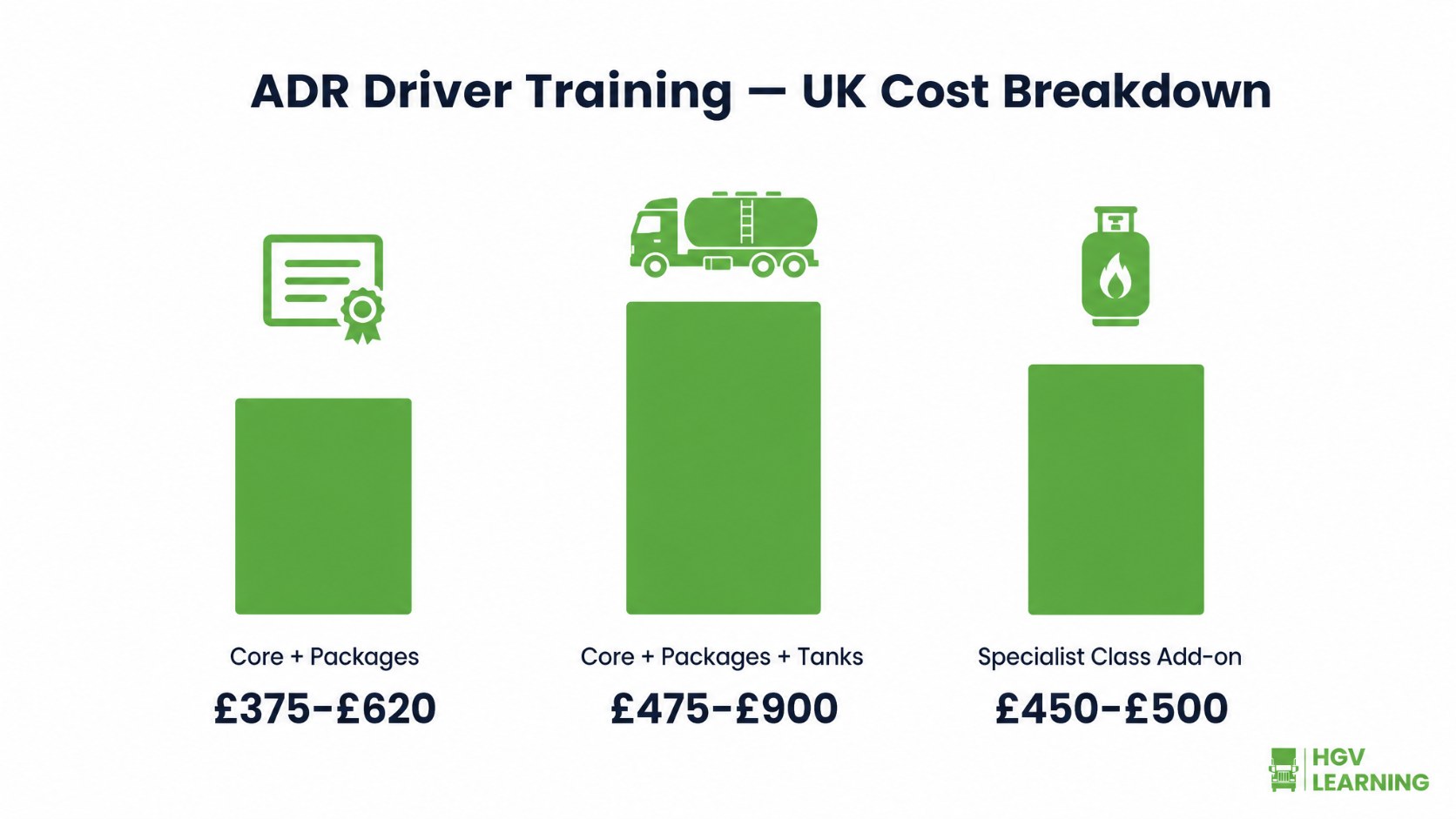
Prices vary between training providers and by region, but the figures below reflect what you’ll typically be quoted across UK providers for 2026. Treat this as a realistic planning range rather than an exact quote, since your own price depends on the factors covered further down.
Additional specialist class (Explosives or Radioactive)
£450 – £500 per class
1 day each
Full package (all classes, Core to Tanks)
£1,600 – £1,800+
7 – 10 days
Refresher, Packages only
£300 – £400
2 – 2.5 days
Refresher, Packages + Tanks
£350 – £450
4 – 5 days
Core, Packages and Tanker Modules
Core is the foundation module every ADR driver needs, covering general handling, documentation and emergency procedures for dangerous goods. Packages adds the classes for carrying goods in containers, drums and IBCs rather than bulk. Tanks is the module you need if you’ll be driving a tanker, and it’s priced separately because it adds extra practical assessment on top of the written exams.
Most drivers starting out take Core plus Packages first, since it covers the widest range of general haulage work. Tanks gets added later if a specific job needs it, which is often cheaper overall than booking everything up front for work you might never actually do.
Specialist Classes: Explosives and Radioactive Goods
Class 1 (explosives) and Class 7 (radioactive materials) are priced as standalone add-ons on top of Core and Packages, typically £450 to £500 each. Very few driving jobs need either one, so most drivers never book them, and there’s no reason to pay for them speculatively if nothing in your target job list actually requires it.
Refresher Training Costs
Your ADR certificate is valid for five years, and refresher training is genuinely cheaper than the initial course, usually 15 to 25% less. It covers the same modules you already hold rather than starting from scratch, and the exams are shorter as a result.
What Affects the Price You Pay
Six things move the number you’ll actually be quoted:
Which modules you need. Core and Packages alone is a different price to Core, Packages and Tanks, so be precise about the work you’re training for rather than over-buying.
Initial versus refresher. Renewing an in-date or recently-expired certificate is cheaper than training from zero.
Classroom versus online-plus-exam. Some providers run the theory portion online with a single in-person exam day, which can undercut a fully classroom-based course.
Region and provider. Prices in and around major logistics hubs are often slightly lower thanks to higher competition between training centres.
Group or employer bookings. Providers regularly discount per-head pricing for fleet operators booking several drivers at once.
Exam resits. A first-time pass is included in the course price; a resit for a failed module usually carries its own separate fee.
Choosing exactly the modules your work needs, rather than the full package, is usually the single biggest saving available.
New Driver Versus Renewing an Existing Certificate
If you’re training in ADR for the first time, budget for the full initial course price and expect the full duration, since none of it can be shortened. If your certificate has lapsed or is close to expiring, ask specifically for the refresher rate rather than being quoted the initial-training price by default, some providers only offer the discount if you say upfront that you’re renewing.
A certificate that’s already expired by more than a set period (this varies slightly by provider) can sometimes be treated as a fresh application rather than a refresher, which pushes the price back up to the initial rate. If your certificate is due to lapse, it’s worth booking the refresher before the expiry date rather than after it.
Common Mistakes That Push the Price Up Unnecessarily
A few avoidable habits account for most of the money drivers overspend on ADR training:
Booking the full package “just in case.” Paying for Class 1 or Class 7 on the assumption you might need them one day is rarely worth it when neither is common in general haulage work.
Not asking about the refresher rate. Some providers won’t proactively apply it, you need to state that you already hold an ADR qualification.
Booking Tanks before confirming the job needs it. Tanks adds real cost and an extra day or two of training; only book it once you know it’s required.
Ignoring employer or agency funding. Plenty of drivers pay out of pocket for training that an employer or agency would have covered, simply because they didn’t ask before booking.
Is ADR Training Worth the Investment?
ADR-qualified drivers are consistently paid more than standard HGV drivers holding the same underlying licence category, because fewer drivers hold the qualification and the goods carry more risk. Reed’s current UK salary data puts the average ADR driver salary at £41,165, and pay rises further for drivers who also hold the Tanks module or a specialist class.
Set against a typical training cost of £475 to £900 for Core, Packages and Tanks, most drivers recover the outlay within the first few months of ADR-rate work. For a fuller breakdown by region and experience level, see our ADR driver salary guide.
ADR training genuinely earns its cost back. A qualified driver typically commands several thousand pounds more a year than a standard HGV driver doing the same underlying licence category.
The Types of Jobs ADR Actually Opens Up
ADR-qualified drivers aren’t limited to one type of work. Fuel tanker driving for fuel distribution companies is the most common route, and it’s steady, well-paid work since fuel deliveries don’t stop. Gas and chemical distribution is the other major route, delivering to industrial sites, agricultural suppliers and construction firms.
Hazardous waste transport is a smaller but consistently in-demand niche, since waste carriers need ADR-qualified drivers to move classified waste between sites legally. Some drivers also move into emergency or standby work for chemical plants and refineries, which tends to pay a premium again on top of standard ADR rates.
Why ADR-Qualified Drivers Stay in Demand
The Road Haulage Association estimates the UK needs around 40,000 new HGV drivers a year for the next five years, roughly 200,000 in total, just to keep pace with demand across the sector as a whole. That figure covers general Cat C and C+E driving, not ADR specifically, but it sets the backdrop: HGV driving overall is short of people, and ADR-qualified drivers are a smaller pool again within that. Fewer drivers hold the qualification than hold a standard HGV licence, which is a large part of why the pay gap between ADR and non-ADR work has held up.
Choosing an ADR Training Provider
Price shouldn’t be the only thing you compare. A few checks are worth doing before you book, regardless of which provider quotes the lowest number:
JAUPT approval. Confirm the course is JAUPT-approved so it genuinely counts towards your Driver CPC hours, not every course that mentions ADR automatically does.
What’s actually included in the price. Check whether exam fees, DVSA certificate processing and materials are bundled in, or charged separately once you’ve already committed.
Practical assessment quality, not just theory. Tanks training in particular should include genuine hands-on practical time, not just a written module.
Resit policy. Ask what happens, and what it costs, if you don’t pass a module first time.
Location and format. A provider offering online theory with one local exam day can save you several days off the road compared to a fully residential course.
How ADR Training Counts Towards Your Driver CPC Hours
Every HGV driver needs 35 hours of periodic Driver CPC training every five years to keep their licence valid, covered in more depth in our own Driver CPC guide. A JAUPT-approved ADR course counts towards those hours, so the time you spend on ADR training isn’t an extra obligation on top of your CPC requirement, it’s part of it.
That matters for cost planning too. Hours spent on ADR training are hours you don’t need to find elsewhere for a separate CPC module, which is worth factoring in alongside our Driver CPC cost guide when you’re budgeting your full five-year training cycle.
As a rough worked example: Core plus Packages plus Tanks typically runs to around 5 days, which comfortably covers a meaningful chunk of your 35-hour CPC requirement in one go. That leaves fewer separate CPC days to book elsewhere over the rest of the five-year cycle, which is a real saving even though it doesn’t show up directly on the ADR invoice itself.
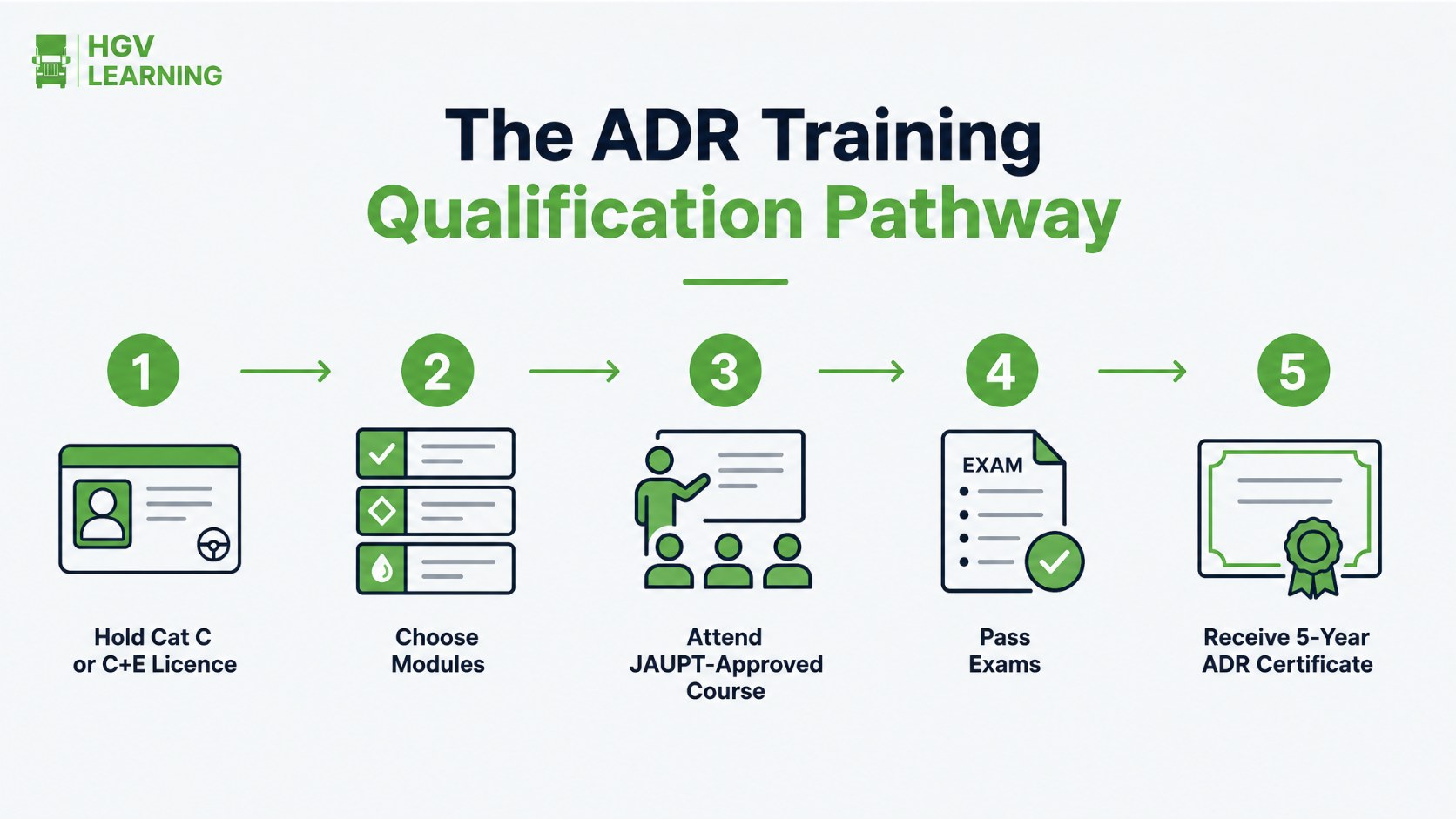
Step-by-Step: How to Get ADR Qualified
Confirm you already hold a full Cat C or C+E licence, since ADR is added on top of it, not taken instead of it.
Work out which modules the job actually needs (Core, Packages, Tanks, or a specialist class) rather than booking everything.
Book a course with a JAUPT-approved provider and complete the classroom or online-plus-exam training.
Sit and pass the multiple-choice exams for each module you’ve trained in.
Receive your ADR vocational training certificate, valid for five years from the date of issue.
A few practical routes bring the real cost down without cutting corners on the qualification itself:
Ask your employer to fund it. Operators actively recruiting ADR drivers will often cover training costs outright, or split them with a return-of-service agreement.
Check with recruitment agencies. Some driving agencies fund ADR training for drivers who commit to taking shifts through them once qualified.
Book only the modules you need now. You can always add Tanks or a specialist class later once a specific job calls for it.
Compare online-plus-exam formats. These can be genuinely cheaper than five days in a classroom if your own study discipline suits it.
If you’re weighing this up alongside other add-on qualifications, our guides to HIAB training cost and telehandler training cost cover the other two most common HGV add-ons, both of which also open up higher-paying work. And if you’re still exploring routes into ADR work generally, our recruitment advice page covers how agencies place newly-qualified drivers.
Because ADR training counts towards your 35-hour Driver CPC requirement, the hours you spend training aren’t a separate cost on top of your CPC obligations, they’re part of it.
Getting Started
ADR training is one of the more affordable ways to increase your earning potential as an HGV driver, and the real cost is smaller than most drivers assume once the “contact us for a quote” uncertainty is stripped away. For most people starting out, Core plus Packages at £375 to £620 is the sensible first step, with Tanks or a specialist class added later once a specific role actually needs it.
If you’re ready to move ahead, get in touch with HGV Learning for a quote based on the exact modules your target job needs, or visit our ADR training course page for more on how the course itself is structured and delivered. Our training cost calculator is also worth a look if you’re weighing ADR up against other qualifications, and our FAQs page covers more general questions about training with us.
Frequently Asked Questions
How much does ADR training cost in total?
Most drivers pay between £375 and £900 for their initial training, depending on whether they need Packages only or Packages plus Tanks. Specialist classes like Explosives or Radioactive add roughly £450 to £500 each on top.
Do I need a Cat C or C+E licence before I start ADR training?
Yes. ADR is added on top of an existing HGV licence, it isn’t a standalone category. You need a full Cat C or C+E licence first.
How long does ADR training take?
Core plus Packages typically takes 3 to 3.5 days. Adding Tanks extends this to around 5 days. Refresher courses are shorter, usually 2 to 5 days depending on which modules you’re renewing.
How long does an ADR certificate last?
Five years from the date of issue. After that you need refresher training and to re-sit the relevant exams to stay qualified.
Can I do ADR training online?
Some providers run the theory portion online with a single in-person day for the practical elements and exams. This can work out cheaper than a fully classroom-based course, though you still need to attend in person to sit the exams.
Does ADR training count towards my Driver CPC hours?
Yes, a JAUPT-approved ADR course counts towards the 35 hours of periodic Driver CPC training you need every five years, so it isn’t an extra obligation on top of your CPC requirement.
Will an employer or agency pay for my ADR training?
Often, yes. Operators and recruitment agencies actively looking for ADR drivers will frequently cover training costs, sometimes in exchange for a minimum commitment period once you’re qualified.
Is the Tanks module worth paying for upfront?
Only if you already know the job needs it. Tanks adds cost and extra training days, so most drivers are better off starting with Core and Packages, then adding Tanks later once a specific tanker role comes up.
What happens if I let my ADR certificate expire?
You’ll usually still be able to renew it as a refresher for a period after expiry, but leave it too long and some providers will treat it as a fresh application at the full initial-training price. Booking your refresher before the certificate lapses avoids this entirely.
Related Articles
16/10/2026
What Age Can You Start HGV Driver Training? A 2026 UK Guide to Licence Age Requirements
If you're asking what age you can start HGV driver training, the honest answer depends on which licence you're after. A C1 licence, covering vehicles...