Ask most training providers what telehandler training costs and you will usually get the same answer: "get in touch for a quote." That is not much use when you are trying to work out whether a new qualification is actually within reach.
The real figures are not a secret. Telehandler training in the UK typically costs between £900 and £1,700, depending on whether you train through NPORS or CPCS, and whether you are starting from scratch or already have relevant plant experience.
This guide sets out exactly what you will pay, what changes the price, and how to work out which route fits the work you actually want to do. If you would rather talk it through, you can see the full course details on our telescopic handler training page.
What Is Telehandler Training, and Do You Need a Driving Licence?
A telehandler, short for telescopic handler, is plant machinery used to lift, carry and place loads on construction sites, farms and in warehouses. It is not a road vehicle, so operating one does not require a DVLA driving licence category the way an HGV does.
What it does require is a recognised plant operator qualification, delivered through one of two UK-wide accreditation schemes: NPORS or CPCS. Employers, sites and insurers generally expect to see a valid card from one of these before they will let you near the controls.
A lot of people training for telehandler work already hold, or are working towards, an HGV licence. The two pair well: a Cat C licence gets you behind the wheel, while a telehandler ticket widens the roles you can take on once you are on site, particularly in construction logistics, agriculture and plant hire.
NPORS and CPCS: the two accepted schemes
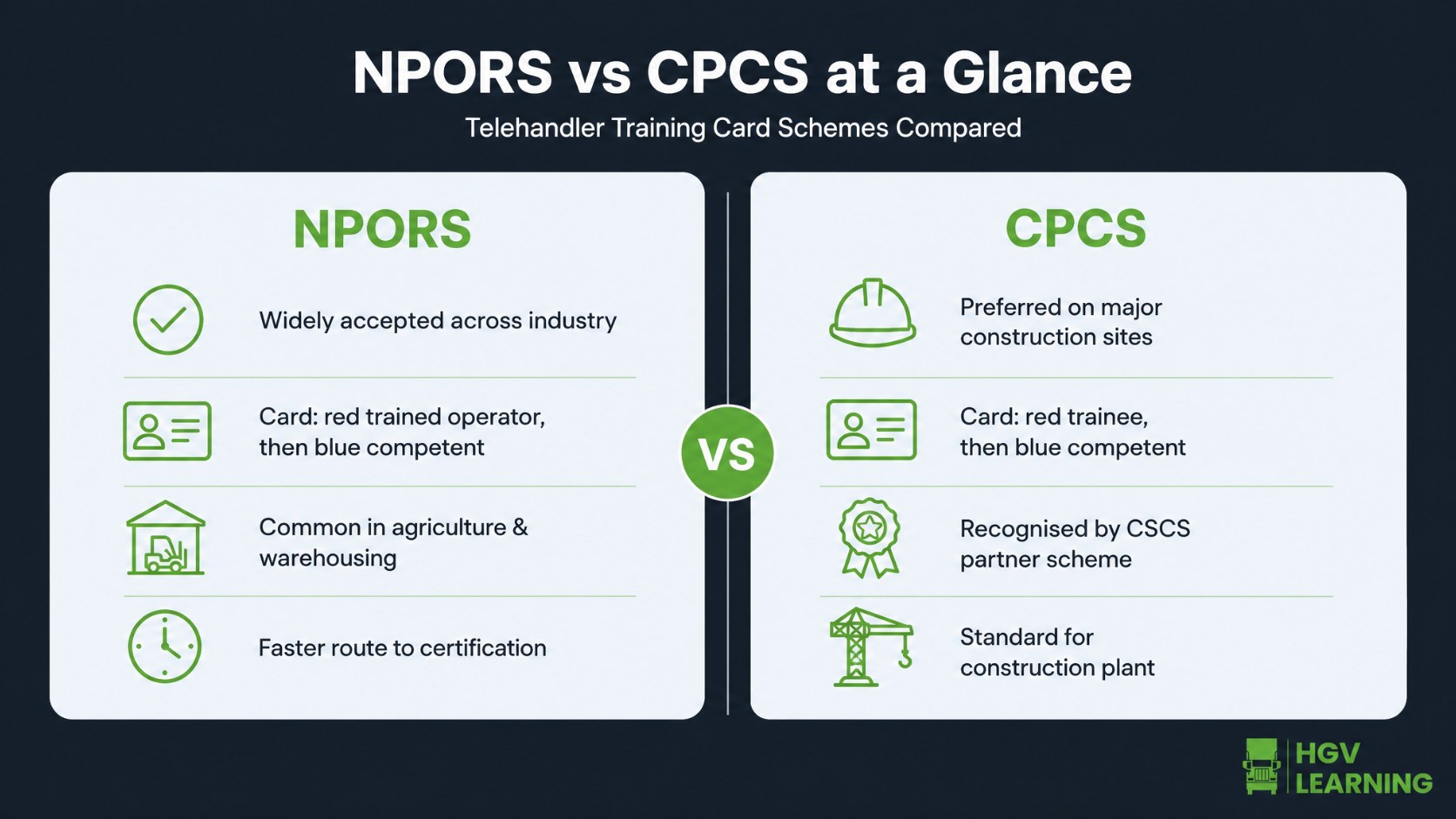
NPORS (National Plant Operators Registration Scheme) and CPCS (Construction Plant Competence Scheme) both certify telehandler operators, and both are widely recognised across UK construction, agriculture and logistics sites.
Neither scheme is universally "better." Some principal contractors and larger construction projects specifically ask for CPCS, since it sits closest to the CSCS card system used across major UK building sites. Others accept NPORS without issue, and NPORS also offers a version of its card without construction branding, useful if you are working in agriculture or warehousing rather than on a construction site.
The honest answer is to check what your target employer or site actually asks for before you book, since that decides which scheme is worth paying for.
Telehandler vs forklift: not the same qualification
Telehandlers and forklifts are often confused, but they are different machines with different qualifications. A forklift moves loads on forks in a relatively flat, low-reach environment, usually indoors or in a yard. A telehandler extends a telescopic boom to lift and place loads at height and at a distance, which is why it needs its own NPORS or CPCS category rather than a forklift ticket.
If you already hold a forklift qualification, it will not cover you to operate a telehandler, and vice versa. Our guide to the forklift theory test covers the related but separate forklift route if that turns out to be the better fit for the work you are aiming for.
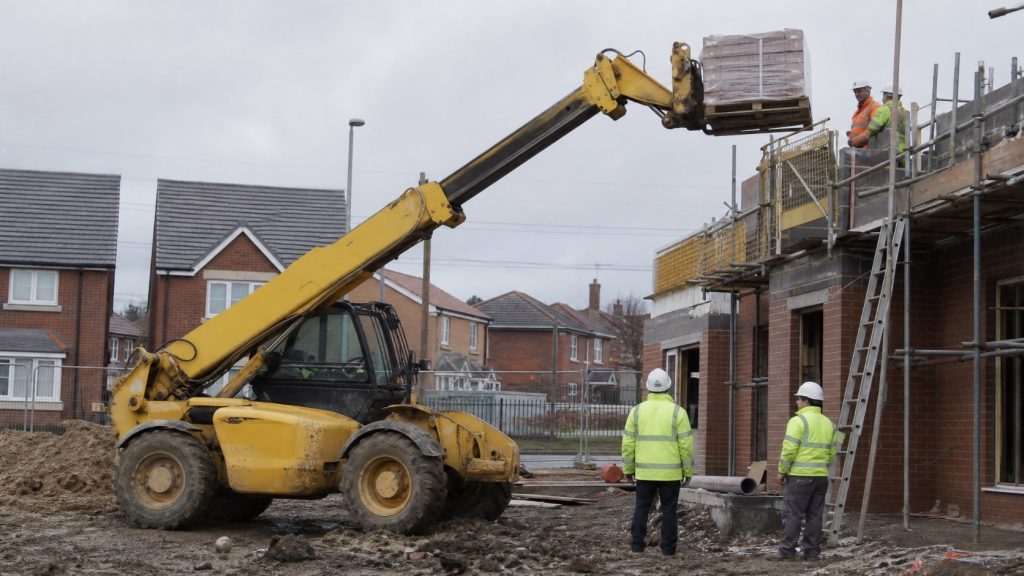
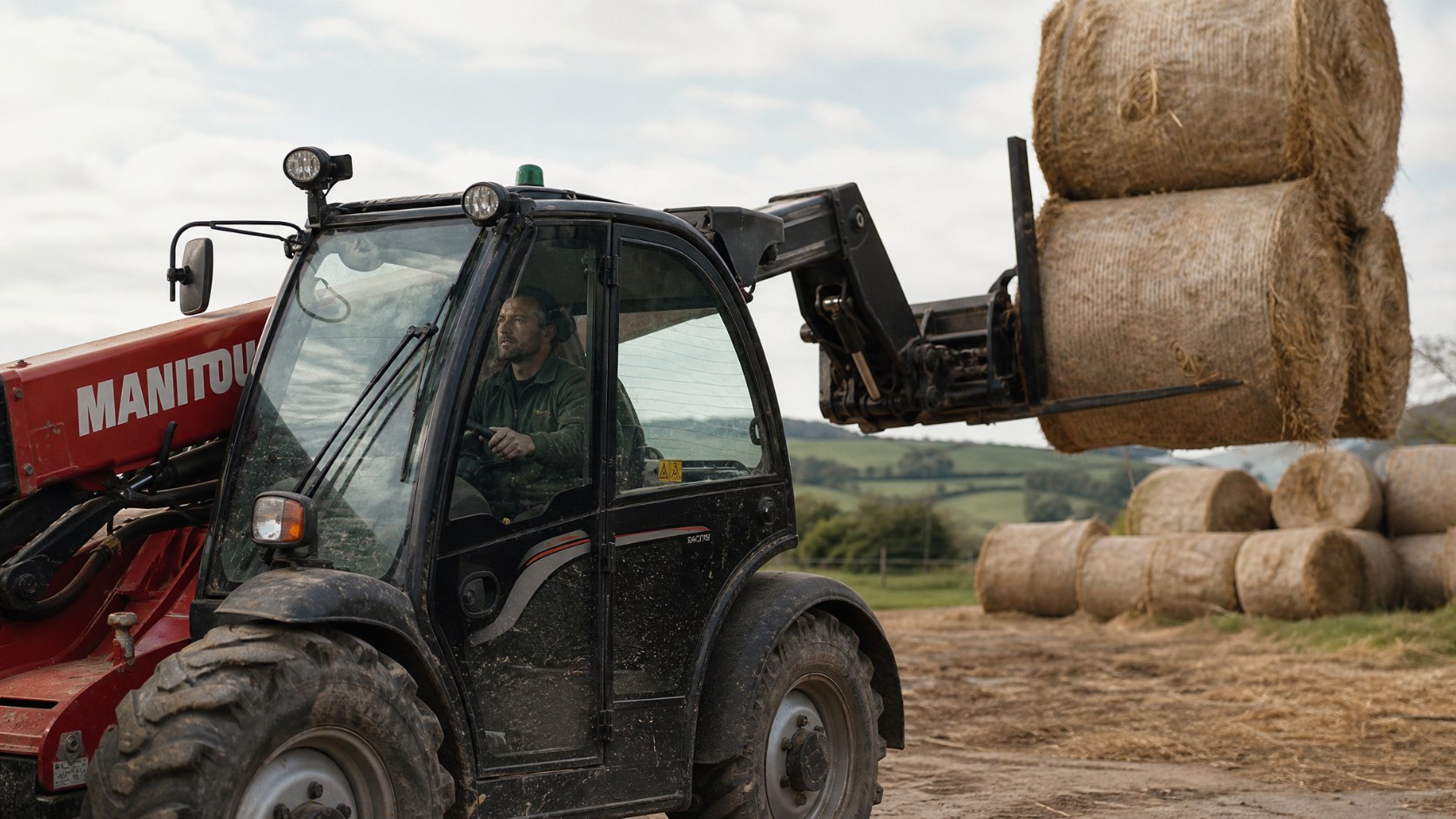
Telehandlers turn up on a wide range of sites: house builders use them to move materials to upper floors, farms use them for bale handling and feeding, and warehouses use larger models for racking work that a standard forklift cannot reach. The qualification you need is the same regardless of sector, but the machine size and attachments can vary.
The Real Cost of Telehandler Training in 2026
Prices vary by training provider, region, group size and exactly which category you are training for, so treat the figures below as a realistic UK-wide range rather than a fixed price list. No governing body sets a national price for either scheme.
Course
Duration
Typical cost
CPCS A17 (standard telehandler, novice)
5 days
£1,200–£1,500
CPCS A77 (360° slew telehandler, novice)
5 days
£1,500–£1,700
NPORS N010 (telehandler, novice)
3–5 days
£900–£1,200
Experienced operator / refresher
1–2 days
£300–£500
A17 to A77 conversion
1–2 days
£700–£900
The novice course is the expensive part. Once you are carrying a card, keeping it valid or adding a related category costs a fraction of the original price.
What is included in the price
A novice course price normally covers the full training days, use of the machine and instructor time, theory and practical tuition, the test or assessment itself, and your card application once you pass.
Some providers include the CITB Health, Safety and Environment test if you do not already hold one. Others charge it separately, so it is worth checking exactly what is bundled before you book rather than assuming. Group bookings can also bring the per-person price down, so if you are training two or three staff at once, it is worth asking whether the provider offers a group rate before booking each person separately.
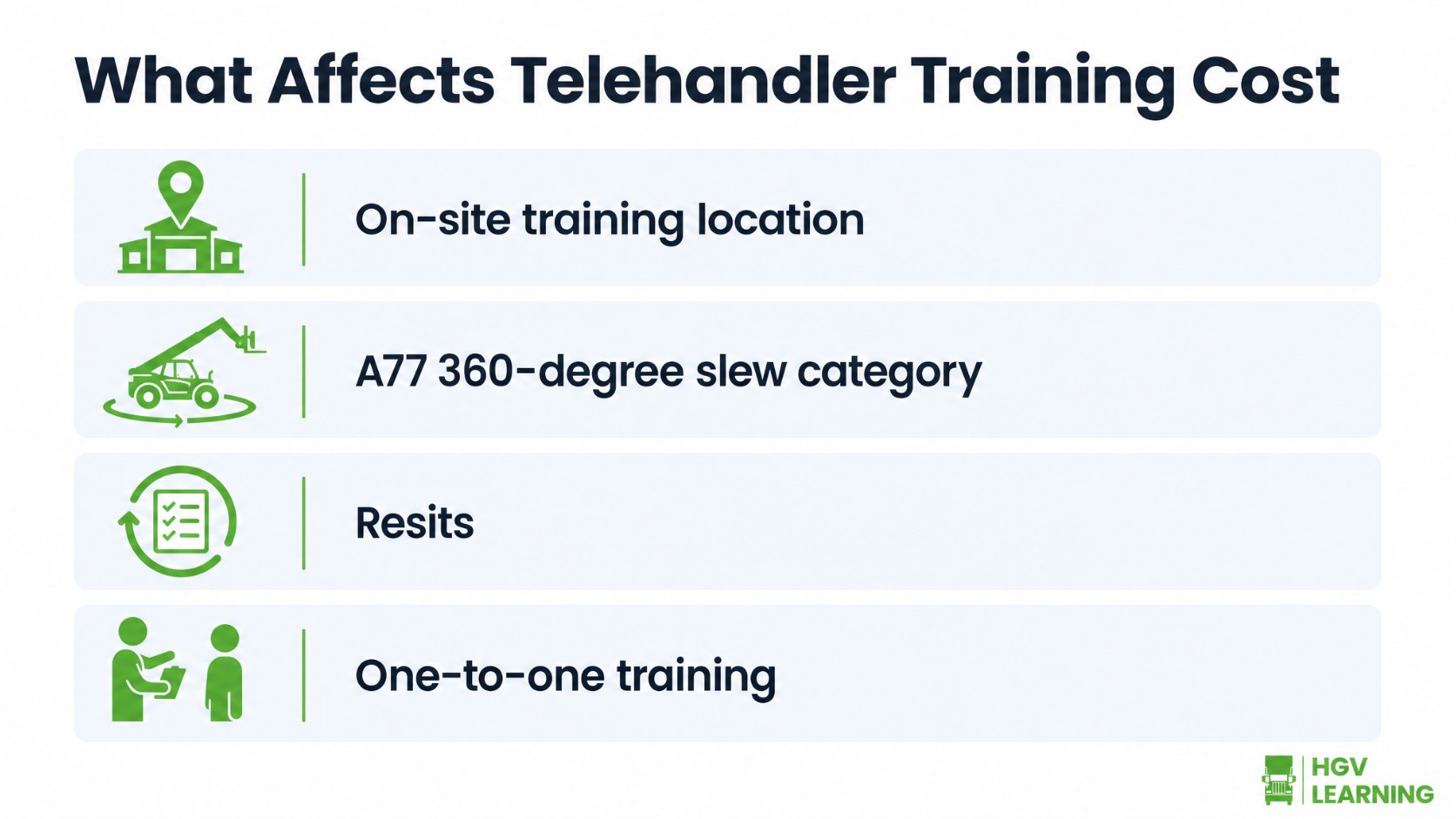
What can push the price up
Training on-site at your own workplace rather than at a training centre, which usually costs more but saves travel and accommodation.
The A77 360° slew category, which commands a higher price than the standard A17 because the machine and the skill set are more specialised.
Resits if you do not pass first time, typically charged separately from the original course fee.
One-to-one or small-group training instead of a full course, which increases the per-person cost but can mean a faster pass.
Novice vs Experienced Operator Training: Which Do You Need?
If you have never operated a telehandler before, you will need the full novice course, typically 3 to 5 days depending on the scheme. This covers everything from basic controls and pre-use checks through to safe lifting, load handling and manoeuvring, all under supervision.
If you have already operated a telehandler informally, perhaps on a farm or in a previous job, without a formal card, the experienced operator route is usually faster and cheaper. It is a shorter course, typically 1 to 2 days, that tests and formalises skills you already have rather than teaching from zero.
What a novice course actually covers day by day
Most 5-day novice courses split roughly into two phases. The first two to three days cover theory, pre-use inspection, basic controls and low-risk manoeuvring in a controlled environment.
The remaining days move into practical lifting exercises, load placement, working near other plant or structures, and a final practical test. Some providers run the CITB Health, Safety and Environment test alongside this if it is not already held.
Be honest about which category you actually fit. Providers can usually tell within the first hour whether someone booked onto the experienced route genuinely has the background for it.
NPORS or CPCS: Which Should You Choose?
Start with the job, not the scheme. If you are aiming for work on major construction sites through a principal contractor, check whether they specify CPCS, since some do, and NPORS will not be accepted for that particular site.
If you are heading into agriculture, warehousing or general plant hire, NPORS is widely accepted and tends to be the cheaper route for the same novice qualification. It is also often quicker to book, since NPORS training is delivered through a wider network of registered providers, including on-site options.
If you are not sure yet which sites you will end up working on, it is worth asking a few local employers or agencies which card they actually ask for before committing to a scheme.
Is Telehandler Training Worth the Cost?
A novice telehandler course is a genuine outlay, so it is fair to ask whether it pays for itself. For most people moving into construction, agriculture or warehouse work, the answer is yes, and fairly quickly.
A telehandler card widens the roles you are eligible for on almost any site that uses lifting plant, often without needing a separate job change. Many operators recover the cost of training within their first few weeks of qualified work, simply through the wider pool of roles a valid card opens up.
It also compounds well alongside other qualifications. Someone who already holds an HGV licence and adds a telehandler card, or vice versa, becomes noticeably more employable than someone with only one ticket, since fewer candidates can offer both.
If your CV needs to work across multiple sectors, NPORS tends to give more flexibility. If you are set on major construction contracts specifically, CPCS is usually the safer bet.
It is also worth asking whether your employer, or the agency placing you, has a preference before you pay for training yourself. Some employers fund or part-fund NPORS or CPCS training for staff moving into plant roles, and choosing the scheme they already work with can make that conversation easier.
CITB Grant Funding for Telehandler Training
If you are training through an employer registered with the CITB levy, some or all of the cost may be recoverable through a grant, which changes the real cost picture significantly.
According to CITB’s current plant standards and grants guidance, telehandler training sits under Plant tier 2, with a novice grant of £630 per person and an experienced operator grant of £300 per person, claimed by the training provider on the employer’s behalf.
To qualify, the course needs to meet CITB’s current plant training standards, be delivered by an approved training organisation, and result in a card carrying the CSCS logo. That last point matters if you are considering NPORS’s non-CSCS "Traditional" card, since that version will not attract the grant even though it is a valid operator card for non-construction work.
Self-employed operators paying for their own training are not usually eligible in the same way, so it is worth asking your training provider directly whether a specific course qualifies before assuming a grant applies.
Card Validity and the Cost of Staying Qualified
Both schemes issue a Red, or "trained operator," card first. This is valid for 2 years and marks you as trained but still building up supervised experience on site.
After that, moving onto a Blue, or "competent operator," card usually needs further on-site experience and, often, an NVQ or equivalent assessment. A Blue card is valid for 5 years once awarded, and renewal at that point is far cheaper than the original novice course, typically a short refresher and reassessment rather than a full retrain.
Under LOLER, the Lifting Operations and Lifting Equipment Regulations, employers also have a legal duty to make sure lifting operations are properly planned and supervised by a competent person, which is part of why a valid card matters beyond just site access. Separate thorough examination requirements also apply to the machine itself, covering the lifting mechanism under LOLER and other safety-critical parts, such as brakes and steering, under PUWER.
Career Opportunities and What Telehandler Operators Earn
Telehandler operators are in steady demand across construction, agriculture and warehousing, and the qualification pairs well with other tickets if you want to widen the roles you are eligible for.
According to Reed’s UK salary data, the average telehandler salary sits around £40,546 a year, with typical roles ranging from roughly £40,300 to £40,700. Some regions, including Blackburn and Edinburgh, have shown average salaries closer to £45,800 for the same work.
A telehandler card rarely stands alone. Most of the highest-earning roles go to operators who can also drive, or who hold a second plant ticket alongside it.
If you already hold, or are working towards, an HGV licence, adding a telehandler qualification is a genuinely efficient way to widen your options. Combining plant operation with HIAB lifting work or a Cat C licence opens up construction logistics and site-based haulage roles that a single qualification alone would not reach. For roles once you are qualified, our recruitment advice service works with newly qualified drivers and plant operators across the UK.
Typical employers include house builders, groundworks and civil engineering contractors, agricultural businesses, and warehouse or distribution operators running larger telehandlers for racking work. Plant hire companies also take on qualified operators directly, sometimes offering more varied day-to-day work across different sites and machines.
Common Mistakes to Avoid When Booking Telehandler Training
Booking the wrong category. A17 and A77 are separate qualifications, and paying for A17 when your target job actually needs A77 360° slew experience means paying again later.
Choosing a scheme before checking what your target employer accepts, then finding out too late that the site specifically requires the other one.
Assuming the quoted price includes everything. Test fees, card application costs and the CITB Health, Safety and Environment test are not always bundled in.
Leaving the Red-to-Blue card upgrade too long. Employers increasingly expect to see progress towards a competent operator card, not just a trained operator one, once you have a couple of years of experience.
How to Choose a Telehandler Training Provider
Price alone is not a reliable way to choose a provider. A few checks matter more:
Confirm the provider is accredited to deliver NPORS or CPCS specifically, not just plant training in general.
Ask what is actually included in the quoted price: theory, practical, test fees, and the card application.
Check the machine you will train on matches what you will actually be operating on site, particularly for A77 360° slew work.
Ask about pass rates and what happens, cost-wise, if you do not pass first time.
Once you have picked a scheme and provider, the path to a card follows a fairly consistent shape:
Confirm whether you need the novice or experienced operator route.
Book onto an accredited NPORS or CPCS course matching your chosen category, A17, A77 or equivalent.
Complete the theory and practical training days.
Pass the test or assessment and apply for your Red, trained operator, card.
Build supervised on-site experience towards a Blue, competent operator, card.
Frequently Asked Questions
How much does telehandler training cost in the UK?
Novice telehandler training typically costs between £900 and £1,700, depending on whether you train through NPORS or CPCS and which category you need. Experienced operator and refresher courses cost significantly less, usually £300 to £500.
Do I need a driving licence to operate a telehandler?
No. A telehandler is plant machinery, not a road vehicle, so it does not fall under DVLA driving licence categories. You need a recognised NPORS or CPCS operator card instead.
What is the difference between an A17 and an A77 telehandler category?
A17 covers standard telescopic handlers. A77 covers 360° slew telehandlers, which rotate on their base like a crane. A77 training costs more and is a distinct qualification, not an automatic upgrade from A17.
How long does telehandler training take?
A novice course usually runs 3 to 5 days depending on the scheme and category. An experienced operator or refresher course is typically 1 to 2 days.
Is NPORS or CPCS better for telehandler work?
Neither is universally better. Some construction principal contractors specifically require CPCS, while NPORS is widely accepted in agriculture, warehousing and general plant hire. Check what your target employer or site asks for before booking.
How long is a telehandler card valid for?
A Red, trained operator, card is valid for 2 years. A Blue, competent operator, card, awarded after further supervised experience, is valid for 5 years.
Can I train for a telehandler card alongside my HGV licence?
Yes, and many operators do. A telehandler qualification pairs well with a Cat C or C+E licence, particularly for construction logistics and site-based haulage roles that call for both driving and plant skills. See our guide on HIAB training costs for a comparable lifting qualification.
Budget £900 to £1,200 for NPORS novice training, £1,200 to £1,700 for CPCS depending on category, or £300 to £500 if you already have experience and just need the experienced operator route. If your employer is CITB-registered, check the grant first, since it can cover a meaningful chunk of the novice course cost.
Beyond the price tag, the choice that matters most is NPORS versus CPCS, and that comes down to what the sites you want to work on actually ask for, not which scheme happens to be cheaper on paper. Get that right first, and the rest of the decision is straightforward.
Related Articles
16/10/2026
What Age Can You Start HGV Driver Training? A 2026 UK Guide to Licence Age Requirements
If you're asking what age you can start HGV driver training, the honest answer depends on which licence you're after. A C1 licence, covering vehicles...