You pass your theory test, book your practical, and then realise nobody has actually told you what happens on the day itself. Most guides talk about nerves and general tips.
Few explain the structure: what Part 3a and Part 3b actually involve, what the examiner is marking, and what the coupling and uncoupling exercise really demands if you are training for C+E.
That gap matters. Candidates who know the shape of the test walk in calmer, because there are fewer surprises left to manage. This guide sets out exactly what happens in the HGV practical test, category by category, with the official DVSA structure, fees, and fault rules rather than vague reassurance.
It also goes deeper on one exercise most other guides skim over: coupling and uncoupling an articulated trailer, the step that only applies to C+E candidates and the one that catches out otherwise capable drivers.
1. How the HGV Practical Test Is Actually Structured
The HGV practical test is not one event. It is split into two separate DVSA assessments, Part 3a and Part 3b, booked and taken separately and often on different days.
Part 3a is the off-road exercises test. Part 3b is the on-road driving test. You must pass Part 3a before you can book Part 3b, and both are part of the wider Driver CPC qualification alongside the Part 1 theory test and Part 2 case studies.
Part 3a: the off-road exercises
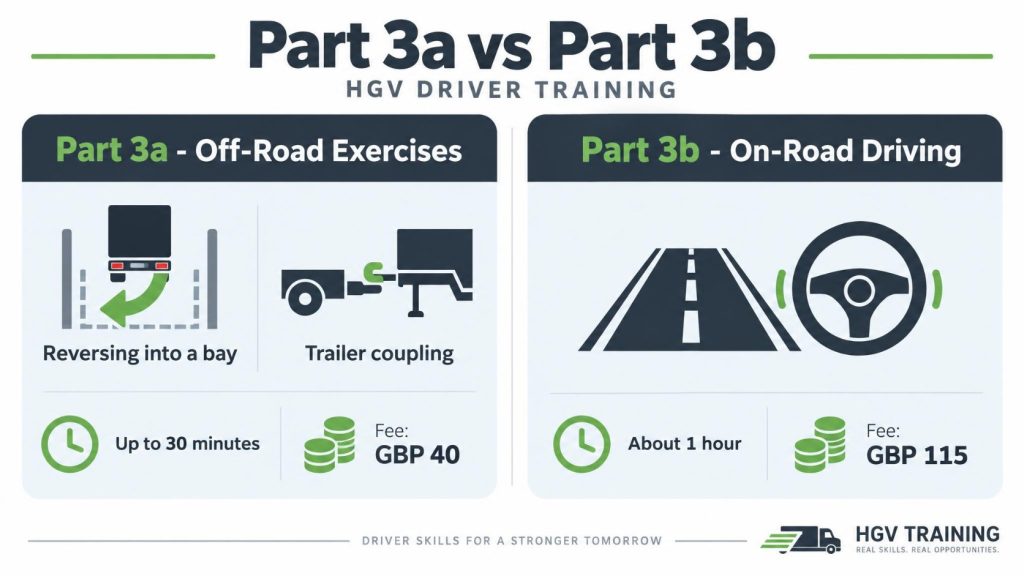
Part 3a lasts up to 30 minutes and takes place off the public road, usually in a manoeuvring area at the test centre or training site. It has two possible elements, depending on your category.
The reversing exercise: an “S” shaped reverse into a marked bay, assessed on vehicle control and observation.
Uncoupling and recoupling: required only if your test vehicle has a trailer, which means every C+E candidate has to complete it.
You can make a mistake and carry on. The examiner only stops the test early if your driving becomes a danger to others, according to DVSA’s own Part 3a guidance. A pass gives you a certificate valid for Part 3b, which you then need to book separately.
Part 3b: the on-road drive
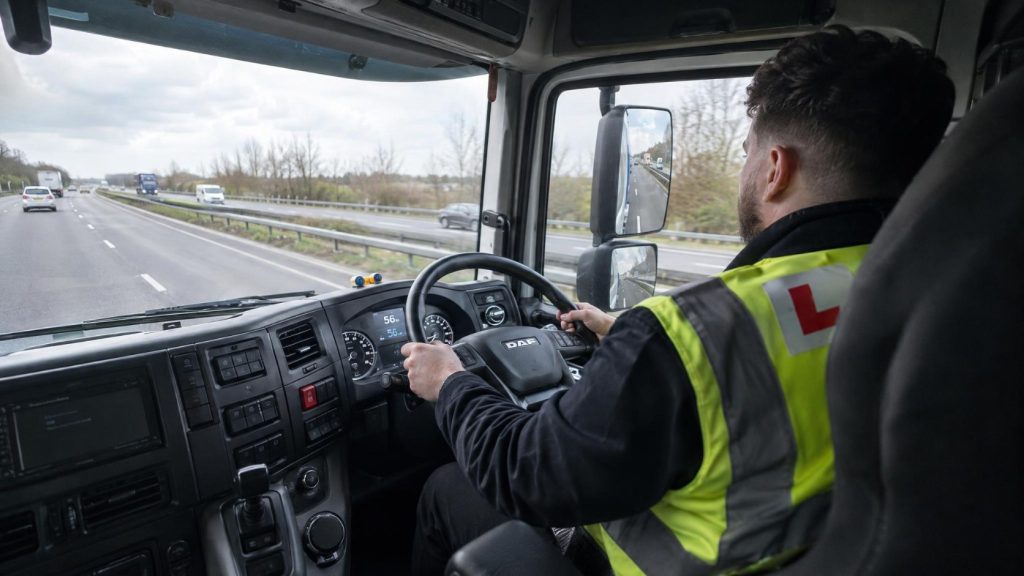
Part 3b is the one most people picture when they think of “the driving test”. It runs for about an hour and includes 10 minutes of independent driving, where you follow road signs or a simple route rather than turn-by-turn instructions from the examiner.
To pass, you need 12 or fewer driving faults and no serious or dangerous faults, confirmed directly on DVSA’s Part 3b test page. One serious misjudgement can end the test even with a clean sheet up to that point.
Practical rule: Part 3a and Part 3b are graded completely separately. A strong reverse does not carry any marks over to your on-road drive, and a clean drive does not make up for a failed coupling check.
The table below sets out how the two parts compare, including the fees DVSA publishes for each.
Element
What it covers
Typical length
DVSA fee (weekday)
Part 3a: off-road exercises
S-shaped reverse, plus uncoupling/recoupling for trailer categories
Up to 30 minutes
£40
Part 3b: on-road driving
One hour of road driving including 10 minutes independent driving
About 1 hour
£115
2. The Reversing Exercise: What the Examiner Is Actually Watching For
Every category, from C1 to C+E, includes the reversing exercise in some form. The examiner is not just checking whether you end up in the bay. They are watching your control, your observation, and how you recover from a wobble.
According to DVSA’s own marking guidance, the two most common faults are crossing a boundary line with the full width of a tyre, and hitting a cone, confirmed on DVSA’s guidance on off-road exercise faults. Both are avoidable with a calm, well-planned setup rather than quick hands.
We cover the full technique, mirror sequence, and setup routine in detail in our guide to how to reverse a trailer, so we will not repeat it step by step here. What matters for this guide is how reversing fits into the wider test and what changes once a trailer is involved.
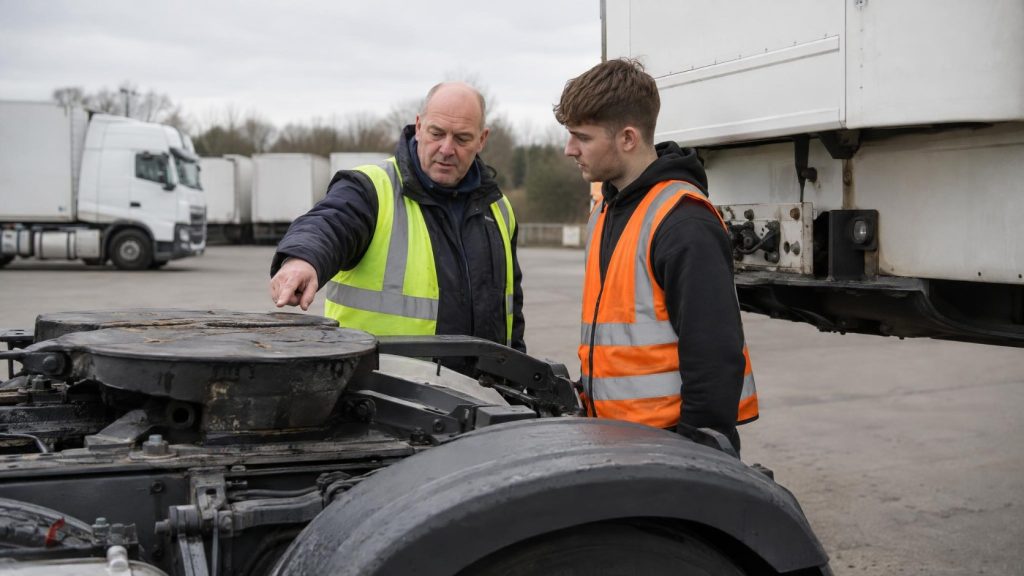
3. Coupling and Uncoupling: The Exercise That’s Unique to C+E
This is the part of the test that genuinely separates C+E from every other category. If you are training for C1 or Cat C on a rigid vehicle, you will never face it. If you are training for C+E, you will face it every single time, including on every retest.
The exercise is simple to describe and unforgiving to rush. You uncouple the trailer, move the tractor unit, reposition it alongside the trailer, then recouple safely and correctly.
Coupling and uncoupling is tested on process, not speed. A methodical candidate who checks everything in order will usually beat a confident candidate who skips a step to save thirty seconds.
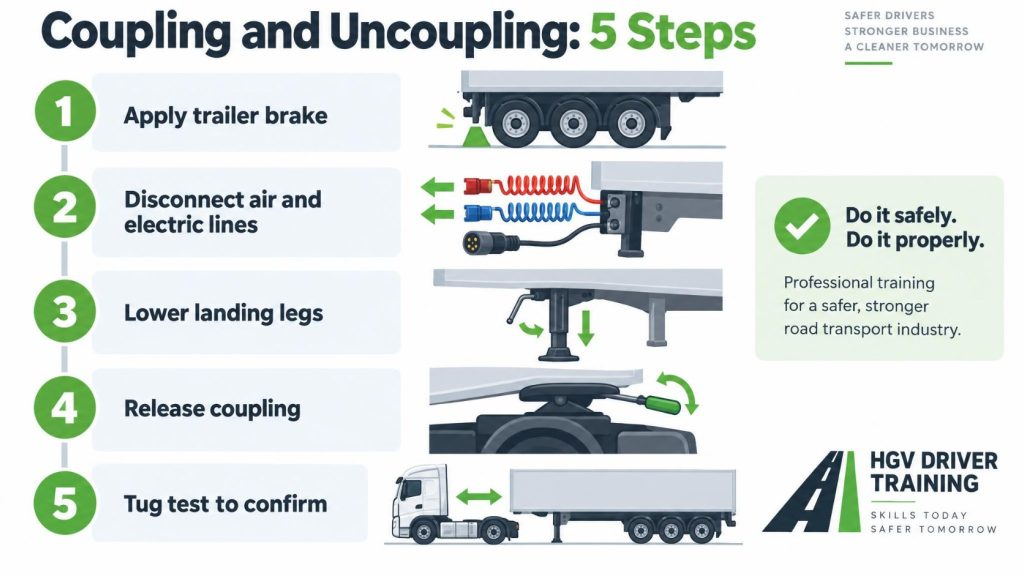
The uncoupling sequence
DVSA examiners are specifically trained to watch for a handful of steps. Miss one, and it shows up as a fault even if the vehicle ends up safely parted.
Position the vehicle in a straight line before you begin, with the parking brake applied.
Apply the trailer’s own parking brake before disconnecting anything. DVSA lists failing to do this as a specific, named fault.
Disconnect the air and electrical lines (the “suzies”) and stow them correctly so they cannot drag or snag.
Lower the trailer landing legs fully before releasing the fifth wheel coupling.
Release the coupling and draw the tractor unit forward slowly and smoothly, checking the trailer stays stable as the weight transfers.
The recoupling sequence and the tug test
Recoupling has its own named fault points, and they matter just as much as the uncoupling steps above.
Reverse in a straight, controlled line to line the fifth wheel up with the kingpin, checking mirrors throughout rather than guessing the angle.
Check the coupling has engaged before raising the landing legs, confirmed on DVSA’s own fault list, which names “not checking the coupling” as a specific error.
Carry out a tug test, driving gently forward against the trailer brake to confirm the coupling is genuinely secure before trusting it on the road.
Reconnect the air and electrical lines and confirm the trailer’s brake and running lights respond correctly.
Apply the dog clip or safety catch on the fifth wheel handle. DVSA lists skipping this as its own named fault, separate from the coupling check itself.
Two patterns explain most failed attempts here. The first is rushing the sequence out of order because nerves take over. The second is treating the tug test and the dog clip as optional extras rather than steps the examiner is specifically trained to look for.
Neither pattern is really about skill. Most candidates who fail this exercise can physically couple and uncouple a trailer without any trouble in a calm training session.
What changes on test day is pressure, and pressure is exactly what makes a rushed candidate skip a step they would never skip in the yard.
4. Show Me, Tell Me: The Vehicle Safety Questions
Before the driving element of Part 3b begins, you will be asked a small number of vehicle safety questions, often called “show me, tell me” questions. DVSA publishes the full official list of these questions for lorries and buses, including a separate list for vehicles towing a trailer.
A “tell me” question asks you to explain how you would check something, such as how you would know the air brake system has enough pressure. A “show me” question asks you to physically demonstrate it, such as showing how you would check a tyre for wear or damage.
These questions are not designed to catch you out with trick wording. They check that you understand the vehicle you are responsible for, not just how to steer it. Learning the official published list beforehand removes one entire source of test-day nerves for free.
5. Independent Driving and the On-Road Hour
The 10-minute independent driving section inside Part 3b is designed to show the examiner how you make decisions without step-by-step instructions. You might be asked to follow signs for a particular town, or follow a simple diagram shown to you before you set off.
Taking a wrong turn during independent driving is not an automatic fault on its own. What matters is how you respond. Candidates who stay calm, signal their intention clearly, and correct the route safely rarely lose marks for the mistake itself.
On-road habit: if you take a wrong turn, say so calmly and correct it smoothly. A panicked, sudden correction causes far more problems than the wrong turn ever did.
6. What Actually Fails You: Faults Explained Properly
DVSA splits every mistake into one of three categories, and understanding the difference changes how you should think about a small error on the day.
A driving fault is a minor error that is not, on its own, dangerous. You can collect up to 12 of these on Part 3b and still pass.
A serious fault involves potential danger, and a dangerous fault involves actual danger to you, the examiner, the vehicle, or another road user. Either one ends the test immediately, regardless of how clean the rest of your drive was.
For our deeper breakdown of the specific mistakes that most often cause a fail across theory and practical stages, see our guide to the most common reasons people fail the HGV test.
7. What Each Part Actually Costs
DVSA’s fees are published in full and worth knowing before you book, because some candidates are caught out assuming the practical test is a single fee rather than several separate payments.
Test stage
Weekday fee
Evening/weekend/bank holiday fee
Theory, multiple-choice
£26
£26
Theory, hazard perception
£11
£11
Part 2, case studies
£23
£23
Part 3a, off-road exercises
£40
£40
Part 3b, on-road driving
£115
£141
Part 4, practical demonstration
£55
£63
These figures are DVSA’s own published rates, confirmed directly on gov.uk’s fees page for becoming an HGV or bus driver. Booking through an approved private test provider instead of DVSA directly can change the Part 3a fee slightly, but DVSA caps it at the same £40.
8. What Happens If You Fail a Part
A fail is not the end of the process, but the waiting rules differ between the two parts and catch people out if they assume otherwise.
Fail Part 3a: you can book another attempt straight away, but you must wait at least 24 hours before actually taking it.
Fail Part 3b: you can book again immediately, but you cannot sit the retest for at least 3 working days, not counting the day of the failed attempt.
Both rules come directly from DVSA’s own published test guidance. Treat the waiting period as useful, not wasted. It is enough time to isolate exactly what went wrong with an instructor rather than repeating the same mistake under the same pressure a day later.
9. Category Differences: C1, Cat C and C+E on Test Day
The test structure stays broadly the same across categories, but what each vehicle demands from you changes significantly.
C1
C1 candidates, often moving up from a car or van licence, usually need the most work on judging the extra length and width of the vehicle rather than on raw confidence. The reversing exercise is the only off-road element, since there is no trailer.
Cat C
Cat C vehicles are larger rigids, and the jump in braking distance and turning space catches out drivers who still drive on instinct rather than planned space. Like C1, there is no coupling exercise, just the reversing bay.
C+E
C+E is the only category where Part 3a includes both the reversing exercise and the full coupling and uncoupling sequence covered above.
If you are weighing up whether to train directly for C+E or build up through Cat C first, our guide on choosing between Cat C and C+E covers that decision in full, including the training time and cost trade-offs.
The vehicle changes the test. C1 and Cat C reward restraint and planned space. C+E adds a whole extra skill, coupling discipline, on top of everything a rigid licence already demands.
10. How to Prepare Properly for Test Day
Good preparation starts well before the vehicle moves. A clear, repeatable routine beats last-minute revision every time, particularly for the coupling and uncoupling steps, where the order matters as much as the action itself.
Drill the same sequence every time: practise uncoupling and recoupling in the exact same order until it feels automatic, not just familiar.
Revise the vehicle safety questions properly: DVSA’s list is published in full, so there is no excuse for guessing on the day.
Review your daily walkaround habits: our guide to HGV roadworthiness checks covers the inspection routine examiners expect you to already know.
Sort your documents the night before: your theory pass certificate and photocard licence are both required, and DVSA cancels the test and keeps the fee if you turn up without them.
Treat a small mistake as recoverable: ask yourself “what is the next safe action”, not “did that just fail me”.
Build the sequence in layers, not all at once
Instructors who teach coupling and uncoupling well tend to break it into stages rather than running the full sequence from day one. First the trailer brake and the suzies, done slowly and correctly every time.
Then the landing legs and the actual coupling or uncoupling movement. Only once both stages are automatic should the full sequence be timed and put under any pressure at all.
That order matters more than it looks. A learner who rushes straight to a timed full run usually just practises their own mistakes faster, rather than actually fixing them.
If your theory knowledge still feels shaky, our guide to the lorry theory test is worth revisiting before you focus purely on the practical stages.
11. Life After the Test: What the Licence Actually Opens Up
Passing Part 3a and Part 3b is a genuine milestone, but it is the start of a career, not the end of a process. Employers care about the same things the examiner was checking: safe control, calm decision-making, and a methodical approach to the vehicle.
If you are planning your route to a first job, our HGV recruitment advice covers what happens next, from CV basics to realistic first-role expectations.
You can also compare the training time and cost for each route on our C1, Cat C and C+E course pages, or use our training cost calculator to work out your own numbers before booking anything.
If you want a joined-up path from theory support through to practical training and test booking, you can find out more about how we work on our who we are page, or check our full FAQs for anything this guide has not covered.
Frequently Asked Questions
Is coupling and uncoupling part of the Cat C or C1 test?
No. Coupling and uncoupling is only tested on C+E, because it is the only one of the three categories that involves a separate trailer. C1 and Cat C candidates only complete the reversing exercise in Part 3a.
How long does the full HGV practical test take?
Part 3a, the off-road exercises, takes up to 30 minutes. Part 3b, the on-road drive, takes about an hour and includes 10 minutes of independent driving. They are booked and usually taken as separate appointments.
What happens if I miss a step during coupling or uncoupling?
DVSA examiners mark specific named faults, including not applying the trailer parking brake, not checking the coupling has engaged, not carrying out a tug test, and not applying the dog clip. Missing any one of these is recorded as a fault even if the coupling ends up secure.
How soon can I retake Part 3a if I fail?
You can book another attempt straight away, but DVSA requires at least 24 hours between a failed Part 3a attempt and the retest.
How soon can I retake Part 3b if I fail?
You can book immediately, but you must wait at least 3 working days after the failed attempt before sitting the retest, not counting the day you failed.
What is a dog clip and why does it matter on test day?
The dog clip, or safety catch, locks the fifth wheel coupling handle so it cannot shake loose on the road. DVSA treats skipping it as its own named fault, separate from checking the coupling itself, because it is a specific, overlooked safety step.
How many driving faults can I have and still pass Part 3b?
You can pass with up to 12 driving faults. A single serious or dangerous fault ends the test immediately, regardless of how many driving faults you had before it.
What are “show me, tell me” questions?
They are vehicle safety questions asked before your Part 3b drive. A “tell me” question asks you to explain a check, such as how you would confirm air brake pressure. A “show me” question asks you to physically demonstrate one, such as checking a tyre for damage.
Do I need to redo Part 3a if I already passed it once?
You need a valid Part 3a pass before you can book Part 3b, but DVSA does not publish a fixed expiry date for that pass on its own guidance pages. Book Part 3b reasonably soon after passing Part 3a rather than leaving a long gap. Check directly with DVSA or your test provider if you are unsure your pass is still current.
Related Articles
06/11/2026
Cat C or Straight to C+E? How to Choose the Right HGV Licence Route in 2026
If you're weighing up HGV training, you've probably hit the same question most learners do: go for Cat C first, or train straight for C+E?...