Thinking about a career change? If so, you've probably noticed the huge demand for qualified Class 1 (C+E) drivers in the UK. This creates a fantastic opportunity for new professionals to join the industry. This guide is your complete roadmap. It breaks down every stage of your Class 1 (C+E) driver training: from the first piece of paperwork to landing your first job behind the wheel.
Why 2026 Is the Year to Start Your Driving Career
If you're looking for a stable and well-paid profession, the logistics industry is calling. The role of a Class 1 driver has never been more vital. These drivers form the backbone of the UK's economy by keeping our supply chains moving. This isn’t just about getting a licence; it's about building a solid career with serious earning potential and job security.
The simple fact is, goods will always need to be moved. From getting daily essentials onto supermarket shelves to delivering materials to building sites, qualified HGV drivers make it all happen. The boom in e-commerce has only increased this demand, creating a constant need for drivers who can handle the biggest vehicles on our roads.
The Opportunity in the Driver Shortage
For years, the UK has been dealing with a major shortage of qualified HGV drivers. What is a big challenge for the industry is a clear opportunity for anyone considering a career change. Companies are actively looking for new talent. They are often willing to offer competitive packages to attract and keep skilled drivers.
As we head through 2026, the situation is still critical. Industry data shows the UK is grappling with a shortage of 18,000–25,000 qualified drivers. Forecasts suggest up to 60,000 new drivers are needed every year to keep up. This makes the value of completing your Class 1 driver training clearer than ever. You can dive into the latest the official gov.uk guide to becoming a lorry driver to get the full picture.
This isn't just a temporary blip. The need for new drivers is a long-term reality for the logistics sector. This means your new qualification will stay in high demand for years to come.
A Smart Financial Investment
Starting any new career path brings up questions about the cost versus the reward. The good news is that the investment in Class 1 driver training offers a remarkably quick and strong return. While you can expect the training to cost between £1,500 and £3,000, the earning potential from the start is substantial.
Standard Rates: Newly qualified Class 1 (C+E) drivers typically start on £38,000 to £50,000 a year for permanent positions.
Hourly Rates: That works out to £18–£24 an hour, with higher rates for night shifts, bank holidays and multi-drop specialist routes.
Career Progression: With experience on specialist or night trunk routes, pay regularly climbs to £45,000–£55,000+ (Aspion HGV Driver Salary Guide 2026).
This guide will walk you through every step of the journey. We'll make sure you have the knowledge and confidence to get started. From understanding the initial requirements to mastering the practical skills, we've got the clear, actionable advice you need to launch your new career on the open road.
Getting The Paperwork Sorted
Before you can think about climbing into the cab for your Class 1 training, there's some essential groundwork to cover. Getting this initial paperwork and a few checks out of the way first is key to a smooth journey. It stops any frustrating delays from popping up later.
It all starts with something you likely already have: your car driving licence. You must hold a full Category B (car) licence to start the process. On top of that, you'll need to be at least 18 years old to begin your training for a C+E licence.
Getting Your D4 Medical Sorted
The first task on your to-do list is passing the driver's medical, known officially as the D4 medical. This is a mandatory check to make sure you meet the higher medical standards needed for driving commercial vehicles. It’s a straightforward check-up, nothing to worry about, designed to confirm you’re fit and healthy for life on the road.
A doctor will fill out the D4 form with you. You can go to your own GP, but many drivers find it’s quicker and cheaper to use a private doctor who handles these medicals all the time. During the exam, the doctor will look at:
Eyesight: This is a big one. Your vision will be tested to ensure it meets the DVSA's strict requirements. Be sure to bring your glasses or contacts, and your latest prescription, to the appointment.
Neurological and mental health: The doctor will screen for any conditions that could affect your driving, like epilepsy, seizures, or severe mental health issues.
Heart health: This part of the assessment checks for conditions like angina, high blood pressure, or past heart problems that might pose a risk.
General health: A wide range of other conditions are covered. These include diabetes (especially if it's insulin-treated), sleep apnoea, and any history of alcohol or drug misuse.
Being completely honest on the form is crucial. Hiding a condition can have serious consequences later, including the risk of losing your licence entirely.
Top Tip: Don't put off your medical. Book it well in advance and think about using a specialist service that focuses on HGV medicals. They know the D4 form inside out, which helps prevent simple mistakes that could hold up your application.
Applying for Your Provisional Licence
With your completed D4 medical form in hand, you're all set to apply for your provisional HGV licence. This is the vital document that allows you to legally start your practical training on public roads with a qualified instructor.
You’ll need to fill out a D2 application form, which you can get from the DVLA. This is the standard form for any lorry, bus, or minibus application. You'll put the D2 form, your D4 medical form, and your current photocard driving licence in an envelope and send it all off to the DVLA. To get into the details of the forms, you can learn more about getting a provisional HGV licence in our detailed guide.
One of the most common mistakes is simply filling out the forms incorrectly. Double-check, and then triple-check, every single box before you send it. Small errors like a missed signature are the biggest cause of rejections and can push your start date back by weeks. The DVLA can take a while to process everything, so getting it right the first time is a massive help.
Once that new licence with your provisional entitlement lands on your doormat, you’re officially ready to book your theory tests and move on to the exciting part: the training itself.
Passing Your HGV Theory and CPC Tests
With your provisional licence sorted, it’s time to hit the books. The next stage of your Class 1 driver training involves passing the HGV theory and CPC tests. This isn't just about memorising facts for an exam. It's about building the solid foundation of knowledge every professional driver needs to be safe, compliant, and efficient on UK roads.
Think of it as the 'classroom' part of your journey. You’ll tackle multiple-choice questions, hazard perception clips, and real-world case studies. Completing these is non-negotiable: you can't book your practical driving test until you’ve passed them.
Breaking Down the Theory Test
First up is the multiple-choice section. You’ll face 100 questions covering a huge range of topics, from the Highway Code to specific HGV regulations. To pass, you need to score a minimum of 85. Don't underestimate this; a broad and thorough revision plan is your best bet.
Then comes the hazard perception test. Here, you'll watch 19 video clips showing developing hazards on the road. Your task is to spot these dangers early by clicking your mouse. The quicker you identify one of the 20 scorable hazards, the more points you get. You need to achieve a score of 67 out of 100 to pass this part.
Many trainees find hazard perception tricky. It’s a test of judgement and timing, not just memory. A common mistake is clicking too much or in a set rhythm, which can lead to a zero score for that clip. The trick is to click as soon as you spot a potential hazard, and perhaps once more as it becomes a definite danger.
Mastering the CPC Module 2 Case Studies
In addition to the main theory test, you have the Driver CPC Module 2. This is another computer-based test, but it focuses on practical, real-world scenarios you’ll encounter in your day-to-day work as a driver.
You’ll be presented with seven case studies, each detailing a typical situation. Based on these scenarios, you'll answer between six and eight multiple-choice questions. The pass mark here is 40 out of 50. This test is all about applying your knowledge of safety, compliance, and even customer service. You can learn more by reading our complete guide to CPC training.
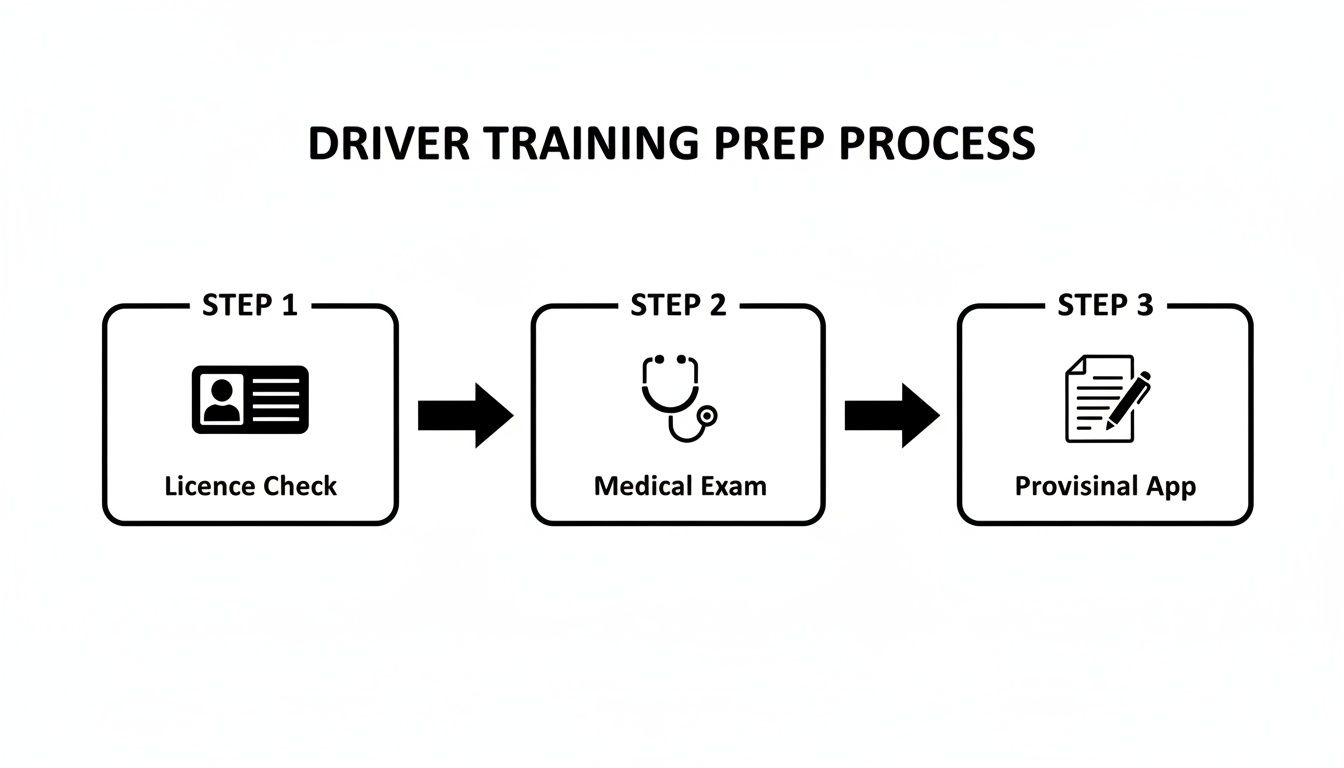
This flowchart shows the initial steps you've already completed to get to this point in your training.
As you can see, the path logically flows from checking your car licence and passing your medical to securing your provisional licence: all of which prepares you for tackling the theory tests.
How to Revise Effectively
Just reading the Highway Code from cover to cover isn't going to cut it. The best way to prepare is by using modern revision tools, which have made studying far more effective. Any good Class 1 driver training provider should give you access to dedicated online learning software.
These platforms are worth their weight in gold for a few reasons:
Realistic Mock Tests: They let you take unlimited practice tests that copy the real exam's format and timing. This is brilliant for building confidence and getting used to the pressure.
Hazard Perception Practice: You get to work through hundreds of different video clips. This helps you perfect your timing and sharpen your hazard-spotting skills.
Progress Tracking: The software tracks your scores and, most importantly, highlights your weak spots. This tells you exactly which topics you need to focus on.
A smart approach is to break down your revision into smaller, manageable chunks. One day, you might focus on vehicle weights and dimensions; the next, you could tackle drivers' hours. It’s far more effective than trying to cram everything in at the last minute.
By mixing a structured study plan with the right revision software, you can walk into the test centre knowing you’ve done everything possible to pass. Getting your theory and CPC tests done first time is the best way to keep your training on schedule and get you one step closer to that practical test.
Mastering Your Practical Driving Skills
Once you've cleared the theory tests, it's time to swap the screen for the tarmac. This is where your Class 1 driver training truly begins. You start developing the real-world skills needed to handle a 44-tonne articulated lorry. The practical phase is intensive, structured, and incredibly satisfying as you build your confidence behind the wheel.
You’ll be paired with a DVSA-approved instructor, a seasoned pro who knows exactly what examiners are looking for. They're not just there to help you pass a test; they’re committed to making you a safe, competent driver from your very first day on the job.
What You Will Learn in Practical Training
Your time in the cab is all about getting to grips with the core skills of C+E driving. These sessions are a huge step up from your car test. They introduce you to the unique challenges that come with a large, articulated vehicle.
Here’s a taste of what you'll master:
Coupling and Uncoupling: You’ll learn the precise, safety-critical routine for attaching and detaching your trailer. This covers everything from connecting brake lines and electrics to working the landing legs and performing a 'tug test' to ensure it's all secure.
Vehicle Safety Checks: Instructors will drill you on how to conduct a thorough walkaround check. This isn't just a tick-box exercise. It's about learning to spot potential defects with tyres, brakes, or couplings that could become a serious hazard on the road.
Manoeuvring in Tight Spaces: A good portion of your training will be spent on slow-speed manoeuvres. Learning to accurately judge your vehicle's length and turning circle is an essential skill for navigating depot yards and tight delivery spots.
On-Road Driving: This covers the full spectrum of driving situations. These range from pulling away safely and using your gears efficiently to navigating tricky junctions, roundabouts, and motorways. A massive focus is placed on forward planning and managing the space around you.
Think of these skills as the foundation of your professional driving career. A good instructor will ensure you not only learn the steps but also understand why each one is important for long-term safety and efficiency.
Understanding the Two-Part Practical Test
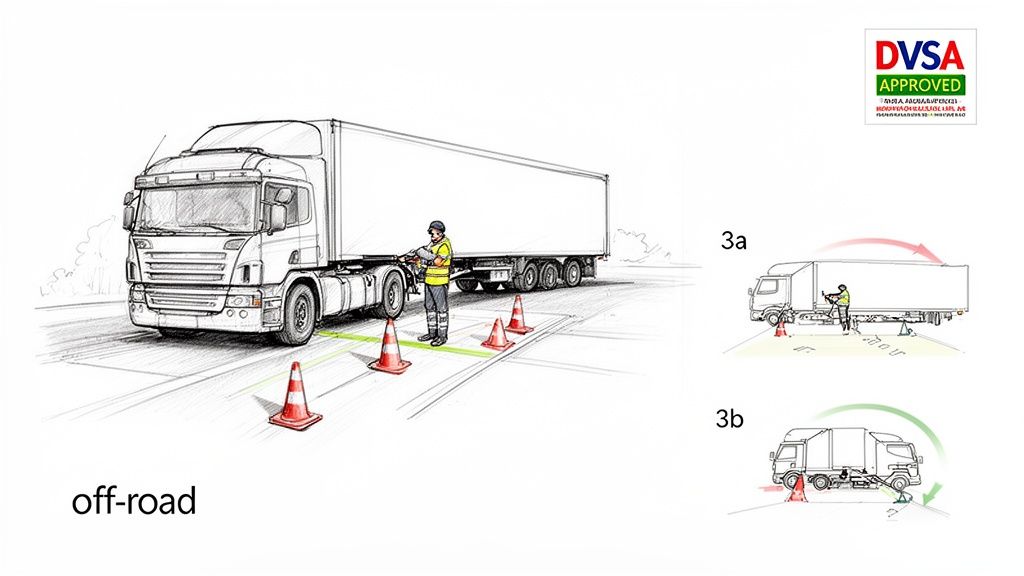
Since 2021, the HGV practical test has been split into two separate parts: the 3a (off-road) and the 3b (on-road). You must pass the 3a before you're allowed to take the 3b.
This change was introduced to free up more test slots and streamline the whole process. The good news is that most quality training providers have their own DVSA-approved assessors. This means you can often take your 3a test right at your training centre.
Insider Tip: The 3a reversing exercise is what most learners worry about. The secret is to take it slow. Examiners are looking for control, accuracy, and constant observation: not speed. Don't be afraid to pull forward to correct your line; a controlled correction is always better than hitting a cone.
The 3a Test: Off-Road Exercises
The first part of your practical test happens on a private test area, well away from public roads. It’s designed to assess your vehicle control and precision in a controlled environment. You’ll be asked to complete a specific reversing manoeuvre into a bay, just as you would at a loading dock.
During this part, the examiner is watching for three key things:
Control: Your ability to move the lorry slowly and smoothly.
Accuracy: How precisely you position the trailer inside the marked bay.
Observation: Proof that you are constantly checking your mirrors and blind spots.
You will also have to demonstrate the full coupling and uncoupling procedure. The examiner will observe you to make sure you follow the correct sequence and don't miss any safety-critical steps. Passing this module proves you have sorted the fundamental vehicle handling skills.
The 3b Test: On-Road Assessment
With your 3a pass certificate in hand, you can book your 3b on-road test. This part feels more like a standard driving test, but the standards and expectations are much higher. The test lasts about 60 minutes and will cover a route with a wide variety of roads and traffic scenarios.
The examiner isn't just looking for you to get from A to B. They want to see a consistently high standard of driving that proves you are a professional in the making. This means excellent road positioning, constant use of your mirrors, and the ability to anticipate what other road users might do.
During the drive, you’ll be asked to pull over and move off safely, which may include a hill start. A key component of the assessment is your 'eco-safe driving': showing that you can use your gears and acceleration to drive efficiently. Employers really value this mindset. Passing the 3b test is the final hurdle in your Class 1 driver training and the gateway to your full C+E licence.
Crunching the Numbers and Planning Your Career
Alright, let's talk money. Getting your Class 1 (C+E) licence is a serious investment in your career. It’s only right that you know exactly what you’re paying for. A clear breakdown of the costs helps you plan properly and avoids any nasty surprises down the line.
The final figure isn't just one number; it's a sum of different parts. You'll need to account for your D4 medical, the provisional licence application, theory tests, and, of course, the practical training itself. Each piece is a step on the ladder to getting qualified.
A No-Nonsense Look at Training Costs
The biggest part of your budget will naturally go towards the hands-on practical training. While prices vary between providers, this is one area where you don't want to cut corners. Going for the cheapest option can be a false economy. A top-notch training school with experienced, DVSA-approved instructors gives you the best shot at passing your tests the first time.
Besides the main course fee, you'll also need to set aside funds for:
D4 Medical Exam: Expect to pay somewhere between £50 and £100. You can often find a better price with private doctors who specialise in driver medicals rather than going to your local GP.
Provisional Licence: The D2 application to the DVLA is typically free of charge.
Theory Tests: This covers the multiple-choice, hazard perception, and CPC Module 2 (case studies) tests, which come to about £60 in total.
Practical Test Fees: The DVSA sets the fees for the 3a (off-road manoeuvres) and 3b (on-road driving) tests, currently costing £40 and £115 respectively.
The table below gives you a clear snapshot of how the initial training investment compares to your potential first-year earnings.
Estimated Costs and Earnings Potential (2026)
Item
Estimated Cost / Salary
Notes
Total Training Investment
£1,500 – £3,000
Includes medical, tests, and practical training.
Average New Driver Salary
£38,000 – £50,000
Starting salary for a newly qualified Class 1 driver.
As you can see, the return on your investment is fantastic, often paying for itself within the first couple of months on the job.
Flexible Ways to Fund Your Future
Seeing the total cost laid out can feel a bit overwhelming. However, there are flexible payment plans designed to make it much more accessible. Spreading the cost over several months means you don't have to find a large lump sum at the start.
Here at HGV Learning, we offer finance options that allow you to pay for your training over 10 to 12 months. Use our repayment calculator to work out what that looks like month to month, or read more about funding your HGV training.
These payment plans help you get behind the wheel without the financial headache. You can get on with your training, knowing the cost is handled with a manageable monthly payment.
This kind of flexibility is key to getting fresh talent into an industry that desperately needs it. With the UK facing an ongoing HGV driver shortage, an estimated around 60,000 new drivers are needed every year to keep the country moving, according to the Road Haulage Association. As government-funded bootcamps become less common, these private, flexible routes are the main way forward. You can read more about the RHA figures on the UK HGV driver shortage.
Build a Real Career with Specialist Skills
Your C+E licence is your ticket to the show, but it’s not the end of the road. To really push your career forward and open up the best-paying jobs, you should look at getting specialist qualifications. These endorsements prove to employers you’re a cut above the rest.
Think of it as adding high-value tools to your professional toolkit. Two of the most sought-after qualifications are:
ADR Certificate: This is your licence to carry dangerous goods, from fuel and flammable gases to corrosive chemicals. Drivers with an ADR ticket are always in demand and earn more because of the extra skill and responsibility involved.
HIAB Licence: A HIAB is a lorry-mounted crane, perfect for loading and unloading goods without needing a forklift or separate crane on site. This skill is like gold dust in sectors like construction, timber, and specialist delivery.
Earning these qualifications does more than just boost your pay packet; it makes you a far more versatile and valuable driver. It’s the difference between just having a job and building a long-term, rewarding career.
Launching Your Career After You Pass
Congratulations, you’ve passed your tests and now hold a shiny new C+E licence. This is a huge achievement, but the real work starts now: turning that qualification into a long and rewarding driving career. Your first task is getting your CV in front of the right people: see our HGV recruitment advice and job placement support for help with that.
Creating a Winning Driver CV
A strong CV does more than just state you have a licence. It sells you as a professional, safety-conscious driver who understands the industry. Think of it as your first impression on a potential employer: make it count.
Make sure you clearly highlight:
Your Licences and Qualifications: Put your full, clean C+E licence front and centre. Don't forget to list your Driver CPC qualification and any valuable endorsements you've earned, like ADR for dangerous goods or a HIAB certificate.
Essential Industry Knowledge: Show you’re ready to hit the road responsibly. Mention your solid understanding of drivers' hours regulations, tachograph operation, and daily vehicle safety checks. This tells employers you’re a compliant and safe pair of hands.
The 'Soft' Skills That Matter: Reliability, excellent timekeeping, and a professional attitude are like gold dust in this industry. These qualities are just as important as your technical skills, so be sure to include them.
Think of your new C+E licence as the key that unlocks the door. Your CV is what convinces the employer to let you in. Make sure it's polished, professional, and shows you’re ready to get behind the wheel from day one.
Finally, remember that your career doesn't stop with the practical test. To stay on the road legally, you must complete 35 hours of periodic Driver CPC training every five years. This isn't just a box-ticking exercise; it keeps your skills sharp and ensures you remain compliant. This is non-negotiable for any reputable employer. This ongoing commitment is your passport to a long and successful career, whether you aim to become an experienced long-haul driver or a future transport manager.
Frequently Asked Questions About Class 1 Training
Thinking about becoming a Class 1 driver? You probably have a few questions. It's a big career move, and we get asked the same things all the time by people just like you. Let's clear up some of the most common queries.
How Long Does It Really Take to Get a Class 1 Licence?
One of the first things everyone wants to know is the timeline. Realistically, you should plan for about 8 to 12 weeks to go from a complete beginner to holding a full C+E licence. This gives you enough time to get through each stage without feeling rushed.
That timeframe isn't just about the driving. You have to factor in the initial admin, like your medical exam and waiting for the DVLA to process your provisional licence application. This can take several weeks on its own.
Then there's the theory. You'll need some solid revision time to get through the multiple-choice, hazard perception, and CPC Module 2 tests. The practical training itself is usually a focused, intensive block, often over five days, leading straight into your 3a (off-road) and 3b (on-road) tests.
Of course, things can sometimes take longer. Paperwork delays, local test availability, or just needing a bit of extra time behind the wheel can extend the process. But for most people, getting qualified in under three months is a very solid and achievable goal.
Can I Go Straight to a Class 1 Licence?
Yes, absolutely. A rule change in late 2021 means you no longer have to pass the Class 2 (Category C) test for rigid lorries first. You can now train for and take the Class 1 (C+E) artic test directly. Some drivers still prefer to build up through Category C first though: our Cat C licence cost guide covers what that route involves and how it compares.
This "direct access" route is now the standard for most new drivers, and for good reason. It saves you a significant amount of time and money by cutting out an entire practical test. You get to train for the licence that opens up the best job opportunities and higher earning potential right from the start.
Some people worry that the jump from a car to an artic is a big one: and it is. But any good training provider will build your skills and confidence from the ground up to make sure you're more than ready to handle it.
For new drivers, the direct access route is the most logical and cost-effective way to start your career. It fast-tracks you to the highest licence category, making you more attractive to employers immediately.
What Happens If I Fail a Test?
Failing a test is tough, but it’s not the end of the road. The HGV tests are designed to be challenging, so it’s not uncommon for people to need more than one attempt. The most important thing is not to let it knock your confidence.
A failed test simply highlights an area that needs a bit more work. A good training school won't just send you on your way. They'll sit down with you, go through the examiner's report, and figure out exactly what went wrong.
From there, they’ll put a plan together. This usually means a few more hours of focused training on that specific weakness before booking a retest. The DVSA makes you wait three clear working days before you can take the test again, which is the perfect amount of time for a refresher session.
Is There Any Funding for HGV Training in 2026?
The funding situation has shifted quite a bit. While the big government-funded 'bootcamps' are not as common now, that doesn't mean you have to pay for everything upfront.
Today, most drivers fund their Class 1 driver training using private finance plans offered directly by training providers.
These plans are a game-changer. They let you spread the cost of your course over a more manageable timeframe, often 10 to 12 months. This breaks down the financial barrier, so you don't need to find a large lump sum to get started. It’s a smart way to get qualified and into a well-paid job, letting your new salary cover the training costs.
Ready to start your journey to a new career on the road? HGV Learning provides end-to-end support, from medicals and theory prep to practical training with DVSA-approved instructors. Check out our flexible payment options and find the perfect course for you at https://hgvlearning.com.
Related Articles
16/10/2026
What Age Can You Start HGV Driver Training? A 2026 UK Guide to Licence Age Requirements
If you're asking what age you can start HGV driver training, the honest answer depends on which licence you're after. A C1 licence, covering vehicles...