You’re probably standing by a trailer right now with a gauge in your hand, wondering whether the tyres need “a bit less” because the load isn’t full today. That’s one of the most common mistakes I see.
Trailer tyres don’t forgive guesswork. Get the pressure wrong and you affect stability, grip, wear, braking feel, and your legal position before you’ve even left the yard. The awkward part is that many drivers apply car tyre logic to trailers. That’s where trouble starts.
Why Correct Trailer Tyre Pressure Is Non-Negotiable
Hooking up a trailer often feels routine. Lights. Breakaway cable. Coupling. Load straps. Then you glance at the tyres and think they look fine. That visual check is not enough.
Tyre pressure for trailer use is a safety item first and a compliance item second. In the UK, trailer tyre pressures typically range from 35 PSI (2.4 bar) to 95 PSI (6.5 bar), and what matters is using the correct figure for the tyre and job, not a rough guess based on how the sidewall looks, as explained by GT Towing’s guide to trailer tyre pressures.
What low pressure actually does
Low pressure lets the sidewall flex more than it should. That extra movement builds heat. Heat is what turns a minor pressure error into a tyre failure on the road.
A trailer tyre can look serviceable at the yard and still be running hot a few miles later. By the time the driver feels instability, the damage may already be done.
Practical rule: If you’re judging pressure by eye, you’re already behind.
What high pressure does wrong
Too much pressure creates a different problem. The contact patch gets smaller, traction drops, and the trailer can bounce instead of settling properly behind the towing vehicle. That matters on rough roads, in braking zones, and in crosswinds.
This is why pressure has to match the tyre’s intended operating condition. Not too soft. Not too hard. Correct.
Why trailers are different from cars
Car drivers get used to comfort-led advice. Many cars have a normal setting and a fully laden setting. Trailers aren’t like that. Their tyres carry load differently, react differently in turns, and punish poor pressure discipline much faster.
That’s also why good pre-journey habits matter so much. If you want the wider safety mindset right, HGV accident prevention habits start with dealing properly with the basics, and tyre pressure is one of those basics.
Use a gauge. Check when cold. Read the sidewall and placard properly. That’s how you keep a trailer stable, legal, and predictable.
How to Read Trailer Tyre Sidewalls and Placards
A lot of bad pressure decisions start with reading the wrong number.
On a trailer, that usually happens in one of two ways. A driver reads the maximum figure on the tyre and assumes that is always the target pressure, or reads the trailer plate and ignores the fact that someone has fitted a different tyre since the trailer left the factory. Both mistakes can put you on the wrong side of safety and compliance.
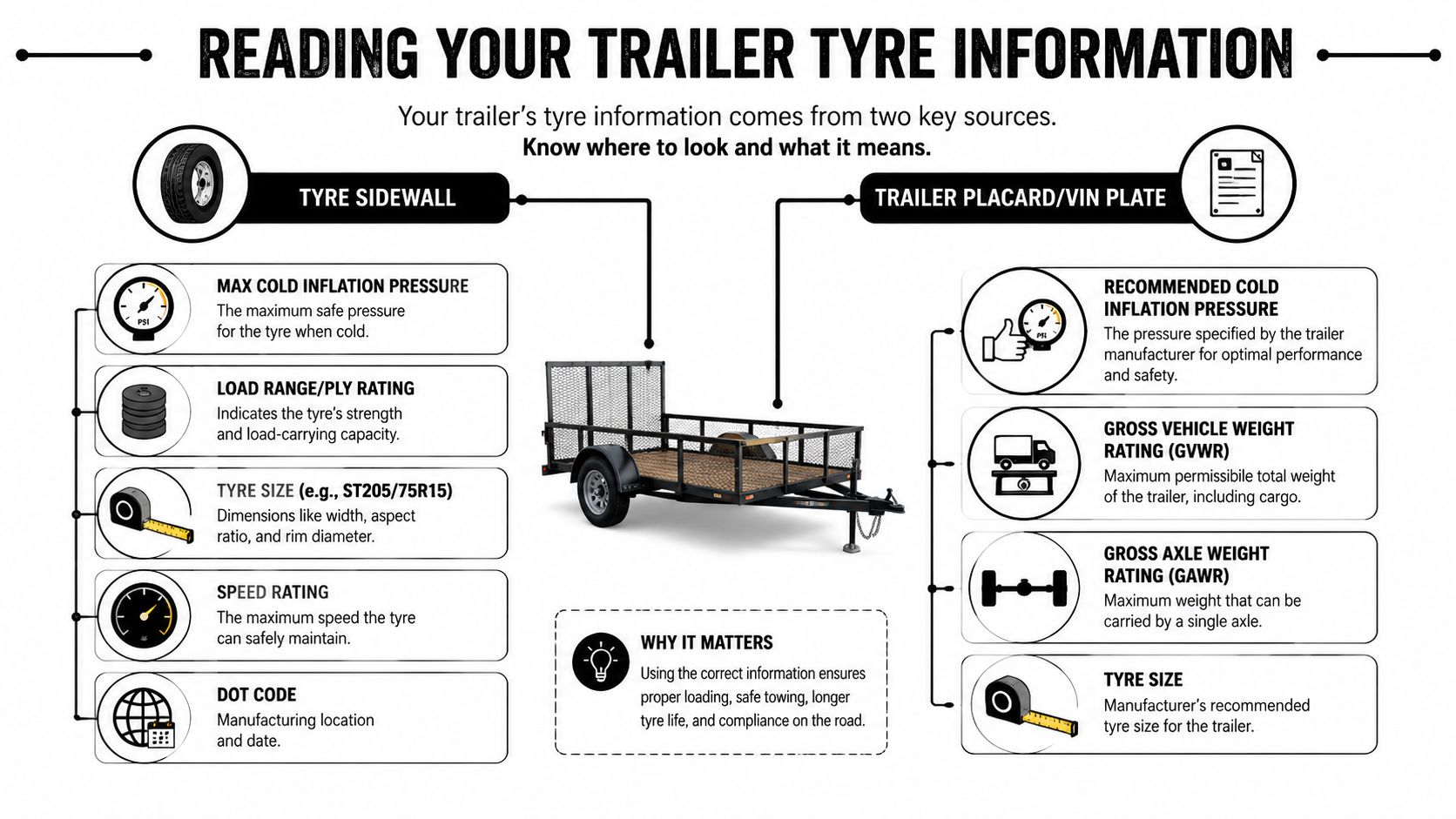
Start with the trailer placard or VIN plate. That tells you what the manufacturer approved for that trailer. You are checking the tyre size, axle limits, and any stated cold inflation pressure. If the trailer is plated for one tyre size but is running another, stop there and sort out the specification before you touch the gauge.
Then read the tyre sidewall carefully. The sidewall tells you what is fitted, and that matters more than many new drivers realise. Trailer pressure advice is not like car advice. On cars, handbook pressures often change between light load and full load because comfort and ride quality are part of the equation. Trailer tyres are there to carry load, control sway, and stay stable under braking. That is why the lazy “half-load means lower pressure” idea causes trouble so often.
The main sidewall markings to find are:
Tyre size, such as 145 R10, 165 R13, or 195/60 R12
Load index or load range, which shows how much weight the tyre is built to carry
Maximum cold inflation pressure, which is a limit for that tyre specification, not an invitation to guess
Speed symbol, which helps confirm the tyre is suitable for road use
Date code, so you can check age as well as condition
One point catches drivers out all the time. “Max pressure” on the sidewall does not automatically mean “set every trailer to this.” It means the tyre is designed to carry its rated load up to that cold pressure. The correct working pressure depends on the approved setup, the tyre fitted, and the load the axle is carrying.
That is why you compare the plate and the sidewall together. If they match, you have a sound starting point. If they conflict, do not improvise. The trailer may have the wrong tyres, mixed tyres across an axle, or a replacement tyre with a different load capability. Before you make any pressure decision, make sure the load itself is placed properly on the trailer. Poor loading changes what each tyre has to carry, so it is worth checking proper HGV load distribution guidance alongside the tyre markings.
To see the markings being discussed in a practical format, this short video is useful.
A simple working rule helps. Read the placard for the trailer’s approved specification. Read the sidewall for the tyre’s actual specification. If there is any mismatch, treat that as a defect to resolve, not a detail to ignore.
Adjusting Pressure for Your Trailer’s Load
Many drivers expect a simple sliding scale. Half the load, half-way down on pressure. That sounds tidy. In practice, it can be unsafe.
For trailers, load adjustment has to be handled with caution because trailer tyres are built and used differently from car tyres. The right approach starts with knowing what the trailer carries on the axle, not what you think it carries.
Use real axle weight, not guesswork
The pressure decision should be based on the weight the tyre has to support. If you don’t know the axle load, you’re estimating. Estimates are where under-inflation starts.
Check the actual loaded condition of the trailer, especially if the cargo varies. A box trailer with tools, a flatbed with plant, and a horse trailer all place load differently. Nose weight, axle position, and load placement all matter.
If you need to tighten up the loading side before you even think about pressure, proper HGV load distribution guidance will save you trouble.
The key trade-off
Drivers often want the trailer to feel softer when it’s light. That’s a comfort mindset. Trailer tyres are not there to improve comfort. They are there to carry, stabilise, and resist sway.
The safer working habit is to use the approved pressure approach for the tyre and trailer, rather than trying to tune feel by dropping a few PSI. Once a driver starts “taking a bit out” because the trailer seems empty enough, pressure discipline usually slips every week after that.
What works in the yard
Use this routine:
Check the tyre specification first: Read the sidewall and confirm the fitted size matches the trailer’s intended setup.
Assess the operating load: Think in terms of axle burden, not loose descriptions like light load or part load.
Inflate when cold: Pressure has to be set before the tyres warm up.
Keep axle pressures consistent: Mismatched pressure across the same axle can upset the trailer’s behaviour.
A trailer doesn’t care what you meant to load. It only reacts to what’s actually on it.
When manufacturer information is missing
Sometimes older trailers have poor labelling, faded plates, or replacement wheels fitted long ago. In that case, don’t invent a pressure based on another trailer that “looks about the same”.
Work from the tyre that is fitted and the legal weight limits of the trailer. If there’s any doubt over suitability, replace uncertainty with the correct tyre and correct documentation. That costs less than a roadside prohibition and far less than a failure at speed.
Example Pressure Calculations for UK Trailers
You pull into the yard with an empty trailer and a gauge in your hand. One driver says, “Take a bit out. It’s only running half-load today.” That is how trailer tyres get ruined and trailers start snaking. Trailer pressure is set for the tyre’s rated job, not for whatever feels sensible compared with a car.
These examples show why the half-load idea is poor practice. They are working examples only. The tyre fitted and the trailer maker’s approved setup still decide the cold pressure.
Example 1 for a small utility trailer
A small utility trailer fitted with 145 R10 tyres may run at 38 PSI, or 2.6 bar, as its cold setting.
That can look high to a car driver. It is normal in trailer work. If the tyre and wheel combination is specified to run there, leave it there. Dropping pressure because the trailer only has bags of garden waste in it weakens the tyre’s support and lets the casing flex more than intended.
Example 2 for a medium single-axle trailer
Take a single-axle trailer on 165 R13 tyres. A typical cold setting for that kind of trailer fitment is 65 PSI, or 4.5 bar.
New drivers often misunderstand this point. They compare it with car advice and assume a lighter load means lower pressure. Trailer tyres do not follow that comfort-based logic. They are carrying load through a smaller contact patch and stiffer construction, and they need the pressure that matches that design. For a broader look at pressure discipline across commercial vehicles, see this guide to HGV tyre management.
Example 3 for a heavier compact trailer
A heavier compact trailer fitted with 195/60 R12 tyres may need 95 PSI, or 6.5 bar, when cold.
That number shocks drivers who have only worked around cars and pickup trucks. On the correct trailer tyre, it is entirely normal. The mistake is treating a high pressure figure as a warning sign by itself. The primary warning sign is using a pressure that does not match the tyre’s intended load rating.
Quick reference table
Common Trailer Tyre Size
Example Recommended Cold Pressure (PSI)
Example Recommended Cold Pressure (Bar)
145 R10
38
2.6
165 R13
65
4.5
195/60 R12
95
6.5
What these examples teach
The gap between one trailer tyre and another can be large, even on trailers that look similar in the yard. That is why copying a mate’s pressure figure is unsafe. Size, construction, load index, and trailer use all matter.
There is another trade-off worth understanding. Running the correct pressure may make an unloaded trailer feel firmer over rough ground, but that is not a fault. It is the tyre doing its support job properly. Under-inflation might feel less harsh at low speed, but it increases heat, wear, and instability once the trailer is working.
Age matters too. A tyre that has spent long periods parked up can crack before the tread is worn out, which is why storage condition matters alongside pressure. Good storage and preventing tyre dry rot help protect trailer tyres that do low annual mileage.
Use example figures as a sense check only. For trailer work, the right question is simple. What cold pressure is specified for the exact tyre fitted and the exact trailer application?
Essential Trailer Tyre Maintenance and Checks
You are parked in the dark at 05:30, the trailer looks fine at a glance, and the pressure was “about right” last week. That is how defects get missed.
A roadworthy trailer tyre is more than a PSI figure. It also needs sound rubber, legal tread, good valves, and no damage that could turn into a blowout once the tyre starts working under load.
Check pressure when the tyre is cold
Check trailer tyre pressure before the day starts, not after a run to the yard or fuel station. Heat raises the reading and can hide an under-inflated tyre.
Use a proper gauge. Do not rely on a kick, a quick glance, or the fact that the trailer “towed fine yesterday”. For UK operators, Autodue’s summary of commercial vehicle tyre law is a useful reminder that tyre condition, pressure checks, and age rules are part of compliance, not just good practice.
One more point matters here. Trailer tyres often age out before they wear out, especially on kit that stands for long periods between jobs.
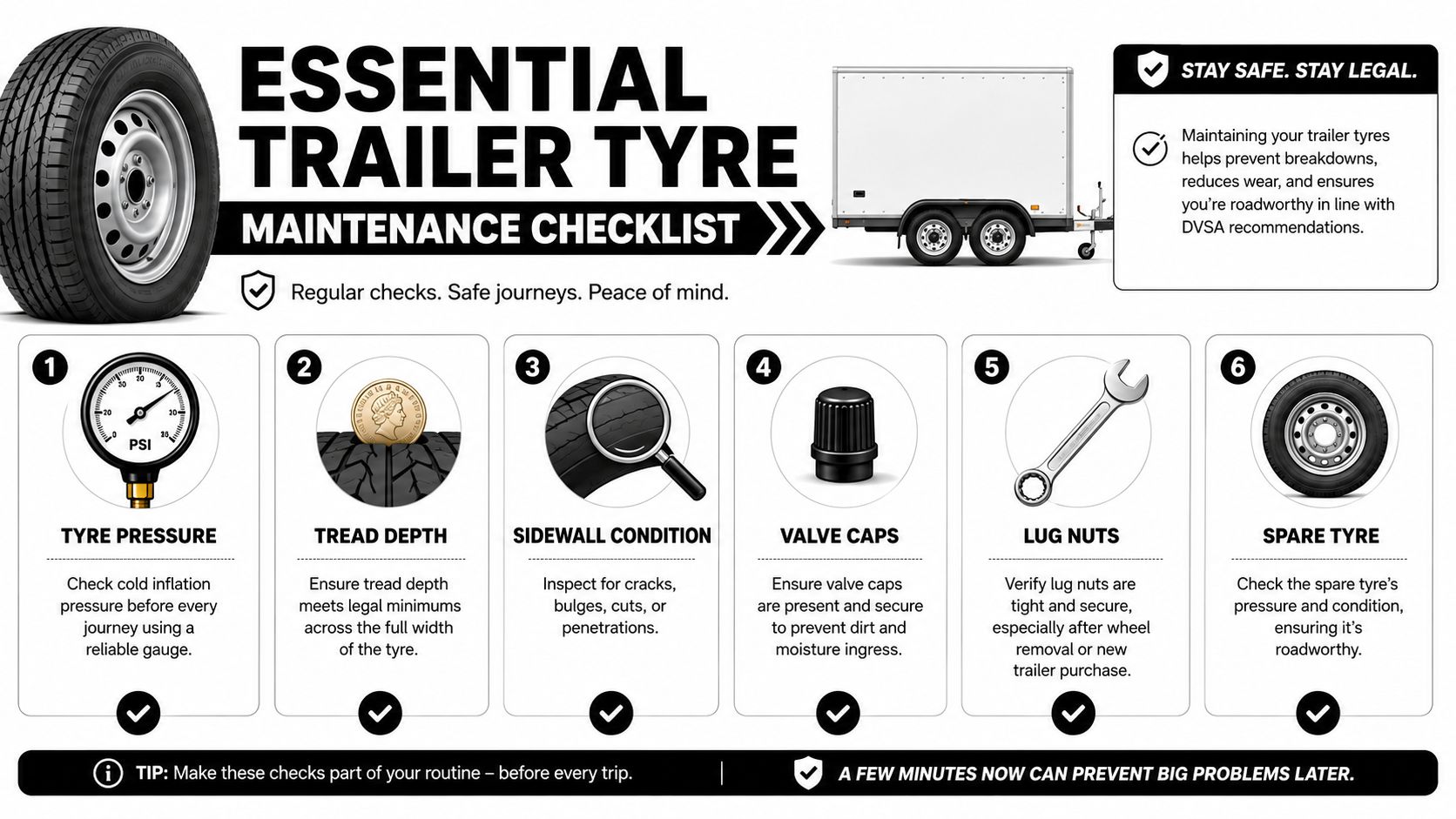
A practical inspection routine
Use the same order every time. Consistency stops you missing the quiet problems.
Pressure first: Check every tyre with an accurate gauge while cold.
Tread next: Look across the full tread width. Uneven wear often points to pressure or running gear issues.
Sidewalls: Check for cuts, bulges, cracking, exposed cords, and objects stuck in the rubber.
Valves and caps: Damaged valves leak slowly. Missing caps let dirt and moisture in.
Wheel fixings: Look for anything loose, missing, or marked by movement.
Spare wheel: A flat or perished spare is no help on the hard shoulder.
A simple routine done every time beats a longer routine done once in a while.
Tyre age and storage matter
Trailer tyres live a hard life even when mileage is low. Long periods parked in one place, sunlight, standing water, and infrequent use all shorten tyre life.
That is why I tell new drivers to inspect the sidewalls as carefully as the tread. Fine cracking, weathering around the bead, or rubber that looks dry and tired are all warnings. If you want a straightforward guide to preventing tyre dry rot, that resource explains how storage and inactivity damage tyres long before the tread looks finished.
Legal condition checks
Pressure alone will not keep a trailer legal. The tyre also has to meet tread and condition rules, and it must be free from cuts, bulges, and other defects that make it unroadworthy.
The exact tread requirement depends on the trailer class, so drivers need to know what applies to the unit they are pulling. Mixed tyre constructions on the same axle can also create problems. If you run trailers regularly, this HGV tyre management guidance is useful for building checks into a repeatable daily standard.
Keep the routine workable
A check that takes two minutes and gets done properly is better than a long checklist drivers skip.
Walk the trailer. Gauge the tyres cold. Inspect tread, sidewalls, valves, wheel fixings, and the spare. Record defects straight away and get them dealt with before the trailer goes out.
Avoiding Common Mistakes and Staying Legal
You collect a part-loaded trailer, glance at the tyres, and someone says, “Drop a bit of air out. It’s only half full.” That advice sounds practical. It is also one of the quickest ways to make a stable trailer feel loose and put yourself on the wrong side of a roadside check.
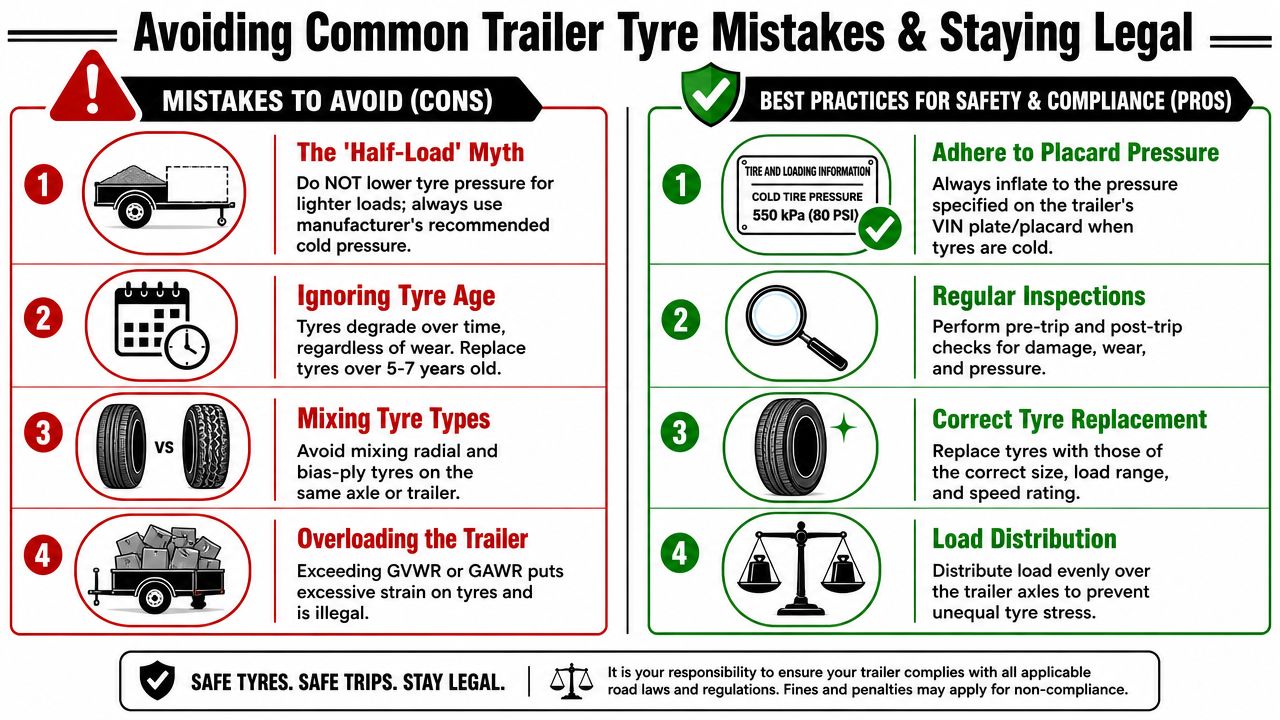
The half-load myth catches drivers because they apply car logic to trailer tyres. That is the wrong comparison. On a car, pressure advice often balances ride comfort, grip, and fuel use. On a trailer, the main job is carrying load safely, holding shape under sway, and keeping a margin against under-inflation. For most road trailers, that means running the pressure specified for the trailer and tyre setup, not guessing lower because the deck looks light.
The half-load myth
Here is the practical problem. A trailer tyre already works hard for its size. If you bleed pressure off for a part load, the sidewall flexes more, heat builds faster, and stability gets worse before the tyre looks obviously flat. That is why experienced trailer operators do not “soften it off” the way some motorists might with a car.
Professional drivers need a simple rule. Unless the trailer manufacturer and tyre data clearly tell you otherwise, do not reduce trailer tyre pressure just because the load is lighter than maximum. Use the specified pressure for the fitted tyre and trailer setup.
That point matters legally as well as mechanically. If a tyre is under-inflated enough to affect roadworthiness, DVSA will treat it as a defect. “It looked about right” will not help at the roadside.
Other mistakes that cause trouble
Pressure errors are not the only way drivers get caught out.
Using car habits on trailer tyres: Trailer pressure rules are stricter because stability matters more than comfort.
Checking by eye only: Trailer tyres can be well below pressure and still appear usable.
Mixing constructions on the same axle: Keep tyre types matched to avoid uneven handling.
Forgetting the spare: An empty or cracked spare is useless when you need it.
Trusting tread depth alone: Old rubber, cuts, bulges, and sidewall damage can make a tyre unroadworthy long before the tread is gone.
What legal means in daily practice
Legal does not mean “good enough to get home.” It means the tyre is suitable, correctly inflated, free from serious damage, and fit for the journey you are starting.
For day-to-day work, that means checking pressures cold, using the manufacturer’s figures for the trailer and fitted tyres, and recording defects before the trailer leaves the yard. If the trailer has mixed tyres, damaged valves, exposed cords, or clear signs of under-inflation, it should not be moving until the fault is fixed.
Drivers sometimes focus on paperwork and forget condition. Enforcement works the other way round. Condition comes first.
A simple rule set to stay out of trouble
Use this standard every time:
Read the sidewall and placard, then set the pressure with a gauge.
Check tyres cold, before the trip starts.
Do not lower pressure because the trailer is only part-loaded.
Match tyre type and size correctly across each axle.
Reject tyres with cuts, bulges, cracking, or other visible defects.
Make sure the spare is serviceable, not just present.
Get those basics right and the trailer will tow straighter, wear tyres more evenly, and stand up far better if DVSA takes an interest.
If you’re building your driving skills or moving into professional towing work, HGV Learning can help you train for safe, compliant driving across C1, Category C, and C+E routes, with support that matches real DVSA standards and real working conditions.
What Age Can You Start HGV Driver Training? A 2026 UK Guide to Licence Age Requirements
If you're asking what age you can start HGV driver training, the honest answer depends on which licence you're after. A C1 licence, covering vehicles...