If you’ve passed your Cat C or C+E test, or you’re already qualified and thinking about your next move, you’ll hit this question fast. Do you go agency, or take a direct employed job?
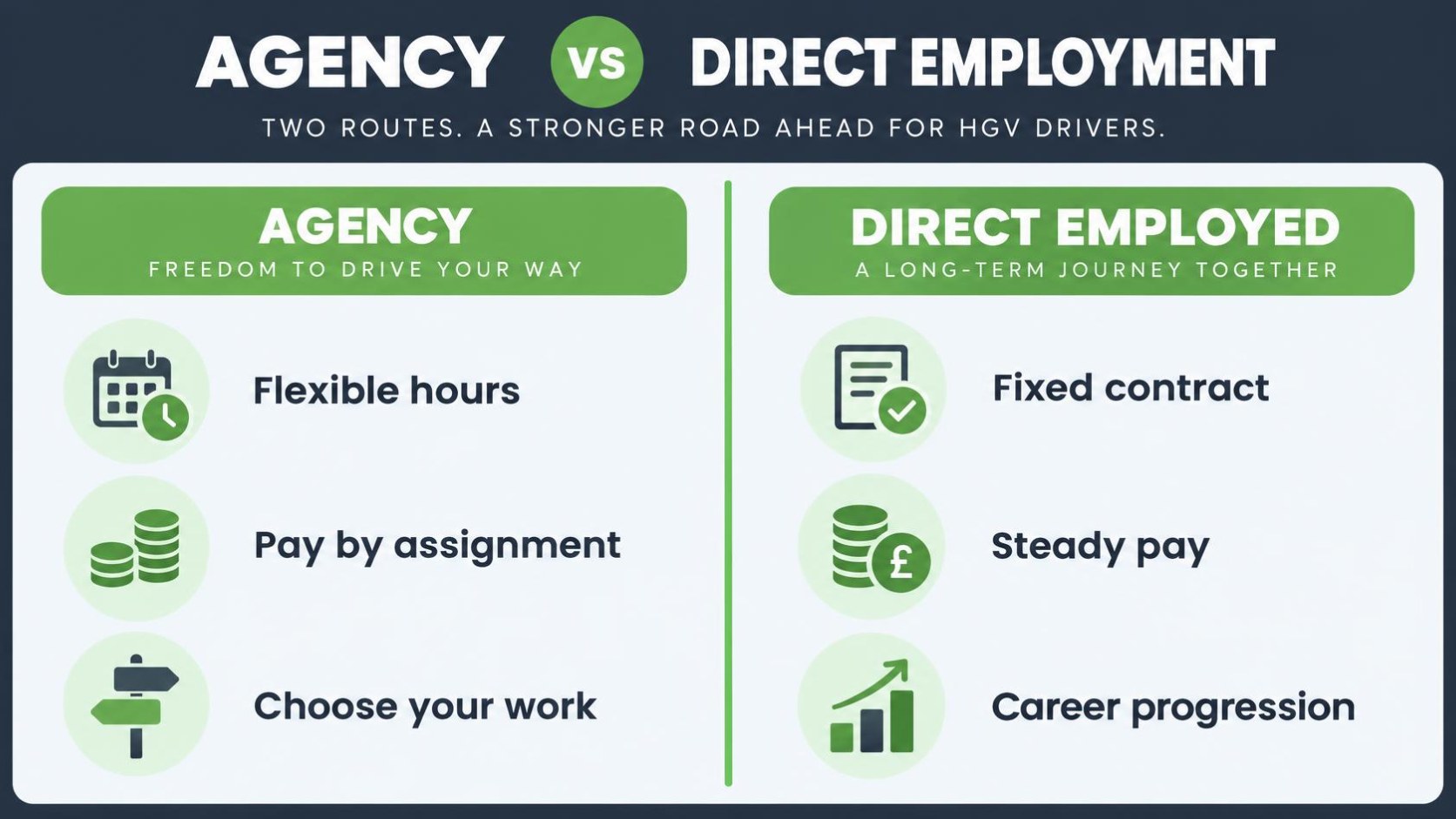
Both routes get you behind the wheel. They pay differently, feel different day to day, and suit different stages of a driving career.
This guide sets out how agency driving and direct employment actually compare in the UK right now. We cover pay, your legal rights after 12 weeks on an assignment, job security, benefits, and how to move between the two routes.
We also look at what the current driver shortage means for your choice, and where umbrella companies fit into the picture for agency drivers.
Agency Driving and Direct Employment: The Real Difference
The basic distinction is who employs you. With agency driving, a recruitment agency, or an umbrella company working on its behalf, is your employer. It places you with different haulage firms on short or longer assignments.
With direct employment, the haulage firm itself is your employer, full stop. There’s no third party between you and the business paying your wages.
There’s a third route some drivers choose instead of either: working as a self-employed owner-driver. We cover that path separately in our guide to becoming a self-employed HGV driver, since it carries different tax and vehicle-ownership considerations.
How agency driving actually works
You register with one or more driving agencies, who match you to assignments based on your licence category, any ADR endorsements, and your availability. An assignment might last a single shift, a few weeks, or several months.
You’re usually paid weekly for the hours you actually work, rather than a fixed monthly salary. That can be a real advantage if you want to pick up extra shifts, or a real drawback if work dries up suddenly.
Agency work suits drivers who want experience across different vehicles and depots quickly. Our guide to the different types of HGV driving jobs, from multi-drop to trunking to long-haul, is worth reading before you commit to a type of assignment.
How direct employment actually works
Here you apply directly to a haulage company, retailer, or logistics operator, and you’re on their payroll from day one. You get a proper contract of employment and a fixed or rotating shift pattern.
You also get the same terms as every other driver on the books, rather than a rate negotiated assignment by assignment. Direct roles are usually advertised for specific licence categories and specific depots.
National pay figures for 2026 show C+E artic drivers earning the most, followed by Class C rigid drivers, then C1 drivers. These are basic rates before overtime, nights, or weekend premiums.
Both agency and direct roles can pay extra on top of these basic rates, so always ask what a quoted figure actually includes.
Figures are from the Road Haulage Association’s Pay Report 2026, based on a survey carried out across the UK haulage sector in November 2025.
An agency “pay rate” and a direct employer’s “salary” are not measuring the same thing. Always ask what’s actually included before you compare two offers side by side.
Why the headline agency rate is not the whole story
An agency assignment rate usually looks higher per hour than a direct employer’s basic pay. That’s because it has to cover costs a direct employer pays separately, such as employer National Insurance, pension contributions, and holiday pay.
If you’re paid through an umbrella company, these costs come out of the assignment rate before you see a penny. Two agencies quoting different day rates for the same job can leave you with very different take-home pay.
Always ask for the actual rate after deductions, not just the headline figure. A recruiter who won’t give you a straight answer on this is worth being cautious about.
Nights out and subsistence pay
Trunking and long-haul work often comes with a nightly subsistence or “night out” payment on top of basic pay, covering time away from home. This applies on both routes, but the amount and whether it’s taxable can differ.
Direct employers tend to have a fixed, published night-out rate written into your contract. Agency rates for the same work can vary by client, so always confirm the night-out figure before accepting a multi-day assignment, not after.
The 12-Week Rule: Your Legal Right to Equal Pay
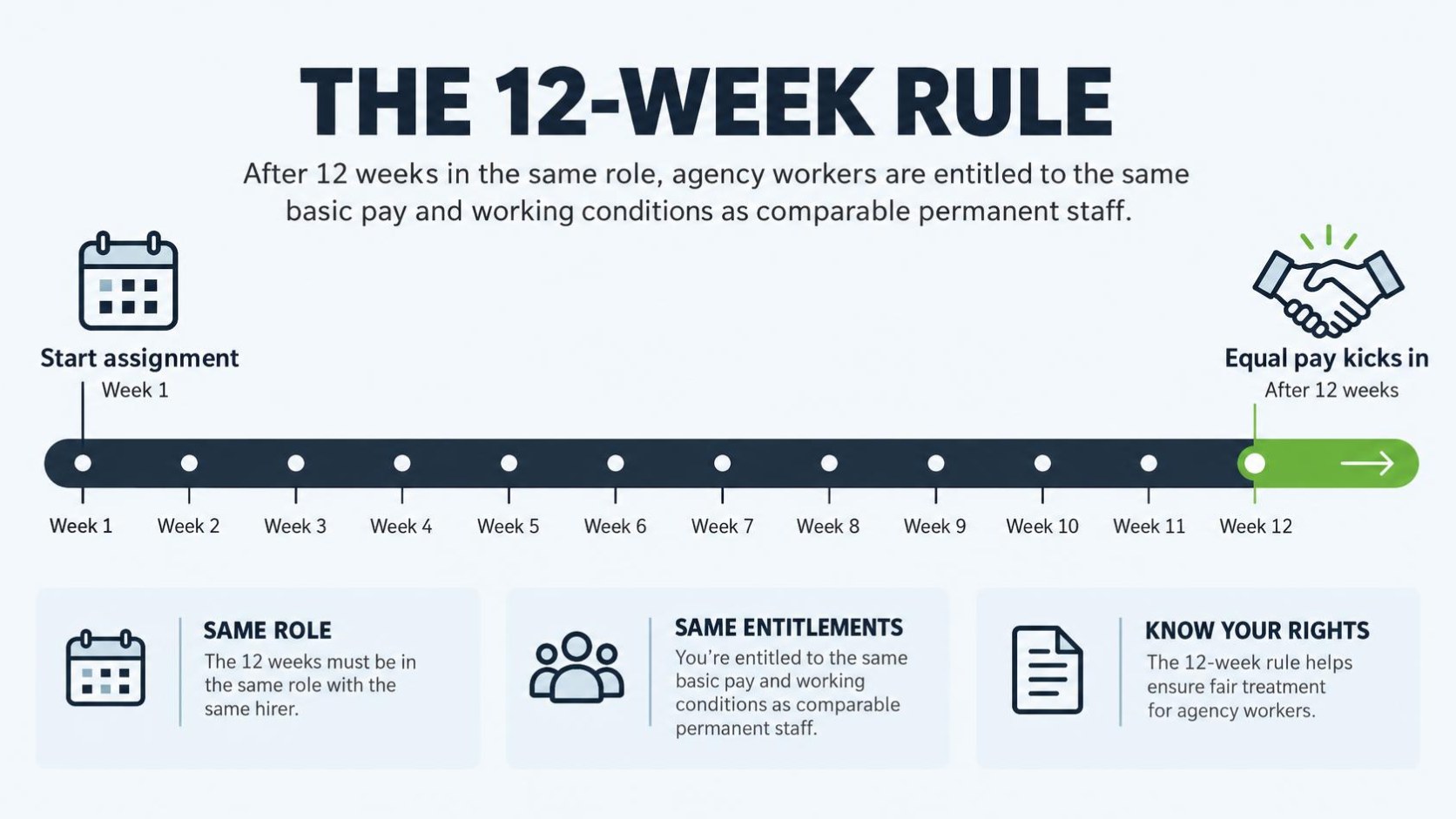
Agency workers in the UK are protected by the Agency Workers Regulations 2010. Once you’ve worked in the same role, for the same hirer, for 12 continuous weeks, the law changes in your favour.
You become legally entitled to the same basic pay and working conditions as a comparable permanent employee doing the same job at that hirer.
This right covers basic pay, holiday pay above the statutory minimum, individual performance bonuses, commission, overtime, and shift or unsocial hours allowances.
It does not cover company-wide bonus schemes, enhanced parental pay, employer pension schemes, redundancy pay, or sick pay above the statutory minimum, according to ACAS guidance on agency worker rights.
The 12-week clock resets if you take a break of more than six weeks, or if you move to a genuinely different role or a new hirer. Agencies cannot legally rotate you between sites purely to dodge the rule.
If you believe you’ve reached 12 weeks on the same assignment and your pay hasn’t been adjusted to match, raise it with your agency first and ask them to show their working.
Umbrella Companies Explained
Most agencies pay HGV drivers through an umbrella company rather than paying them directly. The umbrella company becomes your employer on paper and pays your wages through PAYE, as set out in HMRC’s guidance on working through an umbrella company.
It invoices the agency for your hours at the agreed assignment rate, then pays you after its own deductions. This is different from the self-employed route, where you invoice clients yourself and handle your own tax.
Before you start an assignment, the agency must give you a key information document. This sets out the umbrella company’s name, the minimum assignment rate, a breakdown of deductions, and your expected minimum gross pay.
Read it properly before you accept any assignment, not after your first payslip lands.
From the assignment rate, the umbrella company deducts its own margin, employer National Insurance, employer pension contributions, holiday pay, and the Apprenticeship Levy where it applies.
What’s left becomes your gross pay, from which Income Tax, employee National Insurance, your own pension contribution, and any student loan repayment are taken as normal.
Check these things on every payslip you receive:
Your Income Tax and National Insurance deductions match what’s shown in your personal tax account.
The umbrella company’s name and PAYE reference haven’t changed without you being told.
Holiday pay is either paid on top of your wages each week or properly accrued and paid out when you take leave, not silently absorbed into your hourly rate.
You’re not being offered separate “non-taxable” payments, loans, or unusual bonus structures. These are a recognised sign of a tax avoidance scheme, and HMRC can still pursue you for unpaid tax even where the scheme was the umbrella company’s idea.
Job Security, Hours and Career Progression
Agency: flexibility over security
Agency work gives you control over when and where you drive. You can turn down an assignment that doesn’t suit you, take weeks off between placements, or work across several depots to build experience fast.
The trade-off is that assignments can end with very little notice. There’s no guaranteed minimum of hours unless your contract with the agency or umbrella company says otherwise.
A direct role gives you a proper contract, a set notice period, and a manager who knows your name and your record. That matters more than it sounds when something goes wrong and you need support.
Haulage firms are generally more likely to invest in C+E upgrade training, ADR renewals, or a move into a trainer or supervisor role for drivers they’ve employed for a while.
If you’re weighing up funding a Cat C to C+E upgrade yourself while working agency shifts in between, our training cost calculator is worth running the numbers through first.
Holiday, Sick Pay and Other Benefits Compared
Benefits are where the two routes diverge most, even once the 12-week rule applies to your basic pay:
Statutory sick pay applies to both routes, but many direct employers top this up with company sick pay, which agency and umbrella arrangements rarely match.
Pension auto-enrolment applies to both, but a direct employer’s scheme may include employer contributions above the legal minimum, and the 12-week rule doesn’t force an agency to match that.
Training and CPC renewal costs are more often covered upfront by direct employers, while agency drivers more commonly fund their own periodic training and claim it back later, if at all.
Overtime and night-out allowances vary hugely by employer on both sides, so always ask for the actual rate card rather than assuming either route pays more as standard.
Which Route Suits Different Drivers
Newly qualified drivers
If you’ve just passed your test, agency work can be a fast way to get varied experience across different vehicles and depots. Some direct employers genuinely like to see that range on a CV.
It can also mean inconsistent hours while you’re still building a reputation with agencies, so budget for a quieter first few weeks.
Drivers who want flexibility
Parents working around school hours, drivers with a second income stream, or anyone easing back into driving after time away often prefer agency work.
If you’re planning a mortgage application, have a young family, or simply want predictable pay every month, direct employment removes a lot of uncertainty that agency work can’t match.
Experienced drivers wanting specialist work
Drivers with ADR or HIAB endorsements often find agency demand for specialist work outstrips direct vacancies, since fewer employers need that skill set full time. Agency work can pay a genuine premium here, at least until a direct specialist role comes up.
How to Find Work on Each Route
Getting agency work
Register with two or three reputable agencies rather than relying on just one source of assignments. That spreads your risk if one agency goes quiet.
Keep your CPC card, digital tachograph card, and any ADR certificates up to date and ready to send, since agencies often move fast on last-minute bookings.
Getting a direct employed role
Direct roles are advertised on haulage firms’ own websites, on major job boards, and through HGV Learning’s own recruitment service, which works directly with employers looking for newly qualified and experienced drivers.
The UK Driver Shortage and What It Means for Your Choice
The driver shortage that made headlines in 2021 hasn’t disappeared. It has just changed shape.
Analysis published by the RHA in May 2026 found the number of drivers with an up-to-date Driver Qualification Card had fallen to 586,597, down from 684,000 in 2024. Around 110,000 drivers failed to renew their DQC by December 2024.
Official government figures tell a similar story on the ground. In the final quarter of 2025, DfT figures show that 26% of HGV businesses reported driver vacancies.
Of those businesses with vacancies, 23% said they had missed deliveries because drivers weren’t available. That’s a real, current shortage, not a leftover pandemic story.
A genuine shortage of qualified drivers is good news if you’re choosing between job offers. It means more room to negotiate pay, hours, or a direct contract instead of settling for whatever assignment comes up first.
Switching Between Agency and Employed Work
Plenty of drivers move between the two routes more than once across a career. Neither one locks you out of the other permanently.
The route that suited you at 22 with no ties often looks different at 35 with a mortgage and a family to plan around. Revisiting the choice every few years is normal, not a sign you got it wrong first time.
Moving from agency to direct usually means a probationary period. Varied experience across different vehicles and depots is a genuine selling point at interview, not something to play down.
Moving from direct employment into agency work is more straightforward logistically. It’s worth checking your notice period and any training-cost clawback clause in your current contract before you hand in your notice.
Before you switch either way, it helps to get the practical groundwork done first:
Request a reference from your current or most recent employer while contact details are still fresh.
Check your CPC card, tachograph card, and any specialist certificates all have enough validity left to cover a new assignment or probation period.
Read your current contract’s notice period and any clause about repaying training costs if you leave within a set time.
Neither route is a one-way street. Treat your first choice as a starting point, not a life sentence, and reassess it every time your circumstances change.
Frequently Asked Questions
Can I work for more than one agency at once?
Yes. Most drivers register with two or three agencies to maximise the assignments on offer. There’s no legal restriction on registering with multiple agencies, though they’ll expect you to confirm your availability honestly to avoid double-booking.
Does the 12-week rule reset if I change agency but stay at the same depot?
The 12-week period tracks your time with the same hirer in the same role, not which agency pays you. Changing agency while staying on the same assignment shouldn’t reset your 12 weeks, but confirm this with your new agency in writing first.
What happens to my 12 weeks if I take a week off between assignments?
A single week off, whether for holiday or between bookings, doesn’t reset the clock. Only a break of more than six weeks resets the 12-week count under the Agency Workers Regulations.
Is agency pay better than direct employment pay?
It depends what you’re comparing. Headline agency day rates often look higher, but once umbrella company deductions are accounted for, and once you compare like-for-like after 12 weeks on the same assignment, the gap usually narrows considerably or disappears.
Do agency drivers get holiday pay?
Yes. Agency workers get at least the statutory 5.6 weeks of paid holiday a year, the same legal minimum as any employee. This is either paid as you earn, rolled into your hourly rate and clearly itemised, or accrued and paid when you take leave.
Can an umbrella company legally pay me less than the agency’s quoted rate?
The deductions an umbrella company takes from the assignment rate, including its margin and holiday pay, should all be set out in your key information document beforehand. If your actual pay doesn’t match that document, raise it with the agency and, if unresolved, with HMRC.
Will agency work hurt my chances of getting a direct employed job later?
No. Most employers see varied agency experience as a sign you can adapt quickly to different vehicles, routes, and depot procedures, which is a genuine asset on a CV for a direct role.
How long does it typically take to move from agency to a direct contract?
There’s no fixed timeline. Some drivers are offered a direct contract after a few months of consistently good agency work, while others deliberately stay on agency terms for years. It comes down to what the hirer needs and what you ask for.
There’s no single right answer between agency driving and direct employment. Agency work suits drivers who value flexibility and variety. Direct employment suits drivers who want structure and a clear path upward.
Plenty of drivers choose differently at different points in their career, and that’s a sensible way to think about it rather than a decision to get right once and never revisit.
If you’re newly qualified or ready for a change, HGV Learning’s recruitment team works with employers across the UK looking for both agency-ready and directly employed drivers.
Visit our recruitment advice hub to talk through which route fits where you are right now, or check our full FAQs page for more on licences, costs, and getting started.
Related Articles
20/11/2026
What Is C1 On A Driving Licence?
C1 on a driving licence means you can drive medium-sized vehicles weighing between 3,500kg and 7,500kg, such as 7.5 tonne lorries, horseboxes and larger motorhomes....