Plenty of qualified HGV drivers reach the same point a few years into the job: they’re doing well, they know the work inside out, and they start wondering whether driving for someone else is really the best way to get paid for it. Going self-employed, buying or leasing your own lorry and working as an owner-driver is a real option in UK haulage.
It’s also a bigger step than most people expect, with its own licence, costs and entry barriers to understand first.
This guide walks through what self-employment actually means in HMRC’s eyes, the Operator’s Licence you’ll need before you turn a wheel, what it genuinely costs to set up, what you can realistically expect to earn, and the barriers that catch out newly qualified drivers specifically. We’ll also cover when staying employed, or working through an agency, is honestly the better call.
What Does “Self-Employed HGV Driver” Actually Mean?
Being a self-employed HGV driver isn’t just a different box ticked on a form. HMRC has a specific test for whether someone genuinely works for themselves or is really an employee being paid as if they aren’t, and haulage is an area HMRC checks closely.
Genuine Self-Employment vs Being an Employee in Disguise
The Road Haulage Association’s own guidance is blunt about this: HMRC generally expects a self-employed driver to work in their own vehicle and hold their own Operator’s Licence. If you’re driving someone else’s lorry and being told what to do and when, HMRC is unlikely to accept that you’re genuinely self-employed, whatever your contract says.
This matters because the business that engaged you, not just you, can end up liable for unpaid income tax and National Insurance, plus interest and penalties, if HMRC later decides the relationship was really employment. Getting this wrong isn’t a paperwork slip. It’s a real financial risk for both sides.
If you’re driving your own lorry under your own Operator’s Licence, you’re on solid ground. If you’re driving someone else’s vehicle on their terms, “self-employed” on paper won’t protect either of you from HMRC.
HMRC’s own internal guidance backs this up directly: where a worker supplies the equipment that’s genuinely fundamental to the job, such as a driver providing their own lorry, that’s described as “a very strong pointer to self-employment.” It’s one of the clearest tests HMRC applies to this exact trade.
Case law backs this up too, though it cuts both ways. In one well-known tribunal case, a company providing cars to its salesmen was treated as evidence of employment, because the vehicle wasn’t the salesmen’s own. In another, the court found that supplying equipment pointed towards employment but wasn’t decisive on its own.
The vehicle question matters, but it’s not the whole picture. That’s exactly why getting proper advice before you set up matters more than copying a template contract off the internet.
The Operator’s Licence You Need Before You Start
You cannot legally run your own HGV business without an Operator’s Licence, or O-Licence, issued by the Traffic Commissioner for your area. Which type you need depends entirely on whose goods you’ll be carrying and where.
Restricted, Standard National or Standard International?
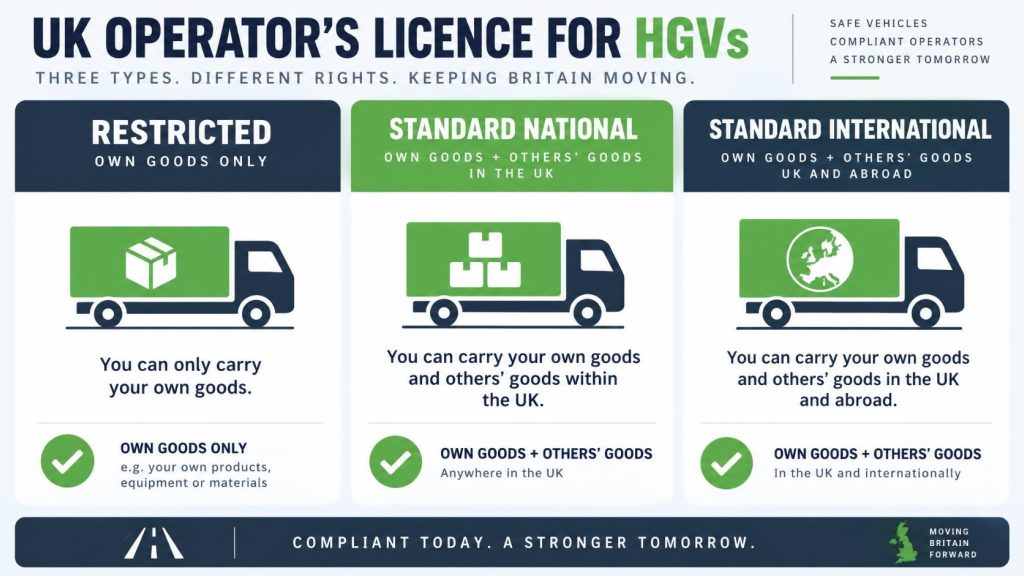
According to GOV.UK’s own guidance on licence types, a restricted licence lets you carry your own goods, but not other people’s. A standard national licence lets you carry your own goods anywhere, and other people’s goods within the UK. A standard international licence goes further still, covering other people’s goods on international journeys too.
Most genuinely self-employed owner-drivers, carrying loads for other companies under contract, need a standard licence rather than a restricted one. A restricted licence only really suits someone transporting their own business’s goods, which isn’t the typical owner-driver setup most readers researching this topic have in mind.
Licence type
What you can carry
Financial standing (first vehicle)
Transport manager needed?
Restricted
Your own goods only, UK and abroad
£3,100
No
Standard National
Your own goods anywhere; other people’s goods within the UK
£8,000
Yes, CPC-qualified
Standard International
Your own and other people’s goods, UK and international
£8,000 (HGV)
Yes, CPC-qualified
What You Need to Show the Traffic Commissioner
Per the official Goods Vehicle Operator Licensing Guide, financial standing is the money you must be able to show you have available, not a fee you pay away. For a restricted licence it’s £3,100 for your first vehicle and £1,700 for each extra one. For a standard licence it’s £8,000 for the first vehicle and £4,500 for each additional one.
On top of that, you’ll need an operating centre with suitable off-street parking for your vehicle, a plan for keeping it properly maintained, and, for a standard licence, a transport manager who holds the CPC qualification in transport management. Many new owner-drivers hold this themselves after completing the training.
An application fee of £257, plus a further £401 if your licence is granted.
A continuation fee of £401 every five years to keep the licence active.
Advertising your application in a local newspaper for your traffic area, which is a legal requirement, not optional.
A decision usually takes around seven weeks, longer if anything in your application is incomplete.
None of this is designed to catch people out, but it does reward preparing properly before you apply rather than rushing the form in. A weak operating centre or thin financial evidence is the most common reason applications stall.
What It Actually Costs to Go It Alone
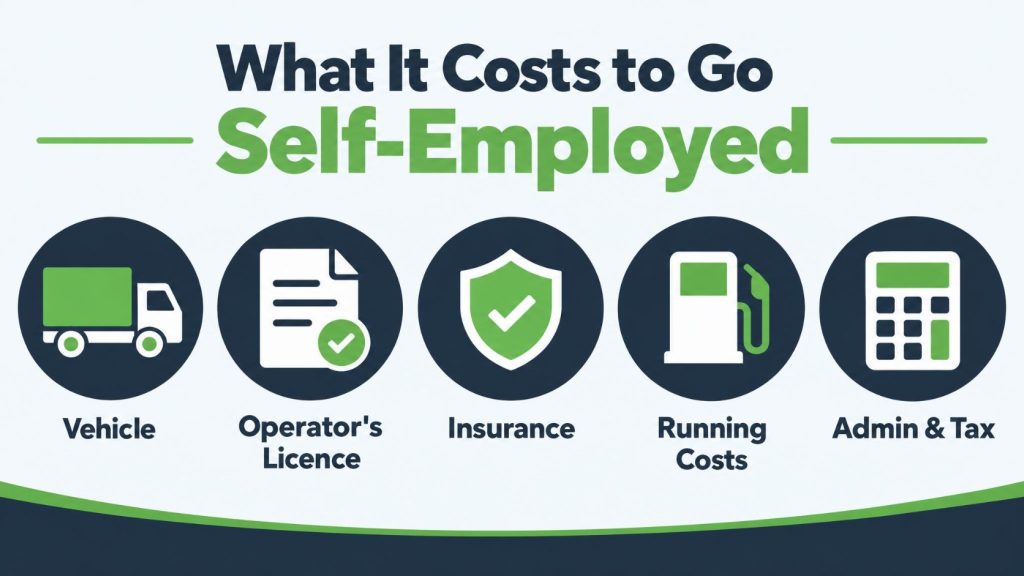
The Operator’s Licence is only one line on the budget. The real cost of going self-employed sits in the vehicle, the insurance, and the running costs that don’t stop when the work does.
Buying or Leasing Your Own Vehicle
You’ll either buy a tractor unit outright, finance one, or lease through a contract that bundles in maintenance. Each has a different risk profile: outright ownership gives you an asset but ties up capital, while leasing keeps costs predictable but means you’re committed for the contract term whether work is steady or not.
A second-hand unit costs considerably less to buy than a new one, but brings a higher risk of unplanned repair bills just when cash flow is tightest. A new or nearly-new unit under warranty costs more upfront but removes a lot of that early uncertainty. Neither choice is automatically right, and it genuinely depends on how much of a cash buffer you’re starting with.
Insurance, and the Two-Year Rule That Catches Newly Qualified Drivers
This is the part most newly qualified drivers don’t see coming. Most standard commercial vehicle insurance policies restrict cover, or load the premium heavily, for drivers with less than two years of HGV licence experience.
One UK trade investigation found that 87% of live HGV job listings either excluded newly qualified drivers outright or were silent on the point. That tells you how widespread this bar is across the whole industry, not just with insurers.
If you’ve only just passed your test, going straight into self-employed owner-driving is usually the hardest route in, not the easiest. Building two years of employed experience first is what actually opens the door.
Specialist insurers do exist for younger licence-holders, but cover is narrower and pricier than the standard market offers once you clear that two-year mark. Get quotes before you commit to a vehicle, not after, and see our guide to HGV insurance costs for what drives the premium up or down.
Running Costs and Continuation Fees
Fuel, servicing, tyres, tachograph calibration, the five-yearly O-Licence continuation fee, and your own accountancy or bookkeeping all sit on top of the vehicle and insurance. None of these go away in a quiet month.
Tax, Self Assessment and VAT
Going self-employed means managing your own income tax and National Insurance through a yearly Self Assessment return, rather than having it taken care of through PAYE. Many genuine business costs, including fuel, maintenance, insurance and your accountancy fees, are tax-deductible, which makes clean record-keeping worth the effort from the very first invoice.
If your turnover passes £85,000 a year, you also need to register for VAT and follow Making Tax Digital rules for your record-keeping and returns. Most new owner-drivers sit well under this threshold in year one, but it’s worth knowing the figure exists before you’re surprised by it later.
Cost category
What it covers
How to budget it
Vehicle
Purchase, finance or lease of your tractor unit and trailer
Get several quotes; factor resale value if buying
Operator’s Licence
Application, issue and five-yearly continuation fees
£257 application, £401 issue, £401 per renewal
Insurance
Vehicle, goods-in-transit, public liability
Varies sharply by experience; quote before buying a vehicle
Running costs
Fuel, maintenance, tyres, tachograph calibration
Build a per-mile working figure from real quotes
Admin
Bookkeeping, Self Assessment, VAT if turnover exceeds £85,000
Budget for an accountant from day one
What You Can Realistically Earn
There’s no official, published figure for what self-employed owner-drivers earn in the UK, and anyone who gives you a confident exact number is guessing. Earnings swing hard on your contracts, your running costs, and how much of the year your wheels are turning rather than sitting still.
What we do have is a solid benchmark for employed pay to compare against. The RHA’s 2026 Pay Report puts average gross weekly pay for a UK C+E (artic) driver at £883, based on a 55-hour week, with a median of £876. As a self-employed owner-driver, you’re aiming to clear that figure after every single cost above, not before.
The question isn’t whether owner-drivers can out-earn an employed wage. Some do, comfortably. The question is whether you can clear your actual running costs reliably enough, month after month, to make the extra risk worth carrying.
Our own guide to average HGV driver salary in the UK breaks down employed pay by licence category and experience, which is worth reading alongside this one before you decide which route suits you.
Worked Example: Two Drivers, Two Routes
Driver A stays employed as a C+E driver on standard RHA-benchmark pay, around £883 a week gross before tax. His employer handles the vehicle, insurance, maintenance and admin. His income is steady and predictable, week to week, with no exposure to fuel price swings or a quiet month.
Driver B qualifies on the same licence, builds two years of experience, then goes self-employed and subcontracts for an established operator. Some months he clears well above Driver A’s pay once work is steady. Other months, after a breakdown or a slow patch, his real take-home after costs lands below it.
Driver A’s ceiling is lower, but so is his floor. Driver B’s ceiling is higher, but a bad month can genuinely cost him money rather than just time. Neither driver is making the wrong call.
Which of these two sounds more like you is a better guide to the right path than any single earnings figure could ever be.
The Pros and Cons of Being an Owner-Driver
Self-employment isn’t automatically the better or worse option. It’s a genuinely different trade-off, and it suits some drivers far more than others.
You control which work you take, within whatever contracts you sign, rather than being allocated a run by someone else.
Upside is uncapped in a way an hourly or salaried wage isn’t, if you run efficiently and keep your vehicle working.
You own the asset, which has resale value, unlike time spent as an employee.
You carry all the risk, including quiet periods, breakdowns, and insurance costs that an employer would otherwise absorb.
Admin and compliance sit on you, not a transport office, including the O-Licence, tax, and maintenance records.
Newly qualified drivers face real entry barriers, especially around insurance, that employed drivers simply don’t hit.
How to Become a Self-Employed HGV Driver: Step by Step
Qualify and gain real road experience first. Get your Cat C, C+E or C1 licence and build at least two years of employed driving, which clears the insurance barrier most newly qualified drivers hit.
Decide what you’ll actually carry. Your answer determines whether you need a restricted or standard licence, so settle this before you apply for anything.
Sort your operating centre and maintenance plan. You need somewhere suitable to keep the vehicle and a credible plan, or contract, for keeping it roadworthy.
Apply for your Operator’s Licence. Budget seven weeks for a decision, advertise your application as required, and have your financial standing evidence ready before you submit.
Get quotes for insurance and a vehicle in parallel. Insurance cost can make or break the numbers, so don’t commit to a vehicle before you know what cover will actually cost you.
Set up your tax and admin properly. Register for Self Assessment, keep clean financial records, and talk to an accountant who understands haulage before your first invoice goes out.
Line up work before you need it. Subcontracting for an established operator, or building a direct client base, both take time to establish, so start before your first O-Licence renewal is due, not after.
Finding Work as an Owner-Driver
Most new owner-drivers don’t start by chasing their own direct customers. They subcontract for an established haulage operator, running under that operator’s work while keeping their own O-Licence and vehicle. It’s a steadier way in than going fully independent from day one.
Driver shortage figures from the RHA show the industry needs around 60,000 new HGV drivers trained every year for the next five years, a figure revised up sharply from its earlier estimate. That demand runs through subcontracted and agency work just as much as direct employment, which is genuinely good news for a new owner-driver looking for contracts.
If owner-driving turns out not to suit you, or you decide to build two years of experience first, our guide to HGV driver CVs and recruitment agencies covers how to get hired faster as an employed driver, and our recruitment advice service can help you find the right role directly.
Specialist work, such as ADR tanker and hazardous goods driving, tends to command a premium over general haulage for owner-drivers who hold the extra certification. Staying current also means keeping your Driver CPC card renewed, which lapses just as easily for a self-employed driver as an employed one.
Is Going Self-Employed Right for You?
Self-employment suits drivers who are genuinely comfortable running a small business alongside driving it, who have, or can build, a financial buffer for quiet months, and who’ve already cleared the two-year experience mark most insurers look for.
It tends to suit less well a driver who wants to focus purely on driving, who needs predictable monthly income straight away, or who’s newly qualified and keen to start earning without a long run-up. None of those are wrong reasons. They’re just a better fit for employed or agency driving, at least for now.
Whichever direction you’re leaning, it’s worth understanding the licence route itself properly first. Our guide to choosing between Cat C and C+E and our breakdown of the different types of HGV driving job are both worth reading before you commit to either path.
If you haven’t qualified yet, use our course cost calculator to see what training will actually cost, or read about who we are and how we support drivers from first licence through to a long-term career, employed or self-employed.
Frequently Asked Questions
Can I go self-employed straight after passing my HGV test?
You can legally hold an Operator’s Licence as soon as you qualify, but most standard insurance policies restrict or heavily load premiums for drivers with less than two years of licence experience. Building employed experience first is usually the more realistic route in.
What’s the difference between a restricted and standard Operator’s Licence?
A restricted licence only lets you carry your own goods. A standard national or standard international licence lets you carry other people’s goods for payment, which is what most self-employed owner-drivers actually need.
Do I need to be CPC qualified to hold a standard Operator’s Licence?
You need a transport manager who holds the Certificate of Professional Competence in transport management. Many owner-drivers complete this training themselves and act as their own nominated transport manager.
How much does an Operator’s Licence actually cost?
The application fee is £257, with a further £401 if your licence is granted, plus a £401 continuation fee every five years. Financial standing requirements on top of this start at £3,100 for a restricted licence or £8,000 for a standard licence.
Can HMRC decide I’m not really self-employed?
Yes. HMRC looks at whether you’re genuinely working for yourself, including whether you supply your own vehicle and control how the work is done. Driving someone else’s lorry on their terms is unlikely to count as genuine self-employment, whatever the paperwork says.
Is it better to buy or lease my first lorry?
Buying gives you an asset with resale value but ties up more capital upfront. Leasing keeps monthly costs predictable and often bundles in maintenance, but commits you to the contract term regardless of how steady the work is.
How do new owner-drivers usually find work?
Most start by subcontracting for an established haulage operator, running under that operator’s contracts while keeping their own O-Licence and vehicle, rather than chasing direct customers from day one.
What happens if I don’t pay my Operator’s Licence continuation fee?
Your licence lapses, which means you can no longer legally operate. The continuation fee is due every five years and is a straightforward administrative requirement, not something to let slip.
Is self-employed HGV driving more profitable than being employed?
It can be, but only once every running cost, insurance premium and quiet period is accounted for. There’s no official published figure for self-employed owner-driver earnings, so treat any confident number you see elsewhere with caution.
Related Articles
13/11/2026
Types of HGV Driving Jobs Explained: Multi-Drop, Trunking and Long-Haul Compared
Passing your test is one job done. Working out what kind of HGV driving you actually want to do is the next one, and it...