You’ve probably had the same thought while watching wagons roll up the A1, the A46, or through the industrial estates around Lincolnshire. Someone is getting paid to do that, and there’s clearly work about.
They are, and there is. The county has a steady pull from logistics, food production, agriculture, builders’ merchants, port traffic further north, and general haulage. On paper, that makes HGV driving look straightforward. Pass the test, get the keys, start earning.
The hard bit comes after the pass certificate.
A lot of people hit the same wall. Job adverts say “new passes welcome” in one line, then ask for proven commercial miles in the next. That gap is real. A 2025 DVSA analysis cited alongside Lincolnshire HGV listings found that 68% of new drivers fail to secure a job within 3 months post-licensing due to the experience paradox, with employers pointing to insurance and safety concerns.
That doesn’t mean you can’t get in. It means you need a better plan than “apply everywhere and hope”.
Starting Your Journey into HGV Driving in Lincolnshire
Lincolnshire suits people who like practical work and steady demand. You’ve got trunk roads, farms, food sites, warehousing, local delivery, mixer work, container traffic within reach, and larger operators who need drivers week in, week out. If you’re changing career, that’s attractive. If you’re younger and want a trade with a clear route in, it’s just as attractive.
The mistake most starters make is thinking the licence is the finish line. It isn’t. The licence is your entry ticket.
The real problem new drivers face
Passing your Cat C or C+E test proves you can handle the vehicle to test standard. Employers still want to know something else. Can you reverse under pressure, keep calm when plans change, turn up on time every day, deal with paperwork, protect the load, and speak to traffic office staff and customers properly?
That’s why the experience paradox catches people out. Ads often talk about opportunity, but the strongest jobs still lean towards drivers with recent commercial work behind them.
Practical rule: Treat your first job hunt as part of your training, not something separate from it.
A new driver in Lincolnshire needs to think in stages:
Stage one: get licensed and legally qualified
Stage two: target employers that can absorb a new pass
Stage three: build enough clean, recent experience to move into better-paid roles later
If you’re still at the training stage, it helps to understand what local training routes look like before you commit. A guide to HGV training in Grimsby and the wider local route into licensing gives a useful picture of how many Lincolnshire learners start close to home and then branch into work across the county.
What actually works
What works is realism. Go after structured work first. Be open on shifts. Get your paperwork right. Stop chasing the best-paid advert in week one if it clearly wants someone with road miles already logged.
That approach feels less exciting, but it gets drivers hired.
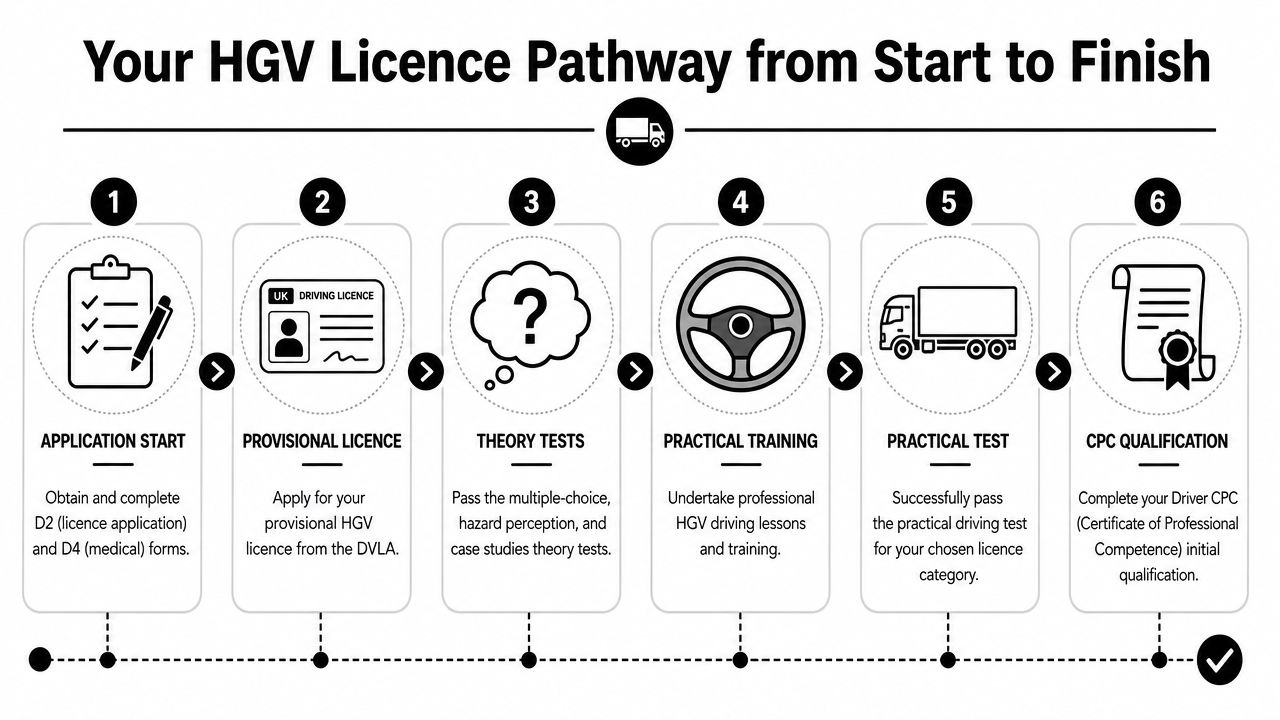
Your HGV Licence Pathway from Start to Finish
The licensing side catches a lot of Lincolnshire starters out because it looks like one job, but it is really a chain of separate steps. Miss one form, book things in the wrong order, or leave a gap between tests, and the whole process drags on for weeks.
Treat it like a job file. Get each stage done cleanly, keep copies of everything, and book the next step before momentum drops. New passes who move quickly usually reach the interview stage faster too, which matters when you are trying to beat the experience paradox and get that first operator to take a chance on you.
Start with the paperwork
You need two key forms at the start. The D2 application form adds provisional HGV entitlement to your licence. The D4 medical form is completed as part of your driver medical.
The medical is typically straightforward, but do not leave it until last. Delays usually come from admin, appointment availability, or missing details, not from the actual driving side of the process.
A sensible order is simple:
Get the D2 and D4 sorted early
Book the medical as soon as you can
Send the provisional application straight after the medical
Check progress rather than assuming the paperwork is moving
That last point saves time. Plenty of learners lose a month by waiting politely instead of checking whether anything is missing.
Theory comes in separate parts
The theory stage tests more than road signs and stopping distances. It checks whether you can make the sort of decisions employers expect from day one.
You will usually deal with:
Multiple choice, covering rules, safety, vehicle knowledge, and legal duties
Hazard perception, checking how early you spot trouble developing
CPC case studies, based on real work situations such as load security, driver hours, and compliance
Some new drivers slip. They focus on the practical test because that feels like real driving, then treat theory like a box-ticking exercise. Employers do not see it that way. A driver who understands legal limits, defects, walk-round checks, and basic compliance is easier to trust with a vehicle, even if they have not got many road miles yet.
Practical training and the test
Once theory is passed, the process feels more like proper driver training. You are working on control, mirror discipline, planning, road position, manoeuvres, and safe routines that stand up under test pressure.
Instructors are not just looking for someone who can get around the route without hitting anything. They are looking for repeatable habits. That matters later in interviews as well, because firms hiring new passes want signs that your standards will hold up when a sat nav goes wrong, a yard is cramped, or a delivery point is awkward.
Part of training
What good assessors are checking
Road driving
Safe decisions made in good time
Mirrors and awareness
Regular observation without reminders
Manoeuvres
Control, patience, and proper setup
Vehicle sympathy
Smooth use of brakes, gears, and steering
Professional routine
Consistent habits every time you drive
If you are aiming for a first job in Lincolnshire, do not just try to scrape through the test. Use training to build examples you can talk about at interview. Reversing cleanly, staying calm in tight spaces, and following a proper routine before moving off all help answer the question every traffic office asks about a new pass. Will this person be safe to send out?
Do not overlook Driver CPC
If you plan to drive professionally, Driver CPC is part of the legal route, not an optional extra. GOV.UK explains that professional lorry drivers need the relevant CPC qualification and periodic training to keep driving for work: Driver CPC training overview.
That matters for two reasons. First, you need to be legal. Second, employers notice very quickly whether a candidate understands the difference between holding the right licence and being fully qualified to work.
The practical point is simple. Getting the licence is the start of your employability, not the finish. The drivers who get hired fastest are usually the ones who handle the admin properly, pass without long gaps, and can show they understand the working side of the job as well as the test standard.
Choosing the Right Licence for Lincolnshire’s Roads
Not every new driver needs to go straight for the biggest combination on the road. The right licence depends on the work you want, the employers you’re targeting, and how quickly you want to widen your options.
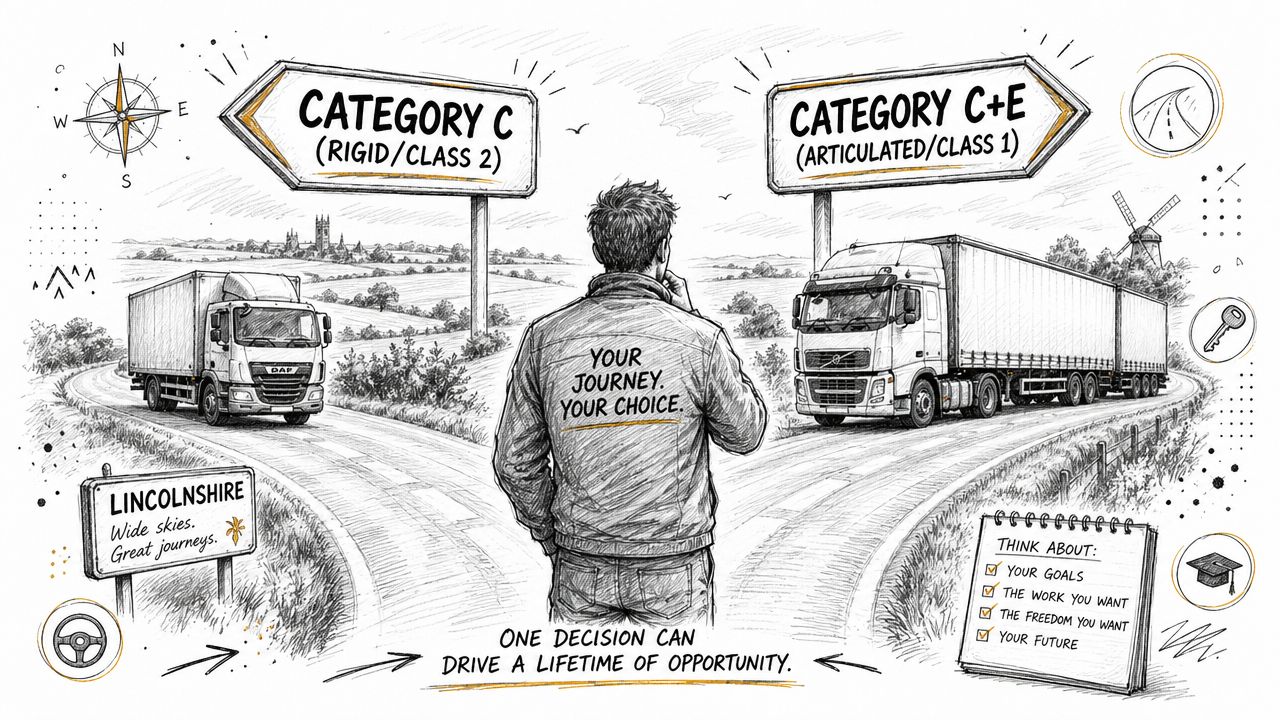
Category C for local and regional work
Category C, often called Class 2, suits rigid vehicles. In practical terms, that points you towards many local and regional jobs. Think builders’ merchants, food distribution, municipal-style work, pallet networks, and some specialist roles where you’re in and out of sites all day rather than sitting on a long trunk run.
This route often suits people who want:
More varied days with multiple drops
A quicker move into local work around towns and industrial estates
Experience handling customers and delivery points early in their career
It’s also a good fit if you’d rather master rigid vehicle work before moving up.
Category C+E for wider access
Category C+E, or Class 1, opens the door to artic work. That usually means more access to trunking, depot-to-depot runs, larger logistics firms, supermarket networks, container work, and long-distance general haulage.
The upside is simple. More employers recruit at this level, and the stronger-paying jobs often sit here. The trade-off is that some firms are even more cautious about giving brand-new C+E licence holders their first break, especially on insurance-sensitive fleets.
If your long-term target is artic work, don’t talk yourself out of C+E. Just be ready to take a sensible first role rather than waiting for the perfect one.
Where C1 fits
C1 covers smaller lorries. It isn’t the main route people mean when they search for HGV driver jobs in Lincolnshire, but it matters for certain careers. Ambulance service applicants, some community transport roles, and smaller commercial vehicle jobs can all sit closer to C1.
Here’s the simple comparison:
Licence
Typical fit
Best for
C1
Smaller lorries
Ambulance and specialist service roles
Category C
Rigid vehicles
Local delivery and site-based work
Category C+E
Artics and drawbar combinations
Trunking and broader logistics work
The right answer isn’t always the biggest licence. It’s the one that gets you moving into paid work and builds the sort of experience employers in your chosen lane respect.
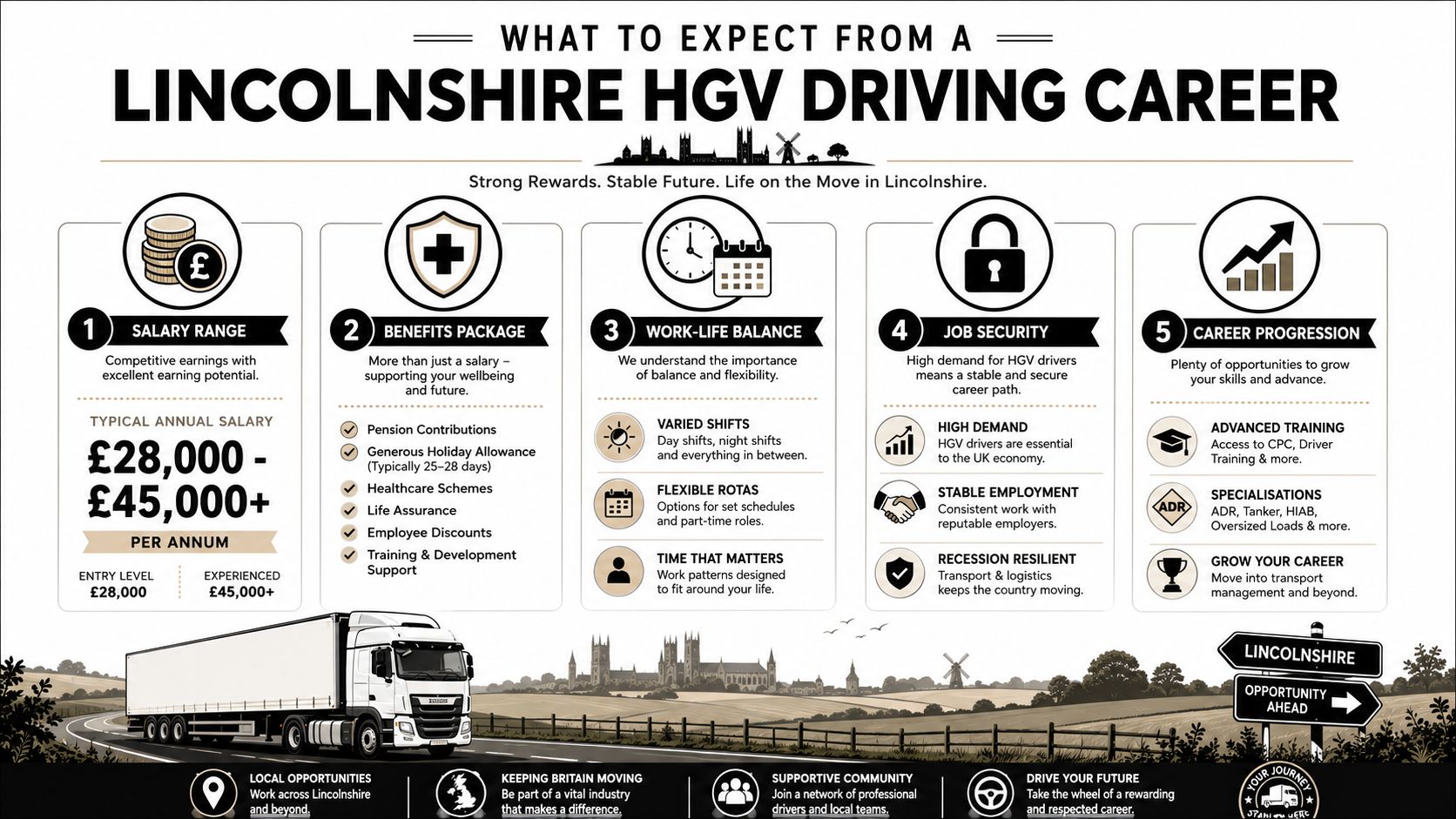
What to Expect from a Lincolnshire HGV Driving Career
You pass on Friday, start calling round on Monday, and by midweek you realise the licence was only the first step. The key question is what the job looks like once you are out on Lincolnshire roads every day, dealing with starts before dawn, farm traffic, depot delays, and rotas that do not always care about your plans.
That catches new drivers out. They focus on getting qualified, then hit the experience barrier and start wondering whether the work is worth chasing. In Lincolnshire, it often is. You just need a clear view of the trade-offs before you commit to a type of role.
Pay in the county
Pay varies hard by vehicle type, shift pattern, and who is carrying the insurance risk on a new pass. Totaljobs HGV vacancies in Lincolnshire show a busy local market, with average salaries sitting around the low £30,000s and stronger Class 1 packages pushing much higher in the right operation.
That spread matters. A starter job may not be the best-paid job you ever do, but it can still be the right move if it gets you six to twelve months of clean, recent commercial work. In practice, that first block of experience often has more value than holding out for the headline rate.
The better-paying roles usually come with conditions attached. Nights, weekends, store delivery pressure, awkward start times, or stricter expectations around reversing, paperwork, and pace are common. Higher pay normally reflects a harder pattern, more responsibility, or a fleet that wants drivers who can get on with the job with minimal hand-holding.
Hours and routine
Expect long days at times. The legal framework governs driving and working time, but the lived routine still depends heavily on the traffic office, the customer, and the type of run.
Lincolnshire work often splits into a few familiar patterns:
Local multi-drop or rigid work can mean early starts, physical graft, and plenty of yard time.
Trunking is usually cleaner and more repetitive, but start times may be antisocial and the better jobs are not always easy for a new pass to get straight away.
Agricultural, tipper, tanker, or mixer work can be seasonal, weather-sensitive, and more site-based than many beginners expect.
Agency shifts can help you build exposure fast, but one good week does not always mean the next week looks the same.
Weekend availability helps early on. So does being realistic about start times. Plenty of solid driving jobs in this county begin long before typical waking hours.
What the job feels like after the novelty goes
Some days are straightforward. You check the vehicle, get loaded, keep your times clean, and finish without drama.
Some days are not.
You wait on a bay for an hour. A farm entrance is tighter than the photo suggested. A site wants you in a place that looks impossible until you stop rushing and set it up properly. The traffic office changes the order. The last drop runs late and your finish time disappears.
That is normal working life in transport. Drivers who settle well are usually the ones who stay calm, protect their licence, and stop treating every delay as a personal insult.
The first year is usually about proving reliability
This is the part many guides miss. Your first HGV job in Lincolnshire is often less about finding the perfect role and more about becoming employable for the next one.
Employers want signs that you will turn up, look after kit, follow site rules, and keep paperwork and walk-round checks in order. A new driver who is steady, safe, and easy to deal with can progress quickly. A new driver who chases money, moans about every awkward run, or cuts corners usually gets stuck.
That is why the experience paradox is real, but beatable. You may need to start in a role that is less glamorous, more physical, or further from your ideal shift pattern. If it gets recent commercial experience on your record, it is doing its job.
If you are still weighing up what sort of work to target, this guide to finding lorry driver jobs near you helps you match the job hunt to the kind of driving life you want.
A Lincolnshire HGV career can be stable and well paid. It can also be tiring, repetitive, and unforgiving if your attitude is wrong. Go in with your eyes open, use the first role to build a record, and the better options tend to come much faster.
How to Find HGV Jobs and Get Hired in Lincolnshire
You pass your test, start applying, and within a week you keep seeing the same line. Experience preferred. Experience required. Minimum time on Class 1. That is the point where plenty of new drivers lose momentum.
Lincolnshire does have work for new passes, but you need to separate true entry routes from jobs that only look open on the surface.
Read the ad like a recruiter would
A lot of applicants read job adverts too quickly. Recruiters do not.
The words that matter are usually brief and easy to miss. “Recent commercial experience”, “for insurance purposes”, “must hold CPC and Digi card”, “minimum experience preferred”, or “Class 1 background” all tell you how much risk the employer is willing to take on a new driver.
In practice, many better-paid jobs go to drivers who already have some time in real transport work. That does not mean you are blocked. It means your first target should be operators, training-led roles, and employers that regularly take on new passes instead of fighting for jobs built for experienced drivers.
Part-time work catches people out here. It sounds like the easier way in. Often it is not. A lot of part-time cover jobs go to drivers who can turn up, take the keys, and work with very little supervision.
The routes that usually get a new driver on the road
The best first move is usually the one that gets you clean commercial experience fastest.
That tends to be one of these:
A full-time role with an operator used to new passes
An apprenticeship or trainee-style job with proper supervision
Agency registration as a backup, while you focus on one main employer
Class 2 work first, if Class 1 doors stay shut at the start
That last point matters in Lincolnshire. Plenty of new drivers want artic work immediately, and some will get it. Others are better off taking a rigid job for a few months, learning delivery sites, reversing under pressure, paperwork, customer handovers, and defect reporting in practical settings. Good Class 2 experience often makes the jump to C+E much easier.
Build a CV that makes sense in transport
A weak CV says you passed the test and want a chance. A useful CV shows why putting you in a vehicle will not become hard work for the employer.
Keep it plain and specific:
Put your licence category at the top
State your Driver CPC and Digi card clearly
List work that shows reliability, such as early starts, shift work, route-based jobs, time-critical deliveries, warehouse loading, plant work, farm work, or site access procedures
Include practical responsibilities, such as vehicle checks, paperwork accuracy, customer contact, handheld scanner use, or safe loading habits
Leave out padded claims that you cannot back up in an interview
A transport manager does not need a fancy CV. They need to see whether you are likely to show up on time, follow instructions, and look after the kit.
If an employer asks about experience, answer it cleanly.
Say you are a new pass. Say you understand why operators and insurers are cautious. Then give them a reason to keep talking. Mention the habits you already have that reduce their risk: good timekeeping, proper walk-round checks, willingness to learn their paperwork and site rules, calm attitude under pressure, and flexibility on starts.
Do not try to sound more experienced than you are. New drivers usually get ruled out for sounding careless or vague, not just for lacking miles.
One honest line works well: you are looking for the first employer willing to help you build safe, recent commercial experience, and you intend to make that pay off for them.
A short explainer on the wider job market can help frame your search:
Where to look locally
Use more than one route, but use them differently.
Channel
How to use it well
General job boards
Good for volume. Filter hard and ignore adverts that clearly want a driver who can be dropped straight into trunking work
Driver agencies
Useful for market feedback, short-notice openings, and finding out which firms will actually consider a new pass
Direct employer sites
Often the best place to find trainee, apprentice, or steady full-time vacancies before they get diluted on job boards
Word of mouth
Strong in transport. Ask trainers, warehouse staff, shunters, and drivers already working the depots you want to target
The goal is not to send fifty weak applications. The goal is to apply where a new driver can realistically get through the door, then turn that first job into the experience every later advert asks for.
Funding Your Training and Planning Your Next Move
A lot of new drivers in Lincolnshire stall here. They get as far as pricing the medical, theory, training and tests, then realise the bigger problem is not only paying for the licence. It is paying for the licence and still having a clear route into that first job.
That second part matters just as much.
If you are trying to break the experience trap, funding and job planning need to sit together from day one. A cheaper course is not a bargain if it leaves you qualified but stuck. A pricier route can make sense if it gives you a real shot at recent commercial experience, a decent introduction to local employers, or training dates that let you move quickly.
Options that make practical sense
The main routes are usually:
Skills Bootcamps if you want a funded or partly funded route and a job interview at the end
Apprenticeships if you want to earn while learning and build experience with one employer
Spread-cost finance if waiting to save the full amount will delay your switch into driving for too long
Employer-funded training if you can find a warehouse, yard, delivery, or van role with a firm that promotes from within
Bootcamps can work well, but ask blunt questions before you sign anything. Which licence are they funding. How quickly do test dates come through. Which employers interview at the end. Are those employers open to true new passes, or do they still prefer drivers with a year behind them.
Apprenticeships get overlooked by career changers, and that is a mistake. In practice, they can be one of the cleaner ways around the experience problem because you are learning inside the business that may hire you long term. The trade-off is pace. It can take longer than booking private training and passing as fast as possible.
Spread-cost finance gives you speed, but only if you treat it like an investment with a plan attached. If your budget is already tight, do the maths properly. Work out what you can afford each month, how long you could cover bills if test dates slip, and what kind of first role you would realistically take to get experience on the board.
Plan the first job before you book the course
New drivers can save themselves months of frustration.
Before paying a deposit, pin down three points:
The licence that matches the work you want locally
The training schedule you can complete without disrupting your income
The employer route most likely to give you that first break
For example, if your best opening is likely to come through multi-drop, pallet network work, refuse, tipper, or a mixed warehouse-to-driver role, you need training and availability that fit those employers. If your whole plan depends on walking straight into clean trunking with no commercial experience, you may spend longer looking than you expect.
For a useful breakdown of grants, payment options, and support routes, read this guide to funding for HGV training.
The drivers who get moving fastest are usually the ones who treat the pass date as the start of the job search, not the finish line.
If you want help choosing the right licence, sorting the training steps, and building a realistic route into work, speak to HGV Learning. They coordinate medicals, theory preparation, practical training, and job-focused support, with flexible payment options that can spread training costs over 10 to 12 months.
What Age Can You Start HGV Driver Training? A 2026 UK Guide to Licence Age Requirements
If you're asking what age you can start HGV driver training, the honest answer depends on which licence you're after. A C1 licence, covering vehicles...