You might be looking at warehouse shifts, retail work, van driving, or a job that no longer feels worth the effort and wondering if HGV driving in Manchester is a realistic move. That's usually where this starts. Not with a grand career plan, but with a simple question: can I get qualified, get working, and build something steadier?
The honest answer is yes, but only if you treat it like a process, not a punt. People get stuck when they rush the wrong step, book training before they're ready, or chase job ads without understanding what employers check. The people who move fastest are usually the ones who get organised early and keep the sequence tight.
Manchester makes that path worth taking seriously. There's a big logistics footprint, plenty of movement in the local labour market, and a wide spread of job types once you're qualified. The key is knowing what kind of role you want, what licence level gets you there, and how to avoid wasting time on admin mistakes.
Your Starting Point for a Driving Career in Manchester
A lot of new drivers start from the same place. They want practical work, better structure, and a role where effort matters. They don't want years back in a classroom. They want a route they can follow, one step at a time, with a clear line between where they are now and their first paid shift.
That mindset suits HGV driving well. It's a regulated trade, so there are boxes to tick, but the route is straightforward when you do it in the right order. You sort the licence paperwork, pass the theory side, complete practical training, finish the CPC requirement, and then apply for roles that match your category and readiness.
For some people, an apprenticeship route is worth comparing against direct training, especially if they want a more structured work-and-learn setup. If that's you, it helps to look at your apprenticeship path to success before deciding which route fits your finances, timetable, and learning style.
What usually trips people up early
The biggest early mistake is thinking the job hunt comes first. It doesn't. Employers want proof that you're close to road-ready or already qualified. If your paperwork is incomplete, your theory isn't passed, or your CPC status is unclear, your application goes to the weak pile quickly.
Another common problem is chasing the wrong licence category without thinking about the work attached to it. Some people want local rigid work. Others really want articulated work and only realise that later.
Practical rule: Start by matching the licence route to the job you want, not the other way round.
If you want a plain-English overview of the journey from first step to first role, this guide on how to become an HGV driver is useful as a reference point.
A better way to approach the change
Treat the move like a build sequence:
Choose your target role first. Local multi-drop, trunking, agency cover, part-time weekend work, and long-distance work all place different demands on you.
Get your admin in order early. Delays here slow everything else.
Learn the market realistically. Not every vacancy offers tidy day shifts and easy depot starts.
Stay compliance-focused. Employers don't just hire a licence holder. They hire someone they can put to work safely and legally.
That's the difference between hoping to break into HGV driver jobs in Manchester and becoming employable.
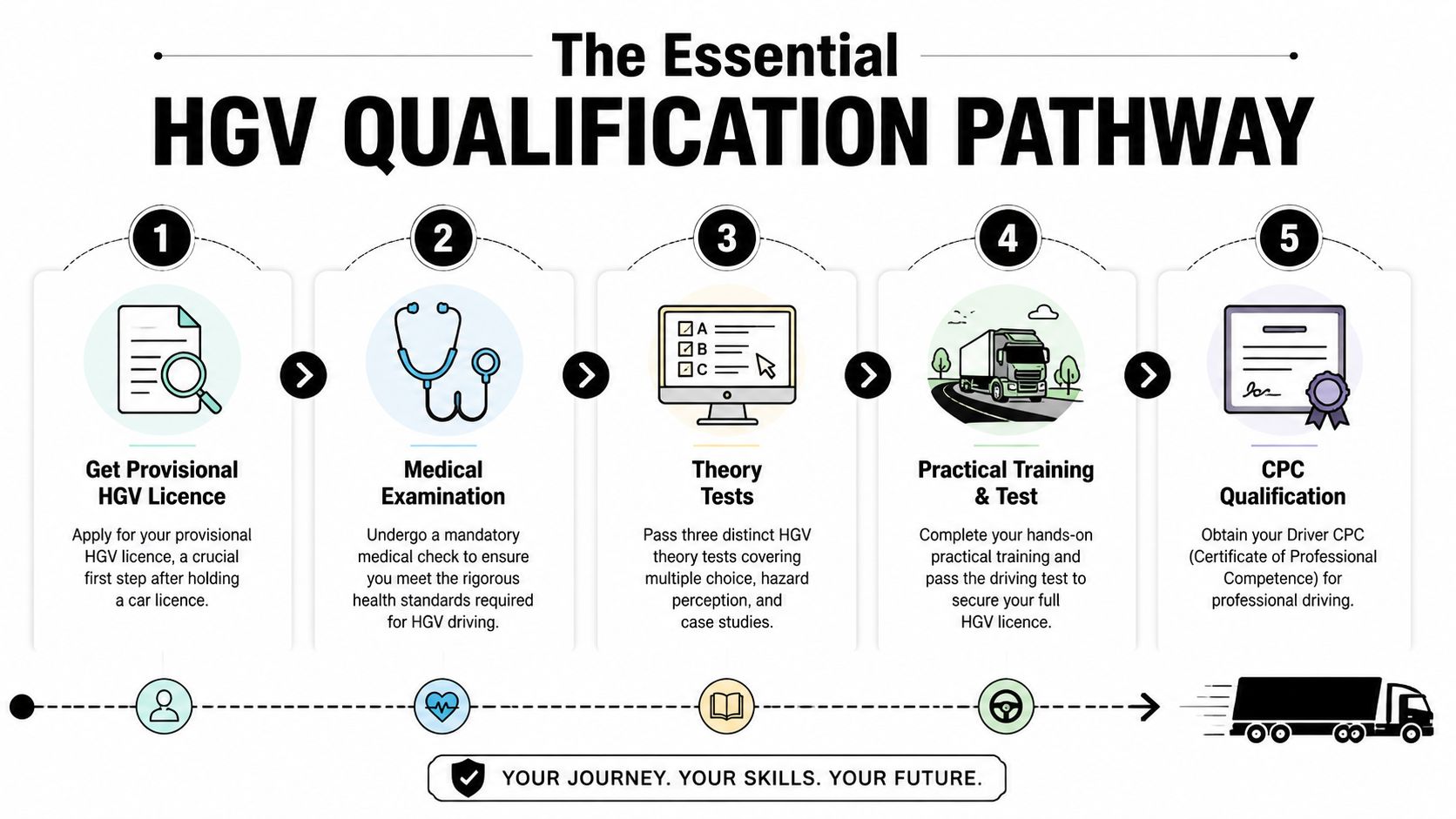
The Essential HGV Qualification Pathway
In Manchester, the fastest way into paid driving work is usually the cleanest route through the licence process. Drivers lose time by booking bits in the wrong order, chasing training dates before the paperwork is live, or applying for jobs without CPC or a tacho card in place. Employers can work around limited experience more easily than incomplete admin.
The route itself is straightforward. Get the medical done, apply for provisional HGV entitlement, pass the theory tests, complete practical training, then finish the Driver CPC requirements and sort your digital tachograph card. Beginner training typically takes 4 to 6 weeks if your bookings line up and there are no delays with forms, medicals, or test availability. An LGV C+E apprenticeship takes much longer, but it suits people who want employed training rather than funding the process themselves.
Start with the medical and provisional paperwork
This is the part that sets your pace.
If your D4 medical or provisional application gets held up, the rest of the plan slips with it. In Manchester, that matters because some training providers can move quickly once your licence record is ready. If your admin is late, you miss those earlier slots and wait again.
A practical sequence looks like this:
Book the medical early. Do it before you start comparing training dates.
Check every form before sending it. Small mistakes create avoidable delays.
Apply for provisional entitlement as soon as the medical is complete.
Store copies of everything. You will want them if anything goes missing or needs chasing.
Drivers changing career mid-job often underestimate this stage because it feels less important than getting behind the wheel. It is not less important. It is the gate that opens the rest.
Why sequence matters more than speed
A rushed start usually costs more time than a steady one. Someone revises manoeuvres before theory is booked, or pays for training before checking what licence category fits the work they want in Manchester. That leads to wasted lessons, rebooked tests, or the wrong qualification for the jobs they end up targeting.
Use a staged approach instead:
Stage
What you're doing
Why it matters
Foundation
Medical and provisional licence
Gets you legally started
Knowledge
Theory preparation and test
Prevents later training from stalling
Skills
Practical tuition and roadwork
Builds test-standard driving
Employment readiness
Driver CPC and supporting documents
Lets an employer put you to work
That order also matches how the Manchester market tends to hire. Depot managers and agency recruiters want drivers they can place with minimal delay. If your licence is passed but your CPC or tacho card is still outstanding, you look half-ready.
The quickest route is usually the one with the fewest interruptions, not the earliest practical lesson.
What employers usually want at application stage
By the time you start applying, the basic expectation is clear. You need the right licence category for the vehicles they run, your Driver CPC in place, and a digital tachograph card ready for regulated work. A lot of Manchester operators also screen for a sensible driving record and whether you can reliably get to early depot starts in Trafford Park, Middleton, Carrington, or the airport side of the city.
That last point catches people out. A 4:00 am or 5:00 am start is normal in parts of the market, and public transport is not always enough. For temp work, weekend shifts, or part-time cover, employers often pick the candidate who can say yes quickly and turn up without fuss.
Check your application against the basics:
Licence category fit. Category C for rigid work, C+E for artic work.
CPC status. Required if you want paid professional driving work.
Tacho card. Needed before you can step into many shifts.
Driving record. Points and recent issues can limit options.
Travel reliability. Employers want confidence that you can make the shift.
Make the process easier on yourself
Some learners handle every booking and form themselves. That can work if you are organised and have time to chase dates, paperwork, and test availability. Others use a coordinator to manage the sequence, keep documents moving, and line up theory support with local practical training.
HGV Learning is one example of that type of service. The value is administrative control and fewer wasted weeks, not hype.
That trade-off is simple. If you self-manage well, you may save money. If you are balancing work, family, and a career change, paying for tighter coordination can save delays that matter more than the upfront cost.
Mastering Your HGV Training and Tests
Once the paperwork is moving, your focus shifts from admin to performance. This is the stage where people either build momentum or lose it. The ones who pass cleanly don't rely on luck. They prepare in the same order the tests are delivered, and they practise with the standard expected of a working driver, not just a learner trying to scrape through.
Get the theory phase right
The theory side catches out people who assume road experience from car driving is enough. It isn't. HGV theory demands a different level of hazard awareness, rule application, and professional judgement.
A better approach is to revise with purpose:
Work on hazard perception regularly. Short, repeat sessions usually beat cramming.
Learn the commercial context. Questions often test how a professional driver should think, not just what a car driver might do.
Use mock tests properly. Don't just chase a score. Review where your judgement was off.
If you struggle here, don't rush to practical training to “keep things moving”. That usually creates more pressure, not less.
What practical training should feel like
Good practical training is rarely dramatic. It should feel controlled, repetitive, and demanding in the right way. You'll spend time on observation, road position, planning, mirrors, speed control, and vehicle handling. Instructors aren't trying to impress you. They're trying to strip out habits that don't hold up in an HGV.
That's also why local route familiarity helps. Around Manchester, trainees may encounter busy urban sections, roundabouts, industrial traffic, dual carriageways, and tighter delivery-style movements. The goal isn't to memorise roads. It's to stay composed in mixed conditions.
Most failed practical attempts start before the serious fault. The driver was already behind the vehicle, behind the mirrors, or behind the plan.
Don't treat CPC as an afterthought
A major bottleneck for new drivers is compliance readiness. It isn't enough to pass the driving test. Professional drivers need a valid Driver CPC, and they must complete 35 hours of periodic training every 5 years to remain professionally eligible, according to Backline Logistics' guide to becoming an HGV driver.
That's why the strongest candidates think in two layers:
Layer
What it means in practice
Driving competence
You can control the vehicle safely and meet test standard
Professional compliance
You hold the CPC status needed to work legally
If you ignore the second layer, you can pass the test and still not be properly ready for employment.
A useful visual walkthrough can help when the process still feels abstract:
How to avoid the common training mistakes
The practical failure points are often concentrated in sequence and preparation, not raw driving ability. A structured learner usually does better because they don't fragment the process.
Focus on these habits:
Finish one gate before opening the next. Theory first, then practical scheduling.
Apply instructor feedback directly. If they tell you a mirror routine is late, fix it immediately.
Prepare like a working driver. Rest, timing, calm arrival, and concentration all matter.
Respect the CPC modules. They're part of the employability picture, not separate admin.
That mindset is what turns training into a route to work, rather than a pile of disconnected tests.
Your Toolkit for Finding Manchester HGV Jobs
You pass your tests, start searching, and the first surprise hits fast. Manchester has plenty of HGV work, but the key question is which jobs will take a newly qualified driver, which ones are agency-led, and which shifts fit your life.
That matters more than a big vacancy number.
A job advert can look attractive and still be the wrong first move. Some firms want one year of Class 1 experience. Some are happy to take a new pass if your paperwork is in order, you present well, and you can cover the shift pattern they struggle to fill. In Manchester, that often means early starts, nights, weekend cover, store deliveries, trunking through the motorway network, or temp bookings that can turn into regular work if you prove reliable.
Build a CV that answers transport managers quickly
A weak HGV CV is full of claims like reliable, hard-working, and keen to learn. Transport offices see that all day. It does not help them decide whether to call you.
A useful CV gets the practical points near the top:
Licence category. State Category C or C+E clearly.
Driver CPC status. Make it easy to spot.
Digital tachograph card. Include it if held.
Relevant work history. Van driving, multidrop, warehouse work, route planning, FLT work, loading, and customer-facing delivery jobs all count.
Shift availability. Say whether you can do days, nights, weekends, ad hoc agency work, or part-time hours.
Location and travel range. Employers want to know if a 04:00 start in Trafford Park is realistic for you.
If you want more ideas on filtering local adverts and narrowing down realistic roles, this guide to lorry driver jobs near me is worth reading.
Apply in a way that matches how the market actually works
New drivers often waste time by applying only for the cleanest-looking permanent jobs. Manchester does have those roles, but they are not usually the fastest route in.
A better approach is to split the search across three channels.
Route
What it's good for
Trade-off
Direct employers
More stability, clearer induction, chance to settle into one fleet
Often slower hiring, sometimes ask for experience
Agencies
Faster starts, broad exposure to depots and work types
Less predictability, hours can vary week to week
Temp or part-time roles
Useful for confidence, family commitments, or building recent driving history
Lower certainty, fewer guarantees on regular shifts
For plenty of new pass drivers, agency work is the first proper foothold. It is not glamorous, but it gives you something employers value. Recent on-road experience, familiarity with different sites, and proof that you turn up ready.
Present yourself like a low-risk hire
Recruiters and transport managers skim applications quickly. They are checking for friction. Can you start soon? Do you understand the basics of legal compliance? Are your expectations realistic? Will your availability match the run sheet?
That is why hiring-side reading can help. A practical recruitment workflow blog gives a useful view of how candidates are screened before anyone calls them.
A new pass driver does not need to pretend to be experienced. A new pass driver needs to look organised, contactable, honest about availability, and safe to put in a vehicle.
What interviewers usually test
HGV interviews are often straightforward, but they are still built around risk and reliability. The manager is not looking for polished speeches. They are checking whether you will protect the licence, the vehicle, the load, and the customer relationship.
Expect questions around these areas:
Interview topic
What the employer is checking
Driver hours and tachograph rules
Whether you respect legal limits and record time properly
Daily walk-round checks
Whether you take defects and roadworthiness seriously
Incident reporting
Whether you report problems early instead of hiding them
Shift flexibility
Whether your availability fits the operation
Delivery pressure
Whether you stay steady when plans change
Keep answers plain and specific. If you do not know a company procedure, say you would follow site instructions and ask the transport team. That is a better answer than guessing.
Common mistakes that slow down the first job offer
The biggest mistake is being too selective too early. Day work, no handball, local routes only, no weekends, permanent contract only. Those preferences are understandable, but they can leave a newly qualified driver waiting much longer than necessary.
The better strategy is to choose your first role based on what it gives you after three months:
regular vehicle time
recent commercial experience
confidence with delivery sites and paperwork
a referee who will back your reliability
a clearer idea of whether you want trunking, store work, general haulage, or multi-drop
That first Manchester job does not have to be perfect. It has to be useful.
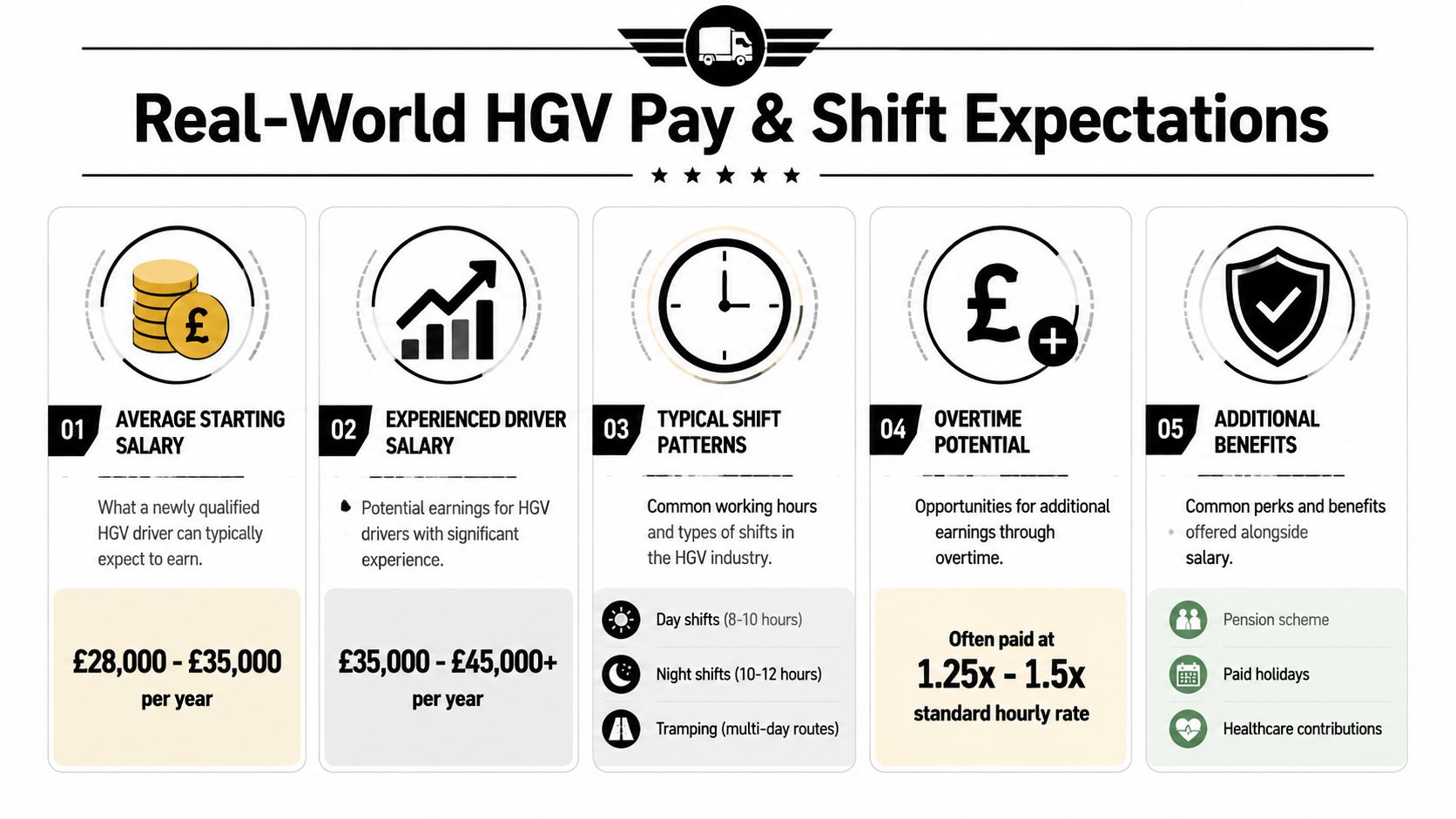
Real-World Pay and Shift Expectations
Often, the initial focus is on pay. However, shift quality should be understood with equal clarity. In Manchester, those two things are tied together. A role can pay reasonably and still be awkward for family life if the starts are brutal, the rota moves around, or the contract is heavily temporary.
As a national benchmark, the median hourly pay for HGV drivers in 2024 was £15.78, according to the UK government's road freight statistics on HGV driver vacancies and pay. That same government release says 24% of HGV businesses reported vacancies in quarter 4 2024, down from 28% in quarter 3 2024, and notes that around a third of businesses said better pay or benefits elsewhere, driver retirement, and drivers leaving the industry were common causes of vacancies.
The contract mix matters
What makes Manchester especially important for career-changers is the variety of contract types on offer. Totaljobs shows 334 temporary HGV Driver jobs and 72 part-time jobs in Manchester, while Indeed shows 118 part-time HGV Driver jobs and sample adverts that call for immediate starts, handballing, or zero-hours and temporary contracts, as reflected in Indeed's Manchester part-time HGV listings.
That changes how you should read job ads. A role might look attractive until you notice the pattern behind it.
What the working week can actually look like
New drivers often imagine one of two extremes. Either neat day work with fixed depot hours, or full long-haul life on the road. In reality, the local market contains a mix:
Temporary cover work often gives faster entry, but less certainty week to week
Part-time roles can suit family schedules or second-income plans, but shift windows may still be awkward
Early starts and nights are common in logistics because freight moves outside retail-friendly hours
Physical duties can vary a lot, especially where handballing is part of the role
That's why pay on its own is a weak decision tool. Shift fit matters just as much.
If you need predictable home time, say that early. If you want overtime and don't mind odd starts, say that early too. The wrong match usually fails in the first few weeks.
Ask practical questions, not just “what's the pay?”
What time do shifts usually start and finish
Is the work ongoing, ad hoc, or temp-to-perm
How much handball is involved
Are weekends expected
Is the route pattern local, regional, or mixed
The best first role is rarely the flashiest advert. It's the one you can sustain.
Starting Your Engine with HGV Learning
A move into HGV driving doesn't need perfect timing. It needs commitment, a realistic plan, and support that keeps the process moving when admin, bookings, and test stages start to pile up. For career-changers in Manchester, that matters because the opportunity is real, but so is the need to be properly prepared before you start applying.
The practical route is clear. Get the medical and provisional side right. Pass theory in the right order. Train properly. Complete the CPC requirements. Then apply with a CV and shift expectations that match the market you're entering.
For many learners, the hard part isn't deciding they want the job. It's managing the chain of tasks cleanly enough to reach employment without drift. That's where a coordinated training route helps. Scheduling, document handling, theory support, local practical arrangements, and job-readiness guidance all reduce the chance of stalling halfway through.
Manchester's HGV market isn't only about headline vacancy counts. It's about finding the right entry point for your licence level, your availability, and the kind of work you can live with. If you approach it with that level of honesty, you'll make better decisions and waste less time.
If you're ready to move, start with a plan that turns the process into actions rather than guesses.
If you want help turning your next step into a workable training and job plan, speak to HGV Learning. They coordinate the route from paperwork and medical booking through theory, practical training, and employment support, which makes the move into professional driving easier to manage.
What Age Can You Start HGV Driver Training? A 2026 UK Guide to Licence Age Requirements
If you're asking what age you can start HGV driver training, the honest answer depends on which licence you're after. A C1 licence, covering vehicles...