You’re probably seeing the same thing a lot of Leicester people see right now. Trucks moving through the city, wagons heading out towards the M1, industrial estates staying busy, and job boards full of driving roles that look better paid than the work you’re doing now.
That usually leads to the same question. Is moving into HGV driving in Leicester realistic, or is it one of those careers that sounds good until you hit the licence rules, test costs and employer requirements?
It is realistic, but only if you treat it like a proper route into a regulated trade. Leicester is a serious logistics area, and that creates real demand for qualified drivers. The people who do well aren’t always the ones with the flashiest CV. They’re the ones who understand the licence path, apply for the right roles, and avoid the common mistakes that get applicants screened out before anyone even phones them.
The Opportunity on Leicester’s Roads
It is 5:30 in the morning on Meridian Business Park, and wagons are already loading for runs out towards the M1, the A46 and the East Midlands hubs. That is the true picture in Leicester. This is not a city where HGV work feels occasional. It is built into the daily rhythm of the local economy.
For local candidates, that matters because job choice tends to be wider than in smaller towns. You are not limited to one type of driving life. In Leicester, we regularly see store delivery, pallet network work, RDC trunking, night work, temperature-controlled fleets and builder’s merchant roles all sitting within a sensible commuting distance. Some suit new Category C drivers. Others only open up once you have the right experience, shift flexibility and a clean record for reliability.
Pay matters, but the job structure matters just as much. A role that looks strong on paper can turn sour quickly if the start times wreck your sleep, the route planning is poor, or the company burns through agency drivers because no one stays. Good Leicester employers usually make their standards clear early. They tell you what kit you will drive, what the shift pattern really looks like, how handball-heavy the work is, and whether nights out are part of the deal.
That is where many applicants get caught out. They chase the headline rate and ignore the working week behind it.
What makes Leicester different
Leicester gives you range. You can target urban multi-drop work close to the city, or look at firms positioned for faster access to motorway corridors and regional distribution centres. That spread creates a practical training-to-job route as well. We often advise people to get qualified, take a sensible first role that builds reversing, vehicle checks and delivery discipline, then step up once their licence and confidence are established. If you need a clear view of the licence process before you start applying, this guide on how to get a HGV licence in the UK sets out the stages.
The other point candidates often miss is long-term well-being. HGV driving can improve your income, but poor shift fit, rushed meal breaks and bad depot culture will wear you down over time. In Leicester, where there is enough choice to be selective, it makes sense to judge employers on sustainability as well as pay. Ask how long drivers stay. Ask whether start times rotate. Ask what support exists after incidents, near misses or long periods on nights. Those answers tell you more about the job than a polished advert ever will.
There is also a business side to the trade. If you later move into subcontracting or owner-driver work, you need to understand the operating costs and protections behind the wheel, including commercial trucking insurance.
Who this suits best
This route usually fits people who want:
Better earning potential than many local entry-level roles
Work with clear routines, legal standards and measurable responsibility
A trade where your licence class and record affect what you can earn
A path from entry-level rigid work into artic, ADR or specialist driving
In Leicester, the best results usually come from treating HGV driving as a local career move, not a quick escape plan. Candidates who stay realistic about shifts, training time and long-term health make better choices and tend to last longer in the job.
Your HGV Licence and Certification Roadmap
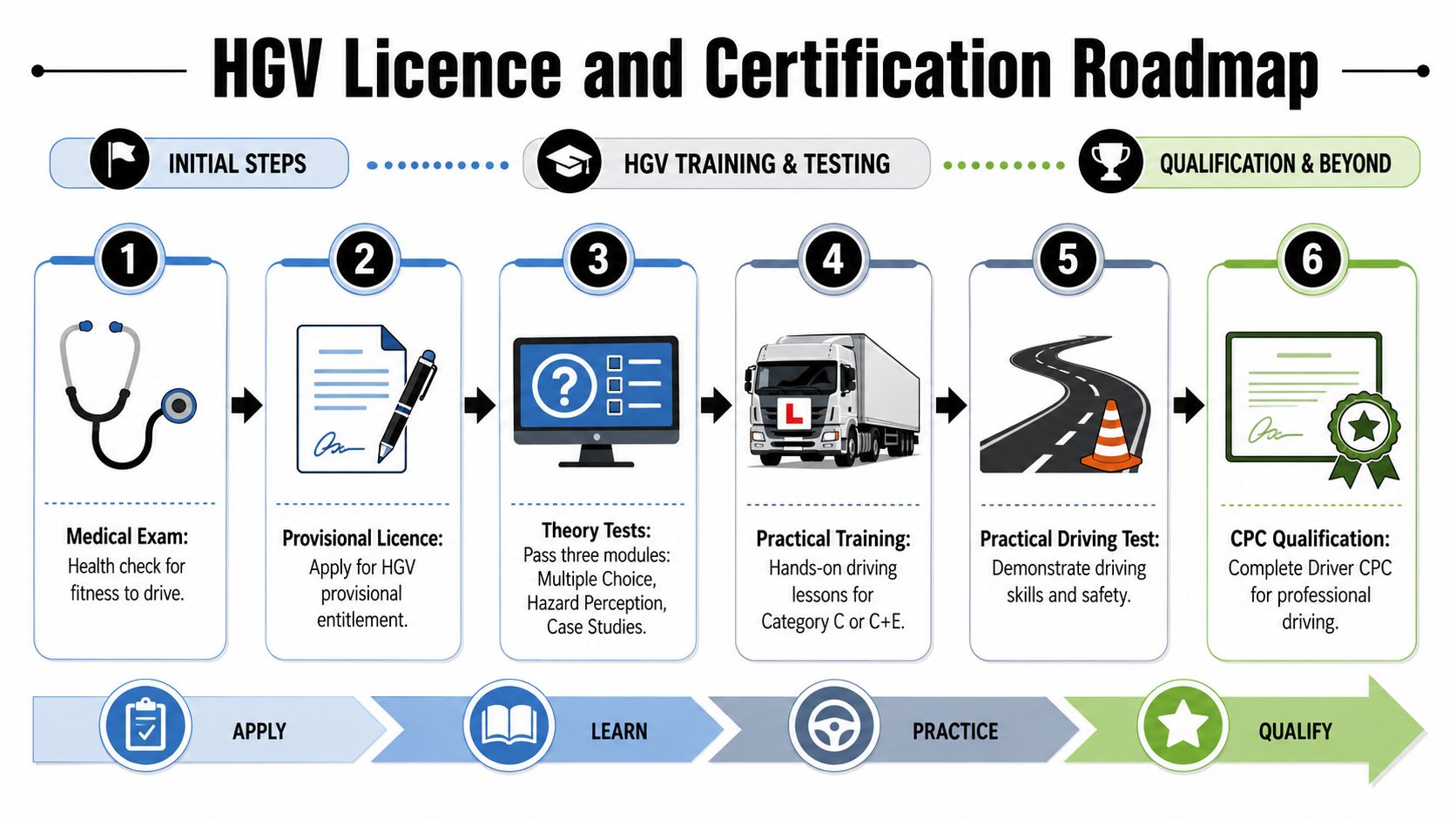
The licence side puts many people off because it looks more complicated than it is. In practice, it becomes manageable when you treat it as a sequence: medical, provisional entitlement, theory, practical training, test, then CPC.
Start by understanding the two main licence paths. Category C is commonly known as Class 2. That covers rigid vehicles. Category C+E is Class 1, which covers articulated combinations and usually opens the door to the better-paid long-distance and trunking roles. If your long-term aim is artic work, you need to build towards C+E rather than assume a standard driving background will carry you into it.
A clear visual helps at this stage.
Start with the paperwork and medical
Your route begins with the medical exam. You need to be assessed as fit to drive a heavy vehicle, and that means completing the required forms and getting the medical signed off properly. If this part is rushed or filled in badly, everything else gets delayed.
After that, you apply for provisional HGV entitlement. Once that’s granted, you can move into theory preparation and practical training.
For a simple walkthrough of the process, this guide on how to get a HGV licence in the UK is useful because it lays out the journey in plain terms.
The CPC is not optional
A lot of new applicants misunderstand the Driver CPC. It isn’t a nice extra. It’s the qualification that makes professional driving legal.
According to the National Careers Service large goods vehicle driver profile, the Driver CPC requires four parts: a driving theory test, online case studies, a practical driving ability test and a practical demonstration test. The same source states that drivers must complete 35 hours of training every 5 years to keep the CPC current, and that UK government Skills Bootcamps can last up to 16 weeks and guarantee a job interview on completion.
That matters for two reasons. First, it tells you this is a profession with ongoing compliance, not a one-time test. Second, it gives career changers a shorter route into the sector if they need a structured start.
Here’s a helpful video overview of the process.
Choosing the right route
Your choice depends on where you want to end up.
Licence route
Best suited to
What to know
Category C
Local rigid work, entry roles, multi-drop
Good starting point if you want to get on the road sooner
Category C+E
Artic work, trunking, wider job access
Better long-term option if your target is Class 1
ADR add-on
Fuel, hazardous goods and specialist freight
Separate specialist credential for dangerous goods work
If you want the broadest access to HGV driver jobs in Leicester, build towards C+E with a valid CPC. If you want a faster first move into the industry, Category C can still be a practical entry point.
Getting qualified is only half the job. The other half is making sure your documents, dates and licence status line up cleanly when you apply.
Preparing an Application That Gets Noticed
A weak application doesn’t usually fail because the CV looks untidy. It fails because the candidate hasn’t matched what Leicester employers screen for.
That’s why a perfectly prepared application matters. In this market, recruiters often reject people before interview if the compliance side isn’t right. The issue isn’t whether you seem hardworking. The issue is whether you are employable under the operator’s rules.
The checks that knock people out early
The UK government data on HGV driver vacancies notes a common pitfall in Leicester. Employers often require a Class 1 licence held for at least 12 months, a valid Driver CPC, a clean DBS check, and they strictly limit applicants to no more than 6 points on their licence.
That one paragraph explains why so many applicants hear nothing back.
If you apply for a Class 1 role with fresh entitlement and no required holding period, many firms won’t bend the rule. If your licence points are over the limit, or your CPC has an issue, your application can die in the first screen. If you ignore the DBS requirement and leave it vague, the recruiter may assume you won’t pass onboarding.
What a strong HGV CV actually does
A useful HGV CV is not a life story. It’s a screening tool. It should quickly show your licence category, CPC status, relevant driving background, shift flexibility and any extra qualifications.
Focus on what transport recruiters want to spot fast:
Licence clarity with the exact category shown
CPC status listed clearly, not buried in a paragraph
Driving history that shows vehicle type, routes, drops or depot work
Shift availability including nights, weekends or fixed patterns if relevant
Compliance readiness such as DBS suitability and clean presentation of licence details
If you’re changing careers, don’t apologise for it. Translate previous work into transport value. Van work shows route discipline. Warehouse work shows loading awareness. Retail delivery work shows customer contact and time pressure.
A recruiter can work with limited experience. They can’t work with missing compliance information.
What not to do
Some habits almost guarantee a poor response:
Applying too broadly when the role asks for experience you don’t have
Hiding licence points in the hope they won’t be checked
Using one generic CV for Class 2, Class 1 and specialist roles
Ignoring advert wording around licence tenure, checks and shift pattern
The best applications feel easy to say yes to. Clean documents, exact licence details, honest disclosures and a clear fit for the vacancy. That’s what gets noticed.
Where to Find the Best HGV Driver Jobs in Leicester
You finish your training, start searching, and within half an hour Leicester looks full of HGV work. Then the problems start. One advert is agency night trunking out of Magna Park, another is multi-drop Class 2 in the city, and a third promises strong weekly pay without saying whether the hours are guaranteed. The best jobs are rarely found by scrolling one site and applying blind.
Leicester rewards a local search plan. You need to know where the freight sits, which employers hire direct, which agencies move quickly, and which roles suit a new pass against those that only sound open to one. Around Leicester, that usually means checking work linked to Magna Park, Bardon, Coalville, Glenfield, Braunstone, and the city depots that feed retail and pallet networks.
Use four channels, but use them differently
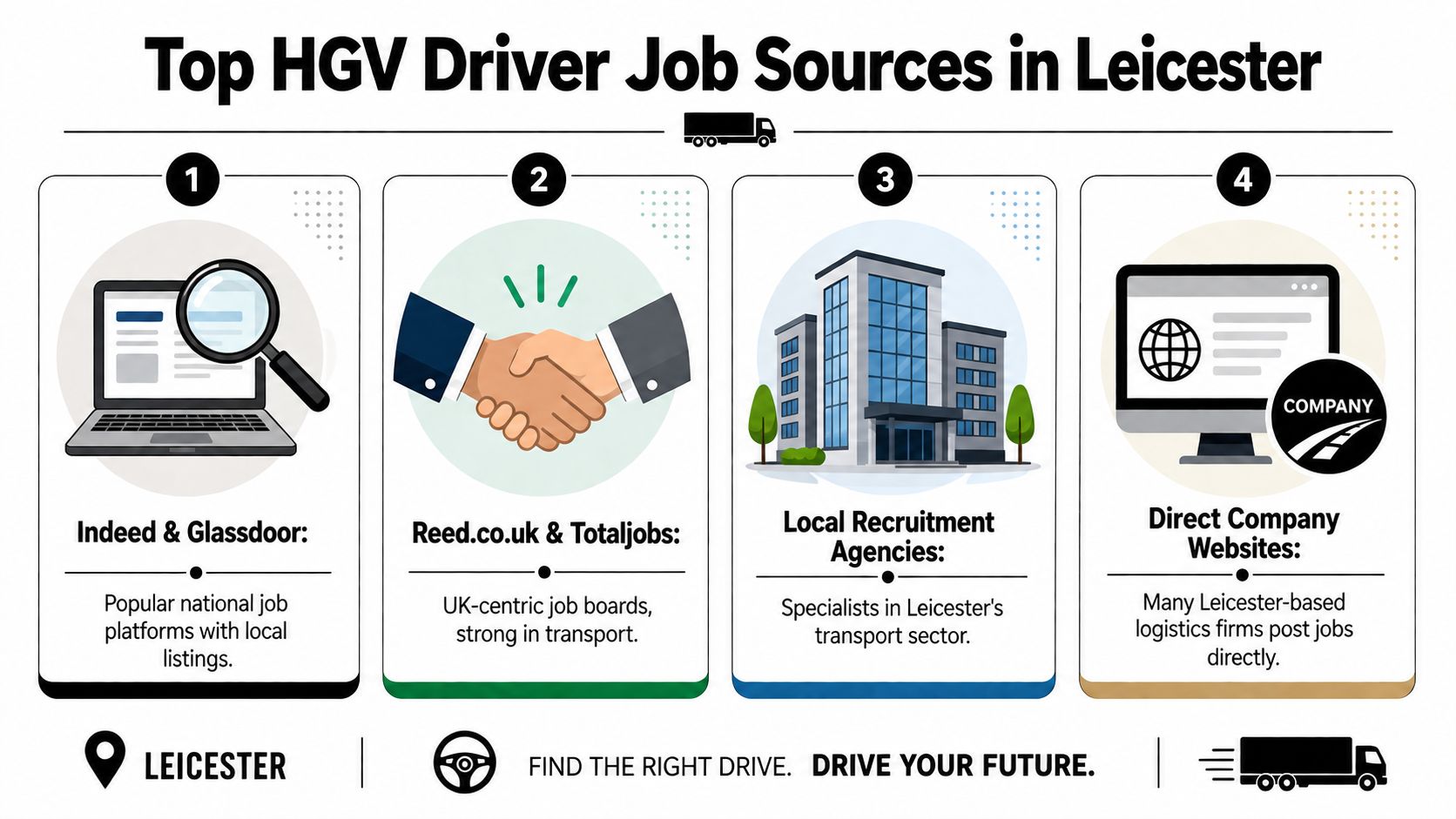
A strong Leicester job search usually combines four routes, each with a different job.
National job boards help you spot volume, repeat advertisers, and the rough spread between Class 2, Class 1, days, nights, tramping, and weekend work.
UK job sites with strong transport listings often pick up vacancies that do not stay live for long, especially agency-led cover and depot-driven demand spikes.
Local recruitment agencies can tell you quickly whether your licence age, points, or limited experience will block a role before you waste an application.
Direct company careers pages are often where the steadier jobs appear first, especially with larger fleets that want drivers who can stay.
If you want to widen the search without drifting too far from the area, this guide to lorry driver jobs near me gives you a practical way to search by route, depot type, and travel distance.
Read Leicester adverts like a recruiter would
The headline tells you very little. The small print tells you whether the job is workable.
A lot of drivers fixate on the top pay figure and miss the catch. OTE can depend on extra shifts. “Regular work” can still mean variable start times. “Leicester based” can mean the depot is out toward Lutterworth or requires a car for a 4am start.
Check these points before you apply:
What to check
Why it matters
Vehicle class
Category C and C+E are different markets, with different expectations and pay structures
Start location
“Leicester” adverts often cover sites outside the city, which affects commute time and parking
Shift pattern
Fixed patterns are easier to sustain than changing bookings, especially if you are new to transport work
Pay wording
Hourly rate, minimum paid hours, overtime trigger, night premium and OTE are not the same thing
Experience requirement
Some firms say “preferred” and will consider a new pass. Others want insurance-friendly experience and will reject quickly
Look beyond the first job and think about staying power
This matters more than many candidates realise. A job can be well paid and still burn you out in six months.
In Leicester, I often see new drivers chase the highest weekly figure, then struggle with poor sleep, long unpaid waiting time, or a commute that adds two extra hours to the day. Better long-term choices usually come from matching the role to your actual life. Nights suit some drivers and damage others. Multi-drop can build skill fast but it is harder on the body. Tramping pays well for the right person, but not if home time is your priority.
That is one reason we steer candidates to a training-to-job pathway rather than a licence-only approach. HGV Learning works best when the job target is clear from the start, because your training, job search and first role need to fit together if you want to last in the trade.
Don’t ignore subcontract and specialist routes
Most new drivers should still look closely at employed work first, because it gives you structure, experience, and a clearer route into better fleets. But later on, some drivers want contract work, short-term cover, or more control over when they work. If that applies to you, these platforms to find subcontractor work can help you see where project-based and self-employed options appear.
The best Leicester candidates keep a simple tracker. Depot, contact name, shift type, pay basis, distance from home, response time. That sounds basic. It also stops you wasting a good application on the wrong job and helps you spot which employers are worth another call.
Mastering Your Application and Interview
A typical Leicester HGV hiring process begins with an application. You submit this. A recruiter or transport office phones you for a short screen. They check the basics first: licence category, experience, CPC, points, availability and whether you can work the advertised pattern.
If that call goes well, the next stage usually gets more practical. You may be asked about vehicle checks, tachograph awareness, reversing confidence, customer handovers, night work or depot routines. Some employers keep it conversational. Others are blunt and fast. Neither style means much. They’re looking for safe, clear answers, not polished speeches.
What a recruiter is listening for
The strongest candidates sound straightforward. They answer directly, don’t overclaim, and show they understand the job beyond moving a wagon from A to B.
Good answers usually show three things:
Safety awareness through walkaround checks, load security and calm decision-making
Reliability through punctuality, shift flexibility and honest route experience
Professional judgement when discussing delays, defects, traffic issues or customer pressure
If you haven’t done a certain type of work, say so. Then explain what you have done that transfers well. That lands far better than bluffing your way through an answer about RDC work or reversing practice.
The pay conversation
Sooner or later, pay comes up. This frequently causes confusion among candidates because transport adverts mix hourly rates, OTE figures, nights, weekends and guaranteed shift pay.
For Leicester Class 1 roles, Industria’s Leicester HGV Class 1 listing shows daytime pay rates of £17.00 to £20.00 per hour. That same listing also makes clear that the drug and alcohol test is mandatory, and that failing it leads to 100% immediate rejection.
That tells you two things. First, know how the pay is structured before you accept an offer. Second, treat compliance screening as part of the interview, not as an afterthought.
Turn up assuming every stage is an assessment. Because it is.
A realistic interview flow
Here’s what a straightforward path often looks like:
Initial phone call where they confirm licence details, experience and availability
Document check for CPC, licence and sometimes DBS-related onboarding requirements
Interview or transport office chat focused on safety, shift fit and attitude
Driving assessment or site induction depending on the employer
Drug and alcohol screening before final offer or start date
Questions worth asking back
Interviews are not just for employers. You should ask sensible questions too.
What shift pattern is fixed and what changes week to week
How pay is calculated if the advert mentions OTE
Whether the role is ongoing or seasonal
What vehicle type and run style you’ll be doing
That last point matters more than people think. A role can sound excellent on paper and still be wrong for you if the pattern, depot culture or assessment standard doesn’t fit.
A Faster Route with the HGV Learning Pathway
A lot of Leicester candidates don’t struggle with motivation. They struggle with sequence. They know they want Class 1 work, but they can’t see the clean path from where they are now to where employers need them to be.
That’s especially common for people coming from van delivery, retail driving, warehouse transport support or part-time rigid work. They can see the vacancy market, but they can’t always see the bridge.
Why the gap exists
Part-time and adjacent driving roles don’t automatically convert into Class 1 eligibility. The training, testing and compliance standards are different, and many adverts don’t explain that well enough for new entrants.
According to Indeed’s Leicester part-time HGV listings context, candidates in Leicester often struggle to find a clear route from other driving work into full-time Class 1 roles. The same source notes a 10 to 12 month training bridge and job matching through HGV Learning, and states that 95% of UK employers require DVSA-compliant C+E certification before hiring.
That’s the practical problem in one sentence. People want to move up, but the market still expects the proper Class 1 qualification first.
What a supported pathway changes
A structured training pathway helps because it removes guesswork. Instead of trying to patch together forms, revision, practical training and test dates from different places, you follow one joined-up process.
That tends to help with:
Documentation handling so medicals and forms don’t stall the process
Theory preparation with proper revision structure rather than random practice
Local practical arrangements that keep training and test planning organised
Job matching support so qualification leads into applications rather than another dead end
The financial side matters too. Training is an investment, and for many career changers the timing matters as much as the ambition. If funding is your main concern, this guide on funding for HGV training gives a useful starting point for understanding the options.
Who benefits most from this route
This kind of pathway makes the most sense if you are:
Candidate type
Why a structured route helps
Career changer
You need a clear order of steps and realistic timescales
Van or retail driver
You already have road sense but need the correct licence bridge
Rigid driver aiming at artic work
You need a focused move from Category C into C+E
Applicant stuck at application stage
You may be missing one key qualification or document standard
The point isn’t speed for its own sake. It’s avoiding drift. In HGV recruitment, drift costs people months.
Securing Your Role and Building a Lasting Career
Once you’ve got the licence route clear, the rest becomes simpler. Not easy, but simpler. You need the right entitlement, a current CPC, clean application documents, and a job search that matches Leicester’s actual market rather than guesswork.
The people who settle into the trade well usually think beyond the first offer. They look at shift pattern, route type, support from the operator and whether the work is sustainable for them over time. That matters because HGV driving can give you a strong living, but only if you can stay consistent in the role.
Think beyond the first payslip
Driver well-being gets ignored far too often. A BMJ Open study on HGV driver health and working conditions found that working conditions can inhibit healthy lifestyles, and this is especially relevant in a local market where over 762 HGV jobs are open in Leicester. High vacancy levels are useful if you’re job hunting, but they don’t solve fatigue, poor food options on shift or the mental grind of badly organised work.
That’s why long-term thinking matters.
Choose patterns you can sustain rather than chasing every extra shift
Protect your compliance habits so CPC, documents and checks stay current
Build specialist value over time if you want stronger options later
Pay attention to health routines because poor habits catch up fast in transport work
The best HGV career is not the one that looks good for six weeks. It’s the one you can still do well in years from now.
Leicester offers real opportunity. If you approach it properly, HGV driver jobs in Leicester can lead to stable work, stronger earnings and a professional route with room to grow. The key is doing each stage properly, in the right order, and not trying to shortcut the rules that employers insist upon.
If you want help turning interest into a real driving career, HGV Learning offers a practical route from licence planning through training and into job-focused support. If you’re starting from scratch, moving from rigid to artic, or trying to make sense of the paperwork and training options, it’s a sensible place to begin.