You're probably in one of two places right now. You've either just passed, or you're seriously weighing up the move into HGV driving and trying to work out what the job will really cost you before it starts paying you back.
That's a smart question.
Insurance catches many new drivers off guard because it doesn't behave like a simple fixed fee. It moves up and down with the kind of vehicle you drive, the work you take on, where you operate, how you store the vehicle, and how much confidence an insurer has in your risk profile. If you understand that early, you make better career choices from day one.
Your First Step into the World of HGV Driving
The first thing to get straight is this. HGV insurance sits inside a wider UK vehicle insurance picture that has become more expensive. A useful benchmark comes from the Association of British Insurers, which reported that motor insurers paid out a record £10.5 billion in motor claims in 2023. The ABI also said the average private motor policy cost £635 in Q4 2023, up 12% year on year, reflecting broader claims inflation in repairs, replacement vehicles and personal injury costs that also feeds into commercial motor pricing in the UK, as noted in this UK insurance cost benchmark.
That doesn't mean every new HGV driver is priced out. It means you need to treat insurance as part of your career planning, not as an afterthought. The same way you learn reversing, road positioning and walk-round checks, you also need to learn what insurers look at and what makes them nervous.
Why this matters early
A lot of candidates focus only on passing the test. That matters, of course, but the licence is only one part of becoming employable and affordable to insure. If an operator can put a trained, organised, lower-risk driver into a vehicle, that driver is often easier to place on work and easier to retain.
If you're still at the start of the process, it helps to understand the licence pathway before you start thinking about insurance detail. This guide on how to get a HGV licence in the UK is a sensible place to ground yourself in the steps.
Practical rule: Insurance is part of being road-ready. It isn't separate from your training, your first job, or your long-term earning potential.
The mindset that helps most
Think of HGV insurance costs as something you can manage, not just suffer. A new driver won't control every part of the price, but you can control more than you think.
Three habits help straight away:
Ask better questions: Don't only ask, “What's the premium?” Ask what is pushing it up.
Build a cleaner risk profile: Training, careful job choice and good habits matter.
Plan for year two, not just month one: Your first insurance outcome is a starting point, not a permanent label.
That's the key shift. Once you stop seeing insurance as a mysterious bill and start seeing it as a risk score you can improve, the whole subject becomes less intimidating.
What Is HGV Insurance
If you already understand car insurance, you've got the basic idea. HGV insurance does the same core job. It protects against financial loss if a vehicle causes damage, suffers damage, is stolen, or is linked to claims from other people.
The difference is scale and purpose.
A private car policy is built around personal driving. An HGV policy is built around commercial use, larger vehicles, more time on the road, more potential damage in a collision, and extra responsibilities linked to cargo, customers and employers. That's why the policy wording matters far more than many new drivers expect.
The basic cover levels
You'll usually come across the same broad cover levels you know from car insurance:
Third-Party Only covers damage or injury caused to other people or their property.
Third-Party, Fire and Theft adds protection if the vehicle is stolen or damaged by fire.
Coverage for your own vehicle and third-party claims usually includes cover for damage to your own vehicle as well as third-party claims, subject to the policy terms.
Those labels are familiar. What often confuses new drivers is that commercial transport usually needs more than the vehicle cover alone.
The commercial layers people forget
An HGV operation can involve several types of protection at once. Depending on the work, you may hear about:
Public liability insurance, where business activity could injure someone or damage their property away from the driving risk itself.
Employers' liability insurance, which matters if a business employs staff.
Goods in transit insurance, which protects the load rather than the truck.
Additional vehicle-related cover, where specific work patterns, trailers, equipment or specialist risks need to be declared.
Many first-time buyers often encounter a misunderstanding. They assume “full coverage” means “everything”. It doesn't. It means a broader level of vehicle cover, but it still won't automatically fill every business risk.
A cheap policy that misses the real exposure isn't a saving. It's just a gap you haven't discovered yet.
If you want a plain-English comparison point for the kind of policy elements brokers often discuss, this overview of commercial truck insurance requirements is useful because it shows how commercial cover is built in layers rather than as one simple box-tick.
The question to keep asking
When reading any HGV policy, ask this: What exactly is being protected?
Sometimes the answer is the vehicle only. Sometimes it's the vehicle plus cargo. Sometimes it includes liabilities around staff or site work. Once you start separating those risks, the language becomes easier and the quote becomes easier to judge.
Main Factors That Determine Your HGV Insurance Premium
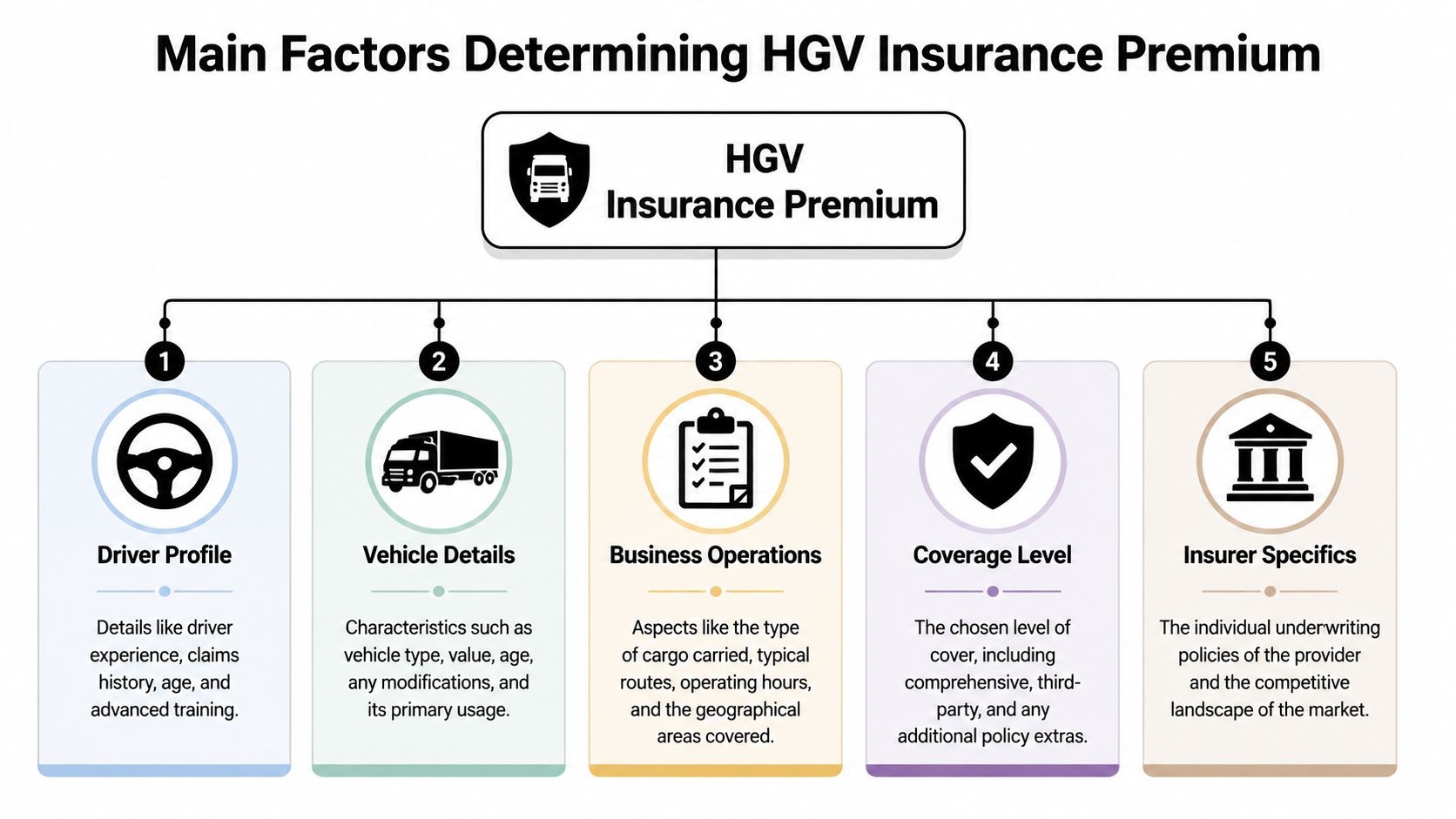
Insurers don't price HGV cover by looking only at the truck class and picking a number from a list. They look at the full operating picture and ask one underlying question. How likely is this vehicle and this driver to generate a costly claim?
In the UK, pricing is driven less by vehicle class alone and more by the claims severity profile of the operation. Higher-value rigid or articulated vehicles, longer annual mileage, night running, urban delivery density, and hazardous or high-theft cargo all push premiums up because underwriters price for both accident frequency and loss size. That's why the same tractor unit can cost very differently to insure depending on whether it does motorway trunking or multi-drop city work, as explained in this commercial truck insurance guide.
Driver profile
A newly qualified driver often looks riskier to an insurer than someone with a settled commercial driving history. That doesn't mean new drivers can't get insured. It means underwriters want stronger signs of discipline, supervision and good habits.
They'll usually care about things like:
Experience level: A new pass is different from a driver with proven time in similar vehicles.
Claims history: Even minor incidents can affect how insurers view you.
Licence record: Endorsements, bans or unresolved issues raise concern.
Training evidence: Extra professional development can support a lower-risk case.
Vehicle details
The truck itself changes the cost base in obvious and less obvious ways. A more valuable vehicle usually costs more to repair or replace. Specialist equipment can add complexity. Older vehicles can create a different risk picture again, depending on condition and parts availability.
A rigid used for simpler daytime work doesn't present the same profile as an artic working dense urban routes with tight loading bays and frequent manoeuvring.
Work pattern and route type
Many people get confused, assuming distance alone drives price. Distance matters, but the type of work matters just as much.
Compare these two examples:
Work pattern
Likely insurance view
Long motorway trunk run with fewer delivery points
Lower incident frequency potential in manoeuvring, but still exposure through mileage
Urban multi-drop work with repeated stopping, reversing and tight turns
Higher incident probability due to stop-start driving and congested environments
The second job often looks harder to insure because each shift creates more chances for scrapes, low-speed impacts and third-party claims.
Cargo and operating conditions
What you carry matters because it changes both theft risk and claim size. So do your working hours and parking arrangements.
Common premium drivers include:
Hazardous or tightly regulated loads: These can increase insurer concern because the consequences of a loss may be wider.
High-theft or high-value cargo: Theft exposure changes the equation quickly.
Night running: Reduced visibility and fatigue concerns may influence pricing.
Overnight storage: A vehicle parked securely creates a different risk profile from one left in a vulnerable spot.
Cover choice and insurer appetite
Two operators with similar vehicles can still get different results because insurers have different underwriting appetites. One insurer may be comfortable with local delivery fleets. Another may prefer established long-haul work. The level of cover and the excess also shape the premium.
Underwriters don't just insure trucks. They insure patterns of behaviour, operating conditions and claim potential.
That's why HGV insurance costs can feel inconsistent from the outside. Once you look through the insurer's lens, the pricing logic becomes much clearer.
HGV Insurance Costs UK Examples and Scenarios
You pass your test, line up your first driving job, and then get a quote that is higher than you expected. That moment catches many new drivers off guard. The reason is simple. Insurers are pricing the job you are about to do, not just the licence you hold.
That is why HGV insurance works more like fuel spend than a fixed admin fee. It changes with the vehicle, the work pattern, the claims history behind the operation, and how much evidence there is that risk is being controlled well. Once you see premium as a variable cost, you can start to influence it.
Two drivers can both hold Category C and still sit in very different insurance brackets. One might be doing steady daytime regional drops with clear procedures and good supervision. The other might be starting in a fast-moving operation where the working week is less predictable. Same licence. Different insurance story.
A clearer way to judge likely costs
A lot of new entrants ask for a price by licence class. Insurers usually start somewhere else. They want to know what sort of work sits behind that licence, what vehicle is being used, and how the day-to-day operation is run.
So use examples as a guide to risk level, not as a price card.
Licence Category
Novice Driver (Annual Premium)
Experienced Driver (Annual Premium)
C1
Often treated cautiously where the driver is new to commercial work and the insurer has little proof of on-road habits
Often steadier where the work is settled and the driver has built a clean operating record
Category C
Can vary widely depending on whether the role is structured regional work or a more pressured delivery pattern
Usually easier to place when the driver has relevant rigid vehicle experience and a stable claims background
Category C+E
Often judged most closely because artic work can involve higher vehicle values, more exposure, and stricter underwriting questions
Can become more competitive over time where the driver and operator show consistency, control, and low claims frequency
The table stays broad on purpose. Fixed figures without full details would create the wrong expectation.
Three realistic insurance scenarios
Here is a practical way to read the market.
New C1 driver in local multi-stop work: A smaller vehicle does not automatically mean a lower premium. If the role involves frequent collections, town driving, and regular manoeuvring, the insurer may still rate it carefully because there are more chances for small incidents.
New Category C driver on supervised regional runs: This often presents better. Clear routes, support from an experienced transport team, and a more predictable working day can make the risk easier for an underwriter to accept.
Experienced C+E driver on regular trunking contracts: This can look stronger still where routes are consistent, handovers are controlled, and the driver has a record that shows steady professional standards over time.
A good comparison is to treat insurance like a work reference. Early on, the insurer has limited evidence, so they read the setting around you very closely. As your record grows, your own history carries more weight.
What these examples mean for a new driver
Your first role helps shape your future insurance position. That does not mean you should avoid ambition or specialise too late. It means the first year is often the period where careful choices pay off twice. You gain experience, and you build a record that can support better terms later.
That is one reason ongoing standards matter. Keeping up with requirements such as Driver CPC training for professional HGV drivers supports the bigger picture. Training will not erase every cost, but it helps build the habits and evidence that insurers and employers both value.
The premium at the start is a snapshot, not a life sentence.
If you understand that, insurance becomes something you can work on, not just something that happens to you.
How Training and Qualifications Impact Your Premium
A newly qualified driver and a newly qualified driver with clear training records can look very different to an insurer.
Both may have limited time on the road. One file says, in effect, “new driver.” The other says, “new driver, but trained, supervised, and working to a clear standard.” That difference does not guarantee a low premium, yet it can make the risk easier for a broker or underwriter to understand and place.
Training matters because insurance pricing is based on uncertainty. The less evidence an insurer has about how a driver will behave, the more cautiously it tends to price the policy. Qualifications, refresher training, induction records, telematics use, and documented safety procedures all reduce some of that uncertainty. They show that the driver is not relying on luck or guesswork.
For a new entrant, that is useful news. You may not have years of claims-free history yet, but you can still build a stronger insurance profile from the start.
Why insurers pay attention to training
Insurers are looking for signs of control. They want to know whether a driver understands legal duties, follows site rules, secures loads properly, checks the vehicle consistently, and responds well under pressure. Training supports all of that.
A simple way to view it is this. Experience shows what you have done over time. Training shows how you have been prepared to do the job properly before that history is fully built.
That is why structured induction can matter so much in the first year. If an employer can show clear onboarding, route support, incident reporting procedures, and in-cab technology, the underwriter is not looking at a blank page. They are looking at a new driver inside a controlled system.
Security measures support that picture too. Vehicle protection, tracking, and theft prevention do not replace driver skill, but they strengthen the overall risk case. Tools such as CarLock security solutions are part of the wider conversation because insurers assess the operation around the driver as well as the driver themselves.
Qualifications that can strengthen your position
Some qualifications keep you legally current. Others show that you can handle more demanding work safely and correctly. Both can help over time, especially when matched with a clean record and sensible job choices.
ADR qualification: Hazardous goods work often brings a different risk profile, but formal ADR training shows that the driver has been taught the rules, handling standards, and responsibilities that come with that work.
HIAB or other specialist certificates: These qualifications do not automatically reduce the premium. They do show that the driver has been trained for the equipment and task, which can support a better underwriting case than turning up with no formal proof of competence.
The point many new drivers miss
Training does not cancel out the fact that you are new. It does something more practical. It gives insurers, brokers, and employers better evidence.
That matters for your career as well as your premium.
A driver who keeps qualifications current, follows procedure, and builds a paper trail of professional standards often becomes easier to insure and easier to place into better work. Over time, that can improve access to stronger roles, steadier contracts, and a healthier long-term earning path. Insurance then starts to look less like a fixed bill and more like one part of your professional development that you can influence.
Practical Steps to Lower Your HGV Insurance Costs
Most drivers can't slash their premium overnight. They can, however, make themselves easier to insure. That's the more realistic goal.
One cost driver that catches people out is payment method. Commercial vehicle commentary says monthly instalments can add about 15–25% to the total premium cost because insurers build financing charges into the arrangement, as noted in this owner-operator truck insurance cost commentary. So the first “saving” may have nothing to do with driving at all. It may come from how you pay.
The changes that usually matter most
Start with the actions that alter the insurer's view of risk, not just the headline quote.
Pay annually if you can: Monthly payments may feel easier on cash flow, but they can increase the overall cost of cover.
Protect the vehicle when parked: Secure overnight storage helps because theft and vandalism risk don't disappear when the engine is off.
Use evidence-based tools: Telematics and dashcams can support a cleaner underwriting case because they show how the vehicle is driven and what happened in an incident.
Think carefully about excess levels: A higher excess can lower the premium, but only if you could comfortably fund that amount after a loss.
For theft prevention and tracking, some operators look at dedicated vehicle monitoring tools such as CarLock security solutions to strengthen their wider security setup.
Small claims can cost more than people expect
Many drivers assume only major crashes matter. In practice, repeated minor claims can still make you look expensive to insure. That's why disciplined reporting, careful manoeuvring and good evidence after incidents all matter.
Worth remembering: A lower quote isn't always lower cost if instalments, recurring small claims and weak security keep pushing the total spend up over time.
A careful approach to funding can also help new entrants avoid short-term decisions that become expensive later. If you're budgeting the move into the industry, it's worth reviewing funding options for HGV training so you can balance training costs, work entry and early operating expenses more sensibly.
Tools and habits that support lower risk
This short video gives a useful visual reminder that safer, more organised operations tend to produce better outcomes over time.
You don't need a complicated strategy. You need consistent habits:
Choose work that matches your current experience. Don't rush into the most demanding role if it creates unnecessary insurance pressure.
Keep your record clean. Every avoidable scrape matters.
Document your professionalism. Training records, vehicle security and safe procedures all help.
Review your setup regularly. If your routes, cargo or vehicle change, your insurance position changes too.
That's how you turn HGV insurance costs from a fixed burden into something you actively manage.
Your Checklist for Getting an Accurate Insurance Quote
A good quote starts with good information. If you guess, miss details out, or describe the work too vaguely, the quote may be inaccurate from the start.
Have these details ready before you speak to a broker or insurer:
Your licence details: Category held, test pass status, endorsements and commercial driving history.
Vehicle information: Type, age, value, modifications and any specialist equipment.
Work description: What you carry, where you operate, when you drive, and whether the work is trunking, local delivery, construction support or something more specialised.
Storage and security: Where the vehicle is kept overnight and what protection is in place.
Claims background: Previous incidents, even if they seem minor.
Cover needs: Vehicle-only cover, goods in transit, public liability, employers' liability, or other extras.
The last check is the one many people skip. Don't judge the policy on price alone. Industry guidance warns that fleets can become underinsured when policies aren't updated after growth or equipment additions, and hidden sub-limits can leave real gaps in cover, as discussed in this analysis of underinsurance risk in commercial vehicle policies.
Ask direct questions about exclusions, sub-limits, named drivers, cargo assumptions and equipment declarations. If the policy doesn't reflect the actual job, it may fail you when you need it most.
The best quote is the one that is accurate, usable and properly matched to the work.
If you're building a career in commercial driving and want help with the training side of that journey, HGV Learning can support you with licence training, specialist qualifications and practical guidance that helps you become a safer, more employable, and more insurable driver.
What Age Can You Start HGV Driver Training? A 2026 UK Guide to Licence Age Requirements
If you're asking what age you can start HGV driver training, the honest answer depends on which licence you're after. A C1 licence, covering vehicles...