You're probably here because the telehandler theory test feels like the part that turns a practical career into a classroom problem. That's a common feeling. Many learners are comfortable with the idea of operating machinery, working outdoors, and getting stuck into site life, but freeze up when they hear words like theory paper, CPCS category, suspended loads, or hydraulic safety.
The good news is that the test isn't there to catch you out: and if you want a course that combines the theory with hands-on practical training, our telescopic handler training course covers both. It's there to make sure that when you do get into the cab, you understand what keeps you, your load, and everyone around you safe. That matters on a live site, where one poor judgement call can affect banksmen, pedestrians, other plant, structures, and the job itself.
A telehandler operator with sound theory knowledge usually feels calmer in practical training too. They know why ground conditions matter. They understand why a load changes the machine's behaviour. They can follow instructions with more confidence because the language of the job already makes sense.
Your First Step to Operating a Telehandler
Standing at the start of telehandler training can feel odd. You want to learn the machine, but the first serious step is often a written or spoken knowledge assessment. That can seem backwards until you realise what the industry is asking for.
A telehandler isn't just another vehicle. It lifts, reaches, carries, and works in spaces where people, materials, and deadlines all meet. Before you operate one, you need to show that you understand the rules and the reasons behind them.
Why the theory comes first
The telehandler theory test gives your trainer and test centre a clear sign that you grasp the basics of safe operation. That includes:
Machine awareness. You need to recognise key controls, operating limits, and common hazards.
Load handling sense. You need to understand that the same machine behaves differently depending on the load, reach, attachment, and ground.
Site safety judgement. You need to think beyond the cab and consider pedestrians, banksmen, overhead risks, and restricted areas.
That's why the theory test should be seen as the foundation of the job, not a hurdle in the way of it.
If you're still choosing where to train, it helps to start with a provider that can guide you through both the knowledge and practical side. A local course search like telehandler training near you can help you see what's available and what route fits your experience.
Practical rule: If you understand why a telehandler becomes unstable, many exam questions become easier. You're no longer guessing. You're reasoning.
What most learners get wrong early on
The biggest early mistake is assuming the test will only ask obvious safety questions. In reality, learners often struggle because they revise too narrowly. They focus on familiar topics and avoid the technical ones.
A better approach is to treat every topic as part of one bigger picture. The machine, the site, the load, and the operator all affect each other. Once you see that, the whole test starts to feel more logical.
Understanding the Official UK Telehandler Qualification
The telehandler theory test sits inside a formal UK training framework. For most construction learners, that means the CPCS route for telescopic handlers, specifically the A17 category. This is important because it tells you the test isn't an informal quiz written by a training centre for convenience. It forms part of a recognised competence pathway.
The qualification system also separates out higher-risk work. The UK telehandler qualification framework includes specific machine categories such as A17 for telescopic handlers, and it also includes separate theory papers for specialist tasks such as A94 (A17) for suspended loads, which shows that specialised lifting scenarios are formally assessed rather than treated as an add-on in the CPCS A94 A17 suspended loads theory materialsTheoryTestQuestionsCPCSTTQA941023.pdf).
Why this structure matters on site
This structure reflects real site risk. A telehandler used for routine load placement isn't exactly the same as a telehandler used in lifting situations where loads are suspended. The machine may be familiar, but the judgement required is different.
That's why the qualification system breaks competence into categories and endorsements. It's a practical safety decision. Employers want to know that an operator hasn't merely seen the machine before, but has been assessed for the type of work they'll carry out.
What CPCS and NOCN mean for you
When learners first hear scheme names, they often think they're just labels. In practice, those labels help standardise training and testing. That gives employers and sites a clearer idea of what your qualification represents.
Here's the simple way to understand:
CPCS identifies the plant category and training route.
A17 relates to telescopic handlers.
Additional theory papers can apply where the work carries extra lifting risk.
Your theory result supports safe progression into practical training and assessment.
The theory paper proves that your understanding is broad enough to support safe practical learning. That's why it sits inside a formal qualification route, not outside it.
Breaking Down the Telehandler Theory Test Format
Once you know what the telehandler theory test is for, the next job is understanding its shape. Most nerves come from uncertainty. When you know the format, revision becomes more focused and the test day feels far less vague.
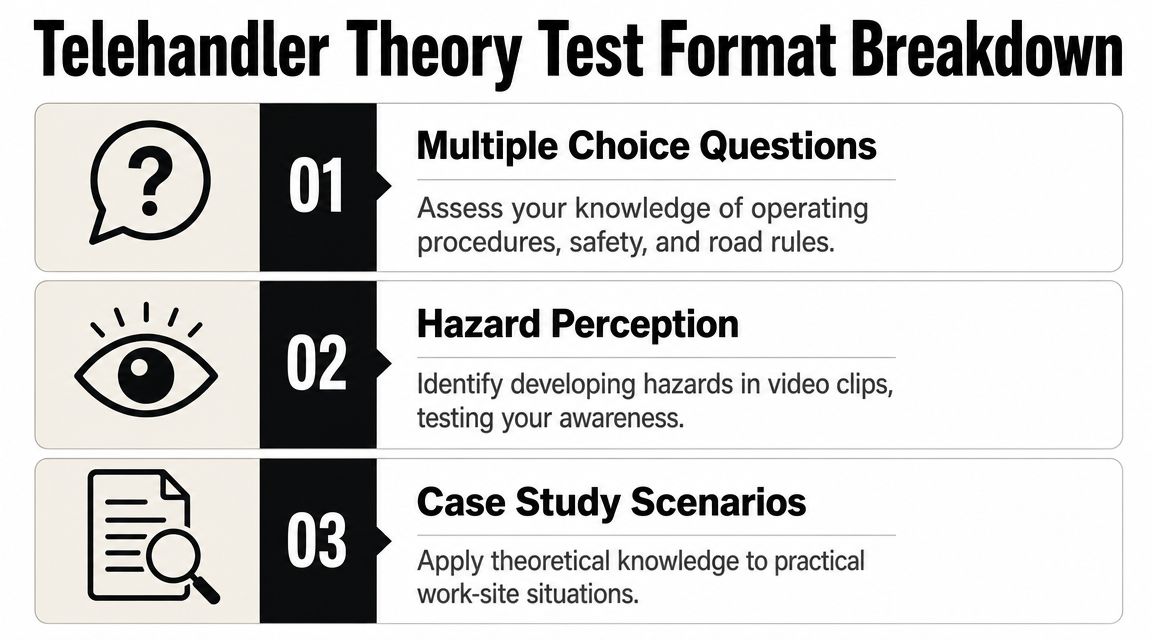
The standard UK telehandler theory test commonly uses a 25-question format, and the pass mark is 20 out of 25, which equals 80%, meaning you can only miss 5 questions according to this CPCS telehandler mock test format guide.
CPCS telehandler theory test at a glance
Metric
Detail
Test structure
25 questions
Pass mark
20 correct answers
Pass percentage
80%
Questions you can miss
5
That tells you something useful straight away. This isn't a test where you can revise half the subject and hope your favourite topics come up. The pass mark is high enough that patchy knowledge becomes risky.
How to use the format to revise better
A strong learner doesn't just ask, “What's the pass mark?” They ask, “What does that pass mark force me to do?”
It means you need broad coverage. You can't afford to ignore topics like checks, load handling, signalling, gradients, hydraulics, or attachments because any weak area could cost you one of the few mistakes available.
A good revision routine usually includes:
Whole-syllabus review. Don't only revise the topics you already like.
Short daily sessions. Regular exposure helps you retain technical wording.
Question practice. This helps you get used to how safety knowledge is tested.
Error review. When you get a question wrong, find out why, not just what the answer was.
If you've seen theory preparation for other lifting or handling equipment, the approach will feel familiar. This guide to the forklift theory test shows a similar point. Strong theory results usually come from steady, practical revision rather than last-minute cramming.
Revision insight: A high pass threshold rewards consistency. One weak topic might seem small in training notes, but it can make the difference in the exam room.
Key Topics Covered in the Test Syllabus
A lot of learners expect the telehandler theory test to focus on site rules in a general sense. In reality, the syllabus goes deeper. It checks whether you understand how the machine works, what affects stability, and how poor decisions create risk.
The official CPCS A17 theory material is built around technical safety competence, with questions covering areas such as the purpose of check valves on boom cylinder rams, the effects of hydraulic failure, and hazards arising from incorrect handling in the CPCS A17 theory test questions document.
Machine stability and load judgement
Many learners discover the test is more practical than anticipated. Stability isn't just a word to memorise. It affects nearly every operating decision you'll make.
You need to think about:
Boom position. Extending or raising the boom changes the machine's behaviour.
Load weight and shape. A load's geometry affects handling, not just its headline weight.
Ground conditions. Uneven or poor ground can change the level of risk quickly.
Attachments. Different attachments can alter safe use and handling limits.
If you only memorise isolated answers, these topics can feel difficult. If you picture a real machine on a real site, the logic becomes clearer.
Hydraulics, checks, and failure awareness
A capable operator doesn't wait for something to go wrong before taking systems seriously. That's why the theory test asks about pre-use checks, maintenance awareness, and component purpose.
The exam may expect you to understand why a check valve matters, or what sort of hazard can follow a hydraulic problem. You don't need to become an engineer, but you do need working safety knowledge.
That includes:
Pre-use inspection routines
Safe reporting of defects
Awareness of hydraulic function
Recognition of unsafe machine behaviour
A learner who understands component purpose usually answers technical questions better than a learner who only memorises wording.
Site communication and lifting context
The telehandler theory test also checks whether you can operate as part of a site system. That means understanding communication, control measures, and work planning.
Banksman signals, exclusion zones, visibility limits, and shutdown procedures all matter because telehandler work rarely happens in isolation. You're often operating around other workers, structures, and moving plant.
If you want a wider safety mindset around transporting and handling heavy equipment, this ultimate guide to safe hauling is useful context. It reinforces the same principle the theory test is built on. Safe work depends on understanding limits, setup, and load behaviour before movement starts.
Your Four-Week Telehandler Test Preparation Plan
Failure often doesn't stem from incapability. Individuals struggle because their revision is random. A plan turns a pile of notes into a sequence you can follow.
This works well when you've got a few weeks before training or test day and want to feel in control rather than rushed.
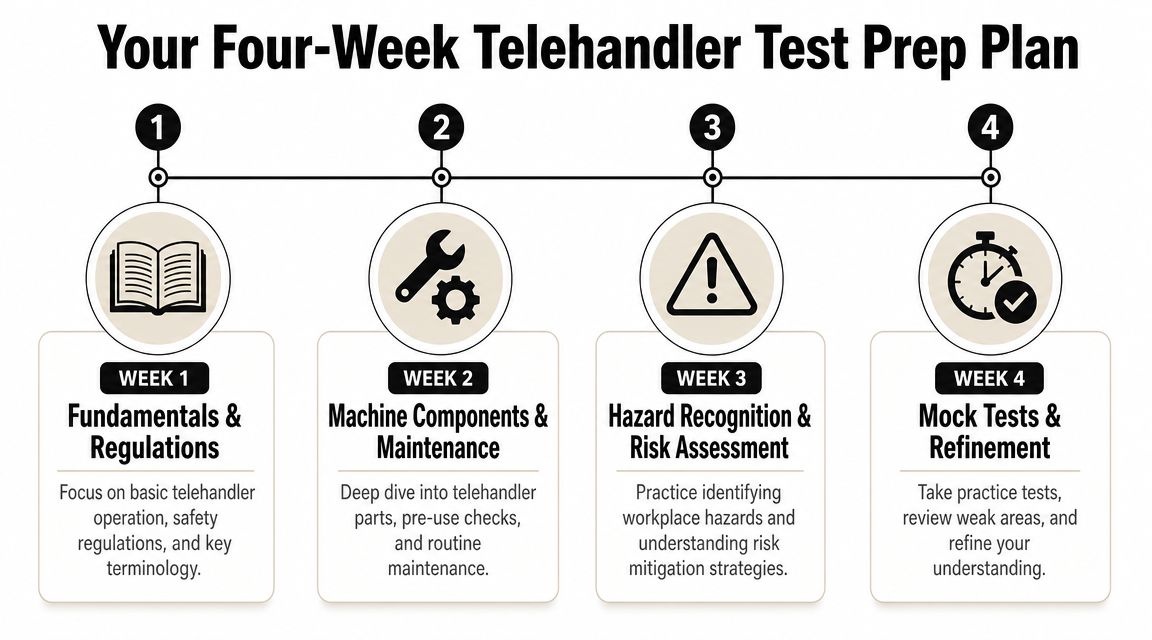
Week one and week two
Start with the basics, then move into the area that often decides confidence.
Week one focuses on fundamentals Learn the names and purpose of major machine parts, operator responsibilities, basic site rules, and common telehandler terms. Keep notes simple. If a phrase feels too technical, rewrite it in your own words.
Week two focuses on stability and loads Spend most of your time on load handling logic. Revise how boom position, attachments, terrain, and load characteristics affect safe operation. Don't just read. Sketch scenarios and ask yourself what changes the risk.
A short video session can help break up reading and make abstract topics easier to remember:
Week three and week four
By this point, you should stop thinking of the machine as a list of parts and start thinking of it as part of a live working environment.
Week three is for site operations. Revise signalling, hazard awareness, travelling safely, parking, shutdown, and defect reporting. Practise explaining answers aloud. If you can explain a rule plainly, you probably understand it.
Week four is for mock questions and weak spots. Take practice papers, mark them accurately, and revisit the topics you miss most often. Don't keep repeating the same easy questions just to feel productive.
How to study without burning out
A simple rhythm works better than heroic cramming.
Study habit
Why it helps
Short sessions
Easier to stick with and easier to remember
Topic rotation
Prevents you from avoiding weaker subjects
Self-testing
Shows what you actually know, not what feels familiar
Mistake review
Turns wrong answers into stronger understanding
One practical option is to use a coordinated training route that combines revision support with test planning and practical progression. HGV Learning provides a structured pathway that includes theory preparation, progress tracking, and locally arranged practical training for relevant licence and plant routes.
Common Mistakes to Avoid During Your Test
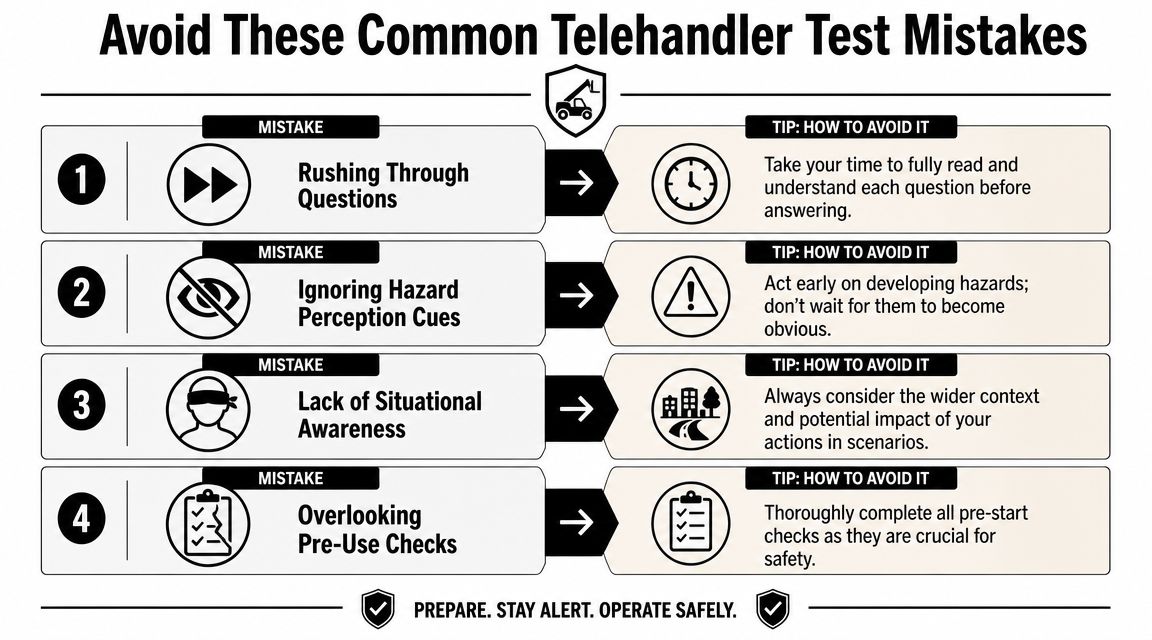
Some candidates revise plenty and still come unstuck because they use the wrong method in the room. The telehandler theory test rewards careful thinking. It doesn't reward rushing, pattern spotting, or blind memorisation.
One area that often catches people out is suspended loads. Official CPCS practice material includes questions on isolating controls and operating on gradients, which shows the test is checking risk judgement rather than simple slogans in this telehandler suspended loads practice discussion.
The mistakes that cost marks
Here are the errors I see most often in learners:
Relying on memory alone. If a question is phrased differently from your practice notes, memorised answers can fall apart.
Ignoring the conditions in the question. Words about slope, attachment, isolation, load type, or visibility often change the correct answer.
Reading too fast. Many wrong answers happen because the learner answers the question they expected, not the one on the page.
Panicking over one technical question. One difficult item shouldn't knock your focus for the rest of the paper.
What to do instead
Use a calmer, more deliberate method:
Read the whole question twice if the wording feels close or tricky.
Underline the risk factor mentally. Ask yourself what condition in the question changes the safe action.
Eliminate weak options first. Even if you're unsure, you can often rule out answers that clearly ignore safety logic.
Think like an operator, not a quiz player. What would keep the site safe in that exact situation?
Don't ask, “What answer have I seen before?” Ask, “What would be safe and correct on site?”
This approach is especially useful for nuanced subjects. Suspended loads, gradients, attachments, and control isolation often require judgement. Learners who understand the reason behind the rule usually cope much better than learners who try to memorise a single universal answer.
From Theory Test to Employment with HGV Learning
Passing the telehandler theory test is a strong result, but it isn't the end of the process. It's the point where your knowledge starts to become useful in practical training, assessment, and eventually in paid work.
That matters because employers don't just want someone who scraped through a paper. They want an operator who can transfer theory into behaviour. Can you inspect the machine properly? Can you judge a lift sensibly? Can you work safely with other people around you? Theory is where those habits begin.
Why integrated training works
Independent training providers describing the CPCS A17 route commonly place the theory test inside a 5-day novice course that also includes practical training and a practical test, showing that theory is meant to be applied directly to machine controls and safe operation in the CPCS A17 novice training route.
That integrated model makes sense. Learners retain theory better when they can connect it to the machine, the controls, and the site tasks they're being taught. It also helps with employability because practical instructors can reinforce the exact judgement that the theory paper expects.
What employers notice after qualification
Employers usually spot the difference between two kinds of new operator quite quickly:
Operator type
What employers tend to notice
Theory-only thinker
Knows terms but hesitates in live situations
Theory-backed practical learner
Links rules to actions and works more confidently
The second type is what your training should be building. When theory and practice support each other, you don't just become test-ready. You become site-ready.
A proper pathway also helps after the pass. Learners often need help booking training in the right order, understanding what category they need, and moving from qualification into work opportunities in construction, logistics, or utilities.
If you're ready to turn revision into a practical training plan, HGV Learning can help you organise the next step. That includes understanding the right telehandler route, preparing for theory, arranging practical training locally, and building a clear path from first test to employment.
What Age Can You Start HGV Driver Training? A 2026 UK Guide to Licence Age Requirements
If you're asking what age you can start HGV driver training, the honest answer depends on which licence you're after. A C1 licence, covering vehicles...