Getting your HGV licence is the first real step towards a new career on the open road. It might seem daunting, but the requirements are clear and totally achievable. At its core, the process is about proving you’re a safe and professional driver. You’ll need to be over 18, have a full UK car licence, pass a medical check, and clear a series of theory and practical tests.
Your Essential Checklist for an HGV Licence
Starting a career as a professional driver is a big move, and it all begins with a well-defined process. Don’t think of it as one massive hurdle. Instead, see it as a series of manageable steps, each one designed to make sure you’re safe, knowledgeable, and completely competent behind the wheel of a big rig. This is your roadmap to getting qualified.
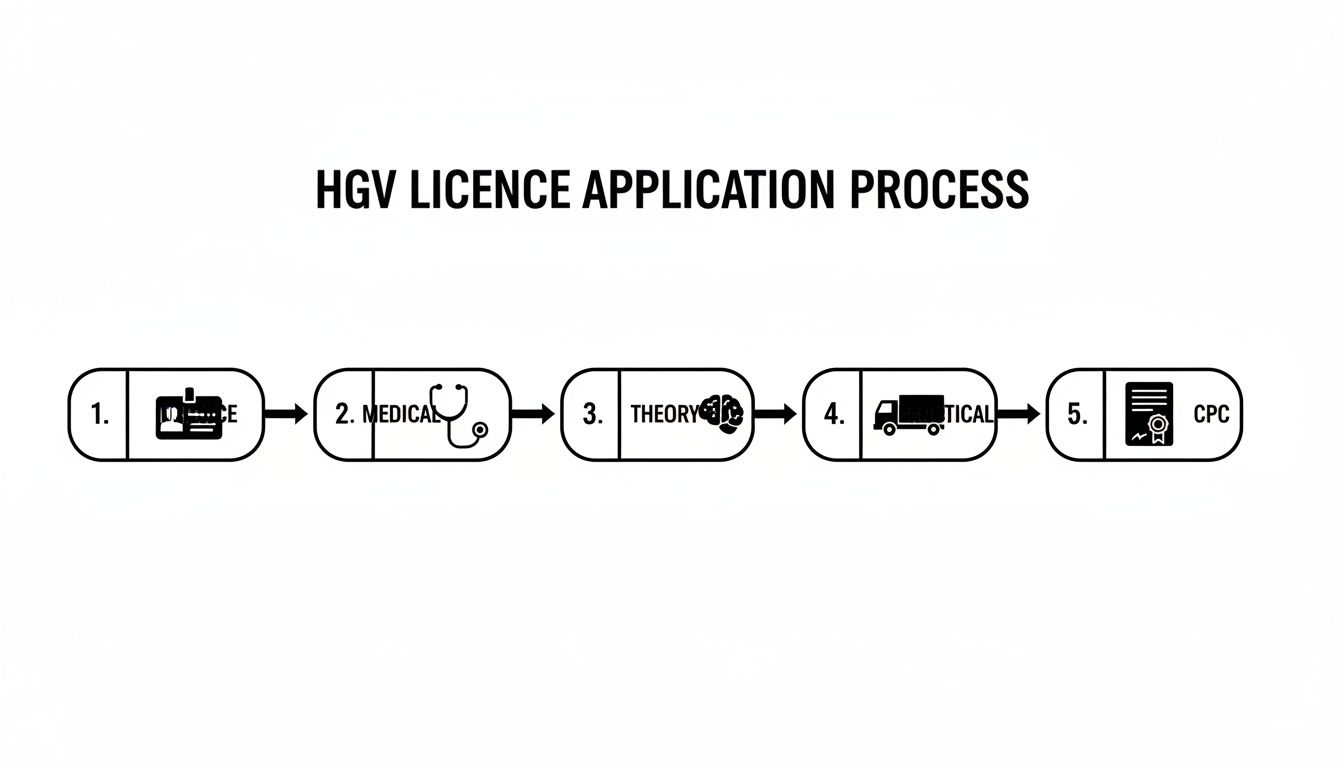
Let’s break down the core requirements into a simple checklist. These are the five key milestones every aspiring HGV driver in the UK must hit:
Age and Licence: You have to be at least 18 years old and already hold a full Category B (car) driving licence.
Medical Examination: A mandatory medical assessment, known as the D4 medical, is needed to confirm you meet the higher health and eyesight standards for HGV drivers.
Theory Tests: You’ll need to pass a few theory tests, covering multiple-choice questions, hazard perception, and case studies (which is your CPC Module 2).
Practical Training and Test: This is where the fun starts. You’ll get hands-on training with a qualified instructor, leading up to the practical driving test (CPC Module 3).
Driver CPC Qualification: To drive for a living, you must get your initial Driver Certificate of Professional Competence (CPC).
This five-step diagram shows you exactly how the process flows, from getting your licence and medical sorted to completing your final qualification.
As you can see, each stage logically builds on the last one, taking you from a complete beginner to a fully qualified professional driver.
HGV Licence Categories at a Glance
Before you dive in, it’s worth figuring out which licence you’re actually aiming for. Different trucks require different licence categories, and your choice will shape your career path. Getting your head around all the steps is key, as the entire HGV licensing journey is basically a form of training in compliance with strict safety and operational rules.
The journey to getting your HGV licence is not just about passing a test; it’s about adopting the mindset of a professional who prioritises safety, responsibility, and legal compliance above all else.
To help you out, here’s a quick comparison of the main HGV licence categories. This should make it easier to see which one fits your ambitions.
Licence Category
Vehicle Type
Minimum Age
Common Use Cases
C1
Rigid vehicles between 3,500kg and 7,500kg
18
Ambulance driving, delivery vans, horseboxes
Category C
Rigid vehicles over 3,500kg
18
Fire engines, bin lorries, large-scale distribution
C+E
Category C vehicle with a trailer over 750kg
18
Articulated lorries (‘artics’), long-haul freight
This guide will walk you through each of these requirements in more detail, giving you the clarity you need to navigate the process with confidence and start your journey on the right foot.
Medicals and a Provisional Licence: Your First Steps
Before you can even dream of getting behind the wheel for your first lesson, there are a couple of key hurdles to clear. Think of these early requirements as the official gateway to your new career, put in place to ensure every new driver starts on a safe, legal, and level playing field.
The first box to tick is simple: you must be at least 18 years old and already hold a full UK car driving licence (Category B). This isn’t just bureaucracy; your car licence proves you have a solid grasp of UK road rules and some real-world driving experience. It’s your ticket to the main event.
Once that’s confirmed, your next move is to prove you meet the higher medical standards needed to operate a large commercial vehicle.
The Gatekeeper: Your D4 Medical Exam
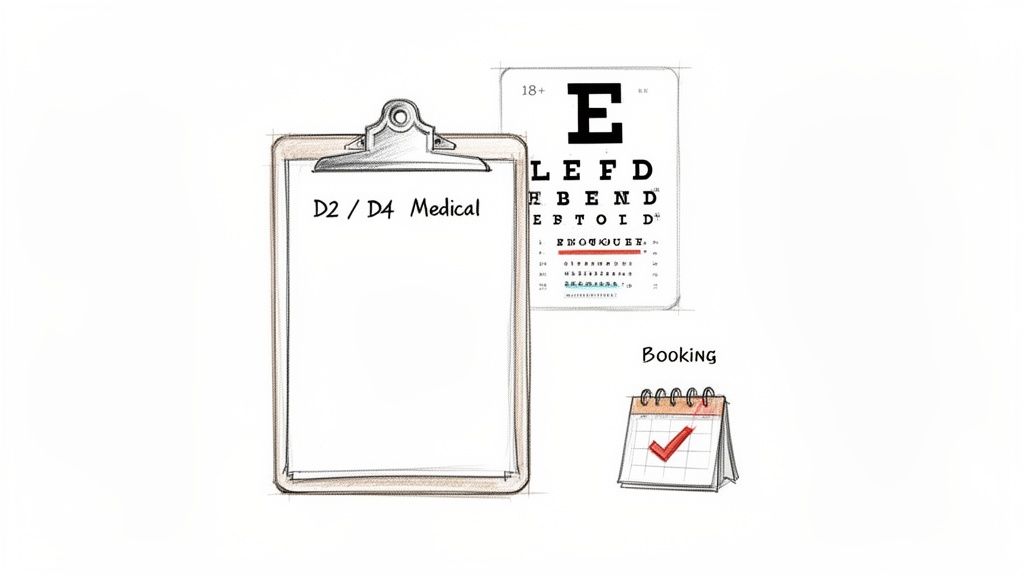
Every single person hoping to drive an HGV has to pass a D4 medical examination. This is more than just a quick chat with a doctor; it’s a comprehensive assessment to make certain you’re medically fit for the huge responsibility of driving a truck. A doctor will fill out the official D4 form, which takes a close look at several key areas of your health.
The exam confirms you meet the stricter eyesight standards for HGV drivers: which are tougher than those for car drivers. It also includes a general health check-up where the doctor will ask about your medical history, looking for any heart or neurological conditions that could impact your ability to drive safely.
The D4 medical is your first major milestone. It’s the industry’s way of ensuring that only those who are genuinely fit and well are handed the keys to a vehicle weighing up to 44 tonnes.
Passing this medical is non-negotiable. It’s there to protect you, the public, and your future employer. Getting expert help here can be a game-changer. A good training coordinator can often arrange the medical for you with a GP who knows the DVSA requirements inside and out, making the whole process much smoother. For a full breakdown of what the assessment involves, take a look at our detailed guide on the HGV medical.
Applying for Your Provisional Licence
With a signed D4 medical form in your hand, you’re ready to apply for your provisional HGV licence. This isn’t a new plastic card. Instead, it’s an added ‘entitlement’ on your current car licence that gives you the green light to start practical training. To get it, you’ll need to fill out a D2 application form, which you can order from the DVLA or grab from most Post Offices.
Here’s how it works:
Get the Forms: You’ll need both the D2 (the application) and D4 (the medical) forms.
Book Your Medical: Schedule and complete your medical exam. The doctor will fill out and sign the D4 form for you.
Complete the D2 Application: Fill in the D2 form, making sure to specify which provisional entitlement you’re applying for (e.g., Category C).
Send It All Off: Post your completed D2 and D4 forms, along with your photocard driving licence, directly to the DVLA.
There’s a long history behind these structured steps. When HGV licences were first made mandatory back in 1970, drivers had to prove their fitness and experience to get on the road. These initial checks are the modern equivalent, ensuring your journey into professional driving is built on a solid foundation of safety from day one.
Passing Your Theory Tests and Driver CPC
With your provisional HGV licence entitlement sorted, it’s time to shift gears from paperwork to knowledge. This next part of your journey is all about the theory tests: a crucial step towards getting your full HGV licence. Don’t think of it as a simple memory quiz; this is where you truly start to build a ‘professional driver’s mindset’.
The whole process is broken down into a few different parts, each designed to test a specific skill. Think of it like building a house. You start by laying a solid foundation of legal knowledge, then you build the walls with road awareness, and finally, you furnish it with practical, job-specific expertise.
Understanding the Theory Test Structure
The theory test isn’t just a single exam. It’s actually a series of modules that check your understanding in different areas. You have to pass these before you can even think about booking your practical driving test. They make sure you’ve got the essential knowledge to handle a large vehicle safely and professionally.
Initially, you’ll tackle two computer-based tests, which are usually taken one after the other at a test centre:
Part 1a: Multiple-Choice Questions: This test throws 100 questions at you, covering everything from road law and vehicle safety to loading procedures and drivers’ hours rules. You’ll need to get at least 85 out of 100 right to pass.
Part 1b: Hazard Perception: This test is all about spotting developing dangers on the road. You’ll watch 19 video clips, and each one has at least one ‘developing hazard’. One clip will even have two! Points are awarded for spotting hazards early, and you need a score of 67 out of 100 to pass.
These tests are designed to make sure you’re not just reacting to what happens on the road, but actively anticipating it. It’s a skill that separates a good car driver from a truly great professional HGV driver.
The Driver CPC Module 2 Case Studies
On top of the initial theory and hazard perception tests, you’ll also need to pass the Driver CPC Module 2. This is another computer-based test, but it has a completely different focus. Instead of just testing what you know, it examines how you would apply that knowledge in realistic situations.
You’ll be given seven case studies, each describing a scenario you could easily face during a typical day’s work as an HGV driver. These might cover anything from vehicle maintenance and dealing with emergencies to staying compliant with drivers’ hours. There are 50 questions based on these scenarios, and you need to score at least 40 to pass.
Think of Module 2 as a flight simulator for your brain. It puts you in the pilot’s seat, forcing you to make decisions about safety, efficiency, and the law without ever leaving the ground. It’s your first taste of professional problem-solving.
This part of the process is what really starts to build your professional judgement. To get properly prepared, you can dive into our detailed guide which covers everything you need to know about the theory test for an HGV licence.
The Importance of Quality Preparation
Given the high pass marks and the sheer amount of information you need to learn, just winging it isn’t an option. Your success really depends on using high-quality study materials and a system that lets you track your progress. Any good training provider will give you access to online learning software and mock test simulators.
This isn’t just about cramming facts; it’s about genuinely understanding the material. Good software should let you:
Practise hundreds of official DVSA revision questions.
Simulate the hazard perception test with realistic clips.
Take full mock tests to see if you’re ready for the real thing.
Pinpoint and work on your weaker areas.
Taking a structured approach like this means you’ll walk into the test centre feeling confident and fully prepared: not just to pass, but to do well. This knowledge forms the bedrock of your career, making you a safer, more reliable, and ultimately more employable driver.
Mastering the Practical Driving Test
This is it: the part where all your study and preparation come to life. The practical training and test, known officially as Module 3, is where you swap the classroom for the cab and turn knowledge into real-world skill.
Passing Module 3 is about so much more than just getting from point A to B. It’s a full assessment of your ability to handle a massive vehicle with precision and complete safety. The test is built to ensure you can operate like a true professional, whatever the road throws at you.
What to Expect on Test Day
Think of your practical training as having an expert coach in your corner. A DVSA-standard instructor isn’t just there to help you scrape a pass; their job is to build the confidence, muscle memory, and situational awareness you’ll need for a lifetime on the road. They’ll drill you on every single aspect of the test until it feels like second nature.
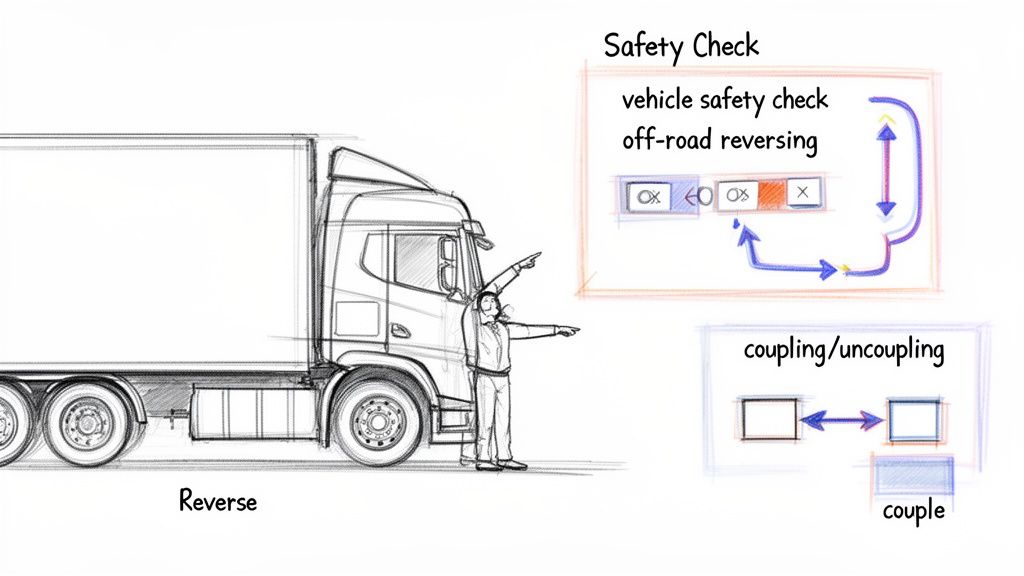
The test itself is split into several key parts:
Vehicle Safety Questions: Before you even turn the key, the examiner will hit you with ‘show me, tell me’ questions. This is your chance to prove you know how to do the essential pre-drive safety checks.
On-Road Driving: This is the main event. You’ll drive on a mix of roads and in various traffic conditions while the examiner watches everything: your general driving, mirror checks, signalling, and how you deal with other drivers.
Off-Road Manoeuvres: You’ll need to complete a reversing exercise in a designated off-road area. This is a critical test of your control and ability to manoeuvre the truck accurately in tight spots.
Coupling and Uncoupling: If you’re going for a C+E licence for an artic, you’ll also have to show the examiner how to safely connect the tractor unit to a trailer and then disconnect it.
Your instructor will make you practise these elements over and over, so nothing on test day will be a surprise. They’re preparing you for a long-term career, not just to tick a box on an exam sheet.
The Direct Access Route to C+E
One of the biggest recent shake-ups in HGV licensing has been the ‘direct access’ route. Back in 2021, the UK was facing a serious driver shortage, with an estimated 69,000 fewer drivers on the road. To get new drivers qualified faster, the government ditched the old system. Previously, you had to pass your Category C (rigid lorry) test before you could even think about training for C+E (articulated lorry). You can read more on the background of this change in the Road Haulage Association’s report.
This change means you can now go straight from a car licence to an articulated lorry licence. You’ll often hear this called the ‘Class 1 direct’ or ‘C+E direct’ route.
The direct access route has opened a fast track to the highest-paying HGV jobs. However, it demands an intense level of focus and high-quality training to ensure drivers develop the skills needed to handle the biggest vehicles on the road from day one.
Going for this accelerated path has clear advantages, mainly saving you time and money. But make no mistake, it’s a much steeper learning curve. The absolute key to success is getting local, tailored training from instructors who know how to build your skills step-by-step, making sure you’re truly competent with the extra length and weight of an artic. These are the core practical skills you need to fulfil all requirements for an HGV licence.
How Much Does an HGV Licence Cost
One of the first, and most important, questions people ask when thinking about becoming a lorry driver is: “how much will it all cost?” It’s a fair question. Understanding the full financial side of things is a vital part of planning your new career. It’s best to see it as a single, upfront investment in your future.
The total figure isn’t just one number; it’s actually a series of smaller, distinct costs. Each step on the path to getting your HGV licence, from the initial medical check-up to the final practical test, comes with its own fee. Breaking it down like this makes the whole thing feel much more manageable.
A Clear Breakdown of HGV Licence Costs
Think of getting your licence like building a professional toolkit. You buy each tool (the medical, the theory tests, the hands-on training) one by one. Once you have them all, you’re ready to get to work.
Let’s run through exactly what you should budget for.
Here’s a realistic look at the estimated costs for each piece of the puzzle. Keep in mind that prices can vary a bit depending on where you are in the country and which training provider you go with.
Estimated HGV Licence Costs Breakdown
This table gives you a clear overview of the potential costs involved in obtaining your HGV licence, from your first medical exam to the final tests.
Requirement
Estimated Cost Range (£)
HGV Medical Exam
£50 – £120
Provisional Licence
FREE
Theory Tests (All parts)
£60
Practical Training & Test (C)
£1,500 – £2,500
Practical CPC (Module 4)
£250 – £350
Driver CPC Card Issue
£25
These figures cover your initial investment to get qualified and out on the road. It’s a significant outlay, but a worthwhile one for launching a new career.
Funding Your Training and Realistic Timelines
The biggest chunk of your investment will almost always be the practical training package. This is one area where you don’t want to cut corners; high-quality instruction pays for itself by giving you the confidence and skills to pass your test first time and drive safely for years to come.
To make this major cost easier to handle, many modern training providers offer flexible ways to pay.
Spreading the cost of your training over several months turns a significant one-off expense into a manageable monthly payment. This makes a new career accessible without needing to save up the full amount in advance.
Instead of needing a large lump sum upfront, you can often set up a payment plan that spreads the cost over 10 to 12 months. For many aspiring drivers, this approach is a real game-changer. For a more detailed look at the numbers and financing options, you might find our complete guide on how much an HGV licence costs helpful.
So, how long does it all take? If you can commit to a dedicated schedule, it’s possible to go from a complete beginner to a fully qualified HGV driver in as little as 8-10 weeks. Of course, this timeline depends on your own availability and the waiting times for tests in your area, but it shows just how quickly you can turn this investment into a brand new career.
Building Your Career After You Pass
Congratulations, your new HGV licence is in your hands. That’s a massive achievement, but it’s not the finish line. Think of it as the starting block for a long and rewarding career on the open road. Now the real work begins: turning that shiny photocard into genuine opportunity.
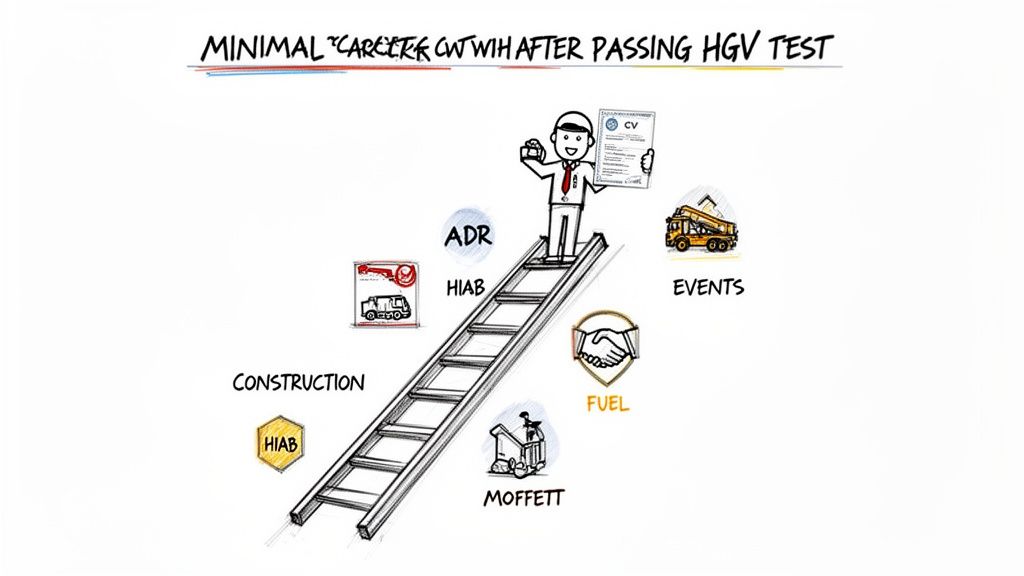
Your standard Category C or C+E licence is your passport to a huge range of driving jobs. But if you want to open up the most specialised and higher-paying roles, you’ll need to add a few more stamps to that passport. Each extra qualification opens up a whole new territory of opportunity.
Boosting Your Earning Potential with Specialist Training
For many industries, just having an HGV licence isn’t enough. They need drivers with specific skills. By getting certified in these specialist areas, you instantly become a much more valuable and attractive candidate.
Some of the most popular and lucrative add-on qualifications include:
ADR Training: This qualifies you to transport hazardous goods, from everyday petrol to industrial chemicals. The extra responsibility involved in these roles often comes with a significant bump in your pay packet.
HIAB Certification: A HIAB is a lorry-mounted crane, perfect for loading and unloading heavy materials yourself. This skill is in constant demand in construction and with builders’ merchants, where self-sufficiency on site is a huge plus.
Moffett/Telehandler Licence: A Moffett is a forklift that cleverly hitches a ride on the back of your lorry. This means you can load and unload your own vehicle anywhere, a game-changer for many distribution and delivery jobs.
These extra tickets do more than just get you a job; they show employers you’re a multi-skilled professional, not just another driver. They open doors to more dynamic work and can seriously increase your earning potential.
Finding Your First HGV Driving Job
With all your qualifications in order, it’s time to land that all-important first role. Getting your foot in the door is the key, and a smart, well-prepared approach makes all the difference. Your CV is your first handshake, so make it a firm one.
Don’t just list your new licence. Highlight your reliability, punctuality, and any transferable skills from previous jobs. It’s also crucial to show you understand the legal side of things. Familiarising yourself with the principles of the Transport Chain of Responsibility demonstrates to employers that you take safety and compliance seriously.
Your HGV licence proves you can drive. Specialist qualifications prove you can solve problems. A strong CV and a proactive job search prove you’re ready to build a career.
Many training providers, like us, offer recruitment support as part of the package. We have strong connections with local and national haulage firms and can often match newly qualified drivers with companies that are hiring right now. This job-matching support is invaluable, helping you skip the crowded job boards and get straight in front of the decision-makers. It’s the final piece of the puzzle, turning your investment in meeting the requirements for an HGV licence into a real, long-term career.
Got Questions? We’ve Got Answers
Getting your head around the final details of your HGV licence can feel a bit like reading the small print. To make sure you’re completely clear and confident, we’ve tackled some of the most common questions we hear from drivers just starting out.
How Long Does My Driver CPC Qualification Last?
Your initial Driver CPC isn’t a “pass once and forget” deal. The qualification you get from passing your Module 2 (case studies) and Module 4 (practical demonstration) tests is valid for five years.
To keep your professional driving status after those first five years, you’ll need to complete 35 hours of periodic training. Think of it as a professional MOT for your driving skills. It’s a great way to ensure you’re always on top of the latest safety rules and best practices throughout your career.
Can I Get Penalty Points on My Provisional HGV Licence?
Yes, absolutely. It’s a critical point many people miss. Your provisional HGV entitlement is directly tied to your car driving licence. Any points you pick up while training in a lorry will go straight onto your existing driving record.
This means you need to be incredibly careful during your training. Racking up too many points could get both your car licence and your provisional HGV status disqualified, stopping your new career in its tracks before you’ve even properly started.
Treat your provisional HGV entitlement with the same respect as a full licence. The rules of the road apply just as strictly, and the consequences of any mistakes can be significant for your future as a professional driver.
What Is the Difference Between a Category C and C+E Licence?
This is probably one of the most common points of confusion, but it’s actually quite straightforward. It all comes down to the trailer.
Category C: This is your licence for a ‘rigid’ vehicle weighing over 3,500kg. Picture a big delivery truck or a bin lorry: the cab and the body are one solid unit.
Category C+E: This licence lets you drive a Category C vehicle plus a large trailer that weighs over 750kg. That ‘+E’ bit is what gives you the entitlement to tow.
So, a Cat C licence gets you behind the wheel of a rigid truck. A C+E licence is what you need to drive what most people call an ‘artic’ or articulated lorry: the biggest rigs on the road. Meeting the requirements for an HGV licence in the C+E category really opens the door to the most long-haul driving jobs.
Do I Need to Renew My HGV Medical?
Yes, you do. Renewing your medical is a non-negotiable part of being an HGV driver. The DVLA needs to know you’re still medically fit to handle large vehicles, and they require proof at regular intervals.
How often you need to renew depends on your age:
Under 65: You’ll need to renew your HGV medical every five years.
Age 65 and Over: From 65 onwards, you must renew your medical every single year.
These check-ups are a vital safety measure. They help ensure every professional driver on UK roads maintains the high standard of health required to operate their vehicle safely.
Ready to stop asking questions and start your journey? HGV Learning coordinates everything you need, from booking your medical to finding a local training centre and even helping with job matching after you pass. Find out how our end-to-end support can get you on the road faster at https://hgvlearning.com.
Got a quick question before you start? Check our FAQs page for fast answers.
Related Articles
23/10/2026
Driver CPC Card Renewal: How to Avoid a Lapsed DQC (2026 UK Guide)
If your Driver CPC card is sitting in your wallet with a date on it you haven't looked at properly in years, you're not alone....