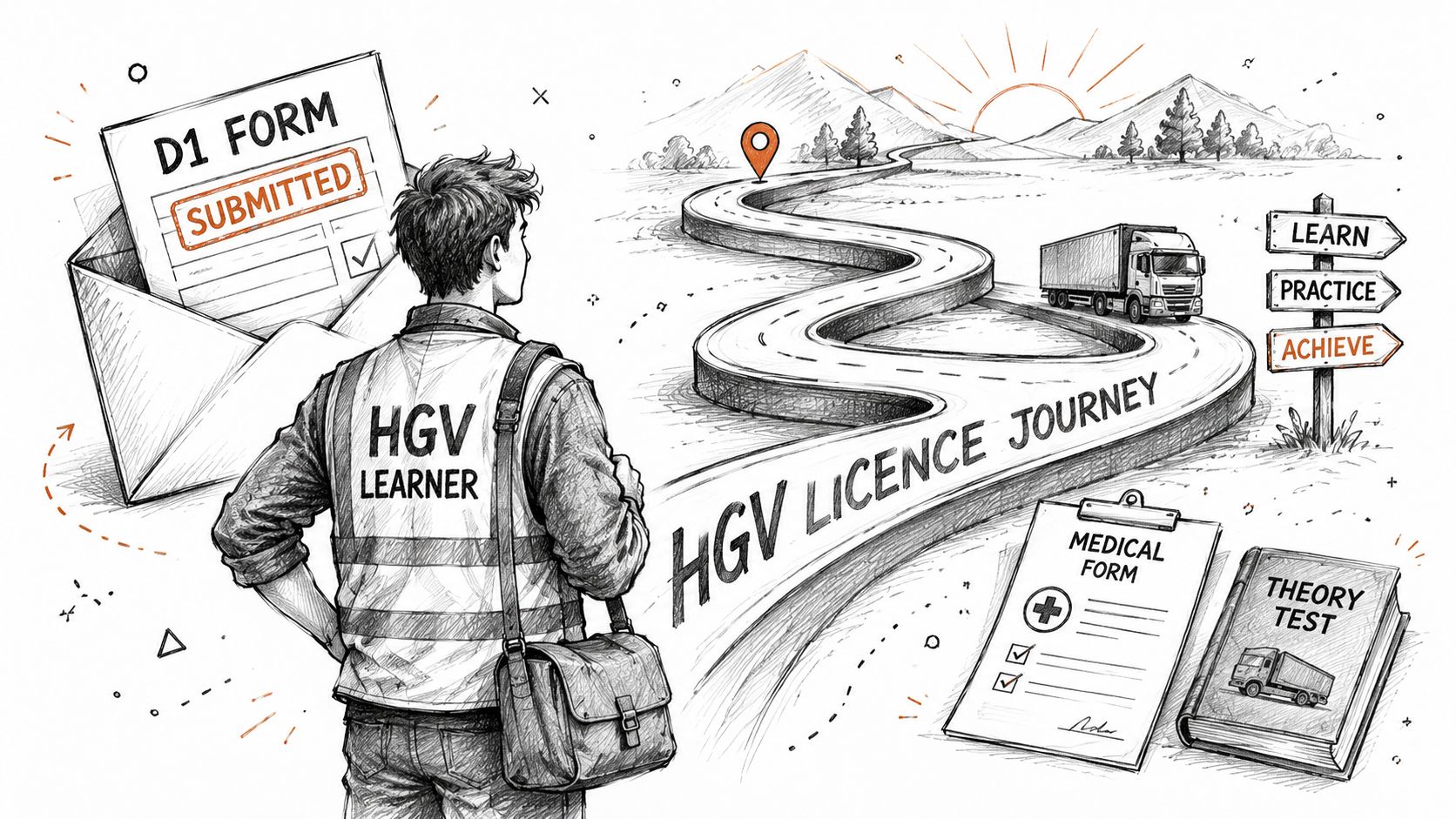
The D1 form is the official DVLA application for a first provisional driving licence in the UK, or to update or replace an existing licence. For an aspiring HGV driver, it matters because over 4.8 million provisional licences were issued in 2024, with 92% of applicants completing the D1 form before booking their theory test (driving-test.uk D1 form guide).
If you're reading this, there's a good chance you've decided you want to drive for a living. Maybe you're looking at Category C, C+E, C1 for ambulance work, or you're just trying to understand the paperwork before you commit to training. That first burst of motivation often runs straight into DVLA forms, licence categories, identity checks, and medical requirements.
That can feel heavier than it needs to.
As someone who helps learners get from “I want to drive HGVs” to “I've got my entitlement and test dates booked”, I can tell you this much. The D1 form is the first bit of official admin that makes the rest possible. Get this part right, and the road ahead becomes far clearer.
Your First Step on the Road to Driving
You decide you want to drive HGVs. You start looking at training, licence categories, and what comes after the car test stage. Then the first piece of paper appears and stops everything cold. The D1 form is often that moment.
For a new HGV learner, the D1 is the form that gets your driving licence record started or corrected so you can move on properly. It is the early admin job many people try to rush past, but it sets the base for everything that follows. If your details are wrong here, the later steps can become slow, confusing, and expensive.
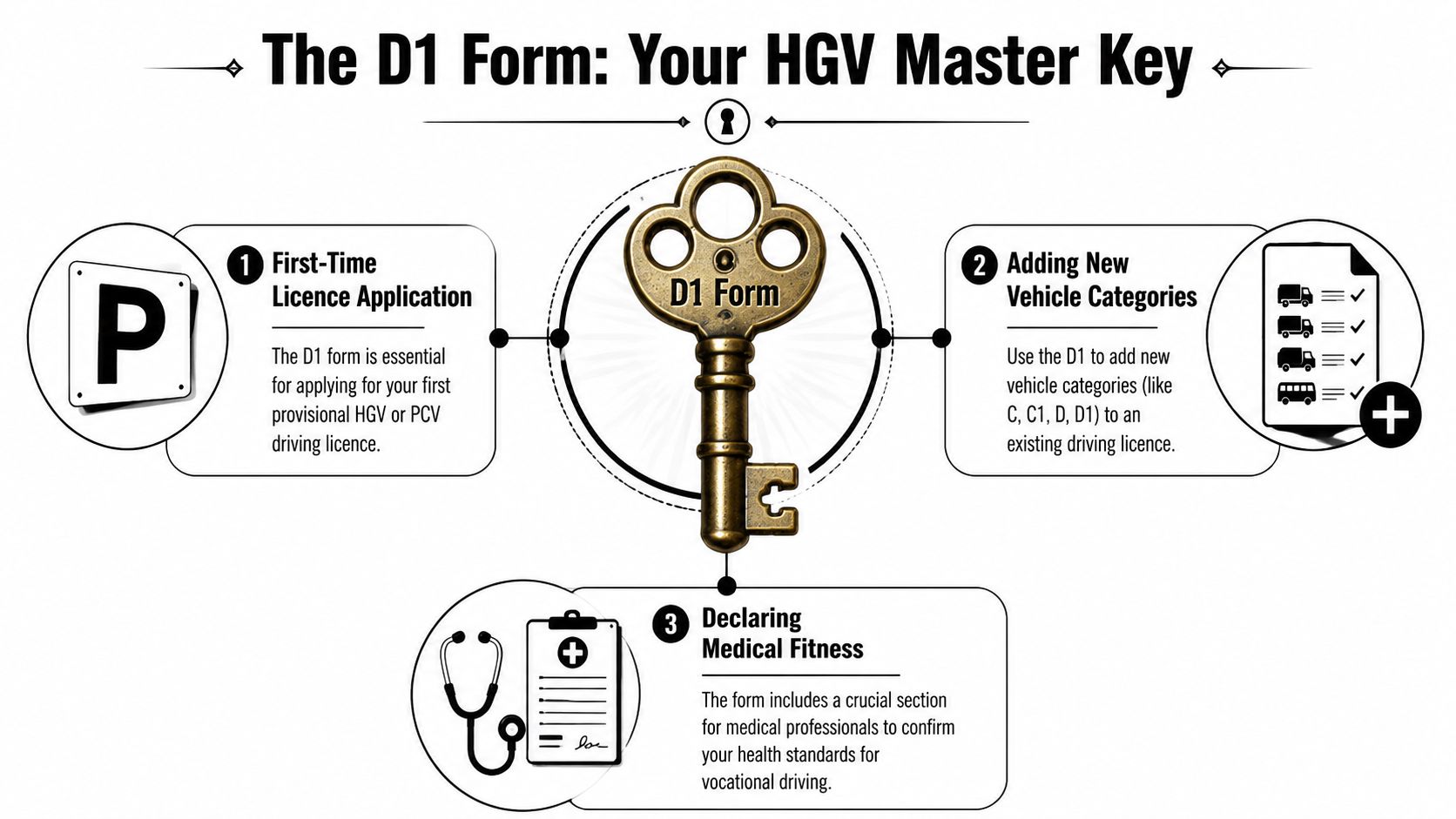
In practical terms, the D1 form covers standard driving licence applications and updates. That includes a first provisional licence, changes to personal details, renewals, and replacement licences. You will also be asked to provide identity documents, and the DVLA instructions make clear that certain documents must be originals rather than photocopies.
Why HGV learners need to pay attention early
If your goal is a truck cab, the D1 is the first form that puts you on the right path.
Many new learners expect the process to begin with the vocational paperwork. In reality, the standard licence side usually comes first. Once your ordinary licence record is in place and accurate, it is much easier to deal with the forms that follow, including the D2 and D4 and the medical checks tied to vocational entitlement.
That is why I often describe the D1 as the first checkpoint, not the finish line. It does not get you an HGV licence by itself, but it clears the way for the later stages that do.
Some learners also confuse the D1 form with a D1 licence category. They are separate things. One is an application form. The other is a vehicle category on a licence. If that wording has been tripping you up, this guide on what an LGV is can help make the categories easier to follow.
A calmer way to look at it
The D1 works like an enrolment form at the start of a training course. It does not teach you to drive a lorry, but it gets your record into the system so the rest of your training journey can happen in the right order.
If you are still getting used to learner-driver language in general, resources such as Skillz2Drive learner lessons can help. Much of the stress around DVLA forms comes from unfamiliar wording, not from the form being impossible to complete.
What the D1 Form Is Really For
For an aspiring HGV driver, the D1 is the form that deals with your basic DVLA licence record. It sits at the standard driving licence level, which is why it often feels less relevant than the vocational forms people talk about later. In practice, getting this part clear early saves confusion once you start dealing with HGV-specific paperwork.
It helps to separate two jobs in your mind. One job is your ordinary driving licence record. The other is your vocational entitlement for lorries or buses. The D1 belongs to the first job.
It is the form used to ask the DVLA to issue, renew, update, or replace a driving licence. That can include a first provisional application, a change of name or address, or replacing a licence that has been lost, stolen, or damaged.
Why that matters to an HGV learner
A lot of new lorry learners hear D1, D2, and D4 mentioned together and assume they are a bundle of forms for the same stage. They are part of the same journey, but they do different jobs.
The D1 handles your main licence record with the DVLA. The D2 and D4 come later when you apply for vocational entitlement and complete the medical side required for higher categories. If you mix those roles up, it becomes much harder to tell which form you need first.
A simple way to picture the process is this. The D1 gets your file in order at the starting point. Once that foundation is correct, the later HGV paperwork has something to build on.
Here are the main situations where the D1 is used:
Applying for a first provisional licence
Renewing an existing licence
Updating personal details such as your name or address
Replacing a licence that is lost, stolen, or damaged
That wider purpose is what catches people out. The D1 is not an HGV-only document. It is a general DVLA form that often appears before the vocational stage of the journey becomes relevant.
Confusion also comes from the name itself. If you have seen "D1" used as a licence category for minibuses, that is a separate meaning from the D1 application form. If you want that distinction explained more clearly, this guide to the minibus driver licence categories and rules helps untangle the terminology.
Who Needs to Complete a D1 Form
You can usually answer this with one simple question. Are you still sorting out your ordinary driving licence record, or are you already at the vocational HGV stage?
If you are applying for your first provisional driving licence, updating personal details, or replacing a lost, stolen, or damaged licence, the D1 is often the form you need. For an aspiring HGV driver, that makes the D1 the paperwork that gets your licence record into the right starting position before the lorry-specific forms come into play.
That matters because many new drivers hear D1, D2, and D4 in the same conversation and assume they should all be completed together. In practice, the D1 usually applies to your basic licence admin. The D2 and D4 deal with vocational entitlement and the medical side of the HGV route, which you can read more about in this guide to the HGV medical process.
The residency rule that catches people out
A UK address on its own is not enough.
Under the Road Traffic Act, you generally need to be normally resident in the UK to qualify for a licence application. In practical terms, that means living here as your usual home, not merely using a family address or a temporary mailing point.
This tends to affect three groups of learners:
People who have recently moved to the UK
People who split their time between countries
People who assume proof of address and normal residence mean the same thing
If that sounds like your situation, check it before you spend money on training dates or medical appointments. It is much easier to pause and confirm your eligibility now than to build an HGV plan on paperwork the DVLA cannot process.
A practical way to decide
Use this quick check.
Question
What it usually means
Have you never held a UK provisional licence?
The D1 is often your starting form.
Do you already have a licence but need to change your name, address, or replace the card?
A D1 may still be the correct route.
Do you already have the right basic licence record and now want provisional lorry entitlement?
You are likely looking beyond the D1 and into the vocational forms.
For HGV learners, the easiest way to view it is as a staged process. The D1 handles the licence foundation. Once that is correct, you can move on to the HGV-specific application steps with much less confusion.
That is why two learners can both be "starting to drive" but need different paperwork. A car learner may stop after the standard provisional stage. An aspiring HGV driver uses that same starting point as the base for the later D2, D4, and medical requirements that lead toward vocational training and tests.
How to Get and Complete Your D1 Application
You decide you're serious about becoming an HGV driver. You start looking at training, CPC, and medicals, then realise none of that moves far if your licence paperwork is not in order first.
For many new drivers, the D1 is the form that gets that foundation in place. It is the paperwork stage that comes before the HGV-specific forms, so it helps to treat it like laying the first section of road before the heavier traffic can use it.
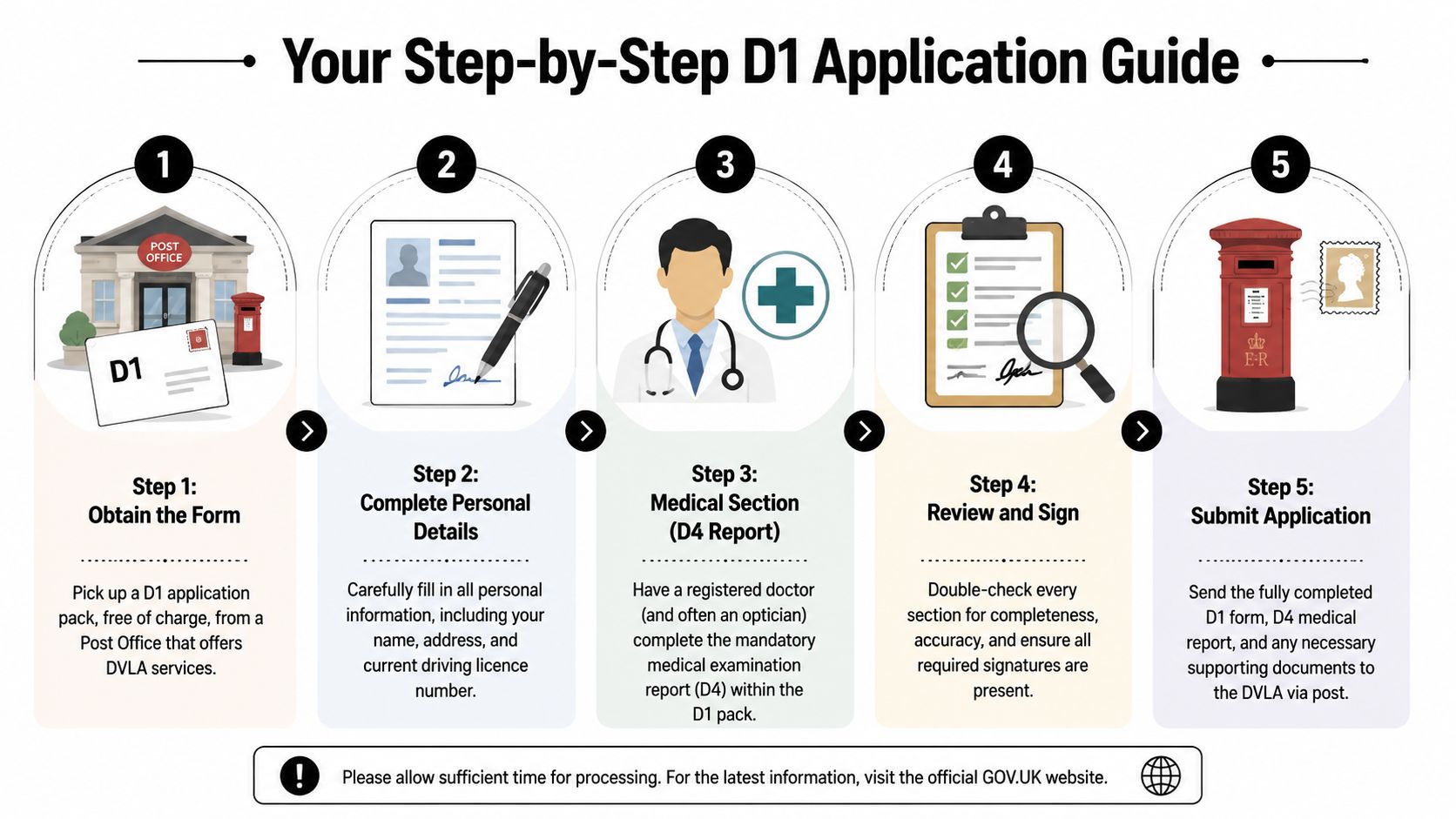
The practical starting point is simple. Get a D1 form from a Post Office that offers DVLA services, as listed on the official DVLA forms information.
Getting the form
Ask for a D1 pack at the counter. Then take a few minutes to read through it before you write anything.
That small pause saves time. New learners often rush into filling out boxes, only to realise halfway through that they need a document, a photo, or details they do not have beside them. If your goal is an HGV licence, a delay here can push back the later stages, including your D2, D4, and medical booking.
Filling it in carefully
The form has several sections, and the safest approach is to work through them in order with your documents beside you. A D1 works a bit like your licence record setup. If the base details are wrong, the later HGV application steps become harder than they need to be.
Use this method:
Choose the right reason for applying Check that you are using the form for the correct purpose, such as a first provisional licence, a replacement, or a change of details.
Copy your personal details exactly Write your full name, address, and any existing licence information so they match your supporting documents. Even a small mismatch can slow processing.
Prepare your identity documents early Do not leave this until the envelope is ready. Make sure the documents you plan to send support the details written on the form.
Handle the photo and signature properly Follow the form instructions closely. A missing signature or photo problem is enough to stop an otherwise accurate application.
If you learn better by seeing the process, this video gives a useful walkthrough:
A simple checking routine before posting
Use a final check like an instructor's walk-round before a lesson. You are looking for the small faults that cause avoidable hold-ups.
Write clearly so each detail is easy to read.
Match every detail to your documents, especially names, dates, and addresses.
Follow the evidence rules exactly if original documents are requested.
Read the whole form once more before you send it.
That habit matters more than many learners expect. The same pattern shows up in other licence systems too. G1ready.ca's insights on test errors make a similar point. Small admin mistakes often create bigger delays than the learner expected.
If you are heading toward lorry driving, keep the sequence clear in your mind. The D1 sorts out the basic licence application stage. After that, many learners move on to vocational paperwork and a medical. This overview of the HGV medical process for vocational licence applications helps you see where that next stage fits.
Common D1 Form Mistakes and How to Avoid Them
Most D1 problems aren't dramatic. They're small, avoidable errors that stop the form moving.
That's frustrating because the learner usually feels they've “done the hard part” by deciding on a driving career. Then a missing signature or wrong document stalls the entire process. If your training window is tight, that delay can affect everything after it.
The mistakes I see most often
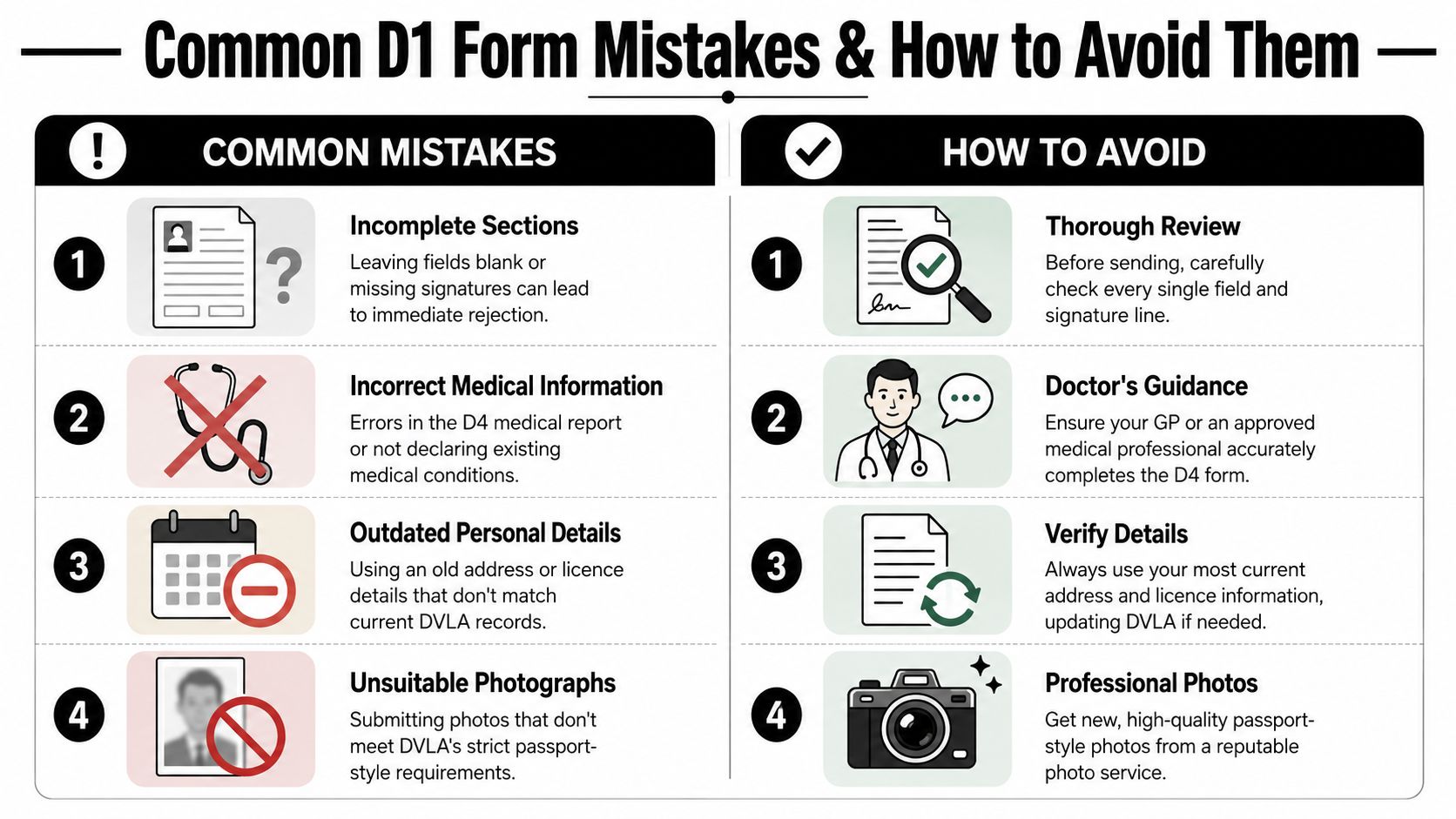
Here are the issues that commonly trip people up:
Missing answers or blank sections People skip a field because they aren't sure what it means, then send the form anyway. That can lead to the application being returned.
Unsigned forms or photos This sounds basic, but it happens often. A form that isn't signed properly is a form that can't be processed.
Identity documents that don't meet the instructions Earlier in this article, I noted that photocopies are not acceptable for certain identity documents. That catches out many first-time applicants.
Details that don't match An old address, a different surname format, or inconsistent dates can all cause hold-ups.
A cleaner way to review your form
Use this quick checklist before anything goes in the post:
Check
Why it matters
Have you completed every relevant section?
Blank gaps can trigger a return.
Have you signed where required?
Missing signatures stop processing.
Do your documents match the form exactly?
Inconsistencies create queries.
Is your photo suitable and signed if required?
Photo errors are a common reason for delay.
A returned form doesn't just waste postage. It can push back medicals, theory plans, and practical training dates.
Why this matters more for HGV learners
If you want a normal car licence, a delay is annoying. If you want an HGV career, a delay can affect the whole chain that follows.
That's because later steps depend on this first one being handled correctly. Employers and training coordinators often want to see that your paperwork is moving in the right order before scheduling the next stages.
If you like learning through examples of avoidable test and paperwork habits, G1ready.ca's insights on test errors are a useful reminder that small admin and preparation mistakes often create bigger problems than people expect, even across different licensing systems.
The HGV Learner Journey Beyond the D1
Once your D1 step is in hand, your HGV path starts to look more like a professional licence route and less like general driving admin.
That's the point where many learners feel relief. The fog lifts. You're no longer asking, “What is a D1 form?” You're asking the better question, which is, “What do I do next to get into a lorry legally?”
Step one and step two are different jobs
The D1 handles your general licence application position.
The vocational stage is different. DVLA guidance says that for lorry, bus, or minibus licences, the correct route is form D2 plus a D4 medical examination report before the vocational application can proceed (DVLA guidance on the vocational route).
That gives you a simple mental model:
Step 1: Sort the underlying licence application position.
Step 2: Apply for the professional vehicle entitlement with the correct vocational paperwork.
What happens after that
Once the paperwork side is aligned, the focus usually shifts to:
Medical clearance
Theory preparation
Practical driver training
Test booking and progression into work
Some learners benefit from coordinated support rather than trying to piece everything together from separate providers. HGV Learning coordinates documentation, medical scheduling, theory support, practical training, and test arrangements for UK learners working toward vocational licences.
The D1 isn't the finish line for an HGV learner. It's the moment the real route opens up.
If you've been putting this off because the forms looked confusing, start with the simplest truth. One form at a time is enough. Get the D1 right, then move forward with the vocational steps in the right order.
If you're ready to move from paperwork questions to a proper training plan, HGV Learning can help you understand the licence route, organise the next steps after your D1, and line up the medical, theory, and practical stages needed for your HGV goal.
What Age Can You Start HGV Driver Training? A 2026 UK Guide to Licence Age Requirements
If you're asking what age you can start HGV driver training, the honest answer depends on which licence you're after. A C1 licence, covering vehicles...