A lot of people in Hampshire start in the same place. You're driving to work on the M3 or passing an industrial estate near Southampton, Basingstoke, or Portsmouth, and you notice the lorries. Then the thought lands. Could I do that for a living?
For many, that question comes after months, or years, in a job that feels stuck. The appeal of HGV driving is easy to understand. It's skilled work, it's practical, and it offers a clear route from training into employment if you approach it in the right order.
Starting Your Journey as a Hampshire HGV Driver
At 6:30 on a wet Hampshire morning, the A34 is already busy. A supermarket artic heads north, a builders' merchant rigid turns into an industrial estate, and a smaller commercial vehicle pulls into a hospital entrance. That is usually the moment the job starts to feel real for people considering HGV training in Hampshire. These are not abstract roles. They are local jobs, on local roads, serving businesses and services that need drivers every day.
That practical side matters. A licence gives you access to work that keeps ports, retail supply chains, construction sites, utilities, emergency services, and regional distribution moving across the South East. In Hampshire, your location is part of the appeal. You are close to major trunk roads, busy depots, and freight routes linked to Southampton and the wider region, which can translate into a broader mix of entry-level driving jobs than in a more isolated area.
The first point to clear up is simple. You do not need to know your full long-term plan before you begin.
You do need a realistic starting point. Some learners want a licence for a specific role, such as ambulance support work. Others are comparing driving with their current job and trying to work out whether the training time, test wait, and cost will pay off. That is the right question to ask, especially in Hampshire, where earnings can differ noticeably between local multidrop, rigid work, and artic work across the South East.
A good way to approach it is to treat the process like building a route before a journey. You would not set off for a delivery without checking the vehicle, the roads, and the destination. HGV training works the same way. Before you book anything, it helps to understand how to become an HGV driver in the UK in clear, plain terms, so the medical, theory tests, practical training, and Driver CPC stop feeling like a wall of jargon.
There is also a timing reality that catches people out. Training itself can move quite quickly once your provisional entitlement and theory are sorted, but the full path is not always as fast as the adverts make it sound. Test availability, medical appointments, and course scheduling can all affect how long it takes from first enquiry to first job application. In Hampshire and nearby areas, that timeline can be short for one learner and stretched for another.
That is why the best first step is not rushing into the biggest vehicle or the cheapest package. It is understanding which licence fits the work you want, what the route will cost in time and money, and what sort of return you are likely to get once you are qualified.
Choosing the Right HGV Licence for Your Career
The first decision trips people up more than any other. They hear terms like C1, Category C, and C+E and assume they should just aim for the biggest one. Sometimes that's right. Sometimes it isn't.
A simpler way to think about it is this:
C1 is for smaller commercial vehicles.
Category C is for heavier rigid lorries.
C+E is for a lorry with a large trailer.
What each licence means in practice
For Hampshire learners, the licence class affects the kind of work you can legally do from the start. A C1 licence allows vehicles up to 7.5 tonnes MAM with a trailer up to 750 kg, which makes it relevant for ambulance-style and other lighter commercial roles. Category C is the first step into heavier rigid vehicles and is widely used for general haulage fleets, according to MSM Training's guide to HGV licence types.
That's why the licence class directly shapes your day-to-day role. It doesn't just change the truck you drive. It changes the employers you can apply to, the shifts you'll be considered for, and the type of freight or service work you can cover.
HGV Licence Categories at a Glance
Licence Category
Vehicle Type
Typical Hampshire Jobs
C1
Vehicles up to 7.5 tonnes
Ambulance support roles, some delivery and service work
Category C
Heavy rigid vehicles
General haulage, builders' merchants, local fleet work, refuse or municipal-style driving
C+E
Articulated or drawbar combinations
Long-distance haulage, supermarket trunking, port and distribution work
How to choose without wasting money
If you want emergency-service-related driving, patient transport, or work that specifically asks for lighter commercial entitlement, C1 may be the sensible route.
If you want a broad starting point for commercial driving, Category C usually gives you the widest entry into rigid vehicle work. It's often the licence that gets career changers moving because it opens the door to established fleet jobs without forcing you into artic work straight away.
If your long-term aim is trunking, container work, or larger fleet operations, C+E may offer the best fit. But don't choose it just because it sounds more advanced. Choose it because it matches the work pattern and vehicle type you want.
Practical rule: Pick the licence for the job you want first, not the badge that sounds most impressive.
A learner in Winchester aiming for ambulance work and a learner in Southampton aiming for port-related haulage shouldn't automatically follow the same route. The smartest training plan is the one that gets you legal, employable, and confident for the specific role you're targeting.
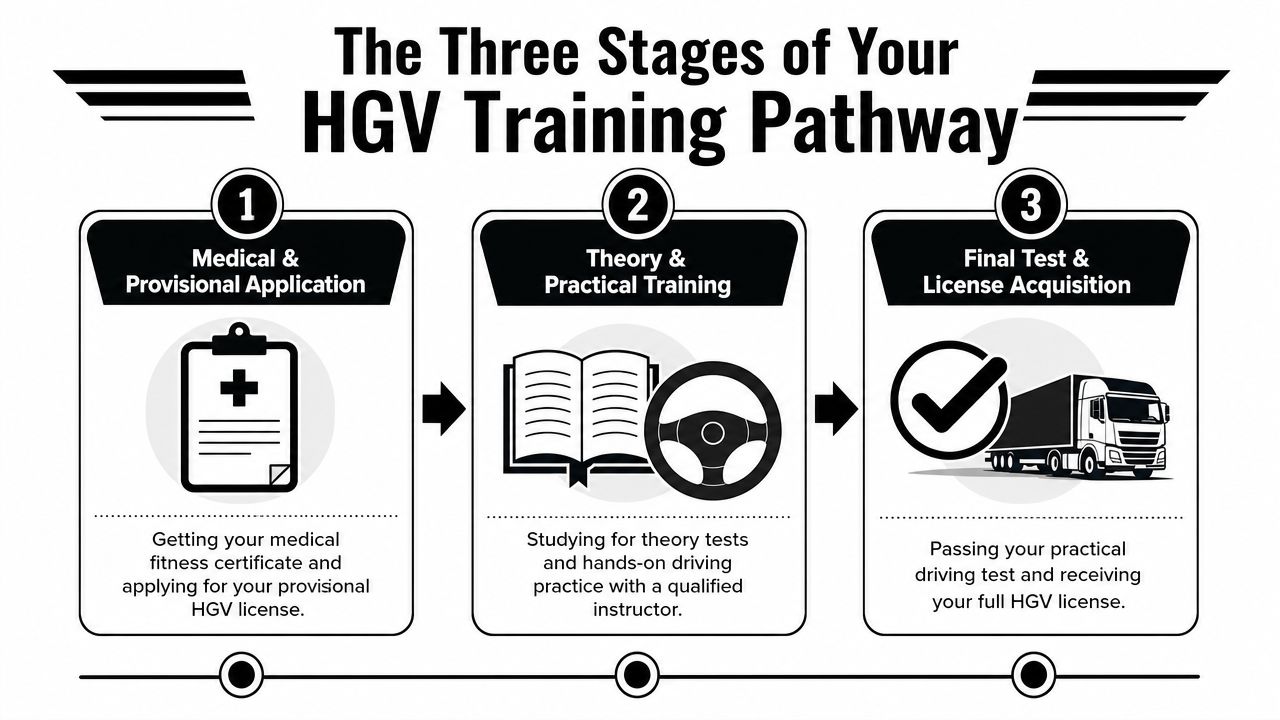
The Three Stages of Your HGV Training Pathway
You have picked your licence. Now the route ahead is much easier to follow if you treat it like a training plan with three clear checkpoints, rather than one long hurdle. In Hampshire, that matters because timing is rarely instant. Medical appointments, theory test availability, and practical test backlogs can all affect how quickly you get from enquiry to earnings.
Stage one starts with paperwork and your medical
Your first stage happens before you touch a training vehicle. You apply for provisional entitlement, complete the right forms, and book the driver medical.
For many Hampshire learners, this feels frustrating because it does not look like progress yet. It is progress. If the paperwork is delayed or completed incorrectly, everything behind it shifts back as well.
The medical is usually straightforward. A doctor checks your general fitness to drive professionally, including eyesight, medical history, and any condition that could affect road safety. Accuracy matters more than speed here. Bring the details you need, answer truthfully, and get this done early so you are not ready to train but still waiting on admin.
Driver CPC can also confuse new starters because people often hear about it before they understand where it fits. A simple way to view it is this. Your licence gives you legal entitlement to drive the vehicle. Driver CPC covers the professional standard expected when you drive for work. If you are unclear on where ADR and Driver CPC sit within the wider qualification picture, this guide to ADR in the UK for professional drivers gives useful context.
Stage two is theory preparation
Theory is the stage where good planning saves time and money. A failed theory test does not just dent confidence. It can push back practical booking dates, which matters more in areas where test slots are already under pressure.
You will usually prepare for the multiple-choice test, hazard perception, and case studies linked to professional driving. Learners who have been driving cars for years sometimes underestimate this part. That is a mistake. Car experience helps, but HGV theory asks you to think like a working driver who is responsible for vehicle checks, road risk, load awareness, and public safety.
A practical revision routine usually works better than last-minute cramming:
Study in short sessions: Regular revision sticks better than one heavy weekend.
Use timed mock tests: They show where your knowledge drops under pressure.
Practise hazard perception properly: The test looks for developing hazards, not just obvious ones.
Treat case studies like real work situations: Read each scenario as if your decision affects a shift, a vehicle, and other road users.
Here's a visual summary of how the whole pathway fits together.
Stage three is practical training and your final test
This is the stage learners usually picture first. It is also the point where the job starts to feel real.
Practical training is not just about making the vehicle move cleanly. You are building the habits employers expect from day one: mirror use, road position, speed planning, observation, space management, and calm decision-making in a large vehicle. The change is similar to going from running a family car to handling a mobile workplace. The controls matter, but judgement matters more.
In Hampshire, the timing of this stage can vary more than learners expect. Some people are ready to train quickly but need to wait for a suitable course date or test slot. Others benefit from spacing things out so the theory is passed, the medical is complete, and practical days are used efficiently. A good coordinator will help you line these pieces up in the right order rather than rushing you into a booking that creates avoidable delays.
The trainees who progress best are usually the ones who listen carefully, ask questions early, and improve session by session.
Your examiner is looking for safe, controlled, professional driving. Clean manoeuvres help, but the bigger picture is whether you manage risk well, read the road early, and keep the vehicle settled and predictable. That is why practical training often changes how people drive their own car afterwards. You start seeing roundabouts, junctions, braking distances, and lane discipline through a different lens.
Taken step by step, the pathway is much less intimidating. Get the paperwork sorted. Pass the theory. Train with purpose. Then take the test.
Boost Your Employability with Specialist Courses
Passing your HGV test gets you through the door. Specialist qualifications help you choose which doors open next.
In Hampshire, that matters because not all driving jobs are the same. Some roles need a straightforward rigid or artic licence. Others need extra competence before an employer can put you on the rota. That's where courses such as ADR, HIAB, and telescopic handler training come in.
Where specialist tickets make a difference
ADR is for drivers involved with hazardous goods, and our ADR licence training course covers exactly that. If you want to move into work connected to fuel, chemicals, or controlled materials, this qualification can become part of the basic entry requirement. If you're new to it, this guide to ADR in the UK for professional drivers explains the role clearly.
HIAB training, like our Hiab training course, suits drivers who need to do more than transport the load. Builders' merchants, construction suppliers, and site-delivery businesses often need someone who can operate a lorry-mounted crane safely and efficiently. That can make you more useful to an employer from your first week.
Telescopic handler training sits slightly differently because it supports plant and site work as much as road transport. But for some learners, especially those moving between construction and transport roles, it creates a more flexible skill set.
Why extra training can be the smarter move
The mistake is to see specialist training as an optional extra with no clear return. In reality, it can sharpen your employability by matching you to harder-to-fill roles.
That doesn't mean every learner should stack qualifications straight away. It means you should think about sequence.
New to the industry: Get the core licence first and settle into commercial driving.
Targeting a niche employer: Add the specialist ticket that matches that niche.
Already in construction or utilities: Choose the qualification that builds on your current sector knowledge.
A plain licence gets you considered. The right specialist ticket can make an employer remember you.
For Hampshire learners, the best choice depends on the work you can realistically reach, the shifts you'll accept, and the type of vehicle or load you want to handle. A specialist course is most valuable when it lines up with a real vacancy pattern, not when it looks good on paper.
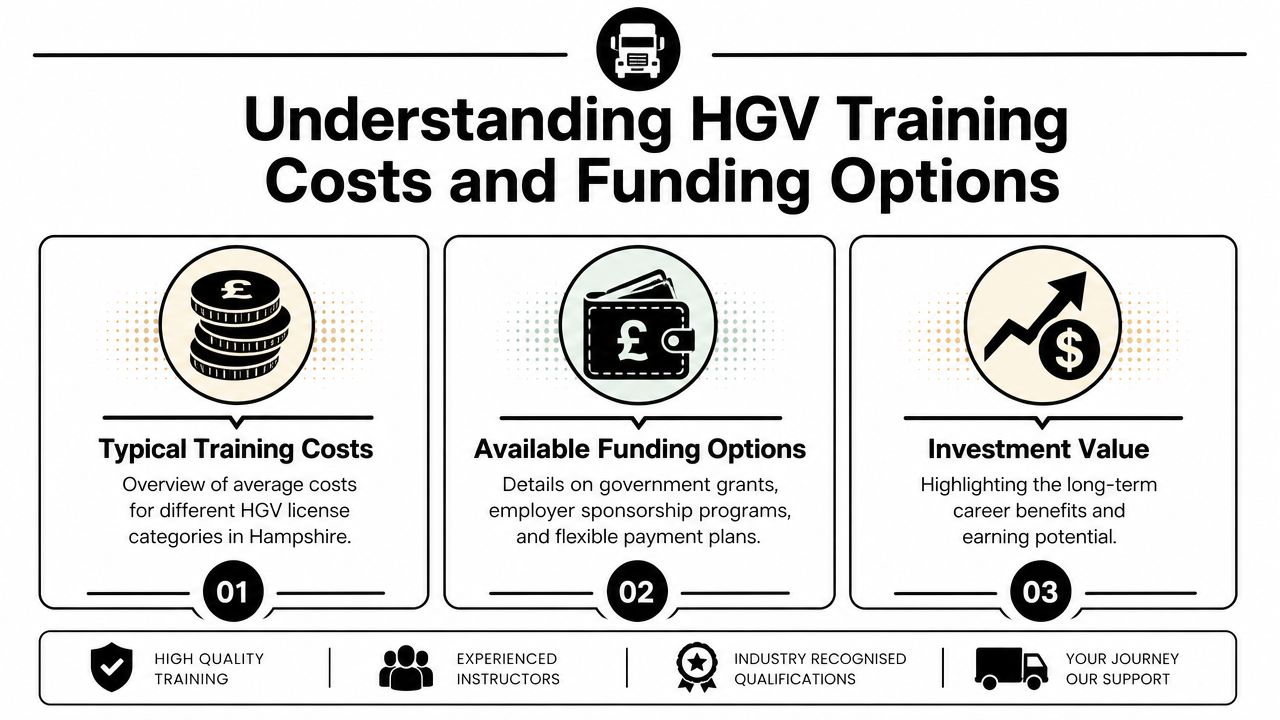
Understanding HGV Training Costs and Funding Options
You find a Hampshire training quote that looks manageable at first glance. Then the practical questions start. Does that price include the medical, theory tests, vehicle hire, and the practical test fee, or is it only the classroom and driving days? That is where many learners get caught out, and it is why cost needs looking at as a full route into work, not a single course fee.
HGV training pays back through a licence, legal compliance, and access to better-paid driving roles. But the payback only feels sensible if you know what you are buying and how quickly that licence can start earning for you.
Price the whole pathway, not the advert
A low headline figure can be a bit like seeing the monthly payment on a van without checking the insurance, servicing, and fuel. The useful number is the total cost to get qualified and job-ready.
Ask any provider to break the quote down clearly. You want to know whether it includes:
Medical and paperwork: Medical examination, forms, and any admin support
Theory stage: Study materials, hazard perception, multiple choice tests, and booking help
Practical stage: Instructor time, vehicle use, reversing, test-day hire, and test coordination
Licence route: C1, Category C, and C+E involve different amounts of training and different likely earnings afterwards
Extras linked to the jobs you want: ADR or HIAB can improve your options, but they also add to the upfront spend
A clear quote helps you compare like with like. Without that, one provider may look cheaper because part of the process is missing from the price.
Funding options can reduce the pressure
Paying all at once is not the only route. Some Hampshire learners qualify for funded training through Skills Bootcamps. Others use staged payments, especially if they are changing career while still covering normal household bills.
Employer support can also be realistic. Learners already working around transport, warehousing, highways, construction, or council services sometimes find that an employer will contribute if the licence fills a real business need. If you want to compare routes in plain English, this guide to funding for HGV training and payment options is a useful starting point.
The right question is simple. Are you trying to minimise the upfront spend, or are you trying to reach paid work as soon as possible? Those are not always the same thing.
Hampshire ROI is about earnings, travel, and timing
Return on investment matters more than the cheapest sticker price. In Hampshire and the wider South East, pay can be stronger than in many other areas, but the best-value licence still depends on the jobs you can realistically reach. A higher-paid role loses some shine if it adds a long unpaid commute, awkward start times, or weeks of waiting before you can begin.
That is why licence choice should be tied to actual vacancy patterns near Portsmouth, Southampton, Basingstoke, Eastleigh, Winchester, and the M27 and A34 corridors. Some learners will earn back a Category C licence quickly because rigid work is easier to step into. Others will do better going straight for C+E if local employers mainly want articulated drivers and the extra training cost opens a wider pool of jobs.
Training path
Best for
ROI question to ask
C1 only
Lighter commercial or specialist vehicle roles
Does this licence match the vacancies I can genuinely apply for nearby?
Category C
Entry into rigid fleet work
Will getting on the road sooner outweigh the lower ceiling of some rigid roles?
C+E
Access to artic work and a broader range of fleets
Will the wider job market and pay potential repay the extra training cost soon enough?
Cat C plus ADR or HIAB
Learners aiming at fuel, pallet, builders' merchant, or specialist delivery work
Will the extra ticket help me get shortlisted faster or start on better rates?
A good decision usually balances three things. What you can afford now. How quickly you can get tested and start work. What local employers are paying for.
The most expensive route is not automatically the best return. The best return is the route that gets you into the right Hampshire or South East job, at the right pace, with earnings that make the numbers work in your own life.
Your Training Timeline and Hampshire Test Centres
The question most learners ask after cost is simple. How long will it take?
The honest answer is that your timeline depends on a few moving parts. Medical appointments, document processing, theory preparation, practical training availability, and test booking all affect the overall pace. Some parts are under your control. Some aren't.
Where delays usually happen
The biggest source of frustration is often the practical test stage. DVSA practical waiting times can have a major effect on how quickly you move from training into work. There's regional variation across Great Britain and an ongoing backlog in the HGV practical test system, which is why planning and date coordination matter so much for Hampshire learners, as highlighted in this discussion of DVSA waiting times and local HGV training timelines.
That changes the actual question. It's not just “How fast is the course?” It's “How smoothly can the whole pathway be lined up so I'm not left waiting between steps?”
Bookings matter almost as much as training quality. A good schedule reduces dead time between your theory pass and your practical test.
What a realistic Hampshire plan looks like
A grounded approach usually looks like this:
Get the medical and provisional moving early. Don't wait until you've researched every possible provider.
Revise for theory while paperwork is in progress. This shortens downtime.
Ask about local practical availability before committing. Course dates mean less if test dates are far away.
Stay flexible on location when sensible. The nearest option isn't always the quickest.
Keep cancellation opportunities in mind. Some learners move faster by being available at short notice.
Test centres and local geography
Hampshire learners often think only in terms of the nearest town, but test geography can influence the whole plan. Depending on where you live, training and testing may involve locations such as Southampton, Farnborough, or Poole. That affects travel time, route familiarity, and how practical your training schedule feels alongside work or family commitments.
Someone based near Basingstoke may have a different best-fit route from someone living near the New Forest or Gosport. That's normal. Local planning is part of the process, not an inconvenience around it.
What helps most is being realistic from the start. If you assume every step will happen instantly, any delay feels like failure. If you plan for a live booking system, variable waiting times, and the need to coordinate dates properly, the process feels much more manageable.
From Passed Test to Paid Professional Your First Hampshire Job
You pass on Friday. By Monday, the question changes from “Can I get the licence?” to “Who will give me that first chance?”
That stage feels exciting, but it can also feel slightly awkward. You are qualified, yet still inexperienced. Hampshire employers understand that better than many new drivers expect. They are not usually looking for a perfect finished product. They are looking for someone who turns up on time, listens properly, treats the vehicle with respect, and stays calm when the day gets busy.
Your first role is often less about finding the dream job and more about getting your first solid year. That year matters because it turns training-yard skills into working habits. Reversing in a quiet practice area is one thing. Reversing behind a busy depot, with a delivery window and a transport office waiting for an update, is different. The licence gets you through the gate. Day-to-day work builds the driver.
What Hampshire employers tend to value first
In this part of the South East, the jobs can vary a lot by area. Around larger depots and distribution routes, newly qualified drivers may find opportunities in store deliveries, trunking support, and regional logistics. In other parts of Hampshire, construction supply, builders' merchants, utilities fleets, and service operators may be a better fit. If you hold C1 for a role-specific path, some specialist employers care more about attitude and reliability than long road history.
That is useful to know because many new drivers assume every vacancy asks for years of experience. Some do. Many do not. A transport manager hiring for an entry-level class of work may be weighing up a simple question: “Can this person be trusted with the vehicle, the paperwork, and the customer?”
Your first job search needs a practical plan
Treat the first application stage like loading a vehicle properly. If the weight is in the wrong place, the whole journey feels harder than it should.
Start with the basics:
Make your CV clear, not clever. Put your licence category, pass date, Driver CPC status, and any extra tickets where they can be seen quickly.
Show work habits that transfer. Timekeeping, vehicle checks, customer contact, safety awareness, and following procedures all count.
Be honest about being newly qualified. Employers usually spot exaggeration fast.
Apply broadly across Hampshire and nearby routes. Your first role may come from a depot you had not originally considered.
Stay flexible on shifts if you can. Early starts, weekends, or less popular patterns sometimes open the first door.
A short, direct CV often works better than a padded one. Transport employers are busy. They want to see what you can legally drive, what kind of worker you are, and whether you sound realistic.
Staying legal once you start work
Passing the practical test is only part of being employable. To work as a professional driver, you also need to keep your Driver CPC position up to date, as noted earlier in the article. New drivers sometimes focus so hard on passing that they treat compliance like an admin detail. It is part of the job itself.
A simple way to think about it is this. Your licence proves you can drive the vehicle. Your ongoing CPC compliance helps keep you road-legal for paid work. Employers will expect both to be in order, along with the basic habits that go with professional driving, such as defect reporting, record-keeping, and following site rules.
What the first few months usually look like
The first job rarely feels smooth on day one. That is normal.
You may need time to get used to tachograph routines, daily walk-rounds under pressure, delivery paperwork, site access rules, and the rhythm of working with a traffic office. Even confident drivers often say actual learning starts after they pass. Training teaches you how to meet the standard. Employment teaches you how to repeat that standard in real conditions, on wet mornings, in tight yards, and on days when things do not run to plan.
This is also where licence choice starts to affect return on investment in a very practical way. In Hampshire and the wider South East, a Category C pass can get you earning sooner in many rigid roles. A Category C+E route may widen options further, but it can also shape the type of work you enter first. The best financial move is not always the fastest course or the biggest vehicle. It is the path that gets you into paid, sustainable work you can realistically secure in your local market.
A sensible mindset for the first role
Your first paid driving job is a platform, not a final destination.
If the role gives you proper road time, exposure to real procedures, and a chance to build confidence safely, it is doing its job. Later, you can be more selective about vehicle type, shift pattern, distance, or specialist work. Early on, momentum matters. A good first employer, even if the job is not glamorous, can give you the references, experience, and routine that make the next move much easier.
Keep applying. Keep learning. Keep your paperwork current. That is how a passed test turns into a working career.
Your Future on the Roads of Hampshire Awaits
A driving career often starts with one practical decision. You choose to stop wondering and start the process.
For people considering HGV training in Hampshire, the route is clear once you break it down properly. Choose the licence that fits the job you want. Handle the paperwork early. Take theory seriously. Train well for the practical test. Then think carefully about timeline, location, and whether specialist tickets will improve your options.
This can be a strong move for career changers, hands-on workers, and anyone who wants a skilled role with a visible path forward. With realistic expectations and proper support, getting from first enquiry to first job is far more achievable than many people think.
If you're ready to take the next step, HGV Learning helps learners across the UK move from first enquiry to licence, compliance, and employment support through a clear, structured training pathway.
What Age Can You Start HGV Driver Training? A 2026 UK Guide to Licence Age Requirements
If you're asking what age you can start HGV driver training, the honest answer depends on which licence you're after. A C1 licence, covering vehicles...