If you're in Exeter and you're thinking, "I need a career that feels more solid than this," you're not alone. A lot of people start looking into HGV driving after a spell in retail, warehousing, hospitality, construction support, or office work that no longer fits. They want a practical job, a clearer route into work, and training that leads somewhere real.
Around Exeter, that idea doesn't feel abstract. You see lorries moving through the city and joining the motorway, and it becomes easier to picture yourself in that seat. Not as a casual driver, but as a trained professional with a proper licence, a recognised skill, and a route into paid work.
The tricky part is that the process can look more confusing than it really is. There are licence categories, forms, medicals, theory tests, practical modules, CPC rules, and funding options. If you're new to it, it's easy to feel stuck before you've even started.
This guide is here to make HGV training in Exeter feel manageable. I'll walk you through the licence options, the exact order of the steps, the likely timeline, the funding picture, and what to look for in a training provider so you can move forward with confidence.
Your HGV Driving Career Starts in Exeter
At 7:30 on a wet Tuesday morning, you are sitting in your car outside a training yard in Exeter with a medical form in your bag, a mug of coffee going cold, and one big question in your head. How do I get from here to a paid driving job without wasting time or money?
That is the point where HGV training becomes real. It stops being a vague career idea and turns into a sequence of practical steps. In Exeter, that sequence often works well because you have access to local roads, busy delivery routes, and the M5, which gives learners exposure to the kind of driving they will later do for work.
The part that catches new applicants out is not usually the driving itself. It is the full chain around it. You need to know what happens first, what can be done in parallel, what costs tend to appear before training starts, and where delays often creep in. A good training plan works like a route sheet. It shows you the order, the likely timings, and the points where you need to make a decision.
In Exeter, learners often come to HGV training from warehouse work, support roles, trade jobs, delivery driving, or a completely different field. Some want a licence for a specific role. Others want a clearer path into steady logistics work with room to increase earnings over time.
Why Exeter works as a starting point
Exeter gives you a sensible base for training because it combines city traffic, roundabouts, local delivery roads, dual carriageways, and straightforward motorway access. That mix matters in practice. A learner who only trains on quiet roads can feel confident too early. A learner who sees a realistic spread of road types builds judgement at the same time as vehicle control.
There is also a practical job angle. Exeter sits within reach of distribution, retail, construction supply, pallet networks, and regional haulage routes across Devon and the wider South West. That means your training is tied to a real local jobs market, not just a licence certificate.
If you are still weighing up whether to train locally or travel farther afield, this guide to lorry driver training near me gives a useful framework for comparing providers and locations.
What new applicants usually want to know first
In our experience, first-time learners ask four questions early on, and they are sensible ones.
What do I need before I can even book training? Usually a car licence, the right provisional entitlement, and a medical at the start.
What is the total cost, not just the course headline price? Medicals, theory tests, CPC elements, retests, and travel can all affect the total.
How long does it take from first enquiry to job applications? The answer depends on test availability, how quickly paperwork is submitted, and whether you are training full time or around work.
Can I get help with funding? Sometimes yes, through employer support, job-related schemes, or finance options offered by providers.
That last point often changes how people approach the process. A learner who understands the full cost from day one can budget properly and avoid the stop-start pattern that delays progress.
Start with the whole route, not just the driving lessons
Many applicants look first at the practical training days. That is understandable, but it is a bit like pricing a house move by checking the van hire and forgetting boxes, fuel, and storage. The practical course is the visible part. The full journey starts earlier, with your medical and licence application, and it ends later, when you have the right qualification for the type of work you want.
Once you see the route as one connected timeline, the process becomes much easier to handle. You can plan the order of each step, set a realistic budget, and choose training that fits your target job rather than guessing your way through it.
Which HGV Licence Do You Need
Not every learner in Exeter needs the same licence. The right one depends on the vehicle you want to drive and the type of job you want afterwards. If you choose the wrong route at the start, you can waste time and money, so this is the first decision to get right.
The three licence types most people ask about
C1 is usually the entry point for people who need to drive something larger than a standard van but not a full-size lorry. Think of it as the bridge between everyday driving and commercial driving.
Category C is for rigid lorries. These are the single-body trucks you see doing store deliveries, pallet work, refuse collection, builder's merchant runs, and many general haulage jobs.
C+E is for vehicle and trailer combinations, including articulated lorries. If your goal is to drive artics, this is the licence that opens that door.
For a plain-language overview of licence terminology, this guide on what an HGV licence is helps if you're still getting used to the categories.
HGV Licence Categories at a Glance
Licence Category
Vehicle Type
Max Weight (Vehicle + Load)
Typical Jobs
C1
Large van or small lorry
3.5 to 7.5 tonnes
Ambulance support roles, local delivery work, service vehicles
Category C
Rigid lorry
Over 3.5 tonnes with a trailer up to 750kg
General haulage, retail delivery, municipal fleets, builders' merchants
C+E
Articulated or drawbar combination
Qualitatively, this is the top-tier large goods combination route
Trunking, long-distance haulage, supermarket distribution, container work
How to choose the right route
If you want a simple rule, use the job to choose the licence.
Choose C1 if a role specifically asks for it, especially in ambulance, medical, or specialist service settings.
Choose Category C if you want broad access to rigid vehicle jobs and a solid first step into commercial driving.
Choose C+E if your target is artic work or you want the widest heavy vehicle scope from the start.
Practical rule: Don't choose a licence because it sounds more advanced. Choose the one that matches the work you actually want.
Where people get confused
Many learners assume "HGV" means one single licence. It doesn't. It's a family of licence categories.
Another common misunderstanding is that smaller jobs are somehow less skilled. That's not true either. A C1 driver in a time-sensitive role may need careful urban driving, strong vehicle awareness, and calm decision-making. A Cat C driver may handle tight yards, reversing, and multi-drop work all day. A C+E driver may spend more time on trunk roads and motorway routes.
Each route is professional. Each route requires proper training. The best choice is the one that fits your destination.
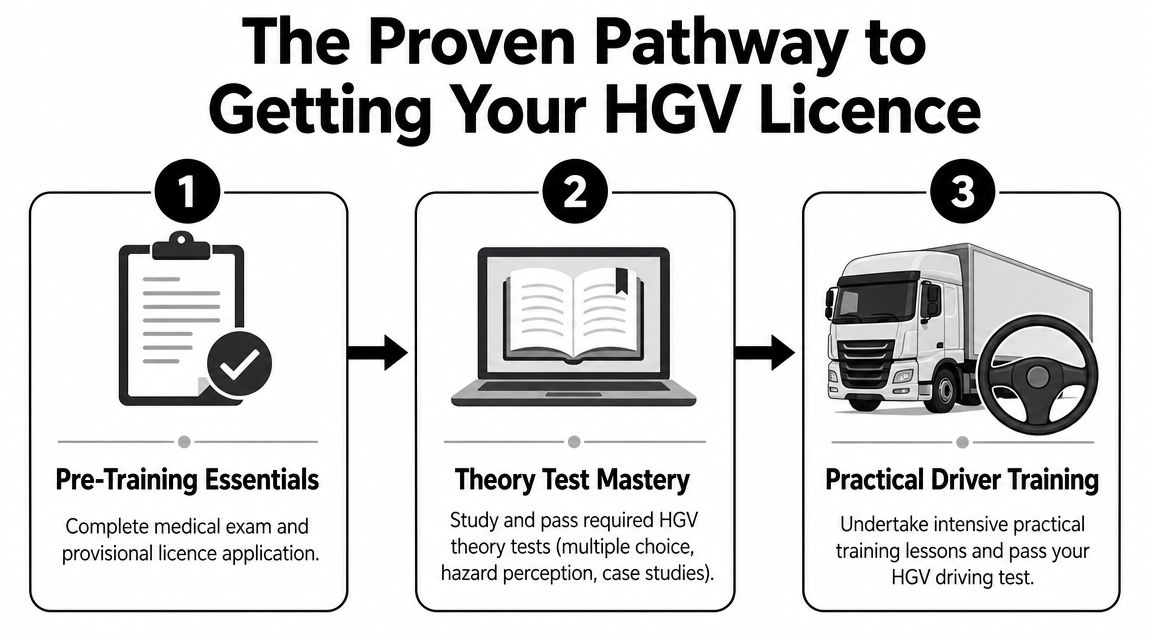
The Proven Pathway to Getting Your HGV Licence
Having a clear understanding of the sequence often brings reassurance. In Exeter, the licensing route still follows the national process: you must hold a full Category B licence, be at least 18, complete a driver medical, submit the D2 and D4 forms to the DVLA, and pass the theory, hazard perception, off-road Module 3a, and on-road Module 3b tests before driving professionally. For paid work, the CPC modules are then added, including Module 2 case studies and Module 4 practical demonstration.
That sounds like a lot when it's written in one sentence. In real life, it breaks down into three manageable stages.
Stage one pre-training essentials
This is the admin stage. It matters because nothing else moves properly until it's done.
You need a driver medical first. The doctor completes the medical report, which is part of your application. You then submit the D2 and D4 forms so the DVLA can add the right provisional entitlement.
At this point, new learners often rush. Don't. Names, addresses, licence details, and signatures need to be right. One small mistake can slow the process and leave you waiting longer than necessary.
Stage two theory test mastery
Before practical training, you need to pass the theory side. That includes the multiple-choice theory test and hazard perception. If you're driving professionally, you'll also deal with CPC Module 2 case studies.
A good theory plan is simple:
Study in short sessions: Daily revision sticks better than cramming.
Use realistic practice materials: You need to get used to the question style.
Treat hazard perception seriously: Some learners focus only on the multiple-choice side and get caught out here.
Here's a useful video that shows the training journey in a visual way:
Stage three practical driver training
This is the part commonly imagined when thinking about HGV training in Exeter. You get into the vehicle, train with an instructor, practise the manoeuvres, build road confidence, and prepare for test day.
The practical route includes:
Module 3a: Off-road exercises such as reversing and controlled manoeuvres
Module 3b: On-road driving assessment
Module 4: Practical CPC demonstration for those driving for work
Learners often fear the practical test most, but confidence usually rises once they understand what's being assessed. Examiners want safe, controlled, professional driving, not flashy driving.
The key is to treat each stage as one job at a time. First the forms. Then theory. Then practical training. When you approach it that way, the pathway feels much more achievable.
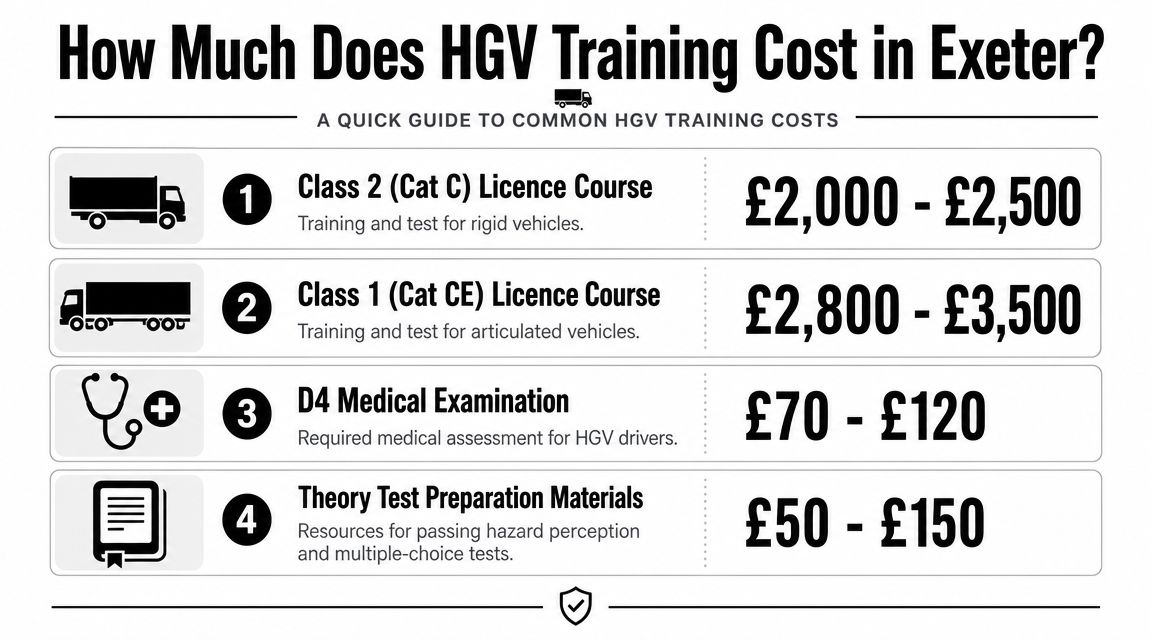
How Much Does HGV Training Cost in Exeter
This is usually the question people ask first, even if unspoken. They don't just want the course price. They want the full picture from medical to test day and, if needed, to a retest.
A lot of Exeter training pages say training is affordable, but they don't always explain what that means in practice. That creates confusion for career changers, lower-income applicants, and anyone trying to compare providers properly.
What the total cost picture really includes
The full cost isn't always one single invoice. Depending on the provider, you may be looking at a package plus separate admin and test-related items.
Typical cost areas include:
Medical and provisional stage: The medical happens early and may be packaged in or charged separately.
Theory preparation: Some providers include learning materials. Others don't.
Practical training and test booking: This is usually the largest part of the spend.
CPC elements: If you're driving professionally, you need to know whether CPC support is built into the package.
Retests or extra training: These are the items that catch people out if they haven't budgeted for them.
Cost check: Always ask, "What would I pay if I need extra practice or another test?" That's often where the real difference between providers shows up.
If you're comparing funding routes, this guide to funding for HGV training is a useful starting point.
The funding route many Exeter learners should check first
For many people in England, the most important funding option is the Skills Bootcamp route. According to the official Skills Bootcamps for HGV driving guidance, these programmes are free and last up to 16 weeks. The same guidance says they cover all costs for the provisional licence medical exam plus each of the 4 Driver CPC tests and one re-sit per test. The scheme is open to people aged 19 or older with a full car licence.
That can remove a major barrier for new entrants. It means some learners in Exeter may be able to access training without paying separately for core medical and CPC testing stages.
Where people still get caught out
Free funding doesn't automatically mean everyone qualifies. Eligibility matters, and your route may differ depending on your current work status and licence goal.
So ask these questions before you commit:
Am I eligible for funded training right now
Does this route cover my exact licence category
What's included in the package and what's outside it
If I need a retest, who pays
Will the provider explain the out-of-pocket costs clearly before I book
Some learners also choose a private route because they want a faster or more flexible schedule. That's a valid choice, but only if you've seen the total financial picture clearly first.
How to Choose the Best Exeter HGV Training Provider
You ring two Exeter training providers on the same afternoon. One gives you a low headline price but stays vague about retests, theory support, and who books what. The other talks you through the process from medical to test day, explains what happens if you need extra hours, and tells you how training fits around Exeter roads, the M5, and local industrial routes. That difference matters long before you sit in the cab.
Choosing a provider is a bit like choosing the person who will teach you to swim in deep water. Price matters, but clarity, structure, and calm instruction matter more. A good school helps you build skill in the right order, so you are not paying twice for confusion that could have been avoided at the start.
What to check before you book
Start with the full training package, not the sales pitch. Ask the provider to break the route into stages and explain exactly who handles each one. If they cannot explain the process clearly on the phone, that usually shows up later in missed details and avoidable delays.
Focus on these points:
Instructor experience: Ask who will coach you on the practical course and whether they regularly train new entrants, not just licence upgrades.
Vehicle match: Check that the vehicle suits the licence category you want and the kind of work you hope to do after passing.
Test administration: Find out whether they book tests, help with paperwork, and guide you through each step, or whether you must organise parts yourself.
Local route knowledge: Exeter training should prepare you for roundabouts, dual carriageways, tighter urban sections, and the kind of road layouts you are likely to meet in training and test conditions.
Cost transparency: Ask what is included in the quote, what triggers extra charges, and how retests or additional hours are priced.
That last point catches out a lot of new applicants. A low quote can rise quickly if the package leaves out theory materials, vehicle hire for test day, or extra tuition after an unsuccessful attempt.
Questions worth asking on the phone
A short call tells you a lot about how a provider works. You are listening for plain answers, patience, and a willingness to explain the steps without rushing you.
Ask questions like these:
What is included in the quoted price
Who books the theory, practical, and CPC parts if I need them
What happens if I need extra training before test day
Will I train one to one or share time with another learner
How far ahead are practical training dates being booked
What support do you give after I pass if I want help finding work
That last question matters because your goal is not just a pass certificate. It is a first driving job. Some learners also look at job platforms that offer an efficient job search experience once they are ready to start applying.
One option some learners consider is HGV Learning, which coordinates training through a three-stage pathway covering medical and documentation support, theory preparation, and locally arranged practical training and test dates. That setup can suit people who want one point of contact rather than managing each stage separately.
A good provider teaches the test standard and explains what professional driving looks like after the test.
What a strong provider feels like
You should finish the first conversation with a clearer picture of your route, your likely timescale, and your total spend. Good providers do not hide behind general promises. They explain the likely sequence, set realistic expectations about training intensity, and answer direct questions about delays, retests, and extra costs.
Look for calm honesty.
If a provider explains things in a way that makes the whole process feel manageable, that is a strong sign. New applicants in Exeter usually do best with providers who treat the licence process like a step-by-step build, not a quick sale.
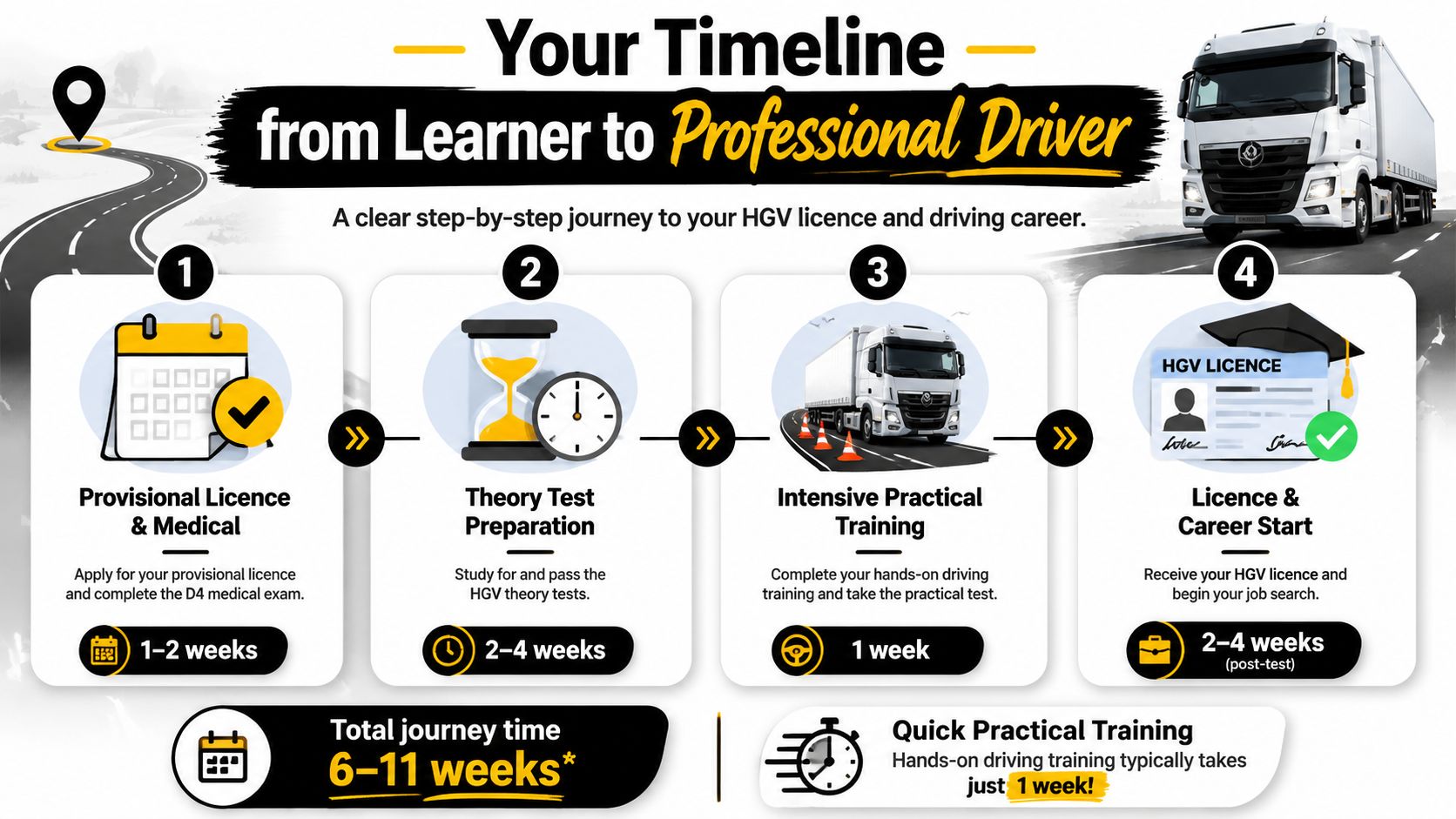
Your Timeline from Learner to Professional Driver
Many applicants often get the wrong impression. They hear that practical HGV training is short and assume the whole process will be over in a few days. The practical part can be quick. The full qualification journey usually isn't.
According to this HGV driver training overview, provider-led programmes are commonly delivered in 3–8 days for the driving element, but the end-to-end process can take 6–8 weeks when DVLA entitlement processing, theory revision, and test scheduling are included.
What that timeline looks like in real life
The first stage is usually admin. You sort your medical and provisional paperwork and wait for the entitlement to be processed.
Then comes theory preparation. Some learners move through it quickly because they study consistently. Others need a little longer, especially if they've been away from tests for years.
The practical training itself is often the shortest part. It's focused, intensive, and designed to prepare you for the test standard. But even after the training dates are set, test availability can affect the overall pace.
Planning around work and family
Being realistic helps. Don't only ask, "How long is the course?" Ask, "How long until I can apply for jobs confidently?"
A sensible plan often includes:
Time for revision: Theory is easier when you build regular study into your week.
Time for flexibility: Test dates and admin steps don't always line up perfectly with your personal schedule.
Time after passing: You may need a short period to update your CV, speak to recruiters, and choose the kind of driving work you want first.
If you're moving straight into applications, tools that make job hunting simpler can help. A platform with an efficient job search experience can be useful when you want to browse roles without making the search feel like a second full-time job.
The fastest practical course isn't always the fastest route into work. The full timeline depends on paperwork, test booking, and how prepared you are at each stage.
After the licence comes the job
A first driving job doesn't have to be your final destination. Many drivers start with general work, build confidence, then add specialist qualifications later. Depending on your path, you might eventually look at areas such as ADR, HIAB, or telehandler training to widen the type of roles you can apply for.
That's why I encourage new learners to think beyond the pass certificate. Your licence gets you through the door. Your professionalism, reliability, and continued training build the career after that.
Common Questions About HGV Training in Exeter
A few questions come up in almost every first conversation. If you're researching HGV training in Exeter, these are usually the sticking points.
Can I go straight to C+E
In practice, many learners ask this because they want the broadest licence and the best job options. Whether that route is right for you depends on your confidence, your training plan, and the provider's advice. Some people benefit from starting with a rigid vehicle route first. Others are aiming clearly at articulated work from the outset and want training built around that goal.
The important thing is to choose a route that matches your ability and job target, not just your ambition.
What is Driver CPC and do I need it
If you want to drive professionally for work, Driver CPC matters. It's part of the professional qualification route rather than just the driving licence itself.
For new entrants, the key point is simple. Passing the driving test alone isn't the whole picture if your goal is paid work. Make sure the provider explains how the CPC modules fit into your training route.
How many times can I retake my tests
Learners often ask this because they want certainty before spending money. The practical answer is that retests are part of planning, not a sign that you've failed as a driver.
The bigger issue is cost and who covers what. The government has acknowledged that one of the biggest unanswered questions for learners is the full out-of-pocket picture after medicals, theory, and possible retests. The same guidance explains that funding such as Skills Bootcamps can be free, but eligibility is limited to adults aged 19+ who are employed, self-employed, recently unemployed, or returning to work, as set out in the Education Hub guidance on HGV training questions.
What about the medical and eyesight rules
You will need a driver medical before the provisional application goes through. If you already know you have a medical condition or eyesight concern, raise it early rather than hoping it won't matter. That doesn't mean you can't train. It means you need proper guidance before you spend money and time.
What's the smartest first step
If you're serious, start by confirming three things:
Your target licence category
Your likely funding route
Your availability for theory study and practical dates
Once those are clear, the path becomes much easier to manage.
If you're ready to turn interest into a proper plan, HGV Learning can help you organise the route from medical and theory through to practical training and test booking, with guidance that keeps the process clear and manageable.