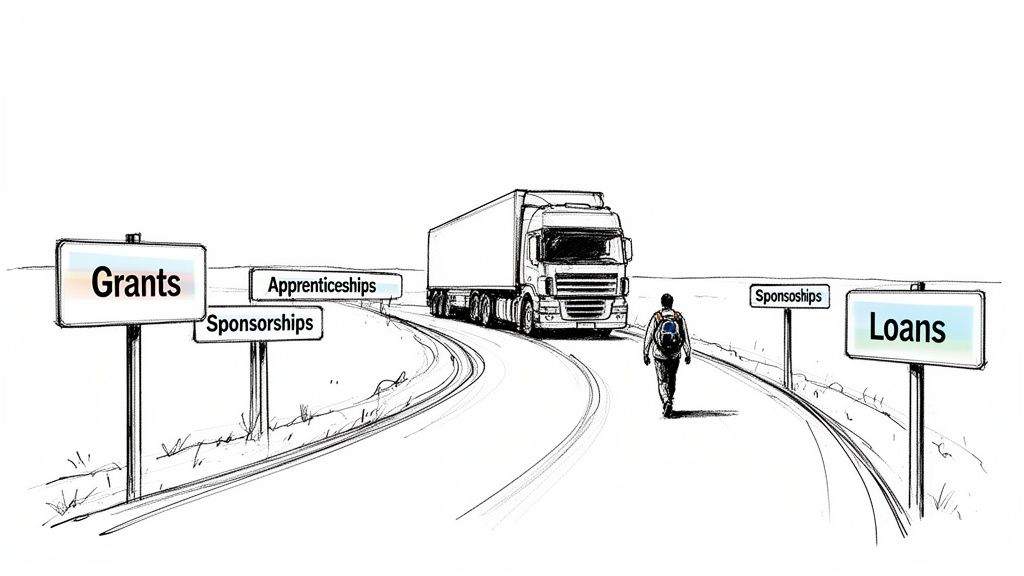
The cost of professional HGV training can seem a bit steep at first glance, but thankfully, there are plenty of funding for HGV training options out there in the UK. From government schemes like Skills Bootcamps to apprenticeships and employer sponsorships, you can get your licence without having to pay the full whack upfront. This guide is your roadmap to navigating these financial routes.
Starting Your HGV Career Without the Financial Roadblocks
The idea of paying for HGV training can feel like a major hurdle, stopping a lot of great people from even considering a career in logistics. The good news is, you do not have to go it alone. There are real-world funding options available right here in the UK, all designed to get you behind the wheel without that immediate financial pressure.
With a huge demand for qualified drivers across the country, both the government and private companies are actively investing in new talent. This means there has never been a better time to look into a career as a professional driver. Think of this article as your personal guide, showing you exactly how to tackle the costs and find a path that works for you.
Why Is Funding So Widely Available?
Put simply, the UK logistics industry relies on a steady stream of qualified drivers to keep the country moving. A few years back, a combination of factors led to a significant driver shortage, which called for some decisive action.
In a major push to fix this, the government invested a massive £34 million back in 2021 to launch Skills Bootcamps specifically for HGV driving. This funding created opportunities to train just over 11,000 new drivers, hitting the workforce gap head-on.
This investment highlights a really key point: getting new drivers trained and on the road is a national priority. For you, this opens up several doors, including:
Government-funded programmes designed for quick training and getting you into a job.
Company sponsorships where businesses cover your costs in return for your commitment.
Apprenticeships that let you earn a wage while you learn the trade on the job.
These routes make becoming an HGV driver more accessible than it has ever been. Whether you’re starting a new career or changing direction, the financial support is there. You can also explore our guide on finding local HGV driver training near you to see what is available in your area. Let’s get you on the road to a rewarding and secure new career.
How Government Grants and Schemes Can Fund Your Licence
For a lot of people eager to get behind the wheel for a living, government funding is the most straightforward and attractive way to get started. These schemes are built to get new drivers qualified and into jobs fast, tackling the industry’s need for skilled professionals head-on.
Think of it as a national investment in the UK’s supply chain, and you’re the person they want to back.
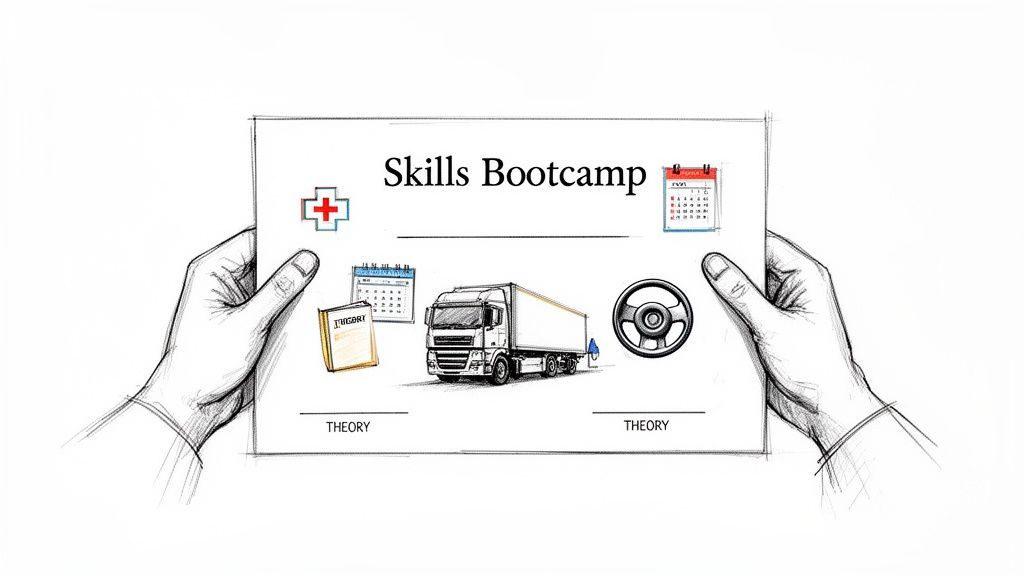
The most popular of these schemes are the Skills Bootcamps. These are short, intense, and free training courses designed to take you from zero HGV experience to fully licensed in as little as 16 weeks. They are a fantastic way to fast-track your new career without worrying about the cost.
It is an incredibly practical approach. The government partners up with training providers across the country who deliver the whole package, getting you road-ready without any fuss.
What Do Skills Bootcamps Actually Cover?
A government-funded Skills Bootcamp is not just a handful of driving lessons; it is a complete, all-in-one package designed to handle every single step of the licensing process. This takes away many of the headaches you would face trying to organise everything yourself.
Typically, a fully funded place on a Skills Bootcamp will include:
Your Driver Medical: The essential first hurdle to confirm you are medically fit to drive a large goods vehicle.
Provisional Licence Application: All the guidance and support needed to get the correct provisional entitlement on your licence.
Theory Test Training & Booking: Full access to learning materials, with both the multiple-choice and hazard perception tests booked and paid for on your behalf.
Practical Driver Training: A serious number of hours of one-on-one practical instruction in either a Category C (rigid) or Category C+E (articulated) lorry.
Practical Test & CPC: The final practical driving test and the initial Driver Certificate of Professional Competence (CPC) qualification are also completely covered.
The whole point of these bootcamps is to remove every single barrier. By covering all the upfront costs, from medicals to test fees, they make a career in driving a real possibility for a much wider range of people.
On top of all the licence training, these programmes often come with a guaranteed interview with a local employer once you qualify. This creates a clear, direct path from the training yard straight into a paying job, which is exactly what everyone wants.
Who Is Eligible for This Funding?
While the exact rules can change a little depending on where you are, the general eligibility criteria for government funding are pretty simple. This helps make sure the support gets to the people who will benefit from it the most.
You will generally need to be:
Aged 19 or over.
A resident of England.
Either unemployed, self-employed, or looking to change careers.
It is worth noting that these schemes are not just for the unemployed. Even if you are in a job right now but want to move into logistics, you can often still qualify for a fully funded or heavily subsidised spot. The main goal is to get new drivers into the industry.
The government has shown a real commitment to growing the driver workforce. For instance, alongside bootcamps, dedicated funding for Large Goods Vehicle Driver apprenticeships was launched in August 2021, providing up to £7,000 per trainee. To give recruitment an extra push, employers who hired apprentices before January 2022 even received a £3,000 incentive. This was followed by the Urban Driver apprenticeship for Category C vehicles, offering up to £5,000 in funding. You can read more about the government’s response to the HGV driver shortage for all the details.
How to Find and Apply for Local Schemes
One of the biggest changes recently is how this funding is managed. Instead of one single, central system, the power has been handed to local and regional authorities. This means the schemes available and the way you apply can be different depending on where you live.
This localised approach helps direct funding where it is needed most, but it does mean you will need to do a bit of digging for your specific area.
Here is how you can find programmes near you:
Check Your Local Council Website: Many councils and combined authorities have dedicated ‘skills’ or ’employment’ sections on their websites where they advertise these opportunities.
Contact Local Jobcentre Plus Offices: They are usually the first to know about government-backed training and can give you solid advice on eligibility and applications.
Search for “Skills Bootcamps” Online: A quick search for “HGV Skills Bootcamp [your town/city]” will usually bring up local training providers that have won government contracts.
When you apply, be ready to show your passion and commitment to a career in driving. The providers are looking for candidates who are serious about seeing it through and landing a job at the end. A well-thought-out application can make all the difference in securing one of these incredibly valuable funded places.
The Apprenticeship Pathway: Earning While You Learn
What if you could start your HGV career getting paid from day one, learning from seasoned professionals on the job, and walking away with a full HGV licence without spending a single penny on training? It sounds too good to be true, but that is exactly what an HGV apprenticeship delivers. This is the ultimate debt-free route for anyone ready to commit to a company and build their career from the ground up.
An apprenticeship is not just a training course; it is a proper job with a contract of employment. You are an employee who is learning, not a student who works on the side. This means you will earn a wage, get holiday pay, and become a genuine part of a team, all while your training costs are covered by your employer and the government.
What Does an HGV Apprenticeship Involve?
Think of an HGV apprenticeship as a carefully structured mix of practical, hands-on work and formal learning. Over a period of about 12-15 months, you will work towards a nationally recognised qualification, which is usually the Level 2 LGV Driver apprenticeship standard. This qualification proves you have the skills and knowledge to be a safe, professional, and efficient HGV driver.
The whole journey is designed to build your skills progressively. You will not be tossed the keys to a 44-tonne lorry on your first day. Instead, you’ll start with foundational tasks, gradually taking on more responsibility as your competence and confidence grow.
Your time will be divided between a few key activities:
On-the-Job Training: This is where the real learning happens. You will be paired with experienced drivers and mentors, getting to grips with the day-to-day realities of the job—from vehicle checks and route planning to dealing with customers.
Classroom Learning: You will also have dedicated “off-the-job” learning time. This is where you cover the theory, like driving regulations, tachograph rules, health and safety, and the principles of fuel-efficient driving.
Licence Acquisition: The heart of the apprenticeship is getting you fully licensed. The programme includes every step, from the medical and theory tests to the practical training and final driving test for your Category C or C+E licence.
An apprenticeship is a two-way street. The employer invests a lot of time and money in your development. In return, they’re looking for a dedicated person who wants to grow with the company and become a valuable, long-term member of the team.
Finding and Applying for an Apprenticeship
Getting an apprenticeship requires a bit of hustle, as you are applying for a job, not just a course. Companies want to see candidates who show genuine enthusiasm and a solid work ethic.
Here is where you can start your search:
The Government’s “Find an apprenticeship” service: This is the official and most comprehensive place to find approved apprenticeships across England.
Major logistics company websites: Big haulage firms and supermarket chains often advertise their driver apprenticeship schemes directly on their careers pages.
Local job boards and recruitment agencies: Keep an eye out for roles advertised as ‘Trainee HGV Driver’ or ‘Apprentice LGV Driver’.
When you apply, your CV and cover letter need to stand out. Employers are not necessarily looking for previous driving experience. What they really want to see is reliability, a can-do attitude, and a clear desire to build a career in logistics. Highlighting skills like good timekeeping, problem-solving, and a commitment to safety can make all the difference. For more advice on getting started, check out our guide on how to become a trainee HGV driver.
This earn-while-you-learn model is an excellent form of funding for HGV training because it completely removes any financial barriers. It is a fantastic option for anyone ready to dive headfirst into the world of work and build a solid foundation for a long and successful career on the road.
Getting an Employer to Sponsor Your Training
While government schemes are a great place to start, one of the most direct ways to get your funding for HGV training is straight from the businesses that need drivers the most. Many logistics companies are so eager to find reliable, long-term staff that they will pay for your entire training process from start to finish.
This is not just an act of charity; it is a shrewd business move. By investing in you, a company gets a qualified driver who already knows their operations and fits into their culture. In an industry crying out for skilled drivers, growing their own talent is often a far better strategy than constantly recruiting.
For you, it is a brilliant deal: a direct, cost-free path to your licence and a guaranteed job waiting for you. It is a powerful way to kick-start your career with the security of an established employer behind you.
Finding Your Sponsored Training Opportunity
So, how do you find these golden tickets? Employer-funded training usually comes in one of two flavours. Knowing the difference will help you focus your search.
First up is the Trainee Driver role. These jobs are advertised specifically for people who do not have an HGV licence yet. You get hired, and your first task is to get qualified. Once you have passed your tests, you transition smoothly into a full-time driving role with the company.
The second route is through internal progression. This means joining a company in a different capacity—maybe as a warehouse operative, forklift driver, or driver’s mate—and proving you are a reliable team player. Many large firms run internal schemes to help their best people get their HGV licence as a promotion.
To track down these opportunities, you need to be a bit savvy:
Job Search Keywords: Use specific phrases like “trainee HGV driver,” “driver development programme,” or “warehouse to wheels” on job boards.
Company Career Pages: Head straight to the source. Check the websites of big supermarkets, haulage firms, and logistics giants, as they often advertise these schemes directly.
Direct Approach: Do not be afraid to reach out to local transport companies. A polite email or call expressing your keenness to become a driver and asking about training can sometimes open doors you did not know were there.
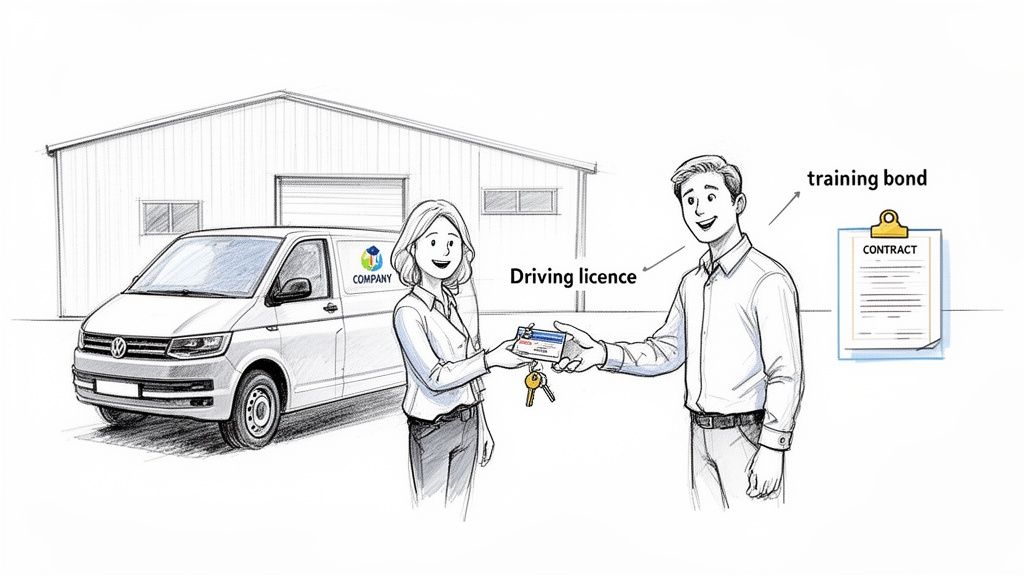
What Is a Training Bond?
When a company spends several thousand pounds on your training, they understandably want to know you will stick around long enough for them to see a return on their investment. That is where a training bond (or training agreement) comes in.
Think of it as a safety net for the employer. In short, it is a contract where you agree to stay with the company for a set period after you qualify—usually between 12 and 24 months.
If you stay for the agreed period, you will not have to pay back a single penny for your training. If you decide to leave before the contract is up, you will typically be asked to repay a portion of the training costs. This amount usually reduces the longer you stay.
This is a completely standard and fair practice in the logistics world. It protects the company’s investment and makes sure they benefit from the skilled driver they have helped create. Just make sure you read the terms carefully so you know exactly what you are signing up for.
Making Yourself the Ideal Candidate
To land one of these sponsored positions, you need to show an employer that you are a solid, low-risk investment. They are not just looking for someone who can pass a test; they want a professional, reliable, and safe employee for the long haul.
Your CV and interview are your chance to prove you are that person. Focus on showcasing qualities that make a great driver, even if your experience is not in logistics.
Reliability: Highlight excellent attendance and timekeeping from previous jobs.
Strong Work Ethic: Give examples of times you have gone the extra mile or taken on more responsibility.
Commitment to Safety: If any of your past roles involved health and safety protocols, make sure you mention it.
Enthusiasm for the Industry: Show you have done your homework and are serious about building a long-term career as a driver.
By presenting yourself as a future professional, not just someone after a free licence, you massively boost your chances of getting that “yes.” This is a fantastic opportunity, offering a secure job and a clear career path right from day one.
Using Loans and Payment Plans to Invest in Yourself
If government schemes, apprenticeships, or sponsorships do not quite fit your circumstances, do not write it off. Taking control of your own funding is a powerful way to invest in your future, giving you complete freedom over your career path without being tied to a specific employer from the start.
Think of it less as a cost and more as a direct investment in your earning potential. The most common ways to do this are through an Advanced Learner Loan or by using a payment plan offered by your training provider. Both are fantastic tools for breaking down the initial expense into smaller, more manageable chunks.
The Advanced Learner Loan Explained
An Advanced Learner Loan is a government-backed loan specifically created to help people aged 19 and over pay for approved technical and vocational qualifications. For HGV training, this usually applies to courses that result in a formal qualification, like a Level 3 Diploma.
It works a lot like a student loan for university. You will not have to pay a penny upfront, and you only start making repayments once you’re employed and earning above a certain salary. This completely removes the immediate financial pressure, letting you focus on what is important: your training.
The key benefits are pretty clear:
No Upfront Costs: The loan covers your course fees directly, so you do not need savings to get started.
Income-Based Repayments: You only pay it back when you can afford to, with payments automatically taken from your salary.
Not Credit Score Dependant: Your household income and credit history do not affect whether you are eligible.
This loan is all about opening up opportunities. It is a practical financial tool that allows you to gain valuable qualifications now and pay for them later, once your new career is providing a solid income.
While the way some schemes are funded has shifted, the government’s commitment to skills training is still strong. The Department for Education has set aside a massive £233,168,727 for the next financial year to support local initiatives like Skills Bootcamps. This shows a sustained, if more localised, focus on getting people into high-demand roles like HGV driving. You can discover more about the 2025 to 2026 Skills Bootcamps funding allocations on GOV.UK.
Flexible Payment Plans
Another hugely popular option for funding HGV training is an in-house payment plan. Many top training providers, including us here at HGV Learning, offer these to help you spread the cost of your licence over several months. This completely avoids the need for a big one-off payment, making the whole thing much more affordable.
Instead of paying for everything in one go, you will typically pay an initial deposit and then split the rest into equal monthly instalments. These plans are often interest-free, making them a very straightforward and attractive way to manage your budget.
This approach puts you firmly in the driver’s seat. You are not taking on a formal loan; you are simply agreeing to a payment schedule directly with the people training you. It is a simple, transparent, and effective way to get on the road.
If you are considering this path, you might want to break down the numbers further. Take a look at our guide on the cost of HGV Class 1 training to get a clearer picture of the investment. By choosing a payment plan, you make this investment manageable, letting you focus on what really matters—passing your tests and starting your new career.
Your Roadmap to a Funded HGV Career
Working out the best way to fund your HGV training can feel like a maze, but remember that every path leads to the same place: a brilliant career on the road. Do not let financial worries be the roadblock that stops you from getting started. We have walked through the main routes available, and there is an option to suit everyone’s circumstances.
Government-backed Skills Bootcamps, paid apprenticeships, and direct company sponsorships are fantastic ways to get your licence without paying out of pocket. These are perfect if you are happy to jump into a structured programme or commit to a specific employer from the get-go, giving you a clear, supported journey into the industry.
Choosing Your Best Path
On the flip side, maybe you value your independence and want more flexibility. If that is you, self-funding with an Advanced Learner Loan or an in-house payment plan puts you firmly in the driver’s seat. These options let you qualify on your own schedule and give you the freedom to pick your employer once you have got your licence.
The right choice is all about what works for you. Think about how quickly you want to get qualified, what your financial situation looks like right now, and whether you prefer the security of a guaranteed job or the freedom to shop around.
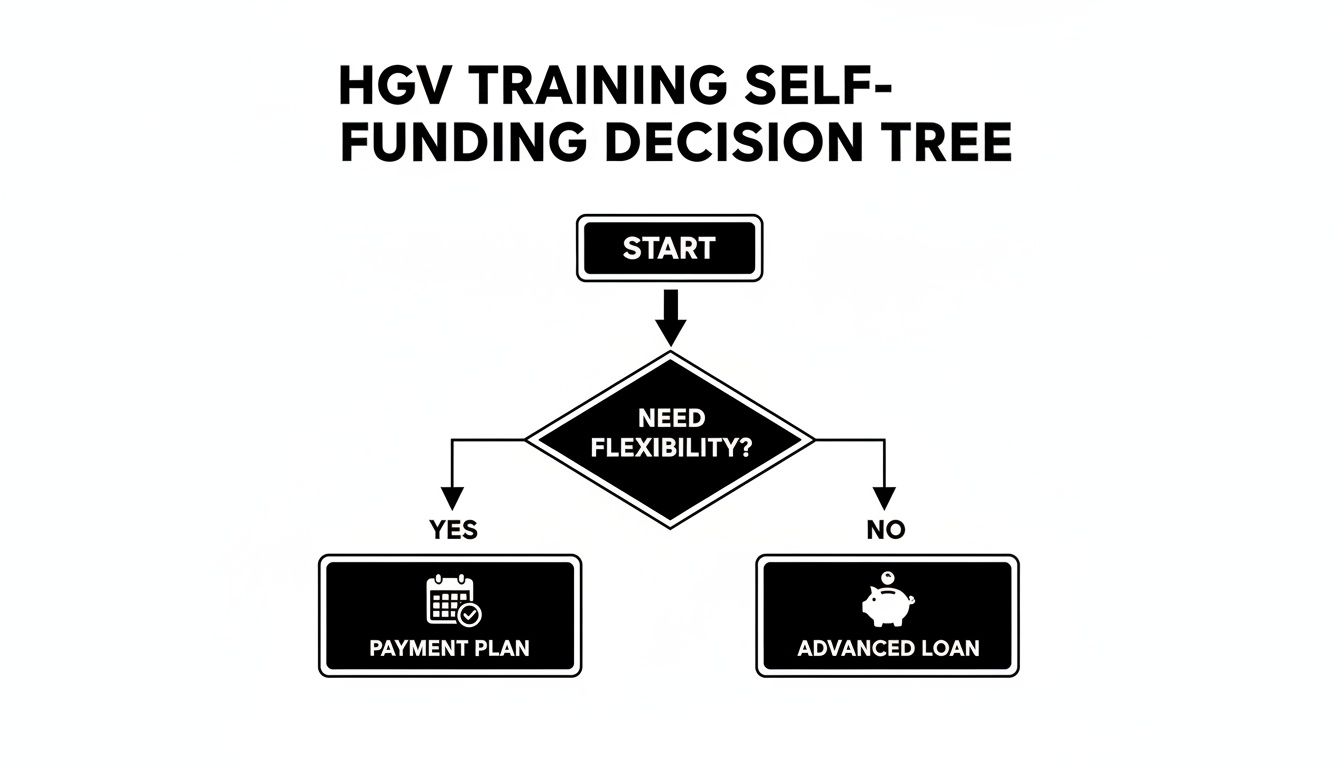
If you are leaning towards self-funding, this decision tree can help you visualise the choice.
As the graphic shows, it is quite straightforward. Payment plans are great for those needing flexibility, whereas loans are ideal if you are ready to commit to a formal qualification.
Once you’re trained and out on the road, things like maintaining compliant Driver Qualification Files will become a key part of your professional life, but that all comes later. The very first step is getting that licence.
No matter which route you think is right for you, our team is here to chat it through. We can give you personalised advice to match your goals with the perfect funding solution. Why not take that first step today? Get in touch and let’s get you started.
Frequently Asked Questions About HGV Training Funds
Figuring out the money side of HGV training can throw up a lot of questions. It is completely normal. Here, we have tackled some of the most common queries we hear, giving you clear, straightforward answers to help you get on the road.
Can I Get Funding If I Am Currently Employed?
Yes, absolutely. While it is true some government schemes like Skills Bootcamps often give priority to people who are out of work, they are also designed for career-changers.
On top of that, employer sponsorships and apprenticeships are specifically for those in employment, and in-house payment plans are open to pretty much everyone.
How Long Does It Take to Get Funding Approved?
This really varies and depends entirely on the path you take. There is no single timeline.
Skills Bootcamps: These can be surprisingly quick. Approval often comes through in just a few weeks because the providers are eager to fill their spots.
Apprenticeships: Think of this like any other job application. It involves interviews and the usual company hiring process, so it naturally takes a bit longer.
Advanced Learner Loan: Once you have got a confirmed place on a course, the loan application itself is usually processed within a few weeks.
Payment Plans: These are almost always sorted on the spot by the training provider.
Is There an Age Limit for HGV Training Funding?
For the most part, no. The majority of funding options are available to anyone aged 19 or over. There is a common myth that apprenticeships are just for school leavers, but they are now incredibly popular with people of all ages looking for a new challenge.
The main hurdles are not age-related; they are about having a full UK car driving licence and being able to pass the HGV medical assessment.
A common misconception is that HGV funding is only for young people. In reality, the logistics industry actively seeks mature, reliable candidates, and funding routes are structured to support a diverse range of applicants.
Do I Have to Pay Anything Back?
It all comes down to which funding option you go for. With a Skills Bootcamp or most apprenticeships, the training is completely free to you. You will not have to pay a penny back.
If you opt for an Advanced Learner Loan, it works just like a student loan. Therefore, you only start repaying it once your earnings go above a certain threshold. With a company sponsorship, the only time you would pay anything back is if you leave the company before your training bond agreement is up.
What if I Have a Poor Credit History?
Do not let a poor credit history put you off. It is simply not a barrier for most funding for HGV training routes.
Government-backed options like Skills Bootcamps and Advanced Learner Loans do not run credit checks. Likewise, when it comes to apprenticeships and direct employer sponsorships, they are interested in your potential as an employee, not your financial history.
Ready to map out your own journey to becoming a professional driver? The team at HGV Learning is here to provide expert, no-obligation advice on all the funding options available to you. Visit us at https://hgvlearning.com to explore our courses and start the conversation.
Related Articles
09/03/2026
UK CPC Course Cost: A Complete 2026 Pricing Guide
When you're looking to get on the road professionally, one of the first questions on your mind is bound to be about the cost. In...