If you’re already driving in West Yorkshire, or you’re trying to move into building supplies, utilities, plant hire, or site delivery work, you’ve probably seen the same pattern. The better local jobs often ask for more than a standard lorry licence. They want someone who can arrive, unload safely, and get the vehicle turned round without waiting for a second crew.
That’s where HIAB training starts to matter. It isn’t just another ticket to collect. It changes the type of work you can take on and the amount of responsibility you’re trusted with from day one.
A HIAB is the crane mounted on a lorry. In formal training language, you’ll also hear it called a Vehicle Mounted Hydraulic Lorry Loader, or VMHLL. In practical terms, it’s the equipment that lets a driver move loads such as pallets of bricks, building materials, site equipment, and other awkward deliveries safely from the vehicle to the drop point.
The process is more straightforward than many people expect, but there are a few details that catch people out. The biggest ones are choosing the right attachment training, understanding whether you’re booking as a novice or experienced operator, and planning ahead for renewal so your qualification doesn’t lapse later.
Why HIAB Skills Are in Demand in West Yorkshire
A typical West Yorkshire shift can change quickly. Morning might start with a builders’ merchant delivery into Leeds, then turn into a tight-access drop in Bradford or a site unload in Wakefield where the load needs placing accurately, not just getting off the truck. Operators who can drive, assess the lift, and complete the unload safely are the ones employers keep asking for.
What the job really looks like
The demand is not only about having a crane ticket. In day-to-day work, firms need someone who can turn up and make sensible decisions under site pressure. That includes reading the drop point properly, checking for overhead hazards, judging whether the ground will take the operation, and choosing a lifting method that matches both the load and the attachment fitted.
That last point gets missed in a lot of guides. In West Yorkshire, the type of work varies enough that attachment choice matters. A hook is common for straightforward lifts, but grab and clamshell work can suit different materials and job types. If your target roles include mixed delivery or merchant work, it is worth thinking ahead about whether one attachment will cover your likely jobs, or whether broader training will make you more useful to an employer.
Employers usually look for operators who can:
Assess the delivery area: spot space limits, traffic movement, pedestrians, and unstable ground.
Use the right attachment: match the lift to the material, not force one method onto every job.
Protect the schedule: complete the unload efficiently without cutting corners.
Work without close supervision: make safe decisions on site and keep the job moving.
Why the qualification matters
Recognised HIAB training gives employers more confidence than an informal yard handover. Firms want an operator trained to accepted safety standards for vehicle-mounted hydraulic lorry loaders, especially where the driver is expected to unload independently on customer sites.
In practical terms, that makes a difference at hiring stage. A candidate who can show proper training is easier to place into builders’ merchants, utility support, plant movement, and site delivery work across the region.
There is also a longer-term reason demand stays steady. HIAB training is not a one-off box to tick for life. Certificates need renewing on a 5-year cycle, so operators who plan ahead tend to stay employable and avoid last-minute gaps in qualification. I always tell people to view HIAB training as part of a working career, not just a short course.
For many people looking for HIAB training West Yorkshire, the goal is simple. Get into better-paid delivery work, take on more responsibility, and stay useful in a market that values drivers who can do the full job.
Checking Your Eligibility for HIAB Training
Before you compare courses, check the basics. This saves time and avoids booking a course that doesn’t match your current licence or work situation.
Often, the first question isn’t about the crane at all. It’s whether one is already entitled to drive the vehicle the crane sits on.
Your basic checklist
Use this as a quick self-check before you book anything:
HGV licence position: You’ll typically need the correct vehicle entitlement, often Category C, to drive the rigid lorry carrying the crane.
Age: You’ll usually need to be at least 18.
Medical fitness: You should be fit to meet the standard expected for vocational driving.
Work type: Think about the loads you expect to move. That affects the attachment you should train on.
Experience level: Be honest about whether you’re a true novice or an operator with current, usable experience.
The mistake I see most often is people focusing on the crane first and the vehicle entitlement second. In real work, both matter.
What catches people out
A HIAB certificate doesn’t replace the need for the right driving licence. If you’re planning to drive the lorry as well as operate the crane, your licence entitlement has to match the vehicle. That sounds obvious, but it’s one of the most common misunderstandings.
Medical fitness matters for the same reason. HIAB work isn’t just seated driving. You’re checking equipment, watching the lift, controlling the load, and making safety decisions under pressure. If you’re already on the HGV route, the standards will feel familiar.
If you’re unsure whether you’re eligible, sort that out before you pay for attachments, dates, or travel. A ten-minute check now is better than a cancelled booking later.
A sensible way to decide if you’re ready
Ask yourself three plain questions:
Can I legally drive the vehicle involved?
Am I physically fit for vocational vehicle work and site activity?
Do I know what kind of HIAB work I want afterwards?
If the answer to all three is yes, you’re usually in a good position to move forward. If one answer is unclear, fix that first. It makes the rest of the process much easier.
Choosing the Right HIAB Course and Accreditation
A common West Yorkshire booking goes like this. Someone rings up asking for “a HIAB course,” however, the job they want involves a brick grab, the employer expects ALLMI, and the operator also needs to think about renewal five years down the line. The course is not just about getting a pass. It needs to fit the work you want next and the certificate you will still need to keep current later.
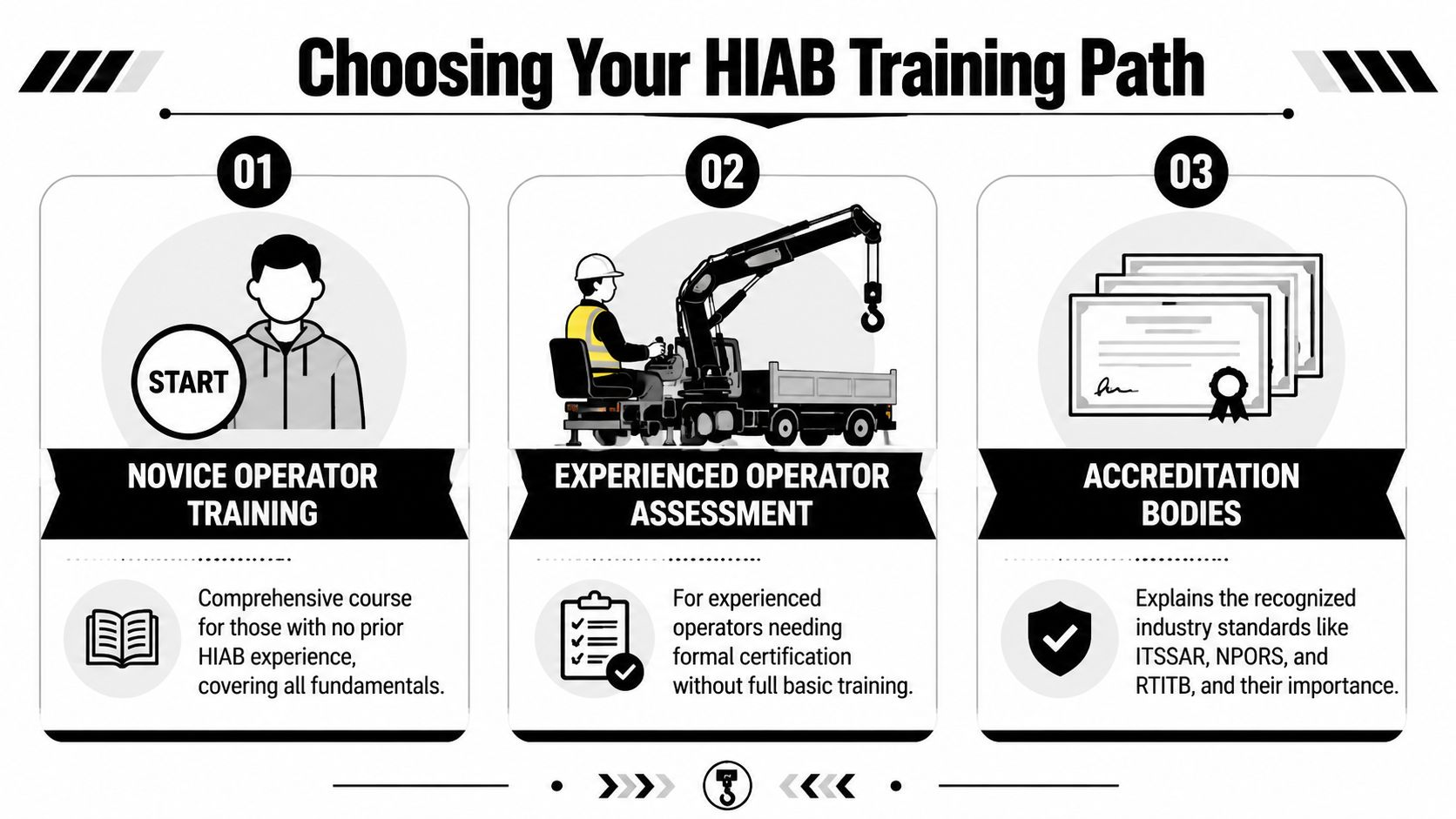
The first decision is your entry point. New operators should book novice training. Operators with solid, recent crane experience who need formal assessment or refresher-level recognition may suit the experienced route better. Getting that wrong wastes time and usually costs more than doing it properly from the start.
Accreditation matters for the same reason. In day-to-day hiring, ALLMI is the name employers ask for most often because it is widely recognised for lorry loader operator training. If a vacancy, agency, or builders’ merchant specifies an accredited card, check that before you book anything.
Attachment choice decides how useful your ticket will be
This is the part many candidates underestimate. A HIAB qualification is tied to the type of lifting equipment you train and test on, so attachment choice affects what work you can step into confidently.
Common training options include:
Hook: the usual starting point for general lifting and delivery work
Brick grab or brick clamp: common in builders’ merchant and site delivery roles
Clamshell: more specialised, often chosen for operators heading into mixed or less routine lifting tasks
A hook-only course is often the sensible first step if your target job is straightforward delivery work. If you expect to work across merchants, construction supply, and varied site drops, multi-attachment training can be the better investment. It costs more up front and takes more concentration during training, but it can save you from needing another course a few months later.
That trade-off is worth thinking through properly. Some operators want the fastest route to being employable. Others are trying to future-proof their card for a wider range of contracts. Both approaches can be right, but only if they match the jobs available to you in West Yorkshire.
Candidates often compare prices first. I understand why, but format usually has a bigger effect on the result.
A shared course can work well if you are confident, adaptable, and happy learning alongside another operator. One-to-one training gives more seat time, more direct correction, and usually a better pace for anyone who is completely new or adding unfamiliar attachments. Neither is automatically better. The right choice depends on how you learn, how quickly you need to qualify, and whether the attachment work is simple or varied.
The same applies to duration. Novice courses are longer because they need to cover safe setup, operating checks, stability, load handling, and the habits that stop small mistakes becoming dangerous ones. Experienced assessments are shorter because the instructor is confirming existing competence rather than building it from scratch.
Choose for the full career cycle, not just test day
A HIAB card is not a one-time purchase. You will need to renew it after five years, so it helps to choose an accreditation and attachment mix you can realistically maintain. If you train on three attachments but only ever use one, that may not be the best long-term use of your money. If your work is likely to widen, adding extra attachments early can make renewal planning simpler later because your training history already reflects the kind of work you do.
The best course choice is usually the one that fits three things at once. The jobs you want now, the equipment employers use, and the certificate you will still be able to justify renewing in five years.
Your Path to Certification with HGV Learning
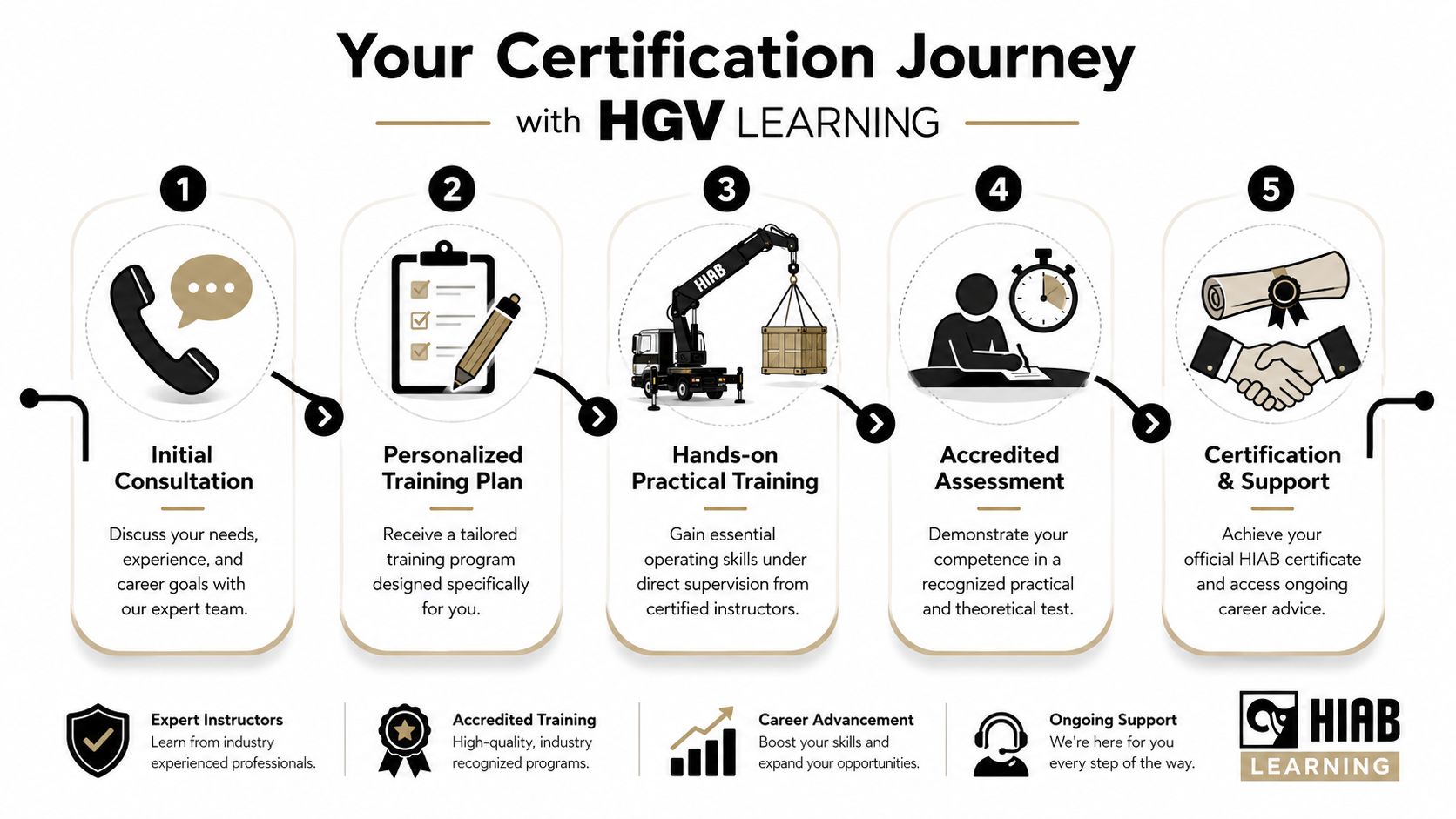
Getting qualified is easier when the process is organised properly. People struggle less with the actual training than with the admin around it. Dates, paperwork, medical steps, theory preparation, and booking the right practical slot are the bits that usually create delays.
In industry terms, the discipline is also known as Vehicle Mounted Hydraulic Lorry Loader, or VMHLL, which is the classification used for operators trained to manoeuvre and use a truck-mounted crane safely in line with commercial vehicle safety expectations. Dulson Training’s HIAB overview uses that terminology and ties it to DVSA-aligned safe operation.
Stage 1 paperwork and planning
The best training journeys start with the boring part done properly. That means checking your current licence position, confirming whether you need novice or experienced operator training, and making sure any medical requirement is dealt with early rather than at the last minute.
At HGV Learning, that first stage is built around support rather than guesswork. The aim is to get your documentation and booking path straight before you spend time preparing for training that doesn’t fit your licence or work goal.
Stage 2 theory preparation
HIAB training isn’t only about pulling levers and moving loads. You need to understand safe lifting principles, hazard awareness, and the reasons behind each operating decision. That’s where structured theory prep helps.
A proper support model includes:
Clear learning materials: so you know what the trainer expects before day one
Progress tracking: so weak areas are spotted early
Simple scheduling: so your theory prep doesn’t drift while you wait for practical dates
Here, many learners gain confidence. Once the technical language starts to make sense, the crane work becomes far less intimidating.
Later in the process, practical guidance helps bring the qualification to life:
Stage 3 practical booking and local delivery
The final stage is arranging practical training at a suitable local venue in or around West Yorkshire with dates that fit your schedule. The biggest advantage here is coordination. Most learners don’t need more complexity. They need a clear date, the right course type, and a trainer who understands the standard expected.
Payment flexibility matters too. HGV Learning offers accessible options, including in-house 10 to 12 month payment plans, which can make specialist training easier to manage alongside work and home costs.
Good coordination doesn’t make the course easier. It removes the avoidable friction around getting onto the right course in the first place.
Inside Your HIAB Practical Training Days
A typical practical day starts in the yard, not in the cab. You arrive, meet the instructor, walk the vehicle, and get clear on the lifting setup before any load leaves the ground. That steady start matters, especially for new operators who have only seen HIAB work from the driver’s seat or from site.
What the day includes
HIAB training typically mixes theory and practical work, often delivered on Thursdays, Fridays, and Saturdays at client premises or site locations. That reflects how many West Yorkshire learners train. Some of the day is spent covering rules, controls, and lift planning. The rest is hands-on work in the yard until the sequence becomes repeatable.
The first practical exercises are usually simple. Pre-use checks come first, then control familiarisation, then basic lifts with close supervision. Good instruction builds habits in the right order. Safe setup, stable lift, controlled movement, safe landing.
The skills that matter on the ground
The operators who pass cleanly are not always the quickest learners. They are usually the ones who stay methodical under pressure and follow the same routine every time.
Core practical skills include:
Pre-use checks: spotting faults, damage, leaks, or missing safety items before work starts
Load assessment: checking the shape, stability, and condition of the load before lifting
Weight judgement: working within the crane’s limits and using the load chart properly
Slinging and attachment setup: choosing the right approach for the lift in front of you
Controlled crane operation: smooth movements, good positioning, and safe stopping points
Site awareness: keeping clearances, ground conditions, and people nearby in view throughout the lift
If you are training on more than one attachment, the day becomes more demanding in a useful way. Hook work, grab work, and clamshell work each require different handling habits. A learner who looks tidy on hook operations may need more time to improve rhythm and accuracy on a grab, especially when the load is uneven or visibility is tighter. That is one of the practical realities many short guides skip over. The licence is one step. Attachment range affects the jobs you can take later.
What a real training scenario feels like
A common exercise is placing a palletised load into a restricted space where control matters more than speed. The instructor is watching well before the lift begins. Outrigger setup, ground awareness, load security, body position at the controls, and whether you pause when something looks wrong all count.
Slow, controlled lifts are what trainers want to see.
The same applies with brick grabs and clamshells. These attachments can catch people out because the movement feels less forgiving than a standard hook lift. The answer is not to rush through more lifts. It is to repeat the setup and handling sequence until it becomes consistent.
Good practical training gives you a working routine you can use after test day, in poor weather, on awkward access, or on a busy delivery schedule. For a wider view of where those skills can take you, see our HIAB career pathways guide for new and experienced operators.
Beyond the Test: Renewals and Career Growth
The day you pass isn’t the end of the process. It’s the point where you start managing the qualification properly. Many operators lose track at this stage, especially if they move jobs or stop using the crane for a period.
Keep your renewal in view
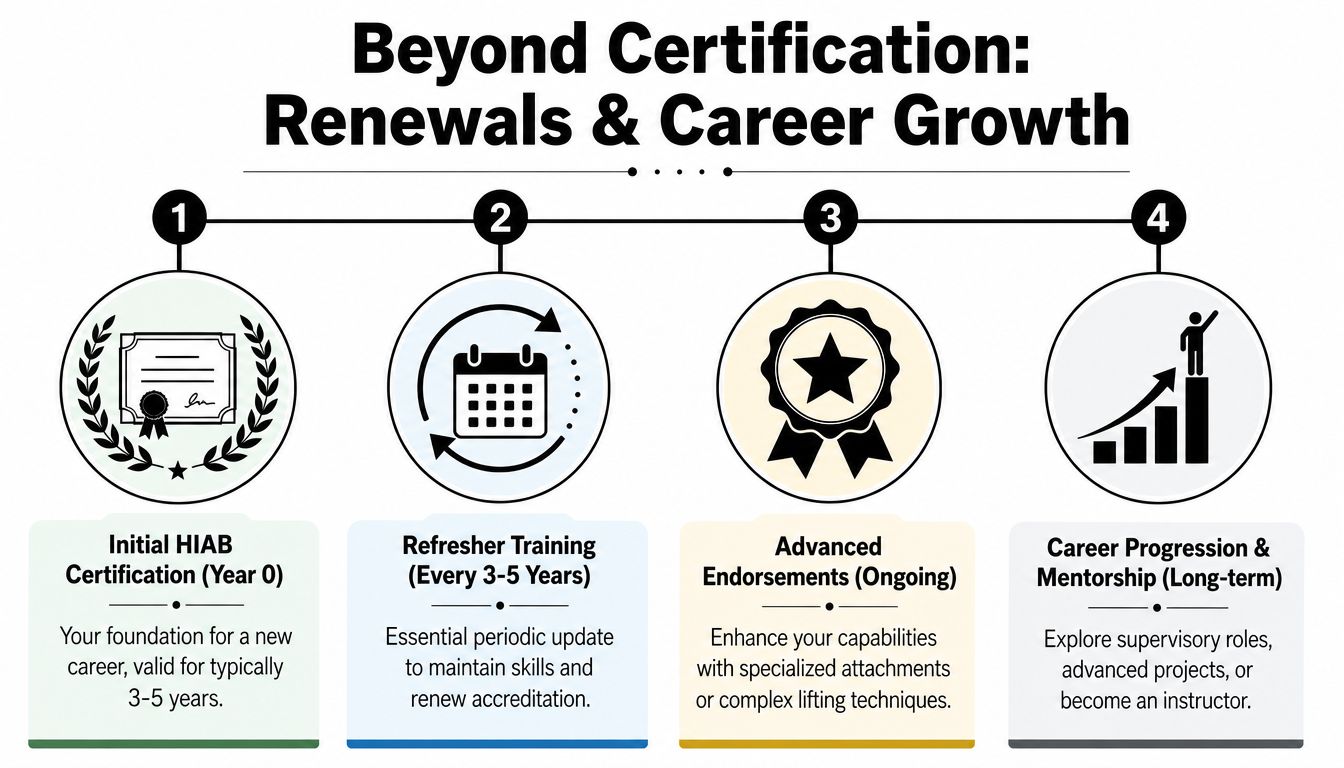
HIAB certification in the UK is valid for five years, after which operators need a 1-day refresher course to stay current, as you’d expect for a safety-critical qualification. Refresher pricing varies by provider, so it’s worth getting a specific quote rather than assuming one figure applies everywhere.
Leaving refresher training too late creates avoidable problems. A current certificate is far easier to manage than an expired one that needs urgent attention because a job start date is coming up.
Why multi-attachment planning matters
This is the long-term point most local guides miss. Your first HIAB qualification gets you in. Your attachment choices often determine how far you can go after that.
The strongest evidence on this comes from a 2024 report referenced in a West Yorkshire social discussion. It noted that 68% of UK HIAB operators need multi-attachment skills, while only 22% of local training ads in Yorkshire explicitly offer combined attachments, according to the Backline Logistics report shared in that discussion.
That gap explains why so many drivers ask about combined hook, grab, and clamshell options. The demand is there, but local course information doesn’t always make availability clear.
A better way to manage your career
Treat the qualification as a cycle, not a one-off task:
First certificate: get the attachment that matches your immediate job target
Early work experience: build safe, repeatable habits on real deliveries
Broader endorsements: add attachments when your work starts demanding them
Renewal planning: book refresher training before the five-year point becomes a problem
The operators who get the best mileage from their HIAB ticket don’t just pass once. They keep the certificate current and expand it when the work demands more.
If you’re looking at HIAB training West Yorkshire, think beyond the first booking. The better plan is to choose the right starting attachment, keep your renewal date in sight, and add extra capability when it helps you say yes to a wider range of jobs.
If you’re ready to move into HIAB work or add crane skills to your current licence, HGV Learning can help you plan the right route, from initial checks and theory support to locally arranged practical training and longer-term career guidance.
What Age Can You Start HGV Driver Training? A 2026 UK Guide to Licence Age Requirements
If you're asking what age you can start HGV driver training, the honest answer depends on which licence you're after. A C1 licence, covering vehicles...