That heart-stopping moment when you realise your tacho card is gone. It’s a feeling every professional driver dreads. Whether it has vanished from your wallet or you have simply left it somewhere, the key is not to panic. Instead, act fast and follow the right steps to stay on the road and out of trouble.
This happens more often than you might think, and there’s a clear process to sort it out. Trying to ignore it is the worst thing you can do—the fines and penalties for you and your boss can be severe. These rules are in place for a good reason: they make sure drivers’ hours are tracked accurately, which is all about keeping everyone safe on the road.
Your First Steps After Losing a Tacho Card
The clock starts ticking the moment you know the card is missing. You have a legal responsibility to get things moving, and the timelines are strict.
According to DVSA rules, you must report the loss to the Driver and Vehicle Licensing Agency (DVLA) immediately. You then have seven calendar days to officially apply for your replacement. Any delay can lead to serious issues, including fixed penalty fines that start at £200.
The good news is you can keep driving for up to 15 days while waiting for the new card to arrive. The catch? You have to take daily printouts from your vehicle’s tachograph unit (the VU) and manually record all your activities.
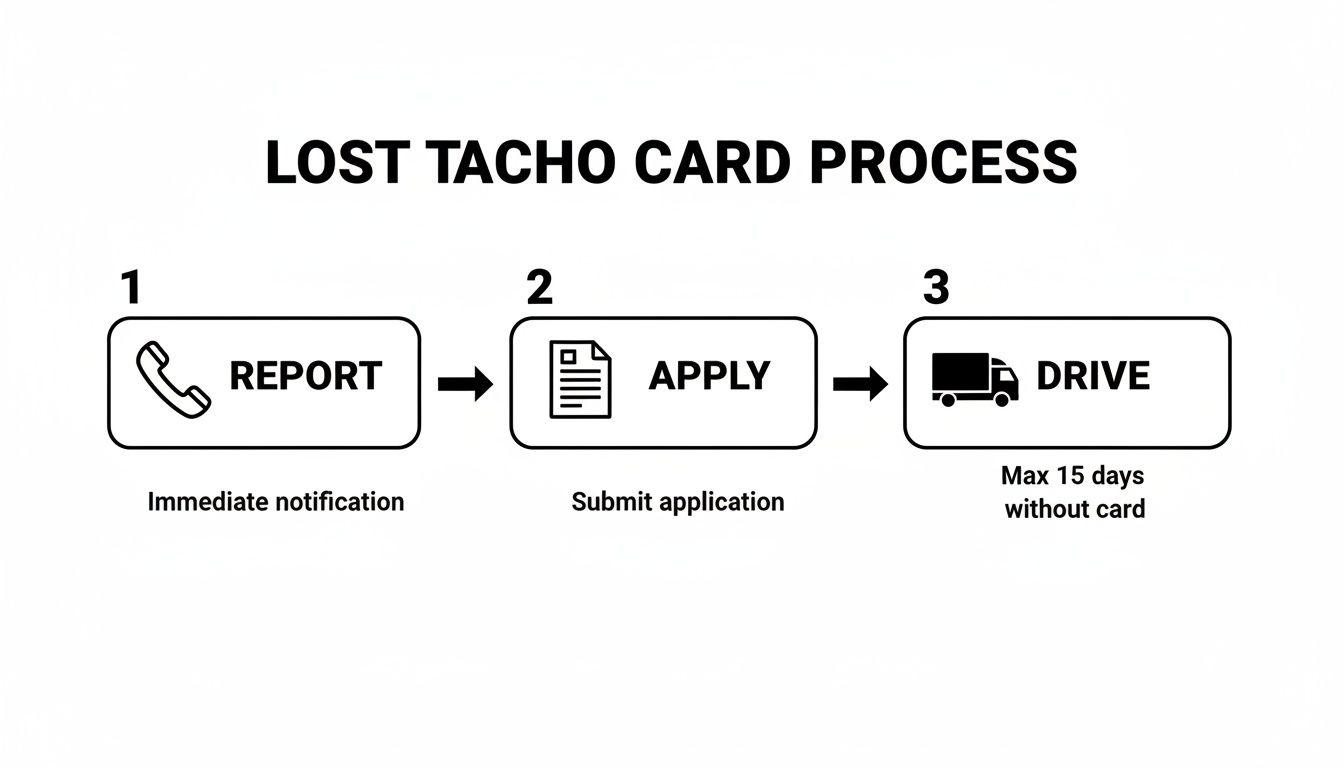
The flowchart below breaks down this simple three-step process.
This visual is a great reminder of what to do: report it, apply for it, and stick to the 15-day limit with your printouts.
To make it even clearer, here is a quick summary of what you absolutely must do straight away.
Immediate Actions For A Lost Tacho Card
Action Required
Deadline
Why It Matters
Report the Loss
Immediately
Notifies the DVLA and officially logs the card as lost, protecting you from potential misuse.
Apply for Replacement
Within 7 days
This is a legal requirement. Missing this deadline can result in fines and driving prohibitions.
Inform Your Employer
Immediately
Ensures your company remains compliant and allows them to support you with scheduling and paperwork.
Following these steps without delay is the best way to handle the situation professionally and avoid any unnecessary stress or penalties.
Who to Inform and Why
Your first official action is reporting the card as lost to the DVLA. This is non-negotiable and gets the ball rolling on your replacement.
But just as importantly, you need to tell your transport manager or employer straight away. They need to know for a few critical reasons:
Company Compliance: They share the legal responsibility for making sure you are working by the book.
Operational Planning: Your schedule might need adjusting, especially if you have long-haul jobs that could push you past that 15-day driving limit.
Support and Guidance: A good transport manager will know the procedure. They can help you with the application and make sure your manual printouts are done correctly.
Getting your boss in the loop immediately shows you are a professional who takes compliance seriously. It turns a “you” problem into a “we” problem, and they can help protect your licence and the company’s operator licence by making sure all vehicle unit data is downloaded and recorded properly.
For a deeper dive into how these devices function, you can explore our detailed guide on tachographs in HGV driving.
Navigating The Replacement Tacho Card Application
So, you have reported your tacho card as lost. The next critical job is getting the replacement process started. It might feel like a mountain of paperwork, but if you know what you are doing, it is actually quite a straightforward procedure. The whole thing is handled by the DVLA and relies on one key form.
The document you will need is the D777B, officially called the ‘Application for a digital tachograph driver card’. This is the same form you would use if your card was stolen, damaged, or just stopped working. It is absolutely vital to get this sent off within that seven-day window to stay on the right side of the law.
Getting and Filling Out the D777B Form
First things first, you need to get hold of the application form. You can order one online from the GOV.UK website and have it posted to you. If you are lucky enough to live near a DVSA test centre, you can often pick one up in person. Ordering online is usually the fastest way to get the ball rolling.
The form itself is broken down into a few sections. Make sure you take your time and fill it out clearly using black ink and capital letters—this helps avoid any silly processing delays. You will need to have your key details to hand, like your full name, address, and, most importantly, your driving licence number. Double-check that the address you write down is the exact same one that is on your driving licence, as that is where your new card will be posted.
Top Tip: Go over every single detail before you seal that envelope. Simple mistakes, like a typo in your licence number or forgetting to sign the form, are the biggest reasons applications get sent back. A rejection can easily push you past your 15-day limit for driving on printouts.
A Real-World Example
Think about a driver, let’s call him Dave, who realises his card is missing on a Monday morning. He does the right thing and reports it straight away, then orders a D777B form online that same day. The form lands on his doormat on Wednesday. He fills it out, but in his haste, he puts his new address on it, forgetting he has not updated his driving licence yet.
He posts it off, but a week later it comes back, rejected. By the time he has sorted out the mistake and sent it again, he is already on day 12 of his 15-day grace period. It caused a massive amount of stress and meant his transport manager had to take him off long-distance runs. Dave’s situation is a perfect example of why getting every detail spot-on from the start is so important.
Paying the Fee and Posting Your Application
A replacement card isn’t free, unfortunately. You will need to pay the fee, which is currently £19. The D777B form explains how to pay, but it’s usually by including a cheque or postal order made out to ‘DVLA, Swansea’.
With the form filled out and the payment sorted, it’s time to post it to the address on the form. I would always recommend using a tracked or signed-for service. It just gives you that peace of mind that it has arrived safely and gives you proof of postage if anything goes wrong.
Below is what the official GOV.UK page looks like, where you will begin the process of getting that new tacho card.
This page is your gateway for ordering the D777B form and checking the most current guidance and fees.
What Happens Next?
Once your application is in the post, the waiting game begins. The DVLA is usually quite quick, aiming to process applications and send out new cards within five working days of getting them. But you need to factor in postage time both ways. To be realistic, you should have your new card in your hand within about 8 to 10 working days.
If it has not turned up in that time, it’s worth giving the DVLA a call to chase it up. Make sure you have kept a note of the date you posted it, as they will likely ask. For anyone wanting to brush up on the wider rules and how these essential bits of kit work, our comprehensive digital tachograph guide has a ton of useful information.
Staying Compliant On The Road Without Your Card
So, you have reported your card lost and applied for a replacement. What now? The good news is you do not have to be parked up immediately. You can legally continue to drive for up to 15 calendar days from the day you realised your tacho card was gone.
This 15-day window is a lifeline, but it comes with some very strict rules. Think of your tachograph’s printout roll as your temporary best friend; getting your manual records spot-on is absolutely non-negotiable.
This isn’t a long-term fix or a loophole. It is a short-term measure designed to keep you and your vehicle moving while the DVLA processes your new card. If you get pulled over for a roadside check by the DVSA or police during this time, you can bet they will be scrutinising your manual records. There is zero room for error.
The Art Of The Manual Printout
To stay compliant without your card, you have to create two printouts from the Vehicle Unit (VU) for every single shift. One at the very start of your day, and one right at the end. These printouts become your official record, proving you are sticking to the drivers’ hours regulations.
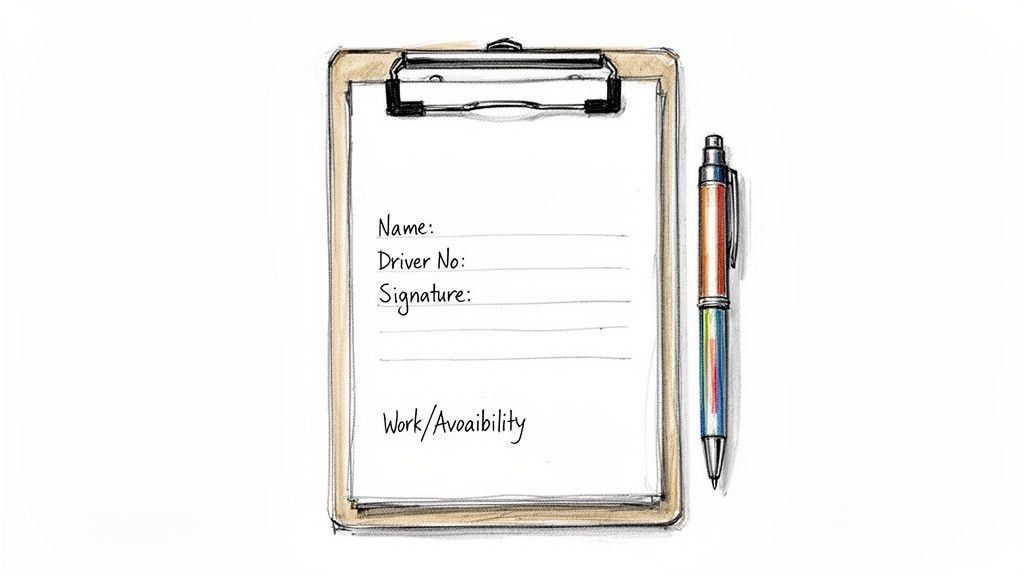
On the back of each printout, you must manually write down key details. This information effectively replaces the data your card would normally log automatically. Forgetting even one of these details can land you with a hefty fine.
Here is what you need to record on the back of both the start and end-of-shift printouts:
Your Full Name: Write it clearly, just as it appears on your driving licence.
Your Driving Licence Number: This is your unique identifier.
Your Signature: This confirms the record is yours and that you vouch for its accuracy.
On the end-of-day printout, you also need to add a full breakdown of your activities.
Think of the back of the printout as a daily diary for the DVSA. It needs to tell the complete, unabridged story of your working day. Any gaps or missing information will immediately raise red flags during an inspection.
Your Daily Printout Checklist
Getting the details right on your printouts is crucial. It shows enforcement officers that you are diligent and understand your legal duties, even in a tricky situation. This table breaks down exactly what you need to write and when.
Information To Record
When To Record It
Example Entry
Full Name, Licence No., Signature
On both start & end of shift printouts
Tom Jones, JONES901223AB7CD, [Signature]
Start of Duty
On the end-of-shift printout
Duty Start 06:00
All Driving Periods
On the end-of-shift printout
Drive 06:00-10:30, Drive 11:15-13:15
All Breaks and Rest Periods
On the end-of-shift printout
Break 10:30-11:15, Break 17:00-17:30
Periods of Availability (POA)
On the end-of-shift printout
POA 13:15-14:00 (Waiting to be loaded)
Other Work
On the end-of-shift printout
Other Work 16:00-17:00 (Warehouse duties)
End of Duty
On the end-of-shift printout
Duty End 18:00
This level of detail is precisely what enforcement officers look for. It leaves no doubt about how you have spent your day. For a more detailed breakdown of the regulations themselves, it is always worth reviewing a comprehensive guide on understanding drivers’ hours rules.
Keep Your Transport Manager In The Loop
Your manual records are not just for your own protection; they are essential for your company’s operator licence too. You must hand these printouts to your transport manager regularly, just as they would download the data from your card. They need this information to ensure the company’s records are complete and accurate.
This teamwork is vital. Your manager can cross-reference your printouts with vehicle tracking data, making sure everything lines up. This proactive approach demonstrates that both driver and operator are committed to compliance, which is a massive plus if the company ever faces a DVSA audit.
Ultimately, mastering the manual entry process is a core professional skill. It shows you are a responsible driver with a thorough understanding of the rules that govern our industry. It can turn a stressful situation like a lost tacho card into a manageable, routine task.
Your Employer’s Role And Responsibilities
Losing your tacho card is not just your problem to solve. Your employer or transport manager has a legal duty to step in and support you through it. This is not just about being helpful; their operator’s licence relies on every driver, including you, staying compliant.
From the moment you report the card missing, they should be an active partner in getting things sorted. A good transport manager will not just leave you to it. They will guide you through the process, because any compliance failures spotted at a roadside stop or DVSA audit will come straight back to them.
Ensuring You Take The Right Action, Fast
First things first, your employer needs to make sure you apply for a replacement card within the mandatory seven-day period. They should have a clear company policy for this, whether that means giving you the D777B form or pointing you to the GOV.UK portal.
A switched-on company will often ask to check your application before you send it off. It is a smart move. An incorrect application could mean you are parked up after the 15-day grace period is over, and that costs everyone time and money.
Think of your transport manager’s involvement as a crucial safety net. Their oversight helps catch simple mistakes that could have big consequences, protecting both your licence and the company’s O-licence from unwanted attention.
Managing Your Records While You Wait
While you are driving on printouts, your employer’s job does not stop. They have a critical role in managing the data from the Vehicle Unit (VU). There is a legal requirement to keep downloading the VU data at the usual intervals, even though your card is not in there.
They must also collect and properly file all your manual printout records. Here is what that looks like in practice:
Collecting Printouts: They need to get your daily printouts from you regularly, usually weekly, just like they would download your card.
Checking Records: The transport manager should be looking over your printouts to make sure they are filled out correctly and nothing is missing.
Joining Up the Data: They have to combine your manual records with the VU data to build a complete picture of your work for that period.
This is not just paperwork for the sake of it. If the company gets audited, they must be able to show a full, coherent record of all driver activities, card or no card.
What A Good Company Policy Looks Like
A responsible operator will not leave this to chance. Their internal policies should lay out exactly what the driver and the manager need to do when a tacho card goes missing. This avoids any confusion during what can be a stressful time.
A solid company policy will usually include:
Immediate Reporting: Clear instructions for drivers to tell their manager straight away.
Application Help: Offering to assist with the D777B form, including checking it for errors.
Printout System: A proper process for collecting, checking, and filing all manual records.
Scheduling Smarts: Being aware of the 15-day limit and adjusting your schedule if needed, especially if international work is involved.
Knowing what your employer should be doing helps you understand the support you can expect. When a driver and manager work together, a lost tacho card is just a minor hiccup, not a major compliance disaster that could lead to fines or a public inquiry. It is a team effort, from start to finish.
Avoiding Fines and Future Problems
Knowing the potential fallout from a mishandled lost tacho card is the best motivation for getting the process right. The rules are strict for a reason, and DVSA enforcement officers have the power to issue some hefty on-the-spot fines if they find problems during a roadside check. These are not just minor slaps on the wrist; they can hit both your wallet and your professional licence hard.
It is not just about the money, either. Persistent or serious infringements can easily escalate to a driver conduct hearing with the Traffic Commissioner. In the worst-case scenarios, this could mean penalty points on your vocational licence or even a temporary or permanent suspension of your right to drive HGVs.
Common Pitfalls and Their Penalties
It is easy to think a small slip-up will not matter, but from the DVSA’s perspective, things are black and white. You are either compliant or you are not. Missing deadlines or failing to keep proper manual records are two of the most common ways drivers get caught out after losing a card.
Here are a few of the most frequent mistakes and what they could cost you:
Missing the 7-Day Application Deadline: Failing to apply for a replacement within seven calendar days is a clear breach. It immediately suggests you are not taking the situation seriously.
Incomplete Printout Records: Just printing the slip from the tacho head unit is not enough. Forgetting to write your name, driver number, and signature on the back, along with a full account of your activities, is a major red flag for any inspector.
Exceeding the 15-Day Limit: Driving on day 16 without your new card is a serious offence. This 15-day period is an absolute deadline, not a friendly guideline.
These issues can lead to fixed penalties starting from £200 per offence. If an officer finds multiple issues, those costs can stack up very quickly.
The bottom line is simple: the potential fines and licence suspension far outweigh the hassle of following the rules correctly from day one. Taking an extra few minutes to get your printouts right is an investment in your career.
Developing Habits to Prevent Future Loss
Of course, the best way to dodge all this trouble is to not lose your card in the first place. Accidents happen, but building a few simple, unbreakable habits can dramatically cut the risk of it happening again. Prevention is always better than cure.
Think about it like your wallet or your house keys—create a solid routine for where you keep your card at the end of every single shift.
Practical Tips for Card Safety
The goal is to make card safety part of your daily muscle memory. It does not need to be complicated, it just needs to be consistent.
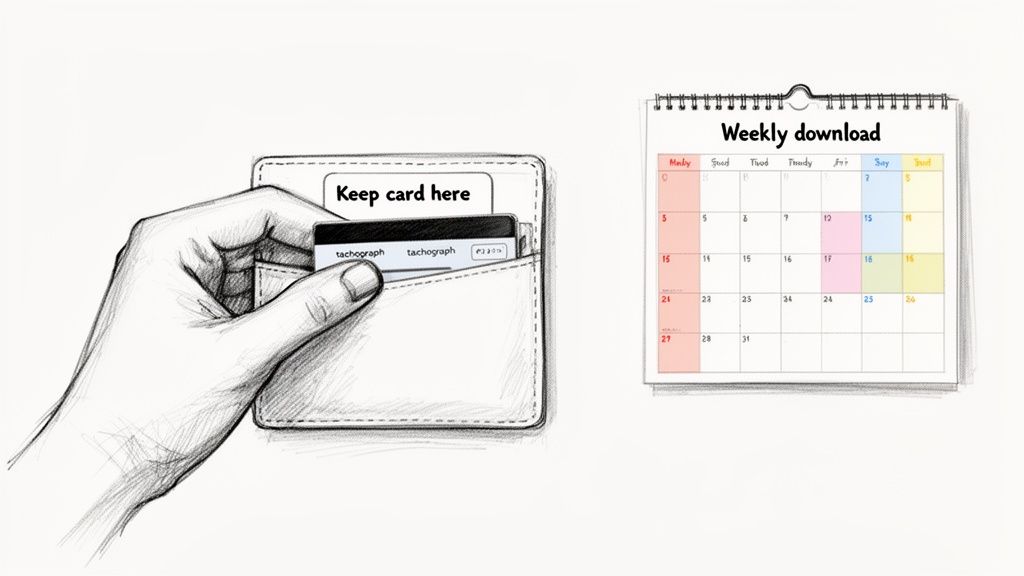
Designate a “Home” for Your Card: When that card comes out of the tacho, it should go to one specific place, every time. This could be a dedicated slot in your wallet or a protective case you keep in the same pocket of your work bag. Never just toss it on the dashboard or into a random cupholder.
End-of-Day Check: Make it the last thing you do before you lock up the cab. A quick pat-down or glance in your bag to confirm you have your essentials. Turn it into a mental checklist: “Phone, Wallet, Tacho Card.”
Use Data Downloads as a Check-in: Your employer should be downloading your card data at least every 28 days. This process is a fantastic built-in reminder to physically handle your card and make sure it is exactly where it should be. Think of it as a regular compliance health check for both you and your operator.
By building these small routines, you create a protective bubble around one of your most vital professional tools. A lost tacho card is a preventable headache, and a bit of discipline goes a long way in keeping you on the road and out of trouble.
Answering Your Top Questions About Lost Tacho Cards
When your tacho card goes missing, it is easy for your mind to start racing with questions and ‘what-if’ scenarios. Getting clear, no-nonsense answers is the best way to handle the situation without stress. We have pulled together the most common questions drivers ask us, so you can stay compliant and get back on the road with confidence.
Every driver’s situation has its own quirks, but the basic rules are always the same: report it, apply for a new one, and keep manual records. Knowing the details helps you make the right call straight away.
What If I Find My Old Card After I’ve Applied For a New One?
This happens more often than you would think. You have done everything by the book—reported the card lost and sent off your application—only to find the old one tucked down the side of your seat. It might be tempting to just use it, but you absolutely cannot.
As soon as the DVLA processes your application for a replacement, your old card is cancelled. It is instantly invalid. If you try to use it, it will flag up immediately at a roadside check or when the data is downloaded, and that is a serious offence.
Found your old card? You are legally required to post it back to the DVLA. Just pop it in an envelope with a quick note explaining you have already applied for a replacement. This keeps your record clean and shows you have followed the correct procedure.
Can I Still Drive in Europe if My UK Card is Lost?
Driving abroad without a valid tachograph card is a massive risk, and we strongly advise against it. The 15-day grace period that lets you drive in the UK using manual printouts is a domestic rule only. It is not recognised across the EU.
Enforcement officers in other countries have their own strict regulations and are very unlikely to accept your UK printouts. The penalties can be severe and immediate:
Hefty on-the-spot fines, which can easily be hundreds of euros.
Your vehicle could be immobilised on the spot until a new card arrives.
It can cause serious compliance problems for your operator’s licence.
The only professional and safe option is to avoid any international trips until your replacement card is in your hand.
How Long Does a Replacement Tacho Card Take to Arrive?
Once you have sent a correctly filled-out application, the DVLA is usually quite quick. They tend to dispatch new cards within five working days of getting the form.
Do not forget to factor in postage time, though. Realistically, you should expect to wait around 8 to 10 working days from the day you post your application to the day the new card arrives. This is exactly why the rule is to apply within seven days of the loss—it builds in a buffer so your card arrives well within the 15-day limit for driving on printouts. Any mistakes on your form will cause delays, so double-check everything.
Is the Process Different for a Damaged or Faulty Card?
No, the process is exactly the same whether your card is lost, stolen, broken, or just malfunctioning. From the DVSA’s perspective, any situation where your card is unusable is treated the same way. You must still report it and apply for a new one using the D777B form within seven days.
The only small difference is what you do with the old card. If it is damaged or faulty, you need to post it back to the DVLA with your application. Do not just bin it—the DVLA needs to receive the old card to process your replacement properly.
Knowing how to handle a lost tacho card is a vital skill for any professional driver. At HGV Learning, we offer expert training to help you manage every part of your career, from getting your first licence to earning specialist qualifications. Get started with our industry-leading support by visiting HGV Learning.
Related Articles
09/03/2026
UK CPC Course Cost: A Complete 2026 Pricing Guide
When you're looking to get on the road professionally, one of the first questions on your mind is bound to be about the cost. In...