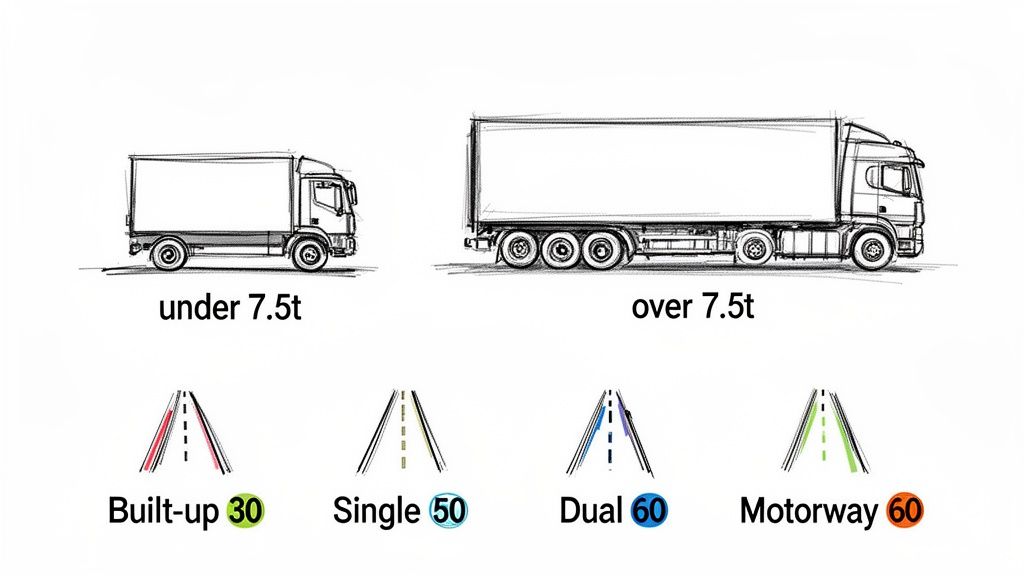
Understanding the HGV speed limits in Scotland is vital for any professional driver, as the rules differ slightly from the rest of the UK. For HGVs over 7.5 tonnes, the limits are generally 30 mph in built-up areas, 50 mph on single carriageways, and 60 mph on both dual carriageways and motorways. Confusing these rules can lead to serious penalties.
Your Essential Guide to Scottish HGV Speed Limits
Driving an HGV through Scotland’s beautiful but often challenging roads requires more than just knowing the route. You need a solid grasp of the speed limits that apply to your specific vehicle. It’s not like driving a car, where you simply follow the signs. For an HGV, your speed limit depends on your vehicle’s weight and the type of road you’re on. This guide will make everything clear.
Whether you are a new driver in a 7.5-tonne rigid truck or a seasoned professional in a 44-tonne artic, the rules are strict. A common mistake is confusing the limits in Scotland with those in England or Wales, but it’s an easy error to avoid once you know the facts.
HGV Weight and Road Type
The two main factors that determine your legal speed are your truck’s gross weight and the road you are travelling on. The limits are split into two key groups:
HGVs with a gross vehicle weight up to 7.5 tonnes.
HGVs with a gross vehicle weight over 7.5 tonnes, which includes both rigid and articulated lorries.
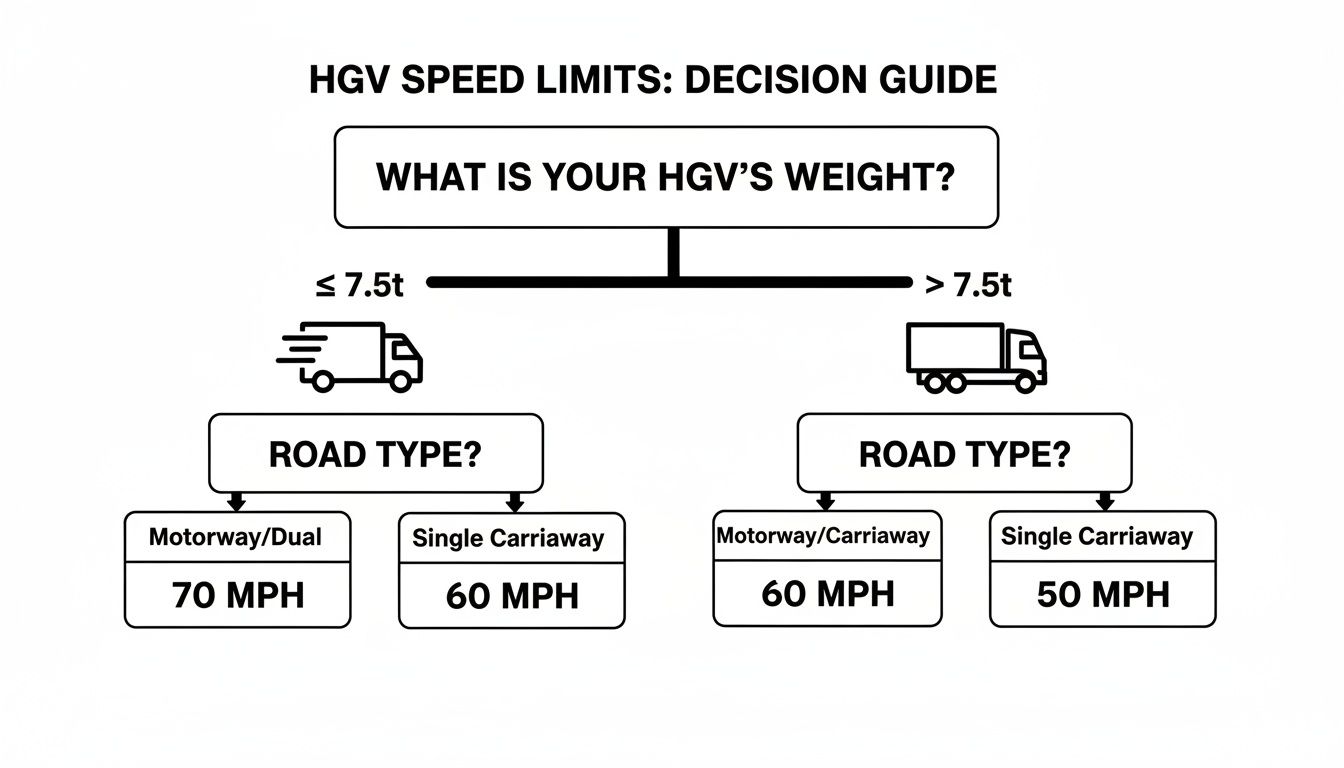
This flowchart offers a quick visual guide to find your speed limit. Simply trace the path from your HGV’s weight to the road you’re on.
As you can see, the first step is to check your vehicle’s weight. From there, the chart shows the specific limits for each road type. It’s a simple two-step process to stay safe and compliant.
For an even quicker reference during your journey, here is a detailed table breaking it all down.
Scottish HGV Speed Limits at a Glance
This table provides a simple summary of the national speed limits for different HGV categories across Scotland’s main road types.
Road Type
HGVs up to 7.5t (Rigid)
HGVs over 7.5t (Rigid & Articulated)
Built-up Areas
30 mph
30 mph
Single Carriageways
50 mph
50 mph
Dual Carriageways
60 mph
60 mph
Motorways
70 mph
60 mph
Keep this table in mind, particularly the key difference on motorways, to ensure you are always driving within the legal limits.
If you have driven your HGV across the UK, you might have noticed that the rules of the road can change as soon as you cross the border into Scotland. This is a common point of confusion for drivers, but there is a good reason for it. The difference comes down to devolved powers, which means the Scottish Government can set its own road safety policies and speed regulations.
This isn’t just about having different rules for the sake of it. Scotland’s approach has been shaped by its own research and a focus on the unique challenges of its road network, which includes many rural single carriageways. Instead of simply following changes made in England and Wales, Scottish policymakers chose an evidence-led path.
The A9 Pilot: A Game Changer for Road Safety
A perfect example of this is the groundbreaking pilot project on the A9. This vital route, which connects Perth and Inverness, became a real-world test for a new approach to HGV speed limits. The goal was simple but ambitious: to make one of Scotland’s most notorious roads safer for everyone.
In October 2014, a trial began that increased the speed limit for HGVs over 7.5 tonnes from 40 mph to 50 mph on the A9’s single carriageway sections. The results were remarkable. The speed difference between cars and lorries—a major cause of risky overtakes—dropped significantly from an average of 6.7 mph to just 2.7 mph by 2017. With fewer slow-moving trucks, car drivers felt less pressure to make dangerous manoeuvres, and better enforcement also led to a reduction in average car speeds. You can read the full breakdown in the official evaluation of the A9 HGV speed limit trial.
This successful trial provided the evidence needed to roll out the 50 mph limit for larger HGVs on other suitable main roads across Scotland.
The core idea was that matching speeds creates a smoother, more predictable flow of traffic. When cars are not stuck behind a much slower lorry, the temptation for frustrated drivers to take risks is reduced, directly improving road safety.
Understanding the ‘Why’ Behind the Rules
The A9 project highlights the principle behind Scotland’s distinct HGV speed limits. It is not about punishing drivers; it is about creating a safer road environment for everyone. By closing the speed gap between different types of vehicles, the road network becomes more efficient and less prone to accidents.
As a professional driver, understanding this ‘why’ is important. It changes the speed limit from just a number on a sign into a key part of a national strategy to protect all road users. Sticking to these specific HGV speed limits in Scotland is not just about compliance—it’s about playing your part in a system designed to get everyone home safely.
Decoding Speed Limits for Your HGV Class
Now that we have covered why the rules are different, let’s look at the details. Knowing the exact HGV speed limits in Scotland for your vehicle is a non-negotiable part of being a professional driver. This isn’t about guesswork; it’s about understanding how your vehicle’s weight and class determine your speed on any given road.
The limits are tailored to the type of HGV you are driving. A driver of a smaller, rigid C1 vehicle often has a different set of rules to follow than someone in charge of a larger Category C rigid or a full C+E artic.
Let’s break it down, road by road, so you’re never left in any doubt.
Built-Up Areas: The Universal Constant
This is the easiest rule to remember. No matter what you are driving—from a 3.5-tonne van to a 44-tonne artic—the speed limit in a built-up area is 30 mph.
This rule applies everywhere unless signs show a lower limit, such as in 20 mph zones around schools or on residential streets. It’s that simple.
Single Carriageways: Where Weight Matters
Once you are on a single carriageway, your vehicle’s weight becomes the key factor. For smaller HGVs up to 7.5 tonnes, the type you would drive on a C1 licence, the national speed limit is 50 mph. This keeps you in line with cars and vans.
For larger lorries over 7.5 tonnes, the limit is now also 50 mph on most of Scotland’s main trunk roads. This change followed a successful pilot on the A9 and is designed to improve traffic flow and reduce risky overtaking. Just be sure to watch for road signs, as local councils can still set lower limits on other roads.
Dual Carriageways: A Clearer Picture
On a dual carriageway—any road with a central reservation separating you from oncoming traffic—things become straightforward again. For all HGVs, regardless of weight, the speed limit in Scotland is a solid 60 mph.
Having one consistent limit for all trucks helps to create a much more predictable and steady flow of traffic, making these major routes safer for everyone.
Think of it this way: your vehicle’s licence category is your guide. A C1 driver follows one set of rules on smaller roads, but on dual carriageways and motorways, the limits for all HGVs become much more aligned.
Motorways: The Final Stretch
Finally, when you reach Scotland’s motorways, the rule is simple and absolute. All HGVs over 3.5 tonnes, whether rigid or articulated, are restricted to a maximum speed of 60 mph.
It’s a common mistake to think that smaller HGVs can travel at 70 mph like cars, but that is not the case. As soon as your vehicle is classed as an HGV, that 60 mph motorway limit applies to you. Sticking to it keeps you safe, legal, and professional on the fastest roads. Knowing these details is what separates a good driver from a great one.
Navigating Special Conditions and Variable Limits
The national speed limits provide a solid baseline, but as any professional driver knows, roads can be unpredictable. Mastering the HGV speed limits in Scotland means knowing how to react when special conditions arise and temporarily change the rules. This knowledge helps keep you, other drivers, and your licence safe.
Bad weather is a classic example. The sign might say 60 mph, but in heavy rain, thick fog, or high winds, you must use your professional judgement. The safe and legal speed in those conditions will always be much lower. For more detailed advice, check out our guide to winter HGV driving tips.
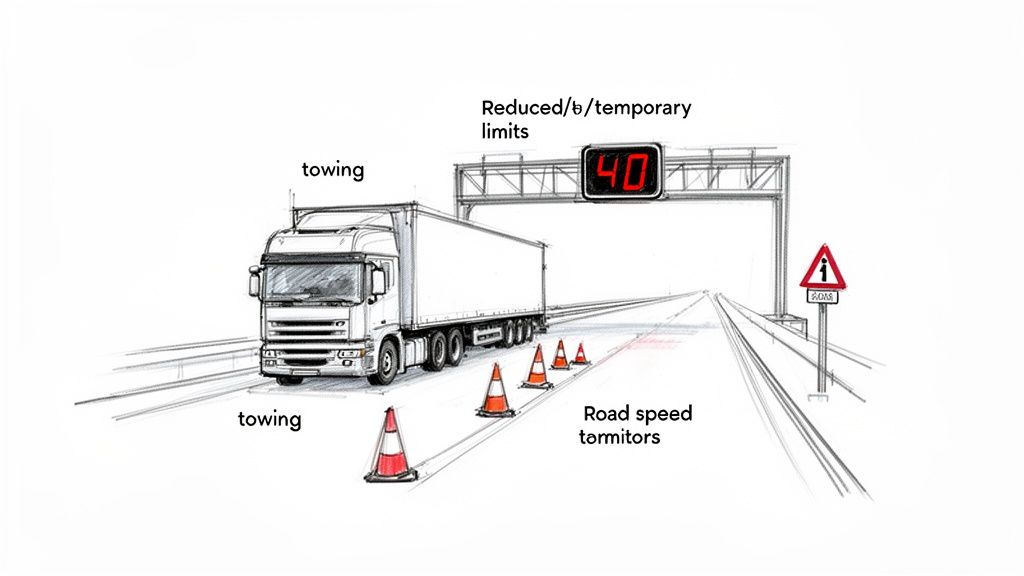
Temporary and Variable Speed Limits
Roadworks are perhaps the most common reason for a change in the speed limit. As you approach a construction zone, you will see clear signs showing a new temporary limit, which is often enforced by average speed cameras. These limits are not just a suggestion—they are mandatory and are there to protect the lives of road workers.
You will also encounter variable speed limits, especially on Scotland’s smart motorway sections. These are displayed on electronic gantries overhead and can be changed in real-time to manage traffic jams, deal with an accident, or account for poor visibility.
It’s vital to keep an eye out for these signs:
A number inside a red circle on an overhead gantry is a mandatory, legally enforceable speed limit.
Flashing amber lights will often be used with new temporary limits to make sure you see the change.
The Rules for Towing a Trailer
Towing a trailer can also change your maximum speed, although the rules in Scotland are more straightforward than elsewhere in the UK. If you are towing a trailer with any vehicle, including an HGV, your motorway speed limit is capped at 60 mph.
This mainly affects drivers in smaller HGVs (up to 7.5 tonnes), who could otherwise travel at 70 mph on a motorway. For the bigger rigs over 7.5 tonnes, your motorway limit is already 60 mph, so adding a trailer does not change your top speed.
The golden rule is simple: the signposted limit is the absolute maximum, but your professional judgement determines the safe speed. Always be prepared to adapt to changing conditions and temporary restrictions.
This need for constant adaptation is part of why the rules in Scotland have evolved. For years, hauliers faced a real headache when Scotland’s single carriageway limit for large HGVs was 40 mph, while it was 50 mph in England and Wales. When Scotland finally raised the limit to 50 mph on key trunk roads, it was a major victory for both safety and efficiency, leading to smoother traffic flow and fewer risky overtakes. You can find out more by reading the official evaluation of the HGV speed limit increase.
Understanding Enforcement and Speeding Penalties
Knowing the specific HGV speed limits in Scotland is only half the battle. As a professional driver, it is just as important to understand how these rules are enforced and what the real-world consequences are for getting it wrong.
The days of simply watching out for a single police car are long gone.
Enforcement across Scotland is now a complex system designed to ensure everyone follows the limits. You will still see traditional mobile police patrols, but they are now supported by a huge network of fixed and average speed cameras. Routes like the A9 are well-known for their average speed camera systems, which are highly effective at monitoring HGV speeds over long distances.
The Silent Witness in Your Cab
Besides the roadside cameras, every HGV driver has a constant companion that records their every move: the tachograph. This device does not just track your driving hours; it also logs your speed with great accuracy.
Make no mistake, your tacho data can be used as clear evidence of speeding in any investigation.
Think of it as a silent witness that provides a complete, undeniable record of your driving behaviour. Even if you avoid a camera, a routine DVSA check or an investigation after an incident can reveal consistent speeding. This can lead to very serious consequences. To stay compliant, you should learn more about the essential rules for using tachographs in your HGV.
The Real Cost of Speeding
The penalties for exceeding the speed limit in an HGV are far more severe than those for a car driver. A single offence can have a knock-on effect that puts your entire career at risk.
The immediate consequences typically include:
A minimum fine of £100.
At least 3 penalty points added to your driving licence.
A possible court summons for more serious offences, which can lead to much larger fines and even disqualification from driving.
For a professional driver, penalty points are more than just an inconvenience. Collecting them can lead to very high insurance premiums and, in the worst-case scenario, the loss of your vocational licence. Your livelihood is on the line.
The impact also extends beyond your personal licence. Every speeding offence can negatively affect your employer’s Operator Compliance Risk Score (OCRS). A high OCRS score for a company triggers more frequent and targeted roadside inspections by the DVSA. This means delays and operational problems for the entire fleet.
Ultimately, sticking to the correct HGV speed limits in Scotland is a core professional responsibility. It protects your licence, supports your employer’s compliance record, and, most importantly, keeps everyone on the road safe.
Driving Safely and Efficiently Within the Law
Knowing the HGV speed limits in Scotland is one thing; truly mastering them is another. This isn’t just about avoiding penalty points. It’s about becoming a smoother, safer, and more efficient professional driver. The best drivers turn the rules of the road into a real skill.
Ultimately, this proactive driving style reduces your stress, cuts fuel consumption, and lowers wear and tear on your vehicle. It’s a win-win for your safety, your wallet, and your company’s bottom line.
Proactive Driving Techniques
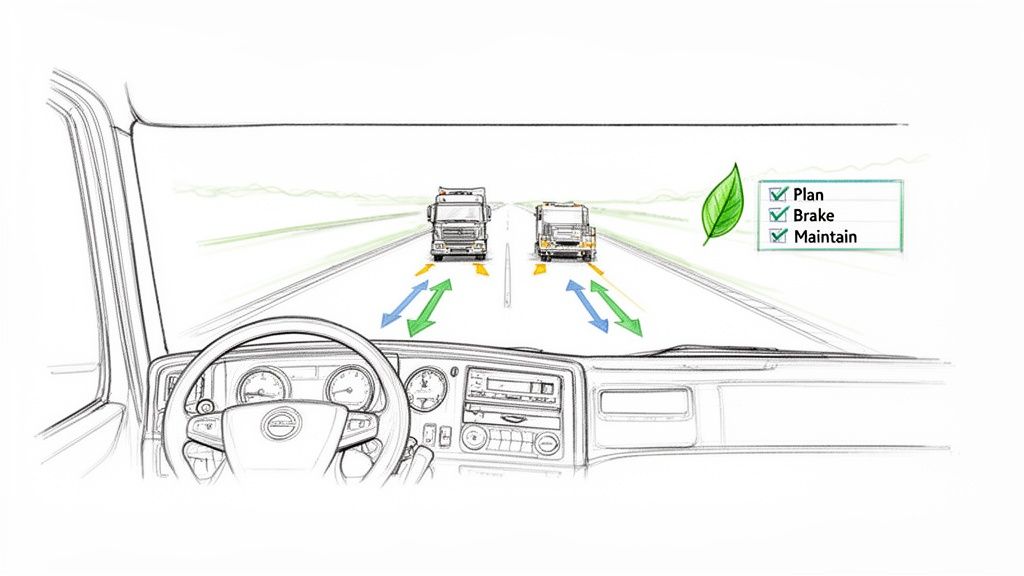
Driving a heavy goods vehicle demands constant forward planning. You need to look well beyond the vehicle in front, anticipating everything from changes in traffic flow to upcoming junctions. When you can read the road ahead, you can make gentle adjustments to your speed instead of braking hard or accelerating sharply.
This smooth approach pays off in several ways:
Anticipate Traffic Flow: Spotting brake lights in the distance gives you time to ease off the accelerator early. This way, you can often keep moving without coming to a complete stop.
Maintain Safe Following Distances: Always leave enough room to stop safely. A good guide is the two-second rule in dry conditions, but you should increase that to four seconds or more in wet or icy weather.
Use Engine Braking on Descents: On long downhill sections, let your engine brake or retarder do the work. This controls your speed without overheating the service brakes, ensuring they are ready for when you really need them.
By combining these techniques, your driving becomes a proactive skill rather than a reactive task. This not only keeps you within the legal speed limits but also develops a professional mindset focused on safety and efficiency.
Making these habits second nature will help you maintain a spotless record and build your reputation as a skilled professional. If you want to learn more, our detailed guide on the principles of eco-driving for HGV professionals is a great next step.
Frequently Asked Questions About Scottish HGV Speeds
When you’re out on the road, questions are bound to arise. To help you stay confident and compliant, we have put together clear answers to some of the most common queries we hear from drivers about HGV speed limits in Scotland.
Are HGV Speed Limits in Scotland the Same as in England?
For the most part, yes—but you still need to watch out for differences. The biggest recent change was bringing Scotland in line with England and Wales by raising the limit for HGVs over 7.5 tonnes to 50 mph on many main single carriageway trunk roads.
However, the key thing to remember is that local councils can, and often do, set their own lower limits on non-trunk roads. So, the golden rule is to always trust the signs, especially when you have just crossed the border. On dual carriageways and motorways, the limits are generally the same at 60 mph.
Do I Have a Different Speed Limit with a C1 Licence?
Yes, you do. The limits are linked to your vehicle’s weight class. If you’re driving a rigid vehicle between 3.5 and 7.5 tonnes (your Category C1), you can often travel slightly faster than larger HGVs.
On a single carriageway, for example, your limit is typically 50 mph. The main difference is on motorways, where a C1 vehicle can travel at 70 mph (as long as you are not towing), while a truck over 7.5 tonnes is restricted to 60 mph.
It’s crucial to know your vehicle’s weight class and the type of road you’re on at all times. This combination is what determines your legal maximum speed.
How Do Average Speed Cameras Affect HGV Drivers?
Average speed cameras are a different challenge. Instead of catching you at one spot, they track your speed over a long distance. This means you have to stick to the correct HGV-specific limit for the entire journey.
They are especially effective at enforcing HGV limits because you cannot just brake for the camera and then speed up again. On a road like the A9, the system is designed to ensure you maintain a steady 50 mph on the single carriageway sections. Plus, your tachograph is always recording your speed, providing a second layer of proof.
At HGV Learning, we’re committed to helping you start and succeed in your professional driving career with expert training and support. Find the perfect HGV course near you and get on the road with confidence.
Related Articles
What Is a Class 2 Licence? Your Guide for UK Drivers
If you want to drive a lorry for a living, the first term you need to know is the Class 2 licence. Officially, it’s called...
What to Do When You Have a Lost Tacho Card: A Step-by-Step Guide
That heart-stopping moment when you realise your tacho card is gone. It's a feeling every professional driver dreads. Whether it has vanished from your wallet...