You might be sitting in Plymouth right now, looking at job boards between shifts, school runs, or another workday that no longer feels like a long-term fit. You may like the idea of a practical career, steady hours, proper responsibility, and work that keeps the South West moving, but the route into HGV driving can still feel confusing at first.
That confusion is normal. Many people searching for HGV driver jobs in Plymouth hit the same problems early on. Job adverts often expect a licence you don't yet have. Training information can feel full of jargon. And local guides rarely explain the practical issues around finding test dates and getting that first role without much road experience.
The good news is that the path is clear once you break it into stages. There is also genuine local opportunity. As of June 2026, there are 43 open HGV driver jobs in Plymouth, England, according to Glassdoor's Plymouth HGV listings. That tells you something important. Employers in and around Plymouth still need qualified drivers.
Kickstarting Your HGV Driving Career in Plymouth
You finish a shift, glance at another job advert, and see the same problem again. HGV licence required. Experience preferred. For many people in Plymouth, that is the sticking point. The route in can look blocked before training has even started.
Plymouth is still a practical place to begin. The city needs drivers for port-related work, retail deliveries, construction supply, utility fleets, and regional runs across Devon and Cornwall. That variety matters because it gives new drivers more than one possible first step. You are not aiming at one narrow job type. You are preparing for a local market with several entry points.
The first job of this process is choosing the right route, not chasing every vacancy you can find. HGV training works a bit like planning a ferry crossing from Devonport. If you head for the wrong terminal, you lose time before the journey has properly begun. The same applies here. Your licence choice shapes the work you can apply for later.
Start with the right goal
A lot of aspiring drivers in Plymouth search for jobs first, then training, then wonder why every advert seems out of reach. It helps to reverse that order. Start by matching the licence to the kind of work you want.
Cat C suits rigid vehicle roles such as refuse collection, builders' merchants, pallet deliveries, and some council or contractor work.
Cat C+E covers articulated lorries and gives access to a wider spread of trunking, supermarket, port, and long-distance work.
C1 is a different route and usually fits smaller commercial vehicles used in certain specialist or service roles.
If you are unsure which one fits, look around Plymouth on an ordinary weekday. Refuse wagons in residential areas, building materials heading through Derriford and Marsh Mills, supermarket vehicles on supply runs, and utility trucks working across the city all give you real examples of what each licence can lead to.
That local view also helps with a problem many guides skip past. Training can be harder to arrange than people expect. Test dates, travel to training, time off work, and course availability all affect how quickly you can qualify. Then comes the next hurdle. Many adverts ask for experience, even for jobs that sound suitable for beginners. That does not mean you should give up. It means you need a plan that gets you qualified first, then targets employers and job types more likely to take newly passed drivers.
For a clear explanation of the official starting requirements, this guide to requirements for an HGV licence sets out what you need before training can move ahead.
Why Plymouth is worth your attention
Local demand is only part of the picture. What matters more for a new driver is the mix of work on offer. Plymouth combines urban delivery routes, nearby industrial traffic, and links to wider South West haulage. That mix can help you build early experience in stages instead of trying to jump straight into the most competitive roles.
So judge the opportunity sensibly. One advert asking for two years of experience does not define the whole market. A better test is whether businesses in and around Plymouth keep needing licensed drivers across different vehicle types and shift patterns. In practical terms, they do.
That makes Plymouth a realistic place to start, especially if you approach the process in the right order. Get eligible, choose the licence that fits local work, train properly, and treat your first role as the bridge to the better-paid jobs that come later.
Your First Turn Eligibility and Documentation
Before you think about reversing exercises, CPC modules, or interviews, sort the admin properly. Administrative missteps often cause many promising candidates to lose momentum. A missed form, an outdated medical, or a licence detail that doesn't match can delay the whole process.
What you need before training can move smoothly
The paperwork side becomes far less stressful when you treat it like a checklist rather than a mystery. For a clear overview of the official requirements, this guide to requirements for an HGV licence helps put the basics in one place.
Here are the key points in plain English:
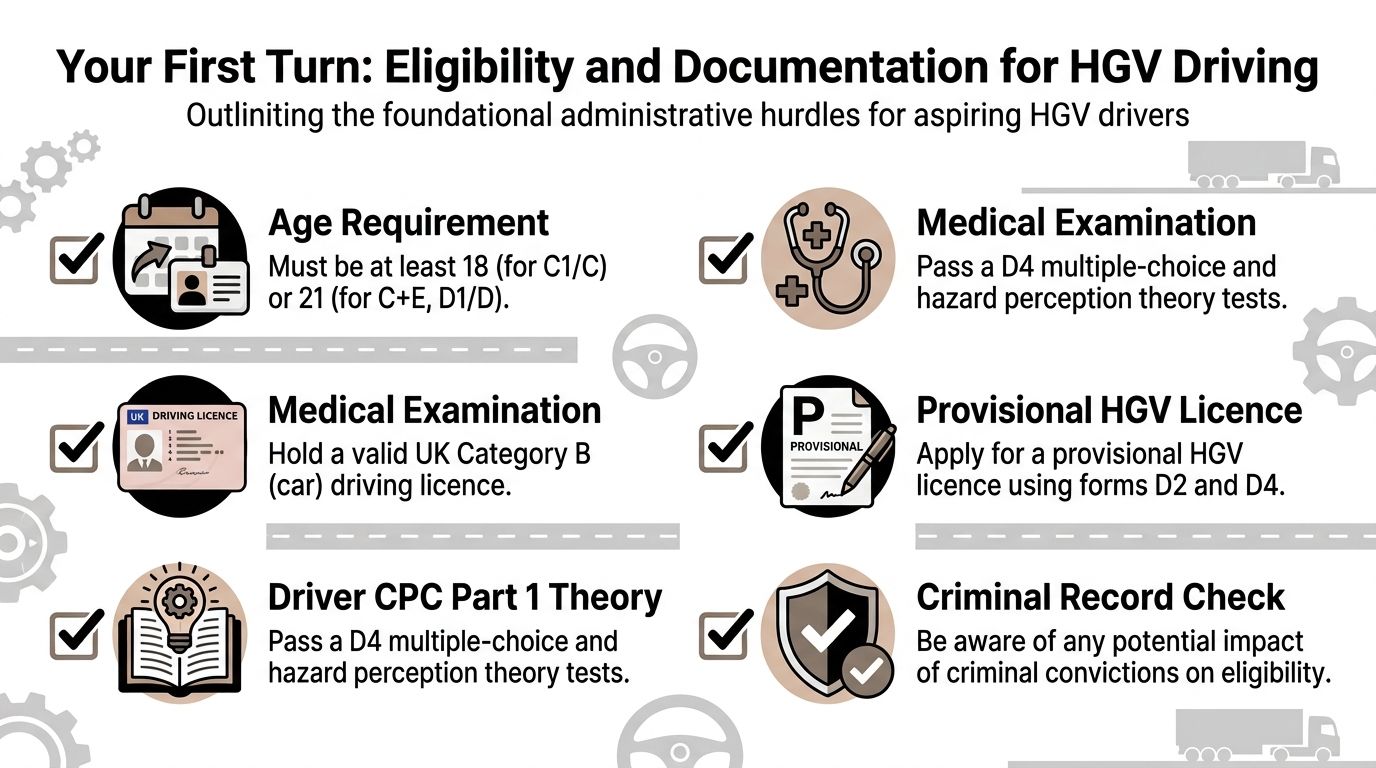
Age matters: The route you take depends on the vehicle category. The infographic above outlines the usual age thresholds for different licence types.
You need a valid car licence: Your UK Category B licence is the starting point.
You need a D4 medical: A doctor checks that you're fit to drive larger commercial vehicles safely.
You apply for a provisional HGV entitlement: That usually involves the D2 and D4 forms.
You'll need to pass theory tests: These include the multiple-choice and hazard perception parts.
You should think about background issues early: Some candidates leave questions about convictions or paperwork history too late.
What the medical is really for
The medical often worries people more than it should. It isn't there to catch you out. It's there to make sure you can drive a heavy vehicle safely for yourself and everyone else on the road.
A doctor will review your general health and relevant medical history. If you wear glasses or contact lenses, make sure your vision details are current. Bring what you need, answer truthfully, and treat it like a standard professional requirement rather than a hurdle designed to block you.
A lot of delays happen because candidates rush the forms, not because they're unsuitable for the job.
The paperwork mistakes that slow people down
Most delays come from simple admin problems. Names don't match across documents. Forms are incomplete. Medical details are missing. A candidate books the next stage before the provisional entitlement is sorted.
Keep a small folder, paper or digital, with:
Your driving licence details
Medical paperwork
Proof of address and ID
Any booking confirmations
Notes on dates and expiry points
That habit sounds basic, but it saves time later when employers ask for licence checks, CPC details, or supporting documents.
Your Training Pathway to Getting Licence Ready
Training looks complicated when people describe it as a list of separate tests. It feels simpler when you view it as a sequence. One part prepares you for the next.
A useful starting point is this overview of HGV driver training, especially if you want to see how theory, practical training, and Driver CPC fit together.
What the full route looks like
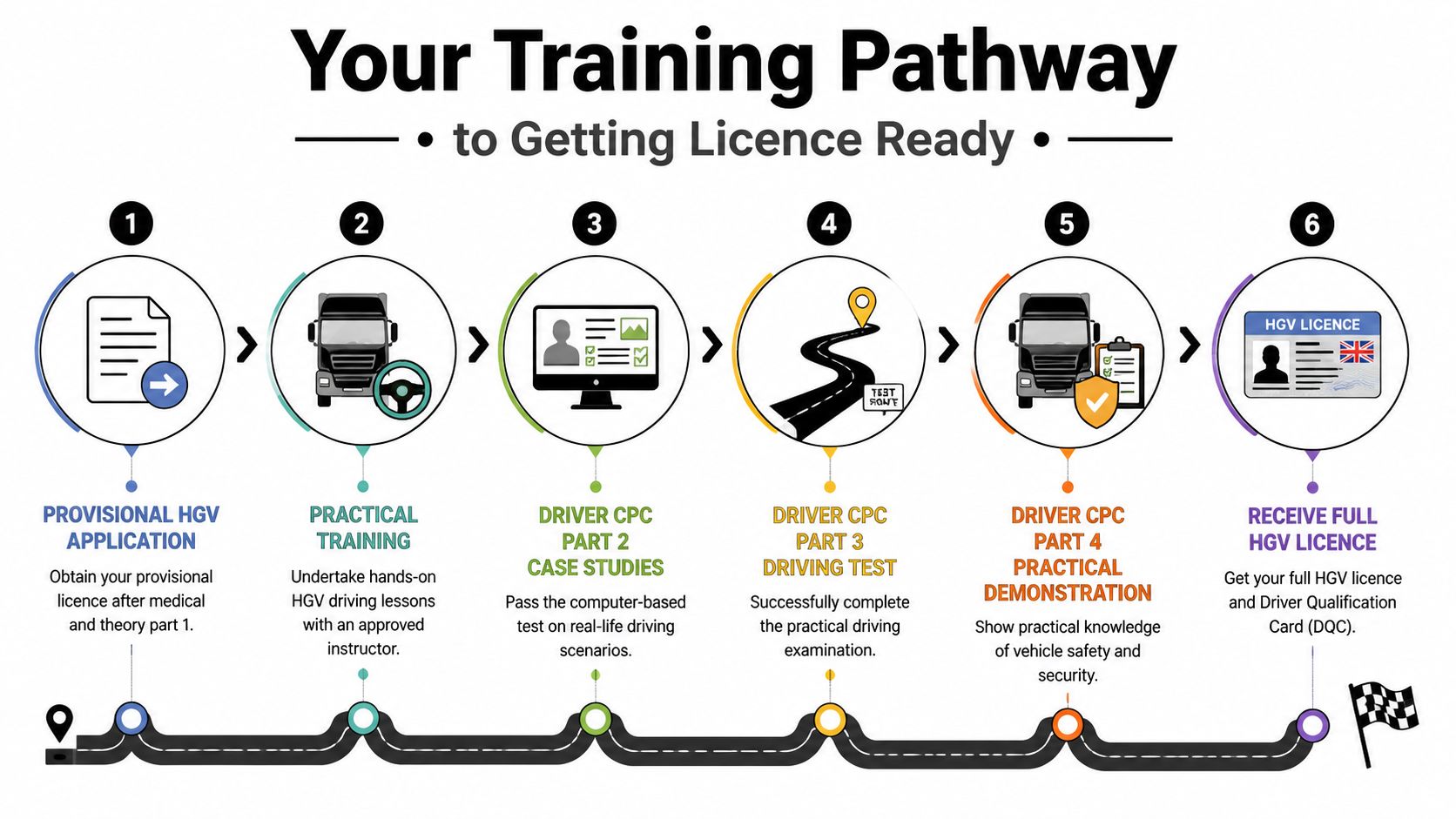
The flow usually works like this:
Get your provisional entitlement sorted
Prepare for and pass theory
Begin practical vehicle training
Complete the CPC stages required for professional driving
Pass the driving test and practical demonstration
Move into job applications with the right documents ready
The National Careers Service explains that HGV driving normally requires the Driver Certificate of Professional Competence, with 4 test parts, and says typical weekly hours are 38 to 52, with average annual pay across the UK at £27,000 for starters rising to £47,000 for experienced drivers on the National Careers Service HGV driver profile.
How to prepare for theory without making it harder than it is
Theory catches people out when they treat it casually. You're not revising for a pub quiz. You're learning how a professional driver is expected to think.
Focus on:
Road signs and hazard awareness: These aren't just test topics. They shape safe decision-making in a larger vehicle.
Rules and compliance: You need to show that you understand the standards expected of commercial drivers.
Case-study thinking: CPC questions often test judgement, not just memory.
A steady study routine usually works better than last-minute cramming. Short sessions, repeated often, help most learners hold onto the detail.
The South West issue that few guides explain
Plymouth learners often encounter a very practical problem. Training may be available, but access to test dates is not always straightforward. DVSA data shows that 62% of South West trainees must travel over 50 miles for test dates, and test centre capacity in Plymouth remains at 18 slots per month, against an estimated demand of 120 monthly, according to this South West HGV job and training market reference.
That matters because it changes how you should plan.
Book early where possible: Waiting for the “perfect time” often means a longer delay.
Stay flexible on travel: You may need to consider nearby centres for practical stages.
Keep your calendar clear around test windows: Rearranging work and family commitments at the last minute is one of the biggest stress points for trainees.
If your test date isn't local, that doesn't mean the plan has failed. It means your training needs better coordination.
What practical training is really teaching
Practical training isn't just about getting a vehicle around a route. Your instructor is teaching you how to think ahead, manage space, use mirrors properly, plan turns, control speed, and keep the vehicle safe in real traffic conditions.
That's why the best learners aren't always the fastest. They're the ones who listen, repeat the process, and improve steadily. If you've spent years driving a car, remember that some habits won't transfer neatly into a larger vehicle. Give yourself room to learn a new driving style.
Finding the Best HGV Driver Vacancies in Plymouth
Job searching gets awkward at the exact point many people expect it to get easier. You've done the hard part, you've trained, and then half the adverts seem to ask for experience you don't yet have. That's common in Plymouth.
Why new drivers feel shut out
The local market has a real training-to-employment gap. LinkedIn's Plymouth listings show 33 HGV jobs but only one trainee role, while 12,000 new drivers entered the UK sector in 2024, according to LinkedIn's Plymouth HGV jobs page. That's why so many applicants feel they're qualified on paper but still not the obvious first choice.
The answer isn't to wait until you somehow have experience. The answer is to apply more strategically.
Where to look beyond the usual search
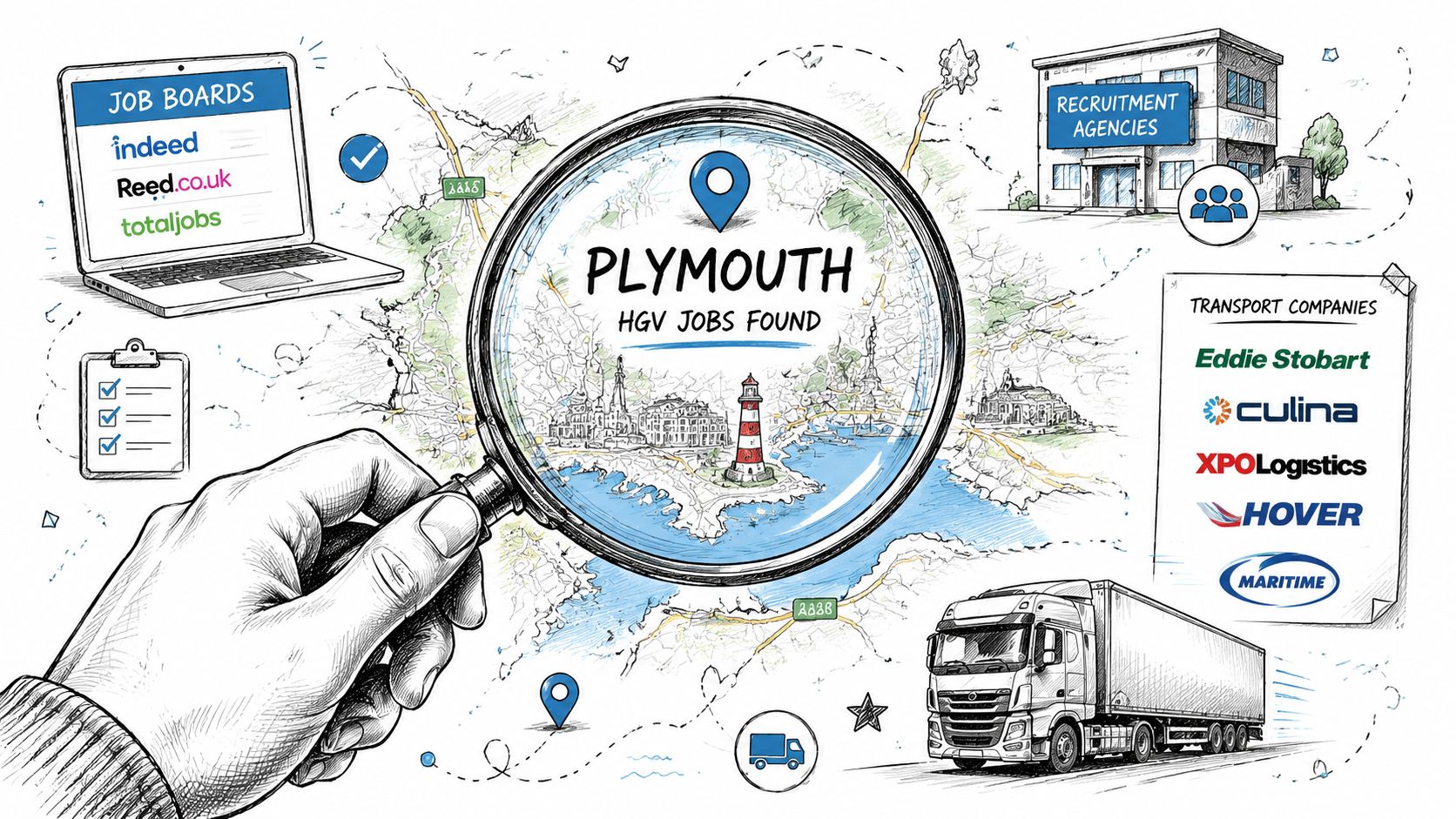
Don't rely on one job board. For HGV driver jobs in Plymouth, build a short search routine and repeat it each week.
Try a mix of:
Mainstream job boards: These give you volume and help you track what employers keep asking for.
Direct employer career pages: Waste management firms, builders' merchants, transport operators, and utility contractors often post roles on their own sites first.
Specialist recruiters: If you want a broader route into local work, directories of recruitment agency partnerships can help you identify agencies that already place transport and logistics staff.
Sector-specific advice hubs: This guide to lorry driver jobs near me is useful if you want to narrow your search by location and licence type.
Read the advert like a recruiter would
New drivers often reject themselves too quickly. They see “experience preferred” and close the page. But “preferred” is not the same as “required”.
Look for the essential requirements first:
Licence category
CPC card
Digital tacho card
Shift pattern
Vehicle type
Any specialist add-ons such as ADR or HIAB
Then ask whether the rest is trainable on the job.
A good local example is a permanent HGV Class 2 driver role at SUEZ in Plymouth, which offers £38,679.21 per year (£15.61 per hour) for 47.5 hours a week, Monday to Friday, and lists an HGV Class 2 licence and CPC card as essential on the SUEZ HGV driver vacancy page. That kind of advert is useful because it shows what employers often care about most. Correct licence. Valid CPC. Ability to do the job reliably.
Apply where you meet the essentials, even if you don't tick every “nice to have” line.
How to make a new-driver application stronger
A newly qualified driver can still look job-ready. Your CV and application should show that you understand what the role involves.
Include practical points such as:
Your exact licence category
That your CPC is current
That your digital tacho card is ready
Any relevant background in deliveries, construction, warehousing, customer service, or vehicle checks
Shift flexibility if you can offer it
If you've worked in physically demanding or time-sensitive jobs before, say so. Employers don't just hire for steering ability. They hire for punctuality, safety habits, calmness, and professionalism.
Understanding Pay Scales and Nailing the Interview
You spot a Plymouth HGV job advert with a better hourly rate than the last one you saved. It looks promising until you notice the fine print. Night work, weekend shifts, multi-drop pressure, or a Class 1 requirement can change what that headline figure really means for a new driver.
That is why pay needs reading in context, not in isolation.
A local Class 2 role can be the better first step even if the top-line pay looks lower. For a newly qualified driver in Plymouth, a steady route, regular start times, and an employer willing to assess attitude over experience can be worth more than an extra pound or two per hour. The hard part is that many adverts talk about pay clearly and training support vaguely, if at all.
Expected HGV driver salaries in Plymouth 2026
Licence Category
Experience Level
Average Annual Salary
Average Hourly Rate
Cat C Class 2
Entry level
£30,000 to £36,000
£13 to £16
Cat C+E Class 1
Experienced
£38,000 to £50,000+
£16 to £22+
Live Plymouth Class 1 C+E vacancies also show hourly rates between £14.62 and £24.00, with a standard full-time week of 40 hours, on Jobsite's Plymouth Class 1 C+E listings.
The pattern is simple. Higher pay usually comes with one or more trade-offs. Less predictable shifts, more complex vehicles, longer distances, tighter delivery windows, or the familiar "experience preferred" line. New drivers often get caught here. They aim only at the highest-paid adverts, then wonder why replies are thin.
A better approach is to read the advert like a route plan. Start with the destination, then check the road in between. Ask:
Is this Class 2 or Class 1?
Are the hours realistic for my current routine?
Does the job sound like store deliveries, builders' merchants, refuse work, trunking, or general haulage?
Does the employer say "experience required," or do they leave room for a strong new driver?
Is the pay basic salary, hourly rate, or a figure boosted by overtime and weekends?
That last point catches people out more often than it should. A salary can look strong until you realise it depends on long weeks every week.
What employers usually test in interviews
HGV interviews are usually less about polished sales talk and more about whether you can be trusted with a large vehicle, a schedule, and a customer's site rules.
Employers commonly test four things:
Safety habits: Can you talk through daily walk-round checks in a clear, sensible order?
Decision-making: What would you do if you arrive at a tight delivery point with parked cars, pedestrians, or poor visibility?
Compliance: Can you explain CPC, drivers' hours, tacho use, and why cutting corners causes problems fast?
Work attitude: Will you stay calm if a route changes, a load is delayed, or a customer is frustrated?
If you are newly qualified, this can feel awkward. You may think, "I have not done the job yet, so what can I say?" Use examples from any role where timing, safety, checks, public contact, or responsibility mattered. Warehouse work counts. Construction support counts. Delivery van work counts. Even a customer-facing job can help if it shows patience and professionalism under pressure.
A simple way to prepare
Treat the interview like a pre-use vehicle check. Small misses can stop the journey before it starts.
Read the advert again the night before. Match your answers to the actual job, not to HGV driving in general. If it is a Plymouth multi-drop role, prepare to talk about route awareness, customer contact, and staying methodical under time pressure. If it is trunking, focus more on compliance, vehicle sympathy, and steady driving.
Then sort your practical prep:
Put your licence, CPC card, and digital tacho card together
Check the interview time, location, and parking
Plan your trip properly, especially if traffic around Marsh Mills, the A38, or city-centre access could slow you down
Wear clean, practical clothes that suit a driving assessment as well as a sit-down interview
For the driving assessment, calm beats flashy every time. The assessor is usually looking for observation, space management, mirror use, smooth control, and safe judgement. A driver who pauses, reassesses, and makes a sensible choice often creates a better impression than one who tries to look ultra-confident and rushes into a mistake.
The aim is not to sound perfect. It is to show that you are teachable, prepared, and safe enough to back as a new driver. In Plymouth, where entry-level openings can be limited and many adverts still ask for experience, that steady, reliable impression is often what gets you through the door.
Your Next Steps on the Road with HGV Learning
A driving career in Plymouth is achievable when you stop treating it as one huge leap. It's a chain of manageable steps. Get the eligibility right. Complete the paperwork carefully. Train with purpose. Prepare for the tests. Then target the right vacancies instead of waiting for the perfect trainee advert to appear.
The hidden hurdles are real. Local test access can be awkward. Entry-level adverts don't always make room for newly qualified drivers. But those problems are easier to handle when you know they're coming and plan around them early.
If you're serious about moving into HGV driver jobs in Plymouth, support matters most at the points where people usually stall. That means sorting documents properly, arranging the medical without confusion, building confidence for theory and practical stages, and getting useful guidance when it's time to apply for work.
You don't need to know everything today. You just need to take the first proper step and keep the process moving.
If you want help turning your plan into a real licence and a real job search, HGV Learning can support you from the first paperwork stage through training, test preparation, and recruitment guidance. If you're aiming for C1, Cat C, or C+E work and want a clearer route into the industry, it's a sensible place to start.
What Age Can You Start HGV Driver Training? A 2026 UK Guide to Licence Age Requirements
If you're asking what age you can start HGV driver training, the honest answer depends on which licence you're after. A C1 licence, covering vehicles...