If you’re searching for “HGV driver training near me,” you’re on the right track for a career that’s both stable and genuinely rewarding. The whole journey starts with one crucial step: finding a reputable, DVSA-approved local provider who can see you through the medical, theory, and practical tests.
Honestly, choosing the right school is the single most important decision you’ll make.
Your Starting Point for Finding Local HGV Training
Starting a career as a Heavy Goods Vehicle driver is a big move, but the path to getting your licence is a lot clearer than you might think. It all starts with tracking down a quality training provider in your area who can guide you through every single step.
A great training centre doesn’t just teach you how to pass a test; it sets you up for a long and successful professional driving career. With a constant demand for qualified drivers across the UK, it’s a smart career choice. But the quality of your training will make all the difference. You need a school that offers more than just a lorry and a few lessons.
What to Expect From Your Training Journey
The entire process is structured to make sure you have the medical fitness, theoretical knowledge, and practical skills to handle these massive vehicles safely. Your journey will follow a few key stages, from the initial paperwork right through to your final practical test. Knowing this path from the start helps you manage your expectations and stay focused on each milestone.
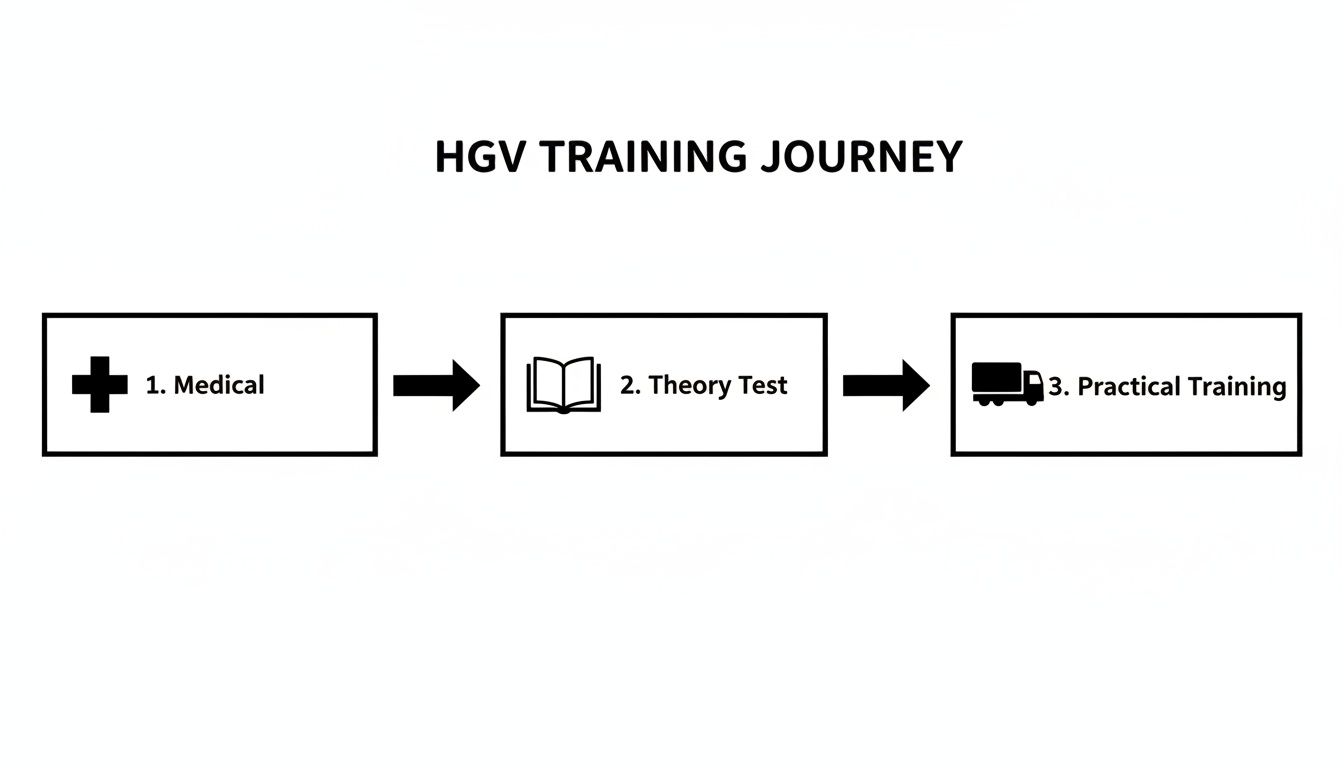
This visual flow shows the typical journey you’ll take to get your HGV licence.
As you can see, it all begins with that essential medical assessment before you even touch the theory books, let alone get behind the wheel. The right training partner makes these steps feel seamless, often helping you book appointments and providing all the materials you need.
That kind of support is invaluable, especially when you’re trying to figure out DVSA requirements for the first time. It cuts out the administrative headache and lets you focus on learning. For those aiming for a rigid lorry licence first, you can find more specific advice on our guide to finding HGV Class 2 training near you.
A well-structured training programme is your roadmap to success. It ensures you tick every legal box efficiently, building your confidence from the classroom to the open road and preparing you for a long-term career.
Your goal isn’t just to get a licence; it’s to gain the competence and self-assurance to handle a 44-tonne vehicle in any situation. A top-tier local school will provide:
DVSA-Approved Instructors: Experts who know the local test routes inside and out and understand precisely what examiners are looking for.
Modern Training Vehicles: You’ll learn on the kind of lorry you’re likely to be driving in your new job.
End-to-End Support: Proper guidance on everything from filling out medical forms to booking your final test.
How to Vet Local HGV Training Centres
Finding a list of local HGV training centres is the easy part. The real work is figuring out which ones are genuinely any good.
A slick website doesn’t always mean quality training, so you need to look closer to separate the best from the rest. Making the right choice now will save you a ton of time, money, and stress down the line.
Look for Substance, Not Just Sales Talk
Your first stop should be the provider’s website, but you’re looking for evidence, not just marketing fluff. Look for clear signs of their credentials. Do they have a physical address for their training ground? Do they proudly display their status as a DVSA-approved training body?
This isn’t just a logo; it’s a mark of quality assurance. It shows they meet national standards for instruction and safety.
Also, pay close attention to the photos and testimonials. Do they show real students with their instructors and lorries, or are they just generic stock images? Genuine reviews from named individuals give you a much better feel for the company’s culture and, most importantly, its success rate.
Key Questions to Ask Before You Commit
Once you’ve got a shortlist, it’s time to pick up the phone. How a training centre handles your first call speaks volumes. A good provider will be happy to answer your questions in detail without rushing you into a decision.
Here are the essential questions you need to ask:
What are your recent pass rates? No one can guarantee a pass, but a consistently high success rate (ideally above the national average) is a very strong sign of quality teaching.
What age and model are your training vehicles? You want to learn in a modern, well-maintained lorry that’s similar to what you’ll actually be driving professionally.
Is all practical training done one-to-one? Steer clear of schools that use ‘cab sharing’, where you have to split your driving time with another learner. Your training time should be 100% your own.
Are your instructors full-time employees or freelance? Full-time instructors are often more invested in the school’s reputation and their students’ success.
This conversation is your chance to get a read on their professionalism. If they’re evasive or pressure you to pay a deposit right away, that’s a major red flag.
A reputable training centre will be transparent and patient. They get that this is a big investment for you and should be focused on making sure they’re the right fit for your career, not just making a quick sale.
Digging Deeper with Independent Reviews
Finally, look beyond the company’s own website for feedback. Check recent reviews on platforms like Google or Trustpilot to get an unfiltered view from former students. When you search for “hgv driver training near me reviews,” you can uncover insights you won’t find on their homepage.
Look for patterns in the comments. Do multiple people praise a specific instructor? Are there recurring complaints about vehicle breakdowns or a disorganised booking system? One bad review might just be an outlier, but a series of similar comments points to a genuine problem.
This balanced approach ensures you’re not just buying a marketing promise. You’re investing in a provider with a proven track record of helping people just like you get qualified and out on the road.
Navigating the Initial Paperwork and Theory Tests
Before you even think about getting behind the wheel, there’s a bit of essential admin to sort out. It can feel like a paper chase at first, but getting this stage right ensures everything that follows runs smoothly. Think of it as laying the foundation for your HGV career.
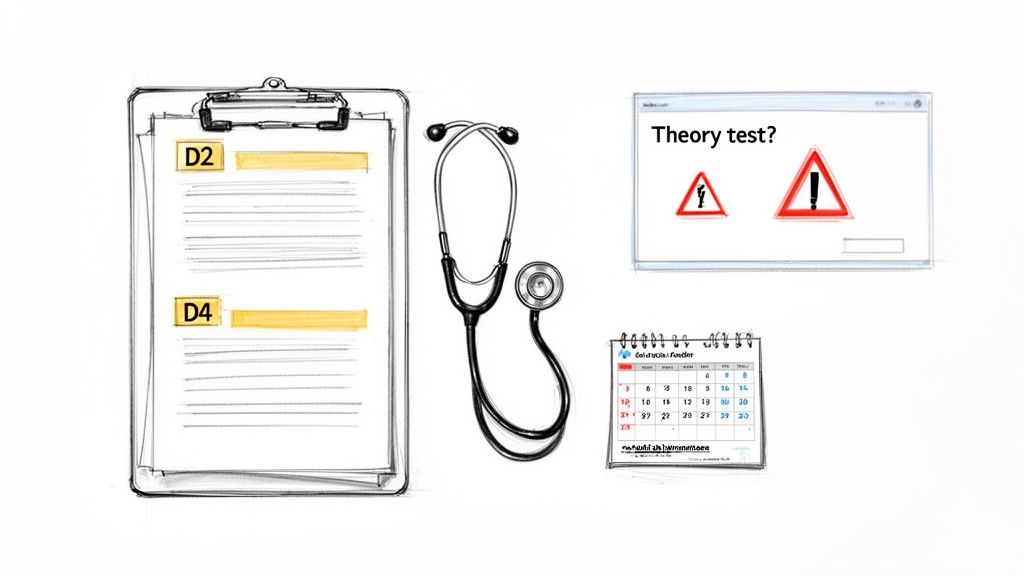
The first things you’ll need to get your hands on are the D2 and D4 forms. The D2 is your application for a provisional HGV licence, and the D4 is a medical report that a doctor needs to complete for you. Any decent local training provider should be able to supply these forms or at least point you in the right direction, taking the guesswork out of it.
Securing Your HGV Medical Examination
You can’t apply for your provisional licence without a signed D4 form, so booking an HGV medical is your first real task. While you could go to your own GP, they often charge a premium for this kind of thing. Many private doctors specialise in driver medicals, and they’re usually quicker and more affordable.
During the medical, the doctor will run through a few key health checks to make sure you meet the standards for safely handling a large vehicle.
Eyesight: Your vision will be tested to confirm it meets the minimum DVSA requirements, both with and without glasses or lenses if you use them.
Blood Pressure: The doctor will check your blood pressure, as high blood pressure could affect your fitness to drive professionally.
General Health: You’ll have a chat about your medical history, including any past or present neurological or heart conditions, to get a full picture of your fitness.
It’s so important to be completely honest on the D4 form. If you withhold information, you risk having your licence taken away down the line. Make sure you turn up to your appointment with your driving glasses and a list of any medications you’re taking.
Once the doctor has signed the D4, you can send it off with your completed D2 form to the DVLA. A few weeks later, your provisional licence should arrive in the post—that’s your green light to get the theory tests booked.
Conquering the HGV Theory Tests
With your provisional licence in hand, the next milestone is the HGV theory test. It’s actually split into two separate parts, and you need to pass both before you can start your practical training. This is a big hurdle where focused revision really pays off.
The first part is a multiple-choice test. This covers everything from road signs and drivers’ hours to daily vehicle safety checks. The second is the hazard perception test, where you’ll watch video clips and click the mouse as soon as you spot a developing hazard.
A lot of aspiring drivers underestimate the theory tests, thinking their car driving knowledge will see them through. The HGV theory is a different beast altogether—it’s far more detailed and technical, covering rules you’ll need to know inside out as a professional.
Proper preparation is the only way to pass the first time. Don’t just try to memorise answers; your goal should be to understand the principles behind the rules. For a complete rundown of what’s involved and how best to prepare, you can learn more about the theory test for an HGV licence in our detailed guide. Remember, this knowledge isn’t just to pass an exam—it’s the professional expertise you’ll rely on every single day on the road.
Understanding the Costs and Funding Your Training
Getting your HGV licence is a serious investment in your future, but it’s one that can pay off handsomely in a career with high demand and solid earnings. Let’s get straight to the point and talk about the costs involved so you can plan properly and avoid any nasty surprises down the road.
When you start searching for “HGV driver training near me,” you’ll see prices vary quite a bit. That’s why it’s crucial to know exactly what you’re paying for. A good, transparent training package should cover everything from start to finish—your medical, theory tests, practical training, and the final exam fees.
Breaking Down the Costs
When you get a quote, don’t just look at the final number. You need to see a full breakdown. A complete training package usually bundles all the essential costs together, which is not only more convenient but often works out cheaper than paying for everything separately.
A proper, all-inclusive package should cover:
Medical Examination: The fee for the doctor to fill out your D4 medical form.
Theory Test Fees: This covers both the multiple-choice questions and the hazard perception test.
Practical Training Hours: This is the biggest part of the cost, covering your one-on-one time in the lorry with an instructor.
Vehicle Hire for Test Day: The use of their lorry for your final practical test.
Practical Test Fees: The fee the DVSA charges for the test itself.
Watch out for providers advertising a temptingly low price. Often, this only covers the practical driving hours, leaving you to sort out—and pay extra for—all the other bits and pieces. Always, always ask for an itemised quote so you can see exactly where your money is going.
Exploring Funding and Payment Options
While a lot of people pay for their training out of their own pocket, there are other ways to make the cost much more manageable. You don’t necessarily need to have a huge lump sum saved up to get started.
One of the most successful government-backed schemes has been the Skills Bootcamps. These are intensive, funded training courses designed to get people into high-demand jobs, like HGV driving, quickly. The results speak for themselves: by the end of February 2025, an incredible 3,474 people had passed their HGV driver training through HGVC-run Skills Bootcamps, and 2,695 of them walked straight into job offers. You can read more about these impressive results on Fleetpoint.
Of course, these funded spots can be limited and depend on government policy at the time, so it’s smart to have a backup plan.
Many reputable training providers get that the cost is a big commitment. That’s why they often offer flexible in-house payment plans. This lets you spread the cost over several months so you can start training without needing the full amount upfront.
These plans make getting your licence so much more achievable, letting you pay in smaller, more manageable instalments. When you’re talking to a potential training school, always ask what payment options they have. A provider that’s willing to be flexible is usually a good sign they’re invested in your success and will be a supportive partner on your journey.
Mastering Your Practical Driving Skills
Okay, this is where the theory ends and the real work begins. Your practical HGV training is an intense, hands-on experience that builds your confidence and skill behind the wheel of a proper lorry. It’s without a doubt the most important part of your journey to becoming a professional driver.
During your lessons, you’re not just memorising facts; you’re engaging in a powerful form of experiential learning. It’s one thing to read about reversing a 44-tonne artic, but it’s another thing entirely to actually do it.
This direct, real-world experience is what truly gets you ready for life on the road, turning abstract rules into pure muscle memory.
From Daily Checks to Complex Manoeuvres
Every single day of your practical training will kick off with the basics: the daily vehicle safety check. Your instructor will walk you through a thorough inspection, showing you how to check everything from tyres and lights to fluid levels and braking systems. This isn’t just about ticking a box for the test; it’s a non-negotiable habit for any professional driver.
Once you’ve got that down, you’ll get into the core driving skills. This is where you really get to grips with the unique challenges of handling a large, heavy vehicle.
Here are some of the key manoeuvres you’ll master:
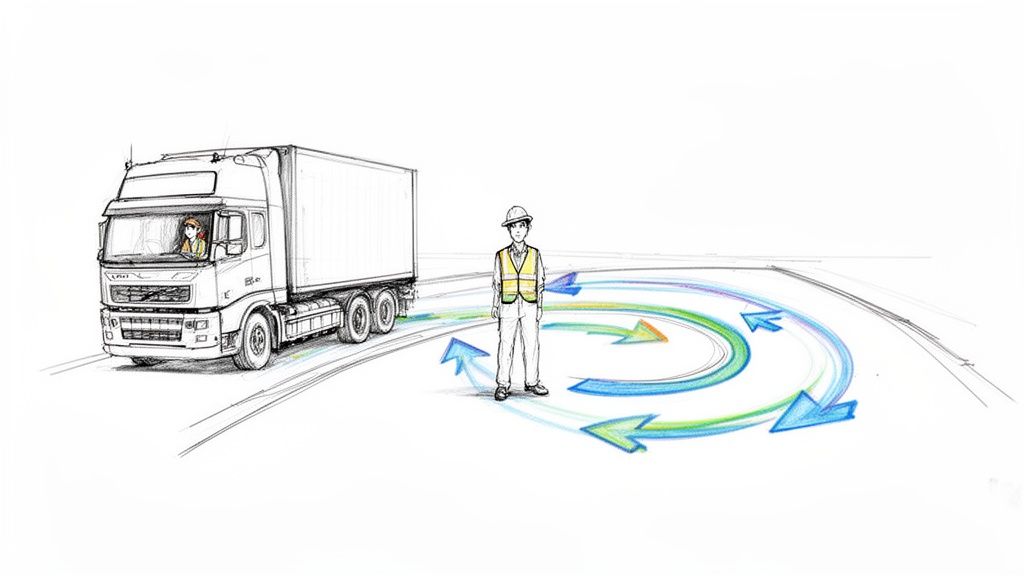
The Reversing Exercise: This is often an ‘S’ shaped reverse into a bay marked out by cones. It’s a true test of your spatial awareness and your ability to control the trailer’s path with precision.
Coupling and Uncoupling: If you’re going for your C+E licence, you’ll learn the exact, safety-critical sequence for attaching and detaching a trailer.
On-Road Driving: You’ll spend a huge chunk of your time out on public roads, learning to navigate everything from tight city streets and tricky roundabouts to fast-moving dual carriageways and motorways.
The need for skilled drivers is massive. The Road Haulage Association (RHA) pointed out in November 2025 that the UK must train 60,000 new HGV drivers every year for the next five years just to keep our supply chains running.
What the Examiner Looks For in Your Practical Test
All your hard work leads up to the Module 3 practical test. A DVSA examiner will assess your ability to drive safely and professionally while following the Highway Code. They aren’t looking for a flawless, perfect drive, but they absolutely need to see a high standard of control and awareness.
The practical test isn’t designed to catch you out. It’s a straightforward assessment of whether you can handle a large vehicle safely. Your instructor will have prepared you for everything the examiner wants to see, so just trust your training and focus on being a safe, competent driver.
The examiner will be marking you on several key areas, from your general driving and awareness of others to how you perform the set manoeuvres. Staying calm and simply demonstrating the safe practices you’ve drilled over and over again is the secret to passing. A good training provider makes sure you’re not just ready for the test, but ready for the job that comes after.
Landing Your First Job as a Qualified HGV Driver
Passing your practical test is a massive achievement, but let’s be honest, it’s just the starting line. The real prize is turning that new licence into a steady, rewarding career. The great news? You’re stepping into a market that is crying out for qualified drivers.
Your first move is to get your CV in order. Knowing how to write a CV (UK version) that gets you noticed is the key to unlocking that first HGV role. This is your professional handshake, so make it a firm one.
Creating a Standout Driver CV
Don’t bury the lead! Your CV needs to shout about your new licence category (Cat C or C+E) and your Driver CPC qualification right at the very top. Employers are scanning dozens of CVs, looking for those exact credentials. Make them impossible to miss.
Even if you don’t have professional driving experience yet, you absolutely have relevant skills. Talk about your clean driving record from your car licence. Mention any customer service experience you’ve had. Highlight your reliability and timekeeping. These are the qualities transport managers are really looking for.
Finding and Applying for Vacancies
With a polished CV in hand, it’s time to hit the job market. The demand for HGV drivers is so high right now that you’re in a fantastic position with plenty of avenues to explore.
Online Job Boards: Sites like Indeed, Totaljobs, and Reed are flooded with HGV driver jobs. You’ll find everything from local multi-drop work to long-distance trunking.
Specialist Recruitment Agencies: Loads of agencies focus purely on placing HGV drivers. They have direct lines to companies that are happy to take on newly qualified drivers.
Go Direct: Never underestimate the power of a direct approach. Contact local haulage firms, logistics companies, or even builders’ merchants. A bit of initiative often pays off big time.
The push to get more drivers on UK roads is huge. Both the industry and the government are working hard to fill vacancies, which means you’ve picked the perfect time to get your licence and start earning.
You can see the drive to fill these roles in the official numbers. Practical HGV tests shot up to 26,388 in the first quarter of 2022 alone. That’s a massive 43% increase from the same time in 2019, driven by recruitment campaigns and extra training spots.
Once you land an interview, be ready to talk about your training, your attitude towards safety, and your professional approach. For more insider tips on nailing the hiring process, check out our guide on HGV recruitment advice. With the right game plan, you’ll be behind the wheel of your new truck before you know it.
Your Top HGV Training Questions Answered
When you’re looking at getting into HGV driving for the first time, you’re bound to have a lot of questions. That’s completely normal. To give you a bit more confidence as you start out, here are some quick, clear answers to the queries we hear most often from new drivers.
Getting the facts straight from the beginning helps you plan your time and money far more effectively.
How Long Does HGV Training Take?
This is probably the number one question we get asked. While everyone learns at their own pace, you can realistically expect the whole process—from sorting your medical and provisional licence to passing all the tests—to take somewhere between 8 and 12 weeks.
The hands-on, in-cab training is usually packed into an intensive one-week course. But the total time can stretch a bit depending on how busy your local DVSA test centre is and how quickly you can get the initial paperwork and theory revision done.
Is There a Difference Between HGV and LGV?
You’ll see HGV (Heavy Goods Vehicle) and LGV (Large Goods Vehicle) thrown around, and it can be confusing. The simple answer? There is no difference.
In the UK, the terms are used interchangeably for the same group of driving licences covering vehicles that weigh over 3.5 tonnes. So, if you spot a course advertising an “LGV licence,” it’s the exact same qualification as an “HGV licence.”
What Qualifications Do I Need to Start?
Good news – you don’t need any academic qualifications like GCSEs or A-Levels to get started. The requirements are much more practical, all designed to ensure you’re safe on the road.
To be eligible to start your training, you must:
Be at least 18 years old.
Hold a full UK car driving licence (Category B).
Pass the DVSA D4 medical exam to prove you’re medically fit to drive.
Is Driver CPC a Legal Requirement?
Yes, absolutely. The Driver Certificate of Professional Competence (CPC) is a legal must-have for nearly all professional HGV drivers working in the UK and Europe. It’s not an optional extra; it’s a core part of your professional qualification.
Your initial Driver CPC is built right into your main training package. It’s made up of what’s known as Module 2 (Case Studies) and Module 4 (Practical Demonstration). To keep your CPC valid, you’ll then need to complete 35 hours of periodic training every five years.
This ongoing training makes sure your professional knowledge is always up to scratch, covering essential topics like drivers’ hours, health and safety, and fuel-efficient driving.
Ready to get started and find the perfect hgv driver training near me? At HGV Learning, we offer complete support to get you qualified and into your new career. Find out more at https://hgvlearning.com.
Related Articles
09/03/2026
UK CPC Course Cost: A Complete 2026 Pricing Guide
When you're looking to get on the road professionally, one of the first questions on your mind is bound to be about the cost. In...