If you want to drive a lorry for a living, the first term you need to know is the Class 2 licence. Officially, it’s called a Category C licence here in the UK. It is your ticket to driving rigid heavy goods vehicles (HGVs) that weigh more than 3,500kg.
This is the most common starting point for anyone serious about a professional driving career. It covers everything from local delivery lorries to large construction vehicles. Think of it as your foundation in the world of logistics and transport.
Your Starting Point for a Professional Driving Career
So, what exactly is a Class 2 licence? Put simply, it’s the qualification that bridges the gap between your standard car licence (Category B) and the world of HGVs. While your car licence keeps you in smaller vehicles, a Class 2 opens the door to the powerful, rigid lorries that are the lifeblood of the UK economy.
Getting this licence is more than just passing a test. It is about proving you have the skill, knowledge, and professionalism to handle heavy machinery safely on the UK’s roads. It’s the most popular starting point for new drivers because it provides immediate access to a massive range of jobs without the added challenge of an articulated lorry (that’s a Class 1).
What Vehicles Can You Drive?
Once you have your Category C licence, you are legally cleared to drive any rigid vehicle with a Maximum Authorised Mass (MAM) over 3,500kg. ‘Rigid’ just means the cab and the trailer are one fixed unit – they do not bend in the middle.
This covers some of the most common lorries you see every day:
Box Lorries: The workhorses of supermarket and retail deliveries.
Tipper Lorries: Absolutely essential on construction sites for moving materials like gravel and sand.
Refuse Collection Vehicles: The council lorries that keep our streets clean.
Flatbed Lorries: Perfect for carrying large, bulky, or unusually shaped cargo.
This incredible versatility is what makes the Class 2 licence so valuable. It unlocks job opportunities across dozens of sectors right away. This gives you a stable and highly in-demand skill set from the day you qualify.
Your Class 2 (Category C) licence is the most direct way into the professional driving industry. It not only qualifies you for a huge variety of jobs but is also the mandatory stepping stone before you can even think about upgrading to a Class 1 (C+E) licence for articulated lorries.
By starting with a rigid vehicle, you build up vital experience and confidence in handling a large HGV. This makes the eventual move to an even bigger ‘artic’ lorry feel like a natural, logical next step. It’s the smart way to build your career.
Understanding the Different HGV Licence Categories
To really understand what a Class 2 licence offers, it’s useful to see where it fits in the wider world of professional driving. The HGV licensing system is a bit like a ladder. Each category lets you drive bigger, more complex vehicles. Think of your standard car licence as the ground floor; the Class 2 is your first proper step up.
The official term for a Class 2 licence is Category C. This is the one that lets you drive any rigid lorry with a Maximum Authorised Mass (MAM) over 3,500kg. A brilliant feature of this licence is that you can also tow a small trailer, as long as it does not weigh more than 750kg. This is a huge plus for many jobs that need you to haul extra tools or small bits of equipment.
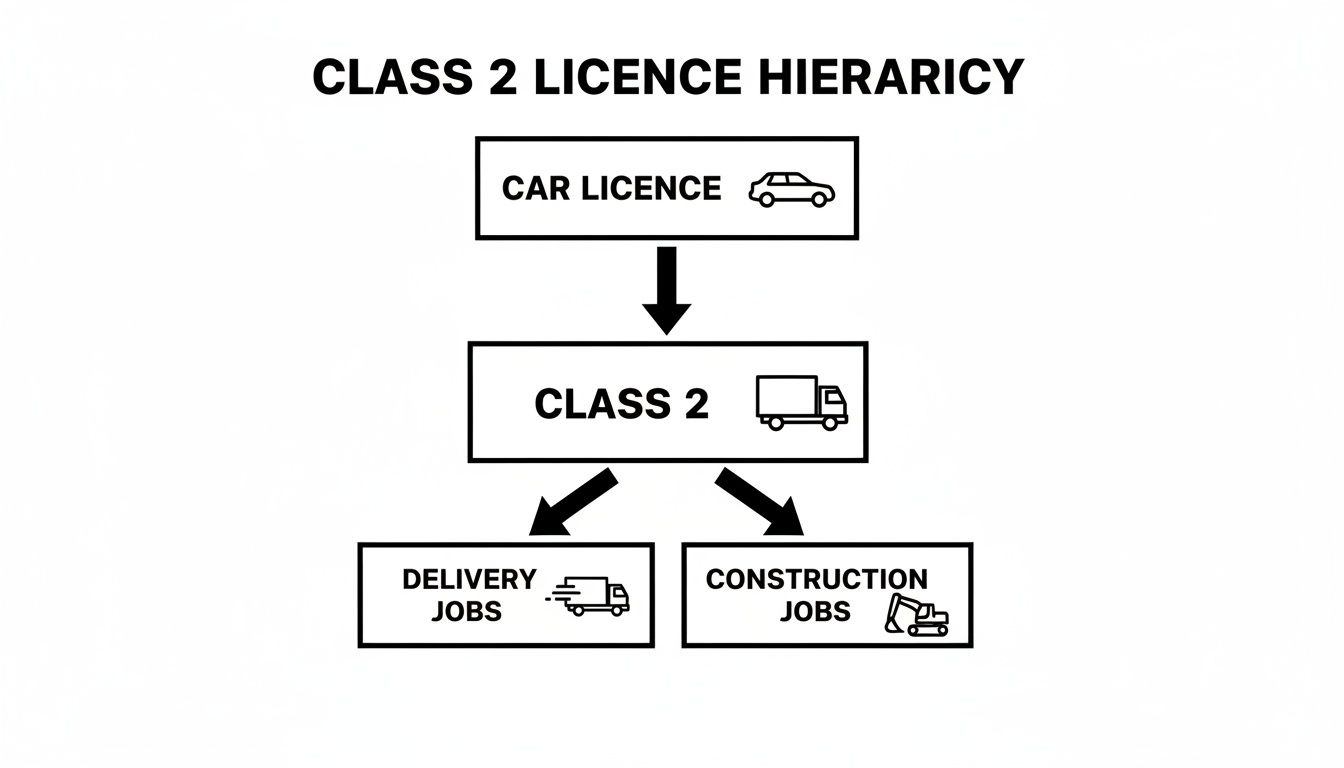
This diagram shows the journey from a basic car licence to getting your professional Class 2 qualification and the doors it opens.
As you can see, it’s a clear path. Your car licence is the starting block. The Class 2 is the core HGV qualification, and it leads straight into great career opportunities in logistics, construction, and beyond.
UK HGV Licence Categories at a Glance
The HGV world mainly revolves around three key categories: C1, C (Class 2), and C+E (Class 1). Seeing how they differ makes it obvious why the Class 2 is such a popular choice for new drivers. It hits that sweet spot between being accessible and opening up a massive range of jobs.
Here’s a quick comparison to make things crystal clear.
Licence Category
Common Name
Vehicle Type
Maximum Authorised Mass (MAM)
Typical Jobs
C1
7.5 Tonne
Smaller rigid lorries, large vans
3,500kg – 7,500kg
Local delivery, horseboxes
C
Class 2
Any rigid vehicle
Over 3,500kg
National distribution, tippers
C+E
Class 1
Articulated lorry (‘artic’)
Over 3,500kg + trailer over 750kg
Long-haul, supermarket trunking
Understanding these categories shows why the Category C licence is the essential gateway to driving the most common and versatile lorries on our roads. If you want to dive deeper into this specific qualification, check out our complete guide to the Category C licence pathway to professional driving.
Real-World Examples of Class 2 Vehicles
Theory is one thing, but it all makes sense when you see these vehicles on the road. Once you have your Class 2 licence, you are qualified to drive the lorries that are the true backbone of the UK. These are not just letters on a licence; they are real, working machines.
Think about the lorries you see on your daily commute or doing deliveries at the local supermarket. Chances are, a Class 2 driver is behind the wheel.
A Class 2 licence is your key to operating the workhorses of British industry. From the tipper lorry at a building site to the bin lorry on your street, these vehicles are all driven by professionals holding a Category C qualification.
Here are just a few examples of what you could be driving:
Multi-drop Delivery Lorries: The 18-tonne rigid lorries you see restocking high street shops and supermarkets every single day.
Tipper and Grab Lorries: Absolute essentials in the construction trade, used for shifting earth, aggregates, and building materials from site to site.
Refuse Collection Vehicles: The specialised lorries that are a vital part of our public services, needing skilled drivers to navigate tight residential streets.
Flatbed Lorries: Perfect for carrying everything from scaffolding and bricks to oversized loads that just would not fit in a standard box lorry.
Each of these roles demands the skill and professionalism that comes with passing your Class 2. It’s about more than just driving a big vehicle; it’s about becoming a crucial link in the chain that keeps the country running.
Your Step-by-Step Journey to Getting Your Class 2 Licence
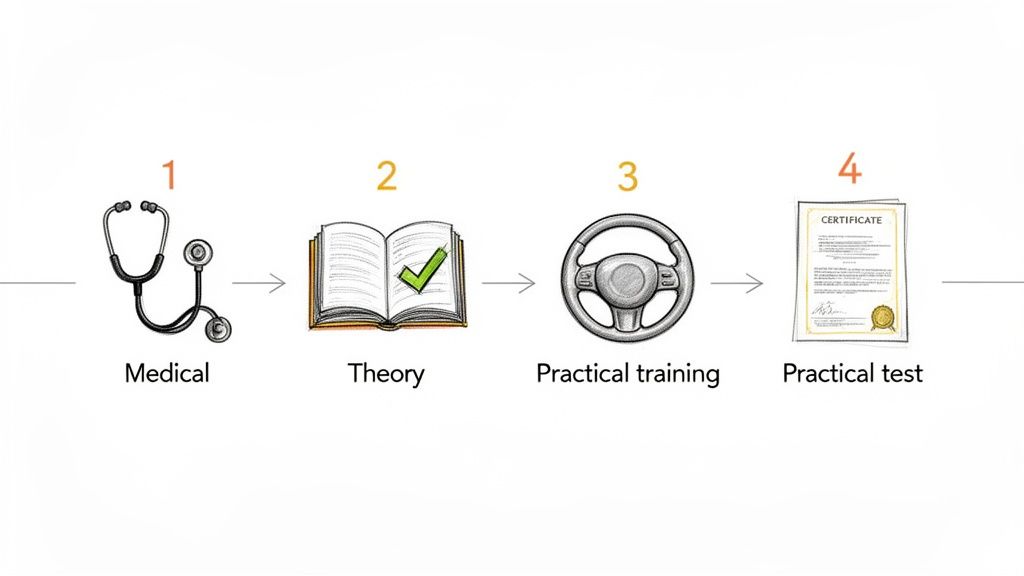
Understanding the licensing process for a Class 2 lorry can feel a bit daunting at first, but it’s actually a very clear, structured path. Think of it as a four-stage mission. Each step you complete gets you closer to becoming a professional driver. This roadmap is designed to cut through the jargon and paperwork, showing you exactly what’s coming up next so you can tackle it with confidence.
Making the leap from a car driver to a qualified HGV professional is more achievable than you might think. With the right support and a clear plan, you can work through the requirements efficiently and get on the road.
Let’s break this journey down into its four core stages. Here’s your straightforward guide to earning that Category C licence.
Stage 1: Medicals and Provisional Application
Before you can even think about theory books or getting in a cab, you need to prove you are medically fit to handle a large vehicle. This is the first official hurdle, and it’s a crucial one.
Your journey starts with a D4 medical examination. A doctor will carry out this specific assessment, checking your eyesight, general health, and any conditions that might affect your driving. It’s much more thorough than the standard for a car licence, reflecting the extra responsibility you have as an HGV driver.
Once the doctor gives you the all-clear and signs your D4 medical certificate, you will use it to apply for your provisional HGV licence. This means filling out two forms:
D2 Form: This is your main application for the provisional Category C entitlement.
D4 Form: This is the medical report you just got signed by the doctor.
You will send both of these off to the DVLA. Once they have processed it, your driving licence will come back with the provisional Category C added. That’s your green light to start practical driver training with an instructor.
Stage 2: The Theory Tests
With your provisional licence sorted, it’s time to hit the books. The theory side of HGV driving is not just a single test. It’s a series of exams designed to build the solid foundation of knowledge every professional driver needs. These are known as the Driver CPC (Certificate of Professional Competence) Modules 1 and 2.
The theory tests are more than just a box to tick—they form the bedrock of your professional expertise. Understanding topics like hazard perception and case studies is what allows you to make safe, split-second decisions on the road. This skill truly defines a great driver.
The theory stage is split into a few key parts:
Module 1a Multiple Choice: This covers everything from vehicle safety and road signs to the complex rules on drivers’ hours. It’s a 100-question exam, and you will need to get at least 85 right to pass.
Module 1b Hazard Perception: In this test, you will watch 19 video clips of real-life driving situations. You will have to click as soon as you spot a developing hazard. It’s all about proving you can see trouble before it happens.
Module 2 Case Studies (CPC): This exam presents you with seven real-world scenarios that you might encounter on the job. You will answer questions on them, showing you can apply your knowledge in a practical, problem-solving way.
You must pass all parts of the theory test before you are allowed to book your practical exam.
Stage 3: Practical Driver Training
This is where it all starts to click. With the theory under your belt, you can finally jump into the driver’s seat of a Class 2 vehicle with a qualified instructor. Practical training is where you translate all that knowledge into real-world skill. You will learn to handle a big rigid lorry through all kinds of traffic and road conditions.
Your training will cover every essential manoeuvre and driving technique required by the DVSA, including:
Vehicle Safety Checks: Learning the daily walkaround checks to ensure your lorry is safe and roadworthy.
Reversing Manoeuvres: Nailing the ‘S’ shaped reverse into a designated bay—a core skill.
Coupling and Uncoupling: While this is more of a Class 1 skill, you may cover the basics of how to attach and detach a trailer.
On-Road Driving: Getting comfortable and confident navigating everything from tight city streets to motorways and winding country roads.
This hands-on experience is absolutely vital. A good training provider will not just teach you how to pass the test; they will prepare you for the day-to-day reality of being a professional HGV driver.
Stage 4: The Practical Tests
The final stage is where you prove you have what it takes. It involves two practical exams: the driving test itself and a practical demonstration test. These make up Modules 3 and 4 of the Driver CPC.
First up are the Module 3a (Off-Road) and Module 3b (On-Road) driving tests. The 3a part checks your reversing and manoeuvring skills in a safe, controlled area. The 3b part is the main on-road exam, where a DVSA examiner will be in the passenger seat for about 60 minutes. They will assess your overall driving ability, control of the vehicle, and road awareness.
Lastly, you will tackle the Module 4 Practical Demonstration Test. Here, you will walk around the vehicle with an examiner, demonstrating your understanding of vehicle safety, load security, and preventing illegal trafficking. You will be asked questions and need to explain how you would perform various checks. Passing this final hurdle completes your Initial Driver CPC. And just like that, you are officially a qualified, professional HGV driver.
Understanding the Costs, Timelines, and Training Options
Taking the leap into a professional driving career is an exciting move. But it is one that requires a clear look at the investment in both time and money. If you know what to expect financially and how long the whole process is likely to take, you can plan properly and pick a path that fits your life.
This section offers a completely transparent breakdown of everything involved in getting your Class 2 licence. We will walk through the typical costs for each stage—from medicals and theory tests to practical training and final exams. This will give you a realistic budget to work with. We will also explore the timelines and different training approaches available.
Breaking Down the Costs
Getting your Class 2 licence is not a single lump-sum payment. Think of it more as a series of smaller investments you make at each step of your journey.
Here are the key components you will need to budget for right at the start:
D4 Medical Exam: To prove you are fit and safe to operate these large vehicles, you will need to pass a comprehensive medical fitness for work assessment. This initial step typically costs between £50 and £100, depending on where you get it done.
Provisional Licence Application: Applying for your provisional HGV entitlement with the DVLA is currently free of charge.
Theory Tests (Modules 1 & 2): The theory test is split into a few parts, including multiple-choice questions, hazard perception, and case studies. The combined cost for these is usually around £60.
These initial admin costs are fairly small, but they are essential hurdles you need to clear before you can get into the real hands-on training.
The largest portion of your investment will be the practical driver training and testing. This is where you develop the real-world skills needed to pass your exams and handle a large goods vehicle with confidence and professionalism.
This is the part where quality instruction really makes a difference. While it’s the biggest expense, it’s the bit that directly translates into your competence and safety out on the road. For a more detailed look at expenses, you can explore our full guide on how much an HGV licence costs.
Practical Training and Testing Expenses
The bulk of your budget will go towards your practical driving course and the final tests themselves. This is the most critical phase, where you will be learning to handle the vehicle under the watchful eye of an expert instructor.
Training costs to get your Cat C licence typically range from £1,800 to £2,300. Many regional training centres charge around £2,030 for a standard five-day course. When you add the Initial Driver CPC costs (Module 4, which is about £300–£400), your total investment usually lands somewhere between £2,300 and £2,800.
The final exam fees are set by the DVSA and are paid on top of your training package. These cover the practical driving test (Module 3) and the practical demonstration test (Module 4), which together cost around £155.
Timelines and Training Options
How long it takes to get your Class 2 licence can vary quite a bit, depending on your availability and the training route you choose. On average, you can expect the entire process—from your medical right through to qualification—to take anywhere from 8 to 12 weeks.
When it comes to your practical training, you generally have two main options:
Intensive Courses: These are usually run over five consecutive days. It’s a great way to immerse yourself, learn quickly, and take your test at the end of the week. This is a very popular choice for people who want to qualify as fast as possible.
Flexible Schedules: Some training providers can spread your lessons out over several weeks. This can be ideal if you need to fit your training around an existing job or other commitments.
The right choice really comes down to your personal circumstances, how you like to learn, and how quickly you want to be out on the road. By understanding the costs and timelines upfront, you can plan your journey into this rewarding career with confidence.
Career Opportunities and Earning Potential
Once you have that pass certificate in your hand, the real journey begins. This is where your investment in training starts to pay off, opening up a huge range of career paths across some of the UK’s most essential industries. A Class 2 licence is not just a piece of paper; it’s your ticket to stable, well-paid work with fantastic job security.
The demand for skilled HGV drivers is always strong. This is not a career that follows fleeting trends—the UK economy literally depends on drivers to move goods, materials, and supplies every single day. This constant need gives anyone holding a Category C licence incredible job security.
Industries That Rely on Class 2 Drivers
The best thing about a Class 2 licence is its versatility. You are not locked into one type of work. Instead, you can find a niche in a sector that genuinely interests you, whether that’s the buzz of logistics or the hands-on world of construction.
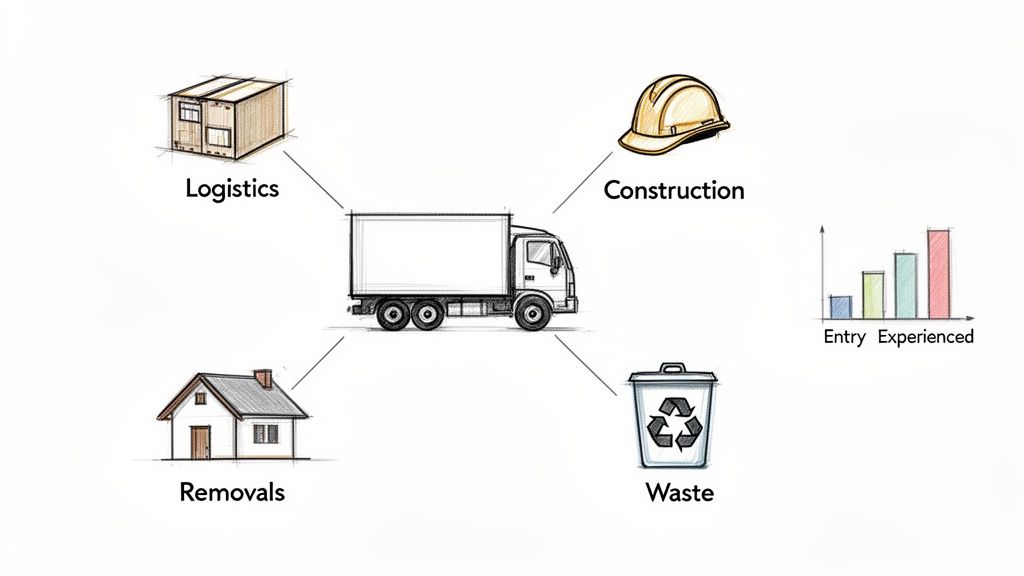
Your skills will be in high demand across a whole host of sectors, including:
Logistics and Distribution: This is the absolute backbone of the UK supply chain. You could be doing multi-drop deliveries to high-street shops, trunking for major supermarkets, or moving goods between regional depots.
Construction: Class 2 drivers are vital on building sites, operating everything from tipper lorries moving aggregates to flatbeds carrying materials and concrete mixers pouring foundations.
Waste Management: A crucial public service, this involves driving refuse and recycling lorries, often requiring real skill to navigate tight residential streets.
Removals: Both home and business removal firms need reliable drivers to safely transport furniture, equipment, and belongings up and down the country.
Specialist Haulage: You could end up driving refrigerated lorries full of fresh food or even operating vehicles fitted with cranes for specialised deliveries.
This variety means you can build a career that fits you perfectly. You might prefer the routine of a regular local route or the challenge of different project-based work each week.
Your Realistic Earning Potential
One of the most appealing parts of getting your Class 2 licence is the immediate earning potential. Unlike some careers where you have to work for years to earn a decent salary, HGV driving offers competitive pay right from the start.
Recent figures show the industry continues to be financially rewarding. In the last few years, Cat C (Class 2) drivers have been earning between £14.00 and £18.00 per hour for standard day shifts. If you are willing to do nights or weekends, that can go up to £15.00 to £20.00 per hour.
For someone just starting, this translates into a solid annual salary. Newly qualified Class 2 drivers typically earn between £22,000–£26,000.
The Class 2 licence isn’t just a qualification; it’s a direct launchpad into a secure, well-compensated career. The skills you learn are in constant demand, ensuring you have a valuable profession for life.
As you gain more experience and build a reputation for being reliable, your earnings will naturally grow. Experienced drivers often see their salaries climb well over £30,000 a year. To get a better feel for the pay scales, check out our detailed guide on how much HGV drivers earn in the UK.
The Perfect Stepping Stone to Class 1
While a Class 2 licence is fantastic in its own right, it’s also the essential foundation for taking your career to the next level. It is the mandatory stepping stone to getting your Class 1 (Category C+E) licence, which allows you to drive the biggest articulated lorries.
Upgrading to Class 1 can unlock even higher earning potential, with top-tier drivers earning £40,000 or more. It also opens doors to long-haul and international routes, offering a completely different driving experience. By starting with Class 2, you build the core skills and confidence needed to handle the biggest vehicles on the road, setting yourself up for a long and prosperous career.
Advancing Your Career Beyond a Class 2 Licence
Getting your Class 2 licence is a massive achievement and the key that unlocks a brilliant new career. But it’s by no means the end of the road. Think of it as the solid foundation you will build the rest of your driving career on—a platform for more specialised skills and, of course, a bigger pay packet.
For ambitious drivers, the transport industry has some really clear progression routes. Let’s take a look.
The most common next step is to upgrade to a Class 1 (Category C+E) licence. This is the ticket you need to get behind the wheel of the biggest vehicles on UK roads: articulated lorries. A C+E licence opens up a whole new world of work in long-haul distribution, supermarket trunking, and even international jobs. All of these tend to come with a significant salary bump.
Thankfully, recent government reforms have made this progression much smoother. Changes to the testing process mean you no longer have to pass separate tests for rigid and articulated vehicles, which has really streamlined things. These updates have cut the time it takes to get a full Category C+E licence by about 6–8 weeks. On top of that, the Level 2 Large Goods Vehicle Driver apprenticeship now attracts government funding of £6,000 per learner, making formal training more affordable than ever. You can discover more insights about these HGV licensing reforms and how they’re helping with the driver shortage.
Unlocking Higher Pay with Specialist Skills
While aiming for a Class 1 licence is a great goal, it’s not the only way forward. Adding specialist certifications to your name can make you a sought-after employee in certain sectors, often boosting your pay even more. These qualifications prove to employers that you have the expertise to handle valuable, complex, or hazardous cargo safely and correctly.
Some of the most valuable “tickets” you can add to your licence include:
ADR Certificate: This qualifies you to transport hazardous goods, like flammable liquids or chemicals. ADR-trained drivers are always in demand and can command premium pay rates because of the extra responsibility involved.
HIAB Licence: A HIAB is a lorry-mounted crane used for loading and unloading heavy goods. It’s an indispensable skill in the construction industry, for builder’s merchants, and in other specialised logistics roles. It makes you a multi-skilled operator, not just a driver.
Gaining a specialist qualification like ADR or HIAB transforms you from a driver into a specialist operator. This not only increases your value to employers but also gives you more control over your career path, allowing you to choose roles that are more engaging and better paid.
Building a Long-Term Specialised Career
By combining your Class 2 licence with these extra qualifications, you can move out of general haulage and into more specialised, niche markets.
An ADR certificate could land you a job working for major fuel companies or chemical manufacturers. A HIAB ticket might lead to a career delivering building supplies or installing heavy plant machinery.
Each new skill you add gives you another layer of job security and professional appeal. It’s how you build a career that’s not only financially rewarding but also varied and challenging. This ensures you remain a vital asset to the transport industry for years to come.
Your Class 2 Licence Questions Answered
To wrap things up, let’s go through some of the most common questions we hear from drivers thinking about getting their Class 2 licence. This should clear up any final bits of confusion before you get started.
What Is the Minimum Age for a Class 2 Licence?
In the UK, you only need to be 18 years old to get a Category C (Class 2) licence. This makes it a fantastic career option for younger people who are keen to get into a stable, well-paid profession straight out of school or college.
Can I Go Straight to a Class 2 Licence?
Yes, you absolutely can. As long as you have a full UK car licence (Category B), you are ready to start the Class 2 process. You do not need to get a smaller C1 licence first. This is why going straight for the Category C is the most popular and direct route into the HGV industry.
One of the best things about the UK system is that you can aim for a full Class 2 licence as your very first step into professional driving. It saves a lot of time and money compared to working up through smaller licences.
How Does the Driver CPC Work?
The Driver CPC (Certificate of Professional Competence) is a must-have for anyone driving an HGV for a living. To get your initial qualification, you need to pass four modules: two theory tests (Modules 1 & 2) and two practical tests (Modules 3 & 4).
After you have qualified, you will need to complete 35 hours of periodic training every five years. This is to keep your Driver CPC card valid and ensures your skills and knowledge are always up to the latest industry standards.
How Long Is My Licence Valid For?
Your HGV licence entitlement has to be renewed every five years right up until you turn 65. Once you are over 65, this changes to an annual renewal. Each renewal usually involves a medical check-up to confirm you are still fit and well enough to handle an HGV safely on public roads.
Ready to take the first step towards your new career? HGV Learning provides complete, end-to-end support to get you qualified and on the road. Find out more at https://hgvlearning.com.
Related Articles
09/03/2026
UK CPC Course Cost: A Complete 2026 Pricing Guide
When you're looking to get on the road professionally, one of the first questions on your mind is bound to be about the cost. In...