You’re on the M25, the lane ahead tightens, spray hangs in the air, and the driver in front keeps brushing the brakes. In an HGV, that’s not a moment for nerves or guesswork. It’s a moment for space, scan, signal, and steady control, because the driver who manages the gap early usually avoids the hardest choice later.
For professional drivers, defensive driving techniques aren’t a theory lesson. They’re the habits that protect the cab, the load, the licence, and everyone else sharing the road. On UK roads, especially in an artic or a rigid in mixed traffic, defensive driving has to be more assertive than passive. It’s about making your vehicle readable, stable, and predictable while staying ready for what other road users do wrong.
Beyond the Basics of HGV Driving
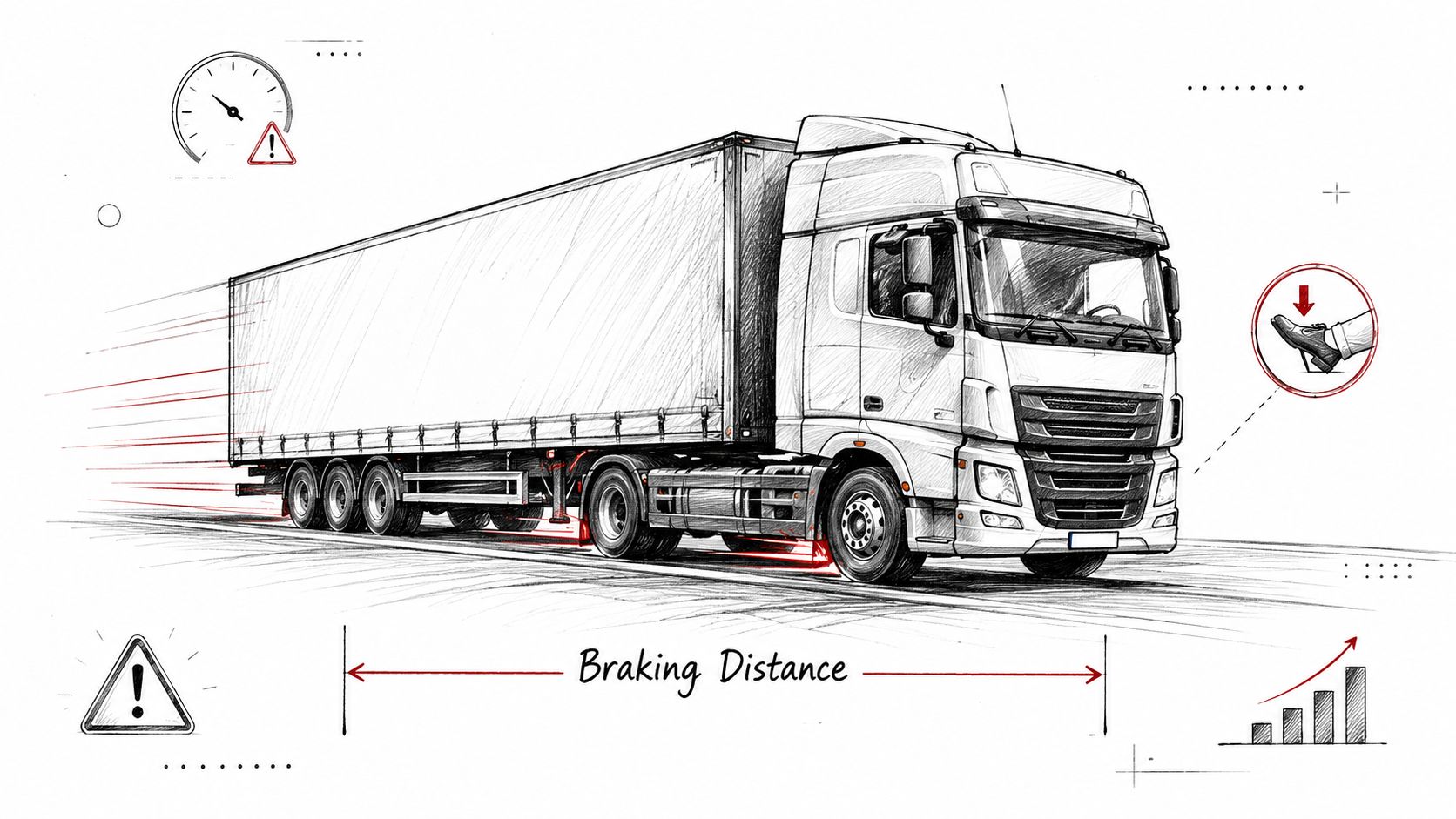
A common near-miss starts the same way on a motorway slip road. Traffic compresses, a car appears in the blind spot, and the driver ahead brakes harder than expected. In a car, that’s uncomfortable. In an HGV, with more mass, a longer stopping distance, and limited room to correct a mistake, it can turn into a chain of events very quickly.
That’s why defensive driving isn’t just “being careful”. It’s professional road management. The Highway Code’s 2-second rule in dry conditions is a baseline for safe spacing, and it matters because tailgating and inadequate stopping distance are closely tied to rear-end crashes, especially when conditions turn wet or slippery. For HGV work, the same logic becomes more important because the vehicle is heavier and less forgiving when the gap disappears.
Practical rule: if you’re close enough to read the vehicle ahead as your only reference point, you’re already using too little space for an HGV.
What separates a professional from an amateur is anticipation. The professional scans early, keeps the cab calm, and treats every junction, roundabout, and merge as a decision point, not a surprise. That mindset is built into HGV safety guidance from HGV Learning, because good driving starts before the braking point, not after it.
For UK drivers, that means thinking in terms of process, not reactions. The safest operators are rarely the slowest ones on the road. They’re the ones whose choices are visible, measured, and early enough for everyone else to respond cleanly.
The Core Principles of Space and Anticipation
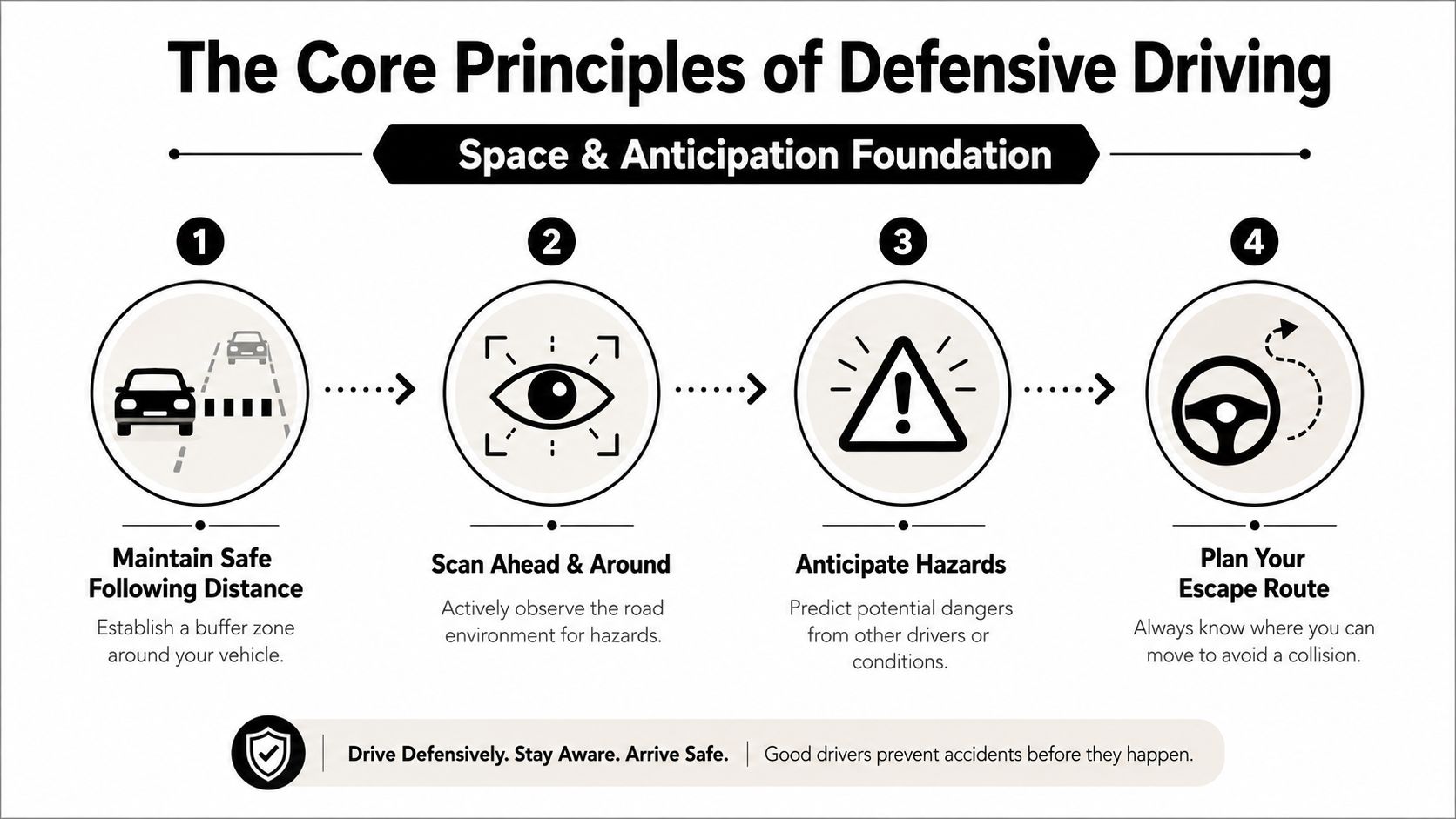
An HGV driver needs a moving safety bubble, not just a lane position. That bubble comes from two habits working together, space management and anticipation. The first gives you room to stop or steer. The second gives you time to decide what to do before the situation becomes urgent.
Identify, predict, decide, act
A practical defensive-driving workflow for HGVs is the identify–predict–decide–act loop. Scan at least 10 to 15 seconds ahead in urban traffic, keep mirror checks frequent, and maintain a minimum 2 to 4 second following gap that gets bigger in rain, heavy traffic, or when following large vehicles, with the count completed against a fixed roadside marker. Those points come together because space without observation is wasted, and observation without space still leaves you trapped. The HGV hazard-perception guidance works best when the driver is already reading the road early enough to change pace or lane before pressure builds.
A useful way to think about it is simple. Identify the hazard, a car edging out from a lay-by, a cyclist filtering beside stationary traffic, or a van drifting towards your lane. Predict the likely move. Decide whether to lift, brake, hold, or move off-line. Act smoothly, with enough room left to correct if the other driver does something unexpected.
What the gap is really for
Following distance is not just about avoiding impact. It gives you an escape route. If traffic compresses suddenly, the extra space lets you brake without hard, unstable inputs, and it keeps you from being forced into a last-second lane change.
Leave room for your own mistake and theirs.
A simple lane-change example shows the value of early scanning. If a car sits half-committed to a merge, you should see it before it crosses your front wheel line. That gives you the chance to adjust speed instead of reacting under pressure. The goal is not to win the merge, it’s to never have to fight for it.
Mastering Your Rig and Its Load
A 44-tonne artic does not behave like a car with a bigger bonnet. Weight changes everything. Braking takes longer, turning loads the tyres differently, and the vehicle’s length means the back end does not track exactly where the cab went. That’s why generic advice often fails, because the same gap, speed, or cornering line can be safe in one condition and wrong in another.
Why load changes the way you drive
The key question for HGV training is not “what is the rule?” but how to apply space management when braking, length, and load shift change the margin you really have. That matters most with articulated vehicles, because the pivot point adds complexity that rigid trucks don’t have to the same extent. A steady line through a roundabout, less abrupt steering, and earlier speed control all matter more when the trailer is carrying momentum behind the cab.
Load distribution plays into stability too. An uneven or moving load can make the vehicle feel ordinary until the moment the weight transfers on a bend, a roundabout, or a braking manoeuvre. That’s where the driver’s decisions count. Smooth inputs help the load stay settled. Sharp ones don’t.
How professionals adjust in practice
Before driving, think about what the truck is carrying, how high the load sits, and whether the route includes tight urban turns, exposed junctions, or long downhill sections. If the load is dense and low, the vehicle may feel more planted. If it’s tall, light, or liquid, the driver needs more restraint with corners and lane changes.
For route planning and vehicle checks, CARLOCK’s smart vehicle health system is a useful example of how fleet tools can support awareness of vehicle condition alongside driving discipline. It doesn’t replace judgement, but it can sit alongside the checks that keep the vehicle roadworthy.
If you want a practical baseline for load handling, HGV load distribution guidance should be part of the same conversation as steering and braking. A vehicle that’s loaded badly will punish even decent driving.
Adapting to UK Weather and Road Conditions
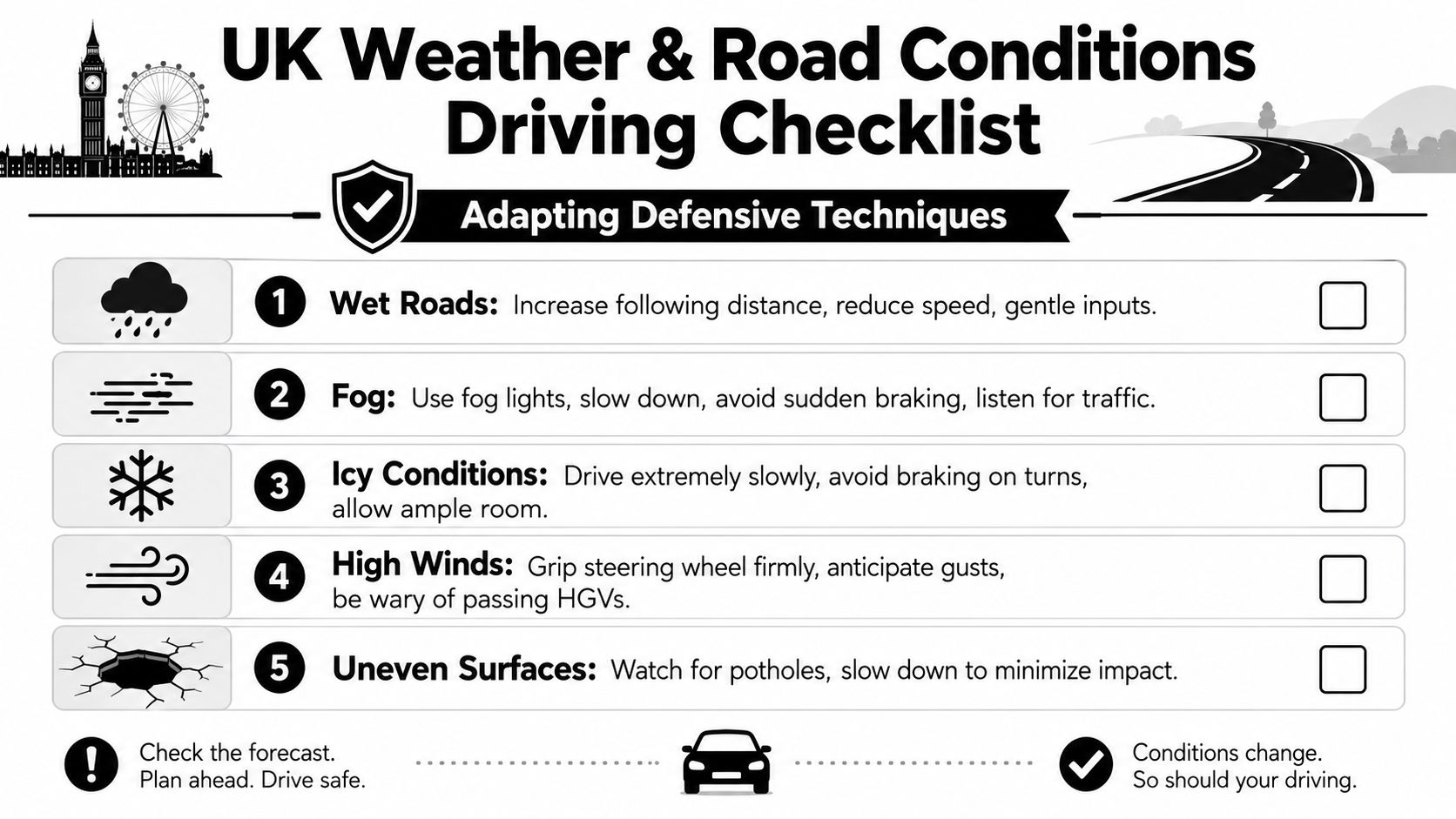
UK roads change fast. Rain, spray, glare, wind, and patchy surface grip can all appear in a single shift. The safest HGV drivers don’t wait for the weather to get worse before adapting. They change spacing, speed, and observation early.
Wet roads and spray
On wet roads, the first adjustment is space. Professional guidance for heavy-vehicle risk control aligns around a four-second following distance at all times and continuous scanning to avoid last-second manoeuvres, especially in adverse weather. That doesn’t mean you must crawl. It means you should create enough room that braking stays controlled if the vehicle ahead changes pace suddenly.
Spray also reduces how far ahead you can read the road. So the driver has to look further past the vehicle in front, not just at it. That helps you anticipate standing water, braking traffic, or a lane closure before you’re right on top of it.
Fog, wind, ice, and poor surfaces
Fog demands a quieter driving style, because speed is only part of the risk. Visibility drops, other drivers misjudge gaps, and your own reactions need more time to work. In high winds, the cab can get pushed just enough to unsettle lane position, especially when passing exposed stretches or meeting another HGV. On icy or patchy rural roads, the key mistake is making sudden corrections once grip is already reduced.
Use the road surface as your warning system. If the steering feels light, the spray is building, or the vehicle starts to feel unsettled, reduce demand on the tyres before the tyres lose the job.
Urban traffic and variable enforcement
Dense city traffic creates different pressure. Buses pull out, cars cut across, and delivery vans make sudden stops. Here, defensive driving means staying smooth and visible, not twitchy. The Highway Code’s duty to keep a safe distance and drive at a speed that lets you stop within the assured clear distance ahead is more useful than a simple slogan, because it asks you to match speed to what you can see and control.
Emergency Manoeuvres and Predictable Responses
When something goes wrong, the first job is not to outsmart the road. It’s to keep the vehicle stable. A tyre blowout, brake issue, or another vehicle losing control creates a short window where smooth inputs matter more than instinct. Sudden steering or harsh braking can make the problem worse, especially in an artic where the trailer can react after the cab has already moved.
The best emergency response is usually boring. Hold your line if you can. Reduce speed in a controlled way. Signal only when the vehicle is stable enough to communicate clearly to others. That may sound cautious, but it’s the difference between one problem and two.
A lot of amateur driving goes wrong because the driver hesitates too long and then overcorrects. That’s where the contrarian point matters. Extra caution can become a hazard if it turns into indecision. The better pattern for UK commercial drivers is predictable defensiveness, maintain space, scan early, and communicate clearly rather than driving slower than the surrounding traffic.
Predictable drivers give other road users something to work with.
That matters in junctions, roundabouts, and motorway merges. A sudden slow-down can force following traffic into hard braking. A delayed lane change can leave your trailer hanging where another vehicle expects clear space. Smoothness protects you because it reduces surprise.
Keep the emergency mindset tied to vehicle behaviour, not panic. If the truck starts to feel unstable, the driver should think about load movement, road surface, steering correction, and whether the safest outcome is to keep moving steadily to a better stopping place. Fast hands rarely beat calm hands in a large vehicle.
Building Habits for a Lifetime of Safe Driving
Defensive driving is not a single technique. It’s a set of repeatable actions that become part of how you work. UK defensive driving is built around mirror checks, planning ahead, and staying aware of what’s happening around the vehicle, and that lines up with the DVSA-style professional standard that underpins compliant driving and vocational training.
Turn good decisions into automatic ones
The simplest daily drill is commentary driving in your own head. Call out what you can see, what might happen next, and what you’ll do if it does. That keeps the road in front of you active rather than passive. It also exposes lazy habits, like checking mirrors too late or drifting into speed changes only after traffic has already compressed.
A second habit is a mirror routine tied to events, not just time. Check before moving off, before signalling, before changing speed, and before any lane change. That kind of discipline stops the cab from becoming a tunnel.
Keep the standard high
Professionalism shows up in small choices. Planning a route around known pinch points, staying patient when traffic is slow, and avoiding distractions all support the same goal, keeping the vehicle predictable. For employers and drivers alike, that’s the core value of defensive driving, because it protects the operation as well as the people around it.
When training, refresh the basics until they’re automatic. If the mirrors, gap, and scan become habits, the driver has more mental room left for the unusual moments. That’s where professionalism shows.
If you’re building those habits into a new licence, a refresher, or a fleet training plan, take the next step with HGV Learning. Strong defensive driving isn’t about being timid, it’s about being early, clear, and ready.
What Age Can You Start HGV Driver Training? A 2026 UK Guide to Licence Age Requirements
If you're asking what age you can start HGV driver training, the honest answer depends on which licence you're after. A C1 licence, covering vehicles...