You’re at the yard at 5:30 am. The keys are on the desk. The trailer is loaded. Someone says, “It’s just waste, drop it at the transfer station,” and hands you paperwork that looks half-filled in.
That’s the moment drivers get caught out.
A lot of people think waste disposal regulations are mainly the boss’s problem, or the office team’s problem, or the site operator’s problem. They aren’t. If you handle the load, sign the paperwork, or deliver it to the wrong place, the issue can become your problem as well. For an HGV driver, that matters for your licence, your record, and your reputation.
Waste loads often look simple from the cab. Bags, skips, pallets, broken kit, scrap, furniture, mixed site waste. But the legal side sits behind what you can see. The description has to be right. The paperwork has to match the load. The carrier and receiving site have to be authorised. If any part of that chain breaks, “I was just driving it” won’t always protect you.
Why Waste Rules Matter on the Road
You’ll hear old hands say that waste work used to be looser. In practice, the UK tightened waste disposal regulations because dumping rubbish cheaply causes lasting damage. Soil gets contaminated. Water gets polluted. Fires start. Dangerous items get mixed with general waste. Councils, regulators and operators then spend time and money putting the mess right.
One of the clearest examples is the Landfill Tax. The UK introduced it in 1996, and it helped reduce municipal waste sent to landfill from over 25 million metric tons in 2010 to 13.1 million in 2022, according to UK waste management data summarised by Statista. That tells you something important. These rules aren’t random paperwork. They were built to change behaviour.
For drivers, that history matters because it explains why sites are strict now. If the load is badly described, they may refuse it. If the waste is mixed wrongly, they may quarantine it. If the paperwork is missing, they may send you away.
What this looks like in real life
A driver collects what he’s told is “general commercial waste”. At the gate, the site staff open the curtain and spot items that shouldn’t be in that stream. Suddenly the load doesn’t match the note. The site can’t just shrug and take it.
The delay hits everyone. The customer gets charged. The office starts asking questions. The driver sits there waiting, often with no clear answer.
Practical rule: If the load and the paperwork don’t match, treat that as a legal issue, not a minor admin issue.
Why employers care who they send
Waste firms, builders’ merchants, skip operators, demolition contractors and recyclers all rely on drivers who can spot trouble early. A driver who checks notes, asks the right question, and refuses to move a dubious load is often protecting the company as much as protecting themselves.
That’s why good waste drivers are valued. They don’t just steer the vehicle. They help keep the whole chain legal.
Understanding Your Personal Duty of Care
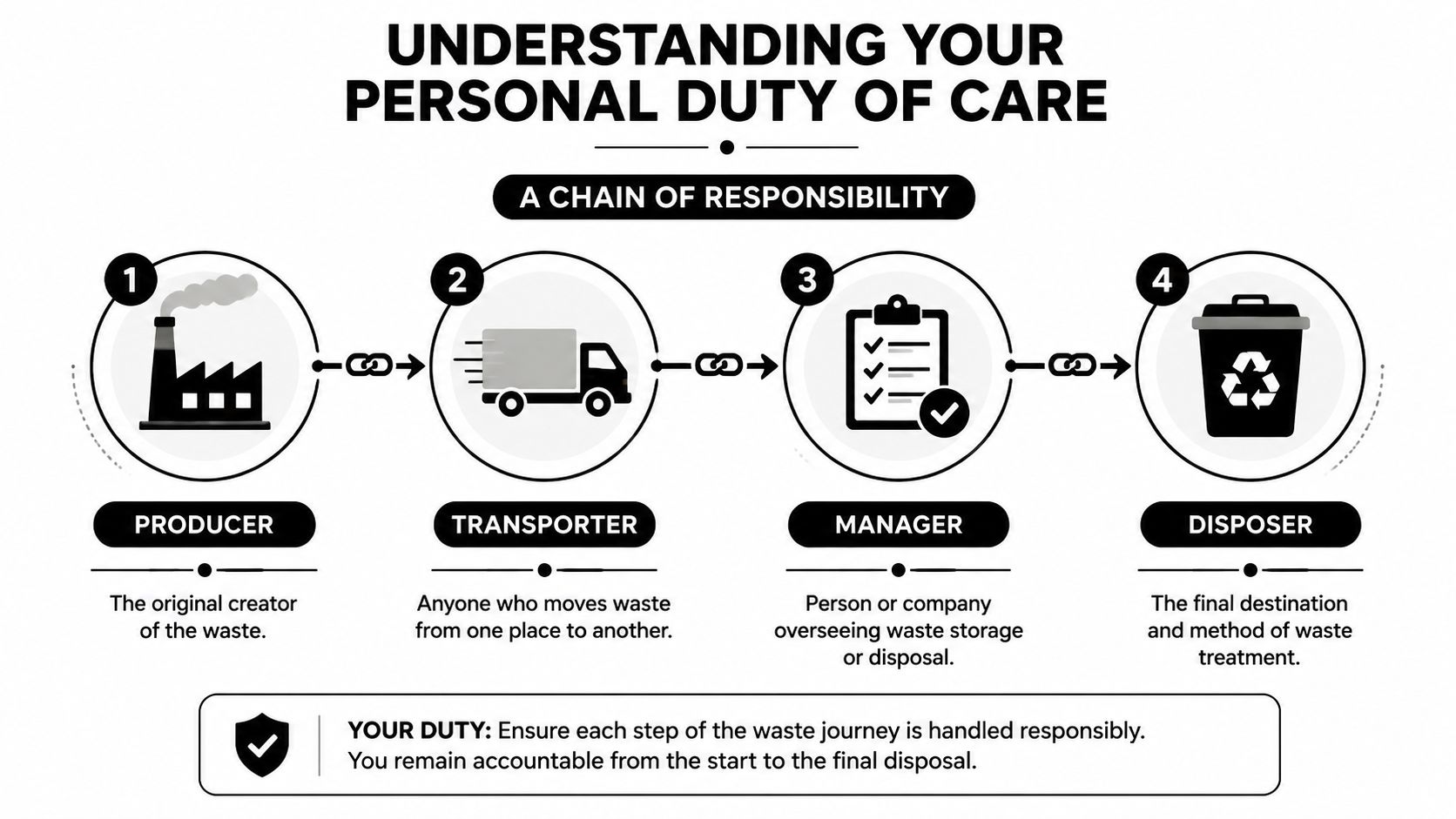
Duty of Care is the backbone of UK waste disposal regulations. In plain English, it means everyone who handles waste must take reasonable steps to make sure it’s stored, described, transferred and disposed of properly.
That chain can include the producer, the transport company, the site manager, the receiving facility, and you.
The point that catches many drivers out is simple. The legal responsibility doesn’t always stop with the employer. The Waste Duty of Care Code of Practice makes the waste holder responsible, and that can include the driver. It also notes a 22% rise in Duty of Care breaches involving individual drivers in 2024, as highlighted in the Waste Duty of Care Code of Practice reference used for this point.
What Duty of Care means in the cab
If you’re the person taking charge of the load for transport, you can’t switch your brain off and say the office must have sorted it. You should be checking obvious basics:
The waste is described properly so the next person knows what they’re receiving.
The paperwork is present and signed where needed.
The carrier details are right so the movement can be traced.
The destination is appropriate for that waste type.
You’re not expected to be an environmental solicitor. But you are expected to notice red flags.
Common points of confusion
Drivers often ask, “If the company loaded me, how can it be on me?” Because the law looks at who handled the waste, not only who employed them.
A few examples make this clearer:
You sign a note without reading it. That signature can link you to bad information.
You know the load doesn’t match the description, but move it anyway. You’ve helped transfer waste incorrectly.
You tip or unload at a place that clearly isn’t set up for that material. That can become a serious offence.
If you wouldn’t be comfortable explaining the load, paperwork and destination to an inspector at the roadside, don’t assume it’s fine.
Your safest habit
Pause before you pull away. Ask three questions:
What exactly is this waste?
What paperwork covers it?
Is this going to the right authorised place?
That short pause can save a lot of trouble later.
Transporting Non-Hazardous Waste Correctly
Most waste loads moved by HGV drivers are non-hazardous. That doesn’t mean casual. It means the paperwork and handling rules are different from hazardous waste, not that the rules disappear.
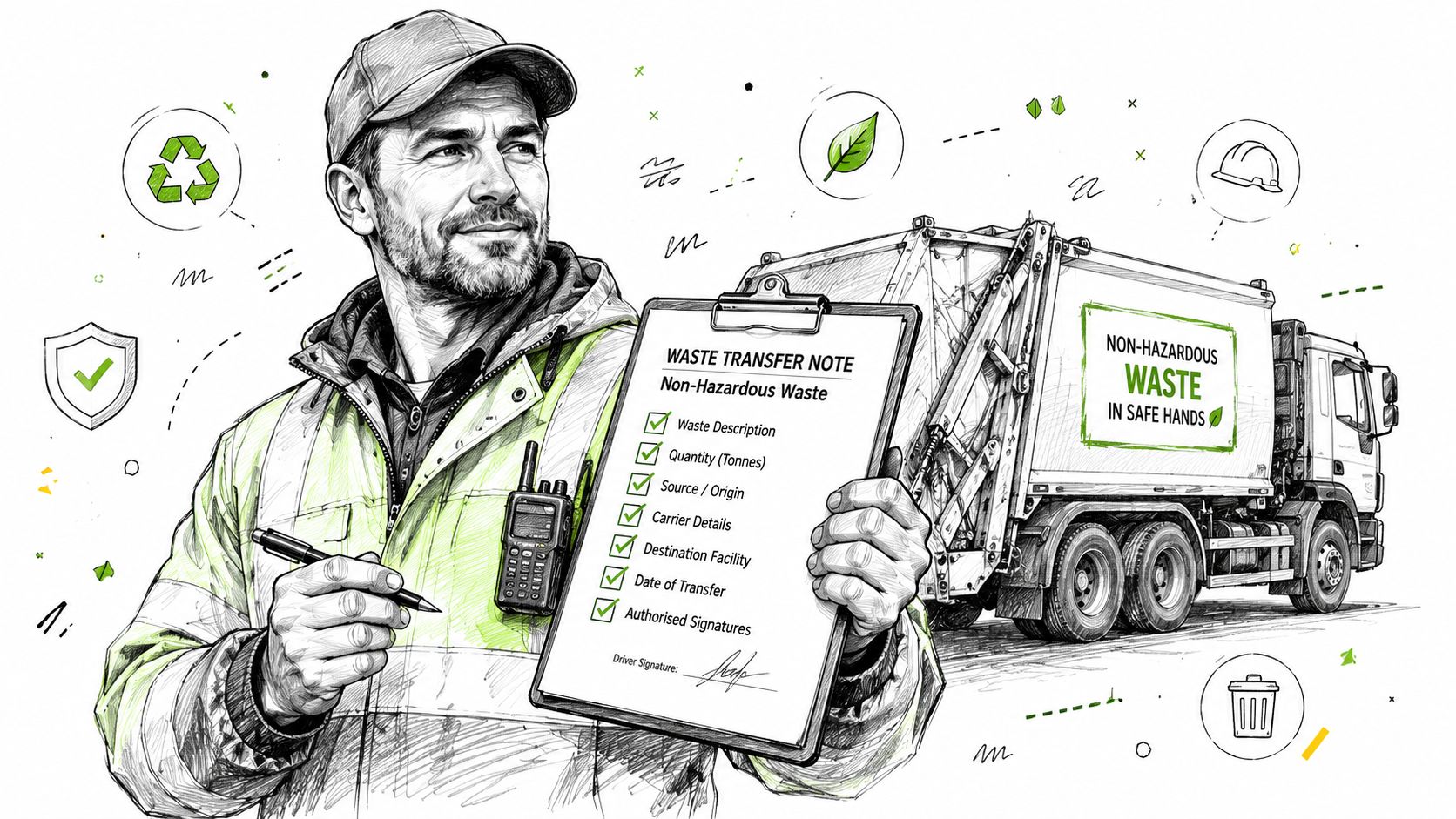
The key document is usually a Waste Transfer Note, often shortened to WTN.
A WTN tells the next holder what the waste is and how it’s being passed on. If the note is wrong, the site may not be able to accept the load legally.
What you should look for on a WTN
The waste description must be precise enough for the next person to identify what they’re receiving. The official guidance says the description must include the nature of the waste and whether it is loose or containerised. The same guidance also makes clear that moving waste without a valid note, or with an inaccurate description, can amount to illegal deposit because the receiving site can’t lawfully accept it under its permit, as set out in this government permit and Duty of Care guidance material.
In practice, check for:
A clear description: “Mixed waste” on its own is often too vague to help anyone.
How it is contained: loose in a tipper, bagged, in bins, in a skip, on pallets.
Who is transferring it and who is receiving it: names and business details matter.
The date of transfer: basic, but often missed.
Any code or classification used by the business: if one is listed, it should fit the load.
Checks a driver should make before moving
Don’t just glance at the top sheet. Compare paper to payload.
Look at the trailer or body: does the load visibly match the written description?
Check obvious contamination: if cardboard is mixed with food waste, timber, or paint tins, the note may no longer describe it properly.
Confirm the destination: some sites accept one stream but reject another.
Secure the load: legal paperwork won’t help if waste blows out on a roundabout.
Ask yourself, “If I’m stopped now, can I show what this load is, where it came from, and where it’s going?”
If the answer is shaky, stop and sort it before you leave.
Cab test: The paperwork should help the next person identify the load without guessing. If they’d need to guess, the description probably needs fixing.
Non-hazardous doesn’t mean low risk
Loads classed as general commercial or construction waste can still create problems if they leak, spill, shift, or contain banned items. Upholstered furniture with certain contents, electrical items, and visibly contaminated waste streams may trigger more questions at the receiving site.
Your job isn’t to memorise every waste category. Your job is to spot when something about the load doesn’t add up.
Managing Hazardous Waste Transport
Hazardous waste is where many drivers feel the ground shift under their feet. The labels may be different. The paperwork is stricter. The consequences of errors are usually more serious.
Typical examples can include chemicals, batteries, some paints, solvents, asbestos-related material, and certain electrical waste. The exact classification depends on the material, not on what someone casually calls it in the yard.
The document changes here
For hazardous waste, the normal WTN is replaced by a consignment note. That note tracks the waste from the holder through the carrier to the consignee.
The key legal point is specific. For hazardous waste, all parties, including the holder, carrier and consignee, must complete and retain their part of the consignment note for exactly three years. In Wales, any business producing over 500 kg of hazardous waste annually must also register as a producer, as explained in this guide to hazardous waste regulations in the UK.
WTN and consignment note compared
Feature
Waste Transfer Note (WTN)
Consignment Note
Main use
Non-hazardous waste
Hazardous waste
Purpose
Records a transfer between holders
Tracks hazardous waste through the whole movement
Parties involved
Transferor and transferee
Holder, carrier and consignee
Detail level
Important, but simpler
More detailed and tightly controlled
Record keeping
Required under normal Duty of Care practice
Each party keeps their part for exactly three years
Welsh producer registration
Not the key issue
Applies if a business in Wales produces over 500 kg annually
What the driver needs to confirm
Hazardous waste work needs a slower, more deliberate approach.
First check the identity of the load
You need a clear description of what you’re carrying. If someone says, “It’s only old batteries” or “just a bit of chemical waste,” that isn’t enough. The note should identify the waste properly.
If the waste has packaging marks, labels, or handling instructions, those should line up with the paperwork. If they don’t, stop and ask.
Then check whether ADR applies
Not all hazardous waste movements require an ADR-qualified driver, but many common hazardous loads do. If you’re unsure where dangerous goods rules overlap with waste rules, this plain-English guide to ADR in the UK is a useful place to get your bearings.
The safe assumption is this. Hazardous waste paperwork and dangerous goods transport rules are connected, but they are not identical. A load can be hazardous waste and also fall under ADR transport requirements.
Keep your copy and protect it
Drivers sometimes focus on departure and forget the record. Don’t. Keep your paperwork safe, legible and available. Wet notes, missing pages, and unsigned sections create avoidable trouble.
Hazardous waste transport is a chain. If your part of the chain has no paperwork, the whole movement is harder to defend.
A Wales point that often gets missed
If you collect hazardous waste from a Welsh producer, the producer may need registration where the annual amount goes over the stated threshold. England, Scotland and Northern Ireland don’t use that same producer registration requirement in the same way.
You don’t need to become an expert in devolved regulation overnight. You do need to notice when a cross-border collection may involve different admin.
Penalties for Non-Compliance
The phrase “non-compliance” can sound soft. The outcomes aren’t.
For a driver, getting waste disposal regulations wrong can lead to fines, interviews under caution, vehicle seizure in serious cases, and lasting damage to employability. Even where the employer takes the main hit, your name may still be linked to the incident, the paperwork, or the delivery.
Why enforcement is getting tighter
Regulators don’t like grey areas, and the system is moving towards fewer of them. The UK government plans mandatory digital waste tracking from April 2026, which is intended to provide real-time data on waste movements. The same government update says householders who use unlicensed carriers could face fixed penalty notices of up to £600, according to the UK waste statistics and policy update on GOV.UK.
That future change matters to drivers now because it shows the direction of travel. More traceability. Less room for vague paperwork. Faster checks on who moved what.
How mistakes turn into offences
Some failures start small:
Missing paperwork: a note isn’t in the cab when it should be.
Bad description: the waste isn’t described accurately enough.
Wrong destination: the site can’t legally accept that load.
Unclear chain of custody: signatures or handover details are missing.
A driver may think one missing detail can be sorted later. Sometimes it can. Sometimes the load gets refused, reported, or investigated.
The career impact drivers forget
The legal penalty is only part of the damage.
Transport managers remember drivers who bring back rejected waste because the note was wrong. Agencies hear about drivers who signed blindly. Employers in waste, construction, utilities and recycling want people they can trust with controlled loads.
A waste compliance problem doesn’t stay in one day’s work. It can follow you into the next job interview.
The practical lesson
Treat every waste movement as traceable, because it increasingly is. If the office is rushed, slow the handover down. If the customer is vague, ask better questions. If the site says the load is wrong, don’t argue from the cab. Get clarification and keep records of what happened.
Your HGV Waste Compliance Checklist
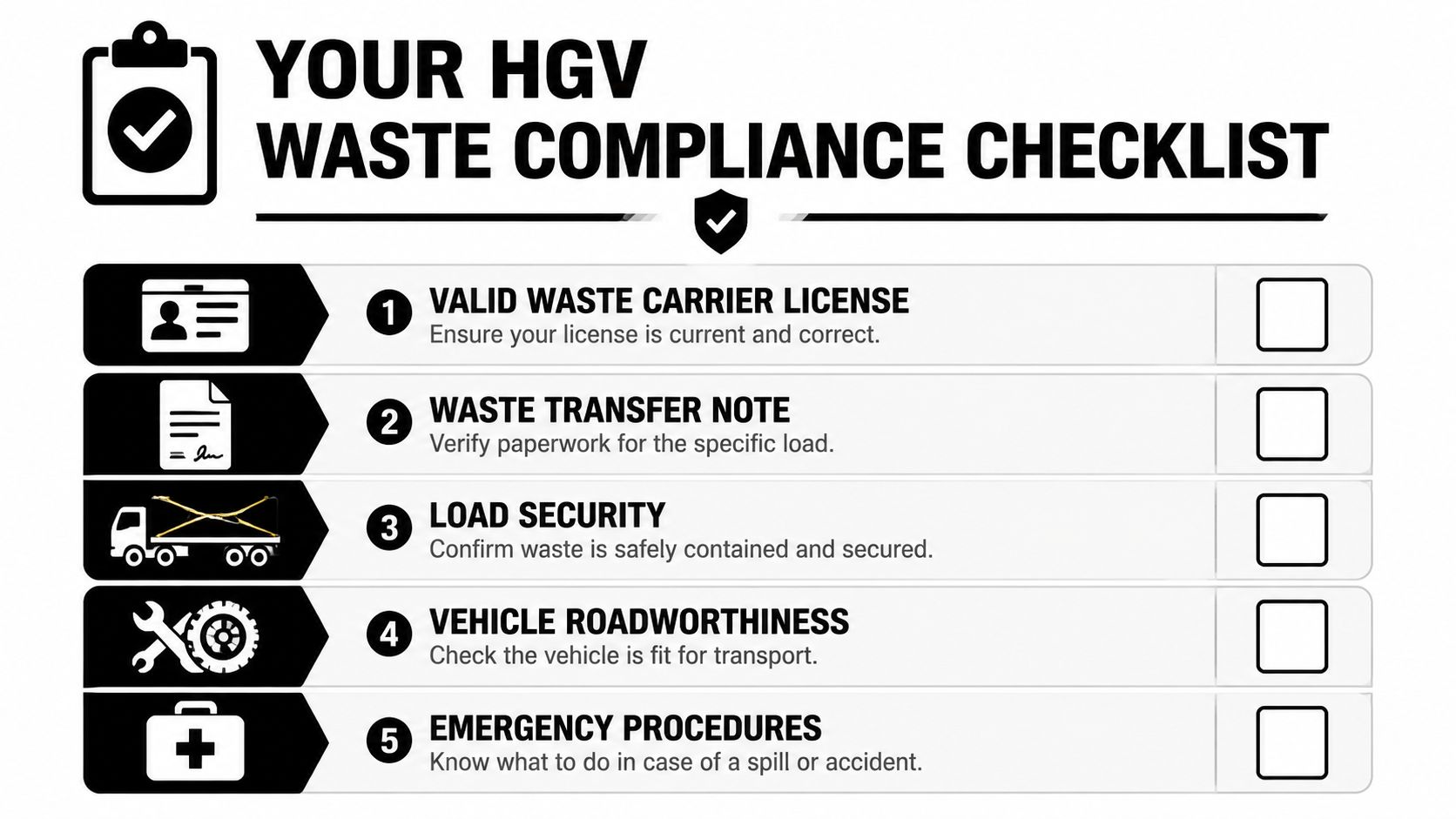
The simplest way to stay legal is to run the same checks every time. Good drivers rely on habits more than memory.
Before you move
Check the document type: Is it a WTN for non-hazardous waste or a consignment note for hazardous waste?
Match paper to load: Walk round and compare what you can see with what the note says.
Confirm the carrier details: The business moving the waste should be the one physically moving it.
Secure the load properly: Nets, straps, curtains, covers and containment all need to suit the material.
Know the odd items: Upholstered furniture, WEEE, batteries and mixed site waste often need extra caution.
If you deal with old electronics or company kit, chain-of-custody paperwork matters just as much as transport paperwork. This guide for IT asset disposition is useful because it shows how documentation protects everyone when equipment changes hands.
On the road
Keep the paperwork where you can reach it. Don’t bury it under food wrappers, gloves and delivery notes.
If anything changes during the journey, such as a spill, torn bag, broken container or obvious shift in the load, report it straight away. A damaged waste load can become a different risk from the one described on the sheet.
Remember: a legal load at departure can become an unsafe load halfway through the route if the containment fails.
At the destination
Check the site details: Make sure you’re at the right place for that specific waste stream.
Don’t rush the handover: The receiving party needs to be able to accept the load properly.
Get signatures or confirmations: Incomplete handover records create problems later.
Keep your copy: Don’t leave without the document trail you need.
A short mental checklist
Ask these five questions before you open the gate or pull off:
Do I know what this waste is?
Do I have the right paperwork?
Does the load match the paperwork?
Is the load secure and contained?
Is the destination right for this waste?
If one answer is “not sure”, stop there.
Training and Certification for Waste Haulage
Waste work rewards drivers who are qualified, calm and hard to catch out. Reading guidance helps, but formal training gives you something more useful on the job. A structure for decisions when the pressure is on.
For hazardous loads, ADR training, like the ADR licence course we run, is often the qualification that opens doors. It helps drivers understand classes of dangerous goods, documentation, marking, emergency actions and the extra controls that can apply when dangerous goods and waste transport overlap. Even when a specific job doesn’t require full ADR, drivers with that knowledge are usually better at spotting when a load needs a second look.
Some drivers also find it useful to read first-hand accounts before booking specialist training. This piece on my dangerous goods driver’s licence experience gives a personal view of what fast-track dangerous goods preparation can feel like.
Why CPC still matters
Waste compliance isn’t only about specialist hazardous goods courses. Driver CPC can support the basics as well. Loading, vehicle checks, legal responsibility, road safety and incident response all affect waste work.
If you want a clear refresher on how periodic training fits into a driving career, this guide on what Driver CPC training is is worth reading.
Qualifications protect more than your job options
Training does three things for a waste driver.
It helps you spot legal risk before it becomes your problem.
It makes you easier to place in better roles.
It gives employers confidence that you won’t treat waste paperwork like an afterthought.
That last point matters. In waste haulage, a driver who asks careful questions is often seen as professional, not awkward.
A good rule to finish on is this. Don’t aim to know everything. Aim to know when something isn’t right, and have the training to act on it properly.
If you want help building the licences and specialist qualifications that make waste haulage safer and more straightforward, HGV Learning can support you from first licence steps through to ADR and ongoing professional development.
What Age Can You Start HGV Driver Training? A 2026 UK Guide to Licence Age Requirements
If you're asking what age you can start HGV driver training, the honest answer depends on which licence you're after. A C1 licence, covering vehicles...