Over 90% of level crossing risk in the UK comes from user error or abuse, with an average annual toll of 9 deaths, 7 major injuries, and 23 minor injuries according to the Office of Rail and Road strategic risk chapter on level crossings. That should reframe the subject straight away. Most level crossing incidents aren’t caused by mechanical mystery. They start with a bad decision, a rushed approach, poor observation, or entering without a guaranteed exit.
For HGV drivers, that risk is sharper. A car driver can still make a fatal mistake at a crossing, but an HGV driver has more length, more weight, more blind spots, more axle movement, and less margin for error. If you misjudge the road space beyond the rails, stall in the wrong gear, ground a low trailer, or get caught by queuing traffic, the situation turns serious fast.
Generic motoring advice isn’t enough here. Professional drivers need a method. They need habits that work when the crossing is unfamiliar, the road is tight, the trailer is long, and pressure is building from traffic behind. That’s what proper level crossing safety looks like in real life.
Understanding the HGV-Specific Risks at Level Crossings
A level crossing is never just a pair of rails across the road. For an HGV, it’s a short decision zone with very high consequences. The road layout, the crossing surface, the approach angle, your load security, your gross weight, and the traffic beyond the crossing all matter before the front axle reaches the rails.
That matters even more because HGVs don’t clear danger in the same way a car does. A rigid may get over with fewer complications, but an artic needs more room to straighten, and a long combination can still be occupying the crossing after the tractor unit has reached the far side. Drivers working close to the upper limits of maximum authorised mass also know that extra weight changes how the vehicle reacts on approach and through the crossing.
Why HGVs need a different mindset
A professional driver has to think beyond “Is a train coming?”
You also need to ask:
Is there enough clear road ahead for the full vehicle length
Could traffic stop and trap my trailer on the rails
Is the crossing surface uneven enough to affect a low trailer or heavy rear overhang
Will I need to change gear while crossing, and if so, why am I committing to that risk
Could a load shift or poor approach angle alter how the vehicle tracks over the rails
Practical rule: If you can’t clear the crossing in one clean, uninterrupted movement, you haven’t got permission from yourself to enter it.
What usually goes wrong
The biggest trap isn’t recklessness in the dramatic sense. It’s ordinary pressure. The driver sees space, assumes traffic will move, or thinks the crossing will be quick enough to “just get through”. That’s where professional discipline matters.
At level crossings, patience is a safety skill. So is humility. If the road beyond isn’t unquestionably clear, wait. If the crossing looks awkward for your vehicle type, slow down early and build a proper plan before you arrive.
Mastering the Approach Signs Signals and Assessments
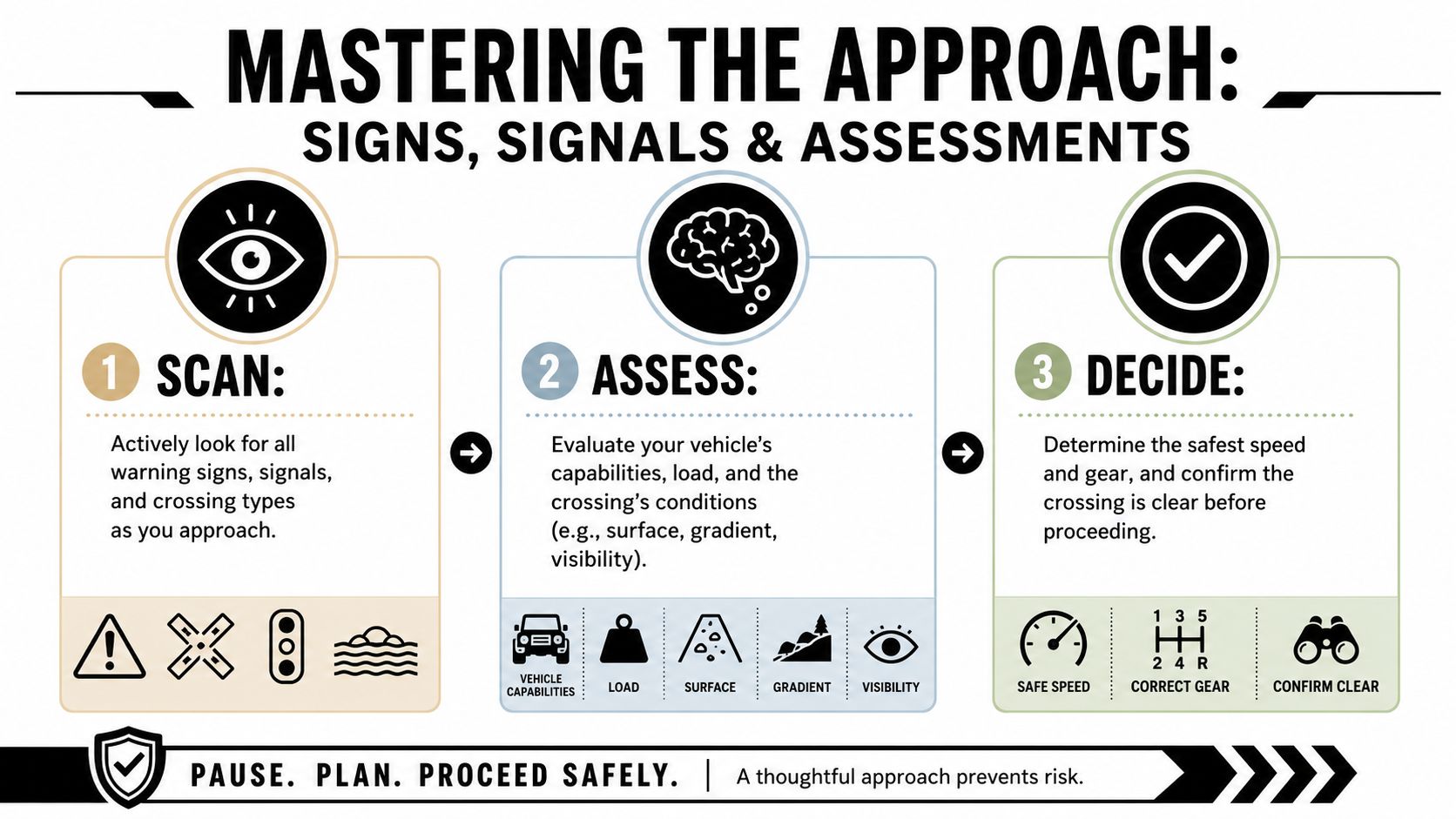
Every safe crossing starts before the stop line. By the time you’re at the lights, most of the work should already be done in your head. I teach drivers to use a simple sequence: Scan, Assess, Decide.
Scan
Start well back from the crossing. Don’t wait until you’re on top of it.
Look for the type of crossing first. Barriers, lights, open crossings, telephones, miniature stop lights, sharp approach bends, raised surfaces, queuing traffic on the far side, and road markings all tell you how much work this crossing demands. Standard safety recommendations also include vibro-tactile warnings such as rumble strips and cross-hatching on the approach, as outlined in the Parliamentary written evidence on crossing design measures.
A driver who scans early gets options. A driver who scans late gets stress.
Use mirrors as part of the scan, not after it. If traffic is tight behind you, you may need a smoother, earlier reduction in speed to avoid harsh braking. This is the same disciplined observation you build in hazard identification training for HGV drivers.
Assess
Once you’ve identified the crossing, assess whether your specific vehicle can cross cleanly right now.
For open crossings, the rule is straightforward. Drivers approaching UK open level crossings, where no barriers or lights exist, must check and listen for trains before proceeding, and must never enter unless their exit is clearly clear to avoid stopping or reversing on the railway track, as explained in the RAC guide to UK level crossings.
For HGVs, “exit clearly clear” means more than a car length of spare room. You need enough road for the full unit. If you’re in an artic, assess for tractor unit swing, trailer off-tracking, and any chance that the rear will still be over the rails when traffic checks up.
A useful operator-level habit is to apply route planning discipline before the journey starts. Fleet teams that need a structured method can use this risk assessment advice for UK companies to build route-specific checks around crossings, queues, turning space, and vehicle type.
Decide
Decision is the final commitment. At that point, you either stop with control or proceed with intent. No drifting. No half-decisions.
If you approach an unfamiliar crossing and the amber light shows, don’t treat it like an invitation to squeeze through. Read the crossing, check the road ahead, and decide whether your vehicle can clear the full crossing area without any pause. If there’s any doubt about traffic beyond the rails, stop.
When the crossing asks a question, answer it early. Late decisions are what put long vehicles in bad places.
A quick approach routine
Read the road early. Spot signs, lights, markings, barriers, telephones, and surface changes.
Measure the exit, not just the entry. The road beyond the crossing decides whether you go.
Match the plan to the vehicle. A loaded rigid, empty artic, and low-loader don’t need the same approach.
Commit once. Either hold back cleanly or cross without interruption.
Executing a Safe Crossing in Any HGV
Getting the approach right means nothing if the crossing itself is sloppy. Once you commit, the job is to keep the vehicle moving smoothly, stay composed, and avoid any action that creates delay on the rails.
A lot of bad crossings start with poor setup. The driver arrives too fast, brakes late, then has to juggle steering, clutch, mirrors, road position, and traffic movement all at once. That’s how stalls happen. It’s also how drivers enter a crossing before they’ve confirmed the far side will stay open.
The problem is sharper for heavy vehicles because a crossing punishes hesitation. You want one steady movement in the right gear, at a controlled speed, with no unnecessary gear change on the rails.
The standard rigid procedure
In a normal rigid HGV, the aim is simple. Select the right gear before the crossing, keep the vehicle balanced, and drive through in one clean movement.
Use this working routine:
Set the gear early. Pick a gear that gives enough torque to carry you across without changing up or down on the crossing.
Keep the wheels straight where possible. Sharp steering input on uneven surfaces can unsettle the vehicle and waste momentum.
Use steady throttle. Don’t crawl to the point of risking a stall, and don’t rush so hard that you reduce observation.
Watch the exit as you cross. The work isn’t done when the cab reaches the far side. The vehicle is clear only when all of it is clear.
Artics and longer combinations
Artics demand more road and more patience. The tractor may be clear while the trailer is still exposed. That’s why I tell drivers to think from the trailer backwards, not the cab forwards.
For longer vehicles, the key risk isn’t speed. It’s space management. If traffic checks up after the unit enters, the trailer can be left across the rails with nowhere to go.
The gap in guidance is well recognised. A critical gap in UK level crossing safety guidance is the specific risk of HGVs blocking back over crossings due to inadequate road space or queue management, a situation Highway Principle 3 mandates minimising but offers no practical guidance on for heavy vehicles, according to the ORR principles for managing level crossing safety.
Driver’s rule of thumb: Never enter on hope. Enter on guaranteed road space.
What blocking back looks like in real life
Blocking back usually follows a familiar pattern:
Situation
What the driver thinks
What actually happens
Slow-moving queue beyond the crossing
“They’ll roll on by the time I get there”
The queue stops and traps the rear of the vehicle
Tight junction after the rails
“I can edge through”
Turning space disappears and the trailer remains foul of the line
Dense urban traffic
“I’ll only be a second”
A pedestrian phase, bus stop, or turning vehicle kills the gap
Long or unusual load
“The cab is clear”
The load or trailer still occupies the crossing
Low-loaders and abnormal loads
Low-loaders, plant carriers, and some abnormal load configurations need a separate level of caution. Raised approaches, crown in the road, drainage channels, and abrupt transitions can cause grounding. If the route includes known awkward crossings, that should be dealt with before the day of travel, not by improvisation at the stop line.
Check these points before committing:
Ground clearance. Know the vulnerable point of the trailer, not just the overall dimensions.
Load stability. A poorly settled load can change the vehicle’s behaviour over uneven surfaces.
Turning path after the crossing. Tight turns immediately beyond the rails are a red flag for long combinations.
Escort and routing arrangements. If the movement is unusual, the crossing should already have been considered in route planning.
A useful reminder of what a smooth crossing should look like is in this demonstration clip:
What works and what doesn’t
What works is boring in the best way. Early speed control. One proper gear. Full attention on the exit. Enough patience to wait out a doubtful gap.
What doesn’t work is trying to recover a poor approach with quick reactions. If you’re selecting a gear late, edging forward to “see a bit more”, or relying on traffic to keep moving, you’re already behind the vehicle.
Your Action Plan for Breakdowns and Emergencies
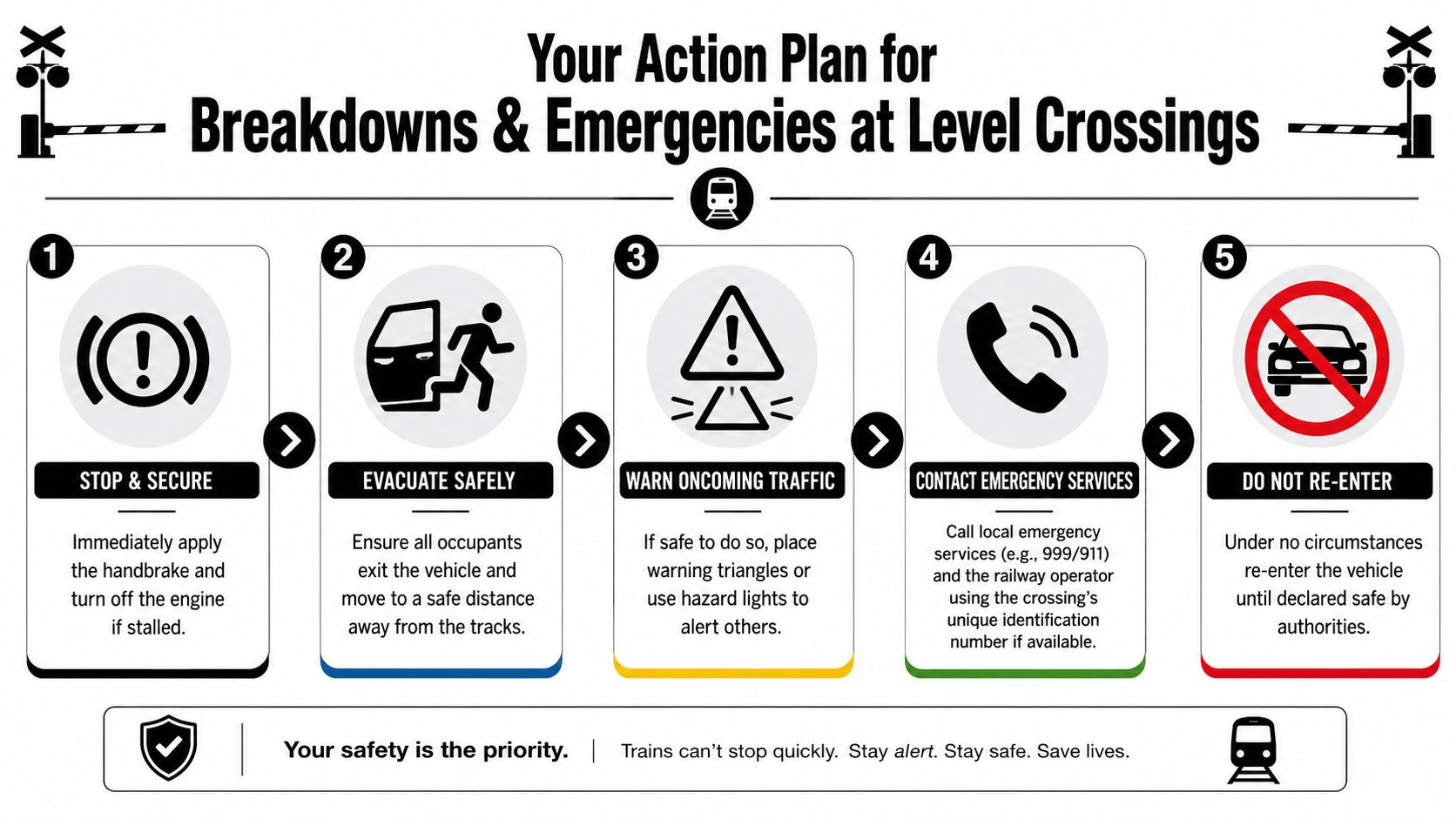
When an HGV stops on a crossing, you don’t need vague advice. You need a drill. This is one of those situations where memory matters more than confidence. Under pressure, drivers fall back on what they’ve rehearsed.
A recognised weakness in current guidance is that HGV drivers often aren’t given nuanced, data-backed protocols for what to do when barriers lower mid-crossing or fail to lift, especially in long vehicles that can’t reverse safely, as highlighted in the Parliamentary evidence on crossing safety and driver response gaps. So the procedure has to be practical.
If the vehicle stalls on the tracks
Your first job isn’t saving the vehicle. It’s protecting life.
Do this in order:
Stop trying to solve it from the seat if the vehicle won’t move immediately. A few seconds of calm judgement is enough. Don’t sit there cycling the ignition while time disappears.
Get everyone out. Move clear of the vehicle and away from the track area.
Use the crossing telephone if there is one. Give the crossing identification and exact location.
Call the emergency services if needed.
Do not go back to the cab unless the situation is declared safe.
Leave the vehicle. Warn the railway. Then let the railway stop the trains.
If the barriers lower while you are still on the crossing
Drivers freeze because they think they mustn’t damage the barrier. That instinct can kill people.
If your vehicle is moving and the only safe way out is forward, your priority is to clear the crossing. A barrier can be replaced. A train can’t stop in the distance a stranded HGV needs. Don’t waste time debating property damage when the vehicle is still exposed.
If the vehicle is trapped and won’t move, switch immediately to evacuation and warning procedures. Don’t stay in the seat hoping the lights stop or the barriers rise.
The call you must be ready to make
When you use the crossing phone, speak clearly and briefly. The signaller or operator needs the crossing identity and the fact that a vehicle is obstructing the line. If you’re flustered, stick to facts:
Who you are
That an HGV is stranded or obstructing the crossing
The crossing number or name
Whether anyone is still in danger
Whether the vehicle is carrying anything that creates added risk
If your firm runs regular long-distance or night operations, breakdown planning matters too. Drivers and traffic office staff should know who to contact for recovery support and escalation. For that side of the response, this 24-hour roadside assistance guide is a useful operational reference for building a practical contact chain.
What panic gets wrong
Panic makes drivers do three dangerous things. They stay in the cab too long. They focus on the engine, not the railway. They waste precious time trying to reverse a vehicle that doesn’t have room to reverse.
That’s why the emergency drill has to be mandatory.
Life first. People out and clear.
Railway warning second. Use the phone and give the crossing details.
Vehicle last. Recovery comes later.
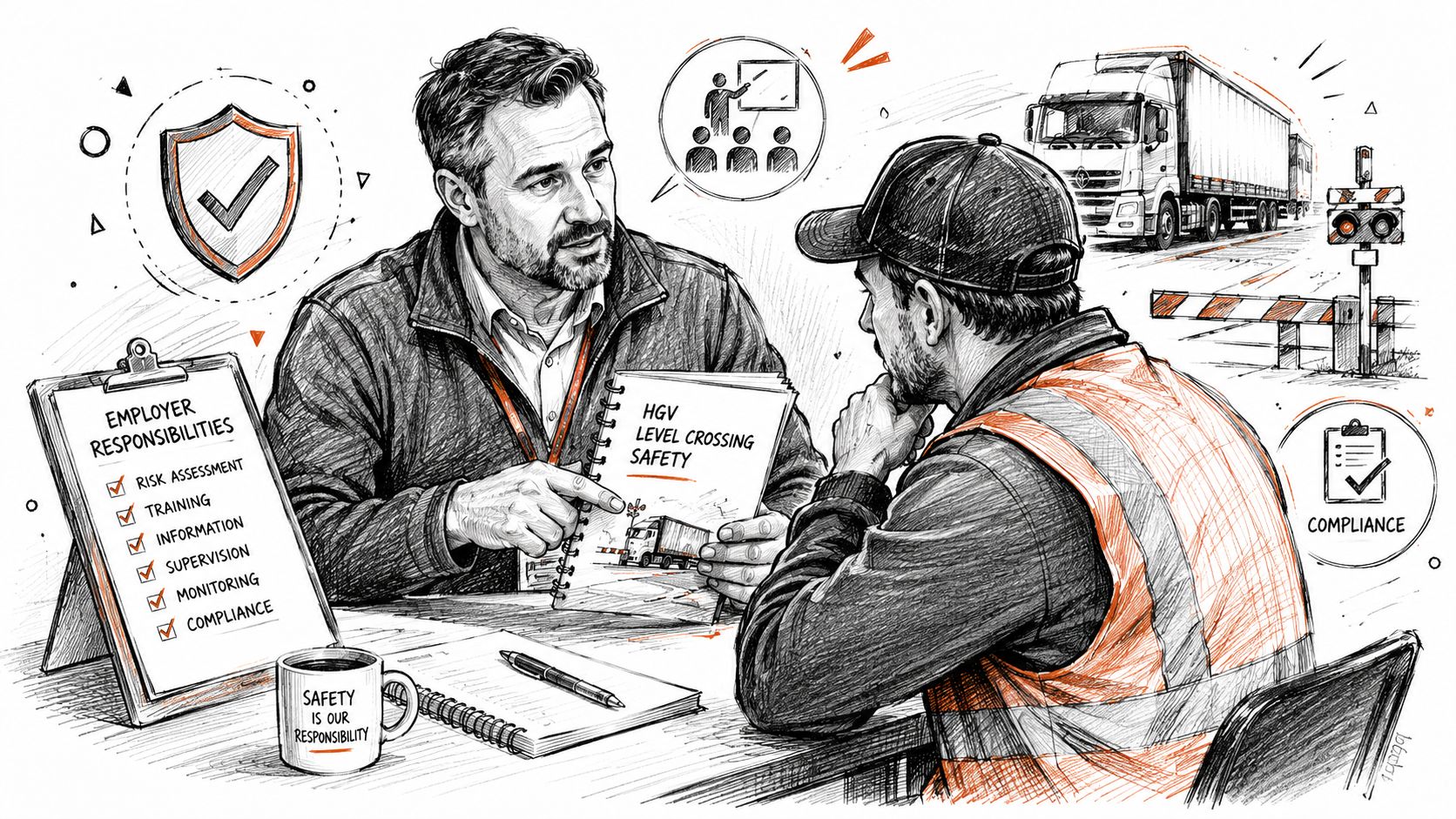
Employer Responsibilities and Training Requirements
A safe crossing policy doesn’t start at the crossing. It starts in the traffic office, the induction room, and the route planning process. Employers decide the routes, the schedules, the training standard, and the quality of the information drivers get before they leave the yard.
The scale of the issue should focus minds. The UK has approximately 6,000 level crossings, and Network Rail is actively closing them at a rate of over 100 per year to mitigate risks, as noted in the overview of level crossings in the United Kingdom. That changing network means route familiarity can’t be assumed forever. A crossing that was manageable last year may now be altered, closed, or made awkward by diversion and local traffic changes.
What employers must control
Under general health and safety duties, an operator can’t shrug this off as a driver-only issue. If the business sends drivers over crossings as part of their work, the business has to manage that risk in a real, documented way.
That means:
Route assessment. Identify known level crossings on regular routes, especially those near junctions, industrial estates, depots, schools, or congested town approaches.
Vehicle-specific planning. A route suitable for a van may be unsuitable for a loaded artic or low-loader.
Briefing and induction. Don’t rely on generic CPC-style knowledge alone. Drivers need company procedures for awkward crossings, reporting concerns, and emergency escalation.
Refresher training. Repetition matters. The dangerous situations are rare, which means memory fades if firms never revisit them.
What good route assessment looks like
A proper route-specific assessment asks practical questions. Is there enough stacking space beyond the rails for the longest vehicle on fleet? Is there a sharp turn immediately after the crossing? Does local queuing make blocking back likely at certain times? Is the surface likely to be a problem for low-clearance equipment?
A weak assessment says “level crossing on route”. A strong one says what type of crossing it is, what the operational risk is, which vehicles can use it, when it becomes unsuitable, and what the alternative route is.
Manager’s test: If a new driver asked, “What exactly is the risk at this crossing for my vehicle?”, your paperwork should answer that in plain language.
What training should include
Level crossing training for HGV drivers should cover more than signs and signals. It should include:
Training topic
Why it matters
Exit-space judgement
Prevents blocking back and trailer entrapment
Gear and speed planning
Reduces stall risk on the crossing
Low trailer and abnormal load awareness
Prevents grounding and delayed clearance
Emergency phone use
Helps drivers warn the railway quickly
Company reporting process
Captures near misses and route hazards before they repeat
The best firms also collect driver feedback after unfamiliar routes, near misses, and local road changes. A crossing that worries experienced drivers should trigger review, not dismissal.
Essential Safety Checklists for Drivers and Managers
Three habits do most of the heavy lifting in level crossing safety. Read the crossing early. Don’t enter without a fully clear exit. Know your emergency drill before you need it. Everything else builds on those habits.
For operators, the same principle applies. If procedures live only in a folder, they won’t protect anyone. They need to show up in route planning, inductions, refresher sessions, and vehicle-specific instructions. Firms tightening their documentation around driver records may also find these audit-ready driver qualification procedures useful when reviewing how training evidence is stored and checked.
Have I identified the crossing type early enough to plan properly
Can I see a completely clear exit for the full length of my vehicle
Have I chosen a gear that lets me cross without changing on the rails
Have I checked for queuing traffic, junctions, or turns beyond the crossing
Is my vehicle or load at risk of grounding or delayed clearance
Do I know where the crossing telephone is if something goes wrong
If the situation changes now, am I prepared to stop and wait
Transport Manager’s Compliance Checklist
Route files are current. Known crossings on regular routes are identified and reviewed when road layouts change.
Vehicle limits are matched to routes. Long, heavy, or low-clearance vehicles aren’t sent over awkward crossings by assumption.
Driver training is specific. Induction and refresher training cover blocking back, gear selection, exit-space judgement, and emergencies.
Near misses are reported. Drivers have a clear way to flag crossings with poor visibility, tight turns, or repeated queue problems.
Emergency contacts are ready. Drivers and planners know who to call and what information must be passed quickly.
Supervision checks behaviour. Managers don’t just issue policy. They verify that drivers understand and apply it.
If you want structured, DVSA-aligned training that builds the habits behind safer professional driving, HGV Learning offers support for new and experienced drivers across licence categories, theory preparation, practical training, and real-world safety standards that carry over into situations like level crossings.
What Age Can You Start HGV Driver Training? A 2026 UK Guide to Licence Age Requirements
If you're asking what age you can start HGV driver training, the honest answer depends on which licence you're after. A C1 licence, covering vehicles...