Why do capable candidates still fail the HGV theory test after putting in hours of revision?
The usual reason is not effort. It is method. Many candidates prepare as if the HGV theory test is just a larger version of the car test, then get caught by the breadth of commercial driving topics and the level of recall the DVSA expects under time pressure.
For lorry and bus drivers, the multiple-choice test is less forgiving. You need to know the pass standard before you build your revision around it, and this guide to the theory test pass mark sets that out clearly. A narrow margin for error changes how you should study. It pushes you away from casual reading and towards a plan that exposes weak areas early.
HGV candidates also face content that generic theory driving test tips barely touch. Drivers’ hours, tachograph rules, safe loading, vehicle checks, road procedure, and hazard perception all have to be understood in the context of a much larger vehicle and a professional standard of driving. That brings a real trade-off. Memorising answers may raise short-term scores, but it often breaks down when a question is reworded or when two similar rules appear side by side.
Official data for the period between April 2024 and March 2025 showed that the overall pass rate for car and motorcycle theory tests was 44.9%, according to DVSA pass rate analysis. HGV revision needs to be more disciplined, not less.
This guide takes a more strategic approach. It uses active recall, spaced repetition, topic sequencing, and exam-condition practice to help HGV candidates build durable knowledge, not just recognition. If you have read broad learner advice before, some of it still applies at a general level, much like these Ontario G1 knowledge test strategies. The difference here is that every step is designed for the demands of professional driver theory preparation in the UK.
1. Master the DVSA Question Bank Systematically
What gets candidates through the HGV theory test. More reading, or a method that shows exactly where the gaps are?
For Category C, C+E and C1, the safest starting point is a full, organised pass through the DVSA-style question bank. Work topic by topic, not by mood. HGV theory is too broad for random revision. You need coverage across road procedure, traffic signs, vehicle weights, load security, drivers’ hours, tachographs, and daily checks. If one area gets skipped because it feels familiar, it usually turns into dropped marks later.
A question bank is useful for more than score practice. It trains you to read the way the test is written. That matters because many HGV questions are designed to check judgement, not just recall. Two answers can look close. One will fit the rule exactly, and the other will reflect a common misunderstanding.
What to do in practice
Start with one topic and clear it fully before mixing in others. Mark every incorrect answer by cause, not just by subject. Some mistakes come from missing knowledge. Others come from rushed reading, weak terminology, or confusion between similar rules. That distinction matters. A candidate who misreads wording needs a different fix from one who does not understand tachograph exemptions.
Use a simple tracking sheet with three labels:
Secure: You can answer correctly and explain why.
Shaky: You get some right, but the reasoning is inconsistent.
Weak: You are guessing, confusing rules, or missing the principle.
That turns revision into diagnosis. It also stops the usual habit of repeating topics you already like while avoiding the technical ones.
Practical rule: Do not leave a topic because it feels familiar. Leave it when you can answer accurately, explain the rule, and handle a reworded version without guessing.
Why this works for HGV candidates
Car test advice often treats the theory paper as general road knowledge. HGV prep is different. Professional drivers are examined on operational rules that carry legal and safety consequences in real work. Safe loading is a good example. You do not just need to spot the right answer in a quiz. You need to understand what makes a load stable, what changes braking distance, and why an apparently minor restraint failure becomes serious in a heavier vehicle.
That is why a systematic pass through the bank beats casual mock-test hopping. It gives you full exposure first, then lets you see patterns in your own errors. If your scores stall, check them against the HGV Learning guide to the theory test pass mark so you know what standard your practice results need to reach.
The trade-off is time. This method feels slower at the start, especially if you are fitting study around shifts. But it saves time later because it cuts out false confidence. Candidates who revise this way usually make fewer repeat mistakes, and that matters more than racing through page after page.
If you want a useful comparison point for memory-based study planning, Spaced repetition for GCSEs and A-Levels explains the review pattern well. The principle carries across. The difference here is that your content includes technical, professional-driver material, so your tracking needs to be tighter and more deliberate.
2. Use Active Recall and Spaced Repetition Techniques
If your revision mostly consists of reading notes and highlighting text, you’re making life harder than it needs to be.
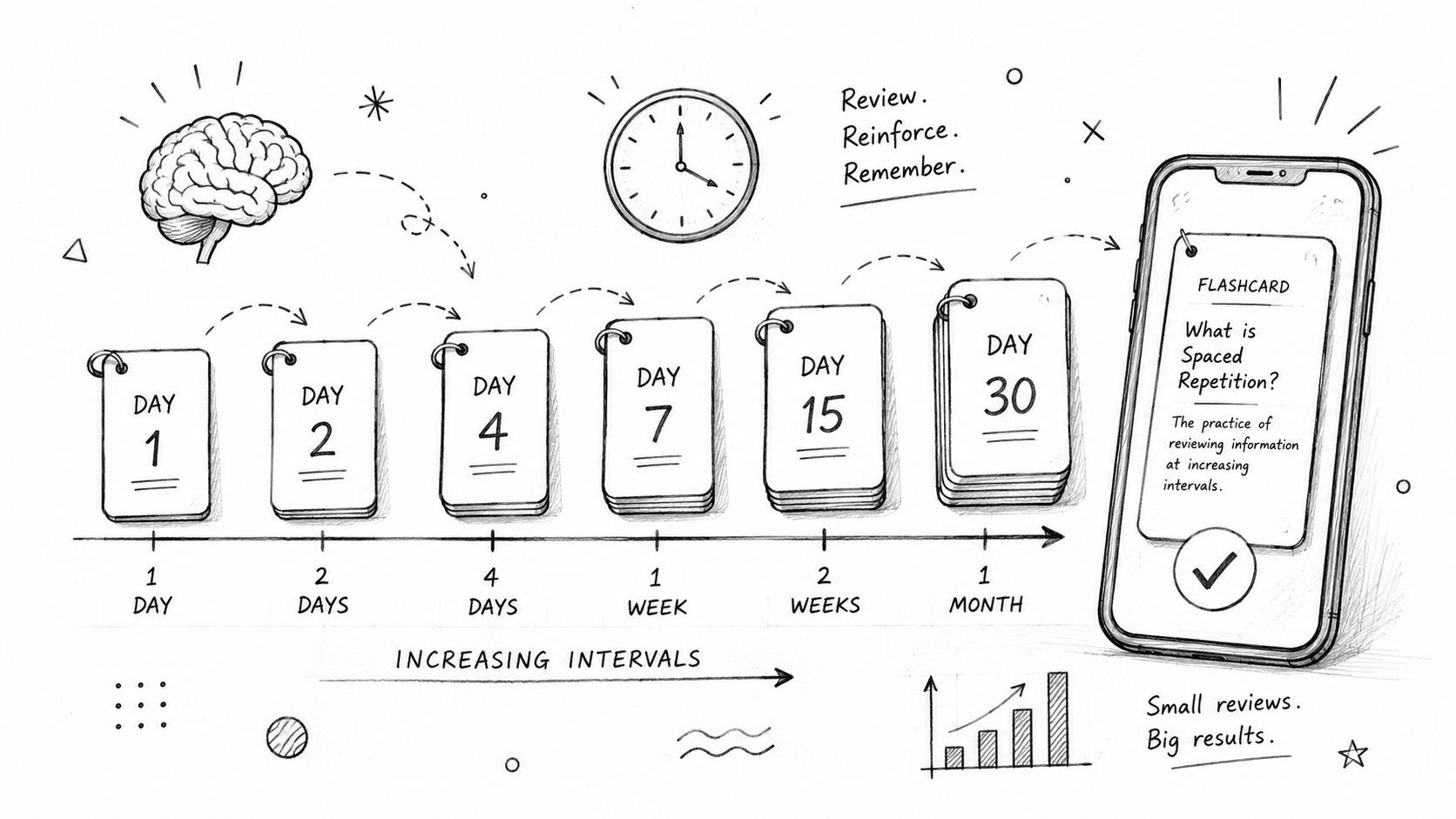
Active recall means pulling information out of memory before checking the answer. Spaced repetition means coming back to that information over time, not cramming it all in one sitting. For HGV theory, this works especially well because much of the content is technical, easy to confuse, and costly to forget under pressure.
A simple way to do it is to turn weak areas into flashcards. One side asks the question. The other side gives the answer and a short explanation. That method is far better than rereading the same page and assuming it has gone in.
Where it helps HGV learners most
Technical rules stick better: Drivers’ hours, loading rules, warning signs, and vehicle systems need retrieval practice, not just exposure.
You catch false confidence: It’s easy to recognise an answer on the page. It’s harder to produce it from memory.
Revision gets calmer over time: Spaced review stops the usual cycle of forgetting and relearning.
Free-form reading still has a place, but it shouldn’t be your main method. If you want a simple overview of the memory method itself, this guide to spaced repetition for GCSEs and A-Levels explains the rhythm clearly, even though the exam context is different.
The best revision sessions feel slightly difficult. That strain usually means your memory is working.
The trade-off
This approach demands consistency. It doesn’t suit last-minute learners who want a quick win the night before. It also takes a bit of setup if you’re building your own flashcards around HGV topics.
Still, for theory driving test tips that improve results, this is one of the strongest methods available. It replaces passive recognition with reliable recall, which is what the exam really tests.
3. Study Topic-Specific Content in Logical Sequences
HGV learners often jump between random subjects because it feels less boring. In practice, it slows understanding.
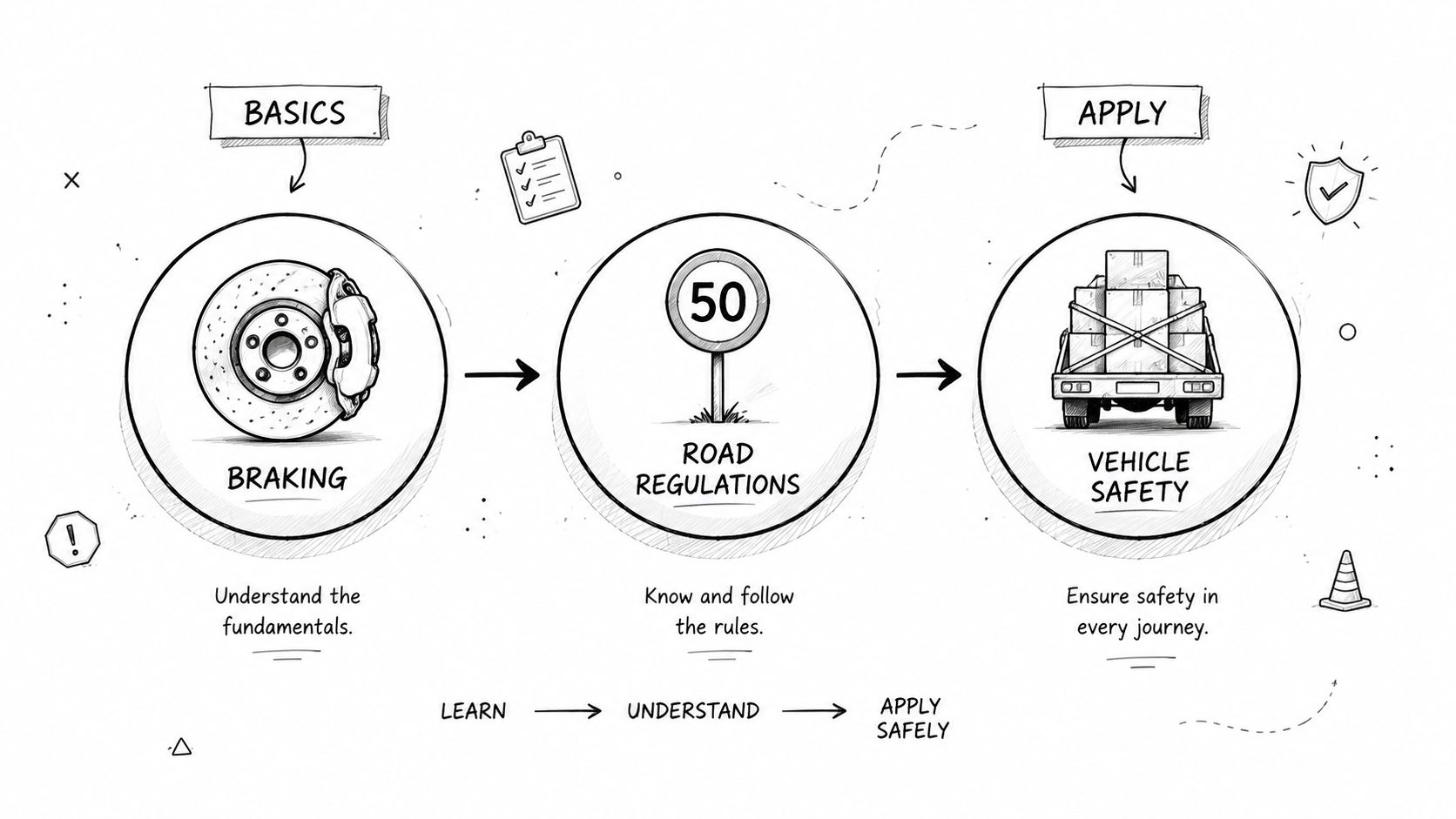
You’ll retain more when you group linked topics and study them in a sensible order. Start with the basics of vehicle safety and road rules. Then move into connected areas such as speed, weight, braking, loading, mirrors, blind spots, and hazard awareness. That sequence gives facts a structure, which makes them easier to remember and easier to apply.
This matters even more in HGV revision because large vehicles don’t behave like cars. One useful warning from nidirect’s LGV theory test preparation advice is that only two free official practice LGV tests are available online, and they’re shortened versions. That makes it even more important to organise your own study in a way that builds complete understanding.
A practical sequence that works
Start with control and safety: Vehicle checks, mirrors, stopping, road position, and observation.
Move into regulation: Drivers’ hours, signs, motorway rules, restrictions, and compliance topics.
Finish with applied scenarios: Load security, hazardous situations, and judgement-based questions.
When topics sit next to related topics, your brain starts making useful links. Vehicle weight connects to stopping distance. Mirror use connects to hazard perception. Safe loading connects to braking, steering, and rollover risk.
The trade-off
This kind of revision needs planning. If your app or question bank throws everything at you in random order, you may need to build your own weekly sequence.
That extra effort pays off because HGV theory isn’t just a memory test. It checks whether you can apply connected knowledge in a professional driving context. Logical sequencing trains exactly that skill.
4. Take Full-Length Practice Tests Under Exam Conditions
Can you hold your accuracy once fatigue, time pressure, and second-guessing start to build?
That is the primary job of a full mock. HGV candidates often revise in short sessions and do well while the material is fresh. The problem shows up later, when concentration drops and question quality slips in the second half of a test. Full-length practice exposes that early.
For professional drivers, this matters more than many people expect. The theory test covers a wide spread of knowledge, from road procedure to compliance topics such as drivers’ hours, vehicle safety, and load-related judgement. That mix puts pressure on both memory and decision-making. A timed mock lets you test both at once.
How to make mock tests count
Sit the whole paper in one session: No notes, no pauses, no checking answers midway through.
Match test conditions closely: Quiet room, phone away, same screen setup you expect to use for computer-based practice.
Track weak areas by category: Separate mistakes in signs, tachograph rules, safe loading, hazard awareness, and vehicle safety. Patterns matter more than one bad score.
Review your decision process: Ask why you changed an answer, where you rushed, and which questions drained time.
One useful method is to take a full mock, mark it, then revisit only the questions you got wrong using active recall the next day. That turns a practice paper into a memory tool instead of a one-off score report.
Hazard perception needs the same treatment. If your multiple-choice marks are solid but your reactions are late, spend time with this guide to the HGV hazard perception test format and scoring and practise spotting developing risks early rather than waiting for the obvious moment.
Treat mock tests as performance training. They show whether your knowledge still works under pressure.
The trade-off
Full mocks take time, and early scores can be uncomfortable. That is not a reason to avoid them. It is a reason to use them properly.
A poor result in practice often means one of three things. Your knowledge is patchy, your stamina is weak, or your exam technique needs work. Each problem has a different fix. Patchy knowledge needs topic revision. Weak stamina needs more full runs. Poor technique needs slower reading, better pacing, and less answer-changing without a clear reason.
Used that way, mock tests do more than measure readiness. They show you exactly what to fix before test day.
5. Focus on Understanding Principles, Not Just Memorising Facts
Memorisation has limits. HGV theory exposes them fast.
Questions aren’t difficult only because of content. They’re difficult because wording changes, scenarios shift, and some questions test judgement rather than simple recall. If you only memorise isolated facts, you’re vulnerable the moment a question looks unfamiliar.
This matters even more in hazard perception and scenario-based judgement. HGV candidates need to think in terms of vehicle size, longer stopping distances, wider turns, mirror dependency, and load movement. If you understand the principle behind the rule, you can work towards the answer even when the question isn’t one you’ve seen before.
What principle-based learning looks like
Ask why every rule exists: Safety rules make more sense when you connect them to real vehicle behaviour.
Link rules to consequences: Loading, speed, fatigue, and observation all have obvious real-world outcomes.
Use unfamiliar questions as training: Don’t avoid them. They show whether you understand the system behind the answer.
One issue in HGV revision is that candidates often worry about unseen questions and unusual phrasing. That concern is real, especially where category-specific material feels less familiar. A useful support topic here is HGV Learning’s explanation of the hazard perception test, because hazard awareness improves when you think in causes and developing risks, not just fixed answers.
If you can explain a rule in plain language, you usually understand it well enough to answer it.
The trade-off
This method is slower at first. It asks you to stop, reason, and sometimes revisit basics instead of racing through question sets.
But it’s the best defence against panic when a question looks new. Principle-based study also builds better habits for life after the theory test, which matters when you’re moving into real commercial driving work.
6. Create a Personalised Study Schedule with Consistent Habits
How do you keep theory revision going when work, family, and fatigue are all competing for attention?
For HGV learners, that is usually the principal test before the DVSA test. Shift patterns change. Energy levels dip. Study time gets squeezed. A personalised schedule solves that problem because it fits revision around the life you lead, not the week you wish you had.
The aim is consistency with a clear purpose. Professional driver theory covers more than road signs and stopping distances. You also need to hold onto rules around driver hours, tachograph use, vehicle checks, and safe loading. Those topics are easier to retain when you revisit them in planned cycles instead of cramming them in long, irregular sessions.
There is also a timing issue to manage. Your theory pass does not stay valid indefinitely. If the practical stages take longer than expected, poor planning can force you to sit the theory again. A steady schedule protects against that and keeps each part of the licence process moving in the right order.
Build a plan you can repeat
Start with your real week, not an ideal one.
Look at when you are most alert. Some candidates learn well after an early shift once they have eaten and switched off for half an hour. Others get far better results from a short morning session before the day starts. Use that pattern. Revision quality matters more than picking a time that sounds disciplined.
Then split the work by task type, not just by duration:
Use short sessions for recall work: 15 to 20 minutes suits flashcards, signs, definitions, and rules that need repeated retrieval.
Use medium sessions for applied topics: 25 to 40 minutes works well for tachograph rules, loading questions, and case-style reasoning.
Use longer blocks sparingly: Save them for full mock tests or hazard perception practice when you can give proper concentration.
Keep one catch-up slot each week: That stops one missed session from wrecking the whole plan.
A simple weekly structure often works better than a detailed daily timetable. For example, one learner might do active recall on Monday, category-specific HGV topics on Wednesday, hazard perception on Friday, and a mock test at the weekend. Another might need six shorter sessions spread across breaks because home life makes longer blocks unrealistic.
Both plans can work.
Make the schedule personal, then make it measurable
A good study plan tells you what you are doing, how long you are doing it for, and what counts as progress.
That means tracking outcomes, not just time spent. Record weak areas by topic. Note whether errors come from knowledge gaps, misreading the question, or rushing. Those are different problems and they need different fixes. A candidate who keeps missing safe loading questions needs targeted review. A candidate who knows the material but drops marks late in a mock test may need better pacing and concentration habits.
Cognitive science provides practical assistance. Repeating the same easy topics feels productive, but it usually wastes time. Bring difficult material back more often, especially the HGV-specific content that is less familiar than standard car theory material. That is how spaced repetition earns its place in a working schedule.
The trade-off
A rigid timetable looks good on paper and fails quickly in real life.
A flexible one lasts longer, but only if it still has rules. Set a minimum weekly target, keep your study slots visible, and review the plan once a week. That balance gives you structure without making one bad week feel like a full reset.
The best schedule is the one you can keep following in week three, not just on day one.
7. Engage with Multimedia and Varied Learning Resources
How do you study topics that are easier to see than read?
For HGV theory, that question matters. Hazard perception, mirror routines, vehicle position, braking effects, safe loading, and tachograph scenarios often click faster in visual or interactive formats than they do in a block of text. A candidate can read a rule and still miss how it plays out on the road or in a depot.
Use each format for a specific job.
Video helps with movement, timing, and developing risk. Diagrams help with systems and layout, especially for loading principles, stopping distances, vehicle checks, and road positioning. Audio explanations work well for revising regulations during commutes or breaks. Interactive quizzes help test whether the point has stuck.
That matters more for HGV learners than many people expect. A lot of theory content online is built around car drivers first, then adapted. Professional driver tests demand more than that. You need resources that reflect larger vehicles, wider turning arcs, restricted visibility, tachograph duties, and the practical consequences of poor load security.
A simple way to keep this under control is to match one resource to one task:
Video for hazard perception and roadcraft: watch how risks develop, not just where they appear.
Diagrams for technical topics: use them for safe loading, braking systems, vehicle checks, and junction positioning.
Audio for regulation review: short listens can reinforce drivers’ hours rules and signs during dead time in the day.
Quizzes for recall: finish each study block by answering questions without looking at notes.
Discussion for sticking points: a tutor, trainer, or study partner can often clear up one bad assumption quickly.
The trade-off is straightforward. Variety improves understanding, but too many tools can turn revision into browsing.
Pick a small set of resources that cover different learning jobs, then reuse them consistently. If a video explains load shift well, pair it with a few recall questions and a diagram of restraint methods. If an app gives you hazard clips, follow them with a short note on why the hazard developed early. That combination builds recognition, understanding, and memory at the same time.
Used properly, multimedia study is not a break from serious revision. It is a practical way to learn HGV theory in the form you will need on test day.
7-Point Driving Theory Strategy Comparison
A comparison only helps if it changes what you do next. Use this one to choose the right priority for your stage of preparation, not to rank methods in the abstract.
For HGV theory, the key question is simple. Which strategy gives you the biggest score improvement for the weakest part of your revision plan? A candidate who keeps missing tachograph rules needs a different fix from someone who knows the content but falls apart under timed conditions.
Strategy
Best used for
Main trade-off
What strong HGV candidates do with it
Master the DVSA Question Bank Systematically
Building test familiarity and spotting weak areas
High repetition can become passive if you only recognise answers
Track misses by topic, especially drivers’ hours, vehicle checks, road signs, and loading rules
Use Active Recall and Spaced Repetition Techniques
Retaining technical rules over time
Takes setup and consistency before it pays off
Revisit hard facts at planned intervals, then test from memory without cues
Study Topic-Specific Content in Logical Sequences
Understanding linked subjects properly
Requires planning instead of random revision
Group related areas such as braking, speed limits, stopping distances, and hazard awareness
Take Full-Length Practice Tests Under Exam Conditions
Measuring readiness and improving timing
Uses more time per session and can feel slower than short quizzes
Sit full papers in one go, review errors by pattern, and adjust the next week’s study
Focus on Understanding Principles, Not Just Memorising Facts
Answering unfamiliar questions and applying rules correctly
Slower at the start than rote learning
Explain why a rule exists, especially for safe loading, fatigue, stopping distance, and vehicle stability
Create a Personalised Study Schedule with Consistent Habits
Keeping revision going around work and family
Needs realistic planning, not optimistic planning
Use short, repeatable sessions across the week instead of relying on long weekend cramming
Engage with Multimedia and Varied Learning Resources
Grasping visual and practical topics faster
Too many tools can reduce focus
Use a small set of videos, diagrams, quizzes, and audio for specific jobs only
The pattern is clear. The strongest approach is not “use all seven equally.” It is sequencing them properly.
Start with question-bank coverage and topic order. Add active recall early so facts stay usable. Bring in full mock tests once your errors are narrowing. Use principle-based study for the subjects HGV drivers cannot afford to treat as trivia, especially load security, tachograph law, vehicle limitations, and hazard development.
That gives this comparison a practical purpose. It helps you decide what to do more of, what to stop doing, and which study method matches the mistake you keep repeating.
Your Next Step to Becoming a Professional HGV Driver
Passing the HGV theory test is a serious milestone. It proves you can handle the knowledge side of professional driving before you move on to practical training, real vehicle control, and day-to-day compliance.
The strongest candidates usually don’t rely on motivation alone. They use structure. They work through the question bank properly, test themselves instead of rereading, group related topics, and practise under real exam conditions. They also learn to think like a professional driver. That means understanding why rules exist, not just what the answer key says.
That matters because the test standard is demanding. HGV candidates need 85 correct answers from 100 in the multiple-choice section, and the theory stage must be completed before practical test booking can move ahead. If your revision has been too generic, too passive, or too car-focused, now’s the time to fix that.
There’s also value in keeping the bigger picture in mind. Your theory test isn’t an isolated hurdle. It sits inside a longer licensing journey that includes practical training, test timing, and career planning. Other countries structure commercial driving pathways differently, as shown in this overview of ELDT rules for box truck drivers, but the same principle applies. Strong foundation knowledge supports safer driving later.
If you want support beyond self-study, HGV Learning is one relevant option. The provider offers a three-stage pathway that includes theory preparation with progress tracking, followed by practical training coordination and support towards licence progression. For candidates who want a more guided route into C1, Category C, or C+E training, that kind of structure can make the process easier to manage.
The best next step is simple. Pick your test date, map your weak topics, and start revising with a plan that matches the actual HGV exam. Done well, theory preparation doesn’t just help you pass. It helps you start your driving career on the right standard.
If you want a structured route into HGV theory and practical training, HGV Learning offers DVSA-aligned support for C1, Category C, and C+E candidates, including theory preparation with progress tracking and help moving through the full licence process.
What Age Can You Start HGV Driver Training? A 2026 UK Guide to Licence Age Requirements
If you're asking what age you can start HGV driver training, the honest answer depends on which licence you're after. A C1 licence, covering vehicles...