You’re parked on the hard shoulder after a load check. A strap has flicked back, someone’s cut a hand, and traffic is flying past. Or you’re pulled into a roadside inspection and the officer asks to see your first aid provision. In that moment, an HGV first aid kit stops being a forgotten box in a locker. It becomes part of your job.
That’s where many drivers get mixed messages. One person says a kit is only recommended. Another says it’s mandatory. A supplier says “compliant” on the bag, but doesn’t explain what standard it meets or how you keep it compliant once items expire or go missing.
For a professional driver, that confusion isn’t good enough. You need a simple answer to three questions. What should be in the kit, when is it legally required, and who is responsible for keeping it ready to use?
A wider essential medical kit checklist can help you think about emergency readiness in general, but HGV work needs a vehicle-specific approach. Day-to-day risk on the road is different from home, office, or leisure travel. Safe preparation also sits alongside other habits such as HGV accident prevention guidance, because first aid is only one part of staying safe at work.
Your First Line of Defence on the Road
An HGV first aid kit is your first line of defence when something goes wrong before professional help arrives. It won’t turn you into a paramedic, and it doesn’t replace proper training. What it does do is give you the basics to protect yourself, protect others, and show that your vehicle is prepared for work.
Many new drivers think of a first aid kit as a few plasters and a pair of gloves. That’s too narrow. On the road, you may be dealing with bleeding from load handling, a burn from hot equipment, shock after a collision, or chemical splash risk if you move hazardous goods. The kit has to match that reality.
Practical rule: If your kit only looks suitable for a paper cut in an office, it probably isn’t suitable for HGV work.
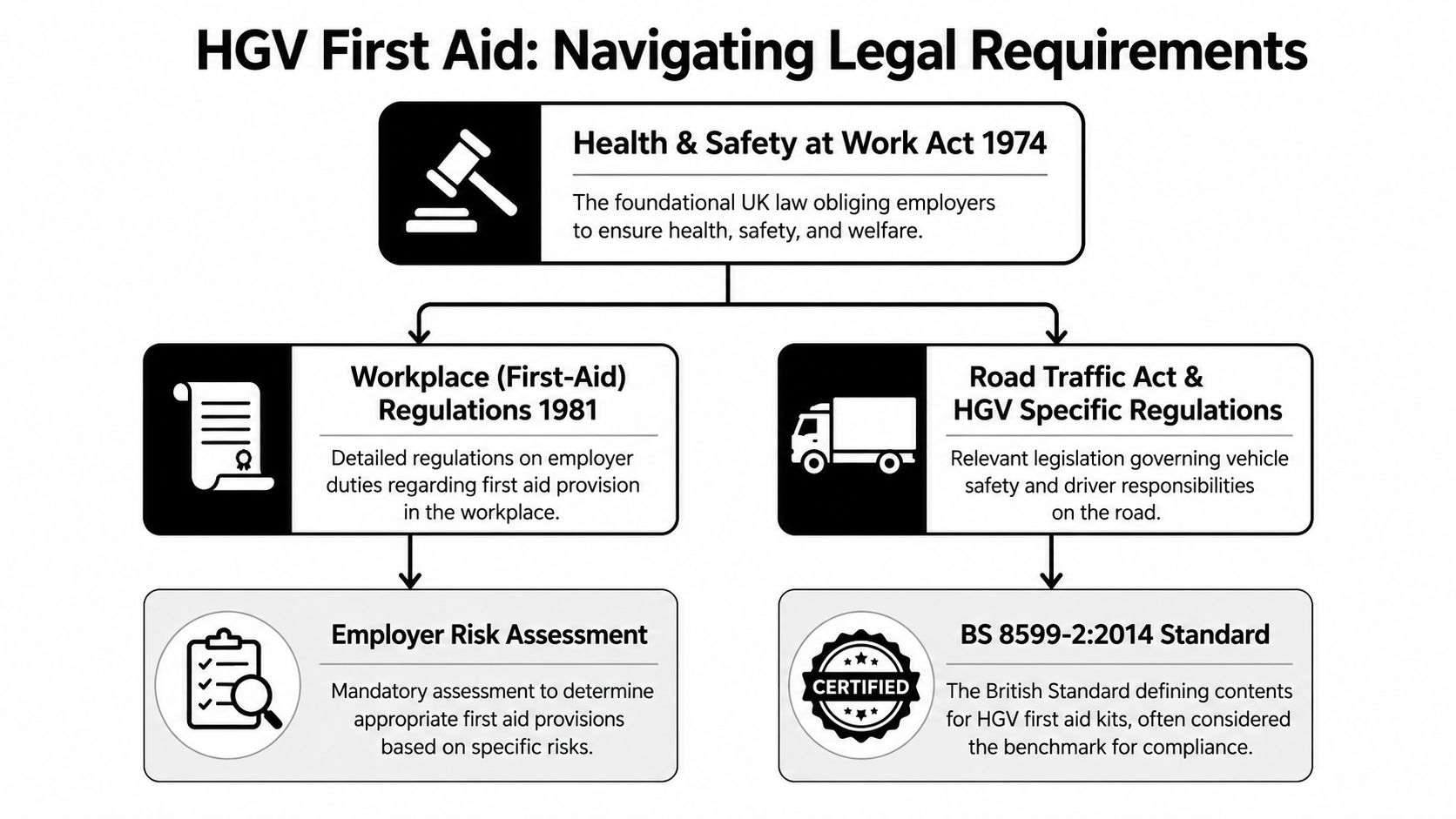
The other point drivers miss is that there are two separate ideas in play. First, there’s the employer’s legal duty to provide adequate first aid arrangements for work. Second, there’s the recognised benchmark people use to show that vehicle provision is suitable. Those two ideas overlap, but they are not the same thing.
That’s why drivers get caught out. They hear “recommended” and think “optional”. They hear “British Standard” and think “law”. Neither answer is complete on its own.
What Goes Inside Your HGV First Aid Kit
For UK drivers, the benchmark followed is BS 8599-2:2014. It’s the recognised standard for vehicle first aid kits and it gives you a practical way to judge whether your HGV first aid kit is up to scratch.
The key point is this: in the UK, all Heavy Goods Vehicles over 3.5 tonnes, classified as N2 and N3 vehicles under BS 8599-2:2014, are required to carry a medium-sized workplace first aid kit as part of mandatory health and safety compliance for commercial transport, according to this guide to BS 8599-2 vehicle first aid kits.
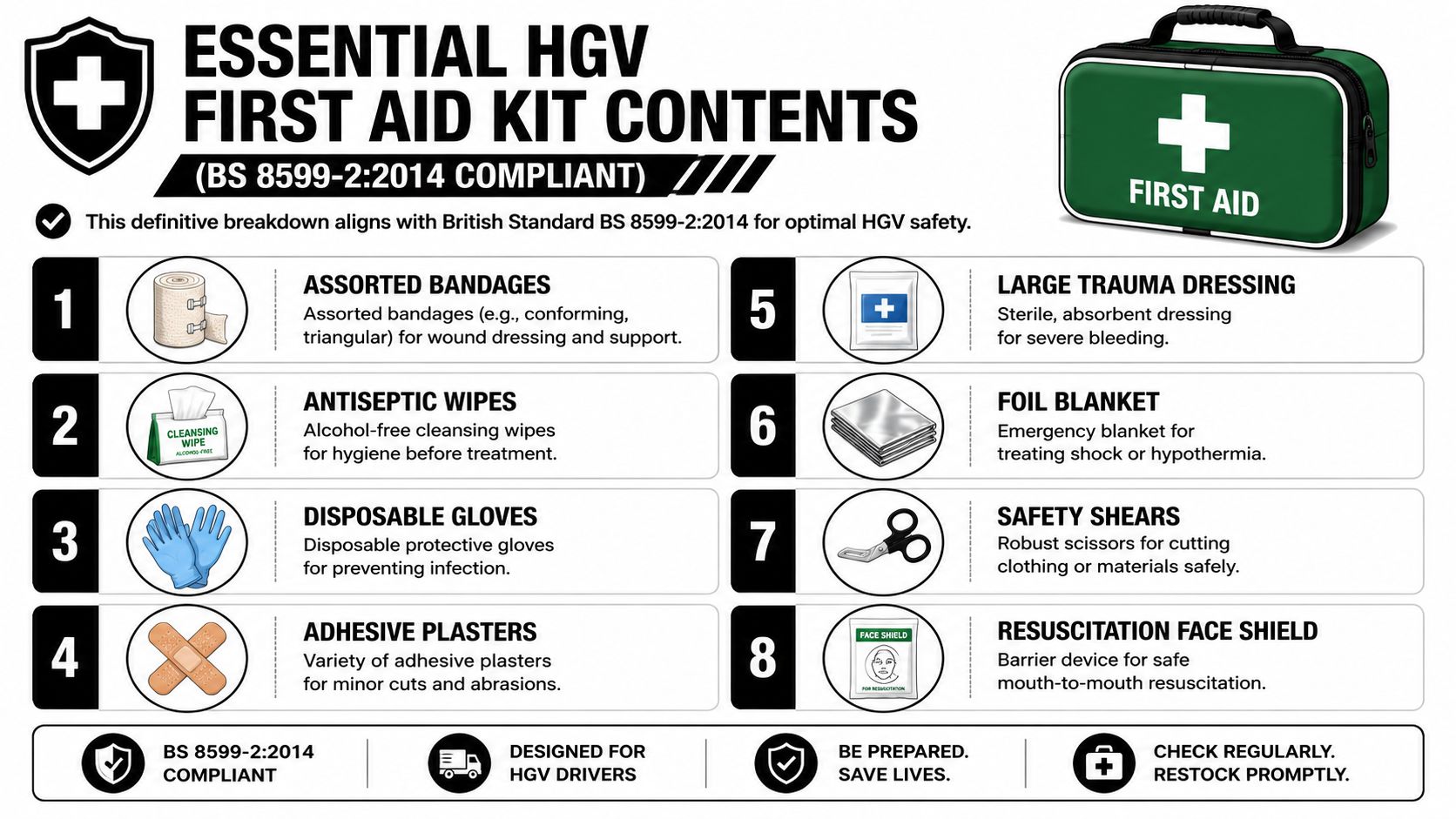
This definitive breakdown aligns with British Standard BS 8599-2:2014 for optimal HGV safety.
What the medium kit is designed to cover
The medium kit under BS 8599-2 is meant for real vehicle incidents, not just minor scrapes. The standard includes specific contents such as sterile dressings, plasters, bandages, burn dressings, disposable gloves, cleansing wipes, foil blankets, shears, and a first aid guidance leaflet. Those items matter because roadside injuries can get worse quickly if bleeding, contamination, cold, or delay becomes a factor.
A foil blanket, for example, isn’t filler. It helps you manage heat loss if someone is in shock or stranded in poor weather. Shears are there so clothing can be cut safely without causing more injury. Burn dressings make sense when drivers work around hot engine parts, tail-lifts, friction burns, or hot surfaces.
If you’re checking ready-made products, compare them against the standard rather than the marketing. A comprehensive first aid kit with eyewash may be useful as a buying reference, especially if you want extra wash-out capability, but you still need to confirm that your vehicle kit matches the HGV requirement rather than assuming a large kit is automatically the right one.
BS 8599-2 Medium Kit Contents Checklist for HGVs
Item
Quantity
First aid guidance leaflet
1
Sterile dressings
As specified by the medium kit standard
Assorted plasters
As specified by the medium kit standard
Bandages
As specified by the medium kit standard
Burn dressings
As specified by the medium kit standard
Disposable gloves
As specified by the medium kit standard
Cleansing wipes
As specified by the medium kit standard
Foil blanket
As specified by the medium kit standard
Shears
1
What drivers often get wrong
Some drivers buy the smallest kit they can find and think they’re covered. Others keep an old workplace box in the cab with random extras added over time. That creates two problems:
Wrong standard: The kit may not match the recognised vehicle benchmark.
Missing essentials: Items for bleeding, burns, or roadside exposure may not be there.
Poor organisation: In an emergency, you don’t want to rummage through loose supplies.
A proper HGV first aid kit should be easy to reach, easy to open, and easy to understand under stress.
Understanding the Legal Requirements
This is the part that causes the most confusion in transport. Drivers often ask, “Is a first aid kit law, or just advice?” The honest answer is that you need to separate legal duty, accepted standard, and special cases.
The legal foundation
Under the Health and Safety (First-Aid) Regulations 1981, every employer in the UK must provide adequate first aid equipment. There is no explicit statutory clause that says every commercial vehicle must carry a kit, but the HSE strongly recommends vehicle kits so employers can meet their wider duty of care. The same guidance also says tablets or medicines must not be included in workplace first aid kits, as explained in this summary of UK first aid at work legal requirements.
That’s the first layer. The law says first aid provision must be adequate and appropriate. It does not give every fleet operator a neat shopping list for every vehicle type.
So how does an operator show that provision is adequate in an HGV? In practice, that’s where BS 8599-2 comes in. It is the accepted benchmark many operators use to prove that the kit is suitable for vehicle work.
Best practice versus mandatory duty
This is the simplest way to understand:
The legal duty: Employers must provide adequate and appropriate first aid equipment for people at work.
The accepted benchmark: BS 8599-2 tells you what a vehicle first aid kit should contain.
The working reality for HGVs: If you want to show that your provision is sensible, organised, and defensible, following the standard is the clearest route.
That distinction matters. A British Standard is not the same as an Act of Parliament. But if an employer is challenged on whether provision is adequate, using the recognised standard is far easier to defend than improvising with a random box.
Key point: “Recommended by HSE” doesn’t mean “safe to ignore” in a work vehicle.
When the requirement becomes more specific
Some work raises the risk level and tightens expectations. Hazardous goods transport is the clearest example. If your operation falls under ADR, the first aid kit needs to reflect the hazards you carry. That means adding specialised items suited to contamination risk and roadside response.
The wider safety picture matters too. Drivers who work in physically demanding environments also need to understand related health issues, including fatigue, fitness, and medical suitability for work. That’s why occupational checks matter alongside first aid readiness, especially in higher-risk roles. A good starting point is this guide to occupational health screening.
What should never be in the kit
Drivers often think they’re improving a kit by adding painkillers, creams, or leftover tablets. Under workplace first aid guidance, that’s the wrong move.
Keep medication out. Keep the kit focused on immediate first aid. If you want personal medication, store it separately, label it clearly, and don’t mix it into the first aid box used for work.
Maintaining and Recording Your Kit
A compliant kit on day one can become a poor kit very quickly. Gloves split. Dressings get used. Seals break. Packs expire. Then a driver opens the case in an emergency and finds half the contents missing.
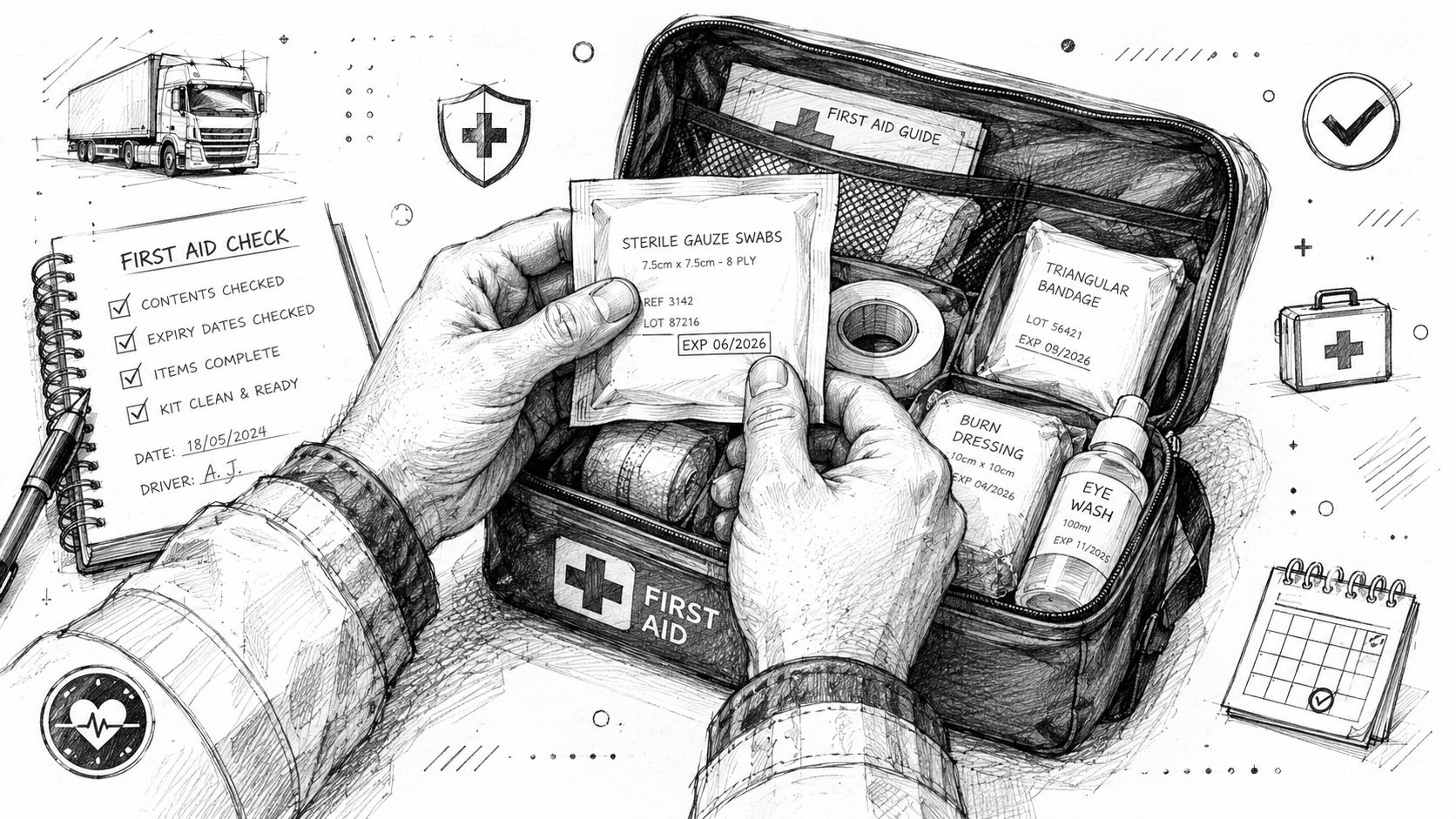
That happens more often than many operators realise. A 2024 UK Transport Research study found that 42% of HGV drivers said they never checked their first aid kit after purchase, and 30% of kits contained expired or missing critical items. HSE guidance says employers must ensure kits are “checked regularly and kept up to date”, as noted in this HSE first aid kit guidance.
A simple checking routine
You don’t need a complicated system. You need a routine that gets done.
Before setting off: Make sure the kit is in the vehicle, easy to reach, and the case isn’t damaged.
At regular intervals: Open it and check for used, torn, expired, or damp items.
After any incident: Replace whatever was used straight away, not at some vague future service date.
The driver and the operator both have a role here. The operator must provide and replace. The driver is the one who sees the kit day to day and should report problems early. If you wait until a roadside emergency, the check is already too late.
What to record
A basic log is enough for most fleets. Keep it practical.
Check point
What to note
Date checked
When the inspection happened
Vehicle ID
Which lorry or unit the kit belongs to
Missing items
Anything used or absent
Expired items
Dressings, gloves, wipes, or other time-limited contents
Action taken
Replaced, ordered, or reported
A sealed bag with an old expiry date is not a compliant solution. It’s only compliant if the contents are still fit for use.
Where to store it
Store the HGV first aid kit where you can reach it quickly without emptying half the cab. It should be protected from obvious dirt and damage, but not buried under personal gear, paperwork, or straps. In an emergency, seconds matter. Good storage is part of readiness.
Using Your Kit in a Roadside Emergency
First aid on the road has one golden rule. Don’t make the situation worse. If the scene isn’t safe, stop and control that first.
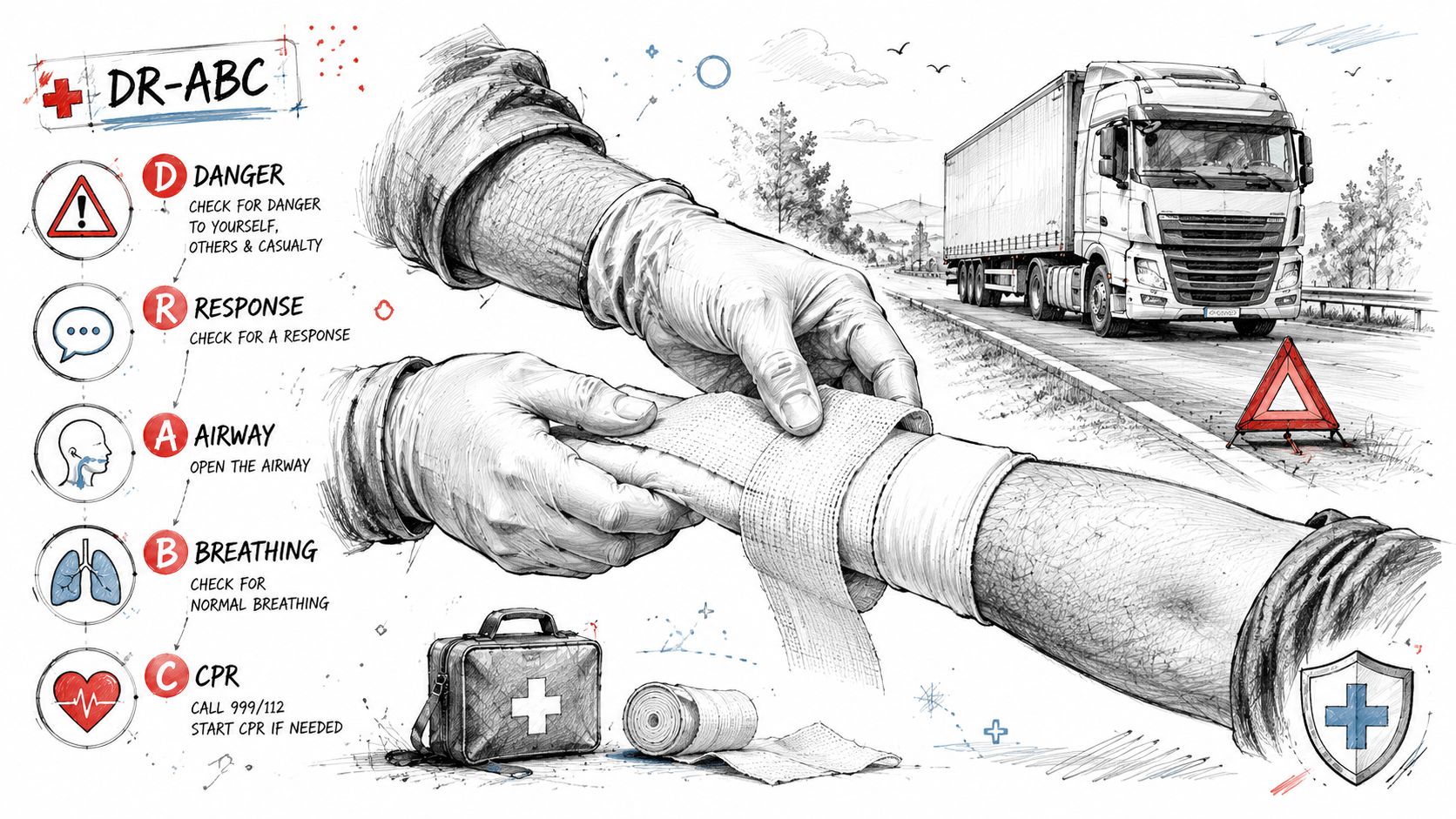
A simple way to think under pressure is DR-ABC:
Danger. Check traffic, fuel, fire, unstable loads, and any chemical risk.
Response. See if the casualty responds.
Airway. Make sure the airway is clear.
Breathing. Look, listen, and feel for breathing.
Circulation. Control severe bleeding and monitor the casualty.
For ADR work, the pressure is higher. Hazardous goods operations require specialised items such as eye wash pods for chemical splashes, and benchmark data says a first-aider must be able to retrieve the kit and reach a casualty within 60 seconds, which matters on fast roads and exposed locations, according to this guide on first aid requirements for commercial vehicles.
Scenario one, a cut during load handling
You’re securing a load, a sharp edge catches your hand, and the cut is deeper than a plaster job.
Put gloves on first if you can. Apply a sterile dressing and firm pressure. If bleeding soaks through, keep pressure on and use additional dressings as needed. If the wound is serious, call for help.
This is also why good lifting and handling technique matters. Many avoidable injuries happen during routine tasks rather than major collisions. Drivers who need a refresher can review these manual handling techniques alongside their first aid habits.
Scenario two, a burn from hot equipment
A driver touches a hot engine part or metal surface and gets a burn.
Use the burn dressing in the kit if appropriate and protect the area. Don’t apply random creams from the glove box. Don’t burst blisters. If the burn is serious, on the face, or affecting breathing, get emergency help.
If you’re guessing which product to use, stop and read the guidance leaflet in the kit. That’s what it’s there for.
Scenario three, shock after an incident
A person may look pale, feel cold, shake, or seem confused after a collision or near miss. Even without obvious major injury, treat it seriously.
Keep them still if possible. Reassure them. Use the foil blanket to help maintain warmth. Watch breathing and response while waiting for emergency services.
For drivers who want extra practical refreshers, short emergency courses outside the transport sector can still help build confidence with the basics. A programme such as mandatory first aid for UK care staff shows the same core principle applies in every setting: act safely, use simple steps, and know your limits.
A quick visual walkthrough can help fix the sequence in your mind:
Know the limits
Your role is to give immediate help, not advanced treatment. Call emergency services early when there is severe bleeding, breathing difficulty, loss of consciousness, suspected spinal injury, chemical exposure, chest pain, or any situation you can’t safely manage.
That isn’t weakness. It’s sound judgement.
Driving with Confidence and Compliance
A good HGV first aid kit is not a box-ticking exercise. It’s part of being a professional driver. When the kit is right, accessible, and maintained, you’re in a stronger position both for safety and for compliance.
The confusion usually comes from mixing up legal duty with best practice. The legal duty sits with the employer to provide adequate first aid arrangements for work. The accepted benchmark for vehicle provision is BS 8599-2. For higher-risk work such as ADR operations, the need becomes more specific and more urgent.
That means your standard should be simple. Carry the right kit for the vehicle. Keep it complete. Keep it current. Keep it somewhere you can reach fast.
A driver who checks tyres, lights, straps, documents, and mirrors should think the same way about first aid. It’s part of the same professional mindset. You don’t wait for a defect to matter before you take it seriously.
The best time to check your kit is before anyone needs it.
If you’re already driving, inspect your kit today. Open it. Check the contents. Check the dates. Make sure used items have been replaced. If you’re new to the industry, learn this early and treat it as normal practice from the start. Drivers who build safe habits early tend to carry them through the rest of their career.
If you want proper training that builds this kind of professional standard from the start, HGV Learning helps new and experienced drivers across the UK progress through licence training, theory support, practical preparation, and specialist courses with safety and compliance at the centre of the process.