You might be reading this on a lunch break, after another shift that goes nowhere, or late at night while comparing jobs that all sound the same. You want decent money, practical skills, and work that feels solid. You also don’t want to spend months chasing a career that looks better on paper than it does in real life.
That’s where trucking drivers jobs can be a smart move, if you approach them with your eyes open. Getting an HGV licence matters, but licence alone isn’t the full story. Pay, shift pattern, loading duties, route type, and the employer’s standards will shape whether you build a career you can live with.
This guide takes the route I’d give a promising trainee. Start with the paperwork. Get through training properly. Understand where people get stuck. Then choose work that fits your body, your home life, and your long-term earning goals.
Why 2026 is the Year to Start Your Trucking Career
A lot of people come into this trade after getting fed up with vague career paths. They want a job where the qualification means something, where demand is visible, and where effort can still move you forward. HGV driving gives you that, but only if you treat it as a profession from day one.
The opportunity is real because employers still need drivers. The Road Haulage Association estimates the UK needs around 100,000 additional lorry drivers to close the gap, which creates strong openings for new entrants who train properly and present themselves well in the market, as outlined in Indeed’s overview of the UK lorry driver shortage.
That figure matters for one reason above all. It gives you an advantage. A shortage doesn’t guarantee a perfect first job, but it does mean firms have to keep hiring, and that gives new drivers a route in.
What makes this a good entry point
The best time to move into HGV work is when demand is there and employers can’t rely on a full bench of experienced drivers. That’s the environment many candidates are walking into now. If you’re organised, pass your stages cleanly, and stay realistic about your first role, you can get established faster than many people expect.
There’s another reason 2026 looks attractive for career changers. Road haulage isn’t a niche corner of the economy. It sits close to everything else people rely on, from retail deliveries to building materials to utilities work.
Practical rule: Don’t think of a driver shortage as a national headline. Think of it as your opening to enter a trade that still needs competent people.
The real question isn’t only how to qualify
New starters often focus on one target. Get the licence. That’s understandable, but it’s too narrow. The better question is this: what kind of driver do you want to become?
Some drivers want regular local work and to sleep at home every night. Others want Class 1 work, specialist loads, or a route into construction support roles. The right first move depends on what you can tolerate as much as what you can earn.
A sustainable plan usually starts like this:
Pick the right licence route: C1, Category C, or C+E should match the work you want.
Budget for more than training: You need to account for medicals, tests, and the time needed to prepare properly.
Choose first-job criteria early: Hours, loading duties, nights out, and commuting distance matter more than most adverts admit.
Treat your first year as foundation work: You’re building experience, safe habits, and a stronger CV, not just grabbing any keys offered.
That mindset makes the whole process clearer. You’re not chasing any vacancy. You’re entering a trade and building position.
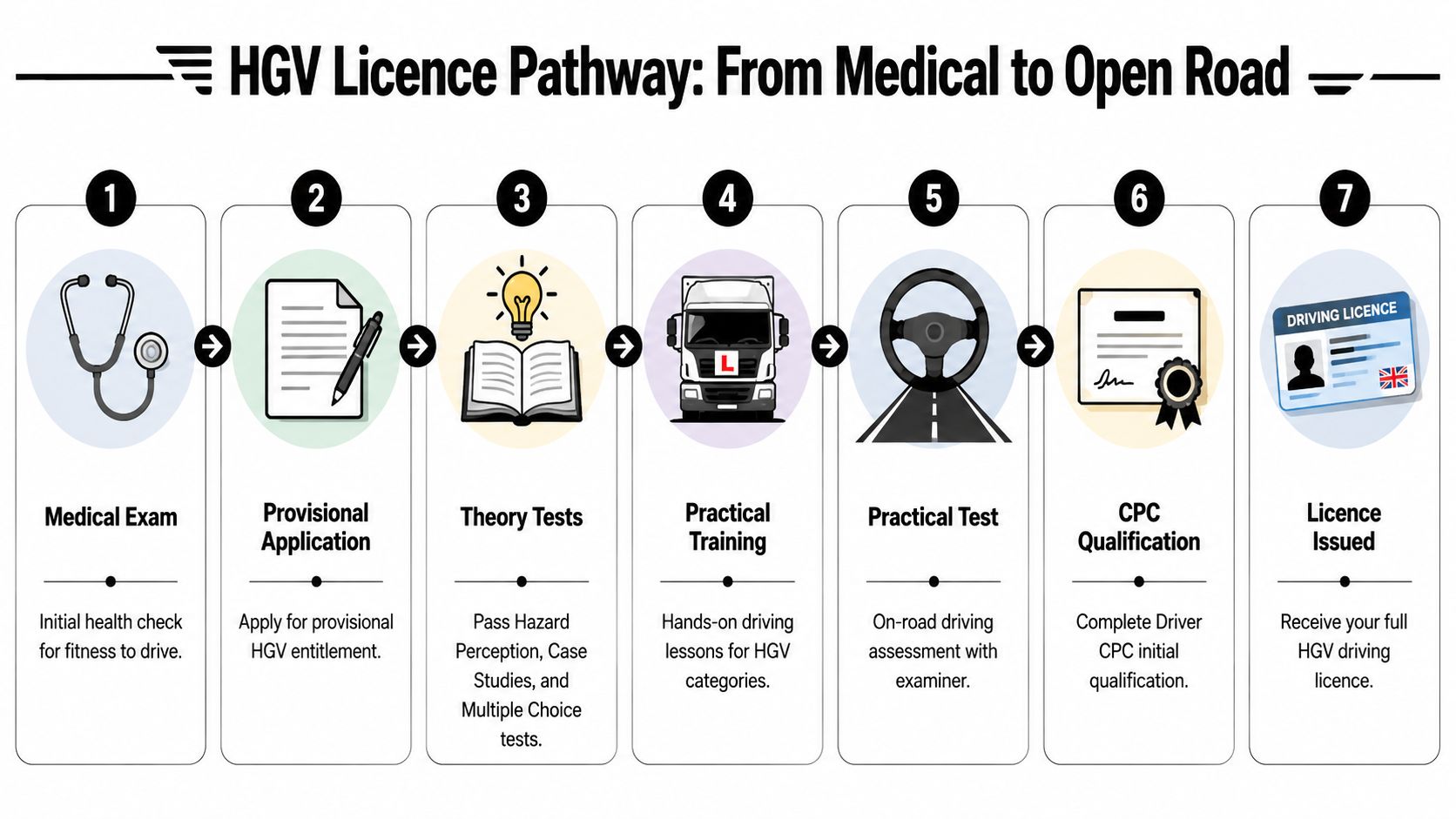
Your HGV Licence Pathway From Medical to Open Road
The licensing process looks confusing until you break it into sequence. Once you do that, it becomes manageable. The danger isn’t complexity so much as poor preparation, missed paperwork, or rushing one stage before you’re ready for the next.
The route is stricter than many new candidates expect, and that’s a good thing. The UK HGV recruitment pipeline follows a six-step methodology and has an overall success rate of about 42% for new entrants, according to the Department for Transport rapid evidence assessment. That figure tells you one thing clearly. Turning up casually is a bad plan.
You begin with the D4 medical. This is the health check that confirms you’re fit to drive commercially. Book it early and fill in your details carefully before you attend. Small admin mistakes slow people down more often than the medical itself.
Next comes the provisional licence application. Don’t leave gaps, don’t guess details, and make sure your ordinary driving licence is current and your address is right. If your paperwork is untidy now, it will stay untidy all the way through training.
Then you move to the theory stage. For most trainees, discipline is demonstrated. Passing the multiple-choice test, hazard perception, and case-study style elements isn’t about being naturally academic. It’s about consistent revision using proper question practice and enough repetition to stay calm on test day.
The practical side where candidates either settle or wobble
Once theory is done, training becomes more tangible. You’re in the vehicle, working on mirrors, road position, gear use if relevant, planning ahead, lane discipline, and controlled manoeuvres.
The practical side includes two key test modules:
Module 3a: reversing exercise
Module 3b: on-road practical driving test
Some candidates fear the road drive most. In reality, plenty lose marks because they treat the reversing phase as an afterthought. Examiners want control, observation, and composure. They don’t want speed.
If a learner struggles, it’s usually because they’re trying to memorise a route instead of building repeatable habits.
A good trainer will coach you to verbalise what you’re seeing. That helps with planning, mirror use, and hazard response. It also stops panic when something changes.
To see the process in action, this walkthrough is worth watching before your training starts:
The final stage that turns training into employability
After the core practical work, you complete the Driver CPC practical demonstration, often referred to as Module 4 for new entrants on the initial qualification route. During this demonstration, you show that you understand safety, loading security, walkaround checks, and professional responsibilities.
Think of the full journey in this order:
Medical first: No point booking everything else if this isn’t sorted.
Provisional entitlement next: Get your application moving as early as possible.
Theory preparation: Use a question bank, hazard practice, and regular mock tests.
Practical training: Learn the vehicle properly, not just the test route.
Module 3a: Practise reversing until the sequence feels calm and repeatable.
Module 3b: Drive smoothly, legally, and predictably.
CPC completion: Show you understand the job, not just the driving.
What works and what does not
A few trade-offs are worth being honest about.
Approach
What happens
Booking too fast
You end up chasing dates before your theory knowledge is solid
Choosing cheap over organised
Poor scheduling and weak support usually cost more later
Taking revision seriously
You arrive calmer and use training hours better
Asking basic questions early
You avoid avoidable delays around forms, ID, and entitlements
The strongest candidates don’t try to bluff their way through. They ask what each stage is for, prepare properly, and treat every pass as something earned.
Go Specialist to Boost Your Earnings
A basic licence opens the gate. Specialist tickets widen the road ahead.
That matters because not all trucking drivers jobs are equal. Some are routine and steady. Others are harder to fill because they involve more responsibility, awkward sites, regulated goods, or extra equipment. Those harder-to-fill roles often put you in a better position when you negotiate work.
Which specialist routes are worth looking at
ADR is the one many drivers look at first. It opens work involving hazardous goods and can make your CV far more useful in fuel, chemicals, industrial supply, and related sectors. If you want a clear explanation of the qualification, read this guide to ADR training in the UK.
HIAB suits drivers who want work around builders’ merchants, construction deliveries, site support, and jobs where operating the lorry-mounted crane is part of the role. These positions can suit drivers who prefer more varied days over pure trunking.
Telescopic handler tickets can also be valuable if your long-term aim sits close to construction and site logistics rather than general haulage.
Why specialism changes your options
The first reason is obvious. You can apply for roles that a standard licence holder can’t touch.
The second reason is more important. Specialist employers often care about judgement, site safety, paperwork, and customer-facing reliability. That can lead to better job quality, not only better pay. The work may still be demanding, but it’s often more defined.
A simple way to think about it:
General haulage: Broader entry point, good for building early experience
ADR work: Better if you like compliance and procedure
HIAB roles: Better if you’re comfortable with site work and physical surroundings
Construction-linked tickets: Better if you want to work around plant, materials, and project delivery
Career judgement: Don’t collect tickets for the sake of it. Add qualifications that match the kind of week you actually want to live.
When to specialise
You don’t always need to do it immediately. Some new drivers are better off getting a solid year of clean, reliable work first. Others already know they want to head into a niche and should train for that path early.
What doesn’t work is drifting. A lot of drivers stay in entry-level roles longer than they need to because they never decide where they’re heading. A licence gets you into the trade. Specialisation is often what starts shaping it around your strengths.
Building Your CV and Finding Your First Role
The hardest part for many new drivers isn’t passing the test. It’s landing that first paid role without a long commercial driving history. That hurdle is real, but it’s not a dead end.
The market is active enough that employers still need people. As a snapshot of demand, there were 26,976 open truck driver jobs listed on Glassdoor across the UK in July 2026, according to the Oxford-based analysis of HGV labour market conditions. That doesn’t mean every vacancy suits a new pass. It does mean there’s movement.
Build a CV that solves the employer’s first concern
A new driver’s CV shouldn’t pretend to be something it isn’t. If you’ve just qualified, say so clearly. Then answer the employer’s main question. Can this person be trusted with a vehicle, a schedule, and a customer-facing job?
Use a skills-based CV. Put your licence category, CPC status where relevant, and any extra tickets near the top. Then pull in transferable strengths from previous work.
Useful examples include:
Time discipline: Shift work, delivery schedules, attendance record
Vehicle awareness: Vans, plant, machinery, or safety-sensitive equipment
Customer contact: Retail, site delivery, service calls, handovers
Calm under pressure: Security, care work, emergency support, factory shifts
Three ways to find work that actually leads somewhere
Job boards are the obvious starting point. They help you see what’s being advertised, what licence categories are in demand locally, and how employers describe routes, hours, and duties. If you want a broader spread of openings in one place, it’s also useful to browse available positions and compare what different employers ask for.
Agencies can help you get a foot in the door quickly, especially when a firm needs cover or volume hiring. The trade-off is control. Agency work can give you fast exposure to different sites and vehicles, but the fit can be uneven, and communication isn’t always tidy.
Direct applications still work very well. Local hauliers, builders’ merchants, waste operators, utilities contractors, and regional fleets often value a candidate who phones professionally, follows up, and shows genuine interest in their operation.
What to say when you have no paid HGV history
Many applicants undersell themselves here. Don’t apologise for being newly qualified. Position it properly.
Say you’re newly passed, locally available, safety-minded, and prepared to start on the kind of work that builds experience. Employers respond better to that than to someone who immediately demands the easiest rota and top-end pay.
Use this structure in applications and calls:
State your qualification clearly: Category held, pass status, extra tickets
Show reliability: Previous job attendance, shift tolerance, early starts
Mention geography: Where you can realistically work from
State your attitude: Willing to learn routes, systems, and site routines
A short, well-aimed application beats a long generic one every time.
Agencies versus direct employers
Route
Best use
Watch out for
Job boards
Good for mapping the market
Many adverts are vague on shifts and duties
Agencies
Fast route to first assignments
Role quality and communication vary
Direct employers
Better for long-term fit
Takes more effort and follow-up
One final point matters. Don’t judge a vacancy only by the headline rate. Look at start times, waiting time, handball, distance from home, nights out, and whether the business runs a tidy operation. Those details often decide whether the job lasts.
Nailing the Interview and Starting Your Career
A typical driver interview day is more practical than people expect. You might have a short sit-down chat first, then a licence check, maybe a walkround discussion, and often a driving assessment. The employer isn’t only asking whether you can drive. They’re asking whether you’ll represent the business safely and without drama.
The formal interview questions are usually straightforward. Why did you move into HGV driving? What do you do before setting off? How do you handle delays? What would you do if you found a defect? They want clear, calm answers. Not speeches.
What the assessor is watching during the drive
During the assessment drive, small habits matter. Mirror use, speed control, lane discipline, planning at roundabouts, and how you manage pressure in traffic all stand out quickly. If you make a minor mistake but recover safely, that’s usually better than getting flustered and creating a second problem.
A strong candidate tends to do three things well:
Observes early: You’re scanning well ahead rather than reacting late
Drives smoothly: No harsh braking, rushed turns, or sudden lane decisions
Listens properly: If the assessor gives an instruction, you take it in and stay composed
The questions you should ask them
This part gets neglected. New drivers often feel they should just be grateful for the chance. That’s how people walk into roles that wear them down within months.
One of the best questions is whether the work involves loading and unloading, and if so, how much. A role described as no-touch freight can be very different from one where you’re repeatedly handling loads yourself. That distinction matters because physical strain affects job quality, fatigue, and whether the role is sustainable, as discussed in this research on long-haul driving conditions and wellbeing.
Ask directly about:
Loading duties: Is the role no-touch, limited-touch, or full handball?
Shift pattern: Fixed starts or constant variation?
Route type: Local multi-drop, regional work, trunking, or mixed?
Induction support: Will you get a buddy period or be sent out fast?
Vehicle standards: What’s the fleet condition like day to day?
The best first job isn’t the one that gets you behind the wheel quickest. It’s the one you can still see yourself doing six months later.
Your first day on the job
Expect information overload. New systems, new yard rules, new paperwork, and a different vehicle setup can make even a good first day feel messy. That’s normal.
Arrive early. Bring your documents. Check the vehicle slowly. If you don’t understand a delivery note, a strap setup, or a site instruction, ask. Employers would rather answer a basic question than deal with a damaged vehicle, a missed delivery, or an avoidable safety issue.
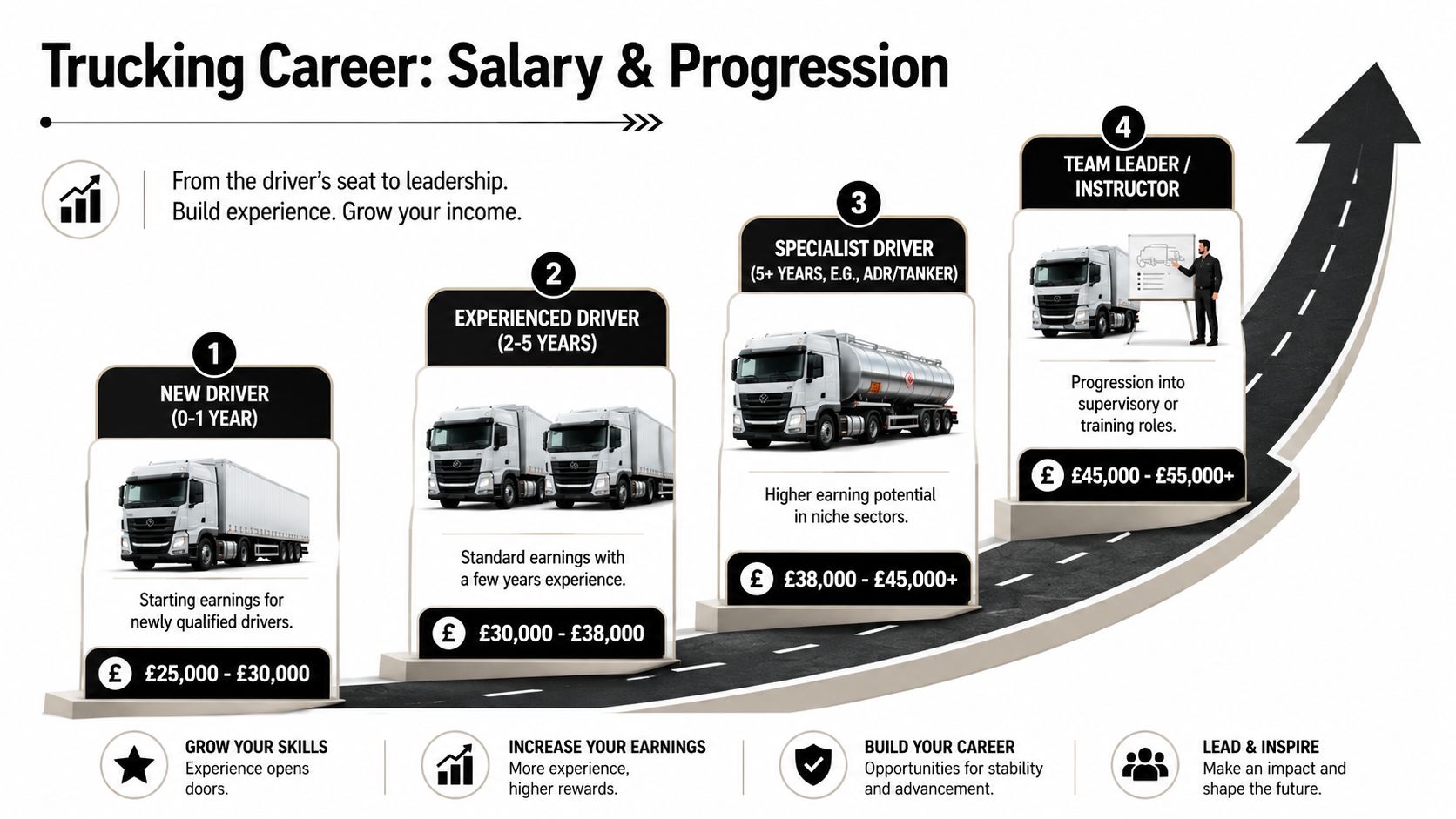
Your Salary and Career Progression Roadmap
Once you’re qualified and working, the next question is how to move from entry-level driving into better-paid and more durable roles. The answer is usually a mix of experience, clean work history, and well-chosen upskilling.
The salary gap between licence categories is meaningful. According to this UK HGV salary guide, Cat C drivers typically earn £30,000 to £36,000, while Cat C+E drivers can expect £38,000 to £50,000+, with long-haul and specialist roles potentially exceeding £55,000, reflecting the market ranges also referenced in Multistaff’s 2026 retention and pay overview.
How progression usually happens
Most drivers start by proving they’re safe, punctual, and easy to trust with equipment and customers. After that, progression often branches in one of two directions. You either deepen your driving specialism, or you move towards mentoring, planning, compliance support, or transport office work.
A simple roadmap looks like this:
Newly qualified driver: Build clean experience and good habits
Established Class 2 or Class 1 driver: Take on stronger routes or better fleets
Specialist driver: Add ADR, HIAB, or sector-specific skills
Senior progression: Mentor, instructor support, supervisor, or transport management path
Don’t chase headline pay alone
A bigger figure can hide a rough rota, poor kit, or too much physical graft. Good earnings matter, but so do recoverability, home life, and whether the employer runs a professional operation.
The strongest long-term careers are usually built by drivers who combine pay progression with role quality. That means choosing the jobs that help you stay in the trade, not just survive the next few months.
If you want structured support from medical booking through theory, practical training, and job-focused guidance, HGV Learning is a strong place to start. They coordinate licence and specialist training across the UK and help candidates move from first enquiry to real driving work with a clear, supported pathway.