You might be looking at your current job and thinking the same thing many people in the Black Country think every year. You want steadier work, better pay, and a role that doesn’t leave you stuck in one place with no route forward.
That’s where HGV driving starts to look serious. You see artics on the ring road, rigids on local drops, tankers and builders’ merchants moving through the West Midlands every day. The work is visible. The question is whether you can turn that demand into a proper long-term career, not just a licence and a few random shifts.
The Driving Opportunity in Wolverhampton
Wolverhampton is a practical place to build a driving career because the work is already there. As of June 2026, there are exactly 487 open job vacancies for HGV drivers in Wolverhampton on Glassdoor’s local listings, which gives you a clear signal that employers are actively hiring in the area, not just talking about shortages in general (Wolverhampton HGV driver vacancies on Glassdoor).
That matters if you’re changing career, returning to driving, or planning your next licence upgrade. You don’t need a vague national story. You need to know whether there’s enough work close to home to justify the training, the time, and the paperwork.
Why Wolverhampton works for drivers
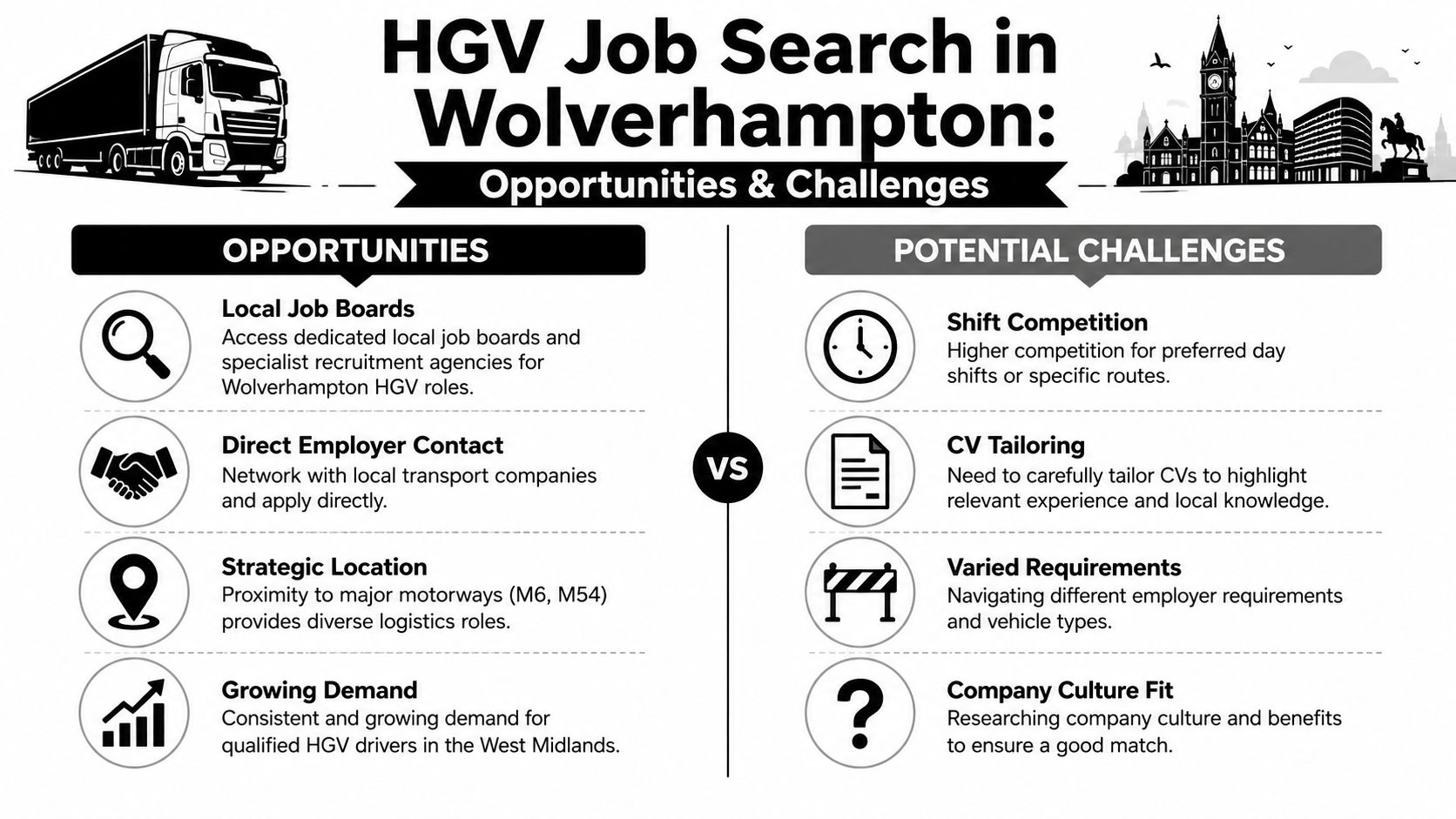
The local advantage is simple. Wolverhampton sits in a strong logistics belt, and that creates a mix of depot work, store delivery, trunking, construction supply, and utility support roles. For drivers, that usually means more than one route into the trade.
A lot of people start by searching broad listings and get lost in mixed results. If you want a better feel for nearby opportunities, it helps to compare local patterns with wider lorry driver jobs near me advice rather than relying on one job board.
The best local markets give you options. That’s what makes Wolverhampton attractive. You can start somewhere sensible and still have room to move.
Opportunity in HGV jobs in Wolverhampton isn’t just getting hired. It’s using the area’s volume of work to choose your first role carefully, build experience, and avoid getting stuck in the wrong kind of contract.
Your Starting Line Licences and Certifications
Before you apply for jobs, you need the right entitlement on your licence and the right qualification route. Too many people rush this stage, book tests in the wrong order, or let paperwork drag on. That slows everything down.
A common decision point is whether to stop at Category C or go straight for Category C+E. Category C covers rigid vehicles. C+E covers articulated combinations and usually opens more doors over time. In practical terms, if you want the broadest choice in HGV jobs in Wolverhampton, Class 1 C+E is the stronger long-term move.
The licence route that actually works
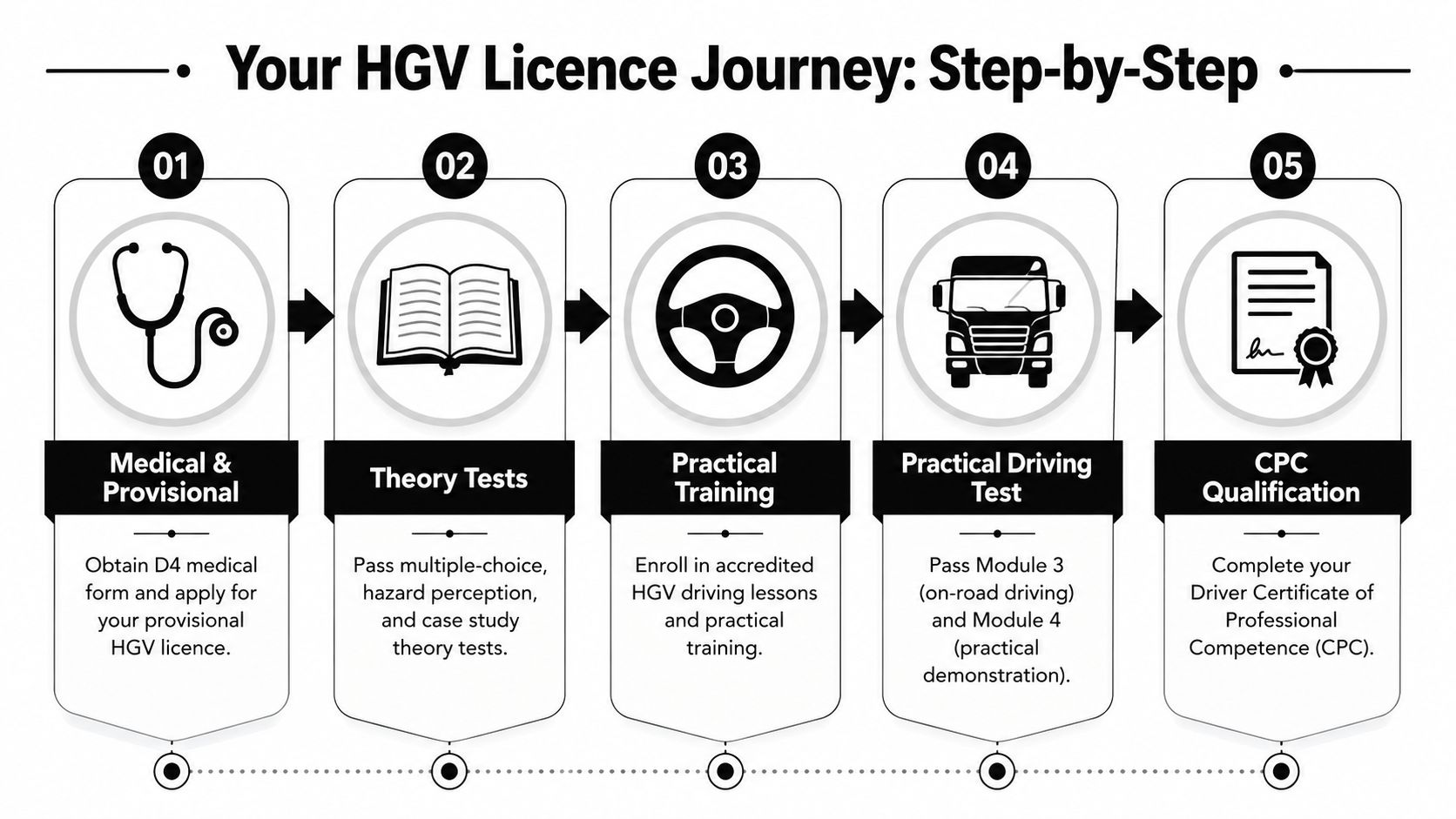
The process is straightforward when you treat it like a sequence, not a scramble.
Medical and provisional first You need your D4 medical handled properly and your provisional HGV entitlement in place before training can move smoothly.
Theory before practical pressure builds Multiple-choice, hazard perception, and case study preparation need proper revision time. At this stage, many candidates lose momentum.
Practical training with the right vehicle Your training vehicle and instruction quality shape how quickly you become test-ready.
Module 3 and Module 4 matter for different reasons One checks your driving on the road. The other checks whether you can operate safely and professionally around the vehicle.
Driver CPC isn’t optional for professional driving If you want to drive for work, you need to understand the CPC requirement properly. A clear explanation of the Driver CPC card and what it means helps avoid confusion at the start.
Where people lose time
The common delays aren’t dramatic. They’re administrative.
According to the verified business context tied to the ONS reference, technical specifications for success include securing Class 1 (C+E) licensure, completing DVSA-aligned theory preparation with progress tracking, and passing medical scheduling protocols. Common pitfalls include inadequate theory scores or delayed medicals, which can extend job placement timelines by 6–8 weeks (ONS-linked HGV workforce context).
That last point catches people out. They assume the hard part is learning to drive the lorry. Often, the hard part is staying organised enough to keep the whole process moving.
Practical rule: Book and track every stage as if one missed document could cost you a month, because it can.
Choose the licence for the career you want
If you only want local rigid work, Category C may suit you. If you want stronger earning power, wider shift choice, and better progression options later, C+E is usually the better investment.
The wrong move is training for the minimum, then paying again to upgrade because the jobs you want keep asking for more.
Local Training and Testing in the Black Country
Good training feels local. Not because the rules change in Wolverhampton, but because your confidence does. You drive better when the roads, roundabouts, industrial estates, and traffic patterns feel familiar.
That’s one reason local success stories matter. In June 2026, an 18-year-old from Bilston became one of the youngest people in the UK to pass his Class 1 HGV test, and the same BBC report noted that less than 2% of HGV drivers in the UK are under 25 (BBC report on the Bilston Class 1 pass). That tells you two things. Young drivers can do this, and they still stand out when they do.
What to look for in a training provider
A decent provider should give you more than dates and a truck.
Look for:
Modern training vehicles that reflect what you’re likely to drive after qualifying
Instructors with real road experience who correct calmly and clearly
Structured theory support so you aren’t left guessing what to revise
Flexible local access if you’re balancing work, family, or shift changes
Clear coordination of nearby options, including support around HGV training in Cannock if that works better for your location and schedule
What doesn’t work is chasing the cheapest course without checking how organised the provider is. If communication is poor before you’ve even started, it rarely improves once tests are booked.
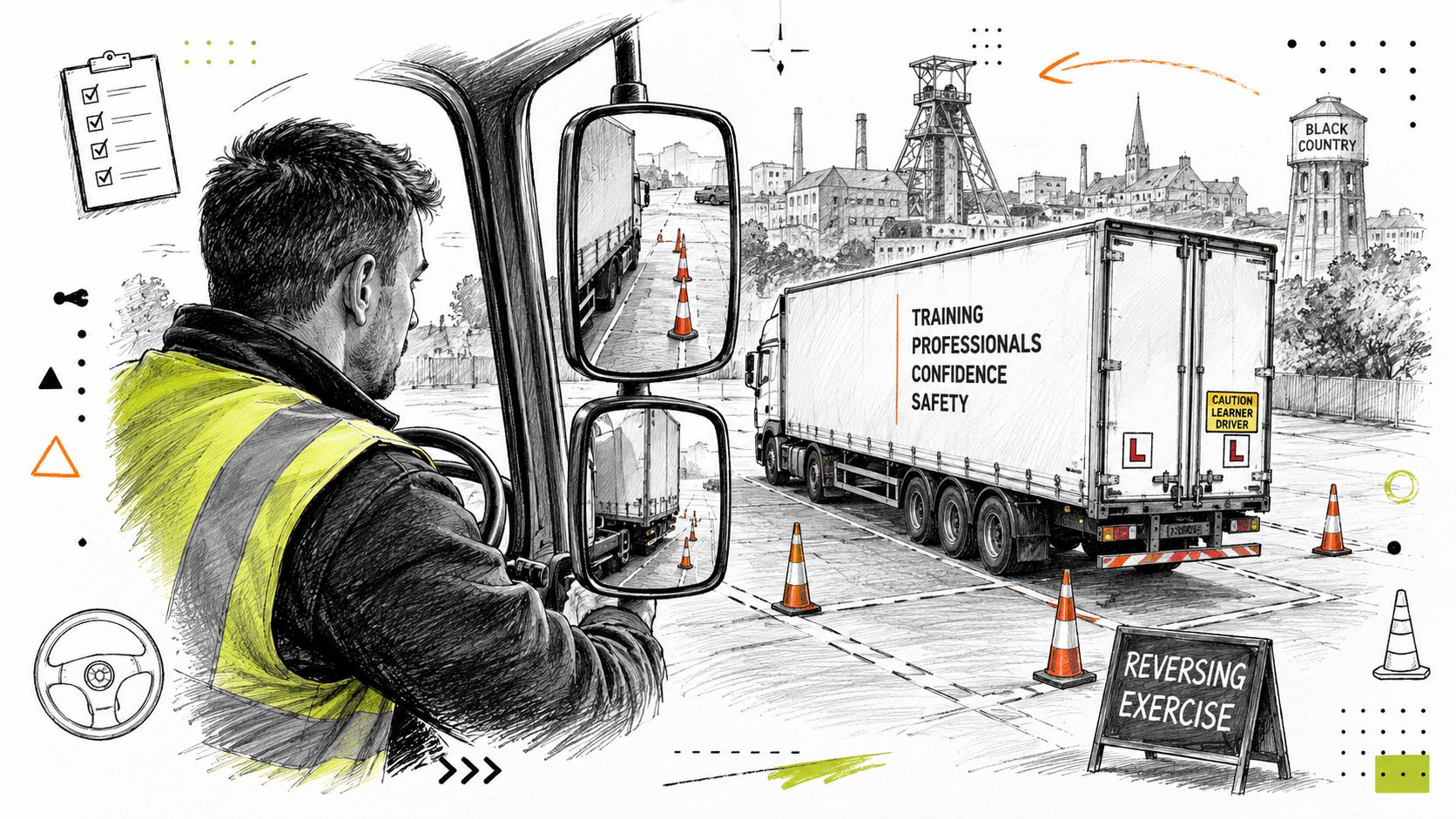
A strong instructor doesn’t just help you pass. They help you build habits that keep you safe in a busy yard, on a tight reverse, and in poor traffic conditions.
Training should prepare you for real work
Passing the test matters, but test-standard driving alone isn’t enough. Employers notice how you handle mirrors, space, planning, and pressure. They also notice whether you can listen, follow site rules, and represent the firm properly.
If you want a feel for the practical side of the job and training environment, this gives useful visual context:
The best local preparation makes the first working week less of a shock. That’s what you should be paying for.
Finding and Winning HGV Roles in Wolverhampton
Many new drivers make their biggest mistake by focusing only on getting any job, instead of getting the right first job.
Wolverhampton has volume, but not every advert leads to the same quality of work. Some roles help you build a career. Others keep you bouncing between short-notice shifts, unclear rates, and little chance of progression.
The agency trap is real
One of the clearest local signals comes from job listing patterns. The verified data shows that 132 live jobs are listed on CV-Library, while over 48% of Reed.co.uk’s Wolverhampton listings are agency or trainee roles, and jobseekers are actively searching for “HGV Class 2 driver not agency” roles (CV-Library Wolverhampton HGV market snapshot).
That doesn’t mean agency work is always bad. It can help a new pass get early experience, learn different sites, and start earning quickly. But it becomes a problem when drivers stay in it by default rather than by choice.
Agency work versus direct employment
Here’s the practical difference.
Feature
Agency Work
Direct Employment
Shift pattern
Can change week to week
Usually more predictable
Income stability
Often depends on bookings and demand
Usually steadier
Holiday and benefits
Can feel limited or unclear in practice
More likely to include paid leave and pension access
Training support
Less likely to include progression funding
More likely to support longer-term development
Best use
Good for quick entry or bridging gaps
Better for building a long-term career
Career test: If a role pays today but leaves you in the same position six months later, it may not be the right role.
How to apply more strategically
A better approach is to split your search into three lanes:
Direct employers first Look at local haulage firms, builders’ merchants, utilities contractors, and distribution operators. A direct role often gives you clearer expectations from day one.
Agencies second, but selectively Use them if you need fast experience, but ask blunt questions about regularity, vehicle type, induction quality, and whether permanent transfer is realistic.
Specialist upgrades third If a role asks for ADR or HIAB and you don’t have it yet, note that as a progression target rather than ignoring the advert.
What employers in Wolverhampton actually notice
A generic CV won’t do much. For HGV jobs in Wolverhampton, employers tend to care about whether you look work-ready.
Focus on:
Licence clarity Put Category C or C+E clearly near the top, along with CPC and Driver Card status.
Relevant site awareness Mention reversing, vehicle checks, delivery paperwork, customer-facing work, or safety-sensitive experience from past jobs.
Availability honesty If you can do nights, weekends, or early starts, say so. If you can’t, say that too. Mismatched expectations kill applications.
Clean admin Keep your documents current and easy to produce. Delays make employers move on.
The strongest candidates don’t just ask, “Who’s hiring?” They ask, “Which employer will still make sense after my first year on the road?”
What to Expect Pay Shifts and Career Progression
Pay matters, but headline pay can mislead if you ignore hours, nights, overtime, and the kind of work attached to it. You need the whole picture.
In Wolverhampton, the average salary for an HGV driver is £31,307, with a range from £22,981 to £32,499, and new-pass drivers often start at £14.00 per hour with 45–60 weekly hours. The same verified data also notes that progression often depends on experience or extra tickets such as ADR or HIAB (Wolverhampton HGV pay overview on Totaljobs).
What new drivers should expect
If you’ve just passed, expect trade-offs. The easiest role to land may not be the cleanest shift pattern or the highest rate. Early jobs often involve unsocial starts, physical unloading, or less-preferred routes.
That isn’t a bad thing if the role gives you solid experience. It becomes a bad thing when you accept poor structure with no path to better work.
The shifts behind the pay
Different patterns suit different people:
Days often appeal to drivers with family routines, but they can be more competitive.
Nights can pay better and may be easier to secure, especially in trunking and depot-to-depot work.
Weekend work can help boost earnings or open doors when weekday slots are tight.
Multi-drop and specialist work may be more demanding but can build stronger handling skills and customer confidence.
Better pay usually comes from one of three things: less popular hours, more responsibility, or better qualifications.
The progression path that tends to hold up
A steady route often looks like this:
Get your first proper role
Build a clean record and dependable routine
Move into better vehicle types or better contracts
Add useful tickets such as ADR or HIAB
Target firms that reward reliability, not just availability
That last step is where quality of life improves. Better employers tend to be organised. They plan shifts properly, support compliance, and communicate clearly.
And because long hours on the road are part of the reality for many drivers, small practical upgrades matter too. If you’re looking at ways of staying connected on the road, especially during breaks or overnight stops, it’s worth thinking about that as part of the job, not an afterthought.
Your Next Steps to a Driving Career
If you’re serious about HGV jobs in Wolverhampton, keep it simple and act in order.
First, decide which licence fits the career you want, not just the fastest route into any job. After that, get your medical and provisional application moving, prepare properly for theory, and choose local practical training that builds confidence as well as test skill.
Then be selective in the job hunt. Don’t judge roles by hourly rate alone. Check the contract, the shift reality, the vehicle type, the support on offer, and whether the job helps you move forward.
A practical next-step list looks like this:
Confirm your target licence Category C for rigid work, or C+E for broader long-term options.
Start the paperwork early Medical delays and admin errors hold people back more often than driving ability.
Apply with a career plan Look for roles that build experience, not just immediate income.
Plan your upgrades If ADR or HIAB appears often in the jobs you want, treat that as your next milestone.
Wolverhampton gives drivers real opportunity. The people who do best are the ones who treat the first licence as the start of a career, not the finish line.
If you want help turning that plan into action, HGV Learning can support the full route from medical and theory prep through to practical training and career guidance, so you can move into professional driving with a clearer path and fewer avoidable delays.