You're probably in one of two places right now. You're either excited because driving looks like a solid career move, or you've already started looking into HGV training and hit the paperwork wall.
That wall can feel bigger than the driving itself.
Most new drivers don't struggle because they can't learn the job. They struggle because the documentation requirements seem scattered, formal, and easy to get wrong. One form needs a doctor. Another needs exact personal details. Later, you need proof that you passed the right tests, and once you're working, you need to carry the right cards and records every day.
The good news is that this is manageable when you treat it as a timeline instead of a pile. Start with identity and medical checks. Move to your provisional licence. Then handle training records, CPC paperwork, and the documents you must keep with you once you're on the road.
Your Roadmap to Becoming an HGV Driver
A lot of people start the same way. They decide they want a steadier job, better prospects, or a route into logistics, construction, utilities, or ambulance work. They look up how to become an HGV driver, then immediately run into forms, entitlement categories, medical reports, and training records.
That's usually the moment the process feels more complicated than it really is.
The easiest way to deal with HGV documentation requirements is to stop thinking of them as one big admin task. Think of them as a driving journey with checkpoints. At each checkpoint, you only need the documents for that stage. You don't need to hold the whole process in your head at once.
There's a practical reason paperwork matters so much. The UK HGV driver workforce saw a net fall of 42,000 UK nationals since 2017, with numbers dropping to 237,000 by 2021, and the shortage was estimated at 22,000 drivers in 2020. The government also supported 4,000 people for driver training, as noted by the ONS analysis of the fall in HGV drivers. When the industry is short of drivers, regulators and employers still expect every new entrant to be fully compliant.
Why the paperwork feels harder than it is
Most confusion comes from three things:
Different documents do different jobs. Your driving licence proves entitlement. Your D4 covers medical fitness. Your CPC card proves professional status.
Timing matters. Some paperwork is needed before training. Some arrives after you pass. Some must be renewed throughout your career.
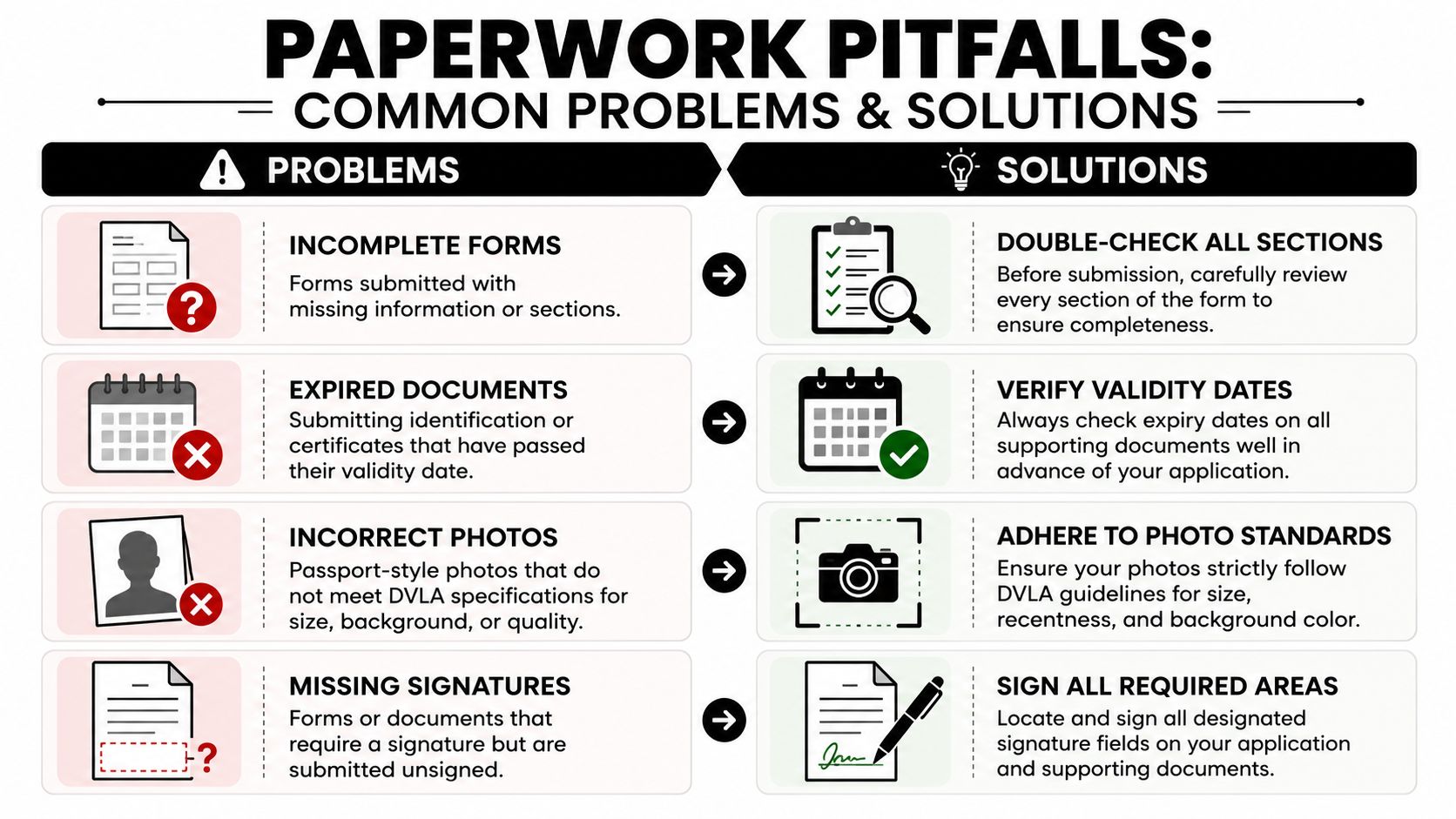
Small errors cause delays. A missing signature, old address, or incomplete form can hold everything up.
Good documentation isn't about bureaucracy for its own sake. It's how drivers prove they're legal, trained, and ready to work.
If you want a broader grounding before diving into forms, it helps to understand what documentation is in plain terms. That makes the HGV process easier to follow, because you can see each document as evidence of something specific rather than just more admin.
The journey makes sense when you see it in order
The route is simpler than it first appears:
Gather your personal and medical documents
Apply for your provisional HGV entitlement
Complete training and keep the right pass records
Add specialist certificates if your target job needs them
Maintain renewal and in-cab compliance documents
That's the whole shape of it. Once you work through it in order, the paperwork maze becomes a checklist.
Stage One The Essential First Steps
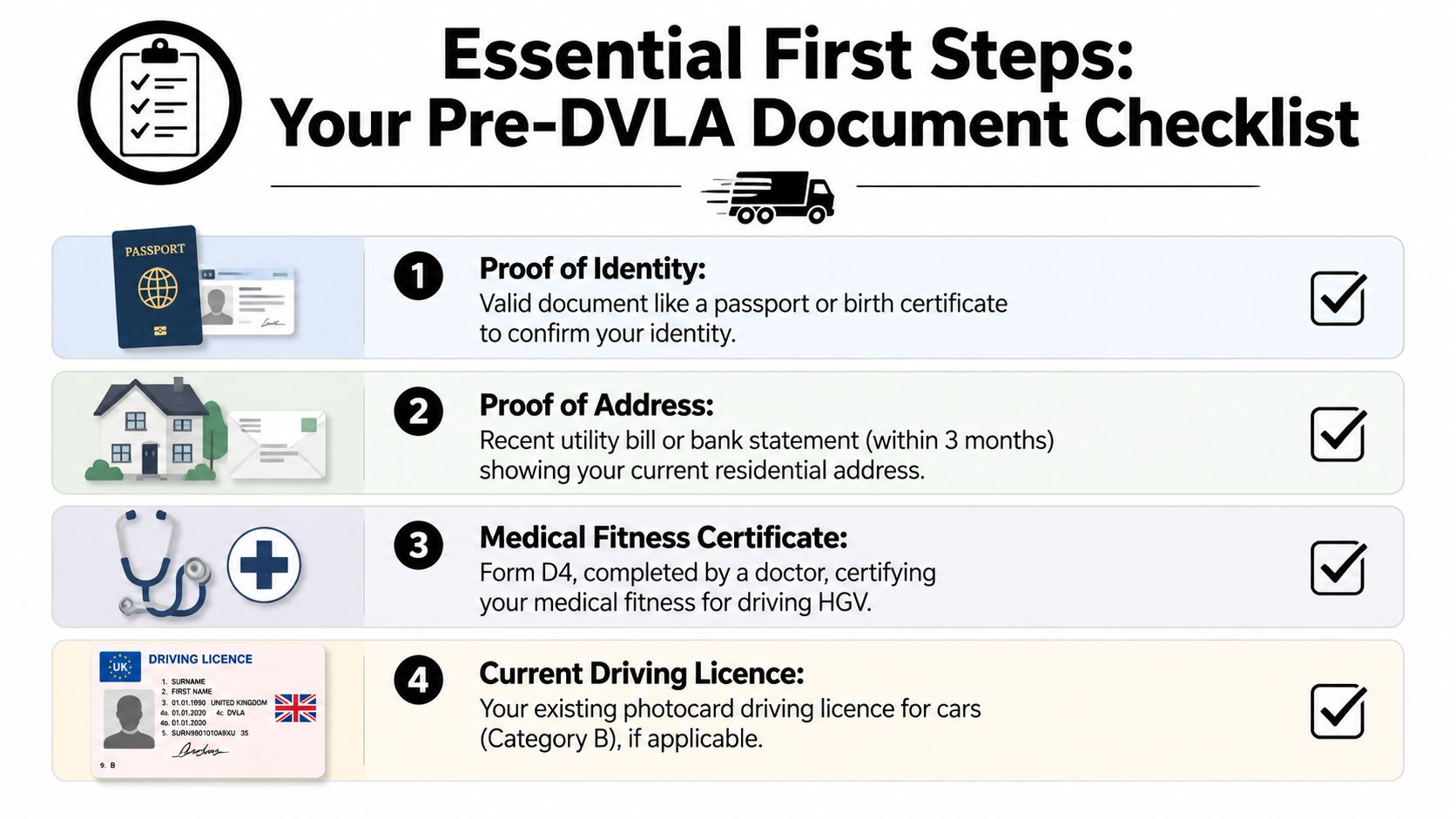
Before you fill in any DVLA form, get your basic documents in order. At this stage, many applicants save time or lose it.
You need to be able to prove who you are, where you live, and that you're already legally able to drive at the level required to begin the process. You also need the medical side sorted properly, because that's one of the most common sticking points.
What to gather before you apply
Start with the basics and put them in one folder, either physical or digital.
Proof of identity. A valid passport is the simplest option. If you don't have one, use the identity document accepted for your situation.
Proof of address. Keep a recent document that clearly shows your current residential address.
Your current driving licence. In most cases, that means your existing car licence, because that's the starting point for moving into HGV training.
Right to work documents if needed. Employers and training providers may ask for these later, so it helps to have them ready early.
Don't assume all names and addresses match automatically. Check the spelling, the order of names, and whether every document uses the same current address.
The D4 medical is where many delays begin
For HGV applicants, the D4 medical examination report is one of the key pieces of paperwork. To apply for a provisional HGV licence in the UK, applicants must submit the D2 application form and the D4 medical examination report, which must be completed by a registered doctor, and there is no application fee for that provisional application process, according to the official GOV.UK guidance on applying for provisional lorry entitlement.
That doesn't mean the medical itself is something to rush.
A doctor has to complete the form properly, and the details need to be clear and consistent. If the doctor leaves part of the form incomplete, or if your personal information doesn't line up with the rest of your documents, the process can slow down.
Make the medical easier on yourself
Use a checklist before your appointment:
Bring identification. Your doctor needs to confirm they are filling in the correct form for the correct person.
Bring any relevant health information. If you have a condition that's already being managed, clear records can help avoid back-and-forth later.
Check the form before leaving. Make sure every section that should be completed is.
Keep a copy if possible. It helps if you need to refer back to what was submitted.
Practical rule: Never post medical paperwork you haven't checked line by line yourself.
If you want a clearer picture of how the medical side works, this guide to the HGV medical process is useful for understanding what you'll be asked for and what can hold things up.
Why this stage matters
A new applicant often wants to move straight to lessons and test bookings. That's understandable. But if your identity, address, licence details, and medical report aren't ready, everything that follows becomes harder.
Get this first pack of documents right, and the rest of the process starts to move much more smoothly.
Stage Two Securing Your Provisional HGV Licence
Once your medical paperwork is ready, you move into your first formal DVLA application. This is the point where your plans start becoming official.
The process is straightforward when you know what each form is for. One form asks for the licence entitlement. The other confirms medical fitness.
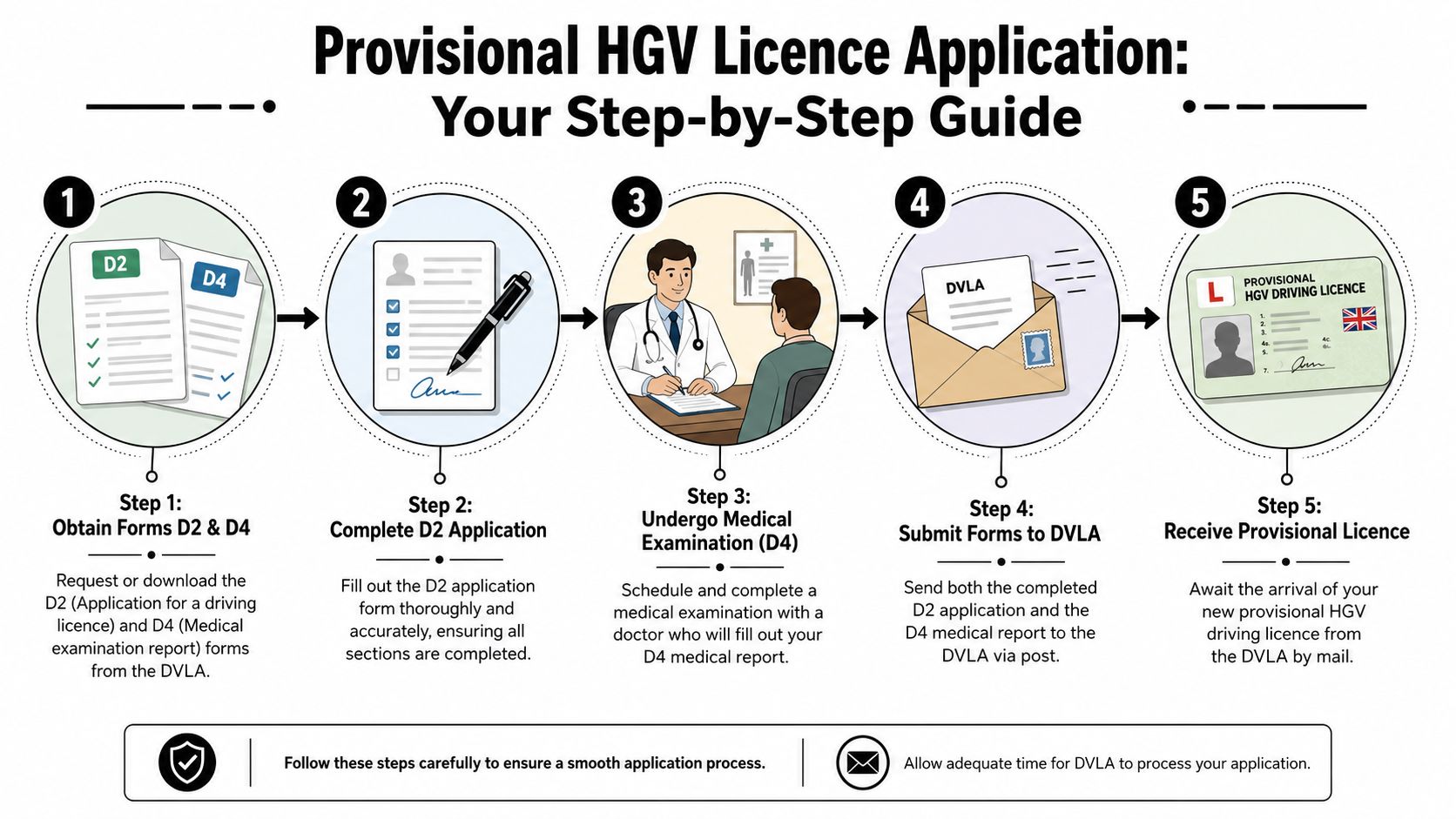
To keep the steps clear, this visual summary helps.
The two forms that matter
At this stage, your core documentation requirements centre on two documents only:
Form
What it does
Who completes it
D2
Applies for provisional lorry entitlement
You
D4
Confirms medical fitness to drive HGVs
A registered doctor
The key fact is simple. The provisional application requires both forms together. Sending one without the other creates a problem from the start.
A clean way to submit your application
Work through it in this order:
Get the D2 form and read it before writing anything.
Check your personal details against your current licence and ID.
Attach the completed D4 from your doctor.
Review for missing sections or signatures.
Post the application to the DVLA using the instructions that come with the forms.
Don't treat the D2 like a casual admin form. It's a licence application. If your handwriting is unclear, if you skip a section that applies to you, or if your details don't match your other documents, you risk delay.
A short explainer can help if you want to see the process set out visually:
What your provisional licence actually gives you
When the DVLA approves the application, your licence shows the provisional HGV entitlement that allows you to move into the next part of training. It doesn't mean you're ready to work professionally yet. It means you're legally cleared to continue the route toward that goal.
That distinction matters. New applicants sometimes think the provisional is the main hurdle. It isn't. It's the gateway.
Send forms only when every box, date, and signature has been checked against your supporting documents.
If you want a simple breakdown of the application stage, this overview of the HGV provisional licence process can help you sense-check what you're preparing before you send anything off.
Common mistakes at this point
A few patterns come up again and again:
Out-of-date details. You've moved house but not updated every record.
Medical mismatch. The D4 contains information that doesn't line up with the licence application.
Rushing the post. Applicants send forms without keeping copies or checking each page.
Assuming “no fee” means “no care needed”. The fact that there's no application fee doesn't make the application less formal.
Accuracy matters more than speed here. A tidy application is usually faster than a hurried one.
Stage Three Core Qualification and CPC Paperwork
This is the stage where many people first realise that becoming a professional driver isn't one certificate. It's a chain of passed parts, booked tests, and final proof that you can drive for work, not just hold a licence category.
The biggest document at the end of this chain is your Driver CPC card. If you drive a lorry, bus, or coach professionally in the UK, you must carry that card at all times, and failing to present it during a roadside inspection results in a fixed penalty, as explained in this guide to UK HGV licences and Driver CPC requirements.
The paperwork trail through the four CPC parts
Your qualification path usually involves four distinct parts. Each creates its own record.
Part 1 theory
This is your theory stage. The paperwork here is usually about booking confirmation and then proof that you passed. Keep every confirmation email, test appointment detail, and pass result together.
If you ever need to rearrange training or prove a stage has been completed, those records matter.
Part 2 case studies
This part checks professional understanding in work-based scenarios. Again, keep the booking details and pass evidence. People often focus on the revision side and forget the admin side.
That's a mistake. If you don't retain records clearly, it's harder to track where you are in the process.
Part 3 practical driving
This is the driving test element people usually think of first. The paperwork here links your training, your test appointment, and your pass result.
Bring the right identification on the day and store your pass documentation safely afterwards. Don't assume you'll never need to show it again.
Part 4 practical demonstration
You show that you can apply professional safety knowledge in realistic situations. Once this is done, you're close to receiving the document that really matters for paid driving work.
Why the final card matters so much
A lot of new drivers casually say, “I've got my HGV licence now.” In practice, employers and enforcement officers care about the full legal picture. For professional driving, that includes CPC status.
That's why good record-keeping matters from the first booking onward.
Keep booking emails in one place
Store pass confirmations as soon as they arrive
Check name spellings on every test record
Carry the CPC card once issued whenever you're driving professionally
Check this before your first job: your entitlement, your CPC status, and the name on every document must all line up.
If you're ever unsure why some documents carry more legal weight than others, it helps to read about understanding digital legal agreements. The HGV world still relies heavily on physical cards, signed forms, and formal records, and that legal mindset helps make sense of the system.
Think like a professional from the start
At this stage, your habits matter as much as your passes. Professional drivers don't just train well. They manage paperwork well. They know what they've passed, what they're carrying, and what they would show if asked.
That mindset makes the jump into actual paid work much easier.
Stage Four Documents for Specialist HGV Courses
Once you've covered the core qualification route, you might want to move into a more specialised role. That usually means more training and more paperwork.
Many people are often caught out by a wrong assumption. They think an HGV licence is a universal pass for any job involving a larger vehicle. It isn't. Many roles need extra evidence of competence beyond your standard licence and CPC documents.
Standard documents versus specialist documents
A simple way to think about it is this:
Type of work
Core paperwork
Possible extra paperwork
General haulage
HGV entitlement and CPC documents
None beyond job-specific checks
Hazardous goods
Core documents
ADR training records and ADR photocard
Crane-assisted delivery
Core documents
HIAB certificate or provider-issued proof
Truck-mounted forklift work
Core documents
Moffett training evidence
Your base HGV documents prove you can drive professionally. Specialist course documents prove you can carry out the extra task or handle the specific risk safely.
ADR needs its own proof
If you want to carry hazardous goods, ADR becomes a separate documentation pathway. Employers won't treat it as implied knowledge. They'll want the actual certificate or photocard that shows you've completed the required training for the classes you're qualified in.
The same applies later when refreshers are due. Keep your original training records and any renewed certification together so you can show a clear compliance history.
HIAB and Moffett are practical examples
In construction, builders' merchants, utilities, and site logistics, drivers are often expected to do more than drive from A to B. They may need to load, unload, place materials, or operate attached equipment safely.
That's where specialist training records matter.
HIAB paperwork shows you've trained to use a lorry-mounted crane.
Moffett paperwork shows you've trained to use a truck-mounted forklift.
Employer checks may still ask for ID, licence entitlement, and proof of recent competence alongside the certificate itself.
A standard HGV licence on its own doesn't answer those questions.
Specialist paperwork does one job. It proves you're qualified for the extra responsibility, not just the vehicle.
Keep specialist records separate from your core licence file
This makes life easier later. Use one folder for licence and CPC documents, and another for add-on qualifications. That way, if an employer asks for your ADR proof or crane training evidence, you're not searching through old medical papers and theory confirmations.
This also helps when you change jobs. A driver moving into fuel, chemical, plant, or site delivery work often needs to show specialist records quickly during recruitment.
The better organised you are, the easier it is to step into those opportunities.
Stage Five Ongoing Compliance and Licence Renewal
Getting qualified is only half the story. Staying compliant is what turns a new pass into a long-term driving career.
Many drivers are surprised by this stage because they assume the hardest admin ends once they start work. In reality, professional driving always carries ongoing documentation requirements. Some sit in your wallet. Some stay in your cab. Some need renewing on a regular cycle.
What you must keep current
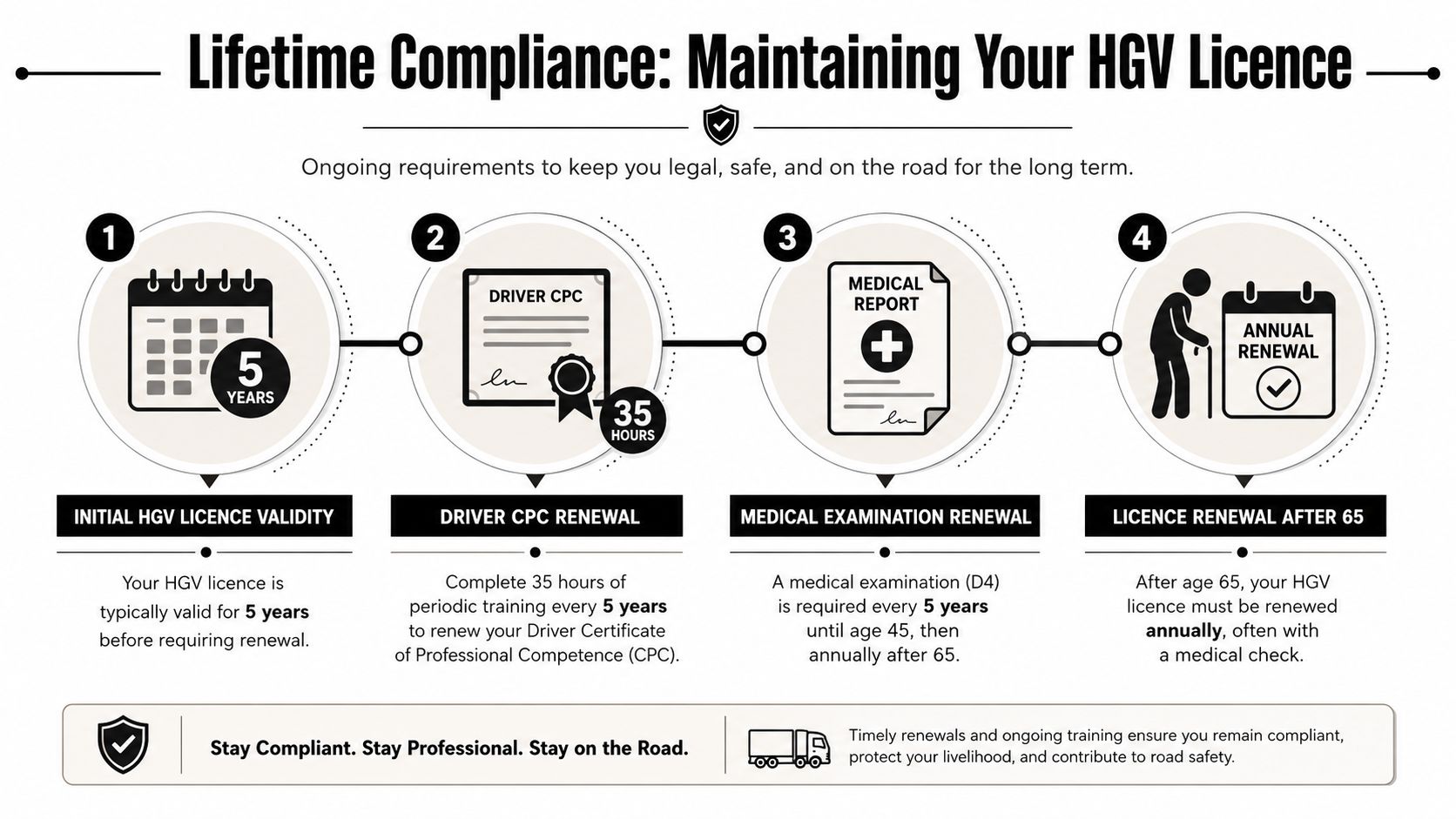
UK drivers holding an HGV licence must renew it every five years, and that requires completing 35 hours of recurrent Driver CPC training. For international haulage, drivers must also carry tachograph records for the current day and the previous 28 calendar days, plus a green card as proof of insurance for certain non-EU countries.
That one sentence covers a lot of working life. It helps to split it into separate habits.
Renewal habit
Your HGV licence doesn't sit there forever untouched. Put your renewal timing in a calendar early, not when the expiry date is already close. If your work is busy, it's easy to let this creep up on you.
Training habit
Your Driver CPC requires 35 hours of recurrent training over each five-year cycle. Don't leave all of it until the end if you can avoid it. Spacing it out usually makes admin and scheduling much easier.
Daily carry habit
When you're driving professionally, your documents need to be with you, not just filed at home.
International haulage needs extra care
If you're travelling internationally, the in-cab paperwork becomes even more important. To legally operate an HGV for international road haulage from the UK, drivers must carry a valid UK driving licence, a Driver CPC card, and tachograph charts with any legally required manual records for the current day and the previous 28 calendar days. For travel to certain non-EU countries, including Albania, Azerbaijan, Israel, Moldova, Morocco, Tunisia, Turkey, Ukraine, and Montenegro, drivers must carry a physical green card, and electronic versions aren't accepted, as set out in the GOV.UK guidance for international road haulage driver documents.
That physical-only point catches some drivers out. If a country requires a green card, having it on your phone isn't enough.
A simple compliance system
Use a routine that covers three levels:
Wallet documents. Licence, CPC card, and anything you need to personally carry.
Cab records. Tachograph records and any manual records required for inspection.
Renewal records. CPC training evidence, licence renewal paperwork, and any medicals tied to renewal.
If you want a practical reminder of what needs attention as time passes, this guide to HGV licence renewal is a useful reference point.
A professional driver stays compliant by building routines, not by relying on memory.
Where support services fit in
This is one point where structured support can help. Some drivers organise everything themselves through their doctor, the DVLA, training providers, and their employer. Others use a coordinator that handles the early admin stages in one route. HGV Learning is one example of that kind of service. It helps with documentation and medical scheduling, theory preparation, and arranging practical training dates.
That kind of support doesn't remove your legal responsibility. It just reduces the chance that an early document gets missed or delayed.
Troubleshooting Common Paperwork Problems
Most paperwork problems aren't dramatic. They're small, avoidable mistakes that turn into delays at exactly the wrong time.
A missed signature can stall a licence application. An expired card can stop you working. A bad assumption about international documents can leave you unprepared at the border. Drivers, therefore, save themselves the most stress by being methodical.
The problems that come up most often
Here's a practical way to think about the usual trouble spots:
Problem
What usually caused it
Better approach
Incomplete form
A section was skipped or rushed
Read every page slowly before posting
Mismatched details
Address or name differs across documents
Check all records against one master ID
Missing signature
Applicant or doctor forgot a required field
Do a final signature check only at the end
Expired supporting document
Old ID or outdated card was used
Check validity dates before booking anything
These aren't unusual mistakes. They happen because people try to do paperwork in a hurry between work, family life, and training arrangements.
Lost licence or missing CPC card
If you lose an important document, act quickly. Don't wait until an employer asks to see it or until you're due to drive.
Your first step is to identify exactly what is missing:
Driving licence. Replace it through the proper DVLA route.
Driver CPC card. Follow the replacement process for that specific card.
Supporting records. Rebuild your folder with copies of pass confirmations and training evidence where possible.
Keep scanned copies of important documents in a secure place. They won't replace the official item, but they make replacement requests much easier.
If you can't put your hand on a key driving document within a minute, your filing system needs work.
The IDP confusion that catches new drivers
One of the most common assumptions is that all UK paper licence holders need an International Driving Permit for EU travel. That isn't correct.
A widespread misconception exists around IDPs for EU travel. GOV.UK guidance mainly applies this to licences from Gibraltar, Guernsey, Jersey, and the Isle of Man, not all UK paper licence holders, and a 2025 survey found 73% of UK drivers were confused, while 58% of new apprentices reported IDP confusion on their first international trip, according to this Safe Driving for Life guide on LGV driver documents.
That matters because bad advice spreads fast. Drivers hear one version from a friend, another from a training group, and another from social media. Before an international journey, always check the exact document rule that applies to your licence type and route.
A final checklist that prevents most issues
Before submitting, renewing, or travelling, ask yourself:
Is every document current
Do the names and addresses match
Have all required signatures been added
Am I carrying what I need, not just storing it at home
Have I checked any international requirement against official guidance
Calm, boring admin beats last-minute panic every time.
If you want a simpler route through the paperwork, training, and booking process, HGV Learning offers a structured path that starts with documentation and medical scheduling, then moves into theory preparation and practical training arrangements across the UK.
Related Articles
16/10/2026
What Age Can You Start HGV Driver Training? A 2026 UK Guide to Licence Age Requirements
If you're asking what age you can start HGV driver training, the honest answer depends on which licence you're after. A C1 licence, covering vehicles...