Manual handling tasks are responsible for 17% of all non-fatal workplace injuries in Great Britain, making them the second most common cause after slips, trips, and falls on the same level at 30%, according to UK manual handling injury statistics. For HGV drivers, that number matters because the job rarely gives you a perfect lift at waist height, on dry ground, with clear space and a tidy box.
A driver might be shifting cages in a tight trailer, guiding a pallet truck over a tail lift, or dragging kit out of a bay with poor light and a wet floor. That is where manual handling techniques stop being classroom theory and become a trade skill. Good drivers know the vehicle, the route, the paperwork, and the load. They also know when a lift is safe, when it needs equipment, and when it needs another pair of hands.
Why Manual Handling Matters on the Road
A lot of people still treat manual handling as a tick-box topic. That's a mistake. In transport, poor lifting habits don't usually fail all at once. They build into sore shoulders, stiff hips, recurring back pain, and days off that could have been avoided.
HGV work exposes drivers to conditions that standard warehouse or office guidance often misses. You're not always working on level concrete in bright light. You're stepping in and out of trailers, working around load bars and straps, dealing with uneven kerbs, and trying to move goods without much room to turn.
The road job changes the risk
Inside a trailer, the lift itself is often only half the problem. The other half is space. A load might be reachable, but not easily turnable. A cage might roll, but not track straight. A parcel might not be heavy on its own, yet it becomes awkward when you're carrying it around stacked goods or lowering it from the back of the vehicle.
That's why manual handling techniques matter so much for career longevity. A bad habit repeated on multi-drop work, store deliveries, building sites, or emergency runs will catch up with you.
Practical rule: If you have to rush the setup, brace the load on your thigh, or twist to finish the move, the job probably wasn't set up properly in the first place.
Drivers also tend to normalise discomfort. They tell themselves it's part of the job. It isn't. Soreness after a shift is often a warning that the method, equipment, or pace is wrong. If you're already addressing chronic back and joint pain, it makes even more sense to tighten up technique before minor strain turns into a long-running problem.
It's part of being a professional driver
Being professional isn't just about reversing neatly or keeping to drivers' hours. It's also about protecting your body so you can keep working safely for years. That means assessing before lifting, using the equipment provided, and refusing the lazy shortcut that saves seconds but creates risk.
Daily habits outside the loading bay matter too. Recovery, mobility, hydration, and posture all affect how well you handle physical work. Practical guidance on HGV driver health tips is worth taking seriously because the body you climb into the cab with is the same body that has to shift the load.
Your First Step: A Smart Risk Assessment
A lot of bad lifts are predictable. The warning signs are usually there before you touch the load. On HGV work, that matters because you are rarely lifting in ideal conditions. You are working in a trailer with limited room, on a tail lift in the rain, or at a delivery point where the drop area was clearly an afterthought.
The quickest way to assess the job is TILE. Task, Individual, Load, Environment. It is simple enough to use on a busy round, but it still catches the problems that injure drivers. It also lines up with the legal duty to avoid risky manual handling where possible, assess what cannot be avoided, and reduce the risk.
The TILE manual handling assessment framework
Factor
What to Consider for an HGV Driver
Task
Is the job a lift, a lower, a push, a pull, a carry, or a mix of all of them? Will you need to turn in a tight trailer or control the load down from deck height?
Individual
Are you fit to do it safely right now? Fatigue after driving, stiff hips, an old shoulder injury, poor footwear, or wet gloves all affect control.
Load
Is it stable, evenly packed, easy to grip, or likely to shift once moved? Do you know the weight, or are you guessing from the size of the box or case?
Environment
Is the floor wet, uneven, sloped, cluttered, dark, or too tight for a clean turn? Are you working near traffic, kerbs, or the open edge of a tail lift?
Task means the full job, not the first grab
Drivers get caught out when they assess only the first movement.
A box coming off the trailer floor might need to be pulled clear, turned at the rear opening, lowered to the tail lift, steadied during descent, then carried across broken paving to the customer's door. That is not one lift. It is a chain of actions, and the awkward part is often the bit in the middle, not the initial pick-up.
The same applies to cages and palletised freight. A cage can look easy because it rolls, until one castor jams at the trailer threshold. A pallet truck can feel fine on a flat trailer floor, then become hard work on an incline or rough yard surface. Assess the whole route before you commit.
Individual means being honest about your condition
Good technique falls apart quickly when the driver is tired, stiff, or rushing.
After a few hours behind the wheel, hips tighten, hamstrings shorten, and reactions slow down. Add poor sleep, bad weather, or an old back strain and a routine unload becomes less routine. A professional driver factors that in instead of pretending it makes no difference.
Ask yourself:
Am I fatigued enough to lose form halfway through the move?
Do I have the right gloves and footwear for grip and footing?
Am I trying to prove I can still handle a job that should be shared or done with equipment?
If the honest answer is yes, change the method.
Load means shape, stability, and grip
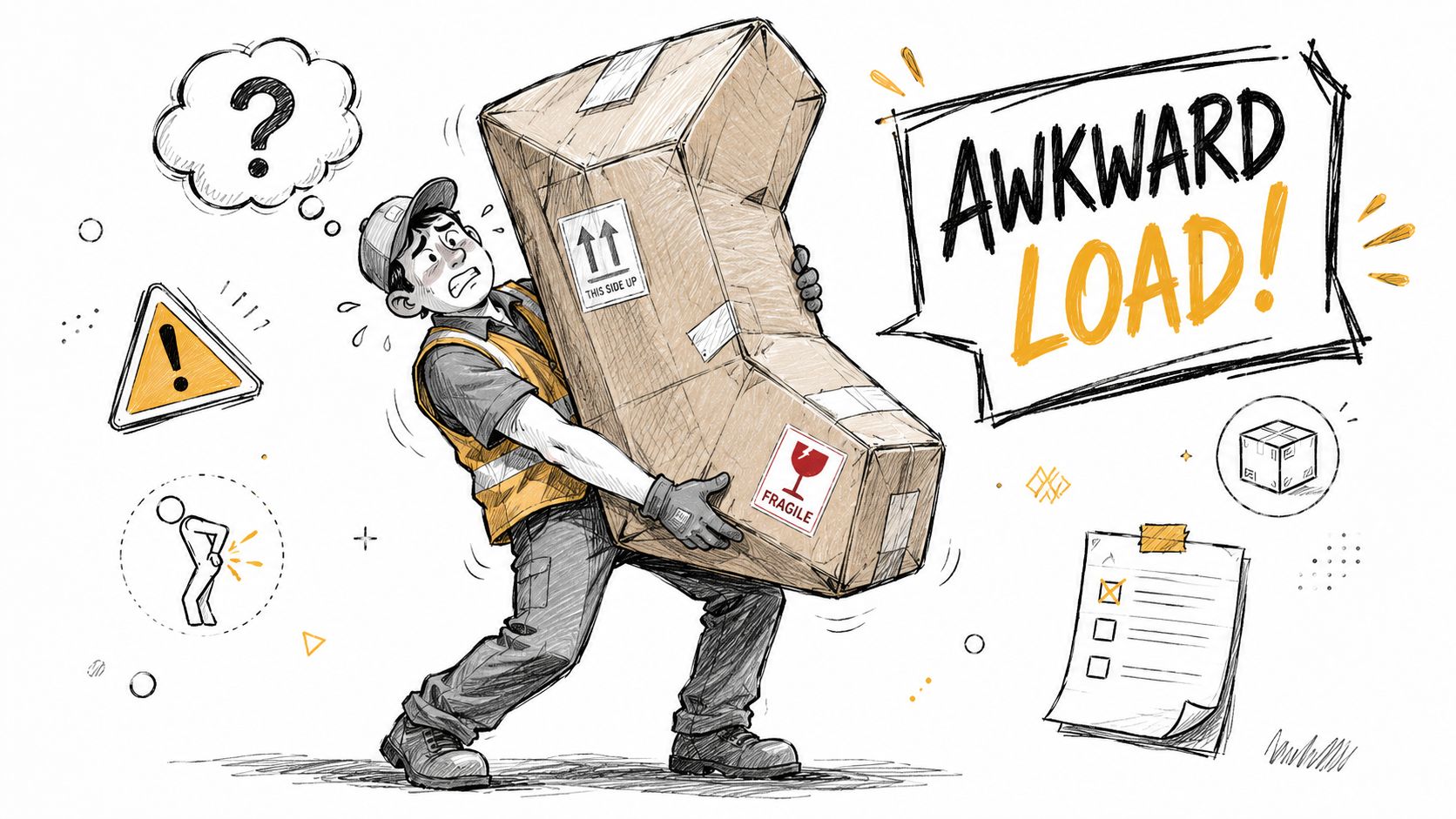
Weight is only part of the problem. In real transport work, awkward loads cause as much trouble as heavy ones.
Poorly wrapped pallets can lean once the pallet truck changes direction. Roll cages with uneven contents pull off line and force correction through the arms and back. Equipment cases with smooth sides or shallow handles push you into fingertip lifting, which is exactly what you do not want in a confined trailer.
Long or bulky items need extra thought as well. A treadmill, for example, is difficult because the weight is spread awkwardly and the handholds are poor. These treadmill transport tips show the same basic issue drivers face with gym kit, plant parts, and other awkward freight. The problem is not just mass. It is how hard the item is to control.
If the load looks unstable, treat it that way. Test for movement. Check the centre of gravity. If the freight arrived badly stacked or restrained, fix the setup before unloading. Good HGV load securing best practices for safe and legal transport reduce manual handling risk at the delivery end because the load is still where it should be when the doors open.
Environment decides whether the plan is realistic
A lift that would be fine in a warehouse can be risky at the roadside.
Look at the floor first. Wet tail lifts, ridged trailer beds, loose gravel, potholes, poor lighting, low roof bars, and narrow exit space all change what is safe. I have seen plenty of drivers with decent lifting habits put in a bad position by a delivery point that gave them nowhere to stand and nowhere to turn.
Run these checks before you move anything:
Route: Know exactly where the load is going, including any step, kerb, slope, or threshold.
Footing: Check for slippery edges, debris, and broken ground.
Space: Make sure you can stand close to the load and turn with your feet, not your spine.
Equipment: Decide early whether the job needs a tail lift, pallet truck, sack truck, or a second person.
That last point matters. If the risk assessment tells you the manual lift is poor, the right answer is to change the method, not to try harder.
The Core Safe Lifting and Carrying Technique
The HSE sets out a clear sequence for safe manual handling. Think, adopt a stable position, ensure a good hold close to the waist, and lift smoothly with leg muscles while keeping the back slightly bent. Twisting the back while bent is the primary cause of injury, so the turn must come from the feet, not the spine, as shown in the HSE guide to good handling technique.
In practical HGV work, that sequence only helps if you can apply it in a trailer, on a tail lift, and in a delivery space that doesn't give you much room.
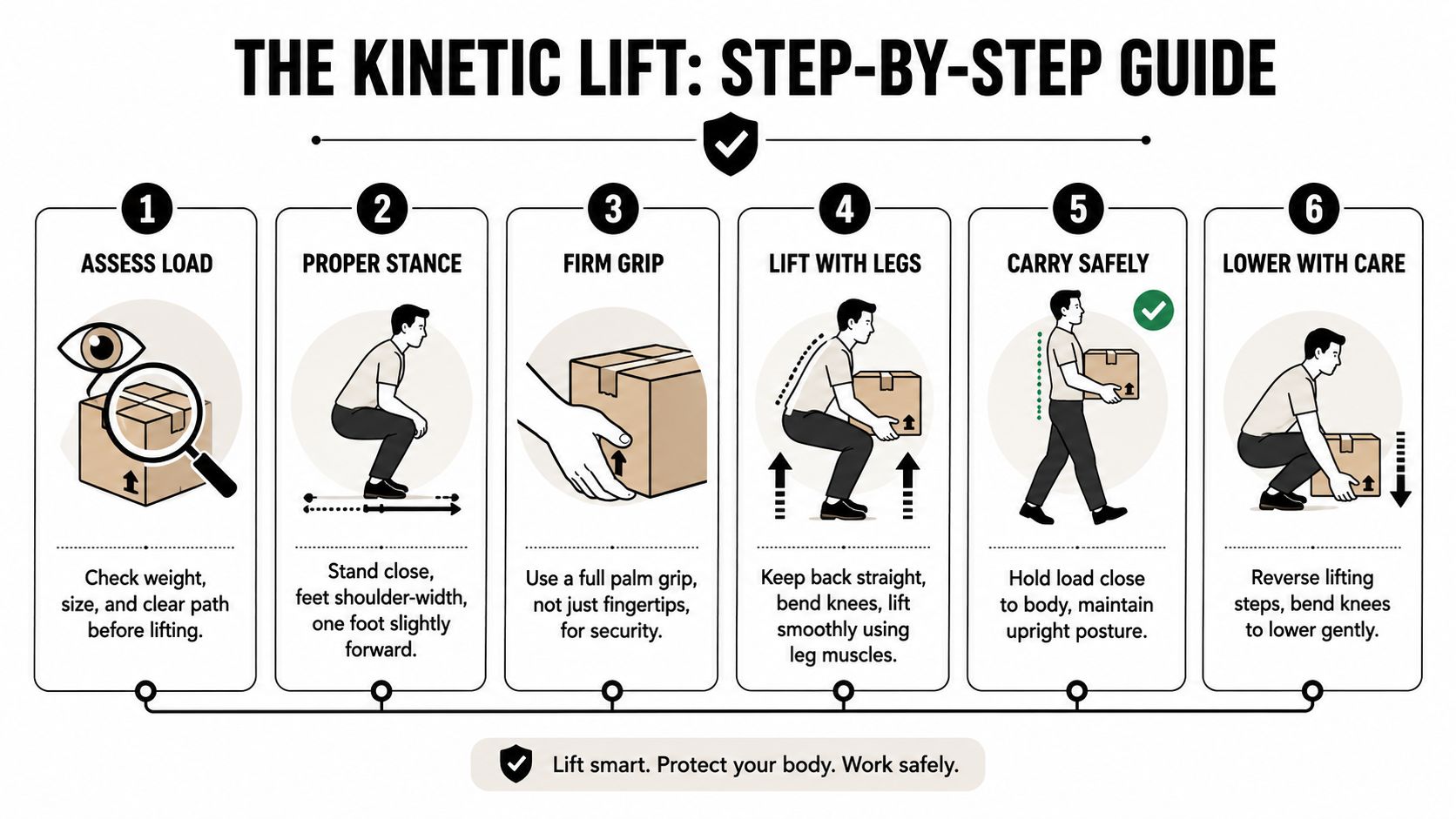
Here's the movement broken down in a way that drivers can use straight away.
Start with your feet, not your hands
A rushed lift usually starts with bad foot placement. If you stand too far from the load, you reach. Once you reach, your back works harder and your grip gets weaker.
Stand close. Keep your feet apart for balance, with one foot slightly forward if that helps the direction of travel. In a narrow trailer, that may mean shuffling goods first so you can get into a decent position. That extra few seconds is time well spent.
Get the load into your power zone
Your strongest position is with the load close to your body, roughly around waist level during the carry. The further the load moves away from you, the more strain it creates against your back and shoulders.
Good drivers don't pinch a box with fingertips and hope for the best. They look for a full palm grip, solid contact, and a way to keep the heavier side nearest the body. If the object doesn't allow that, stop and rethink.
Useful examples include:
Small cartons: Bring them into the body before standing fully.
Plastic totes: Check for cracked handles before trusting the lift.
Loose equipment: Secure or separate parts first so nothing shifts mid-carry.
Lift smoothly and keep the back slightly bent
Often, people get this wrong. “Straight back” gets repeated so often that some drivers lock themselves stiff. That isn't the point. The safer position is a slight bend through the back, hips, and knees, then a smooth lift driven by the legs.
The back should not bend further once the lift begins. That's the key. Stooping over the load or dropping into a deep squat both tend to put you in poor positions for real-world freight work.
On the job: If you need a jerk to break the load off the floor, stop. Either the load is awkward, your grip is poor, or the method is wrong.
A lot of the same principles show up when moving bulky domestic equipment. If you want a simple example of planning, grip, route clearance, and controlled movement around an awkward shape, these treadmill transport tips are useful because they show how quickly shape and bulk can turn a manageable item into a risky one.
A quick visual helps lock the sequence in:
Carry and lower without twisting
Most drivers know twisting is bad. The problem is they still do it during the last part of the job, usually when placing the item down quickly.
If you need to change direction, move your feet. Keep shoulders and hips travelling together. In a cramped trailer, that may mean taking smaller steps or setting the load down to reset your position.
Lowering matters as much as lifting. Reverse the movement under control. Don't drop the load the last few inches and don't reach away from your body to “just place it”. If the final position forces a twist or stretch, reposition yourself first.
Using Mechanical Aids and Team Lifting
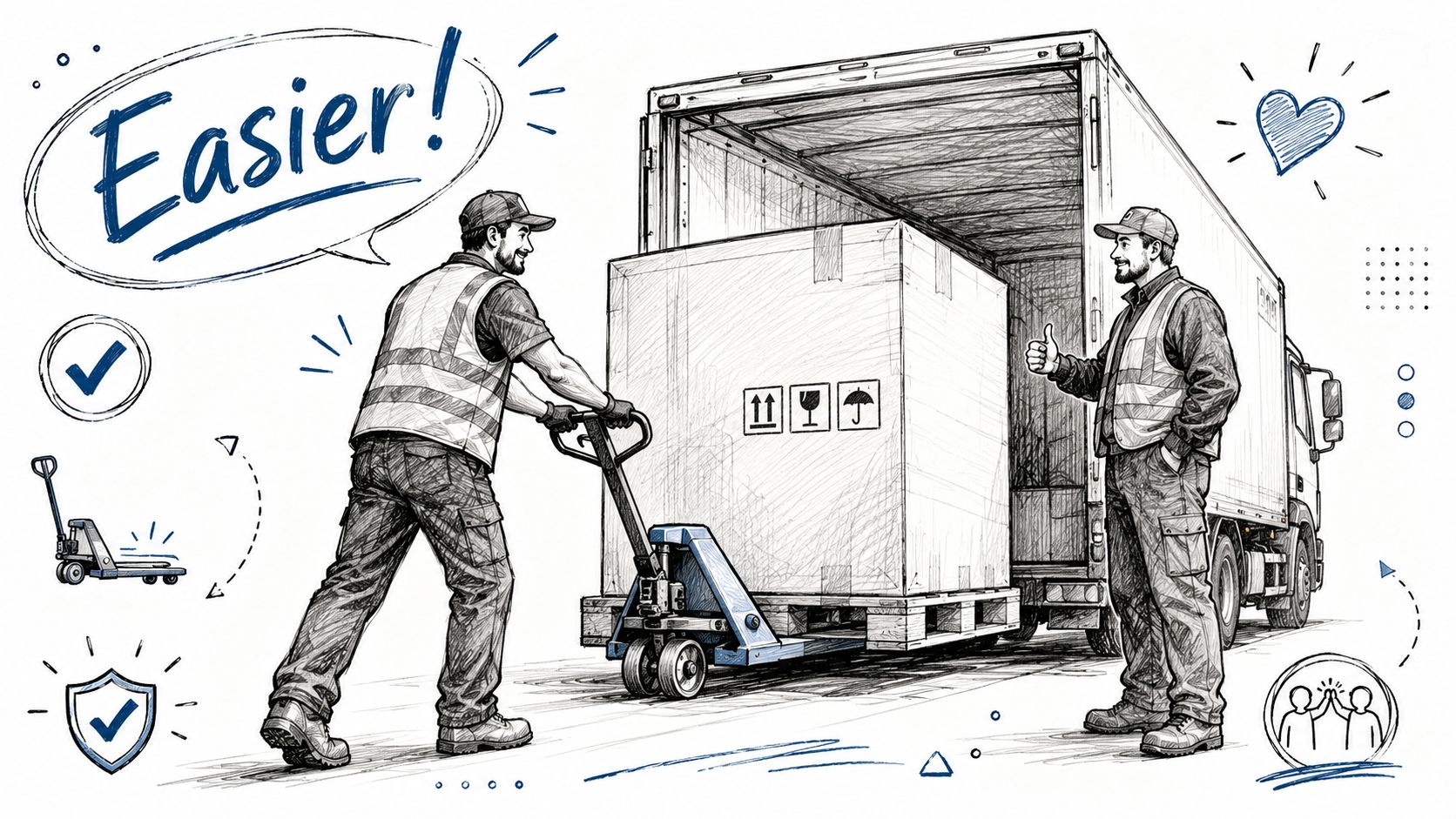
The best manual handling technique is often not lifting manually at all. Drivers sometimes see pallet trucks, tail lifts, sack barrows, or an extra pair of hands as slowing the job down. In practice, they often make the job faster, cleaner, and safer because you're controlling the load instead of fighting it.
For repetitive handling, the margin for error gets smaller. HSE risk filters note that weights should be reduced by 30% for tasks repeated 1 to 2 times per minute, 50% for 5 to 8 repetitions per minute, and 80% for more than 12 repetitions per minute, as outlined in this guide to manual handling weight limits. In plain terms, a load that feels manageable once can become a poor decision when you repeat it across a full run.
When equipment is the better option
Different aids solve different problems. A pallet truck helps with rolling a stable load on sound ground. A tail lift bridges height difference. A sack barrow can turn a carry into a controlled tilt and roll. None of them remove risk by magic. They only work when the surface, slope, and load condition are suitable.
Here's the practical comparison drivers should make:
Pallet truck: Best for stable palletised goods on decent surfaces. Poor choice on broken ground, steep cambers, or where the pallet itself is damaged.
Tail lift: Best for controlled transfer between vehicle and ground. Poor choice if the load is unstable, the plate is wet, or the operator rushes the edge transition.
Sack barrow: Best for stacked items with a reliable centre of gravity. Poor choice for loose, shifting, or top-heavy goods.
If you regularly move pallets, crates, or heavy freight, it also helps to understand where your responsibilities overlap with warehouse equipment users. Formal forklift training classes matter because poor coordination between truck drivers and lift truck operators creates avoidable risk during loading and unloading.
Mechanical aids still need technique
A common mistake is thinking that “using equipment” means the manual handling problem has gone away. It hasn't. It has changed shape.
With a pallet truck, the danger often appears when turning in tight spaces or controlling movement on a slight incline. With a tail lift, the danger appears at the point of transition, where the wheels cross the lip or the operator overbalances while guiding the load.
Use this simple check before you move equipment:
Is the route sound enough for wheels
Does the load sit stable through the whole journey
Do I have enough space to stop, turn, and step clear
For broader practical examples on planning routes, controlling momentum, and selecting the right moving method, these expert tips for moving heavy loads are useful because they focus on decision-making, not brute force.
Team lifting only works when one person leads
Two people can make a lift safer. They can also make it worse if they don't move together.
Team lifting is the right call when the object is bulky, hard to grip, or awkward to position, and when no mechanical aid is suitable. But it only works if one person acts as the lead and both know the plan before touching the load.
“Ready, lift, walk, lower” sounds basic, but clear timing prevents the uneven starts and sudden drops that strain shoulders and backs.
The essential points are simple:
Agree the route first: Don't improvise halfway through.
Nominate the caller: One person gives the lift and lower commands.
Match height and pace: If one person is stooping while the other is upright, the lift is already wrong.
Common Mistakes and Handling Awkward Loads
Most real freight isn't a neat training-room box. It's a split delivery behind another pallet, a machine part with no handles, a crate on the trailer floor, or a long item that catches on everything around it. In such scenarios, drivers either apply good manual handling techniques properly, or start taking shortcuts that lead to injury.
A major weak point in standard training is awkward-height lifting. HSE data shows that 40% of musculoskeletal disorders occur during lifting from below-knee or above-shoulder positions, which is highlighted in the University of Greenwich guidance on lifting techniques. That fits what drivers deal with every week.
The shortcuts that cause most trouble
The dangerous habits are usually the ones people defend with “it'll only take a second”.
Common examples include:
Jerking the load free: This often happens when a box is stuck against another item or a pallet edge.
Twisting to save steps: Drivers do this at the final placement point more than anywhere else.
Reaching instead of repositioning: If the load is at the back of a packed trailer, people overreach rather than clear working room.
Catching a slipping item: Once a load starts going, trying to save it can wrench the shoulder or back.
Lifting from below knee height
Low lifts are common in trailers, especially when freight sits directly on the floor or behind a front row of goods. The mistake is bending from the waist to “snatch” it up.
A safer approach is to reduce the distance in stages. Get close. Widen your base. Tip or edge the item into a better grip if that can be done safely. If there's room, bring it onto a raised point or use equipment rather than lifting straight from the floor to standing height in one go.
Field note: If you can't get your shins and feet into a sensible position near the load, you probably don't have enough access to lift it well.
Reaching above shoulder height
High lifts are a different problem. The issue isn't just weight. It's control. Once your hands rise above shoulder level, your effective handling capacity decreases and your ability to recover from movement gets poorer.
If something is stored high in the trailer or on racking during collection, the first choice should be to avoid that reach. A kick stool or proper access aid is better than stretching. If no safe access exists, don't improvise from a tyre, step edge, or loose object.
Awkward shapes need a different plan
Long, flexible, off-centre, or fragile items don't behave like cartons. A rolled mat, a framed panel, a pump unit, or a toolbox with weight at one end all demand a different setup.
Use a simple troubleshooting method:
If it's unstable, secure it before moving.
If it's too wide, turn the route into stages rather than one continuous carry.
If you can't grip it properly, use gloves, handles, straps, or a mechanical aid.
If it blocks your view, split the load or get help.
The old “get it done quick” mindset usually fails on awkward freight because the load punishes every shortcut. A disciplined setup nearly always beats trying to muscle it through.
UK Regulations and Your Legal Duties
Manual handling law matters on an HGV job because poor planning shows up fast. It shows up on a tight bay with no room to turn a pallet truck, on a tail lift that is out of service, or in a trailer where the only way to reach the last item is a bad lift from an awkward angle.
Under the Manual Handling Operations Regulations 1992, employers must avoid hazardous manual handling where they reasonably can, assess tasks that cannot be avoided, and reduce the risk of injury as far as reasonably practicable. For transport work, that means the law looks beyond how a driver lifts. It also looks at how the job was set up in the first place.
What employers must do
Employers need to organise the work so drivers are not left solving avoidable handling problems at the delivery point. Training matters, but it is only one part of the system.
In HGV operations, that usually means:
planning deliveries so access constraints are known before arrival
providing suitable equipment such as working tail lifts, pallet trucks, dollies, or load restraint gear
maintaining that equipment so it is usable on the day, not just listed on a fleet sheet
setting safe systems for awkward loads, mixed freight, cages, equipment, and two-person handling tasks
giving drivers clear reporting routes when site conditions or load presentation make the task unsafe
That last point gets missed. A driver can have good technique and still be put in a poor position by bad loading, damaged pallets, overstacked cages, or freight buried against the headboard.
What drivers must do
Drivers have legal duties as well. Use the equipment provided. Follow the safe system of work. Report defects, poor loading, blocked access, unstable freight, and site conditions that make the job unsafe.
On the road, that often comes down to judgement. If a customer wants a heavy item pulled to the tail on your own because "it'll only take a minute", the right answer may be no. If the pallet is split and leaning, stop before it gets onto the lift. If the only available route means dragging a load sideways through a narrow trailer gap, raise it and get a better plan.
That is professional driving practice.
A workable safety culture in transport depends on both sides doing their part:
The employer provides training, equipment, planning, and a safe method.
The driver uses that method, checks the actual conditions on site, and reports problems early.
Both treat manual handling as part of legal compliance and day-to-day job standards.
The law is practical when you apply it properly. If the load needs a pallet truck, use one. If the trailer space is too cramped for a safe lift, reset the job. If the task needs another person or different equipment, ask for it before someone gets hurt.
If you're planning to start or progress your driving career, HGV Learning helps drivers across the UK gain the licences and practical training they need for safe, compliant work, including C1, Category C, C+E, ADR, HIAB, and telehandler pathways.
Related Articles
16/10/2026
What Age Can You Start HGV Driver Training? A 2026 UK Guide to Licence Age Requirements
If you're asking what age you can start HGV driver training, the honest answer depends on which licence you're after. A C1 licence, covering vehicles...