If you're in Oldham and you're looking at HGV driving as a serious career move, you're probably in one of two positions right now. Either you're seeing job ads everywhere and wondering how to get qualified fast, or you've already started looking into licences and found yourself buried in forms, test names, and conflicting advice.
That confusion is normal. HGV driving is a solid trade, but the route in isn't always explained clearly. Most articles stop at salary lists and job boards. They don't tell you what matters when you're trying to move from "interested" to "road-ready" in a place like Oldham.
This guide does. It covers local opportunity, the licences you need, the tests that catch people out, where to look for work, what pay looks like, and how to give yourself the best chance of landing one of the HGV driver jobs Oldham employers keep trying to fill.
Why Oldham Is a Prime Location for HGV Drivers
If you spend any time around Greater Manchester's main routes, you can see why Oldham works for drivers. The roads stay busy because goods keep moving. Distribution, construction, utilities, retail supply, and regional haulage all depend on drivers who can turn up, drive safely, and keep to schedule.
That local demand matters even more because the national market has been under pressure for years. The UK had 53,000 fewer HGV drivers in June 2021 than at the peak in 2017, which helped create a serious shortage and record vacancies in transport and storage, according to the Office for National Statistics review of the fall in HGV drivers.
Why the shortage benefits new entrants
A shortage on its own doesn't guarantee a good career. What matters is whether employers still need people near you. In Oldham, they do. Local firms need rigid drivers, artic drivers, multi-drop drivers, and agency cover for peak periods, sickness, holidays, and contract expansion.
That creates a practical opening for career changers. You're not trying to break into a dead-end field. You're stepping into a trade that still needs new licence holders, especially those who train properly and turn up with the right documents in order.
Practical rule: In a busy driver market, reliability beats bravado. Operators remember the driver who arrives prepared, keeps legal, and communicates well.
Why Oldham works better than a random postcode
Oldham sits in a useful part of the map. You can access local work, regional runs, and Greater Manchester depots without needing to relocate. That gives you options. Some drivers want Monday to Friday multi-drop. Others want trunking, nights, or specialist work. Oldham gives you a better shot at choosing between those paths instead of taking the first role you can find.
A good HGV career also tends to build in layers. You might start with rigid work, agency shifts, or local deliveries. Then you add experience, move into artic work, and increase your earning power. In a place with active logistics movement, that progression is easier to find.
What makes this a smart move now
The strongest reason to look seriously at HGV driver jobs in Oldham is simple. There is work, there is pressure on supply, and there is a clear qualification route if you follow it properly.
Many people waste time waiting until they feel fully confident before starting. In this trade, it works better the other way round. Start the process, get the paperwork moving, and build confidence through structure.
Your First Step The Essential HGV Licences and Medicals
Before you think about employers, agencies, or pay, get clear on the entry requirements. HGV driving has a fixed route in. Miss one part and the whole process slows down.
To start, you must be over 18 and hold a full UK driving licence, with some employers setting the working threshold above 21 for insurance reasons, as outlined by Go Construct's HGV driver career guide.
The medical comes first
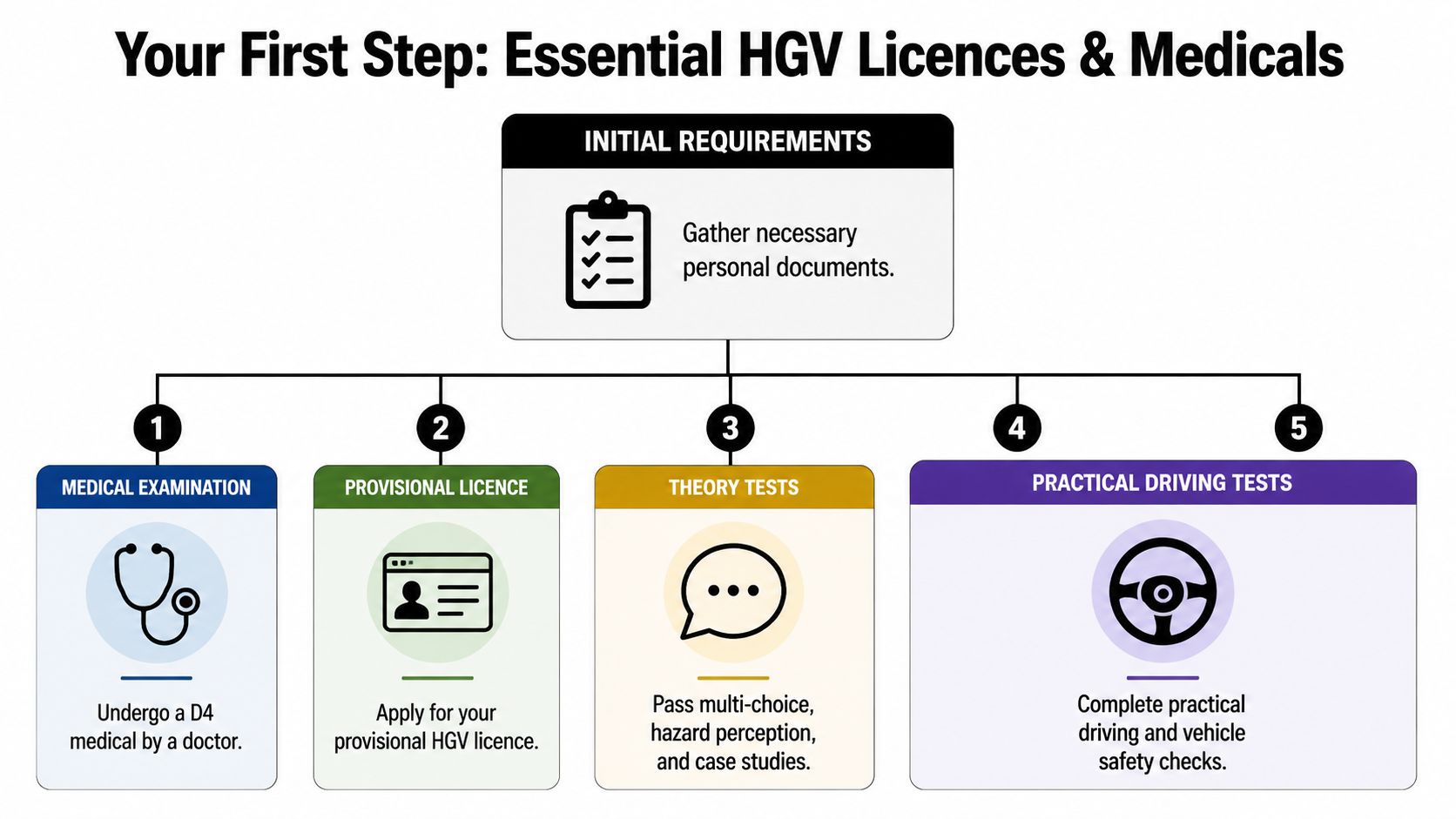
The first serious checkpoint is the D4 Medical Form. A doctor completes this, and it confirms whether you're fit to drive heavy vehicles.
The medical isn't a formality. Around 12% of initial applications are disqualified at the D4 medical stage, so it's worth sorting this early and proactively. If you've got a health issue that needs clarification, it's better to deal with it before spending money on training.
Know which licence you're aiming for
A lot of new starters make the mistake of saying they want an HGV licence without knowing which category fits the job they want. That leads to poor decisions. You need to match the licence to the work.
Licence Category
Vehicle Type
Common Jobs in Oldham
C1
3.5 to 7.5 tonne vehicles
Light commercial and specialist service roles
Category C
Rigid heavy goods vehicles
Multi-drop, local delivery, municipal and construction support
C+E
Articulated combinations up to 44 tonnes
Trunking, regional distribution, long-haul and higher-spec logistics roles
Most successful candidates treat the first stage like a checklist, not a guessing game.
Get your documents together. Driving licence details, ID, address history, and any information relevant to your medical.
Book and complete the D4 medical. Don't leave this until you've mentally committed to test dates.
Apply for the provisional entitlement. You need that in place before theory and practical progress can move smoothly.
Choose the right category. Category C may open local rigid work. C+E usually gives broader options.
Think ahead about specialist tickets. ADR can matter for hazardous goods roles, and some employers expect extra certificates for niche work.
If you're aiming for better long-term options, choose the route that gives you room to grow, not just the fastest route to a licence card.
What people often get wrong
The common failure at this stage isn't lack of effort. It's poor sequencing. People book training before the medical is sorted, choose a lower licence class without understanding the local market, or ignore paperwork until a test slot becomes available and they aren't ready.
A clean start saves weeks of delay. In this trade, admin discipline is part of the job from day one.
Passing Your Tests the Smart Way
Once your provisional and medical are sorted, the actual work starts. At this stage, people either move through the process efficiently or drag it out by trying to wing it.
The licence path includes theory elements, hazard perception, practical driving, and the CPC requirements you need for commercial work. Treat these as linked parts of one standard, not as separate boxes to tick whenever you feel like it.
Where candidates usually lose marks
The practical standard is stricter than many newcomers expect. Official DVSA-aligned figures in the verified training data show a 78% first-time success rate for Category C and 65% for C+E, which tells you two things straight away. First, plenty of people do pass. Second, artic level is tougher and needs proper preparation.
There is also a known trap around rushed tuition. The same verified pathway data shows a 30% failure rate among candidates who complete training courses under 5 days for the on-road test. That's not surprising. Short, compressed training can work for some drivers, but only if their starting point is already strong.
Why structured prep beats patchy self-study
A lot of learners tell themselves they'll revise theory at home, watch a few clips, and sort practical confidence later. That usually creates weak spots. Hazard perception needs rhythm. Theory needs repetition. Practical driving needs feedback from someone who knows where candidates slip.
Verified training data also shows that 10 to 12 day intensive practical training with a certified instructor achieved a 92% pass rate, outperforming the 65% average of self-directed learners in that data set. That's the trade-off in plain terms. Self-study can feel cheaper at first. Failing tests, rebooking, and losing time usually isn't.
The licence you choose affects the job you can get
This isn't only about passing. It's also about employability after the pass. A C+E licence has a 45% higher employment placement rate within three months than Category C alone, based on the verified 2025 National Logistics Jobs Report data provided for this topic.
That doesn't mean Category C has no value. It does mean you should be honest about your end goal. If you want the broadest choice in HGV driver jobs Oldham employers are likely to offer, C+E usually puts you in a stronger position.
Don't overlook CPC completion
The biggest avoidable mistake after passing a driving test is assuming you're ready for paid work when your CPC side isn't complete. If your qualification documents aren't fully in order, commercial driving work can stop before it starts.
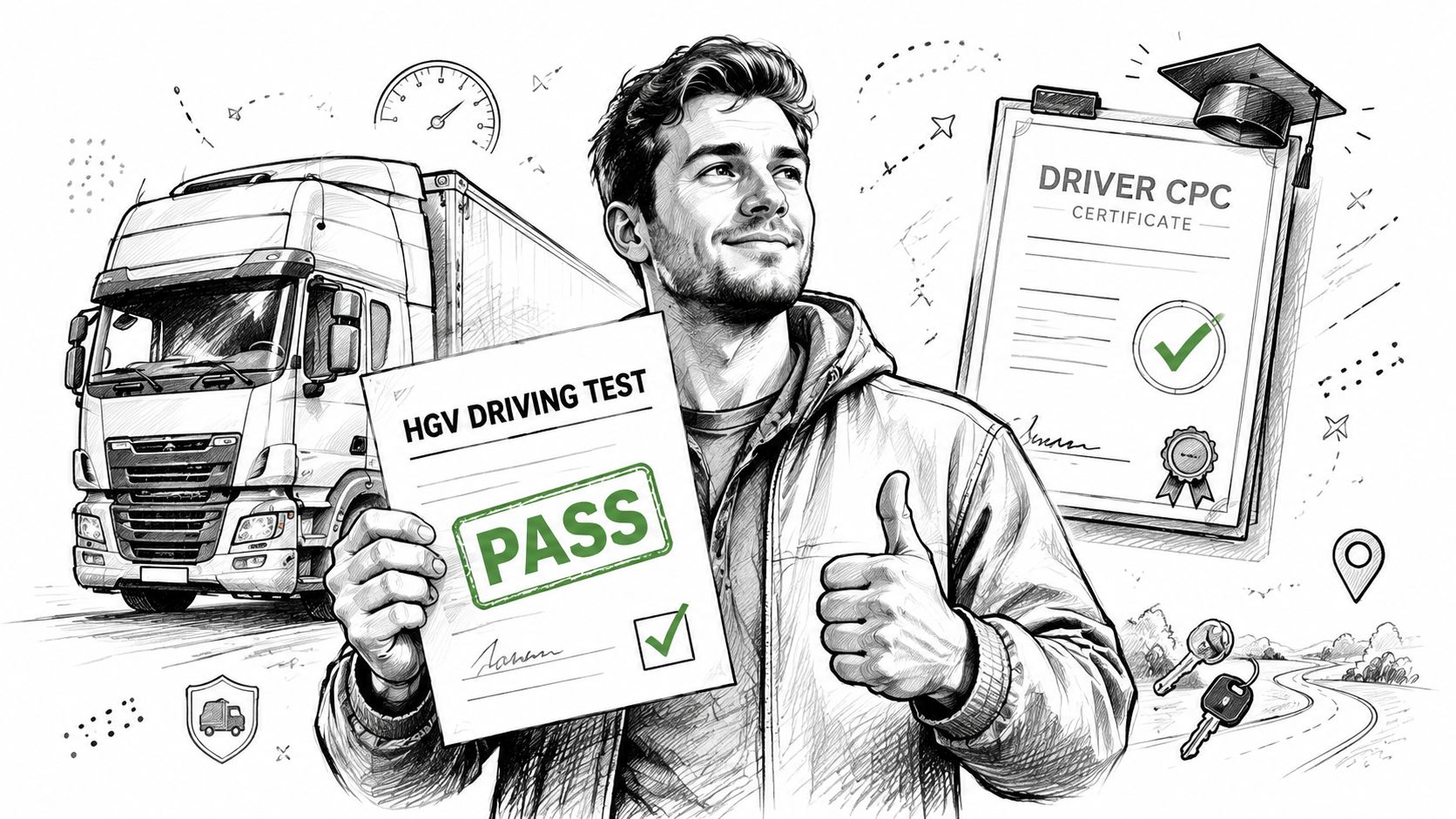
The pass certificate feels like the finish line. In practice, it's the point where operators start checking whether you're employable.
Drivers who move quickest into work usually do three things well. They prepare in a structured way, they train to test standard rather than to personal comfort level, and they finish the CPC side without leaving loose ends behind.
Finding the Best HGV Driver Jobs in Oldham
Once you're qualified, job hunting needs to become targeted. Too many new drivers sit on one job board, fire off the same CV everywhere, and then assume the market is slow. It usually isn't. Their approach is.
In Oldham, there is enough activity to justify a focused search. Recent local figures show 54 active HGV vacancies within a 10-mile radius, while broader searches show 167 Class 2 driver jobs within 20 miles of Oldham. Those same verified local figures also point to specialist recruiters such as Driver Hire Manchester North & Oldham, including direct contact through 0161 804 0235, as active parts of the local hiring scene, with the vacancy data cited from Reed's HGV jobs listings for Oldham.
Use three channels, not one
The best job search in this trade usually combines job boards, specialist agencies, and direct local contact.
Job boards for volume: Reed, Indeed, JobSite, Totaljobs, and similar platforms show what's live and what language employers are using.
Agencies for access: Specialist recruiters often hear about shifts and contracts before they become polished adverts.
Direct applications for local fit: Smaller hauliers and local operators may move faster when they speak to a driver who sounds switched on and available.
Newly qualified drivers often worry they won't be considered because they don't yet have years behind the wheel. That's sometimes true for specialist roles, but not for every opening. Agencies and local firms still need dependable people for entry-level routes, holiday cover, and stepping-stone work.
What gets attention is simple:
Licence clarity: State exactly what you hold.
Document readiness: Make it obvious that your CPC and licence paperwork are current.
Shift flexibility: If you can do early starts, nights, or weekends, say so.
Location realism: Employers like drivers who understand the routes and don't panic at depot start times.
A short, direct phone call after an application can also help. Not every sector rewards that, but transport often does. It shows you're available, organised, and not just bulk-applying.
Know the difference between browsing and searching
Some drivers spend weeks "looking" without building a search system. A real search has a rhythm. Check live boards daily. Speak to agencies. Keep your documents ready. Track where you've applied. Follow up.
A useful refresher sits below if you want a quick visual on the kind of work route many new drivers take into the sector.
Good job hunting in transport is part timing, part paperwork, and part persistence. Most people only do one of those well.
What to Expect Realistic Pay and Shift Patterns
Let's get to the part everyone wants to know. What can you earn in Oldham, and what kind of working week comes with it?
The answer depends on licence class, job type, experience, and whether you're taking general haulage or more specialised work. The useful point is that Oldham offers a genuine spread of options rather than one flat pay band.
The baseline for local earnings
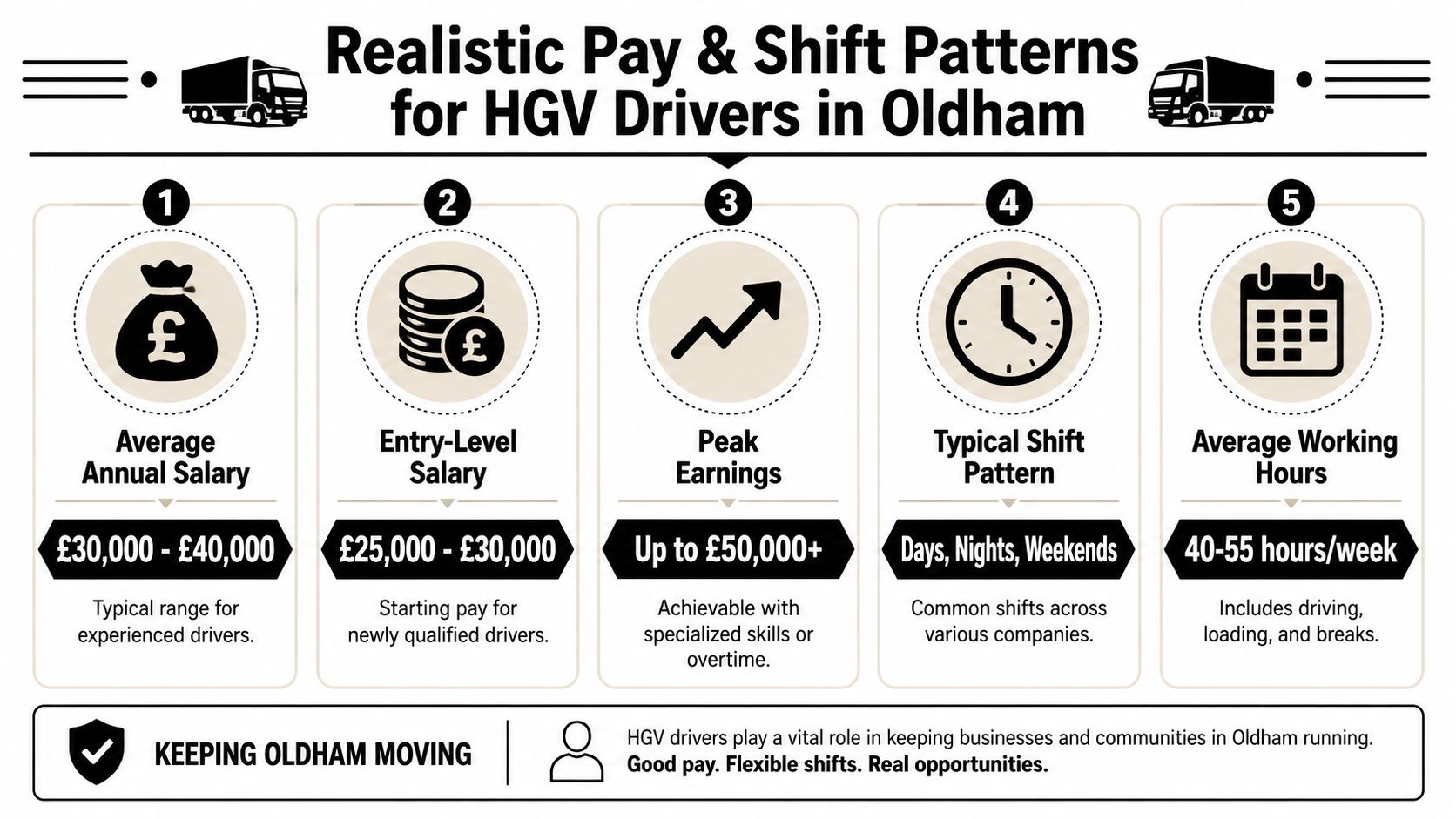
Verified local salary data shows the average annual salary for an HGV driver in Oldham is £31,786, with a reported range up to £36,678, according to Totaljobs salary data for HGV roles in Oldham.
That gives you a sensible midpoint. It isn't the ceiling, and it isn't the minimum. It's a realistic marker for the local market.
Indeed United Kingdom listings in the verified data also place salary ranges for HGV roles in Oldham between £16.38 and £25.88 per hour, with a specific recruitment example for Class 2 AM Multi-Drop Drivers in Radcliffe and Bury at £16.38 per hour for Monday to Friday shifts. That tells you local earning patterns aren't just about annual salary headlines. The shift shape matters too.
Where the higher pay usually sits
At the stronger end of the market, entry-level HGV Class 1 driver roles in Oldham can start from £46,800 per year, with hourly rates of £26.88, based on the verified local listing data from SimplyHired's Class 1 HGV driver search for Oldham.
That kind of figure usually lines up with tougher roles, longer shifts, more responsibility, or work that expects a stronger licence class. The lesson is straightforward. Better tickets and broader capability usually open better-paid work.
Shift patterns matter as much as headline pay
When people compare jobs, they often focus only on the hourly rate. That's a mistake. A role that pays well on paper can still be a poor fit if the rota wrecks your routine.
Common shift patterns in and around Oldham include:
Monday to Friday day work: Often attractive for drivers who want regularity and home time.
Early starts: Popular in multi-drop, building supply, and utility support.
Night trunking: Can suit drivers who prefer quieter roads and steadier delivery patterns.
Longer shifts: Some Class 1 roles advertise 12-hour shifts in the verified local data.
Weekend or rolling rotas: More common where depots run around the clock.
Worth weighing up: The best-paid job isn't always the best first job. A steady role that sharpens your skills can be the smarter move in year one.
What changes your earning power
Three things usually move pay upward in practical terms.
Factor
Why it matters
Typical effect
C+E licence
Opens artic and broader distribution work
More access to higher-value roles
Specialist tickets such as ADR
Helps with niche sectors
Better access to premium vacancies
Experience and clean reliability
Reduces employer risk
More choice and stronger negotiations
If you're chasing HGV driver jobs Oldham firms advertise, read the shift details as carefully as the pay line. The best match is the one you can sustain.
Nailing the Application and Starting Your Career
A fresh pass doesn't get you hired on its own. It gets you considered. The next part depends on how well you present yourself and how ready you are for the checks that come after the interview call.
Many employers want more than a licence number. They want to know whether you'll be safe, punctual, compliant, and easy to put in front of customers, depot staff, and transport managers.
Build a CV that answers transport questions fast
A transport CV should be easy to scan. The person reading it wants to find your licence category, CPC status, work history, availability, and location quickly.
Put the essentials near the top:
Licence entitlement: State whether you hold C1, Category C, or C+E.
Driver CPC and cards: Make your commercial readiness clear.
Relevant work history: Delivery, warehouse, plant, van work, customer-facing work, or anything showing route discipline and responsibility.
Availability: Early starts, weekends, nights, or immediate start if that's true.
Local knowledge: Oldham, Greater Manchester, depot work, and route familiarity can help.
If you want a practical refresher on matching your CV to a specific advert, Proficiently helps you tailor resumes in a way that's useful when you're applying to transport operators with different priorities.
Expect a practical test, not just a chat
In HGV recruitment, interviews are often only part of the process. Employers may also want a driving assessment, a background health check, and document verification. Verified local recruitment notes for this topic also point to a mandatory road test from the hiring logistics firm as part of the process.
That means preparation should be practical, not theatrical. Be ready to talk through:
Daily vehicle responsibility. Show that you understand safety checks and reporting.
Working time and compliance. Employers want drivers who respect the legal side.
Route pressure. Explain how you stay calm when timings change.
Customer contact. Multi-drop and delivery roles still rely on professionalism.
New drivers should lean into strengths they do have
If you don't have years of HGV experience yet, don't apologise for it in every sentence. Replace missing mileage with evidence of work habits.
Good examples include:
Attendance and punctuality
Manual handling or warehouse support
Safe driving record in other vehicle roles
Comfort with paperwork and daily checks
Willingness to take feedback
Employers can train route knowledge. They struggle more with drivers who are careless, late, or difficult to manage.
Starting well matters more than sounding experienced
Your first HGV job doesn't need to be perfect. It needs to be legal, stable, and useful. If it gives you proper road time, introduces you to transport routines, and helps you build a dependable record, it's doing its job.
Many promising recruits often lose momentum. They hold out for an ideal role, ignore solid starter jobs, and miss the chance to get six months or a year of real operating experience behind them. In transport, experience compounds. Once you've proven yourself, the market usually becomes easier to manage.
If you're ready to stop guessing and start moving, HGV Learning can help you through the full route into work, from medicals and theory support to practical training and job-matching guidance.