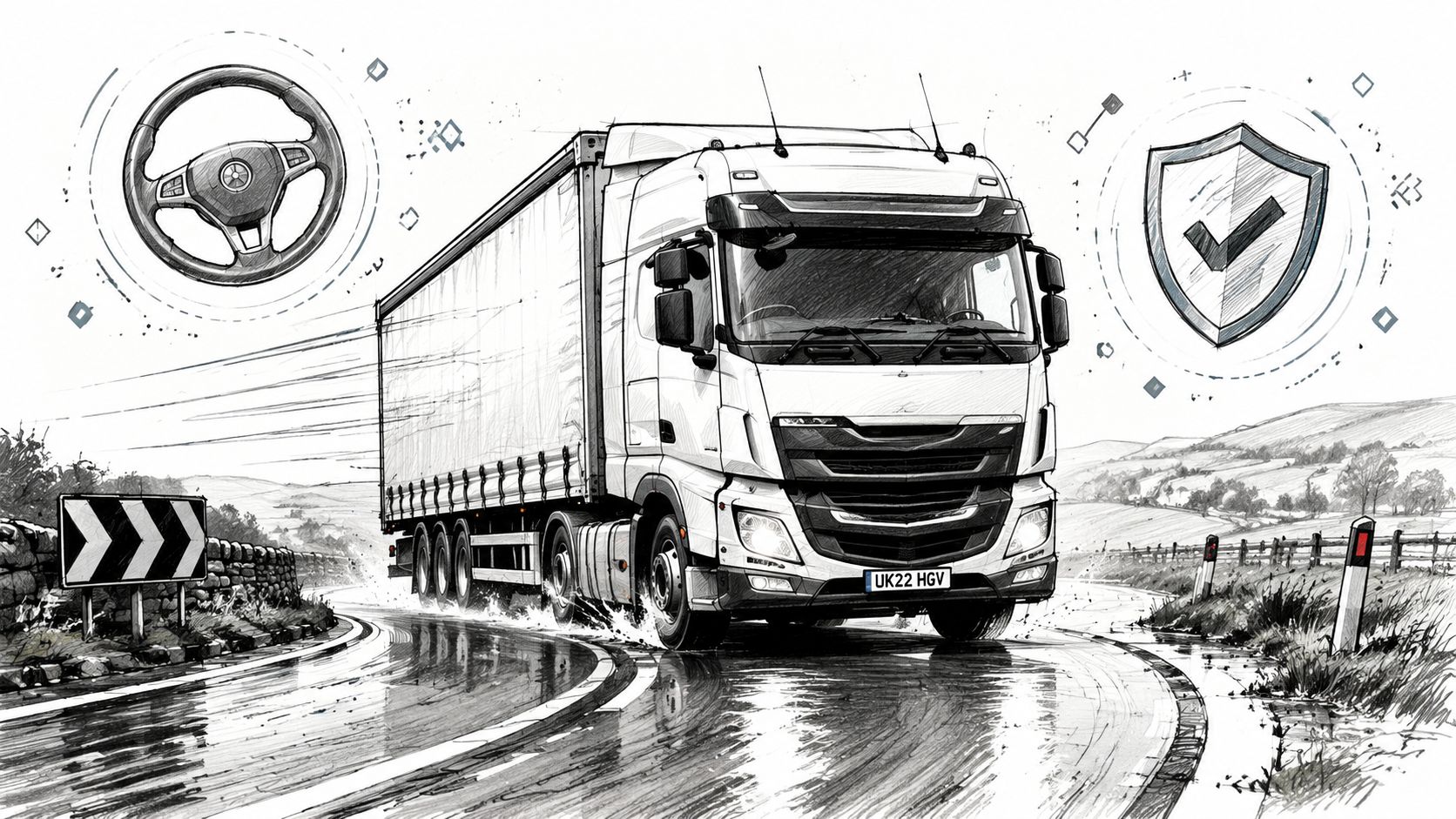
You're joining a motorway in the rain. The trailer is loaded. The slip road tightens more than you expected, and the unit starts to feel light in the wrong way. Not airborne light. Unsettled light. The steering needs more correction than it should, and for a moment the lorry doesn't quite follow the line you asked for.
That's where electronic stability control matters.
Most drivers know the term. Fewer know what the system is doing in an HGV, what it feels like when it steps in, and how to respond without making things worse. In a car, people often describe ESC in broad terms. In a heavy goods vehicle, that isn't enough. You need to understand trailer movement, weight transfer, braking behaviour, and what can happen on wet roundabouts, exposed bridges, downhill motorways, and uneven rural roads.
What Is ESC and Why It Matters for HGV Drivers
Electronic Stability Control is a safety system designed to help stop a vehicle from skidding, spinning, or tipping into a rollover when grip and balance start to break down. In plain language, it watches where you mean to go, compares that with what the vehicle is doing, and steps in if the two no longer match.
In an HGV, that matters more because the vehicle is taller, heavier, and slower to settle after a sudden input. A rigid lorry can lean heavily if you enter a bend too fast. An artic can start to snake if the trailer pushes awkwardly behind the unit. A loaded vehicle can feel stable one moment and unstable the next if the weight shifts across the chassis.
Why HGV drivers should care
ESC isn't a comfort feature. It's there to help prevent some of the worst incidents a professional driver can face.
International studies cited by UK road safety researchers show that ESC can reduce single-vehicle crashes by 34 to 42% and fatal single-vehicle crashes by up to 56% according to the NHTSA ESC evidence summary. That matters because many serious HGV loss-of-control incidents begin with a single mistake, a wet surface, a sudden steering input, or a speed judgement that was only slightly off.
ESC is also part of modern heavy vehicle safety as standard equipment on new vehicles in the UK market. If you're driving newer kit, you're almost certainly driving with it.
Practical rule: Treat ESC as a silent co-driver. It won't drive the lorry for you, but it can step in when physics starts to outrun your margin for error.
What new drivers often get wrong
The biggest misunderstanding is thinking ESC makes a lorry impossible to lose. It doesn't. It gives you extra support inside the vehicle's physical limits. If the speed is far too high, the load is badly managed, or the steering input is violent, the system may not be able to rescue the situation fully.
A second mistake is confusing ESC with ABS. They work together, but they aren't the same thing. ABS mainly helps during braking. ESC looks at the vehicle's overall direction and balance.
If you want a broader view of how this fits with other modern systems, this guide to HGV safety technology is a useful companion.
How Electronic Stability Control Works in Your HGV
Think of ESC as the lorry's balance system.
Your body does something similar when you slip on ice. Your eyes, inner ear, and muscles all work together to detect the slip and correct it before you fall. An HGV's ESC does that with sensors, software, brakes, and engine control.
The senses
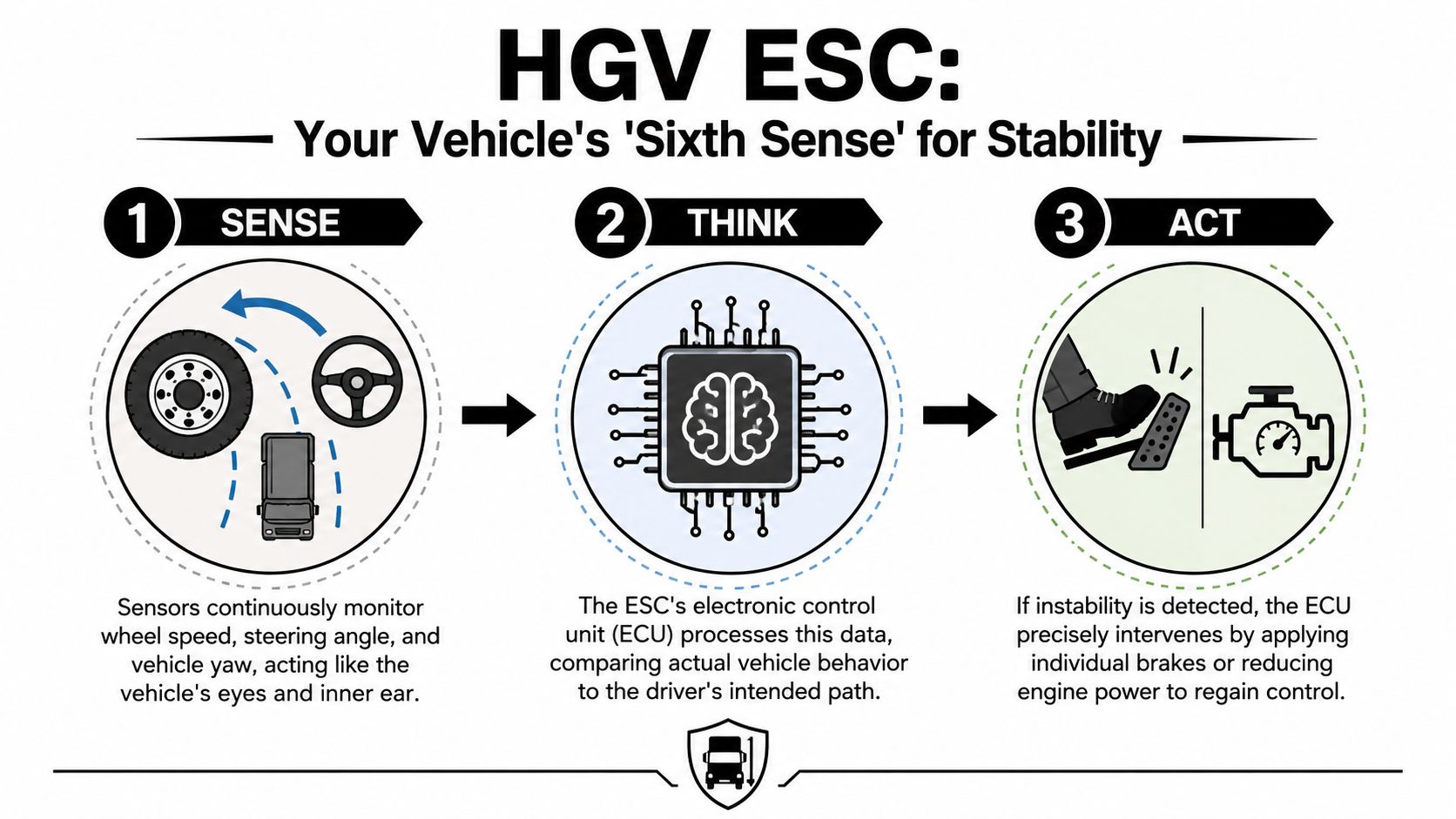
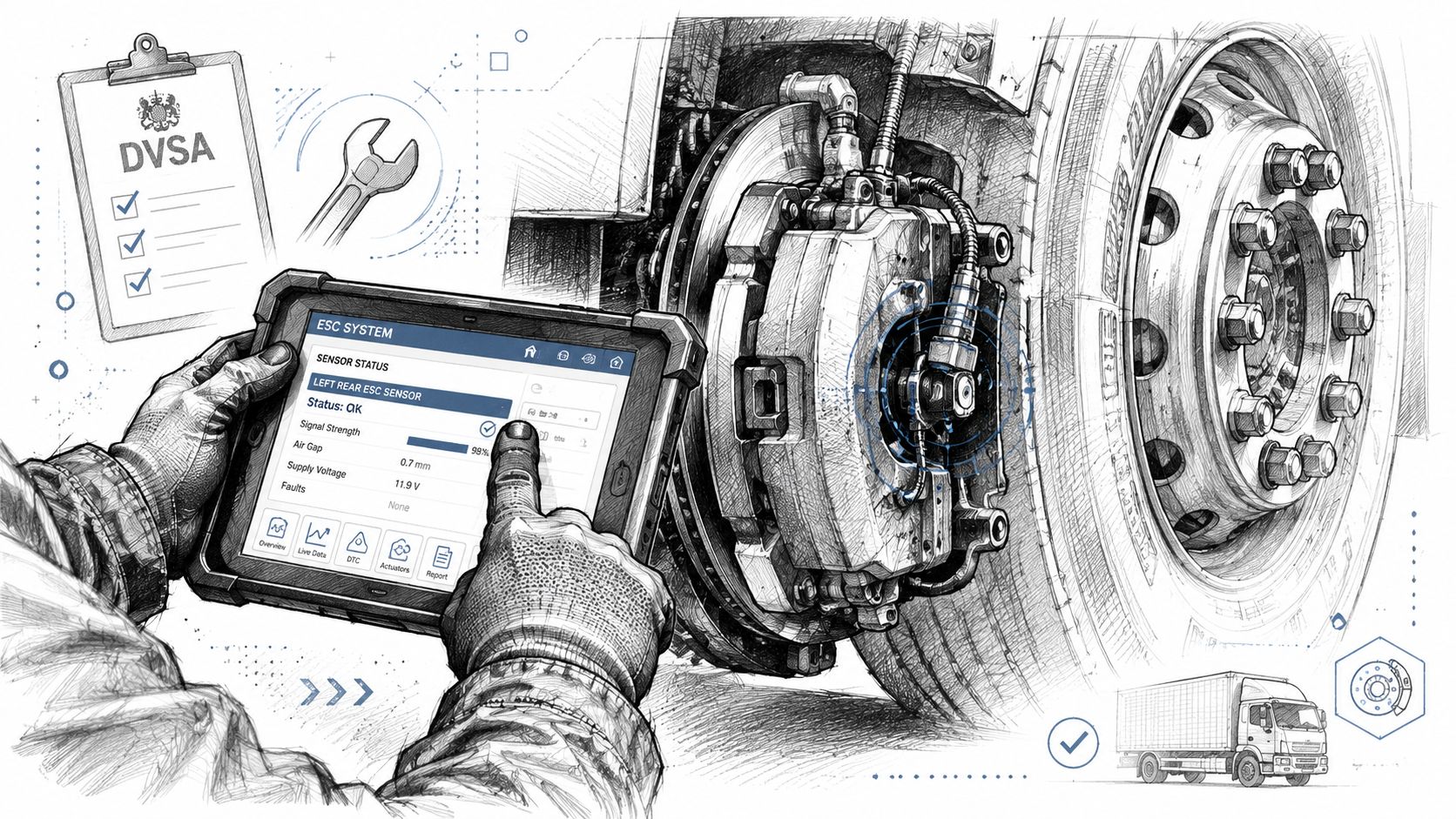
On an HGV, the ESC system integrates wheel-speed sensors, a steering-angle sensor, and yaw-rate sensors. When these sensors detect a mismatch between the driver's intended path and the vehicle's actual movement, the system can intervene within milliseconds by reducing engine torque and selectively applying brakes to individual wheels, as described in this explanation of how ESC systems operate on heavy vehicles.
That sounds technical, so strip it back:
Wheel-speed sensors watch how fast each wheel is turning.
The steering-angle sensor tells the system what line you're asking the vehicle to take.
The yaw-rate sensor watches how the vehicle is rotating around its centre. In simple terms, it checks whether the lorry is beginning to swing, pivot, or drift away from the path you intended.
The brain and reflexes
Once the system sees a mismatch, it has to decide whether that mismatch is normal or dangerous.
If you turn gently into a bend and the vehicle follows cleanly, there's no issue. If you steer into a roundabout and the vehicle starts pushing wide, or the rear begins to step out, ESC recognises that the vehicle's actual movement no longer matches your steering command.
Then it acts.
Detect, decide, act
Here's the process in driver language:
Detect The sensors pick up the first signs of instability. This could be understeer, oversteer, trailer sway, or the early build-up of rollover forces.
Decide The control unit compares your steering input with the HGV's movement. It works out whether the lorry needs correction.
Act The system reduces engine torque and applies braking to selected wheels to bring the vehicle back into line.
That selective braking is the clever part. ESC doesn't stamp on every brake. It applies precise correction where it's needed. In a heavy vehicle, that can help calm a developing skid before it grows into a full loss-of-control event.
If the steering wheel is your instruction, ESC checks whether the vehicle is obeying it.
What that means in a real lorry
In a car, you may feel a quick tug and a warning light. In an HGV, the intervention can feel more deliberate because there's more mass to control. You may notice:
A brief cut in pulling power
A dragging or braking sensation from one part of the vehicle
A dashboard warning light flashing
The lorry settling back into line after feeling loose or top-heavy
If your vehicle uses air brakes and a retarder, the interaction can feel unfamiliar at first. The lorry may seem to check itself in a way that feels firmer than older vehicles with simpler systems. That doesn't mean the truck is malfunctioning. It means the control systems are managing stability, not just speed.
Key Safety Benefits for HGVs on UK Roads
The value of ESC becomes obvious when you look at the kinds of crashes that end driving careers, damage loads, close roads, and injure people. HGV incidents often aren't dramatic at the start. They begin with a small loss of line, a trailer movement that builds, or a bend taken a bit too hard in poor conditions.
UK-oriented studies show that ESC can reduce the rate of single-vehicle crashes involving heavy vehicles by up to 60 to 70%, with a particularly strong effect on run-off-road incidents where the vehicle leaves the carriageway, according to this review of ESC effectiveness in heavy vehicles. For Category C and C+E drivers, that's especially relevant on motorways, dual carriageways, and faster A-roads.
Where ESC helps most
Some HGV risks are built into the vehicle itself:
Road situation
Main danger
How ESC helps
Tight roundabout entry
Rollover force builds quickly
It checks yaw and stability, then intervenes before the lean turns into a full loss of control
Wet motorway lane change
Trailer swing or snaking
It helps settle the combination with selective braking
Rural bend with poor camber
Unit pushes wide or trailer unsettles
It supports directional control when grip drops unexpectedly
Slippery downhill section
Speed and weight work against you
It helps stabilise the vehicle if the lorry starts deviating from the intended line
The benefit isn't just crash prevention
ESC also protects the smaller margins that professionals rely on every day. It can help preserve control during those moments when the road surface, load behaviour, and steering input don't work together.
That matters in the UK because our roads often combine several challenges at once:
Wet surfaces that reduce grip without much warning
Compact roundabouts that load the suspension quickly
Cross-camber roads that unsettle a high-bodied vehicle
Mixed traffic that forces quick decisions near junctions and merges
Good drivers reduce risk early. ESC adds a layer of protection if the situation develops faster than expected. If you want to strengthen the habits that stop incidents before electronics need to step in, this guide to HGV accident prevention is worth reading.
A professional doesn't measure safety by whether they avoided a crash. They measure it by how often they avoided getting close.
Driving with ESC in Common HGV Scenarios
You don't need to know the software logic inside the control unit. You do need to know what an intervention feels like and how to react. The wrong response is often to fight the vehicle with more steering, more throttle, or a panicked brake input.
Studies show ESC is highly effective at reducing fatal single-vehicle rollover crashes by around 70 to 75%. For HGVs, this is critical on roundabouts and slip roads, where the system intervenes if cornering forces risk exceeding the vehicle's stability threshold, based on findings in this NHTSA rollover analysis.
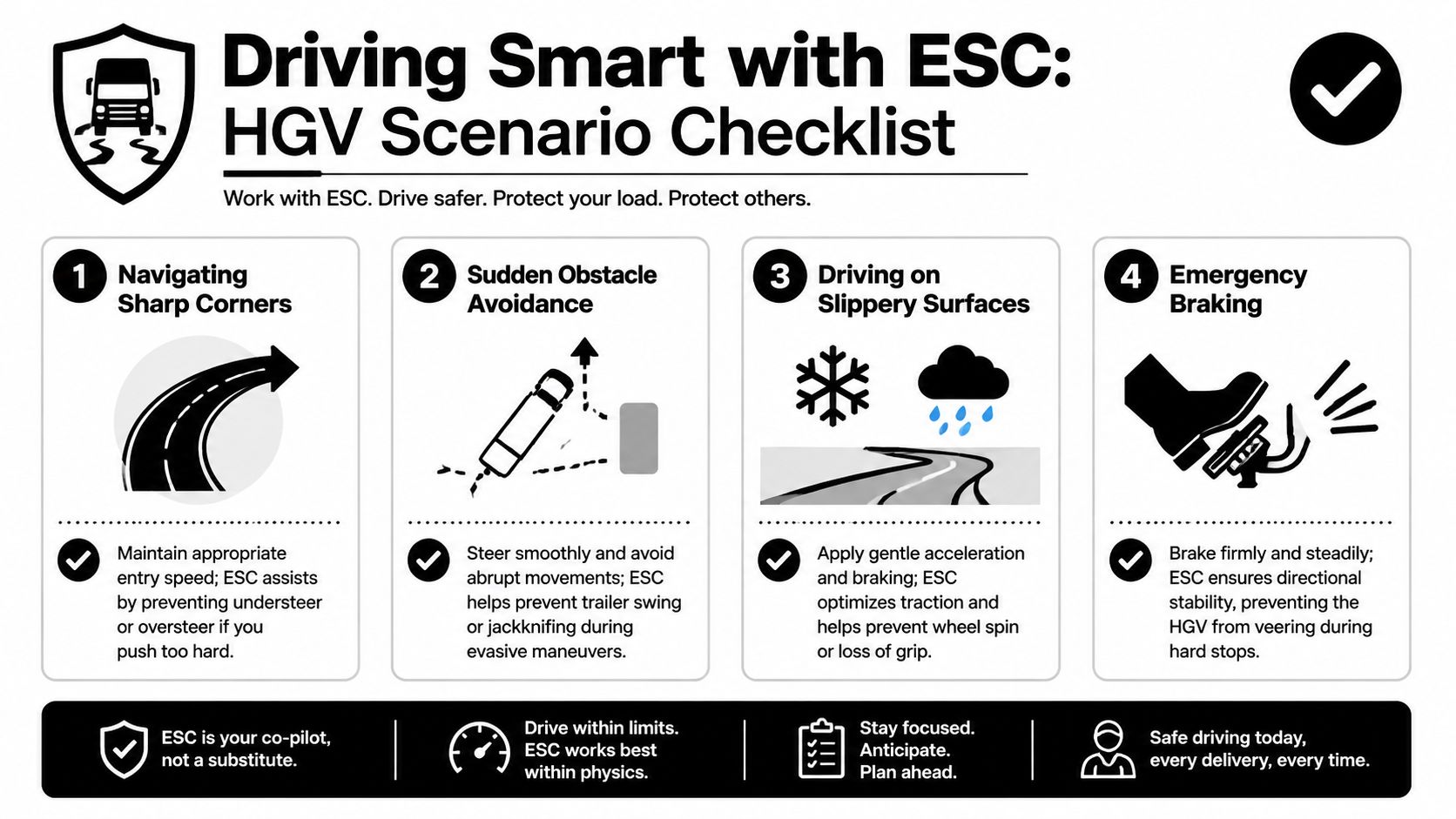
Roundabouts and tight slip roads
This is one of the clearest HGV scenarios for ESC.
You approach a wet roundabout a touch fast. As you turn in, the vehicle leans harder than expected. If you're in an artic, the trailer may feel as though it wants to continue straight while the unit begins turning. That mismatch can become dangerous quickly.
What you may feel:
A sudden reduction in engine pull
A flashing stability warning
A brief braking effect that seems to come from one side
The lorry tightening back into line
What you should do:
Ease off the accelerator.
Keep your steering smooth.
Don't add a sharp correction unless you need one.
Let the system work.
The common error is sawing at the wheel. That can add more instability instead of less.
Emergency lane change on a motorway
A car cuts across. Debris appears late. You need to move, but the danger isn't only the obstacle. It's the weight shift that follows the swerve.
With a loaded HGV, the first steer throws the mass across the suspension. The second steer, to bring the vehicle back into lane, can be the one that starts the problem. That's often when trailer movement, side-to-side swing, or rollover force builds.
Smooth in. Smooth out. ESC works best when your correction is firm but not violent.
If ESC intervenes here, you may feel the lorry being held back just as you want to accelerate away. That can feel counterintuitive. Trust the logic. The system is trying to restore balance before power comes back in full.
Crosswinds on exposed roads and bridges
A strong side gust can nudge a high-sided HGV off line, especially if the trailer is lightly loaded or the body catches wind. Many drivers assume this is purely a steering issue. It often becomes a stability issue instead.
The first sensation is drift. The second is overcorrection by the driver. ESC can help if that correction starts to push the vehicle beyond a stable path.
A good response looks like this:
Hold a steady, measured steering input.
Avoid stabbing at the throttle.
Keep your lane position predictable.
If the vehicle feels unsettled, reduce speed progressively when safe.
Steep descents and downhill motorway sections
Downhill driving can confuse newer drivers because the lorry may feel as if it's fighting them. If speed creeps up and the vehicle enters a bend or lane change under load, ESC may intervene more firmly. In modern HGVs, that can interact with engine management, braking control, and in some cases the way retardation feels through the vehicle.
If the system cuts power downhill, don't treat it as an annoyance. Treat it as a warning that the combination of speed, weight transfer, and direction change is moving toward the edge of stability.
Slippery surfaces in winter or heavy rain
ESC is not a miracle on ice. It can't create grip that isn't there.
It can, however, help stop a small slide from turning into a larger one if the surface still offers enough tyre contact for correction. That's why your job stays the same even in a modern vehicle. Lower the demand you place on the lorry. Gentle steering. Gentle throttle. Progressive braking.
When ESC activates, the best driver response is often to do less, not more.
ESC Checks Maintenance and DVSA Standards
Electronic stability control is automatic, but it isn't a system you ignore. If you drive professionally, checking that the warning lights behave properly at start-up is part of basic vehicle responsibility.
In the UK, ESC is a standard requirement on new HGVs, following EU-type approval standards such as (EC) No 661/2009, and DVSA-aligned training and test protocols such as UNECE Regulation 13H require these systems to prove their effectiveness in standardised stability manoeuvres, as outlined in this overview of electronic stability control regulations and testing.
What to check before you move
You don't need workshop-level diagnostic skill to spot obvious warning signs.
Use a short routine:
Watch the dash at start-up. The ESC warning light should illuminate during the normal bulb check, then go out if the system is functioning as expected.
Pay attention to persistent warnings. If the light stays on, the vehicle may have a fault affecting stability assistance.
Notice changes in feel. If the lorry suddenly behaves differently in wet conditions or under braking, report it.
Record defects properly. A missing report helps nobody if a problem develops into a roadside or crash investigation.
A broader pre-use inspection routine matters too. This guide to HGV roadworthiness checks helps put ESC into the wider context of daily driver checks.
Maintenance matters because sensors matter
ESC depends on accurate inputs. If a wheel-speed sensor, steering-angle sensor, or related wiring develops a fault, the system may be limited or unavailable. That doesn't always mean obvious failure at the wheel. Sometimes the only clue is a warning light or a system message.
For fleet use, a simple inspection record can keep checks consistent across drivers and vehicles. If you want a practical template, you can download our fleet safety checklist as a starting point for defect reporting and inspection habits.
How this fits DVSA expectations
DVSA standards focus on control, anticipation, and safe decision-making. ESC supports those standards. It doesn't replace them.
A driver who enters bends properly, manages speed early, and keeps steering smooth is using the vehicle in a way that allows safety systems to work well. A driver who relies on electronics to rescue poor judgement is already behind the vehicle.
Your Professional Approach to Modern Safety Systems
A modern HGV is full of systems designed to support safe driving. ESC sits alongside other tools such as lane-related alerts, braking support features, and tyre monitoring. The professional approach is the same for all of them. Know what the system does. Know what it doesn't do. Know how the vehicle feels when it steps in.
That mindset matters more than memorising dashboard symbols.
If ESC activates, it tells you something important. The vehicle was getting close to a limit of grip, balance, or directional control. Sometimes that limit was created by speed. Sometimes by road surface. Sometimes by load movement or steering technique. The lesson isn't just that the system worked. The lesson is that the situation needed more margin earlier.
What good drivers do with that information
Professional drivers use safety systems as feedback.
They ask themselves:
Was my entry speed right for the bend and the load
Did I make the steering input smoothly enough
Was the road surface worse than it looked
Do I need to adjust my approach in similar conditions
That same thinking applies beyond ESC. For example, tyre condition and pressure have a direct effect on grip and stability, which is why it helps to understand related systems such as TPMS systems for Class 8 trucks when you're building a broader picture of vehicle safety.
The main takeaway
Electronic stability control is one of the most valuable safety aids fitted to a modern HGV. It can help prevent skids, trailer instability, and rollovers. It can step in fast. It can support you in serious moments.
But it still works best with a calm, trained driver who reads the road early, manages speed properly, and doesn't fight the vehicle when the system intervenes.
That's what professionalism looks like in a modern cab.
If you want DVSA-aligned HGV training that helps you understand real vehicle behaviour, not just pass the test, HGV Learning can help you build the skills and confidence needed for safe, compliant driving across Category C, C+E and other specialist routes.
Related Articles
16/10/2026
What Age Can You Start HGV Driver Training? A 2026 UK Guide to Licence Age Requirements
If you're asking what age you can start HGV driver training, the honest answer depends on which licence you're after. A C1 licence, covering vehicles...