You've picked your training path. You may even have the course dates in mind. Then one line stops you in your tracks: medical assessment required.
That moment catches a lot of new drivers out. It can feel as if you were ready to start the practical part, only to be pushed into paperwork, forms and questions about your health. The good news is that this is normal. It isn't a sign that something's wrong, and it isn't there to trip you up.
For HGV drivers, occupational health screening is part of entering a safety-critical job. You're applying to drive large vehicles, often for long hours, in changing weather, on busy roads, with real responsibility for your own safety and everyone else's. A medical check is one of the first professional steps in that process.
Most of the anxiety comes from not knowing what the check is for, who it's for, and what happens if the doctor spots an issue. Once you understand that, the whole thing becomes much easier to deal with.
Your First Step The HGV Medical Exam
A common starting point goes like this. You decide you want to become an HGV driver, you start looking at training, and then you find out you need a medical before your licence application can move forward. Excitement quickly turns into worry.
That reaction makes sense. “Medical exam” sounds serious. Many people assume it's a hard pass or fail event, or that one old health issue will end the process before it begins. In practice, it's usually far more routine than that.
For a new driver, the HGV medical is best seen as your first check that you're ready for a professional driving role. It helps confirm that your health is suitable for the demands of operating a large goods vehicle. That matters not only for licensing, but for your future employer and for public safety.
Why this step matters early
The HGV medical usually connects directly to the D4 form that supports your licence application. If you leave it until the last minute, the rest of your timeline can stall. If you handle it early, everything feels more organised.
If you want a simple breakdown of the process, this guide to the HGV medical process is a useful starting point.
The medical isn't there to catch you out. It's there to check whether you can drive safely and reliably in a demanding role.
What most new drivers get wrong
The biggest misunderstanding is thinking this is the same as a normal GP check-up. It isn't. The doctor isn't trying to give you a full review of every aspect of your health. They're looking at whether your health affects your ability to do the job safely.
That means the focus is practical. Can you see well enough? Are there conditions that could affect control of the vehicle? Is there anything in your medical history that needs clarification before you move forward?
A calm, prepared driver usually gets through this stage without drama. Bring the right documents, answer questions truthfully, and treat it as part of your route into a regulated profession.
What Is Occupational Health Screening
Think of occupational health screening as the human version of an MOT. An MOT doesn't ask whether you like your car or whether the paint still shines. It checks whether the vehicle is safe and suitable for the road. Occupational health screening works in a similar way for work.
That doesn't mean it judges you as a person. It asks a narrower question. Are you medically fit for the tasks your job requires?
For HGV driving, that's a very different question from the one your GP might explore during a routine appointment. A general health check looks at your wider wellbeing. Occupational health screening looks at your job.
The job comes first
A driver's work has specific demands. You may spend long periods seated, climb into and out of the cab, secure loads, reverse in tight spaces, manage fatigue and respond quickly to hazards. So the screening should relate to those demands, not to a vague idea of “health”.
Employers don't use occupational health screening just to tick a box. They use it because a driver who is medically suited to the role is more likely to work safely and consistently. In haulage, logistics, construction and utilities, that's part of basic risk control.
If you want a broader workplace view of why prioritize employee health, that resource helps explain why businesses take health support seriously in the first place.
Practical rule: Occupational health screening should match the real job, not a generic idea of wellness.
What it is and what it isn't
A quick comparison helps:
Screening type
Main purpose
GP check-up
General health and ongoing medical care
Occupational health screening
Fitness for a specific role or set of tasks
HGV medical assessment
A driver-focused check linked to safe commercial driving
That distinction removes a lot of confusion. If a doctor asks about a condition, medication or past issue, they're usually asking because it may affect driving, loading, physical movement or safety on the road.
Once you view occupational health screening in that light, it feels less mysterious. It's a structured way to match a person to a safety-sensitive job.
Key Screening Types for HGV Drivers
An HGV driver may meet occupational health screening at several points, not just once. Knowing the difference helps because each type has a different purpose.
The first one most drivers meet
Typically, the first screening is the one linked to the D4 medical. This is the gateway check that supports your application for an HGV licence. It's the point where your driving plans become official.
At this stage, the screening focuses on whether you meet the medical standard expected for commercial driving. Vision is one of the most obvious parts, so it helps to read up on the HGV eyesight test requirements before you attend.
The checks that can appear later
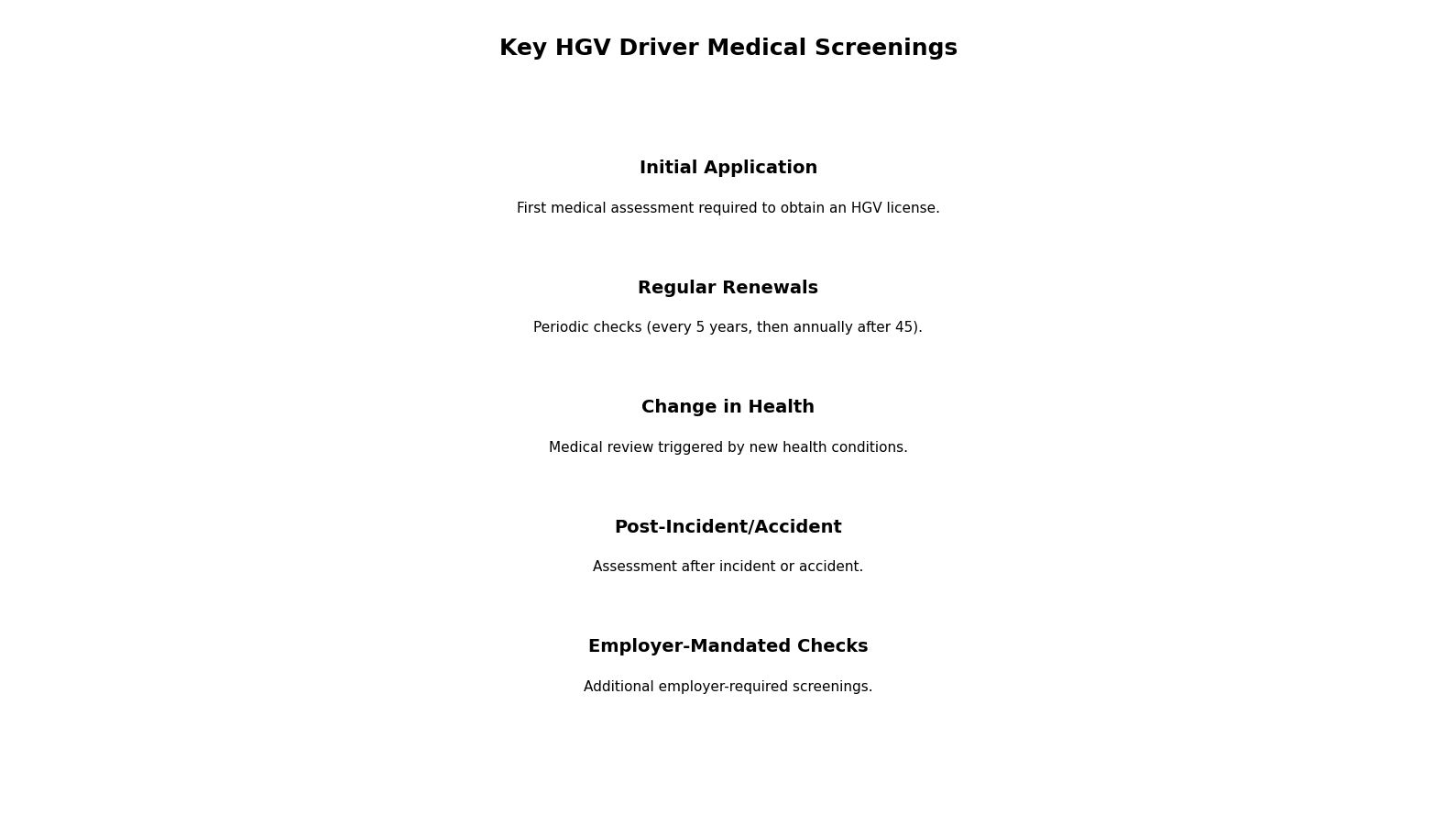
Once you're working, screening doesn't always disappear. Drivers may come across further checks in different situations:
Licence renewal checks: Some drivers need follow-up medical reviews as their licence requirements continue over time.
Employer entry checks: A transport company may ask for its own assessment before placing you in a role.
Change in health reviews: If your health changes, a fresh assessment may be needed to confirm safe driving.
Return after illness or injury: A driver coming back after time away may need confirmation that they're fit to resume duties.
Post-incident review: After a serious event, an employer may want medical clearance before putting a driver back on the road.
Why fitness for duty matters
Some screenings go beyond paperwork and ask a practical question. Can you physically do the job being assigned? For HGV applicants and drivers, this is especially important where there is a fitness-for-duty requirement, because the evaluation can include physical capability checks such as lifting, standing, squatting, twisting, turning and fine motor control, plus respirator-related assessment where exposure risk exists, as outlined in this guide to occupational health screening.
That matters more than many new drivers expect. Driving is only part of the role. Depending on the job, you may also deal with curtainsiders, tail lifts, pallet trucks, manual handling, climbing and load checks.
A driver can be fine for one type of work and still need a closer look for another. A trunking role and a multi-drop role don't place exactly the same demands on the body.
A simple way to think about it
You can group HGV screening into three broad moments:
Career stage
Typical reason
Starting out
Licence application and entry into training or employment
Staying qualified
Ongoing medical suitability for licensed driving
Returning or changing
Illness, injury, incidents or changed duties
When you look at it this way, occupational health screening stops feeling like one random hurdle. It becomes part of the way a professional driving career is monitored and supported.
Understanding the UK Legal and Regulatory Rules
Legal rules can sound heavy, but for drivers the practical message is simple. If you want to drive large commercial vehicles, the medical checks must relate to the actual risks of that work.
That's why broad “wellness” testing isn't the most useful model for HGV driving. A screening only helps if it looks at the parts of health that affect safe vehicle control and work performance.
Why task-specific screening works better
For professional drivers in the UK, occupational health screening is most useful when it is task-specific. The medical review should match the actual driving and loading demands of the role. Screening should prioritise factors that directly affect safe control of a large vehicle, such as vision, musculoskeletal function and any exposure-linked respiratory risk, rather than generic wellness testing, in line with the occupational surveillance principles discussed in this UK-focused review of health surveillance practice.
That idea clears up a lot of confusion. A well-designed screening doesn't ask random questions just because it can. It focuses on what matters for the job in front of you.
What that means for a driver
In practical terms, drivers should expect questions and checks that connect to daily duties, including:
Vision and visual correction: Because reading the road, mirrors, signs and hazards is fundamental.
Movement and function: Because getting in and out of the cab, securing loads and handling equipment all rely on physical capability.
Relevant medical history: Because some conditions may affect alertness, control or reliability on shift.
Exposure-related issues: In some roles, respiratory fitness may matter if the job involves dust, fumes or protective equipment.
What that means for an employer
Employers have a duty to manage work-related risk sensibly. For transport businesses, that means asking for checks that match the role instead of applying blanket tests with no clear purpose.
Good screening asks, “Can this person do this job safely?” It doesn't ask, “Can we find anything medical at all?”
That's why a warehouse operative who occasionally drives on-site, a Class 1 trunk driver and a HIAB driver may all face slightly different occupational health questions. The legal and safety framework points towards relevance, not guesswork.
For drivers, that's reassuring. The process should be tied to your real work, which makes it easier to understand and easier to prepare for.
How to Prepare for Your HGV Medical Assessment
Preparation matters more than often realized. Not because you can “revise” for a medical, but because small practical steps help the appointment run smoothly and stop avoidable delays.
Start with the basics. Know where you're going, what documents you need, and what the clinician is likely to ask. If you turn up rushed, without your forms or medication details, the process becomes harder than it needs to be.
What to bring with you
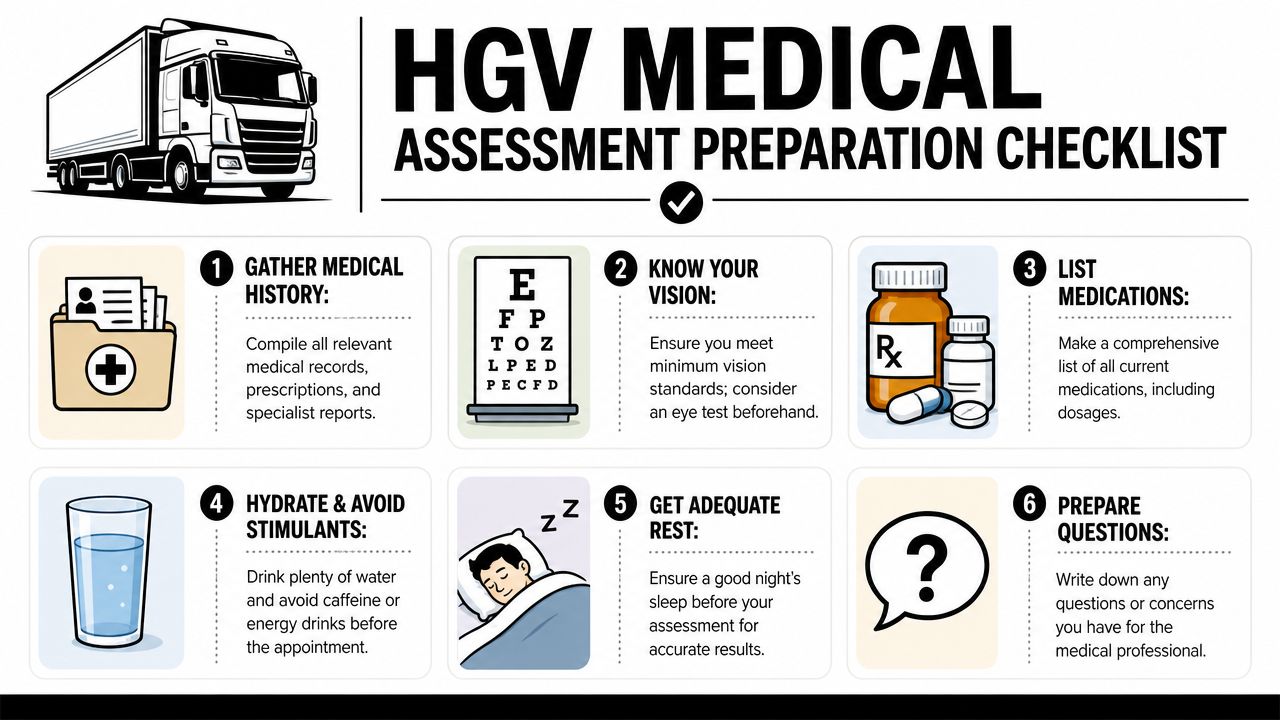
A short checklist helps keep things under control:
Photo ID: Bring valid identification in case the clinic needs to confirm who you are.
Your D4 form: If the appointment is for your HGV medical, make sure you have the correct paperwork ready.
Glasses or contact lenses: If you wear them for driving, take them with you.
Medication list: Write down current medicines clearly. Include anything you take regularly.
Relevant letters or reports: If you've seen a consultant or had recent treatment for a condition that could be discussed, supporting paperwork can help.
What usually happens in the appointment
Most HGV medical assessments are straightforward. The clinician will normally review your medical history, ask about current conditions and check a few practical health points that relate to driving.
You may be asked about:
Part of the assessment
Why it matters
Vision check
Safe driving depends on clear sight
Blood pressure
Some findings may need follow-up
Medical history
Past or current conditions may need context
Medication review
Some medicines can affect fitness to drive
If you feel nervous, it helps to know the appointment is usually conversational. The doctor or examiner isn't trying to make you fail. They're trying to complete a safe, accurate assessment.
A short video can also make the process feel more familiar before the day itself.
Small steps that help on the day
A few habits can make the appointment easier:
Get proper sleep: Tiredness won't help you feel calm or focused.
Avoid rushing in stressed: Leave enough travel time so your blood pressure and nerves have a chance to settle.
Be honest: If you hide something and it comes out later, that creates more trouble than dealing with it now.
Write down questions: If you're unsure about a condition or medication, ask.
Many drivers also benefit from simple reminders before appointments. If you handle lots of bookings in work or manage training around shifts, this guide to automated messages for businesses gives useful ideas on appointment reminders and reducing missed bookings.
Turn up prepared, not frightened. Most problems at this stage come from missing paperwork, confusion or avoidable last-minute stress.
Common Findings and What Happens Next
The question most drivers don't say out loud is, “What if they find something?”
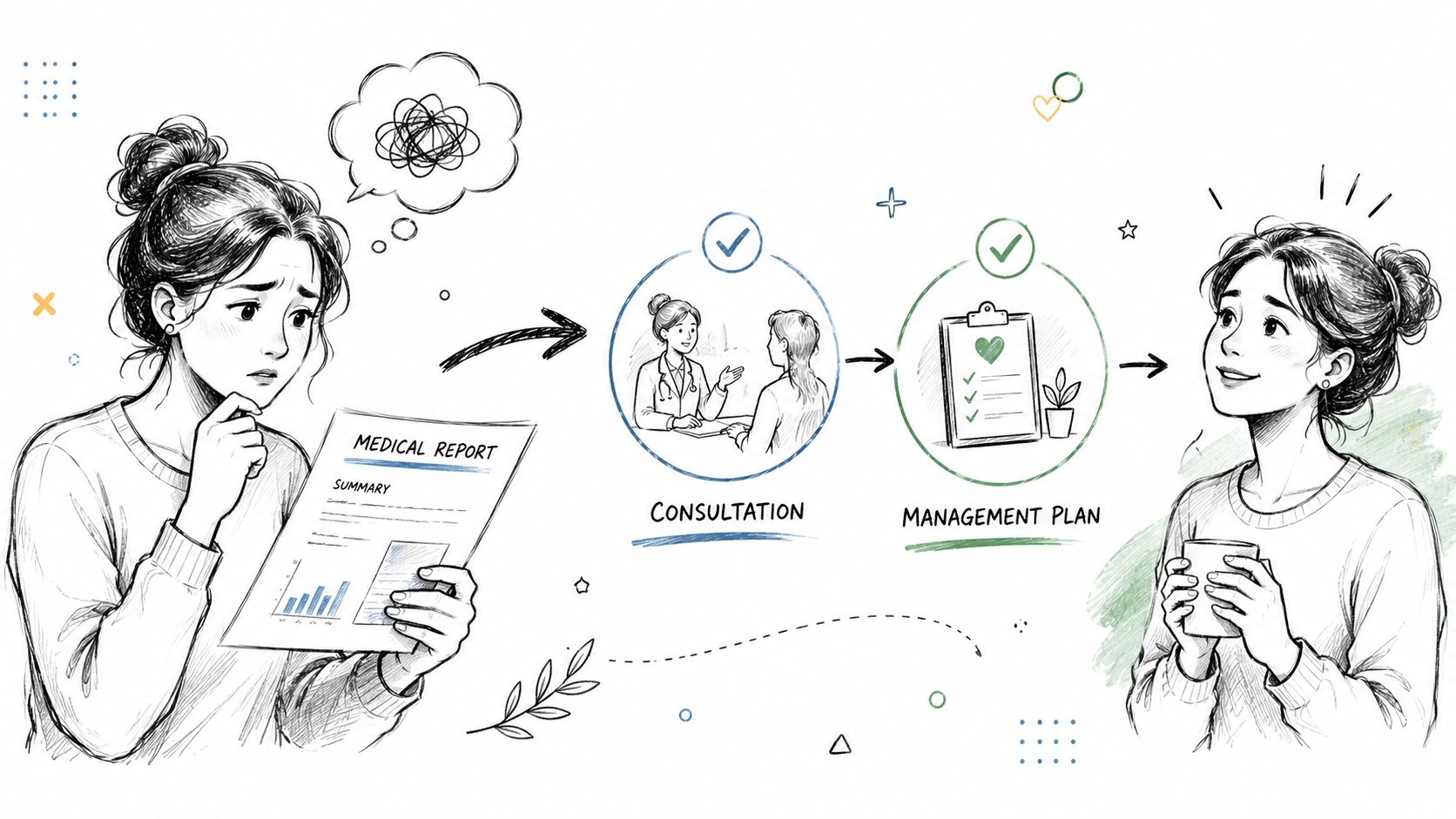
That fear is understandable, but it often paints the wrong picture. In many cases, a finding doesn't mean the end of your application or career. It means someone needs more information, a clearer report or a simple plan to manage the issue safely.
Findings are often manageable
Common concerns can include blood pressure, vision that needs correction, or a health condition that is controlled but needs to be documented properly. The key point is that the clinician looks at how the issue affects safe driving, not just whether the issue exists.
That means the next step may be one of the following:
More information from your GP: A clinic may need confirmation about treatment, stability or medication.
A follow-up test: Sometimes a result needs to be checked again rather than judged on one reading alone.
A short delay while paperwork is completed: This can be frustrating, but it's often administrative rather than fatal to your plans.
A work-related recommendation: An employer may want a phased return or adjusted duties if the issue arose after illness or injury.
Access can be part of the problem
One part of occupational health screening that often gets overlooked is access. Shift workers, mobile workers and people in rural areas can struggle if every follow-up needs a daytime clinic visit. The 2024 Health and Wellbeing at Work survey, discussed here, found that 57% of employers offer occupational health support, while access remains uneven by employer size and sector.
That matters in real life. A driver may be perfectly willing to attend follow-up appointments but still face awkward booking times, travel issues or delays between clinics, employers and GP records.
If a screening raises a concern, ask two things straight away. What extra information is needed, and who is responsible for getting it?
Keep the process moving
If you do get a finding, stay practical:
Read the wording carefully. Don't guess what the report means.
Contact your GP or specialist promptly if more evidence is needed.
Tell the employer or training provider what stage you're at if timing is affected.
Keep copies of reports and letters so you don't repeat the same admin twice.
Drivers often imagine a medical issue creates a brick wall. More often, it creates a short detour. The quicker you understand the next action, the easier it is to get back on track.
How HGV Learning Simplifies Your Medical Screening
For many learners, the hardest part of occupational health screening isn't the assessment itself. It's organising the whole chain around it. You need the right form, the right appointment, the right timing and clear next steps if anything needs follow-up.
That admin load is exactly where many training journeys slow down. A learner may be ready to study and train, but progress stalls because the medical hasn't been booked properly or the paperwork isn't moving.
A joined-up route into training
A coordinated pathway helps because the medical sits alongside other early steps such as licence paperwork, theory preparation and practical booking. Instead of treating the medical as a separate headache, it becomes one managed part of a larger plan.
That's especially helpful for people changing career, balancing current work or trying to understand which licence route they need. Someone aiming for C1 may have slightly different training plans from someone moving towards Category C or C+E, but both still need a clear start.
Why that support matters
Good support reduces the chance of simple mistakes. It also gives drivers a clearer sense of what's happening and when. That peace of mind matters when you're entering a regulated industry for the first time.
The medical process feels much less daunting when it's handled as part of a structured training journey rather than as a disconnected task. That leaves you free to focus on revision, road skills and building confidence for the job ahead.
If you're ready to start your route into professional driving, HGV Learning can help you move from paperwork and medical booking to theory and practical training with a clearer, more supported path.
Related Articles
16/10/2026
What Age Can You Start HGV Driver Training? A 2026 UK Guide to Licence Age Requirements
If you're asking what age you can start HGV driver training, the honest answer depends on which licence you're after. A C1 licence, covering vehicles...