You might be looking at warehouse work, van driving, retail, or another job that pays the bills but doesn't give you much room to move. Preston is one of those places where logistics is always close by. You've got trunk roads, depots, industrial estates, and firms that need reliable drivers every week. That matters if you want a career change with a clear route in.
There's a genuine opening for new drivers who get qualified properly and present themselves well. The wider UK shortage isn't just talk. ONS data on the fall in HGV drivers shows 52,000 vacancies in the transport and storage sector in the three months ending September 2021, the highest level since records began in 2001. For someone in Preston, that means the odds are far better when you arrive job-ready, not half-ready.
The mistake I see most often is treating HGV driving like a simple licence upgrade. It isn't. Employers want a driver who can pass the checks, handle the hours, keep the paperwork right, and turn up with the right attitude. If you can do that, Preston gives you a strong base to build from.
Your Road to a New Career Starts in Preston
A lot of people search for HGV driver jobs in Preston before they've sorted the basics. That's understandable, but it's the wrong order. The jobs are there, but the market rewards the candidate who is already legal, organised, and realistic about the work.
Driving an HGV can be a very good move if you want steadier earning potential, practical responsibility, and work that has a clear purpose. Goods still need moving, stores still need stock, sites still need materials, and waste still needs collecting. When the rest of the economy feels uncertain, that kind of demand matters.
What matters just as much is your mindset. New drivers who do well usually think in three stages:
Get qualified properly: Don't cut corners on licence category, CPC, or test prep.
Choose the right first role: Your first job doesn't need to be perfect. It needs to build useful experience.
Make yourself easy to hire: Fast replies, clean documents, and a sensible CV beat vague enthusiasm every time.
Practical rule: Employers hire readiness. They rarely hire potential on its own.
Preston suits drivers who want options. Some roles are depot-to-depot and suit people who like routine. Some are local and more physical. Some need extra tickets and pay better because fewer drivers can step straight in. That's why a smart plan matters more than firing off applications at random.
If you're serious about this career, think beyond getting a pass certificate. Becoming the sort of driver a planner, transport manager, or agency desk wants to ring first is the goal.
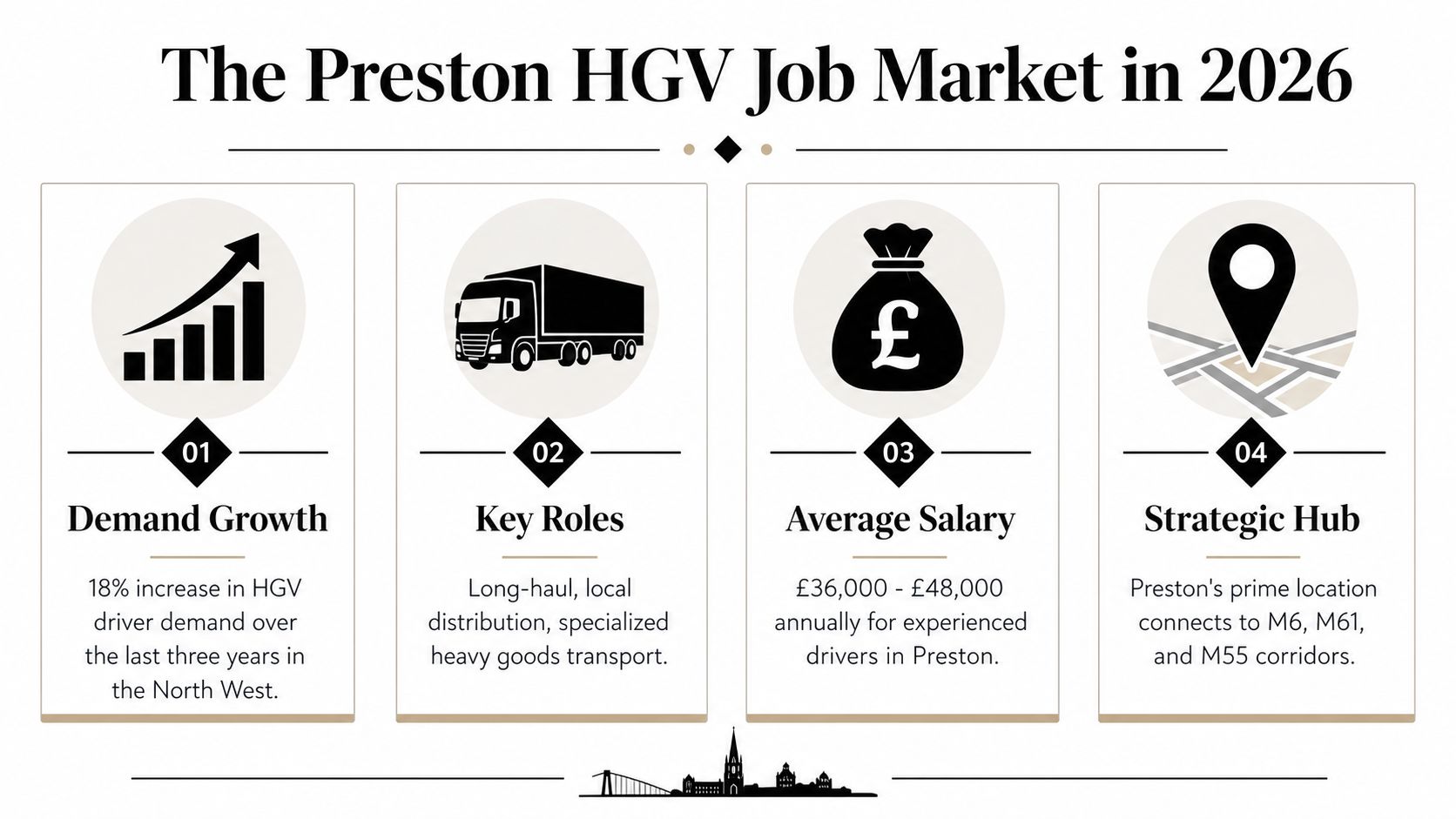
The Preston HGV Job Market in 2026
Preston isn't one single HGV market. It's several smaller markets sitting on top of each other. If you treat all vacancies as the same, you'll miss where the best opportunities are.
Where the demand is sitting
The live picture is strong. In June 2026, Jobsite's Preston Class 1 listings showed roles with annual salaries from £43,000 to £45,500, while the verified market view for the city also notes 449 HGV driver jobs on SimplyHired. That tells you two useful things. There is volume, and there are roles paying at the sharper end for the right candidate.
That doesn't mean every vacancy is equal. A local waste collection role, a trunking shift, and a specialist compliance-heavy job all ask for different strengths. New drivers often look only at the top-line pay, then land in work that doesn't suit them.
The main role types you'll see
Here's the practical breakdown.
Role type
What the work usually feels like
Best fit for
Trunking
Longer road time, fewer drops, more routine
Drivers who like structure and cleaner driving days
Multi-drop
Busy shifts, more stops, more customer contact
Drivers who don't want to sit still all day
Waste and local authority work
Early starts, site rules, repetitive routes
Drivers who prefer local work and consistency
Specialist roles
More compliance, extra checks, role-specific kit
Drivers willing to gain extra qualifications
Preston's location helps. Firms serving Lancashire and the wider North West can run traffic through key motorway corridors without much fuss, so local depots often need a mix of rigid and artic drivers who can slot into different operations.
Preston is a good market if you know what kind of driving day you want. It's a frustrating market if you apply blindly.
Where new drivers usually go wrong
The biggest mistake is chasing only Class 1 adverts because they sound like the top tier. In practice, some newly qualified drivers get hired faster by targeting work that employers struggle to fill consistently. That can mean local rigid work, physically demanding delivery patterns, or roles with awkward shift windows.
A second mistake is ignoring specialist pathways. The local market isn't only about standard Class 1 work. It also includes jobs that sit closer to construction, hazardous goods, or mixed-duty driving. Those roles can be harder to fill because employers want someone who understands the licence, the paperwork, and the added responsibility.
If you're weighing up HGV driver jobs in Preston, judge each opening on four points:
Shift pattern: Are you able to handle the start times and finish times?
Vehicle type: Are you more likely to get hired on rigid, artic, or either?
Physical demand: Some “driving” jobs involve much more than driving.
Progress value: Will this role make the next move easier?
That last point matters. A smart first job in Preston can open the door to better-paying work later, even if it isn't your dream role on day one.
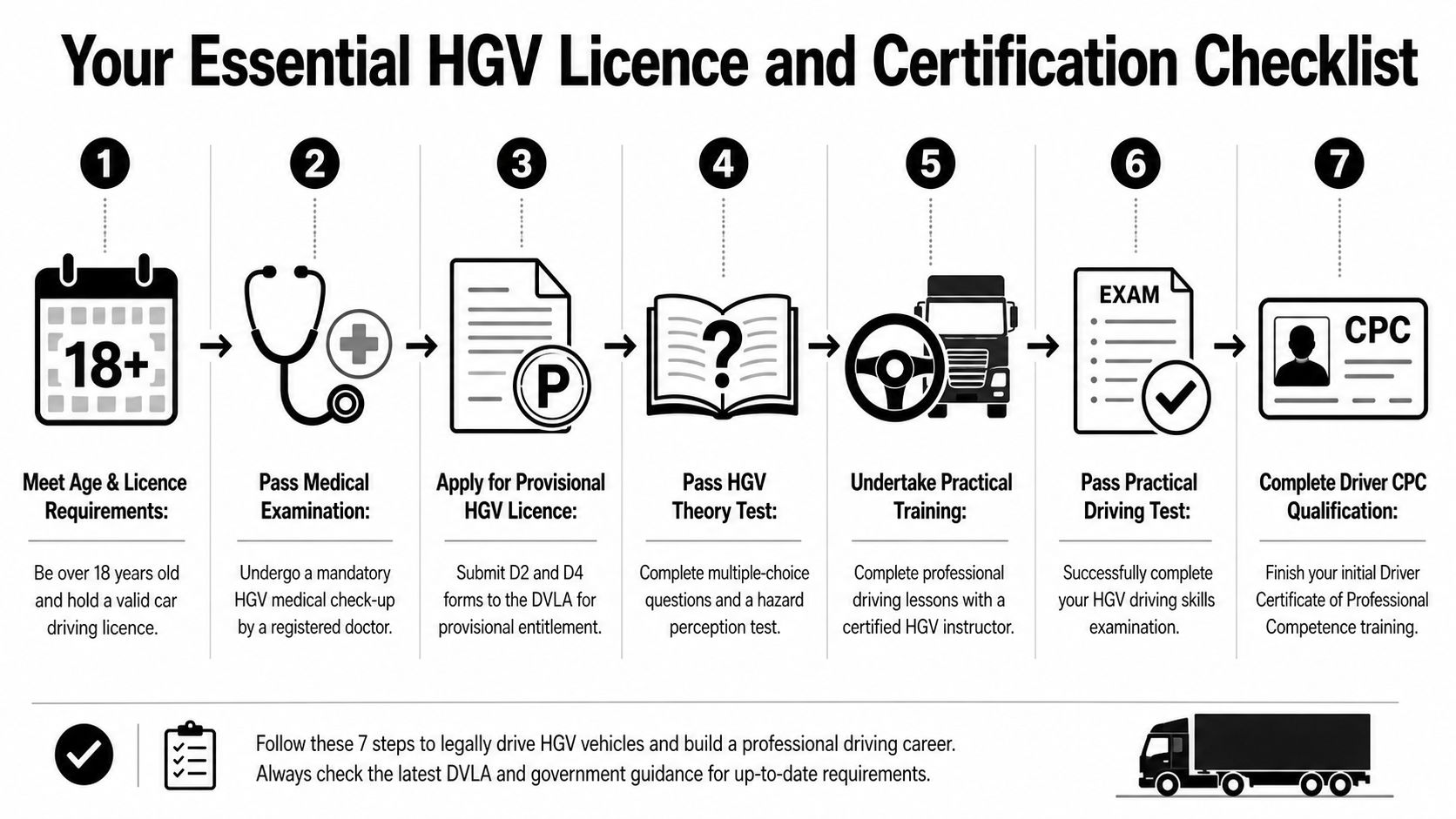
Your Essential HGV Licence and Certification Checklist
Qualification comes first. Without that, your job search is mostly guesswork and wishful thinking.
Start with legal readiness
You need to be over 18 and hold a full car licence before you move into HGV training. After that, the process becomes administrative very quickly. Consequently, people lose time through avoidable errors.
Most candidates begin with the provisional entitlement and medical paperwork. If forms aren't your thing, this guide to vocational driver D2 form help is useful because small mistakes on licence forms can slow everything down. If you want a broader overview of what you need before booking training, these requirements for an HGV licence are worth checking as well.
The practical route in plain English
The sequence matters. Keep it simple.
Apply for provisional entitlement Get your forms right and make sure your details match your existing licence records.
Complete the medical Don't leave this late. If there's any issue, you want time to deal with it before practical training dates start moving.
Pass theory and hazard perception Some candidates underestimate this stage because it isn't the driving bit. That's a mistake. A failed theory test delays everything behind it.
Train for the practical test Instructors iron out bad habits, road positioning, mirror use, planning, and control.
Complete Driver CPC requirements This is not optional if you want to work professionally.
Category C or C+E
This is one of the first real trade-offs you'll face. Category C gets you into rigid vehicles. C+E opens the door to articulated combinations and a broader range of work.
Which one should you aim for? That depends on your target.
Choose Category C first if you want a more local start, waste work, municipal work, or rigid distribution.
Choose C+E if your goal is trunking, larger fleets, and wider long-term choice.
Think about employer demand in practice rather than what sounds more impressive.
A lot of new drivers fixate on artic work because it feels like the full HGV experience. But some of the steadiest starts come through rigid roles where you build road sense, site confidence, and working habits.
Get the licence that matches the work you're prepared to do first, not just the work you hope to do later.
Time and commitment
The training window is shorter than many people think, but it still needs commitment. Indeed's HGV career guidance notes that beginner HGV training typically takes 4 to 6 weeks and can cost up to £3,000. The same guidance states that drivers must complete 35 hours of periodic CPC training every five years to stay compliant.
That CPC requirement catches people out later. They treat it as a one-off hurdle instead of an ongoing part of the job. Don't do that. Professional driving is built on compliance. If you resent that side of it, the career will feel harder than it needs to.
What employers in Preston actually want to see
By the time you apply, recruiters usually want evidence that you are ready for the road, not nearly ready. Keep these documents organised and available:
Driving licence details
Driver CPC proof
Digital tachograph card
Any extra tickets you hold
Basic work history with dates that make sense
The cleaner this admin is, the easier your first hire becomes.
Funding Your Training and Getting Started
The cost puts some people off before they've even looked properly at their options. That's understandable, but it's often more manageable than it first appears.
The first thing to do is treat training like a work investment, not a casual purchase. You're not buying a gadget. You're buying access to a regulated job market. That changes how you should think about the spend.
Ways people usually fund it
Some learners pay directly and want the fastest route. Others spread the cost because keeping cash in hand matters more than clearing the fee upfront. There are also funded routes in some areas, including skills-based schemes, though availability can vary and places don't stay open forever.
A sensible starting point is to review the current options for funding for HGV training. That gives you a better picture of what may be available before you commit.
Here's the practical approach I'd suggest:
Check funded routes first: If a supported place is available, take it seriously and move quickly.
Price the full pathway, not just lessons: Medical, forms, tests, and training all matter.
Ask about payment plans: Spreading the cost can make the move realistic without wrecking your monthly budget.
Keep a small buffer: Travel, time off work, or retests can all affect the actual cost of changing careers.
A short explainer can help if you're still weighing up whether to commit:
Don't make this harder than it needs to be
What doesn't work is hesitating for months, then paying piecemeal without a plan. That usually leads to delays, lost momentum, and repeated admin. A cleaner route is to decide your target licence, work out the funding method, then move through the process in order.
If you're changing career from a lower-paid or less stable role, the upfront cost can still feel heavy. Fair enough. But the right response isn't to stall. It's to structure the move properly and avoid wasting money on false starts.
Crafting a CV That Gets You Noticed in Preston
A generic CV is nearly useless in transport. It tells a recruiter you want a job. It doesn't tell them you're ready for their job.
That distinction matters because speed matters. The DfT evidence review on HGV recruitment and retention notes an industry panel finding that carriers who contact a driver within 5 minutes of an application are twice as likely to hire that driver. In plain terms, the faster the process moves, the better your chance. Your CV has to support that speed, not slow it down.
What a transport manager wants to spot fast
Most HGV CVs are too wordy at the top and too vague in the middle. A transport office doesn't need a life story. It needs proof.
Put the key facts near the top:
Licence categories: Cat C, C+E, or both
Driver CPC status: Make it obvious
Digital tachograph card: State that you hold it
Extra tickets: ADR, HIAB, or anything relevant
Location and availability: Especially useful for local Preston roles
Then show working habits. Mention route discipline, walk-round checks, paperwork accuracy, safe loading awareness, and punctuality if you can support those claims from real past work.
Tailor it to the role
If the advert looks like trunking, write for trunking. If it looks like local multi-drop, write for that. Don't send the same version to every employer.
A simple comparison shows the difference:
Weak CV line
Better CV line
“Experienced driver looking for new opportunity”
“Newly qualified Cat C+E driver with Driver CPC, digi card, and immediate availability for depot-based trunking or local distribution”
“Good under pressure”
“Used to early starts, time-sensitive work, and completing daily checks and paperwork accurately”
“Can work as part of team or alone”
“Comfortable with independent driving, site instructions, and regular contact with transport office”
If you want to understand why wording and layout matter more than many candidates realise, this explanation of how AI resume screening works gives useful context. Even where a human makes the final decision, poor formatting and vague wording can still cost you.
Your CV should answer the recruiter's first question before they ask it. “Can this person start the process quickly and safely?”
Be application-ready, not just CV-ready
Many new drivers often fall short in this regard. They have a CV saved somewhere, but not the supporting documents ready to send. In transport, that lag can cost you.
Keep a folder ready with:
Licence photos or scans
Driver CPC evidence
Digital tachograph details
Proof of address if requested
A short version of your CV for quick sends
When a recruiter rings, be easy to move forward. Answer clearly. Confirm what licence you hold. Know your postcode. Know your shift availability. If you need to “find everything later”, you'll often lose momentum.
A good Preston HGV CV isn't flashy. It's clean, relevant, and ready to support a fast hiring decision.
Acing the Interview and Your First Days on the Job
The interview for an HGV role is usually more practical than polished. That's good news if you're straightforward and prepared.
A typical Preston employer won't be looking for slick corporate answers. They'll want to know whether you understand the work, whether you'll protect the vehicle, and whether you'll create problems for the traffic office.
What the interview often sounds like
You'll likely get questions along these lines:
What licence categories do you hold, and how recently did you qualify?
What do you check on a daily walk-round?
How do you handle delays or route issues?
Are you comfortable with starts, nights, weekends, or physical work?
Have you worked with delivery paperwork, site rules, or customer-facing drops?
If you're newly qualified, don't bluff experience you don't have. A better answer is to show that you understand the responsibility and have taken training seriously.
For example:
“I'm newly qualified, but I'm solid on daily checks, safe driving habits, and following site instructions. I'd rather ask a sensible question than guess and get it wrong.”
That answer is far stronger than pretending you've “seen it all”.
Questions you should ask them
A good driver interview isn't one-way. Ask questions that reveal the actual working day.
Try these:
What does a normal shift look like in this role?
Is it mainly trunking, store deliveries, or mixed work?
What vehicle will I usually be in?
How is induction handled for new starters?
What are the site facilities like on the regular routes?
Those last points matter because the wider HGV sector still struggles with long hours and poor facilities in many places, and that affects job quality in real life.
Talking about pay without guessing
Don't throw out random numbers. Use the market benchmark where it fits. In Preston, live Class 1 vacancies in June 2026 showed annual salaries from £43,000 to £45,500, as noted earlier in the local market section. If you're interviewing for that level of role and you hold the right licence, availability, and role fit, that gives you a sensible frame for the conversation.
If you're interviewing for a different type of work, keep it grounded. Ask how pay is structured. Is it annual salary, hourly rate, guaranteed shifts, or variable agency work? The headline can look good until the pattern underneath tells a different story.
Your first few weeks
The first days usually matter more than the interview. During this time, employers decide if you're dependable.
Focus on the basics:
Turn up early
Listen during induction
Ask before assuming
Keep paperwork tidy
Report issues quickly
New drivers sometimes think they need to prove themselves by acting overconfident. They don't. Calm, safe, coachable drivers last longer and earn trust faster.
How HGV Learning Supports Your Preston Job Search
Passing the test is a milestone, but it doesn't solve the next problem on its own. You still need to turn a licence into paid work, and the Preston market can feel noisy when there are so many similar-sounding vacancies.
The local job volume is clear. Glassdoor's Preston HGV Class 1 listings indexed 256 HGV Class 1 driver jobs in Preston, while the verified market picture also notes 372 HGV Class Driver jobs on Indeed. That's a lot of choice, but choice isn't the same as direction.
Why support matters after you qualify
New drivers often need help with three things:
Targeting the right first role: Not every vacancy is beginner-friendly, even if the advert sounds welcoming.
Presenting themselves properly: Small mistakes in documents, CV wording, or interview approach still cost interviews.
Understanding role fit: Agency, trunking, local rigid work, and specialist jobs each suit different people.
That's why job-search support matters. It shortens the gap between qualification and first earnings, and it helps drivers avoid poor-fit roles that lead to quick burnout.
If you want a wider view of nearby opportunities and role types, this guide to lorry driver jobs near me is a useful next read.
For HGV driver jobs in Preston, the strongest approach is still the simplest one. Get fully qualified. Keep your paperwork sharp. Apply for roles that match your actual readiness, not just your long-term ambition. Then move quickly when the right employer responds.
If you're ready to move from research into action, HGV Learning can help you through the training path and into the job market with practical support that fits how HGV hiring works.